REVIEW 4 major objections 4 minor 38 references
From deterministic dynamics to thermodynamic laws II: Fourier's law and mesoscopic limit equation
T0 review · 4 major / 4 minor · reviewed 2026-08-14 · deepseek-v4-flash
Pith's one-line read This paper shows that a stochastic energy exchange model for a chain of gas cells has, in the many-particle limit, a discrete heat equation whose steady state obeys Fourier's law, together with a mesoscopic SDE that governs its…
desk verdict LLN and CLT for the Beta(1,M-1) exchange chain are mostly solid, but the paper's flagship O(M^-1) mesoscopic approximation is unsupported by the proof of Lemma 6.6. read the letter →
The pith
A machine-rendered reading of the paper's core claim, the machinery that carries it, and where it could break.
The reading
What carries the argument
The argument is carried by the martingale problem for the Markov jump process, with all randomness prescribed in advance as i.i.d. uniforms and Beta(1,M-1) variables attached to each jump. Because the Beta increments are of size 1/M with exponentially small tails, a Taylor expansion of the generator in powers of 1/M yields the drift R(E) zeta_bar(E) = F(E) at leading order and the diffusion coefficient Sigma = H(E)H(E)^T at the next order. Tightness of the rescaled processes is proved with a standard criterion for Skorokhod space, and uniqueness of the limiting martingale problem follows from a standard diffusion well-posedness theorem; the same calculations give the mean-square increment bounds needed for the central limit theorem. The rate function f and the Beta-uniform exchange rule are the concrete objects whose moments enter every coefficient of the limiting equations.
What would settle it
Simulate the full deterministic billiard chain at M around $10^{4}$ to $10^{5}$ with a small temperature difference, record cell energies and the steady flux, and check whether the empirical profile matches the solution of the mesoscopic SDE within O($M^{{-1}}$) and whether the flux approaches (1/2)f(T_L,T_L) as T_R - T_L tends to zero; a mismatch would falsify the numerical bridge on which the paper's title-level claim rests.
Extended reading notes
Core claim
On the paper's own terms, the central discovery is a pair of limit laws plus their combination. For the fast-scale stochastic energy exchange process Theta_M(t), the law of large numbers states that as M approaches infinity, Theta_M(t) converges almost surely to Theta_bar(t), where Theta_bar solves dTheta_bar/dt = F(Theta_bar), with F_i(Theta_bar) = (1/2) f(Theta_bar_{i-1}, Theta_bar_i)(Theta_bar_{i-1} - Theta_bar_i) + (1/2) f(Theta_bar_i, Theta_bar_{i+1})(Theta_bar_{i+1} - Theta_bar_i), and fixed bath temperatures at the two ends. This equation has a unique stable equilibrium, and the expected heat flux through it obeys kappa = (1/2) f(T_L,T_L) + O(T_R - T_L), i.e., Fourier's law for small temperature differences. The central limit theorem states that Gamma_M(t) = $\sqrt$(M)(Theta_M(t) - Theta_bar(t)) converges almost surely to the solution of dGamma_bar = DF(Theta_bar) Gamma_bar dt + H(Theta_bar) dW_t, with H built from the rate function and the variance of the microscopic energy exchanges. The mesoscopic limit equation dZ_t = F(Z_t) dt + $M^{{-1/2}}$ H(Z_t) dW_t then approximates the original process in expectation to order $M^{{-1}}$.
Load-bearing premise
The theorems stand or fall with the numerical claim that the stochastic exchange rules (exponential collision clock, Beta(1,M-1) single-particle energies, uniform redistribution) preserve the asymptotic dynamics and thermal-conductivity scaling of the deterministic billiard gas; if that claim is wrong, the results describe only the surrogate process, not the gas.
Editorial extensions
If this is right
- At infinite M, the stochastic energy exchange model obeys a discrete nonlinear heat equation, so Fourier's law is a derived property of the steady state rather than an input.
- For finite but large M, trajectories are captured by the small-noise SDE dZ_t = F(Z_t)dt + M^{-1/2}H(Z_t)dW_t, with expected error O(M^{-1}), giving quantitative control of finite-size fluctuations.
- The fluctuation process Gamma satisfies a time-dependent linear SDE, so correlations, response functions, and transport coefficients can in principle be computed from the same coefficients F and H.
- The limit heat equation has a unique, linearly stable equilibrium for large chains under the paper's condition on f, supporting the robustness of the predicted temperature profile.
- The invariant measure of the mesoscopic equation is approximately Gaussian with covariance given by a Lyapunov equation, which the paper argues is the route to entropy production, long-range correlations, and fluctuation theorems.
Reading between the lines
- If the numerical bridge from billiards to the stochastic energy exchange model is reliable, these theorems make the mesoscopic SDE a quantitative model for gas cells of 10^4 to 10^5 particles, so one could test the predicted Gaussian steady-state covariance against direct billiard simulations.
- The boundedness assumption on f is the main technical restriction; extending the proof to unbounded rates like f proportional to sqrt(E) would cover the physically motivated rare-collision rates and likely requires a different control of overheating Poisson clocks.
- The same martingale-problem scheme should apply to any chain whose energy exchanges are rare, local, and of relative size O(1/M), suggesting a general mechanism: Fourier's law appears whenever collisions are localized and each exchange moves a microscopic fraction of the cell energy.
Signed reviews
Editorial analysis
A structured set of objections, weighed in public.
Referee Report
Summary. The paper studies the mesoscopic limit of a stochastic energy exchange model that is presented as a numerically derived surrogate for a deterministic billiard chain coupled to heat baths. After rescaling time so that the collision rate is O(M), the paper states a law of large numbers (Theorem 1/5.1) showing that the energy profile Θ_M(t) converges almost surely to the solution of a discrete nonlinear heat equation, and a central limit theorem (Theorem 3/6.1) showing that √M(Θ_M-Θbar) converges to the solution of a linear stochastic differential equation. It further claims in Proposition 4 and Corollary 6.8 that Θ_M(t) is approximated in expectation by the mesoscopic SDE dZ_t = F(Z_t)dt + M^{-1/2}H(Z_t)dW_t with error O(M^{-1}). Fourier's law for the limiting heat equation is derived in Proposition 2/Lemma 5.8. The proofs use tightness in Skorokhod space, martingale problems, and uniqueness arguments.
Significance. If fully established, the paper would provide a rigorous mesoscopic derivation for a concrete stochastic energy exchange model, with an explicit limiting heat equation, an explicit CLT covariance structure, and a closed-form thermal conductivity near equilibrium. The paper is honest about its main modeling assumption: the reduction from deterministic billiards to the Markov chain is numerical, and the rate function f is an input rather than a derived object. The LLN and CLT arguments are plausible and follow established martingale methods, and the covariance calculation in Lemma 6.4 is explicit and checkable. However, the advertised quantitative approximation result, Corollary 6.8, depends on Lemma 6.6, whose proof is not valid as written; this is the main obstacle to accepting the paper in its current form.
major comments (4)
- [§6, Lemma 6.6] The proof of Lemma 6.6 does not establish the asserted O(M^{-1/2}) bound on E||Γ_M(t)-Γ(t)||. Equations (6.4) and (6.5) are martingale or generator discrepancy estimates for a fixed test function. Taken together they imply convergence in distribution of Γ_M to Γ, but they do not imply a rate, because no coupling between the two processes is constructed. The statement P(||Γ_M(t)-Γ(t)||≥1)=O(M^{-1/2}) is therefore unjustified. Since Corollary 6.8 and Proposition 4 depend directly on this lemma, the headline O(M^{-1}) approximation of Θ_M by Z_t is unsupported.
- [§6, Lemma 6.6 (cutoff argument)] The argument with the truncated linear test function A_v is not quantified. The proof asserts that excursions of Γ_M and Γ outside the M^ε-ball are negligible and that the cutoff contributes O(M^{-1/2}), but it does not provide tail estimates for sup_{s≤t}||Γ_M(s)|| or sup_{s≤t}||Γ(s)|| at the order required for the final bound. A complete proof needs explicit bounds on the excursion probabilities and a controlled estimate for the generator applied to the truncated function.
- [§5.1, proof of Theorem 5.1] The uniqueness step in the LLN proof applies Lemma 5.5 to the identity function, although Lemma 5.5 is stated for A∈C_c^∞(R^N). The subsequent derivative computation for E||Θ(t)-Θbar(t)||² therefore lacks justification. One needs a truncation argument with estimates uniform in the truncation parameter, or an extension of Lemma 5.5 to unbounded quadratic test functions.
- [§5, Proposition 2] Proposition 2 states that the flow determined by equation (3.1) admits a stable equilibrium for the general rate function f satisfying assumptions (a)-(c), but its proof through Lemma 5.7 requires the additional condition that γ=div f/f has negative partial derivatives in a neighborhood of E*. The proposition as stated is stronger than what is proved; it should either include this assumption or provide a direct proof of stability.
minor comments (4)
- [§3, proof of main theorems] The proof outline cites 'Lemma 5.9, 5.10, and 5.11' and 'Theorem 2', but these numbered statements do not exist; the intended references appear to be Lemma 5.8 and Proposition 2.
- [§6, Lemma 6.3] The phrase 'The proof is completed by letting M→0' should read M→∞; also the notation E[ζ(E,ωM)^T ζ_j(E,ωM)] appears to be a typo for the covariance entries E[ζ_i ζ_j].
- [§5.2, Eq. (5.3)] The definition of κ contains 'EE∗' without explanation; the expectation should be specified as being with respect to the stationary distribution of the Markov chain, and the integration variables B and p should be written consistently.
- [§2.1] The paper candidly states that the exponential clock, Beta distributed energy, and uniform redistribution are approximations adopted from numerical simulations. The title's phrase 'from deterministic dynamics' should perhaps be qualified in the introduction so that the formal theorems are clearly about the surrogate Markov model rather than the original billiard system.
Circularity Check
Fourier-law 'prediction' evaluates the fitted rate f, and the billiard-to-stochastic step rests on the author's own numerical [25]; the central LLN/CLT mathematics is otherwise self-contained.
-
ansatz smuggled in via citation
[Section 2.1, 'Billiards model with time rescaling' (bullets after Figure 1)]
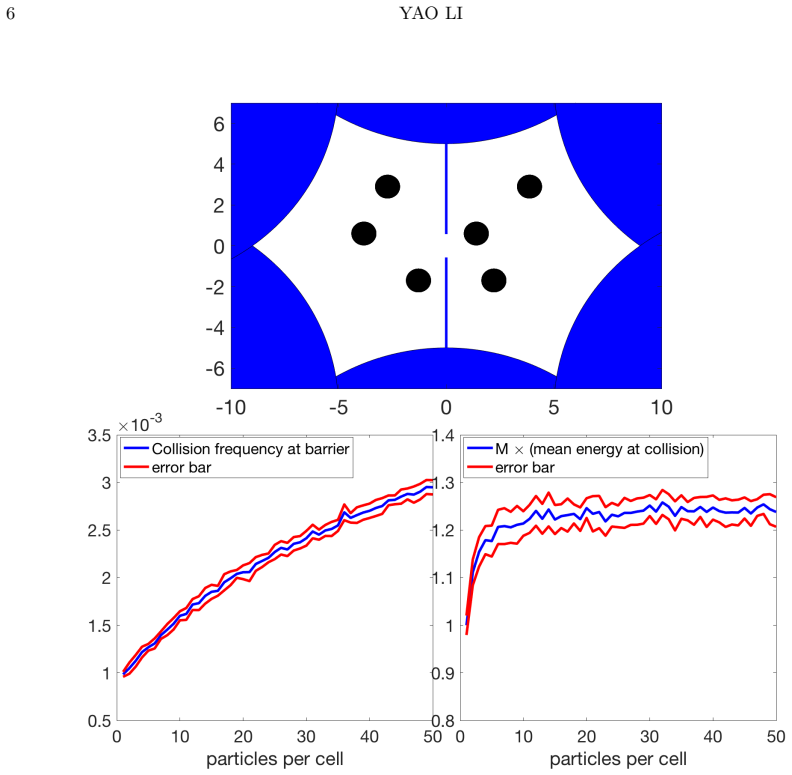
"The time between two consecutive collisions through the barrier is exponentially distributed with a rate that can be approximated by min{E1,E2} if min{E1,E2}≪1, ... The energy carried by the particle that participates a collision through the barrier can be approximated by a Beta distribution with parameters (1,M−1). The energy redistribution during a collision can be approximated by a uniform random redistribution. None of these approximation is precise."
The exponential clock, Beta(1,M−1) energy share, and uniform redistribution are the entire physical input of the stochastic model, and they are not proved or independently derived in this paper. They are imported from [25], a numerical paper authored by the same researcher. The abstract's 'stochastic energy exchange model that is numerically derived from deterministic dynamics' and the title's 'From deterministic dynamics to thermodynamic laws' therefore make the deterministic-to-stochastic step rest on a self-citation whose content is a numerical ansatz rather than a theorem. The advertised derivation chain has no independent justification for its starting point beyond that citation.
-
fitted input called prediction
[Sections 3 and 5.2 (equation (3.1), equation (5.3), Lemma 5.8)]
"F_i(Θ¯(t)) = 1/2 f(Θ¯_{i−1}(t),Θ¯_i(t))(Θ¯_{i−1}(t)−Θ¯_i(t)) + 1/2 f(Θ¯_i(t),Θ¯_{i+1}(t))(Θ¯_{i+1}(t)−Θ¯_i(t)) ... Lemma 5.8 ... κ = 1/2 f(TL,TL)+O(TR−TL)."
The heat equation's drift F_i is exactly the M→∞ form of the expected flux of the update rule in which f is the assumed clock rate, and κ in (5.3) is defined as that same expected flux at equilibrium. Lemma 5.8 then evaluates κ as f/2 plus a small temperature-difference correction. No independent thermal conductivity is introduced: the 'Fourier law' constant is the model's own rate function f, which was obtained numerically in [25]. Because [25] also checked that the approximations preserve the scaling of thermal conductivity, Proposition 2 is a consistency identity of the fitted input rather than an independent first-principles prediction.
full rationale
The core LLN/CLT mathematics is not circular: Theorems 1 and 3, and the qualitative content of Corollary 6.8, are derived from the Markov chain by generator expansions, tightness, and martingale uniqueness, with no hidden use of the target equations. Given the stochastic model, those proofs are self-contained and hold for any rate f satisfying assumptions (a)-(c). The circularity is in the advertised physical claim, not in the martingale analysis. First, the stochastic model itself is an ansatz imported from the author's numerical paper [25], so the 'derivation from deterministic dynamics' is load-bearing on that self-citation. Second, Fourier's law is an algebraic consequence of the same f that defines the model: the drift in (3.1), the flux in (5.3), and Lemma 5.8's κ=f/2 all express the same expected flux, so Proposition 2 is a consistency check rather than a prediction. Separately, the quantitative O(M^{-1}) approximation in Corollary 6.8 is unsupported as written: Lemma 6.6 claims a strong L1 coupling rate from (6.4)-(6.5), but those equations only provide convergence in distribution, with no constructed coupling; this is a correctness gap, not a circularity. The proof outline also refers to nonexistent 'Lemma 5.9, 5.10, and 5.11' and to 'Theorem 2' instead of Theorem 3, an internal inconsistency worth noting for reliability. Overall score is partial: the central limit theorem is genuine mathematical content, but the physical 'derivation' reduces at its two load-bearing interfaces to a numerical self-citation and to the model's own rate function.
Assumptions & free parameters
free parameters (3)
- Rate function f(E_i,E_{i+1}) =
unspecified; assumed C^1, positive, nondecreasing, globally bounded
- Beta(1,M-1) transfer fractions B1,B2 =
Beta distribution with parameters (1, M-1)
- Uniform redistribution fraction p =
Uniform on (0,1)
assumptions (5)
- standard math Ethier-Kurtz tightness criterion and Stroock-Varadhan well-posedness theorem for martingale problems are valid.
- domain assumption The billiard system in each cell is chaotic, particles never leave their cells, and effective collisions through barrier holes are the only energy exchange channel.
- domain assumption The numerical approximations from [25] preserve the asymptotic dynamics and thermal conductivity scaling of the deterministic billiard model.
- domain assumption The rate function f satisfies global boundedness, positivity, and monotonicity in both arguments.
- ad hoc to paper The vector field gamma = div f / f has negative partial derivatives near the equilibrium E*, or f is one of the checked examples, so that linear stability holds.
Cite this review
Pith. "Pith review of From deterministic dynamics to thermodynamic laws II: Fourier's law and mesoscopic limit equation." pith.science (2026). https://pith.science/paper/PXYRE76S
@misc{pith2026190806219,
  author       = {Pith},
  title        = {Pith review of: From deterministic dynamics to thermodynamic laws II: Fourier's law and mesoscopic limit equation},
  year         = {2026},
  howpublished = {\url{https://pith.science/paper/PXYRE76S}},
  note         = {Machine review of arXiv:1908.06219}
}
read the original abstract
This paper consider the mesoscopic limit of a stochastic energy exchange model that is numerically derived from deterministic dynamics. The law of large numbers and the central limit theorems are proved. We show that the limit of the stochastic energy exchange model is a discrete heat equation that satisfies Fourier's law. In addition, when the system size (number of particles) is large, the stochastic energy exchange is approximated by a stochastic differential equation, called the mesoscopic limit equation.
Figures

Reference graph
Works this paper leans on
- [25]
-
[1]
David F Anderson and Thomas G Kurtz, Continuous time markov chain models for chemical reaction networks, Design and analysis of biomolecular circuits, Springer, 2011, pp. 3–42
work page 2011
-
[2]
C´ edric Bernardin and Stefano Olla,Fouriers law for a microscopic model of heat conduction , Journal of Statistical Physics 121 (2005), no. 3, 271–289
work page 2005
-
[3]
F. Bonetto, J.L. Lebowitz, and L. Rey-Bellet, Fourier’s law: a challenge to theorists , Mathe- matical physics 2000 (2000), 128–150
work page 2000
-
[4]
Federico Bonetto, Joel L Lebowitz, Jani Lukkarinen, and Stefano Olla, Heat conduction and entropy production in anharmonic crystals with self-consistent stochastic reservoirs , Journal of Statistical Physics 134 (2009), no. 5, 1097–1119
work page 2009
-
[5]
Leonid Bunimovich, Carlangelo Liverani, Alessandro Pellegrinotti, and Yurii Suhov, Ergodic systems of n balls in a billiard table , Communications in mathematical physics 146 (1992), no. 2, 357–396
work page 1992
-
[6]
Lorenzo Caprini, Luca Cerino, Alessandro Sarracino, and Angelo Vulpiani, Fouriers law in a generalized piston model, Entropy 19 (2017), no. 7, 350
work page 2017
-
[7]
Jacopo De Simoi and Carlangelo Liverani, The martingale approach after varadhan and dol- gopyat, Hyperbolic dynamics, fluctuations and large deviations 89 (2015), 311–339
work page 2015
Show all 38 references
-
[8]
Matthew Dobson, Jiayu Zhai, and Yao Li, Using coupling methods to estimate sample quality for stochastic differential equations , arXiv preprint arXiv:1912.10339 (2019)
2019 arXiv
-
[9]
1, 201–225
Dmitry Dolgopyat and Carlangelo Liverani, Energy transfer in a fast-slow hamiltonian system, Communications in Mathematical Physics 308 (2011), no. 1, 201–225
2011
-
[10]
1, 105–164
J-P Eckmann and Martin Hairer, Non-equilibrium statistical mechanics of strongly anharmonic chains of oscillators , Communications in Mathematical Physics 212 (2000), no. 1, 105–164
2000
-
[11]
1-2, 305–331
Jean-Pierre Eckmann, Claude-Alain Pillet, and Luc Rey-Bellet, Entropy production in non- linear, thermally driven hamiltonian systems , Journal of statistical physics 95 (1999), no. 1-2, 305–331
1999
-
[12]
3, 657– 697
, Non-equilibrium statistical mechanics of anharmonic chains coupled to two heat baths at different temperatures, Communications in Mathematical Physics 201 (1999), no. 3, 657– 697
1999
-
[13]
282, John Wiley & Sons, 2009
Stewart N Ethier and Thomas G Kurtz, Markov processes: characterization and convergence, vol. 282, John Wiley & Sons, 2009
2009
-
[14]
fourier , Chez Firmin Didot, p` ere et fils, 1822
Joseph Fourier, Theorie analytique de la chaleur, par m. fourier , Chez Firmin Didot, p` ere et fils, 1822
-
[15]
260, Springer, 2012
Mark Freidlin and Alexander D Wentzell, Random perturbations of dynamical systems , vol. 260, Springer, 2012
2012
-
[16]
10, 103004
Pierre Gaspard and Thomas Gilbert, Heat conduction and fourier’s law in a class of many particle dispersing billiards, New Journal of Physics 10 (2008), no. 10, 103004
2008
-
[17]
2, 020601
, Heat conduction and fouriers law by consecutive local mixing and thermalization , Physical review letters 101 (2008), no. 2, 020601
2008
-
[18]
11, P11021
, On the derivation of fourier’s law in stochastic energy exchange systems , Journal of Statistical Mechanics: Theory and Experiment 2008 (2008), no. 11, P11021. 30 YAO LI
2008
-
[19]
Grigo, K
A. Grigo, K. Khanin, and D. Szasz, Mixing rates of particle systems with energy exchange , Nonlinearity 25 (2012), no. 8, 2349
2012
-
[20]
2, 159–166
SG Jennings, The mean free path in air, Journal of Aerosol Science 19 (1988), no. 2, 159–166
1988
-
[21]
James E Johndrow and Jonathan C Mattingly, Error bounds for approximations of markov chains used in bayesian sampling , arXiv preprint arXiv:1711.05382 (2017)
2017 arXiv
-
[22]
Kipnis, C
C. Kipnis, C. Marchioro, and E. Presutti, Heat flow in an exactly solvable model , Journal of Statistical Physics 27 (1982), no. 1, 65–74
1982
-
[23]
Stefano Lepri, Roberto Livi, and Antonio Politi, Thermal conduction in classical low- dimensional lattices, Physics reports 377 (2003), no. 1, 1–80
2003
-
[24]
6, 3765–3812
Yao Li, On the polynomial convergence rate to nonequilibrium steady states , The Annals of Applied Probability 28 (2018), no. 6, 3765–3812
2018
-
[26]
6, 1170–1193
Yao Li and Lai-Sang Young, Existence of nonequilibrium steady state for a simple model of heat conduction, Journal of Statistical Physics 152 (2013), no. 6, 1170–1193
2013
-
[27]
, Nonequilibrium steady states for a class of particle systems , Nonlinearity 27 (2014), no. 3, 607
2014
-
[28]
Liverani and S
C. Liverani and S. Olla, Toward the fourier law for a weakly interacting anharmonic crystal , Journal of the American Mathematical Society 25 (2011), 555–583
2011
-
[29]
2, 305–329
Luc Rey-Bellet and L Thomas, Exponential convergence to non-equilibrium stationary states in classical statistical mechanics, Communications in mathematical physics 255 (2001), no. 2, 305–329
2001
-
[30]
Luc Rey-Bellet and Lawrence E Thomas, Asymptotic behavior of thermal nonequilibrium steady states for a driven chain of anharmonic oscillators , Communications in Mathemat- ical Physics 215 (2000), no. 1, 1–24
2000
-
[31]
3, Springer, 2002, pp
, Fluctuations of the entropy production in anharmonic chains, Annales Henri Poincare, vol. 3, Springer, 2002, pp. 483–502
2002
-
[32]
David Ruelle, Positivity of entropy production in nonequilibrium statistical mechanics, Journal of Statistical Physics 85 (1996), no. 1, 1–23
1996
-
[33]
2, 365–371
, Entropy production in nonequilibrium statistical mechanics , Communications in Mathematical Physics 189 (1997), no. 2, 365–371
1997
-
[34]
4, 1663–1711
Makiko Sasada et al., Spectral gap for stochastic energy exchange model with nonuniformly positive rate function, The Annals of Probability 43 (2015), no. 4, 1663–1711
2015
-
[35]
1, 123–178
N´ andor Sim´ anyi,Proof of the boltzmann-sinai ergodic hypothesis for typical hard disk systems , Inventiones Mathematicae 154 (2003), no. 1, 123–178
2003
-
[36]
N´ andor Sim´ anyi and Domokos Sz´ asz,Hard ball systems are completely hyperbolic , Annals of Mathematics 149 (1999), 35–96
1999
-
[37]
18, 4275
Herbert Spohn, Long range correlations for stochastic lattice gases in a non-equilibrium steady state, Journal of Physics A: Mathematical and General 16 (1983), no. 18, 4275
1983
-
[38]
Yao Li: Department of Mathematics and Statistics, University of Massachusetts Amherst, Amherst, MA, 01002, USA E-mail address : yaoli@math.umass.edu
Daniel W Stroock and SR Srinivasa Varadhan, Multidimensional diffusion processes, Springer, 2007. Yao Li: Department of Mathematics and Statistics, University of Massachusetts Amherst, Amherst, MA, 01002, USA E-mail address : yaoli@math.umass.edu
2007
Reviewed August 14, 2026 · model on record in the stance chip above.
Discussion (0). Continue with ORCID to comment.