REVIEW 4 major objections 4 minor 22 references
A Symbolic Neural Network Representation and its Application to Understanding, Verifying, and Patching Networks
T0 review · 4 major / 4 minor · reviewed 2026-08-14 · deepseek-v4-flash
Pith's one-line read A symbolic representation splits piecewise-linear neural networks into finitely many affine pieces, making exact precondition, postcondition, and patching computations possible.
desk verdict A genuinely useful exact-analysis tool for 2D slices of ReLU networks, with a caveat about floating-point exactness and a model swap in one experiment. read the letter →
The pith
A machine-rendered reading of the paper's core claim, the machinery that carries it, and where it could break.
The reading
What carries the argument
The symbolic representation $\hat{f}_{\mid X}$ itself is the machinery: it partitions the two-dimensional restriction domain into convex polytopes on each of which the network acts as an affine map, turning global non-linearity into finitely many local linearities. Composition is carried out by an Extend operator $\otimes$ that pushes a layer through an existing representation, and the two-dimensional specialization uses a vertex-based SplitPlane algorithm to split polytopes along orthant boundaries, with polytopes kept in V-representation to avoid the floating-point error accumulation of H-representations. For patching, the Masking Network separates the parameters that determine the partition ($\theta^a$) from those that determine the affine maps ($\theta^v$), so that Theorem 14 lets a values-only patch be verified on the finitely many vertices of each partition instead of on infinitely many points.
What would settle it
Run the two-dimensional symbolic-representation algorithm on a small ReLU network with rational arithmetic at high precision and compare the output with the floating-point version on a grid of input points near a partition boundary; any point whose assigned affine region differs between the two shows the floating-point path is not exact. Alternatively, construct an input polytope whose true image touches an output orthant boundary and check whether the computed strongest postcondition includes points on the wrong side.
Extended reading notes
Core claim
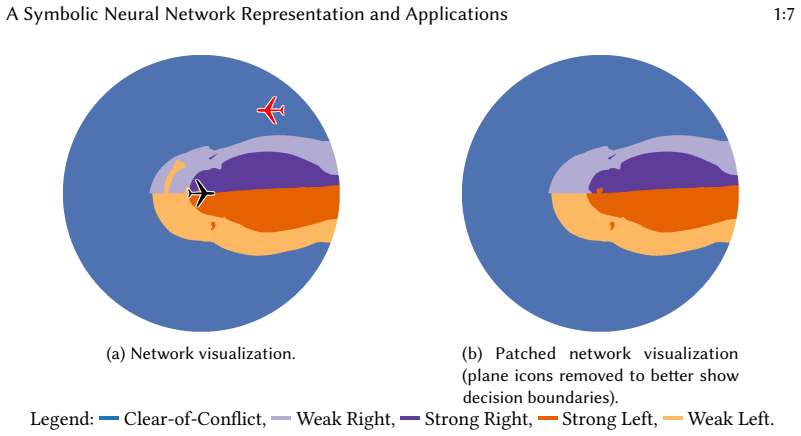
The central claim is that for a piecewise-linear neural network f restricted to a two-dimensional domain of interest X, one can compute a symbolic representation $\hat{f}_{\mid X} = \{(P_1,F_1),\ldots,(P_n,F_n)\}$ in which the $P_i$ partition $X$ into convex polytopes and each $F_i$ is an affine map that exactly matches $f$ on $P_i$. Given this representation, the weakest precondition of any convex output polytope $Y$ is the union of finitely many convex polytopes, one per partition, and the strongest postcondition of a convex input polytope is obtained by pushing vertices through the affine maps and taking convex hulls. The same representation, combined with a new 'masking network' architecture that separates activation parameters from value parameters, reduces the problem of patching behavior over entire polytopes to patching at finitely many vertices. The paper reports that on the ACAS Xu collision-avoidance network the exact decision boundaries can be visualized in seconds, that bounded model checking of three controllers goes deeper than the ReluPlex SMT solver before timeout, and that changing about five weights removes targeted misbehavior regions.
Load-bearing premise
The correctness of the claimed 'exact' weakest preconditions and strongest postconditions rests on the implementation's floating-point arithmetic: if rounding nudges a polytope across an orthant boundary, the computed partition, and everything built on it, can be wrong, and the paper gives no error bounds for that path.
Editorial extensions
If this is right
- Weakest preconditions become exactly computable for convex output shapes on two-dimensional slices, so the decision boundaries of a classifier can be visualized without over-approximation.
- Strongest postconditions can be iterated and reused across time steps, so bounded model checking of piecewise-linear controllers scales much further than querying an SMT solver from scratch at each step.
- A patch that changes only value parameters can be validated on finitely many vertices instead of infinitely many points, making network patching a finite MAX-SMT problem.
- Greedy single-weight patching monotonically increases the fraction of satisfied patch constraints and terminates, and in experiments five weight changes largely removed the targeted misbehavior regions.
- Patches made on one two-dimensional input slice can improve behavior on other slices, indicating a form of generalization.
Reading between the lines
- The same vertex-reduction idea behind Theorem 14 could be adapted to other piecewise-affine structures, such as decision trees or spline-based networks, wherever the geometry is convex per region.
- A natural testable extension would be to derive formal error bounds for the floating-point V-representation path, perhaps by tracking interval enclosures of vertex positions, so the 'exact' results could be certified.
- The 2D restriction may be less of a limitation than it appears: many safety-relevant analyses are naturally slices, and the representation could be composed with projection or abstraction to higher dimensions.
- If the weakest-precondition visualizations are trusted, they could feed human-in-the-loop auditing of trained controllers before deployment, flagging regions where the policy contradicts domain knowledge.
Editorial analysis
A structured set of objections, weighed in public.
Referee Report
Summary. The paper introduces a symbolic representation bf of a piecewise-linear neural network f as a finite set of pairs (P_i, F_i), where the P_i form a polytopic partition of (a restriction of) the input domain and each F_i is an affine map equal to f on P_i. It presents algorithms for computing this representation on two-dimensional restriction domains using V-representations of polytopes, and then applies the representation to three tasks: exact weakest-precondition computation for visualizing decision boundaries of an ACAS Xu network, strongest-postcondition-based bounded model checking of three neural controllers, and weight-based patching of networks through a Masking Network construction and a greedy MAX-SMT solver. The experimental sections compare with DeepPoly and ReluPlex and report substantial improvements in precision and/or verification depth, as well as good generalization of patches to other input slices.
Significance. Assuming the correctness issues below are resolved, the symbolic representation is a useful and well-motivated tool: it converts nonlinear network analysis on two-dimensional slices into finitely many affine problems, and the paper demonstrates this concretely with ACAS Xu decision-boundary plots, bounded model checking that reuses postcondition computations across time steps, and a patching method with a vertex-reduction theorem. The paper is also commendably open about limitations and makes its implementation available. However, the claims of exactness are currently stronger than what the implementation and proofs support, so the contribution cannot be accepted in its present form.
major comments (4)
- [Section 4.3, Algorithms 1-2; Sections 4.5, 5.3, 6.2] The paper repeatedly calls the computed WPre and SPost sets "exact," but Algorithms 1 and 2 are specified and implemented in floating-point arithmetic. SplitPlane computes edge/plane intersections as floating-point ratios, and Algorithm 2 selects affine maps using Sign(F(V_i)_k) and OrthantSign(F#(P)). A value that is exactly on an orthant boundary, or a polytope vertex that rounds to the wrong side, can cause the recursion to terminate with an incorrect sign assignment or to split the wrong polytope; the resulting cf↼X is then not an exact representation of f↼X, and WPre and SPost inherit the error. Section 4.5's argument that V-representations merely "slightly misplace vertices" does not address this, because a misplaced vertex can cross a later orthant boundary and change the partition combinatorially. Please either implement exact/rational arithmetic or certified floating-point predicates, or remove the exactness claims and provide a bound on the error.
- [Sections 6.3 and 8.2] The pendulum verification is performed on a network in which every tanh nonlinearity has been replaced by hard tanh, but no argument is given that verification of the hard-tanh model transfers to the original tanh controller. The counterexample found at step 51 and the verified depths reported in Table 2 therefore concern a different closed-loop system from the one described in the introduction. The paper should either verify the original tanh network (for instance by soundly bounding tanh by hard-tanh plus residual terms) or explicitly restrict the BMC claim to the hard-tanh model and justify its relevance.
- [Appendix D, Theorem 7] The proof that f⊗bд is computable constructs P_i^j by choosing, for each vertex v_l of Y_i^j, a convex combination c_l with Vert(Y_i)c_l = v_l and setting p_l = Vert(P_i)c_l. This lifting is not valid when F_i is not injective. For example, if P_i is the square [-1,1]^2, F_i(x,y)=x, and the linear region of f is x≤0, then the true preimage of Y_i^1=[-1,0] in P_i is the half-square x∈[-1,0], y∈[-1,1], not the convex hull of two chosen preimage points such as (-1,0) and (0,0). The constructed sets therefore need not partition P_i, so the proof does not establish Corollary 6. The hyperplane-preimage splitting described in Section 4.4 appears to be the right repair and should be stated and proved as the general construction.
- [Section 5.2] The claim that, for convex Y, the set {x∈X | A_l(x)∈Y and A_u(x)∈Y} is a valid Pre(f↼X,Y) is false. Componentwise between two points of a convex set is not sufficient for membership in that set. For instance, with Y = {y | y_2 > y_1}, the points A_l=(0,1) and A_u=(2,2.1) are both in Y, yet the point f=(2,1.5) satisfies A_l≤f≤A_u coordinatewise and is not in Y. Consequently DPPre as defined is not guaranteed to produce an under-approximation of WPre, which affects the comparison in Section 8.1. Please either correct the abstract-interpretation construction (e.g., use per-constraint lower/upper bounds derived from the signs of the constraint coefficients) or report DPPre only as an over-approximation with the appropriate caveats.
minor comments (4)
- [Throughout] The manuscript text contains numerous encoding artifacts that obscure symbols and formulas, such as "df↼X" in Table 1, "" in Section 3, and "©«¬" in displayed equations; please ensure that the final version typesets all algorithms and mathematical notation correctly.
- [Algorithm 1] The formulas for p_i and p_j would be clearer with explicit parentheses, for example p_i = V_i + (-F(V_i)_d / (F(V_{i+1})_d - F(V_i)_d)) * (V_{i+1} - V_i), to avoid the current ambiguous notation.
- [Section 7.5] The text says the interval overlap can be found "in linear time" using a linear sweep, but the intervals must first be sorted; please state the total complexity as O(n log n) for the sorting plus O(n) for the sweep.
- [Section 8.3, Table 3] The standard deviation for the ``Pockets'' patch time per iteration (15.2 seconds with a mean of 23.6 seconds) is large; reporting per-iteration times or a median would better characterize the solver's variability.
Circularity Check
No circularity identified; the symbolic representation is a deterministic transformation and all claimed predictions are computed from the network and independently evaluated.
full rationale
The paper's central derivation is self-contained. The symbolic representation bf (Definition 3) is defined directly from the network's piecewise-linear structure, and Algorithms 1-2 compute it by splitting polytopes at activation boundaries; there is no parameter fitted to the target quantities. Weakest preconditions are then obtained by intersecting the exact affine image of each partition with the output polytope (Section 5.3), and strongest postconditions by applying each affine map to partition vertices (Section 6.2), so WPre and SPost are computed, not inferred from data. The patching application (Theorem 14) reduces infinite quantified constraints to vertex constraints using the convexity of affine maps on polytopes; this is a mathematical equivalence rather than a circular definition. The experimental comparison against DeepPoly and ReluPlex uses external baselines, and the patching generalization test evaluates on a different two-dimensional slice than the one whose constraints were optimized, providing independent evidence. No load-bearing self-citation, uniqueness import, or ansatz-smuggling via citation appears in the manuscript. The only caveat flagged by the paper itself concerns floating-point representation error (Section 4.5), which is an implementation-precision concern and not a circularity of the derivation chain.
Assumptions & free parameters
assumptions (5)
- standard math A piecewise-linear function can be finitely partitioned into convex polytopes on which it is affine.
- standard math Composition of piecewise-linear functions is piecewise-linear.
- domain assumption The analyzed networks (ACAS Xu, pendulum, quadcopter, satellite controllers) are piecewise-linear, and two-dimensional restriction domains are sufficient for the target analyses.
- domain assumption The environment transition model E in the pendulum experiment is affine.
- domain assumption Floating-point arithmetic in the V-representation computations preserves polytope partitions well enough to maintain the claimed exactness.
Cite this review
Pith. "Pith review of A Symbolic Neural Network Representation and its Application to Understanding, Verifying, and Patching Networks." pith.science (2026). https://pith.science/paper/2U6GCIY2
@misc{pith2026190806223,
  author       = {Pith},
  title        = {Pith review of: A Symbolic Neural Network Representation and its Application to Understanding, Verifying, and Patching Networks},
  year         = {2026},
  howpublished = {\url{https://pith.science/paper/2U6GCIY2}},
  note         = {Machine review of arXiv:1908.06223}
}
read the original abstract
Analysis and manipulation of trained neural networks is a challenging and important problem. We propose a symbolic representation for piecewise-linear neural networks and discuss its efficient computation. With this representation, one can translate the problem of analyzing a complex neural network into that of analyzing a finite set of affine functions. We demonstrate the use of this representation for three applications. First, we apply the symbolic representation to computing weakest preconditions on network inputs, which we use to exactly visualize the advisories made by a network meant to operate an aircraft collision avoidance system. Second, we use the symbolic representation to compute strongest postconditions on the network outputs, which we use to perform bounded model checking on standard neural network controllers. Finally, we show how the symbolic representation can be combined with a new form of neural network to perform patching; i.e., correct user-specified behavior of the network.
Figures


Figures from the paper (8 more)


Reference graph
Works this paper leans on
-
[1]
Publication date: January 2018
2018
-
[2]
Optimization and Abstraction: A Synergistic Approach for Analyzing Neural Network Robustness
Optimization and Abstraction: A Synergistic Approach for Analyzing Neural Network Robustness. CoRR abs/1904.09959 (2019). Osbert Bastani, Yani Ioannou, Leonidas Lampropoulos, Dimitrios Vytiniotis, Aditya V. Nori, and Antonio Criminisi
work page Pith review arXiv 2019
-
[7]
A Unified View of Piecewise Linear Neural Network Verification. InAdvances in Neural Information Processing Systems 31: Annual Conference on Neural Information Processing Systems 2018, NeurIPS 2018, 3-8 December 2018, Montréal, Canada. 4795–4804. Nicholas Carlini and David Wagner
work page 2018
-
[8]
BERT: Pre-training of Deep Bidirectional Transformers for Language Understanding. CoRR abs/1810.04805 (2018). Souradeep Dutta, Susmit Jha, Sriram Sankaranarayanan, and Ashish Tiwari
arXiv 2018
-
[9]
Marc Fischer, Mislav Balunovic, Dana Drachsler-Cohen, Timon Gehr, Ce Zhang, and Martin Vechev
Decoupling Gating from Linearity.arXiv preprint arXiv:1906.05032 (2019). Marc Fischer, Mislav Balunovic, Dana Drachsler-Cohen, Timon Gehr, Ce Zhang, and Martin Vechev
arXiv 2019
-
[10]
AI2: Safety and Robustness Certification of Neural Networks with Abstract Interpretation. In 2018 IEEE Symposium on Security and Privacy, SP 2018, Proceedings, 21-23 May 2018, San Francisco, California, USA . Ian Goodfellow, Yoshua Bengio, and Aaron Courville
work page 2018
-
[11]
Journal of Guidance, Control, and Dynamics 42, 3 (2018), 598–608
Deep neural network compression for aircraft collision avoidance systems. Journal of Guidance, Control, and Dynamics 42, 3 (2018), 598–608. Guy Katz, Clark Barrett, David L Dill, Kyle Julian, and Mykel J Kochenderfer
work page 2018
-
[13]
DeepFool: A Simple and Accurate Method to Fool Deep Neural Networks. In 2016 IEEE Conference on Computer Vision and Pattern Recognition, CVPR 2016, Las Vegas, NV, USA, June 27-30, 2016 . 2574–2582. Anh Mai Nguyen, Jason Yosinski, and Jeff Clune
work page 2016
Show all 22 references
-
[15]
In Methoden und Beschreibungssprachen zur Modellierung und Verifikation von Schaltungen und Systemen, MBMV 2015, Chemnitz, Germany, March 3-4,
Towards Verification of Artificial Neural Networks. In Methoden und Beschreibungssprachen zur Modellierung und Verifikation von Schaltungen und Systemen, MBMV 2015, Chemnitz, Germany, March 3-4,
2015
-
[16]
PACMPL 3, POPL (2019), 41:1–41:30
An abstract domain for certifying neural networks. PACMPL 3, POPL (2019), 41:1–41:30. Christian Szegedy, Vincent Vanhoucke, Sergey Ioffe, Jon Shlens, and Zbigniew Wojna
2019
-
[18]
In 27th USENIX Security Symposium, USENIX Security 2018, Baltimore, MD, USA, August 15-17,
Formal Security Analysis of Neural Networks using Symbolic Intervals. In 27th USENIX Security Symposium, USENIX Security 2018, Baltimore, MD, USA, August 15-17,
2018
-
[19]
In 2018 Annual American Control Conference, (ACC)
Reachable Set Estimation and Safety Verification for Piecewise Linear Systems with Neural Network Controllers. In 2018 Annual American Control Conference, (ACC). Weiming Xiang, Hoang-Dung Tran, and Taylor T Johnson
2018
-
[20]
arXiv preprint arXiv:1712.08163 (2017)
Reachable set computation and safety verification for neural networks with ReLU activations. arXiv preprint arXiv:1712.08163 (2017). He Zhu, Zikang Xiong, Stephen Magill, and Suresh Jagannathan
2017 arXiv
-
[21]
In Proceedings of the 40th ACM SIGPLAN Conference on Programming Language Design and Implementation, PLDI 2019, Phoenix, AZ, USA, June 22-26,
An inductive synthesis framework for verifiable reinforcement learning. In Proceedings of the 40th ACM SIGPLAN Conference on Programming Language Design and Implementation, PLDI 2019, Phoenix, AZ, USA, June 22-26,
2019
-
[1994]
In Advances in Neural Information Processing Systems 7, [NIPS Conference, Denver, Colorado, USA, 1994]
Extracting Rules from Artifical Neural Networks with Distributed Representations. In Advances in Neural Information Processing Systems 7, [NIPS Conference, Denver, Colorado, USA, 1994] . 505–512. Shiqi Wang, Kexin Pei, Justin Whitehouse, Junfeng Yang, and Suman Jana
1994
-
[2003]
In ESANN 2003, 11th European Symposium on Artificial Neural Networks, Bruges, Belgium, April 23-25, 2003, Proceedings
Extracting Interface Assertions from Neural Networks in Polyhedral Format. In ESANN 2003, 11th European Symposium on Artificial Neural Networks, Bruges, Belgium, April 23-25, 2003, Proceedings. 463–468. Rudy R. Bunel, Ilker Turkaslan, Philip H. S. Torr, Pushmeet Kohli, and Paw...
2003
-
[2009]
Handbook of satisfiability 185, 99 (2009), 457–481
Bounded Model Checking. Handbook of satisfiability 185, 99 (2009), 457–481. Stephan Breutel, Frédéric Maire, and Ross Hayward
2009
-
[2015]
In IEEE Conference on Computer Vision and Pattern Recognition, (CVPR) 2015, Boston, MA, USA, June 7-12,
Deep neural networks are easily fooled: High confidence predictions for unrecognizable images. In IEEE Conference on Computer Vision and Pattern Recognition, (CVPR) 2015, Boston, MA, USA, June 7-12,
2015
-
[2016]
In International Conference on Tools and Algorithms for the Construction and Analysis of Systems (TACAS)
Reliable and reproducible competition results with benchexec and witnesses (report on SV-COMP 2016). In International Conference on Tools and Algorithms for the Construction and Analysis of Systems (TACAS) . Springer, 887–904. Armin Biere, Alessandro Cimatti, Edmund M Clarke, ...
2016
-
[2017]
ImageNet classification with deep convolutional neural networks. Commun. ACM 60, 6 (2017), 84–90. Matthew Mirman, Timon Gehr, and Martin Vechev
2017
-
[2018]
In Advances in Neural Information Processing Systems 31: Annual Conference on Neural Information Processing Systems 2018, NeurIPS 2018, 3-8 December 2018, Montréal, Canada
Verifiable Reinforcement Learning via Policy Extraction. In Advances in Neural Information Processing Systems 31: Annual Conference on Neural Information Processing Systems 2018, NeurIPS 2018, 3-8 December 2018, Montréal, Canada. 2499–2509. Dirk Beyer
2018
-
[2019]
https://github.com/eth-sri/eran
ETH Robustness Analyzer for Neural Networks (ERAN). https://github.com/eth-sri/eran. Accessed: 2019-05-01. Greg Anderson, Shankara Pailoor, Isil Dillig, and Swarat Chaudhuri
2019
Reviewed August 14, 2026 · model on record in the stance chip above.
Discussion (0). Continue with ORCID to comment.