REVIEW 3 major objections 5 minor 46 references
On the boundary condition and related instability in the Smoothed Particle Hydrodynamics
T0 review · 3 major / 5 minor · reviewed 2026-08-14 · deepseek-v4-flash
Pith's one-line read In smoothed particle hydrodynamics, boundary treatment can decide whether particles cross one another and oscillations grow.
desk verdict Useful boundary-condition comparison, but the 'novel' particle-traversal instability is almost certainly the known pairing instability forced by an extreme h/Δx ≈ 12 regime. read the letter →
The pith
A machine-rendered reading of the paper's core claim, the machinery that carries it, and where it could break.
The reading
What carries the argument
The central object is the symmetrized finite particle method (SFPM), an SPH interpolation scheme that represents f, f_x, and f_xx through a coupled matrix equation built from weighted moments using basis functions like (x-x_a)W and (x-x_a)^2W instead of kernel derivatives. Its main advantage is that it avoids evaluating derivatives of the kernel, which the paper links to the observed instability. The stability mechanism is the kernel's pairwise repulsion: when the spacing between neighboring particles becomes smaller than h, the repulsive force decreases with decreasing distance, so the auto-remeshing that normally preserves a regular particle distribution ceases to work and particle crossing begins.
What would settle it
Rerun the symmetric collision of SPH particles over x in (0,2) with the same 125 particles but set h to about 1.2-1.5 times the initial spacing, then record whether any particle trajectory crosses the midpoint x=1 before t=0.8; if no crossing occurs, the claimed novel instability disappears under standard smoothing lengths.
Extended reading notes
Core claim
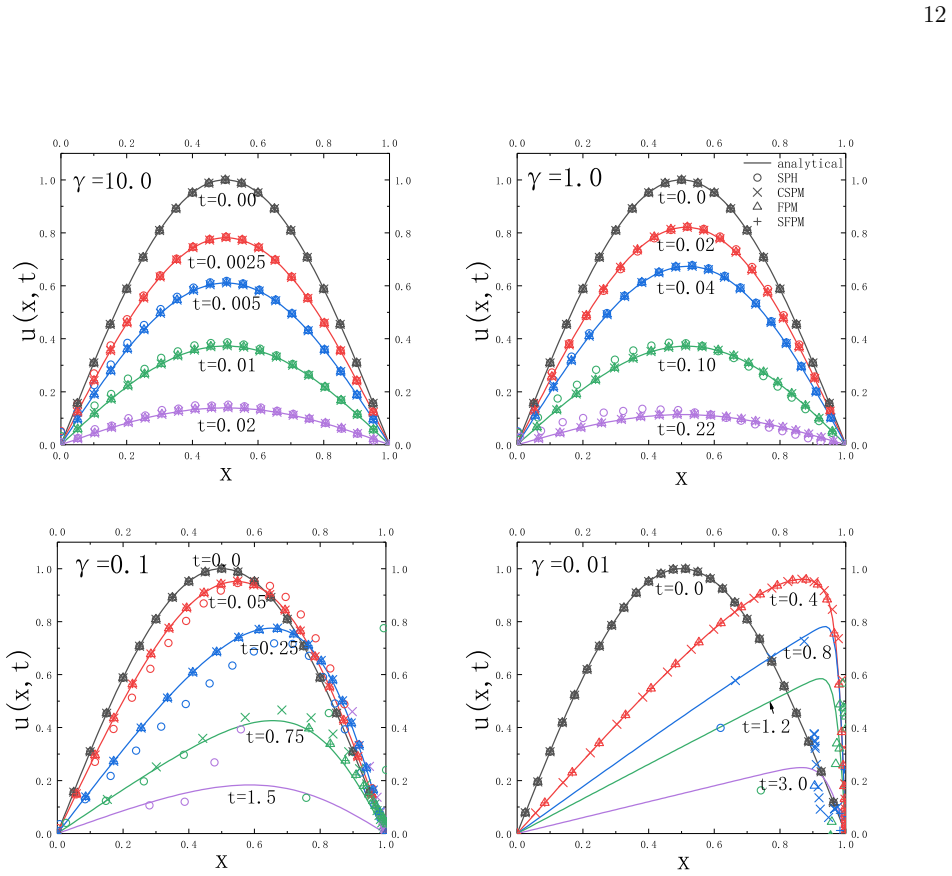
The paper's central claim is that the implementation of the boundary condition is essential for SPH stability, and that this instability manifests as particles crossing through each other when the neighbor spacing falls below the smoothing length h. For the one-dimensional Burgers equation with particles that move according to the continuity equation, fixed and free boundary implementations produce large deviations for small viscosity, while a mirrored imaginary-particle boundary condition suppresses most of the error. When particles pile up near the center of a symmetric collision, the kernel's repulsive force weakens as distance drops below h, so the usual self-regularization of SPH fails and particles pass through one another. The paper also presents a new interpolation scheme, the symmetrized finite particle method (SFPM), which avoids all derivatives of the kernel function while retaining competitive precision and efficiency.
Load-bearing premise
The dynamic runs use a smoothing length h that is more than ten times the initial particle spacing, and the paper never tests the conventional ratio of h to spacing around 1.2 to 1.5, so the observed particle crossing could be an artifact of that regime.
Editorial extensions
If this is right
- Boundary implementations are not interchangeable in SPH: choosing mirrored imaginary particles instead of fixed or free boundary particles can decide whether a low-viscosity simulation remains stable.
- SFPM offers a way to build high-order SPH interpolations without kernel derivatives, which may be useful in schemes sensitive to derivative evaluation.
- The reported particle-crossing instability implies that SPH's automatic re-meshing has a finite compression limit set by the smoothing length, beyond which particle order is lost.
- The oscillations observed for FPM and SFPM near dense regions occur alongside particle crossing, so the two phenomena are closely connected in the authors' analysis.
Reading between the lines
- The dynamic runs use h about ten times larger than the initial particle spacing (h=0.2 with 125 particles, h=0.1 with 250); a rerun at the conventional h/Delta-x ratio near 1.2-1.5 would show whether the claimed instability is a regime artifact rather than a general SPH property.
- The crossing threshold could likely be characterized quantitatively: for a given kernel, particle crossing should start when the local neighbor spacing falls below the distance at which the kernel's repulsive force reaches its maximum.
- The same pile-and-cross mechanism may appear in higher-dimensional SPH at stagnation points where fluid is squeezed below the smoothing scale, which would be a testable extension beyond the one-dimensional Burgers case.
Signed reviews
Editorial analysis
A structured set of objections, weighed in public.
Referee Report
Summary. The paper studies smoothed particle hydrodynamics (SPH) applied to the one-dimensional Burgers' equation. It compares four spatial interpolation schemes: standard SPH, corrective smoothed particle method (CSPM), finite particle method (FPM), and a symmetrized finite particle method (SFPM) that avoids explicit kernel derivatives. In the first scenario, SPH particles are stationary and the authors measure precision via a relative deviation P (Eq. 23) and efficiency E (Eq. 24), reporting that CSPM, FPM, and SFPM outperform standard SPH. In the second scenario, particles move dynamically and three boundary-condition implementations are compared: fixed boundary particles, added free particles beyond the domain, and mirrored imaginary particles. The authors report that the mirrored boundary condition is the most stable and that a 'novel type of instability' appears in which particles traverse one another when the flow piles up near the center, accompanied by oscillations for small viscosity. They conclude that the boundary-condition implementation plays an essential role in SPH stability.
Significance. If established, the sensitivity of SPH stability to boundary-condition implementation and the reported particle-traversal instability would be practically relevant for Lagrangian SPH simulations, and the SFPM scheme would provide a useful kernel-derivative-free alternative. The static-particle comparison in Table I is a clearly described benchmark, and the definition of SFPM is straightforward and reproducible from Eq. (17). However, the paper does not ship code or machine-checked proofs, and the dynamic results that support the main claims are currently not sufficiently supported by quantitative evidence or by a parameter study, so the significance of the boundary-condition and particle-crossing claims is not yet demonstrated.
major comments (3)
- [Section IV, Fig. 5] The dynamic runs in Fig. 5 use h=0.2 with 125 particles over (0,2) and h=0.1 with 250 particles, giving an initial particle spacing of about 0.016 and 0.008, respectively, so h/Δx ≈ 12.5 in both cases. For the fifth-order spline with support 3h, each particle interacts with roughly 75 neighbors, far outside the conventional SPH operating range h/Δx ≈ 1.2–1.5. Because the paper itself states that when Δx < h the kernel repulsion decreases with decreasing distance, the particle traversal in the first row of Fig. 5 may simply be the known pairing/penetration instability forced by this extreme ratio, rather than a new boundary-condition-induced instability. The claim that traversal occurs for 'a broad choice of parameters' is not supported by the two configurations shown, both with the same h/Δx, and rows 2 and 3 of the same figure show no crossing at the same ratio. A parameter scan at conventional h/Δx values and a scan varying h at fixed N are required before the particle-crossing claim can be accepted.
- [Section IV, Figs. 2–4] The boundary-condition comparison that underlies the central claim is qualitative. The figures are assessed by visual inspection, no error norm as a function of time is reported, and the numerical setup (N, h, dt, initial perturbation, kernel parameters) is not stated for these runs. Without a quantitative measure of oscillation amplitude or instability onset, the statement that 'the numerical stability sensitively depends on its implementation' is not demonstrated. Please provide L2 or L∞ errors relative to the analytic solution as functions of time, specify the parameters for each figure, and include a convergence check in h and dt for at least one boundary treatment.
- [Section IV, dynamic formulation] The discrete equations used for the dynamical runs are not given. The text says that Eqs. (20) and (21) are solved simultaneously, but the SPH discretization of the velocity equation, the density update, the time integrator, and the precise treatment of the added and mirrored particles (number of added particles, velocity inversion rule) are not specified. Since the observed particle crossing may depend on these implementation choices, the results cannot be reproduced or independently checked. Please include the full discrete scheme or provide a reference with the exact equations used.
minor comments (5)
- [Eq. (23)] The precision measure P is evaluated at only seven spatial points; please state whether the results are stable under a different choice of evaluation points and whether these points are interior or include the boundaries.
- [Eq. (24)] The symbol Δt is used for both the time step and the CPU time in the efficiency definition, which is confusing; please rename the CPU time (e.g., T_cpu) and clarify the definition.
- [Section I] There is a typo in the first paragraph: 'exploiation' should be 'exploitation'.
- [Fig. 4 caption] The caption begins with '((Color online)' with a double parenthesis; please correct this.
- [Section IV, Fig. 5 discussion] The sentence 'particles simple travel across each other' should read 'particles simply travel across each other'.
Circularity Check
No circularity: the boundary-condition comparison and particle-traversal observation are benchmarked against analytic solutions and external published mechanisms, with no fitted parameter renamed as a prediction.
full rationale
The paper's load-bearing claims are that the boundary-condition implementation strongly affects the stability of dynamic SPH runs (Figs. 2-5) and that a particle-traversal instability can arise. Both claims are obtained by direct numerical simulation of Burgers' equation using the stated equations of motion (Eqs. 20-21) and are compared with analytic solutions and standard finite-difference results. No parameter is fitted to the quantity being predicted, and no quantity is defined in terms of the conclusion it is used to support. The SFPM interpolation scheme is explicitly attributed to an external reference [45], and the pairing and tensile instability mechanisms are attributed to external references [31,34]. The paper explains the observed traversal through the kernel's repulsive-force behavior when the inter-particle spacing falls below the smoothing length, but this explanation is an independent physical mechanism, not a restatement of the input. The unusual h/Delta_x ratio used in Fig. 5 is a possible correctness or parameter-regime concern, but it is not circularity: the paper does not fit or define its conclusion in terms of that parameter choice. I therefore find no circular step in the derivation chain.
Assumptions & free parameters
free parameters (3)
- smoothing length h =
static: h = Delta-x; dynamic: h = 0.2 and 0.1
- time step dt =
static: Delta-t = h/500; dynamic: 0.02 and 0.01
- evaluation points for precision P =
7 evenly spaced points
assumptions (4)
- standard math The particle approximation replaces integrals by finite sums over neighbors (Eqs. (8)-(9)).
- domain assumption The FPM and SFPM moment matrix in Eq. (14) is invertible for all particle configurations encountered.
- domain assumption Burgers' equation with zero boundary data and smooth initial data is representative for SPH stability studies.
- domain assumption Particle motion is governed by the continuity equation Eq. (21) in the dynamic scenario even though u in Burgers' equation is independent of rho.
Cite this review
Pith. "Pith review of On the boundary condition and related instability in the Smoothed Particle Hydrodynamics." pith.science (2026). https://pith.science/paper/YKMAE3X5
@misc{pith2026190806225,
  author       = {Pith},
  title        = {Pith review of: On the boundary condition and related instability in the Smoothed Particle Hydrodynamics},
  year         = {2026},
  howpublished = {\url{https://pith.science/paper/YKMAE3X5}},
  note         = {Machine review of arXiv:1908.06225}
}
read the original abstract
In this work, we explore various relevant aspects of the Smoothed Particle Hydrodynamics regarding Burger's equation. The stability, precision, and efficiency of the algorithm are investigated in terms of different implementations. In particular, we argue that the boundary condition plays an essential role in the stability of numerical implementation. Besides, the issue is shown to be closely associated with the initial particle distribution and the interpolation scheme. Among others, we introduce an interpolation scheme termed symmetrized finite particle method. The main advantage of the scheme is that its implementation does not involve any derivative of the kernel function. Concerning the equation of motion, the calculations are carried out using two distinct scenarios where the particles are chosen to be either stationary or dynamically evolved. The obtained results are compared with those obtained by using the standard finite difference method for spatial derivatives. Our numerical results indicate subtle differences between different schemes regarding the choice of boundary condition. In particular, a novel type of instability is observed where the regular distribution is compromised as the particles start to traverse each other. Implications and further discussions of the present study are also addressed.
Figures


Figures from the paper (2 more)


Reference graph
Works this paper leans on
- [45]
- [1]
- [2]
-
[3]
J. J. Monaghan, Ann. Rev. Astron. Astrophys. 30 (1992) 543
work page 1992
-
[4]
W. Benz, Smooth Particle Hydrodynamics - a Review NATO SAI Series C: Mathematical and Physical Sciences (Kluwer Academic Publishers, 1990)
work page 1990
-
[5]
J. J. Monaghan, Rep. Prog. Phys. 68 (2005) 1703
work page 2005
-
[6]
J. J. Monaghan and D. J. Price, Mon. Not.Roy. Astr.Soc. 328 (2001) 381
work page 2001
-
[7]
Astrophysical Smooth Particle Hydrodynamics
S. Rosswog, New Astron. Rev. 53 (2009) 78, arXiv:0903.5075
work page Pith review arXiv 2009
Show all 46 references
-
[8]
M. B. Liu and G. R. Liu, Archives of Computational Methods in Engineering 17 (2010) 25
2010
- [9]
- [10]
-
[11]
C. L. Fryer, G. Rockefeller, and M. S. Warren, Astrophys . J. 643 (2006) 292, arXiv:astro- ph/0512532
2006
-
[12]
L. D. Libersky and A. G. Petschek, 395 (1991) 248
1991
-
[13]
Bonet and S
J. Bonet and S. Kulasegaram, Int. J. Numer. Methods Eng. 47 (2000) 1189
2000
-
[14]
Rabczuk and J
T. Rabczuk and J. Eibl, Int. J. Numer. Methods Eng. 56 (2003) 1421
2003
-
[15]
Herreros and M
M. Herreros and M. Mabssout, Comput. Methods Appl. Mech . Engrg. 200 (2011) 1833
2011
- [16]
-
[17]
Y. Hama, T. Kodama, and O. Socolowski Jr., Braz.J.Phys. 35 (2005) 24, arXiv:hep- ph/0407264
2005
-
[18]
Derradi de Souza, T
R. Derradi de Souza, T. Koide, and T. Kodama, Prog. Part. Nucl. Phys. 86 (2016) 35, arXiv:1506.03863
2016 arXiv
-
[19]
Baier, P
R. Baier, P. Romatschke, D. T. Son, A. O. Starinets, and M . A. Stephanov, JHEP 04 (2008) 100, arXiv:0712.2451
2008 arXiv
-
[20]
Loganayagam, JHEP 05 (2008) 087, arXiv:0801.3701
R. Loganayagam, JHEP 05 (2008) 087, arXiv:0801.3701
2008 arXiv
-
[21]
Aharony, S
O. Aharony, S. Minwalla, and T. Wiseman, Class. Quant. G rav. 23 (2006) 2171, arXiv:hep- th/0507219
2006
- [22]
-
[23]
J. M. Maldacena, Int. J. Theor. Phys. 38 (1999) 1113, arXiv:hep-th/9711200, [Adv. Theor. Math. Phys.2,231(1998)]
1999 arXiv
- [24]
- [25]
- [26]
-
[27]
R. P. G. Andrade, F. Grassi, Y. Hama, and W.-L. Qian, Phys .Lett. B712 (2012) 226, arXiv:1008.4612
2012 arXiv
- [28]
-
[29]
W.-L. Qian, R. Andrade, F. Gardim, F. Grassi, and Y. Hama , Phys.Rev. C87 (2013) 014904, arXiv:1207.6415
2013 arXiv
-
[30]
D. J. Price, ASP Conf. Ser. 453 (2012) 249, arXiv:1111.1259
2012 arXiv
-
[31]
J. W. Swegle, D. Hicks, and S. Attaway, J. Comput. Phys. 116 (1995) 123
1995
-
[32]
Dyka and R
C. Dyka and R. Ingel, Comput. & Struct. 57 (1995) 573
1995
-
[33]
J. K. Chen, J. E. Beraun, and C. J. Jih, Computational Mec hanics 23 (1999) 279
1999
-
[34]
Dehnen and H
W. Dehnen and H. Aly, Mon. Not. Roy. Astron. Soc. 425 (2012) 1068, arXiv:1204.2471
2012 arXiv
-
[35]
Randles and L
P. Randles and L. Libersky, Comput. Meth. Appl. M. 139 (1996) 375
1996
-
[36]
Chen and J
J. Chen and J. Beraun, Comput. Meth. Appl. M. 190 (2000) 225
2000
-
[37]
M. B. Liu and G. R. Liu, Appl. Numer. Math. 56 (2006) 19
2006
-
[38]
P. Mota, W. Chen, and W.-L. Qian, Commun. Theor. Phys. 68 (2017) 382, arXiv:1704.06165
2017 arXiv
-
[39]
L. D. Libersky, A. G. Petschek, T. C. Carney, J. R. HippFi rooz, and A. Allahdadi, J. Comput. Phys. 109 (1993) 67
1993
-
[40]
D. J. Price, J. Comput. Phys. 231 (2012) 759, arXiv:1012.1885
2012 arXiv
-
[41]
Belytschko and S
T. Belytschko and S. Xiao, Comput. & Math. Appl. 43 (2002) 329
2002
-
[42]
J. K. Chen, J. E. Beraun, and T. C. Carney, Int. J. Num. Met h. Eng. 46 (1999) 231
1999
-
[43]
Inutsuka, J
S.-I. Inutsuka, J. Comput. Phys. 179 (2002) 238
2002
-
[44]
Cullen and W
L. Cullen and W. Dehnen, MNRAS 1126 (2010)
2010
-
[46]
J. P. Morris, P. J. Fox, and Y. Zhu, J. Comput. Phys. 136 (1997) 214. /s48 /s53 /s49/s48 /s49/s53 /s50/s48 /s50/s53 /s51/s48 /s51/s53 /s48 /s53 /s49/s48 /s49/s53 /s50/s48 /s50/s53 /s51/s48 /s51/s53 /s65 /s82/s111/s119 /s32 /s78/s117/s109/s98/s101/s114 /s115 /s84/s111/s32 /s98/...
1997
Reviewed August 14, 2026 · model on record in the stance chip above.
Discussion (0). Continue with ORCID to comment.