REVIEW 2 major objections 6 minor 44 references
Attentional Feature-Pair Relation Networks for Accurate Face Recognition
T0 review · 2 major / 6 minor · reviewed 2026-08-14 · deepseek-v4-flash
Pith's one-line read The paper claims that representing a face by the top-K most relevant pairs of local appearance block features, each weighted by a learned bilinear attention score, outperforms both global-feature baselines and all-pairs attention on nine…
desk verdict Solid, incremental face-recognition architecture paper with credible ablations, but the attention-top-K mechanism is under-identified and the landmark-free claim is overstated. read the letter →
The pith
A machine-rendered reading of the paper's core claim, the machinery that carries it, and where it could break.
The reading
What carries the argument
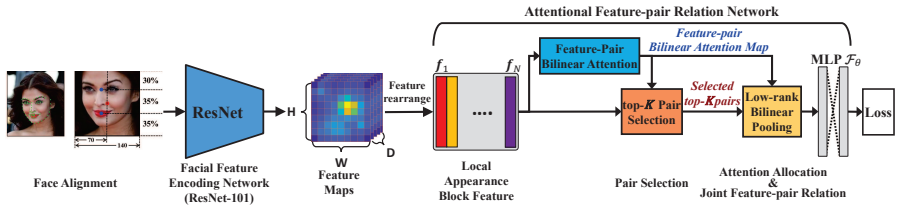
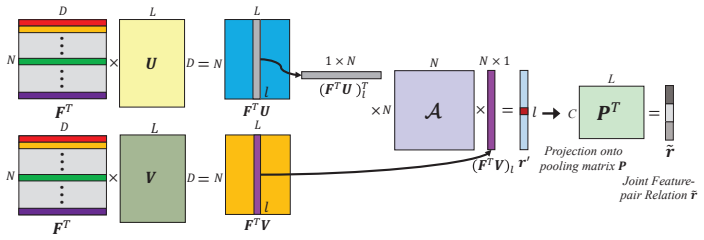
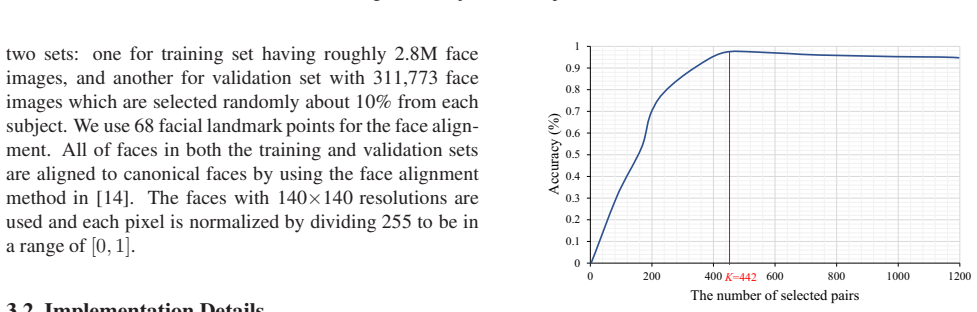
The mechanism that carries the argument is the feature-pair bilinear attention map combined with a top-K selection layer. For each pair of local block features, low-rank bilinear pooling computes an attention logit as the inner product of an element-wise product of two projected and ReLU-activated features, and a softmax over the full pair matrix turns these logits into attention scores. The selection layer keeps only the K pairs with the largest scores (K=442 in the experiments, chosen on a VGGFace2 validation set) and zeroes out gradients for dropped pairs, so backpropagation flows only through selected relations. The pooled relation is then formed as an attention-weighted sum over the selected pairs, projected by a pooling matrix, and fed into a two-layer MLP whose 1,024-dimensional output is the face descriptor. This design lets the network concentrate capacity on a small set of relevant feature-pair relations instead of spreading it over all pairs.
What would settle it
Retrain the full AFRN with K swept over a range on each target benchmark rather than fixed at 442 from VGGFace2 validation; if the accuracy peak shifts substantially across LFW, YTF, IJB-A, IJB-B, and IJB-C, or if K=442 is no better than using all pairs on some benchmark, the claim that top-K selection is the cause of the gains would be refuted. A complementary check is to compare which spatial pairs are selected for matched versus mismatched templates: if selected pairs are not consistently face-related, the improvement may come from regularization rather than from identifying relevant facial relations.
Extended reading notes
Core claim
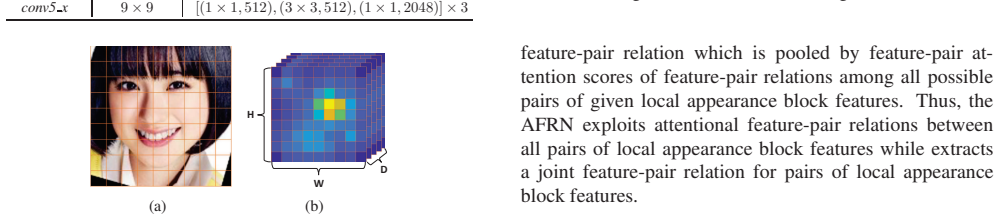
The central claim is that the relevance of a facial feature-pair can be learned and used twice: once to choose which pairs matter and once to weight them. AFRN represents a face by all 81×81 pairs of local block features extracted from the 9×9 feature grid, computes a feature-pair bilinear attention map via low-rank bilinear pooling, selects the top-K pairs according to that map, and forms the joint feature-pair relation as an attention-weighted sum over only those selected pairs. In controlled comparisons on IJB-A, IJB-B, and IJB-C, the full model with pair selection beats the attention model without selection, which in turn beats the global-feature baseline; for example, on IJB-A the full model reaches 0.949 TAR at FAR=0.001, versus 0.904 for attention without selection and 0.895 for the baseline. The paper concludes that dropping irrelevant pairs of local appearance features is an effective and general way to improve both 1:1 verification and 1:N identification.
Load-bearing premise
The load-bearing assumption is that the fixed number K=442 and the attention-based ordering of pairs, chosen to maximize accuracy on a held-out part of VGGFace2, transfer to the test benchmarks: if the best sparsity pattern is specific to VGGFace2, the reported gains of the selection model over the no-selection model would not generalize.
Editorial extensions
If this is right
- Adding the attention-and-selection module to a standard residual backbone improves accuracy even when the network is trained from scratch on about 2.8M images, so the gain is not tied to extra training data.
- The top-K layer is non-differentiable, yet the model trains end-to-end because gradients flow only through selected pairs, and the selection layer itself has no learned parameters.
- On IJB-C, the full model matches or exceeds a much larger fusion model trained on roughly twice as many identities, indicating the pair-selection mechanism is data-efficient.
- On IJB-A, the gap between the selection model and the no-selection model grows at stricter operating points (FAR=0.001), meaning pair selection is most valuable where false alarms are most costly.
Reading between the lines
- A natural extension would be to make K depend on the input image or template rather than using a global K=442, because the attention scores already rank pairs per image and could support a per-image budget.
- The attention map over pairs could be visualized to reveal which facial regions are relied on for cross-pose or cross-age matching; that would test the interpretability promise and could inform data augmentation.
- Because dropped pairs receive zero gradient, the method acts as a hard sparsity regularizer; comparing top-K selection with random K selection or with a learnable soft threshold would isolate whether gains come from the relevance ranking or from sparsity itself.
- The reported advantage over a larger fusion model on IJB-C suggests a testable data-efficiency claim: training AFRN on reduced subsets of VGGFace2 should degrade more slowly than training a comparable global-feature model on the same subsets.
Signed reviews
Editorial analysis
A structured set of objections, weighed in public.
Referee Report
Summary. The paper proposes Attentional Feature-pair Relation Network (AFRN) for face recognition. It extracts 81 local appearance block features from a modified ResNet-101, computes a feature-pair bilinear attention map via low-rank bilinear pooling, selects the top-K feature pairs, weights them by their attention scores, and pools the selected feature-pair relations into a 1024-dimensional face representation. The model is trained on a refined VGGFace2 set using triplet ratio, pairwise, and identity preserving losses. The authors report state-of-the-art results on LFW, YTF, CALFW, CPLFW, CFP, AgeDB, IJB-A, IJB-B, and IJB-C, with ablations showing that the model with pair selection (model C) outperforms the model without selection (model B) and a global-feature baseline (model A).
Significance. If the reported results hold, AFRN is a meaningful contribution to part-based face recognition, demonstrating that attention-weighted top-K feature-pair selection can improve both verification and identification accuracy on challenging benchmarks. The paper's strengths include a clear architectural description, controlled comparisons among models A, B, and C, a comparison with alternative attention mechanisms, and evaluations across nine benchmarks. The central attribution of the gains to attention-based top-K selection is plausible, but it is not fully isolated: the paper lacks a random or fixed-spatial selection control and reports no K sensitivity on the IJB benchmarks. These are inexpensive experiments that would strengthen the paper substantially. No code or trained models are released, which limits reproducibility.
major comments (2)
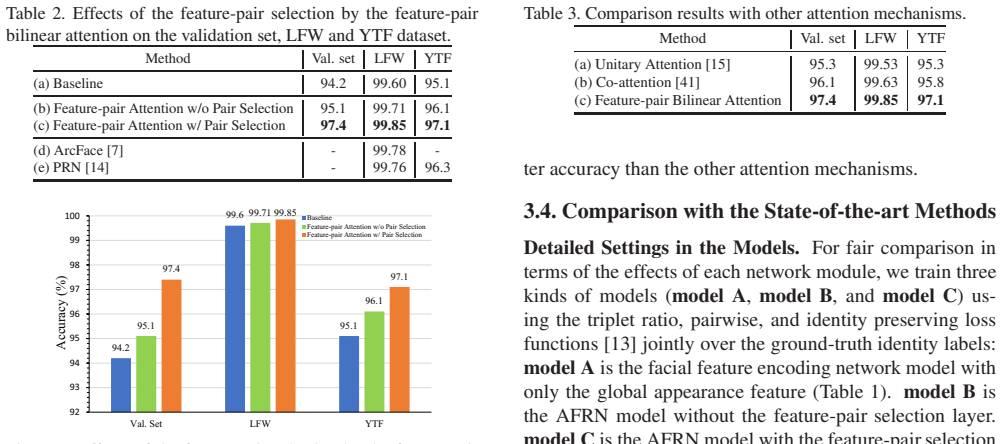
- [3.3, Figure 6; Tables 4, 5, 7] The value K=442 is selected on the VGGFace2 validation split, and the paper reports no sensitivity analysis for K on the IJB-A/B/C benchmarks. The central claim that top-K selection causes model C's consistent gains over model B depends on this single hyperparameter. Please report the accuracy curve or at least a small grid of K values on one or more IJB datasets to demonstrate that the improvements are not an artifact of tuning on the VGGFace2 validation distribution.
- [3.3, Tables 3 and 4] The comparison between model B (no selection) and model C (attention-based top-K selection) changes both the attention weighting and the presence of a hard mask, and the attention-mechanism comparison in Table 3 always uses the same top-K selection. The paper never includes a control with random selection or fixed-spatial selection of the same number of pairs, so the reader cannot tell whether the gains come from the attention-based ranking or merely from sparsification acting as a regularizer. Please add such a control (e.g., a random subset of K pairs per image or a fixed spatial mask) to isolate the effect of the attention ranking.
minor comments (6)
- [Title] The title contains a stray space in 'F ace'; please correct it.
- [Eq. (2)] The notation '/BD' in Eq. (2) is undefined; please clarify whether it is a scalar (e.g., 1/D) or a vector and how it is broadcast.
- [Table 2] The row labeled 'Baseline' is not defined in the caption; please confirm that it corresponds to model A of Section 3.4.
- [3.3] The sentence 'When K equals to 1,200, it is equivalent to not using the feature-pair selection layer in a face region' is unclear because the total number of pairs is 81 x 81 = 6,561; please specify what K=1,200 corresponds to.
- [6 (Appendix A.1), Table 6] In Table 6, model C ties ArcFace on CFP (95.56) and only marginally exceeds it on AgeDB; the text 'outperforms' should be qualified for these cases.
- [3.2] The paper does not release code or trained models, which limits reproducibility of the reported benchmark numbers.
Circularity Check
No significant circularity: the AFRN paper's central claims rest on controlled ablations and external benchmark evaluations, not on derivations that reduce to their own inputs.
full rationale
The paper is an empirical computer vision architecture paper. Its central claim is that the proposed AFRN, especially with top-K pair selection, achieves state-of-the-art face verification and identification accuracy. That claim is supported by controlled experiments comparing model A, model B, and model C on the same training setup, and by comparisons with published state-of-the-art methods on external benchmarks. The top-K value K=442 is a hyperparameter selected on a held-out VGGFace2 validation set and then applied to test benchmarks; tuning a hyperparameter on validation data is not a fitted input renamed as a prediction, and the reported gains over model B are measured on datasets outside the validation procedure. The paper cites the authors' own prior work, including PRN [14] and the triple loss functions [13], but those citations are used as baselines, building blocks, or starting points rather than as the sole justification for the paper's conclusions. The attention map and pair-selection mechanism are learned components evaluated through ablations, not quantities defined in terms of the outcome they are said to predict. No equation in the paper reduces a claimed prediction to its own input, and no load-bearing argument depends on an unverified self-citation. Therefore the derivation chain is self-contained for the claims it actually makes, and the appropriate circularity score is 0.
Assumptions & free parameters
free parameters (2)
- K (number of selected feature pairs) =
442
- Loss weight factors for Lt, Lp, Lid =
1, 0.5, 1
assumptions (3)
- domain assumption Landmark-based alignment keeps the 9x9 local feature grid in correspondence across faces.
- domain assumption Top-K pair sparsity and attention ranking trained on VGGFace2 transfer to other benchmarks.
- domain assumption VGGFace2 refined training set is a suitable source for learning generic face relations.
Cite this review
Pith. "Pith review of Attentional Feature-Pair Relation Networks for Accurate Face Recognition." pith.science (2026). https://pith.science/paper/ENCJNCIL
@misc{pith2026190806255,
  author       = {Pith},
  title        = {Pith review of: Attentional Feature-Pair Relation Networks for Accurate Face Recognition},
  year         = {2026},
  howpublished = {\url{https://pith.science/paper/ENCJNCIL}},
  note         = {Machine review of arXiv:1908.06255}
}
read the original abstract
Human face recognition is one of the most important research areas in biometrics. However, the robust face recognition under a drastic change of the facial pose, expression, and illumination is a big challenging problem for its practical application. Such variations make face recognition more difficult. In this paper, we propose a novel face recognition method, called Attentional Feature-pair Relation Network (AFRN), which represents the face by the relevant pairs of local appearance block features with their attention scores. The AFRN represents the face by all possible pairs of the 9x9 local appearance block features, the importance of each pair is considered by the attention map that is obtained from the low-rank bilinear pooling, and each pair is weighted by its corresponding attention score. To increase the accuracy, we select top-K pairs of local appearance block features as relevant facial information and drop the remaining irrelevant. The weighted top-K pairs are propagated to extract the joint feature-pair relation by using bilinear attention network. In experiments, we show the effectiveness of the proposed AFRN and achieve the outstanding performance in the 1:1 face verification and 1:N face identification tasks compared to existing state-of-the-art methods on the challenging LFW, YTF, CALFW, CPLFW, CFP, AgeDB, IJB-A, IJB-B, and IJB-C datasets.
Figures

Figures from the paper (6 more)



Reference graph
Works this paper leans on
-
[1]
Pose-robust face recognition via deep resid- ual equivariant mapping
Kaidi Cao, Y u Rong, Cheng Li, Xiaoou Tang, and Chen Change Loy. Pose-robust face recognition via deep resid- ual equivariant mapping. In 2018 IEEE Conference on Com- puter Vision and Pattern Recognition (CVPR 2018) , 2018
work page 2018
-
[2]
Parkhi, and An- drew Zisserman
Qiong Cao, Li Shen, Weidi Xie, Omkar M. Parkhi, and An- drew Zisserman. Vggface2: A dataset for recognising faces across pose and age. CoRR, abs/1710.08092, 2017
arXiv 2017
-
[3]
Faceposenet: Making a case for landmark-free face alignment
Feng-Ju Chang, Anh Tuan Tran, Tal Hassner, Iacopo Masi, Ram Nevatia, and G´ erard Medioni. Faceposenet: Making a case for landmark-free face alignment. In 2017 IEEE In- ternational Conference on Computer Vision W orkshops (IC- CVW), pages 1599–1608, Oct 2017
work page 2017
-
[4]
Jun-Cheng Chen, Vishal M. Patel, and Rama Chellappa. Un- constrained face verification using deep cnn features. In 2016 IEEE Winter Conference on Applications of Computer Vision (WACV), pages 1–9, March 2016
work page 2016
-
[5]
One-to-many face recognition with bi - linear cnns
Aruni Roy Chowdhury, Tsung-Y u Lin, Subhransu Maji, and Erik Learned-Miller. One-to-many face recognition with bi - linear cnns. In 2016 IEEE Winter Conference on Applica- tions of Computer Vision (WACV), pages 1–9, March 2016
work page 2016
-
[6]
Template adap- tation for face verification and identification
Nate Crosswhite, Jeffrey Byrne, Chris Stauffer, Omkar Parkhi, Qiong Cao, and Andrew Zisserman. Template adap- tation for face verification and identification. In 2017 12th IEEE International Conference on Automatic Face Gesture Recognition (FG 2017), pages 1–8, May 2017
work page 2017
-
[7]
ArcFace : Additive Angular Margin Loss for Deep Face Recognition
Jiankang Deng, Jia Guo, and Stefanos Zafeiriou. ArcFace : Additive Angular Margin Loss for Deep Face Recognition. ArXiv e-prints, Jan 2018
work page 2018
-
[8]
Face recognition with contrastive convolution
Chunrui Han, Shiguang Shan, Meina Kan, Shuzhe Wu, and Xilin Chen. Face recognition with contrastive convolution . In European Conference on Computer Vision (ECCV 2018) , September 2018
work page 2018
Show all 44 references
-
[9]
Pooling faces: Template based face recognition with pooled face im- ages
Tal Hassner, Iacopo Masi, Jungyeon Kim, Jongmoo Choi, Shai Harel, Prem Natarajan, and Grard Medioni. Pooling faces: Template based face recognition with pooled face im- ages. In 2016 IEEE Conference on Computer Vision and Pattern Recognition W orkshops (CVPRW), pages 127–135, ...
2016
-
[10]
Deep residual learning for image recognition
Kaiming He, Xiangyu Zhang, Shaoqing Ren, and Jian Sun. Deep residual learning for image recognition. In 2016 IEEE Conference on Computer Vision and Pattern Recognition (CVPR), pages 770–778, June 2016
2016
-
[11]
Huang, Manu Ramesh, Tamara Berg, and Erik Learned-Miller
Gary B. Huang, Manu Ramesh, Tamara Berg, and Erik Learned-Miller. Labeled faces in the wild: A database for studying face recognition in unconstrained environ- ments. Technical Report 07-49, University of Massachusetts, Amherst, October 2007
2007
-
[12]
Batch normalizati on: Accelerating deep network training by reducing internal co - variate shift
Sergey Ioffe and Christian Szegedy. Batch normalizati on: Accelerating deep network training by reducing internal co - variate shift. In Proceedings of the 32nd International Con- ference on Machine Learning, ICML 2015, Lille, France, 6- 11 July 2015, pages 448–456, 2015
2015
-
[13]
Deep convolutional neural network using triplets of faces, deep en- semble, and score-level fusion for face recognition
Bong-Nam Kang, Y onghyun Kim, and Daijin Kim. Deep convolutional neural network using triplets of faces, deep en- semble, and score-level fusion for face recognition. In 2017 IEEE Conference on Computer Vision and Pattern Recogni- tion W orkshops (CVPRW), pages 611–618, July 2017
2017
-
[14]
Pairwise relational networks for face recognition
Bong-Nam Kang, Y onghyun Kim, and Daijin Kim. Pairwise relational networks for face recognition. In European Con- ference on Computer Vision (ECCV 2018) , September 2018
2018
-
[15]
Hadamard product for low-rank bilinear pooling
Jin-Hwa Kim, Kyoung-Woon On, Woosang Lim, Jeonghee Kim, Jung-Woo Ha, and Byoung-Tak Zhang. Hadamard product for low-rank bilinear pooling. CoRR, abs/1610.04325, 2016
2016 arXiv
-
[16]
Kingma and Jimmy Ba
Diederik P . Kingma and Jimmy Ba. Adam: A method for stochastic optimization. In 2015 International Conference on Learning Representation (ICLR 2015) , 2015
2015
-
[17]
Klare, Ben Klein, Emma Taborsky, Austin Blan - ton, Jordan Cheney, Kristen Allen, Patrick Grother, Alan Mah, Mark Burge, and Anil K
Brendan F. Klare, Ben Klein, Emma Taborsky, Austin Blan - ton, Jordan Cheney, Kristen Allen, Patrick Grother, Alan Mah, Mark Burge, and Anil K. Jain. Pushing the frontiers of unconstrained face detection and recognition: Iarpa jan us benchmark a. In 2015 IEEE Conference on Com...
2015
-
[18]
Deep alignment network: A convolutional neural network for robust face alignment
Mark Kowalski, Jacek Naruniec, and Tomasz Trzcinski. Deep alignment network: A convolutional neural network for robust face alignment. In 2017 IEEE Conference on Com- puter Vision and Pattern Recognition W orkshops (CVPRW), pages 2034–2043, July 2017
2017
-
[19]
Huang Erik Learned-Miller
Gary B. Huang Erik Learned-Miller. Labeled faces in the wild: Updates and new reporting procedures. Techni- cal Report UM-CS-2014-003, University of Massachusetts, Amherst, May 2014
2014
-
[20]
Sphereface: Deep hypersphere embedding for face recognition
Weiyang Liu, Yandong Wen, Zhiding Y u, Ming Li, Bhiksha Raj, and Le Song. Sphereface: Deep hypersphere embedding for face recognition. In 2017 IEEE Conference on Computer Vision and Pattern Recognition (CVPR) , pages 6738–6746, 2017
2017
-
[21]
Pose-aware face recognition in the wild
Iacopo Masi, Stephen Rawls, Grard Medioni, and Prem Natarajan. Pose-aware face recognition in the wild. In 2016 IEEE Conference on Computer Vision and Pattern Recogni- tion (CVPR), pages 4838–4846, June 2016
2016
-
[22]
Duncan, Nathan Kalka, Tim Miller, Charles Otto, Anil K
Brianna Maze, Jocelyn Adams, James A. Duncan, Nathan Kalka, Tim Miller, Charles Otto, Anil K. Jain, W. Tyler Niggel, Janet Anderson, Jordan Cheney, and Patrick Grother. Iarpa janus benchmark - c: Face dataset and protocol. In 2018 International Conference on Biometrics (ICB) ,...
2018
-
[23]
Agedb: The first manually collected, in-the-wil d age database
Stylianos Moschoglou, Athanasios Papaioannou, Chris - tos Sagonas, Jiankang Deng, Irene Kotsia, and Stefanos Zafeiriou. Agedb: The first manually collected, in-the-wil d age database. In 2017 IEEE Conference on Computer Vision and Pattern Recognition W orkshops (CVPRW), pages 1...
2017
-
[24]
Vinod Nair and Geoffrey E. Hinton. Rectified linear unit s improve restricted boltzmann machines. In Proceedings of the 27th International Conference on International Confer - ence on Machine Learning, ICML’10, pages 807–814, 2010
2010
-
[25]
Castillo, and Rama Chellappa
Rajeev Ranjan, Ankan Bansal, Jingxiao Zheng, Hongyu Xu , Joshua Gleason, Boyu Lu, Anirudh Nanduri, Jun-Cheng Chen, Carlos D. Castillo, and Rama Chellappa. A fast and accurate system for face detection, identification, and ver i- fication. IEEE Transactions on Biometrics, Behavio...
2019
-
[26]
Castillo, and Rama Chellappa
Rajeev Ranjan, Carlos D. Castillo, and Rama Chellappa. L2- constrained softmax loss for discriminative face verificat ion. CoRR, abs/1703.09507, 2017
2017 arXiv
-
[27]
Castillo, and Rama Chellappa
Rajeev Ranjan, Swami Sankaranarayanan, Carlos D. Castillo, and Rama Chellappa. An all-in-one convolutional neural network for face analysis. In 2017 12th IEEE Inter- national Conference on Automatic Face Gesture Recognition (FG 2017), pages 17–24, May 2017
2017
-
[28]
Weight normaliza- tion: A simple reparameterization to accelerate training o f deep neural networks
Tim Salimans and Diederik P Kingma. Weight normaliza- tion: A simple reparameterization to accelerate training o f deep neural networks. In Advances in Neural Information Processing Systems 29, pages 901–909. 2016
2016
-
[29]
Triplet probabilistic embedding for face verification and clustering
Swami Sankaranarayanan, Azadeh Alavi, Carlos Castill o, and Rama Chellappa. Triplet probabilistic embedding for face verification and clustering. In 2016 IEEE 8th Interna- tional Conference on Biometrics Theory, Applications and Systems (BTAS), pages 1–8, Sept 2016
2016
-
[30]
Patel, Rama Chellappa, and David W
Soumyadip Sengupta, Jun-Cheng Chen, Carlos Castillo, Vishal M. Patel, Rama Chellappa, and David W. Jacobs. Frontal to profile face verification in the wild. In 2016 IEEE Winter Conference on Applications of Computer Vision (WACV), pages 1–9, March 2016
2016
-
[31]
Deep learning face representation by joint identification- verification
Yi Sun, Y uheng Chen, Xiaogang Wang, and Xiaoou Tang. Deep learning face representation by joint identification- verification. pages 1988–1996, 2014
1988
-
[32]
Deep learning face representation from predicting 10,000 classes
Yi Sun, Xiaogang Wang, and Xiaoou Tang. Deep learning face representation from predicting 10,000 classes. In 2014 IEEE Conference on Computer Vision and Pattern Recogni- tion, pages 1891–1898, June 2014
2014
-
[33]
Christian Szegedy, Sergey Ioffe, Vincent V anhoucke, a nd Alexander A. Alemi. Inception-v4, inception-resnet and th e impact of residual connections on learning. In Proceed- ings of the Thirty-First AAAI Conference on Artificial Intel - ligence, AAAI’17, pages 4278–4284. AAAI P...
2017
-
[34]
Disentangled rep- resentation learning gan for pose-invariant face recognit ion
Luan Tran, Xi Yin, and Xiaoming Liu. Disentangled rep- resentation learning gan for pose-invariant face recognit ion. In 2017 IEEE Conference on Computer Vision and Pattern Recogntion (CVPR 2017), pages 1283–1292, 2017
2017
-
[35]
A discriminative feature learning approach for deep face recog- nition
Yandong Wen, Kaipeng Zhang, Zhifeng Li, and Y u Qiao. A discriminative feature learning approach for deep face recog- nition. In Computer Vision – ECCV 2016 , pages 499–515. Springer International Publishing, 2016
2016
-
[36]
Jain, James A
Cameron Whitelam, Emma Taborsky, Austin Blanton, Bri- anna Maze, Jocelyn Adams, Tim Miller, Nathan Kalka, Anil K. Jain, James A. Duncan, Kristen Allen, Jordan Ch- eney, and Patrick Grother. Iarpa janus benchmark-b face dataset. In 2017 IEEE Conference on Computer Vision and Pa...
2017
-
[37]
Face recognition in unconstrained videos with matched background similarity
Lior Wolf, Tal Hassner, and Itay Maoz. Face recognition in unconstrained videos with matched background similarity. In CVPR 2011, pages 529–534, June 2011
2011
-
[38]
Compara- tor networks
Weidi Xie, Li Shen, and Andrew Zisserman. Compara- tor networks. In European Conference on Computer Vision (ECCV 2018), September 2018
2018
-
[39]
Neural aggregation network for video face recognition
Jiaolong Yang, Peiran Ren, Dongqing Zhang, Dong Chen, Fang Wen, Hongdong Li, and Gang Hua. Neural aggregation network for video face recognition. In 2017 IEEE Confer- ence on Computer Vision and Pattern Recognition (CVPR) , pages 5216–5225, July 2017
2017
-
[40]
An accurate and real- time multi-view face detector using orfs and doubly domain- partitioning classifier
Jongmin Y oon and Daijin Kim. An accurate and real- time multi-view face detector using orfs and doubly domain- partitioning classifier. Journal of Real-Time Image Process- ing, Feb 2018
2018
-
[41]
Beyond bilinear: Generalized multi-modal factorized high-order pooling for visual question answeri ng
Zhou Y u, Jun Y u, Chenchao Xiang, Jianping Fan, and Dacheng Tao. Beyond bilinear: Generalized multi-modal factorized high-order pooling for visual question answeri ng. CoRR, abs/1708.03619, 2017
2017 arXiv
-
[42]
3d-aided dual-agent gans for uncon- strained face recognition
Jian Zhao, Lin Xiong, Jianshu Li, Junliang Xing, Shuich eng Yan, and Jiashi Feng. 3d-aided dual-agent gans for uncon- strained face recognition. IEEE Transactions on Pattern Analysis and Machine Intelligence , 2018
2018
-
[43]
Cross-pose lfw: A database for studying cross-pose face recognition in uncon - strained environments
Tianyue Zheng and Weihong Deng. Cross-pose lfw: A database for studying cross-pose face recognition in uncon - strained environments. Technical Report 18-01, Beijing Uni- versity of Posts and Telecommunications, February 2018
2018
-
[44]
Cross-age LFW: A database for studying cross-age face recognition in unconstrained environments
Tianyue Zheng, Weihong Deng, and Jiani Hu. Cross-age LFW: A database for studying cross-age face recognition in unconstrained environments. CoRR, abs/1708.08197, 2017. A. More Experiments A.1. Evaluation on the CALFW, CPLFW, CFP, and AgeDB datasets We conduct experiments to de...
2017 arXiv
Reviewed August 14, 2026 · model on record in the stance chip above.
Discussion (0). Continue with ORCID to comment.