REVIEW 3 major objections 5 minor 35 references
OmniMVS: End-to-End Learning for Omnidirectional Stereo Matching
T0 review · 3 major / 5 minor · reviewed 2026-08-14 · deepseek-v4-flash
Pith's one-line read An end-to-end network using spherical sweeping estimates a full 360-degree depth map from four fisheye cameras, outperforming all compared stereo pipelines on five test sets.
desk verdict Solid end-to-end omnidirectional stereo paper with strong synthetic benchmarks and two useful datasets; the real-world evidence is qualitative and the polar regions are cropped out, so the 'omnidirectional' claim is slightly oversold. read the letter →
The pith
A machine-rendered reading of the paper's core claim, the machinery that carries it, and where it could break.
The reading
What carries the argument
The load-bearing object is the spherical feature volume built by calibration-based inverse-depth sweeping. After a shared 2D CNN extracts unary feature maps from each grayscale fisheye image, the feature maps are warped onto concentric spheres at a sequence of inverse depths using each camera's intrinsics and extrinsics, so that every sphere corresponds to one hypothesized distance. The warped maps from all cameras are concatenated and fused with 3D convolutions into a 4D volume indexed by spherical direction, depth, and channel, and a 3D encoder-decoder with skip connections produces a regularized cost volume from which softargmin yields the final inverse depth. This mechanism is what carries the argument: it makes the geometry differentiable, merges evidence from all views before any decision, and lets global context resolve occlusion and multiple-true-match ambiguity.
What would settle it
Run the OmniMVS-ft network on a real four-fisheye rig in a room with a textureless wall and a reflective floor, and compare the predicted inverse depth against LiDAR or structured-light ground truth; if the mean absolute error is no better than the SweepNet+SGM baseline, the paper's claim that learned global context resolves real-world textureless and reflective surfaces collapses.
Extended reading notes
Core claim
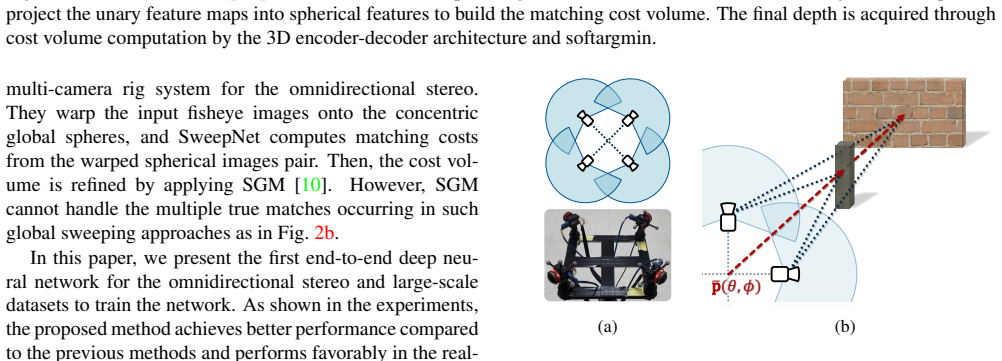
The central claim is that spherical sweeping, the omnidirectional analogue of plane sweeping, can be made fully differentiable and trained end-to-end for a wide-baseline multi-camera rig, and that the learned network resolves problems that defeat the previous generation of omnidirectional stereo. Earlier pipelines such as SweepNet compute a matching-cost volume from warped spherical images and then smooth it with semi-global matching; in a global sweep a single viewing ray can pass through several objects, producing multiple true matches that SGM cannot handle. OmniMVS instead warps deep feature maps from all cameras onto concentric spheres indexed by inverse depth, concatenates and fuses them into a 4D volume, and runs a 3D encoder-decoder that uses global context to regularize the cost before softargmin regression. On the five test datasets (Sunny, Cloudy, Sunset, OmniThings, and OmniHouse) the authors report the lowest mean absolute error among all compared methods, with OmniMVS-ft reaching MAE 0.79 on Sunny versus 1.31 for SweepNet+SGM. The paper's claim, in short, is that end-to-end learned spherical sweeping is not only feasible but strictly better than the multi-stage pipeline it replaces.
Load-bearing premise
The claim that the network works in real environments rests on the untested premise that training on synthetic rendered scenes transfers to real fisheye images; the paper shows qualitative point clouds but never measures real-world ground-truth depth.
Editorial extensions
If this is right
- An omnidirectional rig with four calibrated fisheye cameras can produce a full spherical depth map in about one second per frame on a single GPU, with no separate cost aggregation or stitching stage.
- Networks trained on random synthetic scenes (OmniThings) transfer to indoor, outdoor, and real-image settings, and fine-tuning on OmniHouse and Sunny further improves textureless and reflective surfaces.
- Conventional stereo networks applied by stitching four rectified pairs are a strictly weaker route to omnidirectional depth than a single network that reasons over all views at once.
- Ablating or replacing the 3D encoder-decoder should cause the multiple-true-match failures seen in SGM-based pipelines to reappear, confirming that global-context regularization is the source of the gain.
Reading between the lines
- The paper does not quantify the sim-to-real gap; collecting LiDAR or structured-light ground truth on the same rig and comparing OmniMVS-ft's error against those measurements would turn the qualitative real-world results into a testable metric.
- Because warping uses calibrated intrinsics and extrinsics, the same network design should transfer to other multi-camera layouts, different numbers of cameras, and non-omnidirectional wide-FOV rigs; the paper only demonstrates one four-camera layout.
- The inverse-depth parameterization concentrates depth samples near the rig, so downstream users who care about metric accuracy at long range would need to account for the non-uniform depth resolution rather than treating the error numbers as uniform in meters.
Signed reviews
Editorial analysis
A structured set of objections, weighed in public.
Referee Report
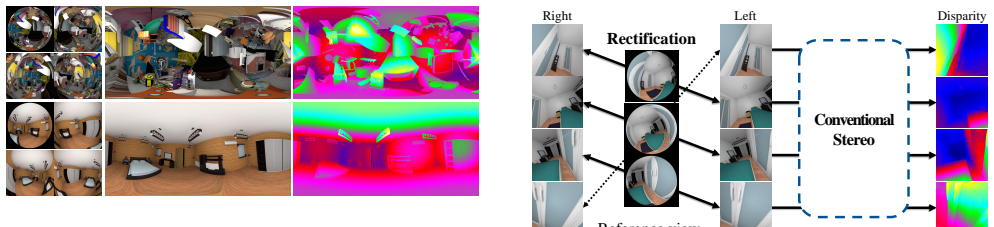
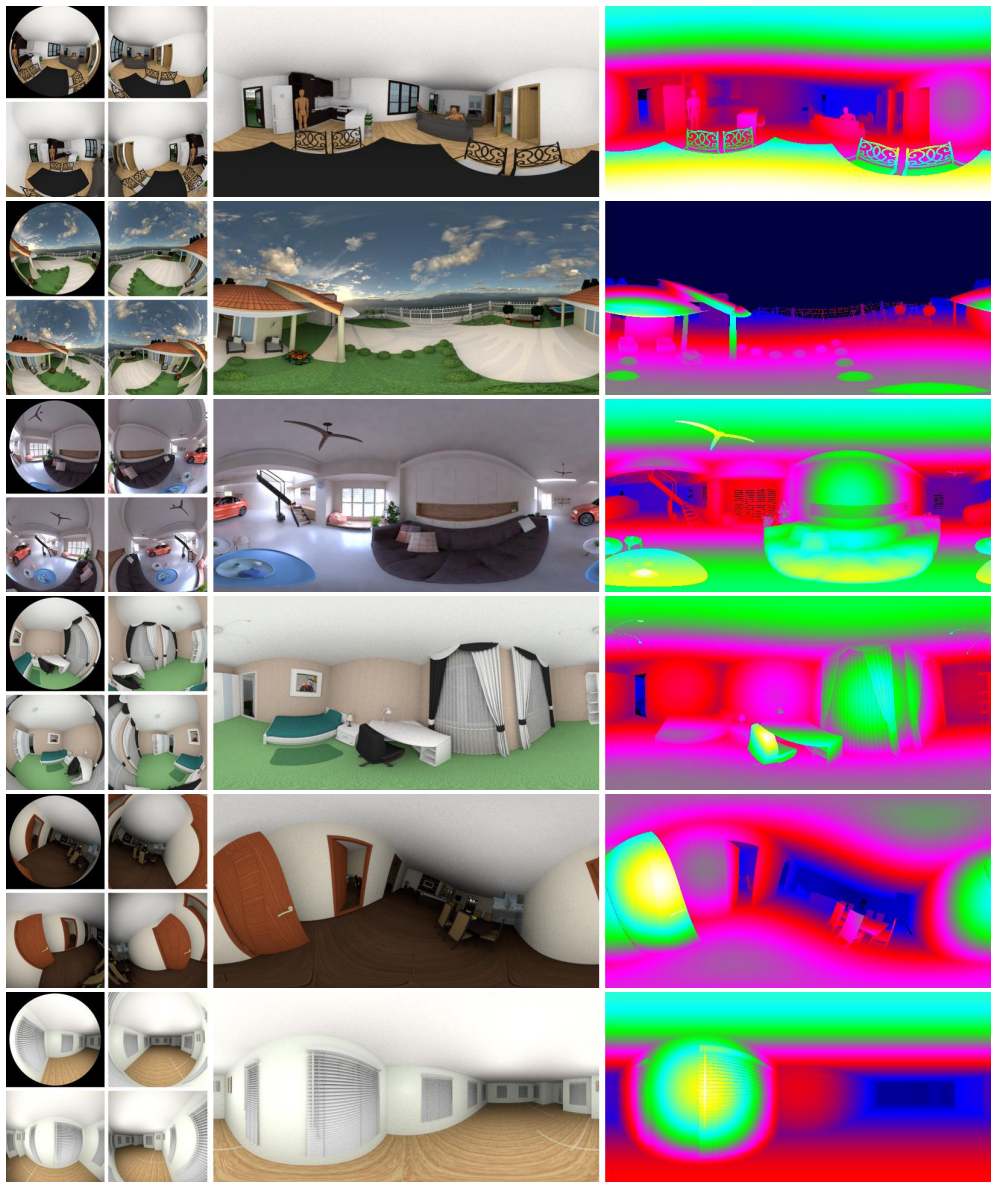
Summary. The paper proposes OmniMVS, an end-to-end CNN for omnidirectional depth estimation from four wide-FOV fisheye cameras on a rig. After extracting 2D unary features, the network warps the feature maps onto concentric spheres at sampled inverse depths using calibrated camera parameters, forms a concatenated 4D cost volume, regularizes it with a 3D encoder-decoder, and regresses inverse depth with softargmin. The authors also introduce two Blender-rendered synthetic datasets, OmniThings and OmniHouse, totaling roughly 12.8K depth maps and 51K fisheye images, and evaluate the method on these plus the existing Sunny/Cloudy/Sunset datasets against spherical-sweeping baselines and stitched conventional stereo methods. The paper claims state-of-the-art results on all synthetic test sets and demonstrates real-world reconstructions qualitatively.
Significance. If the real-world claims are substantiated, this is a useful contribution: it is one of the first end-to-end learned systems for omnidirectional multi-view stereo, it introduces a large publicly described synthetic benchmark, and the architecture is described in sufficient detail to be credible. The synthetic comparison in Table 3 is internally consistent, uses held-out test frames, and includes several baselines, which are real strengths. The significance is currently tempered by the absence of any quantitative real-world evaluation and by the fact that all tabulated metrics are computed on a cropped equatorial band rather than the full sphere.
major comments (3)
- [5.3, Abstract, Conclusion] The real-world claim is supported only by qualitative point clouds and inverse-depth visualizations. There is no ground-truth depth, LiDAR reference, SfM point cloud, or any metric for the real fisheye sequences, while the abstract states that the method 'generates excellent results in both synthetic and real-world environments' and the conclusion says it 'successfully reconstructs accurate omnidirectional depth.' Because the network is trained only on Blender-rendered data, the synthetic-to-real transfer is load-bearing. Please add a quantitative real-world evaluation (for example, comparison with LiDAR or a structure-from-motion reference) or explicitly restrict the real-world claims to qualitative demonstrations.
- [5.1, Eq. (3), Table 3] All quantitative metrics are computed on a crop with H = 160, i.e., phi in [-pi/4, pi/4], excluding the top and bottom 45 degrees, while the paper repeatedly claims omnidirectional depth estimation. The reported 'best on all five datasets' results therefore hold only for this equatorial band. In addition, the depth sampling parameters d0, dN-1, and the actual depth range are never stated, and the text says the inverse radius d_n is swept from 0 to d_max, which makes Eq. (1) undefined at d_n = 0. Please specify the full evaluation protocol, including the depth range and the handling of d_n, and discuss or evaluate the pole regions if the omnidirectional claim is retained.
- [Table 3, Table 4, Sec. 5.1] The headline OmniMVS-ft results are obtained after fine-tuning on 'Sunny and OmniHouse' and then evaluated on Sunny and OmniHouse test frames. Even if the test frames themselves are held out, the paper does not state the exact fine-tuning split, and for OmniHouse the training and test frames are rendered from the same 451 house models, so the fine-tuned numbers may reflect scene-level familiarity rather than generalization. Please report the precise train/test split used for fine-tuning, present the OmniMVS-only results as the primary cross-dataset numbers, and show that fine-tuning does not rely on test-scene geometry.
minor comments (5)
- [Abstract, Table 2] The abstract says the datasets consist of 11K ground-truth depth maps and 45K fisheye images, but Table 2 sums to 12,800 scenes and 51,200 fisheye images if test frames are included. Please clarify whether the abstract refers to training frames only.
- [Sec. 5.2] The sentence 'our end-to-end networks perform better in all datasets and metrics' is not true for OmniMVS-ft on OmniThings, where the MAE is 3.52 compared with 2.40 for OmniMVS. Please qualify the statement or discuss the fine-tuning trade-off.
- [Sec. 5.3 and Fig. 7] The claim that textureless walls are straight and small objects are reconstructed accurately is based on visual inspection. If quantitative evaluation is not added, please soften the wording from 'accurate' to 'qualitatively plausible.'
- [Typographical] There are several typos: 'exsiting' near Table 2, 'OmniThngs' in Sec. 5.2, 'tranined' in the supplementary caption of Fig. 1, and 'texureless' in the caption of Fig. 7.
- [Eq. (3)] The MAE and RMS values are percentages of the inverse-depth index range, not metric depth errors. Please state this explicitly in the main text so that readers do not interpret the numbers as meters.
Circularity Check
No circularity: the reported gains are grounded in held-out synthetic test statistics, and the fine-tuning and self-citations are standard benchmark practice rather than derivation-level circularity.
full rationale
The paper's central claim is that the proposed end-to-end network outperforms prior omnidirectional stereo pipelines on held-out test sets (Sec. 5.2, Table 3). These results come from evaluating networks on test frames that are disjoint from the training frames, and the comparison methods are run with their published weights or with the same fine-tuning protocol. The '-ft' results are explicitly labeled as fine-tuned on Sunny and OmniHouse (Table 4), and the test frames in those datasets are separate from the fine-tuning frames, so this is standard benchmark practice rather than a fitted input being renamed as a prediction. The heavy citation of the authors' own SweepNet work [30] supplies the baseline method, the Sunny/Cloudy/Sunset datasets, and the spherical-sweeping coordinate convention, but none of these citations is used to derive the proposed method's outputs or to forbid alternative designs; the comparison is external evidence, not a load-bearing assumption. The real-world evaluation (Sec. 5.3) is qualitative and lacks ground-truth depth, which is a limitation in evidence strength for sim-to-real transfer, but that is a correctness or validation concern, not a circularity concern under the stated rules. No equation defines the predicted depth index in terms of the training loss or the test metric, and no self-citation supplies a conclusion that is then used as its own input. Therefore no circular step can be exhibited, and the paper is self-contained in the sense required for a non-circularity verdict.
Assumptions & free parameters
free parameters (3)
- Number of depth spheres N =
192
- Depth range (dmax) =
not disclosed
- Evaluation latitude crop =
H=160 (phi from -pi/4 to pi/4)
assumptions (4)
- domain assumption Camera intrinsics and extrinsics are accurately calibrated, and the lookup-table warping with bilinear interpolation is a faithful differentiable model of the fisheye projection.
- domain assumption Synthetic Blender-rendered training data (ShapeNet objects and SUNCG rooms) transfers to real fisheye images.
- domain assumption Each ray has a single true depth that the network can learn despite multi-camera occlusion and multiple true matches.
- ad hoc to paper The pole regions of the sphere are highly distorted and less useful and can be excluded from the omnidirectional output.
Cite this review
Pith. "Pith review of OmniMVS: End-to-End Learning for Omnidirectional Stereo Matching." pith.science (2026). https://pith.science/paper/XHK2BI6P
@misc{pith2026190806257,
  author       = {Pith},
  title        = {Pith review of: OmniMVS: End-to-End Learning for Omnidirectional Stereo Matching},
  year         = {2026},
  howpublished = {\url{https://pith.science/paper/XHK2BI6P}},
  note         = {Machine review of arXiv:1908.06257}
}
read the original abstract
In this paper, we propose a novel end-to-end deep neural network model for omnidirectional depth estimation from a wide-baseline multi-view stereo setup. The images captured with ultra wide field-of-view (FOV) cameras on an omnidirectional rig are processed by the feature extraction module, and then the deep feature maps are warped onto the concentric spheres swept through all candidate depths using the calibrated camera parameters. The 3D encoder-decoder block takes the aligned feature volume to produce the omnidirectional depth estimate with regularization on uncertain regions utilizing the global context information. In addition, we present large-scale synthetic datasets for training and testing omnidirectional multi-view stereo algorithms. Our datasets consist of 11K ground-truth depth maps and 45K fisheye images in four orthogonal directions with various objects and environments. Experimental results show that the proposed method generates excellent results in both synthetic and real-world environments, and it outperforms the prior art and the omnidirectional versions of the state-of-the-art conventional stereo algorithms.
Figures

Figures from the paper (6 more)


Reference graph
Works this paper leans on
-
[1]
write newline
" write newline "" before.all 'output.state := FUNCTION fin.entry add.period write newline FUNCTION new.block output.state before.all = 'skip after.block 'output.state := if FUNCTION new.sentence output.state after.block = 'skip output.state before.all = 'skip after.sentence 'output.state := if if FUNCTION not #0 #1 if FUNCTION and 'skip pop #0 if FUNCTIO...
-
[2]
write newline
" write newline "" before.all 'output.state := FUNCTION fin.entry add.period write newline FUNCTION new.block output.state before.all = 'skip after.block 'output.state := if FUNCTION new.sentence output.state after.block = 'skip output.state before.all = 'skip after.sentence 'output.state := if if FUNCTION not #0 #1 if FUNCTION and 'skip pop #0 if FUNCTIO...
-
[3]
Sameer Agarwal, Keir Mierle, and Others. Ceres solver. http://ceres-solver.org
-
[4]
Fast approximate energy minimization via graph cuts
Yuri Boykov, Olga Veksler, and Ramin Zabih. Fast approximate energy minimization via graph cuts. IEEE Transactions on Pattern Analysis and Machine Intelligence , 23(11):1, 2001
work page 2001
-
[5]
Shapenet: An information-rich 3d model repository
Angel X Chang, Thomas Funkhouser, Leonidas Guibas, Pat Hanrahan, Qixing Huang, Zimo Li, Silvio Savarese, Manolis Savva, Shuran Song, Hao Su, et al. Shapenet: An information-rich 3d model repository. arXiv preprint arXiv:1512.03012 , 2015
arXiv 2015
-
[6]
Pyramid stereo matching network
Jia-Ren Chang and Yong-Sheng Chen. Pyramid stereo matching network. In Proceedings of the IEEE Conference on Computer Vision and Pattern Recognition , pages 5410--5418, 2018
work page 2018
-
[7]
A deep visual correspondence embedding model for stereo matching costs
Zhuoyuan Chen, Xun Sun, Liang Wang, Yinan Yu, and Chang Huang. A deep visual correspondence embedding model for stereo matching costs. In Proceedings of the IEEE International Conference on Computer Vision , pages 972--980, 2015
work page 2015
-
[8]
Dual-fisheye omnidirectional stereo
Wenliang Gao and Shaojie Shen. Dual-fisheye omnidirectional stereo. In Intelligent Robots and Systems (IROS), 2017 IEEE/RSJ International Conference on , pages 6715--6722. IEEE, 2017
work page 2017
Show all 35 references
-
[9]
Are we ready for autonomous driving? the kitti vision benchmark suite
Andreas Geiger, Philip Lenz, and Raquel Urtasun. Are we ready for autonomous driving? the kitti vision benchmark suite. In Computer Vision and Pattern Recognition (CVPR), 2012 IEEE Conference on , pages 3354--3361. IEEE, 2012
2012
-
[10]
Displets: Resolving stereo ambiguities using object knowledge
Fatma Guney and Andreas Geiger. Displets: Resolving stereo ambiguities using object knowledge. In Proceedings of the IEEE Conference on Computer Vision and Pattern Recognition , pages 4165--4175, 2015
2015
-
[11]
Deep residual learning for image recognition
Kaiming He, Xiangyu Zhang, Shaoqing Ren, and Jian Sun. Deep residual learning for image recognition. In Proceedings of the IEEE conference on computer vision and pattern recognition , pages 770--778, 2016
2016
-
[12]
Stereo processing by semiglobal matching and mutual information
Heiko Hirschmuller. Stereo processing by semiglobal matching and mutual information. IEEE Transactions on pattern analysis and machine intelligence , 30(2):328--341, 2008
2008
-
[13]
Evaluation of cost functions for stereo matching
Heiko Hirschmuller and Daniel Scharstein. Evaluation of cost functions for stereo matching. In 2007 IEEE Conference on Computer Vision and Pattern Recognition , pages 1--8. IEEE, 2007
2007
-
[14]
Occlusions, motion and depth boundaries with a generic network for disparity, optical flow or scene flow estimation
Eddy Ilg, Tonmoy Saikia, Margret Keuper, and Thomas Brox. Occlusions, motion and depth boundaries with a generic network for disparity, optical flow or scene flow estimation. In Proceedings of the European Conference on Computer Vision (ECCV) , pages 614--630, 2018
2018
-
[15]
All-around depth from small motion with a spherical panoramic camera
Sunghoon Im, Hyowon Ha, Fran c ois Rameau, Hae-Gon Jeon, Gyeongmin Choe, and In So Kweon. All-around depth from small motion with a spherical panoramic camera. In European Conference on Computer Vision , pages 156--172. Springer, 2016
2016
-
[16]
End-to-end learning of geometry and context for deep stereo regression
Alex Kendall, Hayk Martirosyan, Saumitro Dasgupta, Peter Henry, Ryan Kennedy, Abraham Bachrach, and Adam Bry. End-to-end learning of geometry and context for deep stereo regression. In Proceedings of the IEEE International Conference on Computer Vision , pages 66--75, 2017
2017
-
[17]
Efficient deep learning for stereo matching
Wenjie Luo, Alexander G Schwing, and Raquel Urtasun. Efficient deep learning for stereo matching. In Proceedings of the IEEE Conference on Computer Vision and Pattern Recognition , pages 5695--5703, 2016
2016
-
[18]
A large dataset to train convolutional networks for disparity, optical flow, and scene flow estimation
Nikolaus Mayer, Eddy Ilg, Philip Hausser, Philipp Fischer, Daniel Cremers, Alexey Dosovitskiy, and Thomas Brox. A large dataset to train convolutional networks for disparity, optical flow, and scene flow estimation. In Proceedings of the IEEE Conference on Computer Vision and ...
2016
-
[19]
Object scene flow for autonomous vehicles
Moritz Menze and Andreas Geiger. Object scene flow for autonomous vehicles. In Proceedings of the IEEE Conference on Computer Vision and Pattern Recognition , pages 3061--3070, 2015
2015
-
[20]
Cascade residual learning: A two-stage convolutional neural network for stereo matching
Jiahao Pang, Wenxiu Sun, Jimmy SJ Ren, Chengxi Yang, and Qiong Yan. Cascade residual learning: A two-stage convolutional neural network for stereo matching. In Proceedings of the IEEE International Conference on Computer Vision , pages 887--895, 2017
2017
-
[21]
Eliminating the blind spot: Adapting 3d object detection and monocular depth estimation to 360° panoramic imagery
Greire Payen de La Garanderie, Amir Atapour Abarghouei, and Toby P Breckon. Eliminating the blind spot: Adapting 3d object detection and monocular depth estimation to 360° panoramic imagery. In Proceedings of the European Conference on Computer Vision (ECCV) , pages 789--807, 2018
2018
-
[22]
Playing for benchmarks
Stephan R Richter, Zeeshan Hayder, and Vladlen Koltun. Playing for benchmarks. In Proceedings of the IEEE International Conference on Computer Vision , pages 2213--2222, 2017
2017
-
[23]
The synthia dataset: A large collection of synthetic images for semantic segmentation of urban scenes
German Ros, Laura Sellart, Joanna Materzynska, David Vazquez, and Antonio M Lopez. The synthia dataset: A large collection of synthetic images for semantic segmentation of urban scenes. In Proceedings of the IEEE conference on computer vision and pattern recognition , pages 32...
2016
-
[24]
A flexible technique for accurate omnidirectional camera calibration and structure from motion
Davide Scaramuzza, Agostino Martinelli, and Roland Siegwart. A flexible technique for accurate omnidirectional camera calibration and structure from motion. In Computer Vision Systems, 2006 ICVS'06. IEEE International Conference on , pages 45--45. IEEE, 2006
2006
-
[25]
High-resolution stereo datasets with subpixel-accurate ground truth
Daniel Scharstein, Heiko Hirschm \"u ller, York Kitajima, Greg Krathwohl, Nera Ne s i \'c , Xi Wang, and Porter Westling. High-resolution stereo datasets with subpixel-accurate ground truth. In German conference on pattern recognition , pages 31--42. Springer, 2014
2014
-
[26]
High-accuracy stereo depth maps using structured light
Daniel Scharstein and Richard Szeliski. High-accuracy stereo depth maps using structured light. In 2003 IEEE Computer Society Conference on Computer Vision and Pattern Recognition, 2003. Proceedings. , volume 1, pages I--I. IEEE, 2003
2003
-
[27]
Omnidirectional 3d reconstruction in augmented manhattan worlds
Miriam Sch \"o nbein and Andreas Geiger. Omnidirectional 3d reconstruction in augmented manhattan worlds. In Intelligent Robots and Systems (IROS 2014), 2014 IEEE/RSJ International Conference on , pages 716--723. IEEE, 2014
2014
-
[28]
Sgm-nets: Semi-global matching with neural networks
Akihito Seki and Marc Pollefeys. Sgm-nets: Semi-global matching with neural networks. In Proceedings of the IEEE Conference on Computer Vision and Pattern Recognition , pages 231--240, 2017
2017
-
[29]
Semantic scene completion from a single depth image
Shuran Song, Fisher Yu, Andy Zeng, Angel X Chang, Manolis Savva, and Thomas Funkhouser. Semantic scene completion from a single depth image. IEEE Conference on Computer Vision and Pattern Recognition , 2017
2017
-
[30]
Improved wide-angle, fisheye and omnidirectional camera calibration
Steffen Urban, Jens Leitloff, and Stefan Hinz. Improved wide-angle, fisheye and omnidirectional camera calibration. ISPRS Journal of Photogrammetry and Remote Sensing , 108:72--79, 2015
2015
-
[31]
Stereo calibration and rectification for omnidirectional multi-camera systems
Yanchang Wang, Xiaojin Gong, Ying Lin, and Jilin Liu. Stereo calibration and rectification for omnidirectional multi-camera systems. International Journal of Advanced Robotic Systems , 9(4):143, 2012
2012
-
[32]
Sweepnet: Wide-baseline omnidirectional depth estimation
Changhee Won, Jongbin Ryu, and Jongwoo Lim. Sweepnet: Wide-baseline omnidirectional depth estimation. arXiv preprint arXiv:1902.10904 , 2019
1902 arXiv
-
[33]
Learning to compare image patches via convolutional neural networks
Sergey Zagoruyko and Nikos Komodakis. Learning to compare image patches via convolutional neural networks. In Proceedings of the IEEE conference on computer vision and pattern recognition , pages 4353--4361, 2015
2015
-
[34]
Stereo matching by training a convolutional neural network to compare image patches
Jure Zbontar and Yann LeCun. Stereo matching by training a convolutional neural network to compare image patches. Journal of Machine Learning Research , 17(1-32):2, 2016
2016
-
[35]
Omnidepth: Dense depth estimation for indoors spherical panoramas
Nikolaos Zioulis, Antonis Karakottas, Dimitrios Zarpalas, and Petros Daras. Omnidepth: Dense depth estimation for indoors spherical panoramas. In Proceedings of the European Conference on Computer Vision (ECCV) , pages 448--465, 2018
2018
Reviewed August 14, 2026 · model on record in the stance chip above.
Discussion (0). Continue with ORCID to comment.