REVIEW 1 major objections 5 minor 1 cited by
Impact of planetary mass uncertainties on exoplanet atmospheric retrievals
T0 review · 1 major / 5 minor · reviewed 2026-08-14 · deepseek-v4-flash
Pith's one-line read The paper argues that planetary mass can be retrieved directly from transit spectra for clear, gaseous atmospheres, with better-than-10 percent precision, and that mass uncertainties leave retrieved temperatures and trace-gas abundances…
desk verdict A systematic, honestly-scoped retrieval simulation mapping when planetary mass uncertainties matter for transit spectra; the isothermal caveat is real but acknowledged, and the paper deserves a serious referee. read the letter →
The pith
A machine-rendered reading of the paper's core claim, the machinery that carries it, and where it could break.
The reading
What carries the argument
The load-bearing object is the analytic transit-depth expression: the wavelength-dependent transit contribution is an integral over altitude of $1 - \exp[-\tau(z,\lambda)]$, with the optical depth $\tau$ built from number densities, molecular cross sections, and the scale height $H = k_B T (R_0+z)^2 / (\mu M_p G)$. Because the planetary mass appears only inside this scale height, every parameter that shares $H$ — temperature, mean molecular weight, radius — is a potential partner in degeneracy, and the paper exploits the wavelength dependence of molecular cross sections to separate them. The numerical companion is a fully Bayesian retrieval model run in paired mode, mass fixed versus mass free, on synthetic spectra at future-space-observatory quality and on real short-wavelength transit spectra. Clouds are modeled as completely opaque grey decks, chosen as the worst-case scenario for degeneracy with the radius.
What would settle it
Generate a high-signal-to-noise transit spectrum from a realistic non-isothermal temperature–pressure profile with a known mass and run the same retrieval with mass free: if the retrieved mass is biased by more than the claimed roughly 10 percent despite adequate wavelength coverage, the central claim would fail. A shorter test is to compare masses retrieved from transit spectra against independent radial-velocity masses for a sample of clear-sky gaseous exoplanets at future-observatory quality; systematic offsets would falsify the paper's conclusion.
Extended reading notes
Core claim
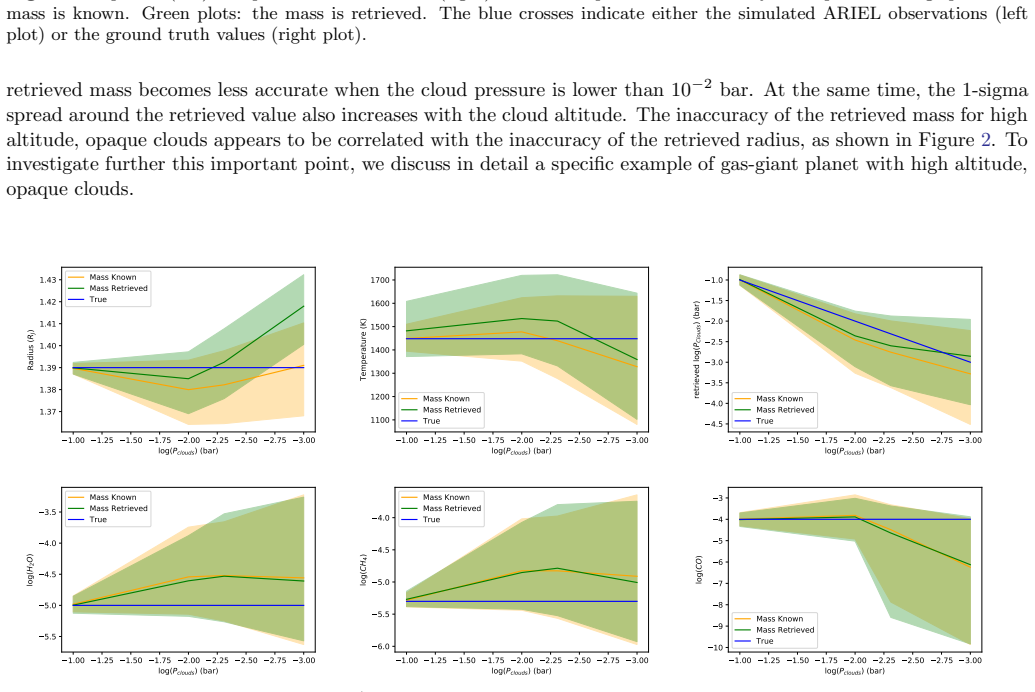
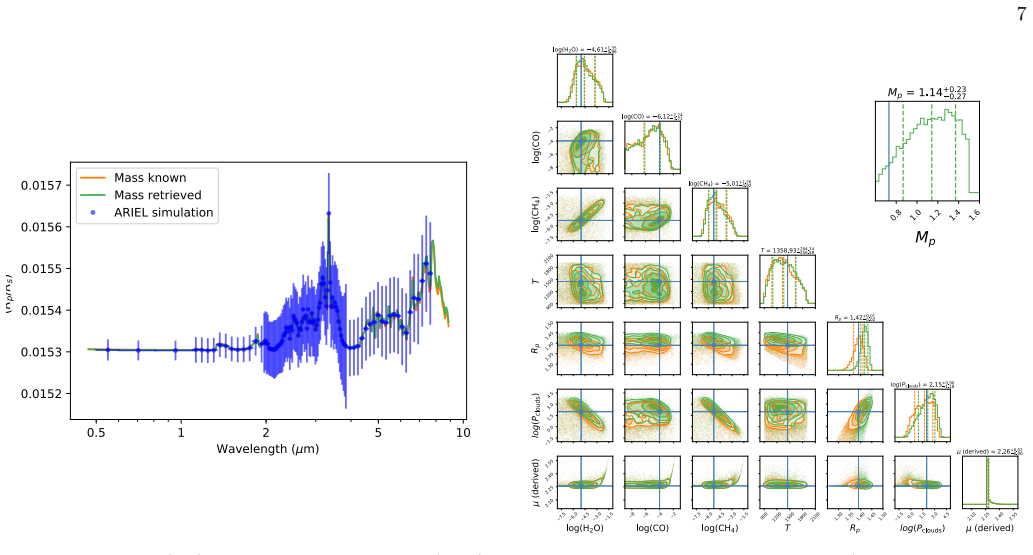
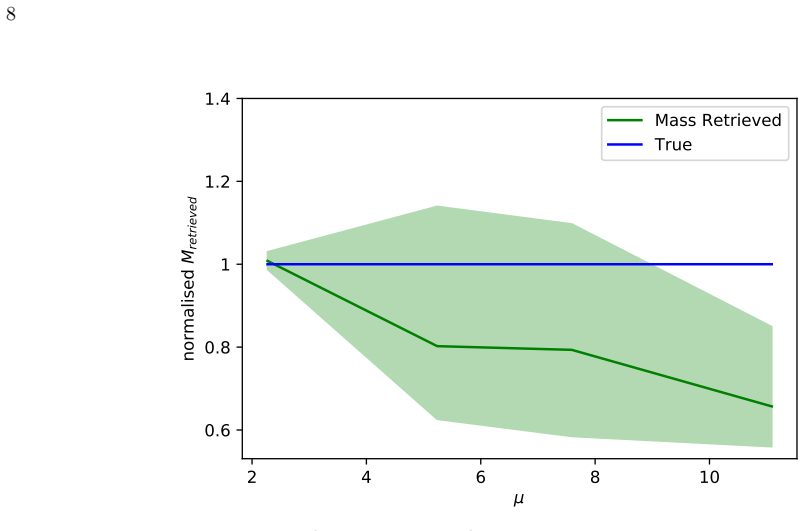
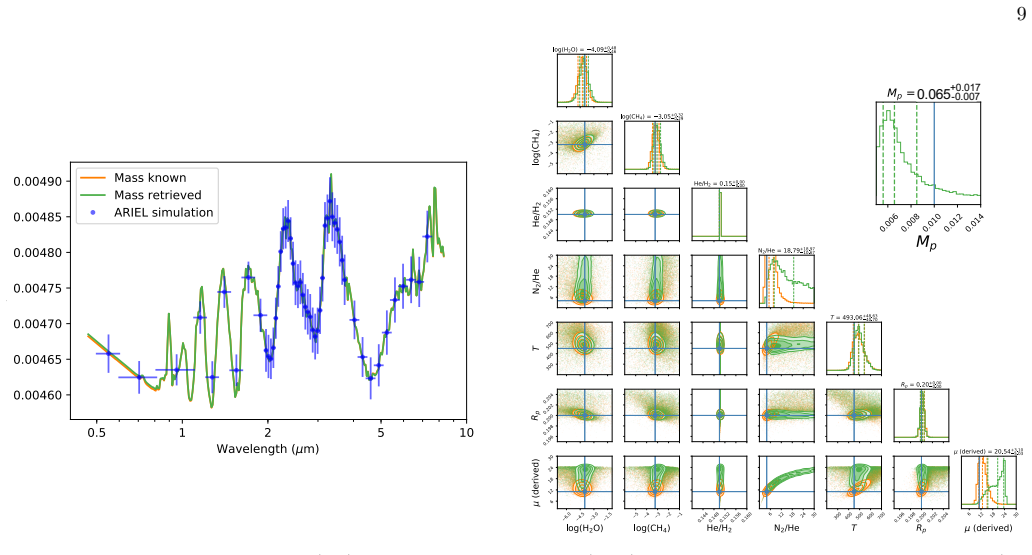
On the paper's own terms, the planetary mass is not an obstacle to transit-spectrum retrievals in the regimes where it has traditionally been assumed necessary to fix it externally. For clear-sky gaseous atmospheres, treating mass as a free parameter yields essentially the same posterior distributions as fixing it, with retrieved mass accurate to better than 10 percent given adequate wavelength coverage and signal-to-noise. For high-altitude opaque clouds, mass accuracy degrades, up to roughly 60 percent offset in the worst simulated case, and the bias correlates with a biased retrieved radius; yet temperature and trace-gas abundances remain unaffected by whether the mass is known. For secondary atmospheres with heavy main constituents, the mass is degenerate with the mean molecular weight, and adding clouds makes the mean molecular weight poorly constrained, so independent mass knowledge becomes important for identifying the main atmospheric constituent.
Load-bearing premise
The simulations assume a single isothermal, hydrostatic atmosphere, so the scale height is one global number; in a real atmosphere with strong vertical temperature gradients, the trade-off between mass and temperature could behave differently than shown.
Editorial extensions
If this is right
- For clear-sky gaseous planets observed with broad wavelength coverage and adequate signal-to-noise, transit spectra alone can deliver the planetary mass to better than 10 percent precision, removing the need for an external mass prior in those retrievals.
- Atmospheric composition and temperature retrievals are robust to mass ignorance across most tested scenarios, including cloudy hot Jupiters, so missions focused on chemistry need not wait for refined mass measurements.
- For planets with heavy secondary atmospheres, an independent mass measurement breaks the mass–mean-molecular-weight degeneracy and is needed to identify the main atmospheric constituent.
- High-altitude opaque clouds can bias the retrieved mass by up to roughly 60 percent even though the spectral changes correspond to less than 3 percent in radius; longer observations or higher signal-to-noise mitigate the degeneracy.
- In survey planning, radial-velocity follow-up should prioritize low-gravity and super-Earth targets, where current mass errors often exceed 50 percent, over hot Jupiters where the mass can be retrieved from the spectrum itself.
Reading between the lines
- Editorial inference: the isothermal assumption is the main boundary of the result; if real atmospheres have strong vertical temperature gradients, the mass–temperature degeneracy could either shrink or widen depending on how cross-section temperature dependence varies with altitude.
- Editorial inference: the fully opaque grey-cloud model is the pessimistic end of the cloud spectrum; realistic clouds with spectral windows would recover some deep-atmosphere information, so mass retrieval in cloudy planets is likely to perform better than the worst cases shown.
- Editorial inference: the same scale-height argument implies that combining transit spectra with independent radius or surface-gravity constraints, for example from asteroseismology or direct imaging, can substitute for mass priors and should be tested as a cheap way to break the mass–mean-molecular-weight degeneracy.
- Editorial inference: since temperature and mass enter the scale height symmetrically, joint retrievals of mass and temperature from emission or phase-curve spectra, where the degeneracy structure differs, are a natural testable extension that the paper does not cover.
Signed reviews
Editorial analysis
A structured set of objections, weighed in public.
Referee Report
Summary. This paper investigates whether exoplanet transit spectra can directly constrain the planetary mass and how mass uncertainties propagate to other retrieved atmospheric parameters. The authors first present an analytic expansion of the wavelength-dependent transit depth under standard assumptions (isothermal, hydrostatic, clear-sky or grey cloudy atmospheres), showing that the mass enters only through the scale height. They then use the TauREx Bayesian retrieval framework on simulated ARIEL-class observations for two classes of planets: hot Jupiters with H2/He-dominated atmospheres and super-Earths with N2-rich secondary atmospheres. For clear-sky gaseous atmospheres, they report that retrieving the mass as a free parameter yields the same posterior distributions for other parameters as fixing it, with a mass precision of about 7% and a relative accuracy better than 10%. For cloudy hot Jupiters, the mass and radius become degenerate for high-altitude opaque clouds, with mass errors up to 60%. For secondary atmospheres, the mass is degenerate with the mean molecular weight; an independent mass prior helps break this degeneracy, especially when clouds are present. The analysis is supported by an appendix with a step-by-step derivation of the optical-depth expression.
Significance. If the results hold, this is a useful and timely parameter study for JWST and ARIEL planning: it provides a systematic map of when the planetary mass can be fitted from transit spectra alone and, more importantly, identifies which retrieved parameters are robust to mass ignorance. The analytical derivation in Section 2 and the Appendix is self-contained and follows the standard transit formalism, and the retrieval experiments are internally consistent and use an open-source, widely used code. The strongest practical conclusion—that independent mass characterization is most valuable for cloudy secondary atmospheres because of the mass–mean-molecular-weight degeneracy—is physically well motivated and supported by the simulations. The paper is honest about the main modelling limitation (isothermal atmospheres) and explicitly defers non-isothermal profiles and eclipse spectra to future work.
major comments (1)
- [Abstract and Section 3.1] The clear-sky mass-precision result (<10%) is obtained from simulations in which both the forward model and the retrieval assume an isothermal, hydrostatic atmosphere. As the authors note in Section 2.2, temperature and mass play symmetric roles in the scale height (Eq. 6), so the only handle separating them is the temperature dependence of molecular cross sections. In a real atmosphere with a vertical temperature gradient, an isothermal retrieval will fit some effective temperature, and the effective-temperature/mass correlation may differ from the simulated one, potentially biasing the retrieved mass and undermining the claim that temperature and trace-gas posteriors are unaffected by mass ignorance. The paper acknowledges this limitation in the methodology and appendix, but the abstract and the concluding 'clear-sky, gaseous atmospheres' statement do not carry the isothermal caveat. I recommend either adding an explicit qualification to the abstract and Section 4, or including a non-isothermal forward-model test (even a simple two-temperature profile) to show that the degeneracy behaves as simulated.
minor comments (5)
- [Abstract and Section 4] The phrase 'precision of more than 10%' is ambiguous: the text later reports a 7% uncertainty, which is a precision better than 10%. Please rephrase to 'better than 10%' or 'about 7%' for clarity.
- [Section 2.1, Eq. (5)] The coefficients K^T_ij, K^p_ij, and K^X_ij are used in Eq. (5) before they are defined in the Appendix (Eqs. 23–25). Consider defining them briefly in Section 2.1 or adding a forward reference to avoid forcing the reader to jump to the appendix.
- [Figure 3] In the version provided, the vertical-axis label of Figure 3 appears garbled ('1.8 1 1.2 1.4 1.6 1.8'). Please check that the axis is properly labeled as 'normalised M_retrieved' with legible tick labels.
- [Table 1] The row labeled 'HJ HST' should specify that the 170% mass error corresponds to the HST WFC3 retrieval with limited wavelength coverage and S/N, so that readers do not interpret it as a general statement about HST data.
- [Section 2.2] The bullet point beginning 'The temperature has a similar role...' uses 'e.g:' without a space; this is a minor typographical issue but should be corrected in the final version.
Circularity Check
No significant circularity: analytic and retrieval analyses are internally consistent under explicitly stated isothermal assumptions.
full rationale
The paper's derivation chain is self-contained and does not reduce to its inputs. Section 2 derives an analytic expression for the transit depth starting from the standard equation Catm(lambda) = 2*pi*integral(...) (Eq. 1) and computes the optical depth with an explicit isothermal, hydrostatic scale height H = kb*T*(R0+z)^2/(mu*Mp*G) (Eq. 6). The mass enters only through H, and the analytic discussion in Section 2.2 identifies the expected degeneracies (mass with temperature via scale height, mass with mean molecular weight in secondary atmospheres, mass with radius/clouds for opaque clouds). Section 3 then uses TauREx to generate synthetic spectra with known input parameters and performs retrievals with the mass free or fixed. The agreement between the analytic identifiability argument and the retrieval posteriors is a consistency check, not circularity: the retrieval code solves the same physical forward problem, but the analytic derivation does not assume the retrieval outcome, and the retrieval results are not forced to match the analytic predictions by construction. The central claim of <10% mass precision for clear-sky primary atmospheres is a simulation result under the paper's explicitly stated assumptions, and the paper acknowledges the isothermal limitation, deferring T-P gradient cases to future work. Self-citations of TauREx are appropriate because the code is used as a tool, and the paper also compares against HST data and external results (de Wit & Seager 2013, Batalha et al. 2017). No fitted parameter is renamed as a prediction, no uniqueness theorem is imported from the authors, and no ansatz is smuggled in via citation. The only mild caveat is that the analytic and numerical components share the same isothermal forward model, so their agreement is internal rather than an independent validation of the model against real atmospheres; this is a limitation on external validity, not circularity.
Assumptions & free parameters
free parameters (3)
- Cloud top pressure (Pclouds) =
10^-1, 10^-2, 5x10^-2, 10^-3 bar (case study)
- Mean molecular weight (mu) =
2.3, 5.2, 7.6, 11.1, 27.8
- Signal-to-noise ratio =
Single transit ARIEL noise model; S/N scan 3 to 10 in Fig. 9
assumptions (4)
- domain assumption Atmosphere is isothermal and in hydrostatic equilibrium
- domain assumption Gray, completely opaque cloud deck parameterized by cloud-top pressure
- domain assumption Cross sections are interpolated linearly in temperature and pressure
- domain assumption ARIEL instrument noise model from Mugnai et al. (2020) approximates future observations
Cite this review
Pith. "Pith review of Impact of planetary mass uncertainties on exoplanet atmospheric retrievals." pith.science (2026). https://pith.science/paper/KSJKUYAQ
@misc{pith2026190806305,
  author       = {Pith},
  title        = {Pith review of: Impact of planetary mass uncertainties on exoplanet atmospheric retrievals},
  year         = {2026},
  howpublished = {\url{https://pith.science/paper/KSJKUYAQ}},
  note         = {Machine review of arXiv:1908.06305}
}
read the original abstract
In current models used to interpret exoplanet atmospheric observations, the planet mass is treated as a prior and is estimated independently with external methods, such as RV or TTV techniques. This approach is necessary as available spectroscopic data do not have sufficient wavelength coverage and/or SNR to infer the planetary mass. We examine here the impact of mass uncertainties on spectral retrieval analyses for a host of atmospheric scenarios. Our approach is both analytical and numerical: we first use simple approximations to extract analytically the influence of each parameter to the wavelength-dependent transit depth. We then adopt a fully Bayesian retrieval model to quantify the propagation of the mass uncertainty onto other atmospheric parameters. We found that for clear-sky, gaseous atmospheres the posterior distributions are the same when the mass is known or retrieved. The retrieved mass is very accurate, with a precision of more than 10%, provided the wavelength coverage and S/N are adequate. When opaque clouds are included in the simulations, the uncertainties in the retrieved mass increase, especially for high altitude clouds. However atmospheric parameters such as the temperature and trace-gas abundances are unaffected by the knowledge of the mass. Secondary atmospheres are more challenging due to the higher degree of freedom for the atmospheric main component, which is unknown. For broad wavelength range and adequate SNR, the mass can still be retrieved accurately and precisely if clouds are not present, and so are all the other atmospheric/planetary parameters. When clouds are added, we find that the mass uncertainties may impact substantially the retrieval of the mean molecular weight: an independent characterisation of the mass would therefore be helpful to capture/confirm the main atmospheric constituent.
Figures


Figures from the paper (9 more)



Forward citations
Cited by 1 Pith paper
-
Revisiting TOI-4438 and TOI-442 planetary systems with new observations from SPIRou and TESS
Refined masses and radii for TOI-4438 b and TOI-442 b, stellar rotation periods from magnetic variability, and a single-transit planet candidate around TOI-4438.
Reference graph
Works this paper leans on
-
[1]
, " * write output.state after.block = add.period write newline
ENTRY address archivePrefix author booktitle chapter doi edition editor eprint howpublished institution journal key month note number organization pages publisher school series title misctitle type volume year version url label extra.label sort.label short.list INTEGERS output.state before.all mid.sentence after.sentence after.block FUNCTION init.state.co...
-
[2]
write newline
" write newline "" before.all 'output.state := FUNCTION format.doi doi empty "" "doi:" doi * if FUNCTION format.url url empty "" new.block "" url * "" * if FUNCTION format.eprint eprint empty "" archivePrefix empty "" archivePrefix ":" * if eprint field.or.null * if FUNCTION format.pid eprint empty format.doi format.eprint if FUNCTION n.dashify 't := "" t...
-
[3]
uc5N"v0Q g q&M] 9yV*9>^Ƅtc i_ > ?\
thebibliography [1] 20pt to REFERENCES 6pt =0pt 10pt plus 3pt =0pt =0pt =1pt plus 1pt =0pt =0pt -12pt =13pt plus 1pt =20pt =13pt plus 1pt \@M =10000 =-1.0em =0pt =0pt 0pt =0pt =1.0em @enumiv\@empty 10000 10000 `\.\@m \@noitemerr \@latex@warning Empty `thebibliography' environment \@ifnextchar \@reference \@latexerr Missing key on reference command Each re...
2017
-
[4]
11em plus .33em minus .07em @technote 4000 4000 100 4000 4000 500 `\.=1000 = #1 #1 #1 0pt [0pt][0pt] #1 * \| ** #1 \@IEEEauthorblockNstyle \@IEEEauthorblockAstyle \@IEEEauthordefaulttextstyle \@IEEEauthorblockconfadjspace -0.25em \@IEEEauthorblockNtopspace 0.0ex \@IEEEauthorblockAtopspace 0.0ex \@IEEEauthorblockNinterlinespace 2.6ex \@IEEEauthorblockAinte...
-
[5]
Al-Refaie, A. F., Changeat, Q., Waldmann, I. P., & Tinetti, G. 2019, TauREx III: A fast, dynamic and extendable framework for retrievals, , , arXiv:1912.07759
arXiv 2019
-
[6]
K., Aigrain , S., Irwin , P
Barstow , J. K., Aigrain , S., Irwin , P. G. J., & Sing , D. K. 2017, , 834, 50
2017
-
[7]
Barton , E. J., Hill , C., Yurchenko , S. N., et al. 2017, , 187, 453
work page 2017
- [8]
Show all 51 references
-
[9]
L., Stevenson , K
Bean , J. L., Stevenson , K. B., Batalha , N. M., et al. 2018, Publications of the Astronomical Society of the Pacific, 130, 114402
2018
-
[10]
2015, Strict Upper Limits on the Carbon-to-Oxygen Ratios of Eight Hot Jupiters from Self-Consistent Atmospheric Retrieval, , , arXiv:1504.07655
Benneke, B. 2015, Strict Upper Limits on the Carbon-to-Oxygen Ratios of Eight Hot Jupiters from Self-Consistent Atmospheric Retrieval, , , arXiv:1504.07655
2015 arXiv
-
[11]
2019, Monthly Notices of the Royal Astronomical Society, 484, 3233
Borsato, L., Malavolta, L., Piotto, G., et al. 2019, Monthly Notices of the Royal Astronomical Society, 484, 3233. https://doi.org/10.1093/mnras/stz181
2019 doi
-
[12]
Brown, T. M. 2001, The Astrophysical Journal, 553, 1006. https://doi.org/10.1086
2001
-
[13]
2018, PyratBay retrieval code, ,
Cubillos. 2018, PyratBay retrieval code, , . https://pcubillos.github.io/pyratbay/index.html
2018
-
[14]
2013, Science, 342, 1473
de Wit , J., & Seager , S. 2013, Science, 342, 1473
2013
-
[15]
2019, The Astronomical Journal, 157, 242
Edwards, B., Mugnai, L., Tinetti, G., Pascale, E., & Sarkar, S. 2019, The Astronomical Journal, 157, 242. https://doi.org/10.3847
2019
-
[16]
2018, Experimental Astronomy, doi:10.1007/s10686-018-9611-4
Edwards, B., Rice, M., Zingales, T., et al. 2018, Experimental Astronomy, doi:10.1007/s10686-018-9611-4
2018 doi
-
[17]
2018, Monthly Notices of the Royal Astronomical Society, 481, 4698–4727
Fisher, C., & Heng, K. 2018, Monthly Notices of the Royal Astronomical Society, 481, 4698–4727. http://dx.doi.org/10.1093/mnras/sty2550
2018 doi
-
[18]
Fortney , J. J. 2005, , 364, 649
2005
-
[19]
2018, , 474, 271
Gandhi , S., & Madhusudhan , N. 2018, , 474, 271
2018
-
[20]
S., Wilzewski , J
Gordon , I., Rothman , L. S., Wilzewski , J. S., et al. 2016, in AAS/Division for Planetary Sciences Meeting Abstracts, Vol. 48, AAS/Division for Planetary Sciences Meeting Abstracts \#48, 421.13
2016
-
[21]
Griffith, C. A. 2014, Philosophical Transactions of the Royal Society A: Mathematical, Physical and Engineering Sciences, 372, 20130086. http://dx.doi.org/10.1098/rsta.2013.0086
2014
-
[22]
2016, Atmospheric Retrievals from Exoplanet Observations and Simulations with BART , NASA Proposal id.16-XPR16-10, ,
Harrington , J. 2016, Atmospheric Retrievals from Exoplanet Observations and Simulations with BART , NASA Proposal id.16-XPR16-10, ,
2016
-
[23]
2017, Monthly Notices of the Royal Astronomical Society, 470, 2972–2981
Heng, K., & Kitzmann, D. 2017, Monthly Notices of the Royal Astronomical Society, 470, 2972–2981. http://dx.doi.org/10.1093/mnras/stx1453
2017 doi
-
[24]
2015, The Astrophysical Journal, 803, L9
Heng, K., Wyttenbach, A., Lavie, B., et al. 2015, The Astrophysical Journal, 803, L9. http://dx.doi.org/10.1088/2041-8205/803/1/L9
2015 doi
-
[25]
N., & Tennyson , J
Hill , C., Yurchenko , S. N., & Tennyson , J. 2013, , 226, 1673
2013
-
[26]
Irwin , P. G. J., Teanby , N. A., de Kok , R., et al. 2008, , 109, 1136
2008
-
[27]
M.-R., Lupu, R., Owusu-Asare, A., Slough, P., & Cale, B
Kempton, E. M.-R., Lupu, R., Owusu-Asare, A., Slough, P., & Cale, B. 2017, Publications of the Astronomical Society of the Pacific, 129, 044402. http://dx.doi.org/10.1088/1538-3873/aa61ef
2017 doi
-
[28]
2019, arXiv e-prints, arXiv:1910.01070
Kitzmann , D., Heng , K., Oreshenko , M., et al. 2019, arXiv e-prints, arXiv:1910.01070
2019 arXiv
-
[29]
M., Mordasini, C., et al
Lavie, B., Mendonça, J. M., Mordasini, C., et al. 2017, The Astronomical Journal, 154, 91. http://dx.doi.org/10.3847/1538-3881/aa7ed8
2017 doi
-
[30]
2008, Astronomy & Astrophysics, 481, L83–L86
Lecavelier des Etangs, A., Pont, F., Vidal-Madjar, A., & Sing, D. 2008, Astronomy & Astrophysics, 481, L83–L86. http://dx.doi.org/10.1051/0004-6361:200809388
2008 doi
-
[31]
Lee, J.-M., Heng, K., & Irwin, P. G. J. 2013, The Astrophysical Journal, 778, 97. https://doi.org/10.1088
2013
-
[32]
R., & Parmentier, V
Line, M. R., & Parmentier, V. 2016, The Astrophysical Journal, 820, 78. http://dx.doi.org/10.3847/0004-637X/820/1/78
2016 doi
-
[33]
R., Zhang , X., Vasisht , G., et al
Line , M. R., Zhang , X., Vasisht , G., et al. 2012, , 749, 93
2012
-
[34]
R., Wolf , A
Line , M. R., Wolf , A. S., Zhang , X., et al. 2013, , 775, 137
2013
-
[35]
D., Coughlin, J
L \' o pez-Morales, M., Haywood, R. D., Coughlin, J. L., et al. 2016, The Astronomical Journal, 152, 204. https://doi.org/10.3847
2016
-
[36]
J., & Madhusudhan , N
MacDonald , R. J., & Madhusudhan , N. 2017, , 469, 1979
2017
-
[37]
2009, , 707, 24
Madhusudhan , N., & Seager , S. 2009, , 707, 24
2009
-
[38]
P., van Boekel, R., et al
Mollière, P., Wardenier, J. P., van Boekel, R., et al. 2019, Astronomy & Astrophysics, 627, A67. http://dx.doi.org/10.1051/0004-6361/201935470
2019 doi
-
[39]
2020, Experimental Astronomy
Mugnai , L., Pascale , E., Edwards , B., Papageorgiou , A., & Sarkar , S. 2020, Experimental Astronomy
2020
-
[40]
W., & Min, M
Ormel, C. W., & Min, M. 2019, Astronomy & Astrophysics, 622, A121. http://dx.doi.org/10.1051/0004-6361/201833678
2019 doi
-
[41]
2019, Monthly Notices of the Royal Astronomical Society, 482, 1485
Pinhas, A., Madhusudhan, N., Gandhi, S., & MacDonald, R. 2019, Monthly Notices of the Royal Astronomical Society, 482, 1485. http://dx.doi.org/10.1093/mnras/sty2544
2019 doi
-
[42]
P., Venot , O., Lagage , P
Rocchetto , M., Waldmann , I. P., Venot , O., Lagage , P. O., & Tinetti , G. 2016, , 833, 120
2016
-
[43]
S., & Gordon , I
Rothman , L. S., & Gordon , I. E. 2014, in 13th International HITRAN Conference, June 2014, Cambridge, Massachusetts, USA
2014
-
[44]
G., Collins , K
Stassun , K. G., Collins , K. A., & Gaudi , B. S. 2017, , 153, 136
2017
-
[45]
N., Al-Refaie, A
Tennyson, J., Yurchenko, S. N., Al-Refaie, A. F., et al. 2016, Journal of Molecular Spectroscopy, 327, 73 , new Visions of Spectroscopic Databases, Volume II. http://www.sciencedirect.com/science/article/pii/S0022285216300807
2016
-
[46]
2018, Experimental Astronomy, doi:10.1007/s10686-018-9598-x
Tinetti , G., Drossart , P., Eccleston , P., et al. 2018, Experimental Astronomy, doi:10.1007/s10686-018-9598-x
2018 doi
-
[47]
P., Zingales , T., et al
Tsiaras , A., Waldmann , I. P., Zingales , T., et al. 2018, , 155, 156
2018
-
[48]
P., Rocchetto , M., Tinetti , G., et al
Waldmann , I. P., Rocchetto , M., Tinetti , G., et al. 2015 a , , 813, 13
2015
-
[49]
P., Tinetti , G., Rocchetto , M., et al
Waldmann , I. P., Tinetti , G., Rocchetto , M., et al. 2015 b , , 802, 107
2015
-
[50]
2019, The Astronomical Journal, 157, 206
Welbanks, L., & Madhusudhan, N. 2019, The Astronomical Journal, 157, 206. http://dx.doi.org/10.3847/1538-3881/ab14de
2019 doi
-
[51]
Zhang , M., Chachan , Y., Kempton , E. M. R., & Knutson , H. A. 2019, , 131, 034501
2019
Reviewed August 14, 2026 · model on record in the stance chip above.
Discussion (0). Continue with ORCID to comment.