REVIEW 5 major objections 5 minor 24 references
Multi-Kernel Filtering for Nonstationary Noise: An Extension of Bilateral Filtering Using Image Context
T0 review · 5 major / 5 minor · reviewed 2026-08-14 · deepseek-v4-flash
Pith's one-line read The paper claims that replacing the single fixed range kernel of bilateral filtering with cluster-tree-derived kernels lets it handle nonstationary noise automatically.
desk verdict A genuinely new way to make bilateral filtering context-aware, but the central equation contradicts its own prose and the experiments are too thin to support the claims. read the letter →
The pith
A machine-rendered reading of the paper's core claim, the machinery that carries it, and where it could break.
The reading
What carries the argument
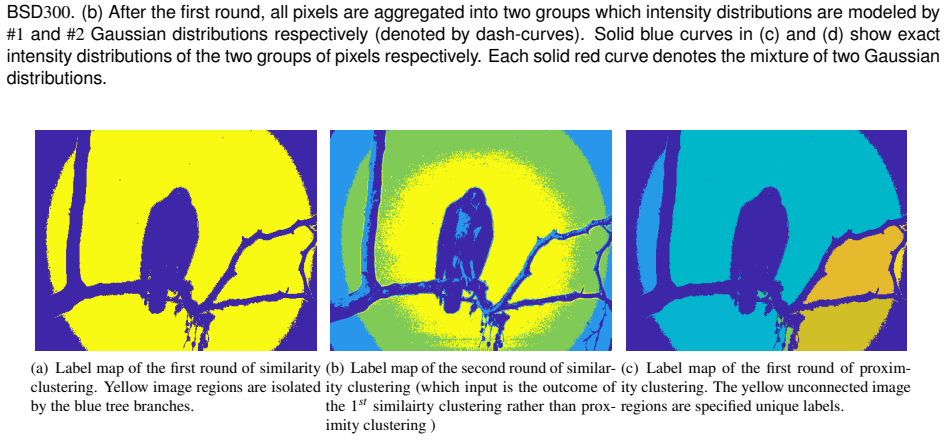
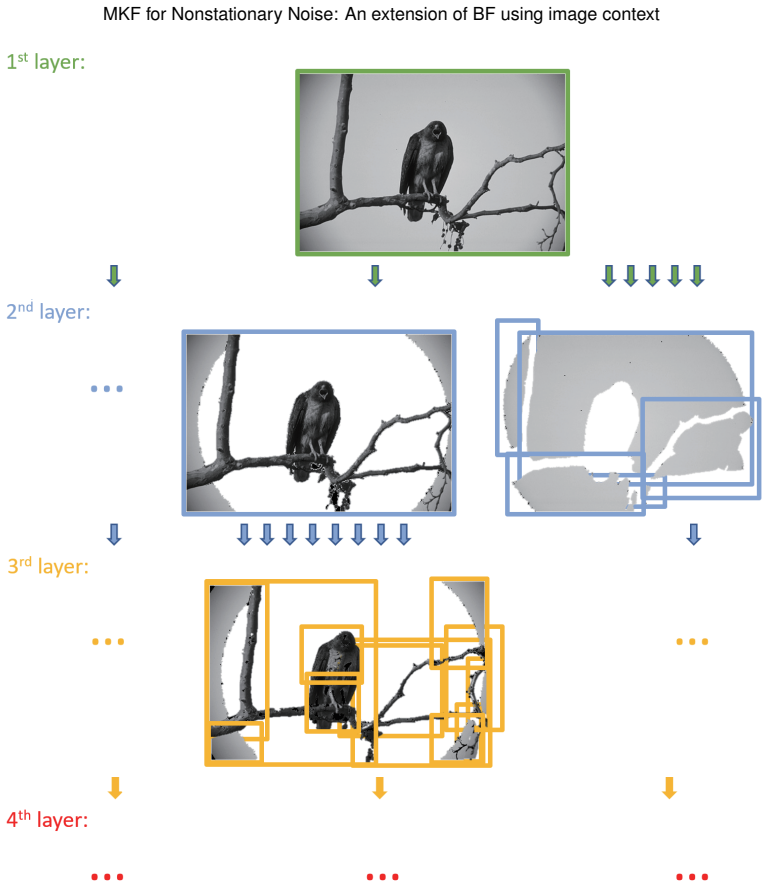
The load-bearing object is the cluster tree: a coarse-to-fine hierarchy of coherent pixel groups built by iterative two-class EM on intensity (similarity clustering) followed by connected-component isolation (proximity clustering). It supplies the image context. Each leaf cluster $C_{t,k}$ contributes one range kernel for the pixels it contains, and its two ancestor clusters $C_{t-1,k^*}$ and $C_{t-2,k^{**}}$ contribute the contextual scaling factor $\tau_{t,k} = \sqrt{\sigma_{t-1,k^*} \sigma_{t-2,k^{**}}}$. The kernel in Eq. (11), $w(\vec x, \vec \xi \mid \sigma_{t,k}, \tau_{t,k}) = \exp\big[-(\vec x - \vec \xi)^2 / (2 h_{\vec x}^2) - (I(\vec x)-I(\vec \xi))^2 / (2 \tau_{t,k} \sigma_{t,k}^2)\big]$, sets the effective range width pixel by pixel. Thus the same local intensity gradient is smoothed heavily inside low-salience regions and preserved near salient boundaries; this is what makes the single fixed kernel of BF into multiple automatically learned, spatially varying kernels.
What would settle it
Take a clean image containing a known flat region and a sharp edge, add Gaussian noise of known standard deviation, run MKF's clustering, and record the leaf-cluster variances $\sigma_{t,k}$ for flat-region and edge-region clusters. If the estimated variance rises with edge contrast rather than matching the injected noise level, the kernel widths are tracking image structure, not noise, and the adaptivity claim fails.
Extended reading notes
Core claim
Bilateral filtering rests on one manually chosen range-kernel width $h_I$, which encodes a global noise level; when the noise level changes over the image or across images, that single width can be either too small to smooth noisy pixels or too large to preserve edges. The paper's core claim is that this single kernel should be replaced by many kernels whose widths are learned from the image itself. MKF builds a cluster tree from the noisy input, with each leaf cluster characterized by an estimated mean $\mu_{t,k}$ and standard deviation $\sigma_{t,k}$, and with the variances of two ancestor clusters entering through $\tau_{t,k} = \sqrt{\sigma_{t-1,k^*} \sigma_{t-2,k^{**}}}$. The effective range width at a pixel is then $\tau_{t,k} \sigma_{t,k}$. With this construction, the paper reports that on BSD300 with noise levels 10 to 1000, and on BrainWeb MRI with spatially varying Gaussian noise, MKF outperforms BF, TV, and CF on both MAE and SSIM.
Load-bearing premise
The load-bearing premise is that the intensity spread estimated from each small cluster of the noisy image measures local noise level rather than the scene's edges or texture; if the clustering encodes structure, then every adapted kernel width is off, and the filter's adaptivity no longer means what the paper claims.
Editorial extensions
If this is right
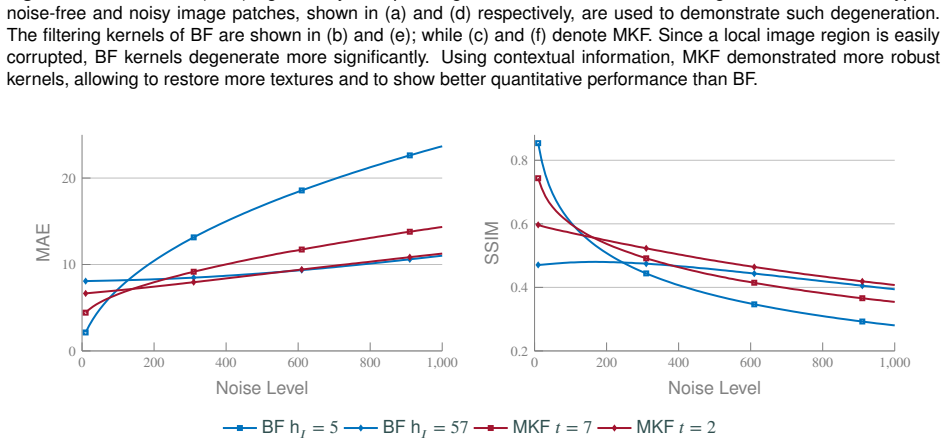
- With one fixed configuration, MKF produces near-linear MAE and SSIM curves across noise levels 10 to 1000 on BSD300, whereas BF's curves bend sharply and depend on the hand-set kernel width.
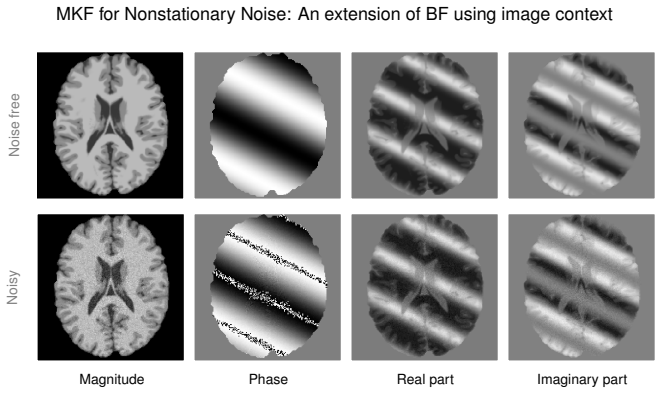
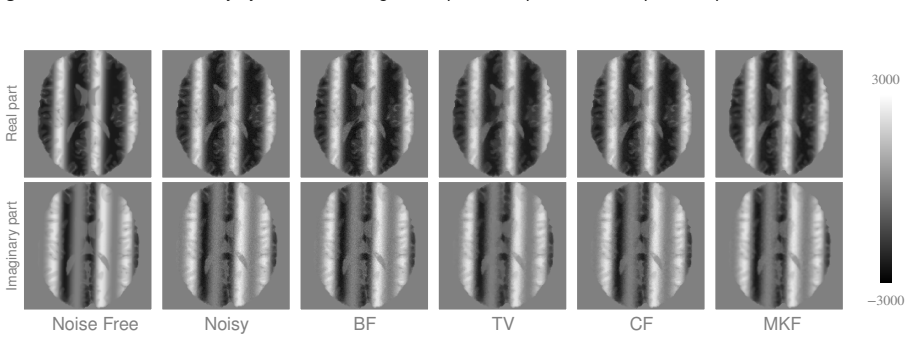
- On complex-valued BrainWeb MRI corrupted by spatially varying Gaussian noise, MKF yields lower MAE and higher SSIM than BF, TV, and CF, and its output keeps the phase-induced gradual transitions rather than producing mosaic blocks.
- Because the clustering splits the image recursively with fixed rules, the method adapts the number of clusters to each image automatically, removing the manual membership count that flat clustering requires.
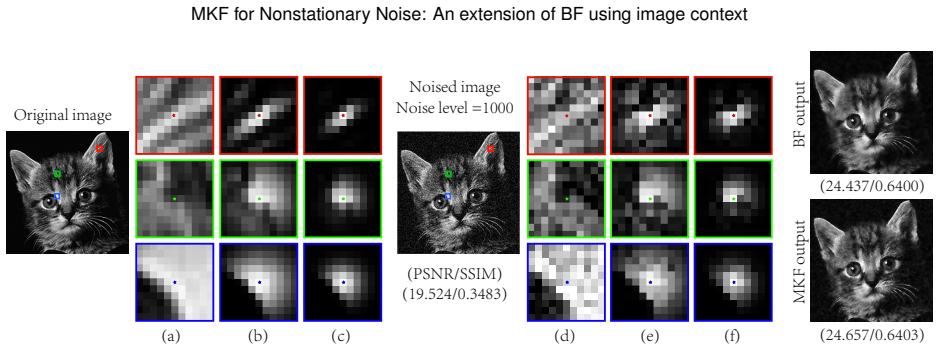
- The two-ancestor context term makes the filter smooth across boundaries of low-salience leaf clusters while preserving boundaries of high-salience ones, which is the mechanism behind the reported texture preservation.
Reading between the lines
- Editorial inference: The cluster-tree conditioning is a general template; replacing the intensity-variance statistic with edge orientation or texture energy would give context-conditioned kernels for other bilateral-filter pipelines, such as tone mapping, depth upsampling, or edge-preserving smoothing.
- Editorial inference: A direct attribution experiment is available: compare MKF against BF whose range width is set from the ground-truth noise-level map. If oracle BF matches MKF, the benefit reduces to per-pixel noise estimation; if it does not, the two-ancestor context term adds more than variance information.
- Editorial inference: The Gestalt and visual-context narration is not required by the mathematics; the same equations can be read as a hierarchical mixture estimate of local noise scale, so the method can be adopted without committing to that framing.
Signed reviews
Editorial analysis
A structured set of objections, weighed in public.
Referee Report
Summary. The paper proposes Multi-Kernel Filter (MKF), an extension of bilateral filtering designed for nonstationary noise. It constructs a hierarchical cluster tree of image pixels via EM-based similarity clustering and proximity clustering, then uses leaf-cluster standard deviations and ratios of predecessor-cluster standard deviations to set spatially varying range-kernel widths. The authors claim that MKF adapts filtering kernels to image content automatically and report experiments on BSD300 and BrainWeb showing lower MAE and higher SSIM than BF, TV, and CF.
Significance. If the mechanism were correctly specified, the idea of using a cluster-tree context to set per-pixel range kernels would be a plausible contribution to adaptive image filtering, and the qualitative kernel illustrations in Figure 5 are suggestive. However, the central formula in Eq. (11) contradicts the accompanying prose, and the experimental evaluation is too thin to support the 'state-of-the-art' claim. The method's adaptivity is shown in Figure 4 to depend strongly on a manually chosen tree depth, and the paper does not provide code, error bars, or statistical tests. The idea is promising but the current manuscript does not establish its validity.
major comments (5)
- [§3.2.2, Eq. (11)-(12)] The contextual factor as written does the opposite of what the text claims. In Eq. (11), the range-kernel denominator is 2 τ_{t,k} σ_{t,k}^2; since the paper states that σ_{t−2,k**} > σ_{t−1,k*}, Eq. (12) yields τ_{t,k} < 1, so the effective range variance τ_{t,k} σ_{t,k}^2 is smaller than σ_{t,k}^2. As τ_{t,k} → 0, the kernel approaches a delta in intensity, which blocks smoothing across intensity differences. The text in §3.2.2 instead states that τ close to 0 'significantly enlarges σ_{t,k}' and 'smooths across the boundaries' of C_{t,k}. This is an internal contradiction in the central mechanism, and the reader cannot determine whether Eq. (11) or the prose describes the intended behavior.
- [§4.3, Fig. 4] Figure 4 shows that the optimal tree depth Dp depends strongly on the noise level: for noise level 10, t=7 gives the best MAE/SSIM, while for noise level 1000, t=7 gives the worst. Since Dp is a manually initialized parameter (§4.1), the method does not automatically adapt to noise nonstationarity; a user must know the noise level to choose Dp. This contradicts the central claim of automatic adaptivity and is acknowledged in the conclusion ('its performance depended on the parameters of the clustering'). The near-linear curves for t=2 in Fig. 6 are achieved by fixing Dp=2, not by adaptation.
- [§4.2-4.4] The experimental evidence is too limited to support the claim that MKF 'outperforms state-of-the-art filters.' On BSD300, MKF is compared only with BF; on BrainWeb, it is compared with BF, TV, and CF, all from 1998, 1992, and 2017 respectively, which are not state-of-the-art denoisers for the reported tasks. No error bars, standard deviations, or statistical significance tests are reported. Also, no sensitivity analysis is given for baseline parameters beyond the statement that they were 'well chosen.' These omissions leave the quantitative superiority claim unsubstantiated.
- [§3.1.1-§3.2] The adaptivity of MKF rests on the assumption that the leaf-cluster standard deviation σ_{t,k}, estimated by EM from the noisy image (Eqs. (2)-(3)), reflects local noise statistics rather than image structure. In natural images, σ_{t,k} is a mixture of both, and using it directly as the range-kernel width may over-smooth textured regions or under-smooth noisy flat regions. No experiment validates this assumption, for example by comparing the estimated σ_{t,k} with the ground-truth noise level in the synthetic BrainWeb data.
- [§4.3, Eq. (12)] The definition of τ_{t,k} is not reproducible for t=2. Eq. (12) references σ_{t−2,k**}, which does not exist for t=2, but §4.3 states that τ_{t,k} = (σ_{t,k}/σ_{t−1,k*})^2 when t=2. These two definitions disagree, and the manuscript does not explain how the root-layer case is handled. This ambiguity affects the parameter setting used in the main experiments.
minor comments (5)
- [§1 affiliation] The affiliation line contains a typo: 'Universtiy' should be 'University'.
- [§3.2.1, Eq. (4)] The parentheses are unbalanced in 'O(I(x)))'; one closing parenthesis should be removed.
- [§4.3, second paragraph] The cross-reference 'In Figure 4.3' should read 'In Figure 4'.
- [Abstract] The abstract duplicates a sentence: 'We first design...' appears twice, and the 'At first, we design...' sentence repeats the same idea verbatim.
- [§4.1, parameter list] The name 'Conduction coefficient' for the spatial kernel variance h_x is nonstandard; consider using 'spatial kernel width' instead.
Circularity Check
No circularity found: MKF estimates kernel widths from the noisy image itself via EM clustering, but no equation reduces the output to a fitted target; the main issue is an internal inconsistency in Eqs. 11–12, which is a correctness concern, not circularity.
full rationale
The derivation chain is self-contained in the sense required by the circularity test. The adaptive range-kernel width sigma_{t,k} is estimated from the noisy input image by EM clustering (Eqs. 2–3), and the contextual factor tau_{t,k} is formed as a ratio of cluster standard deviations from coarser levels (Eq. 12). This is self-referencing in the ordinary filtering sense—the filter uses statistics of the image being filtered—but it is not a fit to the target outputs: no parameter is regressed against the reported MAE or SSIM values, and the denoised image is not a relabeling of the fitted quantities. The claimed 'outperforms state-of-the-art filters' is an empirical comparison on BSD300 and BrainWeb, not a consequence derived from the construction. Self-citations (e.g., Liu et al. 2017 for clustering inspiration; Chen et al. 2019 for spatially varying MRI noise) are background or related-work citations and are not load-bearing for the filtering mechanism. There is no imported uniqueness theorem, no ansatz smuggled in via citation, and no renaming of a known result as a new organization. The conclusion openly admits that performance depends on clustering parameters and that the method is slow; those are limitations but not circularity. One substantive concern is an internal inconsistency in the text around Eqs. 11–12: the prose states that sigma_{t-2} > sigma_{t-1}, hence tau_{t,k} < 1, which 'enlarges sigma_{t,k}', and that tau close to 0 permits smoothing across leaf-cluster boundaries. In Eq. 11, however, tau_{t,k} multiplies sigma_{t,k}^2 in the denominator of the range-kernel exponent, so tau < 1 narrows the effective range width and tau -> 0 turns the range kernel into a delta, preventing cross-boundary smoothing. This is a specification error that would affect reproducibility and correctness of the claimed adaptive behavior, but it is not a circular reduction of the result to its inputs; it does not raise the circularity score.
Assumptions & free parameters
free parameters (4)
- Maximal tree depth Dp =
2 and 7
- Maximal cluster size Mxc =
20
- Spatial kernel sigma h_x =
3 (cat experiment), unspecified elsewhere
- Minimal cluster size Mnc =
9 (threshold)
assumptions (4)
- domain assumption Additive Gaussian noise model (Eq. 1).
- domain assumption Leaf-cluster variance reflects local noise statistics rather than image structure.
- domain assumption EM clustering with two components per split yields a meaningful image context hierarchy.
- ad hoc to paper Gestalt grouping rules motivate the clustering design.
Cite this review
Pith. "Pith review of Multi-Kernel Filtering for Nonstationary Noise: An Extension of Bilateral Filtering Using Image Context." pith.science (2026). https://pith.science/paper/MTDI3SCM
@misc{pith2026190806307,
  author       = {Pith},
  title        = {Pith review of: Multi-Kernel Filtering for Nonstationary Noise: An Extension of Bilateral Filtering Using Image Context},
  year         = {2026},
  howpublished = {\url{https://pith.science/paper/MTDI3SCM}},
  note         = {Machine review of arXiv:1908.06307}
}
read the original abstract
Bilateral filtering (BF) is one of the most classical denoising filters, however, the manually initialized filtering kernel hampers its adaptivity across images with various characteristics. To deal with image variation (i.e., non-stationary noise), in this paper, we propose multi-kernel filter (MKF) which adapts filtering kernels to specific image characteristics automatically. The design of MKF takes inspiration from adaptive mechanisms of human vision that make full use of information in a visual context. More specifically, for simulating the visual context and its adaptive function, we construct the image context based on which we simulate the contextual impact on filtering kernels. We first design a hierarchically clustering algorithm to generate a hierarchy of large to small coherent image patches, organized as a cluster tree, so that obtain multi-scale image representation. The leaf cluster and corresponding predecessor clusters are used to generate one of multiple range kernels that are capable of catering to image variation. At first, we design a hierarchically clustering framework to generate a hierarchy of large to small coherent image patches that organized as a cluster tree, so that obtain multi-scale image representation, i.e., the image context. Next, a leaf cluster is used to generate one of the multiple kernels, and two corresponding predecessor clusters are used to fine-tune the adopted kernel. Ultimately, the single spatially-invariant kernel in BF becomes multiple spatially-varying ones. We evaluate MKF on two public datasets, BSD300 and BrainWeb which are added integrally-varying noise and spatially-varying noise, respectively. Extensive experiments show that MKF outperforms state-of-the-art filters w.r.t. both mean absolute error and structural similarity.
Figures

Figures from the paper (6 more)


Reference graph
Works this paper leans on
-
[1]
Spatially variant noise estimation in MRI: A homomorphic approach
Aja-Fernández, S., Pie, T., Vegas-Sánchez-Ferrero, G., et al., 2015. Spatially variant noise estimation in MRI: A homomorphic approach. Medical Image Analysis (MIA) 20, 184–197
work page 2015
-
[2]
Bar, M., 2004. Visual objects in context. Nature Reviews Neuroscience 5, 617–629
work page 2004
-
[3]
Barash, D., 2002. Fundamental relationship between bilateral filtering, adaptive smoothing, and the nonlinear diffusion equation. IEEE Transactions on Pattern Analysis and Machine Intelligence (TPAMI) 24, 844–847
work page 2002
-
[4]
Fast filter transform for image processing
Burt, P.J., 1981. Fast filter transform for image processing. Computer Graphics and Image Processing 16, 20–51
work page 1981
-
[5]
Denoising of infant diffusion MRI data via graph framelet matching in x-q space
Chen, G., Dong, B., Zhang, Y ., Lin, W., Shen, D., Yap, P.T., 2019. Denoising of infant diffusion MRI data via graph framelet matching in x-q space. IEEE Transactions on Medical Imaging (TMI)
work page 2019
-
[6]
Real diffusion-weighted MRI enabling true signal averaging and increased diffusion contrast
Eichner, C., Cauley, S.F., Cohen-Adad, J., Möller, H.E., Turner, R., Setsompop, K., Wald, L.L., 2015. Real diffusion-weighted MRI enabling true signal averaging and increased diffusion contrast. NeuroImage 122, 373–384
work page 2015
-
[7]
Neurocognitive architecture of working memory.Neuron 88, 33–46
Eriksson, J., V ogel, E.K., Lansner, A., Bergström, F., Nyberg, L., 2015. Neurocognitive architecture of working memory.Neuron 88, 33–46
work page 2015
-
[8]
Gao, T., Gao, Z., Li, J., Sun, Z., Shen, M., 2011. The perceptual root of object-based storage: An interactive model of perception and visual working memory. Journal of Experimental Psychology: Human Perception and Performance 37, 1803–1823. Feihong Liu et al.: Preprint submitted to Elsevier Page 10 of 11 MKF for Nonstationary Noise: An extension of BF us...
work page 2011
Show all 24 references
-
[9]
Organization principles in visual working memory: Evidence from sequential stimulus display
Gao, Z., Gao, Q., Tang, N., Shui, R., Shen, M., 2016. Organization principles in visual working memory: Evidence from sequential stimulus display. Cognition 146, 277–288
2016
-
[10]
Curvature filters efficiently reduce certain variational energies
Gong, Y ., Sbalzarini, I.F., 2017. Curvature filters efficiently reduce certain variational energies. IEEE Transactions on Image Processing (TIP) 26, 1786–1798
2017
-
[11]
MRI simulation-based evaluation of image-processing and classification methods
Kwan, R.S., Evans, A.C., Pike, G.B., 1999. MRI simulation-based evaluation of image-processing and classification methods. IEEE Transactions on Medical Imaging (TMI) 18, 1085–1097
1999
-
[12]
Normalized euclidean super-pixels for medical image segmentation, in: International Conference on Intelligent Computing, Springer
Liu, F., Feng, J., Su, W., Lv, Z., Xiao, F., Qiu, S., 2017. Normalized euclidean super-pixels for medical image segmentation, in: International Conference on Intelligent Computing, Springer. pp. 586–597
2017
-
[13]
Revealing detail along the visual hierarchy: Neural clustering preserves acuity from V1 to V4
Lu, Y ., Yin, J., Chen, Z., Gong, H., Liu, Y ., Qian, L., Li, X., Liu, R., Andolina, I.M., Wang, W., 2018. Revealing detail along the visual hierarchy: Neural clustering preserves acuity from V1 to V4. Neuron 98, 417–428
2018
-
[14]
Martin, D., Fowlkes, C., Tal, D., Malik, J., 2001. A database of human segmented natural images and its application to evaluating segmentation algorithms and measuring ecological statistics, in: Proceedings of the IEEE International Conference on Computer Vision (ICCV), pp. 416–423
2001
-
[15]
Edge preserving smoothing
Nagao, M., Matsuyama, T., 1979. Edge preserving smoothing. Computer Graphics and Image Processing 9, 394–407
1979
-
[16]
Scale-space and edge detection using anisotropic diffusion
Perona, P., Malik, J., 1990. Scale-space and edge detection using anisotropic diffusion. IEEE Transactions on Pattern Analysis and Machine Intelligence (TPAMI) 12, 629–639
1990
-
[17]
The Gestalt principle of similarity benefits visual working memory
Peterson, D.J., Berryhill, M.E., 2013. The Gestalt principle of similarity benefits visual working memory. Psychonomic Bulletin & Review 20, 1282–1289
2013
-
[18]
Noise floor removal via phase correction of complex diffusion-weighted images: Influence on DTI and Q-space metrics, in: MICCAI Workshop on Computational Diffusion MRI, pp
Pizzolato, M., Fick, R., Boutelier, T., Deriche, R., 2016. Noise floor removal via phase correction of complex diffusion-weighted images: Influence on DTI and Q-space metrics, in: MICCAI Workshop on Computational Diffusion MRI, pp. 21–34
2016
-
[19]
Nonlinear total variation based noise removal algorithms.Physica D: Nonlinear Phenomena 60, 259–268
Rudin, L.I., Osher, S., Fatemi, E., 1992. Nonlinear total variation based noise removal algorithms.Physica D: Nonlinear Phenomena 60, 259–268
1992
-
[20]
Normalized cuts and image segmentation
Shi, J., Malik, J., 2000. Normalized cuts and image segmentation. IEEE Transactions on Pattern Analysis and Machine Intelligence ( TPAMI) 22, 888–905
2000
-
[21]
Neuromodulation of attention
Thiele, A., Bellgrove, M.A., 2018. Neuromodulation of attention. Neuron 97, 769–785
2018
-
[22]
Bilateral filtering for gray and color images, in: Proceedings of the IEEE International Conference on Computer Vision (ICCV), pp
Tomasi, C., Manduchi, R., 1998. Bilateral filtering for gray and color images, in: Proceedings of the IEEE International Conference on Computer Vision (ICCV), pp. 839–846. Feihong Liu et al.: Preprint submitted to Elsevier Page 11 of 11 MKF for Nonstationary Noise: An extension...
1998
-
[23]
Denoising of diffusion MRI using random matrix theory
Veraart, J., Novikov, D.S., Christiaens, D., Ades-Aron, B., Sijbers, J., Fieremans, E., 2016. Denoising of diffusion MRI using random matrix theory. NeuroImage 142, 394–406
2016
-
[24]
Joint contour filtering
Wei, X., Yang, Q., Gong, Y ., 2018. Joint contour filtering. International Journal of Computer Vision (IJCV) 126, 1245–1265. Feihong Liu et al.: Preprint submitted to Elsevier Page 12 of 11
2018
Reviewed August 14, 2026 · model on record in the stance chip above.
Discussion (0). Continue with ORCID to comment.