REVIEW 1 major objections 4 minor 12 references
Majorana fermions and the Sensitivity Conjecture
T0 review · 1 major / 4 minor · reviewed 2026-08-14 · deepseek-v4-flash
Pith's one-line read A proof of the Sensitivity Conjecture is a Majorana fermion operator.
desk verdict A clear, honest physics translation of Huang's proof; the main imprecision is an unstated bit-ordering convention in the Jordan-Wigner identification. read the letter →
The pith
A machine-rendered reading of the paper's core claim, the machinery that carries it, and where it could break.
The reading
What carries the argument
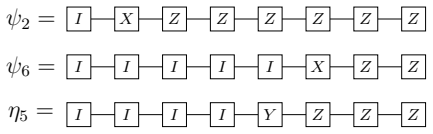
The machinery is the Jordan-Wigner transformation, which maps spin operators to Majorana fermion operators through $\psi_j=X_j\prod_{k=j+1}^n Z_k$ and $\eta_j=Y_j\prod_{k=j+1}^n Z_k$, obtaining generators of a Clifford algebra with anticommutation relations $\{\psi_j,\psi_k\}=2\delta_{jk}$. The key object is the uniform sum $\tilde A=\sum_j\psi_j$, equal up to normalization to the zero-momentum Majorana mode $\gamma_0=\frac{1}{\sqrt n}\sum_j\psi_j$. Its defining property is that $\tilde A^2=nI$ while $\operatorname{Tr}\tilde A=0$, collapsing the spectrum to $\pm\sqrt n$; the proof's recursive matrix is exactly this object, and the same property survives under local rotations $\chi_j=\cos\theta_j\,\psi_j+\sin\theta_j\,\eta_j$.
What would settle it
Write out $A_n$ from Eq. (4) and the operator $\sum_{j=1}^n\psi_j$ in the bit-string basis for $n=2$ or $3$; if any matrix element differs, the claimed identity is false. A reader can also test the alternative left-attached-string operator to see whether it still satisfies the pseudo-adjacency conditions, which would locate the convention as the crucial assumption.
Extended reading notes
Core claim
The central claim is that the $2^n\times 2^n$ pseudo-adjacency matrix $A_n$, defined recursively by $A_1=\begin{pmatrix}0&1\\1&0\end{pmatrix}$ and $A_m=\begin{pmatrix}A_{m-1}&I_{2^{m-1}}\\ I_{2^{m-1}}&-A_{m-1}\end{pmatrix}$, is identical to the operator $\tilde A=\sum_{j=1}^n\psi_j$ acting on the bit-string Hilbert space, where $\psi_j=X_j\prod_{k=j+1}^n Z_k$ is the Jordan-Wigner Majorana operator. The equality holds with the right-attached Jordan-Wigner string and makes the spectrum immediate: $\tilde A^2=nI$ and $\operatorname{Tr}\tilde A=0$ give eigenvalues $\pm\sqrt{n}$ with equal degeneracy. The positive eigenspace has dimension $2^{n-1}$, while any induced subgraph $H$ with $2^{n-1}+1$ vertices spans a space of dimension $2^{n-1}+1$, so the two spaces must intersect; a vector in the intersection is an eigenvector of the induced submatrix with eigenvalue $\sqrt n$, bounding the maximum degree of $H$ from below. Replacing $\psi_j$ by $\chi_j=\cos\theta_j\,\psi_j+\sin\theta_j\,\eta_j$ gives a continuous family of equally valid pseudo-adjacency matrices, and the tight example is understood in fermionic language through an explicit eigenvector.
Load-bearing premise
The load-bearing premise is a convention: the pseudo-adjacency matrix is identified with the Majorana operator when the Jordan-Wigner string is attached to the right of each flipped site, and the exact equality would not hold for the alternative left-attached string.
Editorial extensions
If this is right
- Every induced subgraph of the $n$-dimensional hypercube with exactly $2^{n-1}+1$ vertices has a vertex of degree at least $\sqrt n$, and the bound is tight when $n$ is a perfect square.
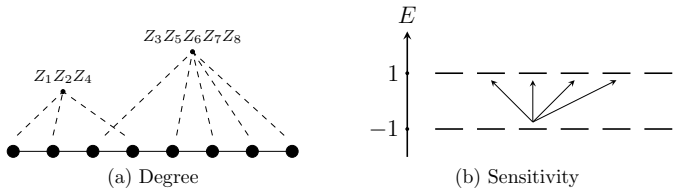
- The Sensitivity Conjecture follows in the form $bs(f)\le 2s(f)^4$, via the intermediate bound $s(f)\ge\sqrt{\deg f}$ and the known polynomial bound $bs(f)\le 2\deg(f)^2$.
- The $\pm\sqrt n$ spectrum is a fermionic consequence: any uniform superposition of anticommuting Majorana modes has the required spectral property, so the proof is not tied to one chosen sign pattern.
- The continuous family $A_\theta=\sum_j(\cos\theta_j\psi_j+\sin\theta_j\eta_j)$ gives many equivalent pseudo-adjacency matrices, each enough to run the argument.
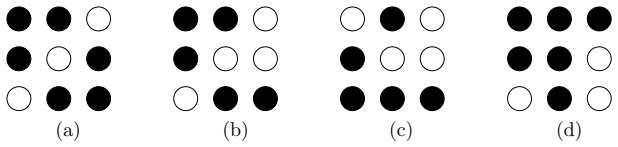
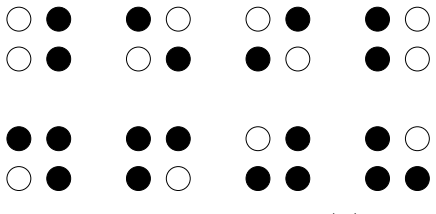
- The tight example for $n=l^2$ has an explicit eigenvector built from fermions: a state with all row zero-momentum modes occupied except one, then one added zero-momentum fermion, is an eigenvector with eigenvalue $l=\sqrt n$.
Reading between the lines
- The paper does not state it, but the string-direction choice is a convention: a left-attached Jordan-Wigner string would produce a different sign pattern that plausibly still satisfies the pseudo-adjacency conditions, so the essential content is the Clifford algebra representation rather than the particular sign rule.
- The angle freedom points to a gauge-like redundancy in the proof; one testable extension is whether other Clifford representations, not tied to spins or to this lattice, yield analogous degree bounds for other graphs.
- Because the zero-momentum Majorana mode is the operator whose square is the identity, the bound can be read representation-theoretically: any representation with $\sum_j\gamma_j^2=nI$ gives the same combinatorial conclusion, which may connect to generalizations of the Sensitivity Conjecture.
Signed reviews
Editorial analysis
A structured set of objections, weighed in public.
Referee Report
Summary. The paper is an expository note that re-casts Hao Huang's proof of the Sensitivity Conjecture in the language of quantum spin chains and Majorana fermions. Huang's theorem (any (2^{n-1}+1)-vertex induced subgraph of the n-dimensional hypercube has maximum degree at least sqrt(n)) is proved through a pseudo-adjacency matrix A_n defined recursively in Eq. (4), which has unit-modulus entries on hypercube edges and satisfies A_n^2 = n I, so that its eigenvalues are +-sqrt(n); since the positive eigenspace has dimension 2^{n-1} and the subspace of the subgraph has dimension 2^{n-1}+1, a dimension-counting argument forces an eigenvalue sqrt(n) on the submatrix. The authors identify A_n with the zero-momentum Majorana operator tilde A = sum_j psi_j (Eq. (10)), built from the right-attached Jordan-Wigner strings psi_j = X_j prod_{k>j} Z_k (Eq. (7)), so that the spectrum follows directly from the Clifford algebra {psi_i, psi_j} = 2 delta_{ij}; they also exhibit a continuous family A_theta (Eqs. (12)-(14)). Section 4 reviews the Chung-Furedi-Graham-Seymour extremal example in fermionic language, counting |H| = 2^{n-1}+1 and constructing an explicit eigenvector |psi> of eigenvalue sqrt(n) (Eqs. (23)-(25)). Section 5 reviews the Gotsman-Linial reduction and, combined with the Nisan-Szegedy bound bs(f) <= 2 deg(f)^2, concludes the sensitivity conjecture in the form bs(f) <= 2 s(f)^4. The note explicitly claims no original results.
Significance. If the identification is made precise, the note is a genuinely useful translation: the 'magic' pseudo-adjacency matrix and its rigid +-sqrt(n) spectrum become a one-line consequence of the Clifford anti-commutation relations, with no fitted parameters, and the same formalism generates the whole family A_theta and provides an intuitive fermionic picture of the sharp example and its eigenvector. The paper is careful and mostly verifiable by hand: the size computation (Eqs. (18)-(21)) and the eigenvector calculation (Eq. (25)) are explicit and checkable, and the authors correctly disclose the parallel work by Karasev, Tao, and Mathews. The main caveat is the unstated bit-ordering convention behind the exact equality in Eq. (10); this does not affect the validity of the spectral argument or of Theorem 1, since any sign pattern satisfying Eq. (3) supports the same proof. As a bridge between a celebrated combinatorial proof and statistical mechanics, the note would be a worthwhile contribution once that convention is explicitly stated.
major comments (1)
- [Sec. 3.3, Eqs. (4), (7), (10)] The exact identification tilde A = sum_j psi_j = A_n holds only under a bit-ordering convention that the paper never states. Reading Eq. (4) under the standard convention that the outer block index in the recursion is the first coordinate s_1 (the labeling used with the vertex s = (s_1,...,s_n) elsewhere in the paper, e.g., Eq. (6) and Section 5), an induction on Eq. (4) gives (A_n)_{s,t} = (-1)^{s_1+...+s_{j-1}} for the edge t obtained by flipping coordinate j, which is the sign pattern of the left-attached string xi_j = X_j prod_{k<j} Z_k. The right-attached string of Eq. (7), psi_j = X_j prod_{k>j} Z_k, gives the sign pattern (-1)^{s_{j+1}+...+s_n}. The two patterns agree only if the rows and columns of Eq. (4) are ordered with the last bit as the outer recursion index (the new bit appended at the end of the string), a convention the text does not state. Concretely, with the outer index taken to be s_1 and n = 3, Eq. (4) gives (A_3)_{010,011} = -1 for the edge flipping bit 3, whereas <010|psi_3|011> = +1 because psi_3 = X_3. The claim is easily repaired either by stating the ordering convention explicitly or by using the left-attached strings xi_j = X_j prod_{k<j} Z_k in Eqs. (7), (12), and Figure 3 (an option the authors already mention in item 1 of Section 3.2). Since every sign choice satisfying Eq. (3) yields the same eigenvalue argument, Theorem 1 and Sections 2, 4, and 5 are unaffected, but the advertised exact coincidence of Huang's matrix with the Majorana operator must be corrected.
minor comments (4)
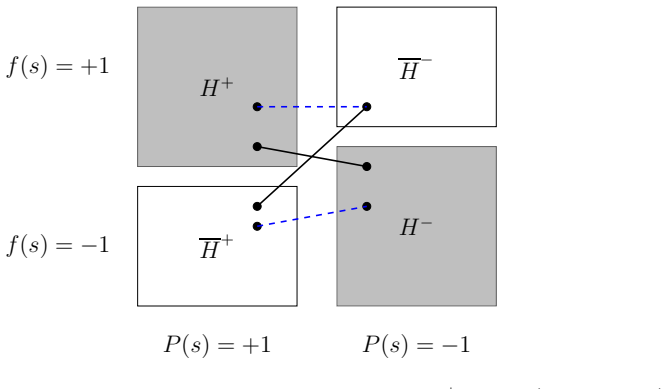
- [Section 5, paragraph after Eq. (28)] In the explanation of Eq. (29), the sentence stating that the local sensitivity s(f,x) is the number of links from x to the vertices in bar H_- uses the wrong block: for x in H_+ the neighbors with opposite f-value lie in H_- (f = -1, P = -1), not in bar H_- (which has f = +1). The formula s(f) = max(Delta(H), Delta(bar H)) is correct, but the block label in that sentence should be H_-.
- [Section 4.2, Eq. (25)] The passage from the first line of Eq. (25) to the second silently drops two terms: sum_alpha B_alpha |phi> = 0 (because the product prod_gamma B_gamma already contains B_alpha) and sum_{alpha,beta} B_alpha^dagger B_beta^dagger |phi> = 0 (which follows from the anticommutation B_alpha^dagger B_beta^dagger = -B_beta^dagger B_alpha^dagger for alpha != beta). A one-sentence justification of these cancellations would make the eigenvector computation easy to verify.
- [Section 5, paragraph after Eq. (32)] The reduction to the subcube Q_m is compressed: the claim that the restricted function 'has maximum degree m' requires the fixed coordinates s_{m+1},...,s_n to be chosen so that every other degree-m monomial either vanishes or drops in degree. A sentence making this explicit would make the step fully transparent.
- [Throughout] Several typographical errors should be corrected: 'preivous' (Introduction), 'reivew' (Section 2), and 'BJ' instead of B_alpha (Section 4.2, text before Eq. (24)).
Circularity Check
No circularity: this is an expository translation of Huang's proof; the Majorana identification is an independently checkable algebraic equivalence, not an input fitted into the conclusion.
full rationale
The paper explicitly states it contains no original results and is a translation of Huang's proof into fermionic language. The load-bearing mathematical content (pseudo-adjacency matrix spectrum ±√n) is taken from Huang's construction in Eq. (4) and verified directly by A_n^2 = n I; the physical rewriting in terms of Majorana operators in Eq. (10) supplies no fitted parameters and does not assume the spectral conclusion it explains. The Jordan-Wigner string convention in Eq. (7) is a definitional choice, and the paper even notes that an alternative left-attached string is possible; any sign-convention subtlety in the claimed exact identification with Eq. (4) would be a correctness imprecision rather than circularity, since the spectral argument only needs any pseudo-adjacency sign pattern satisfying |A_st| = A^Q_st and A^2 = n I. The only self-citations (e.g., Ref. [11] in the further-discussion section) are background remarks and are not load-bearing for the derivation. Therefore the paper is self-contained against external benchmarks and free of circular reasoning.
Assumptions & free parameters
assumptions (5)
- standard math Pauli matrices X_j, Y_j, Z_j are Hermitian, unitary, and satisfy the standard Clifford algebra of spin-1/2 operators.
- domain assumption The Jordan-Wigner transformation (Eq. 7) maps Pauli operators to Majorana operators satisfying {psi_j, psi_k} = 2 delta_jk, {psi_j, eta_k} = 0.
- domain assumption The hypercube adjacency matrix equals \sum_j X_j when bit strings are identified with spin Z-basis states (Eq. 6).
- domain assumption Huang's theorem (Ref. [1]) is correct.
- domain assumption The Gotsman-Linial equivalence and the Nisan-Szegedy polynomial bound are correct.
Cite this review
Pith. "Pith review of Majorana fermions and the Sensitivity Conjecture." pith.science (2026). https://pith.science/paper/PPZUCOM6
@misc{pith2026190806322,
  author       = {Pith},
  title        = {Pith review of: Majorana fermions and the Sensitivity Conjecture},
  year         = {2026},
  howpublished = {\url{https://pith.science/paper/PPZUCOM6}},
  note         = {Machine review of arXiv:1908.06322}
}
read the original abstract
Recently, Hao Huang proved the Sensitivity Conjecture, an important result about complexity measures of Boolean functions. We will discuss how this simple and elegant proof turns out to be closely related to physics concepts of the Jordan-Wigner transformation and Majorana fermions. This note is not intended to contain original results. Instead, it is a translation of the math literature in a language that is more familiar to physicists, which helps our understanding and hopefully may inspire future works along this direction.
Figures


Figures from the paper (4 more)
Reference graph
Works this paper leans on
-
[1]
write newline
" write newline "" before.all 'output.state := FUNCTION blank.sep after.quote 'output.state := FUNCTION fin.entry output.state after.quoted.block = 'skip 'add.period if write newline FUNCTION new.block output.state before.all = 'skip output.state after.quote = after.quoted.block 'output.state := after.block 'output.state := if if FUNCTION new.sentence out...
-
[2]
H. Huang, Induced subgraphs of hypercubes and a proof of the sensitivity conjecture, arXiv preprint arXiv:1907.00847 (2019)
arXiv 2019
-
[3]
N. Nisan and M. Szegedy, On the degree of boolean functions as real polynomials, Computational complexity 4 (1994) 301
work page 1994
-
[4]
C. Gotsman and N. Linial, The equivalence of two problems on the cube, Journal of Combinatorial Theory, Series A 61 (1992) 142
work page 1992
-
[5]
P. Jordan and E. P. Wigner, About the pauli exclusion principle, Z. Phys. 47 (1928) 631
work page 1928
-
[6]
F. R. Chung, Z. F \"u redi, R. L. Graham and P. Seymour, On induced subgraphs of the cube, Journal of Combinatorial Theory, Series A 49 (1988) 180
work page 1988
-
[7]
Huang's theorem and the exterior algebra
R. Karasev, Huang's theorem and the exterior algebra, arXiv preprint arXiv:1907.11175 (2019)
work page Pith review arXiv 2019
-
[8]
Tao, Twisted convolution and the sensitivity conjecture, ``What's New'' (26 July, 2019)
T. Tao, Twisted convolution and the sensitivity conjecture, ``What's New'' (26 July, 2019)
work page 2019
Show all 12 references
-
[9]
D. V. Mathews, The sensitivity conjecture, induced subgraphs of cubes, and clifford algebras, arXiv preprint arXiv:1907.12357 (2019)
2019 arXiv
-
[10]
Nandkishore and D
R. Nandkishore and D. A. Huse, Many-body localization and thermalization in quantum statistical mechanics, Annu. Rev. Condens. Matter Phys. 6 (2015) 15
2015
-
[11]
D. A. Roberts, D. Stanford and L. Susskind, Localized shocks, Journal of High Energy Physics 2015 (2015) 51
2015
-
[12]
Hosur and X.-L
P. Hosur and X.-L. Qi, Characterizing eigenstate thermalization via measures in the fock space of operators, Physical Review E 93 (2016) 042138
2016
Reviewed August 14, 2026 · model on record in the stance chip above.
Discussion (0). Continue with ORCID to comment.