REVIEW 2 major objections 5 minor 84 references
Near Data Acceleration with Concurrent Host Access
T0 review · 2 major / 5 minor · reviewed 2026-08-14 · deepseek-v4-flash
Pith's one-line read By letting host CPUs and near-data accelerators interleave fine-grained requests to the same DDR4 ranks, Chopim captures up to 97% of otherwise idle rank bandwidth while holding host performance steady, and speeds up SVRG logistic…
desk verdict Chopim's fine-grain host/NDA sharing mechanisms are original and well evaluated, but the headline results rest on an unvalidated replicated-FSM synchronization assumption that needs explicit handling of refresh and error cases. read the letter →
The pith
A machine-rendered reading of the paper's core claim, the machinery that carries it, and where it could break.
The reading
What carries the argument
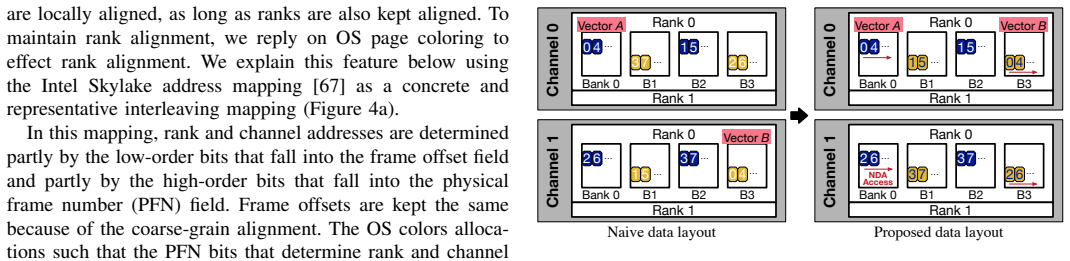
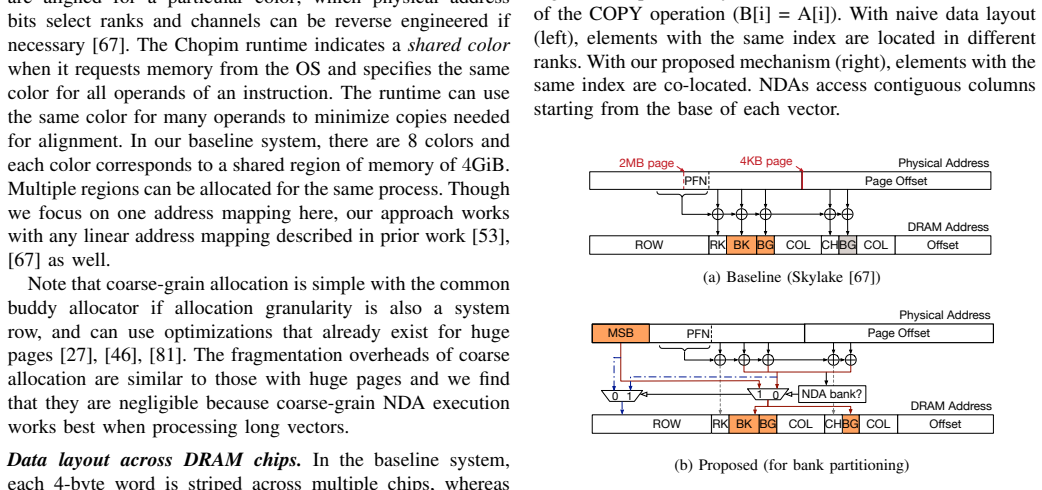
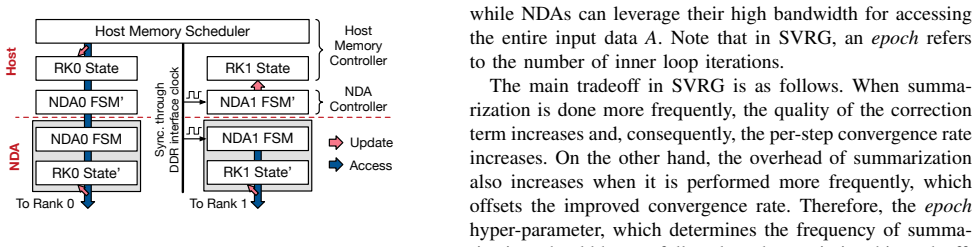
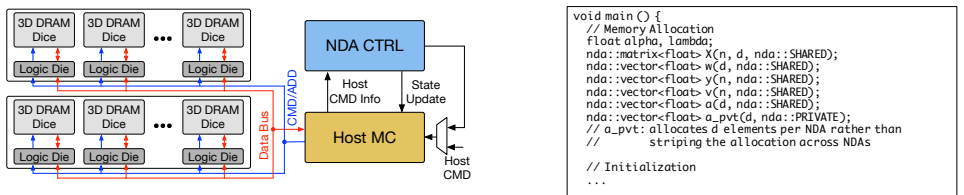
The central mechanism is a bank-partitioning address remap combined with replicated memory-controller FSMs. In the remap, the most-significant physical address bits and bank bits are swapped when an address would otherwise fall into a bank reserved for shared data, so host-only addresses are always steered to host-only banks and aliasing is avoided; this works with huge pages and modern XOR-based interleaving. The replicated FSMs, synchronized by the DDR interface clock, let the host track NDA memory transactions from a deterministic access pattern, enabling non-packetized DDR4 operation without NDA-to-host signaling. Supporting these are a data layout that aligns operands to the same 'system row' across ranks using coarse-grain allocation and OS page coloring, and two write-throttling policies (next-rank prediction over a dedicated pin, and stochastic issue) that curb the read/write turnaround overhead caused by interleaved NDA writes.
What would settle it
Implement the non-packetized DDR4 mode in a cycle-accurate simulator or prototype and inject a single refresh or timing perturbation during an NDA operation: if the host-side and NDA-side FSMs diverge, transactions are lost or corrupted, refuting the synchronization claim. Alternatively, measure actual NDA bandwidth utilization on a DDR4 module with the dedicated pin wired and compare it with the simulated 97% of idle-rank-bandwidth figure; a large gap would falsify the fine-grain interleaving results.
Extended reading notes
Core claim
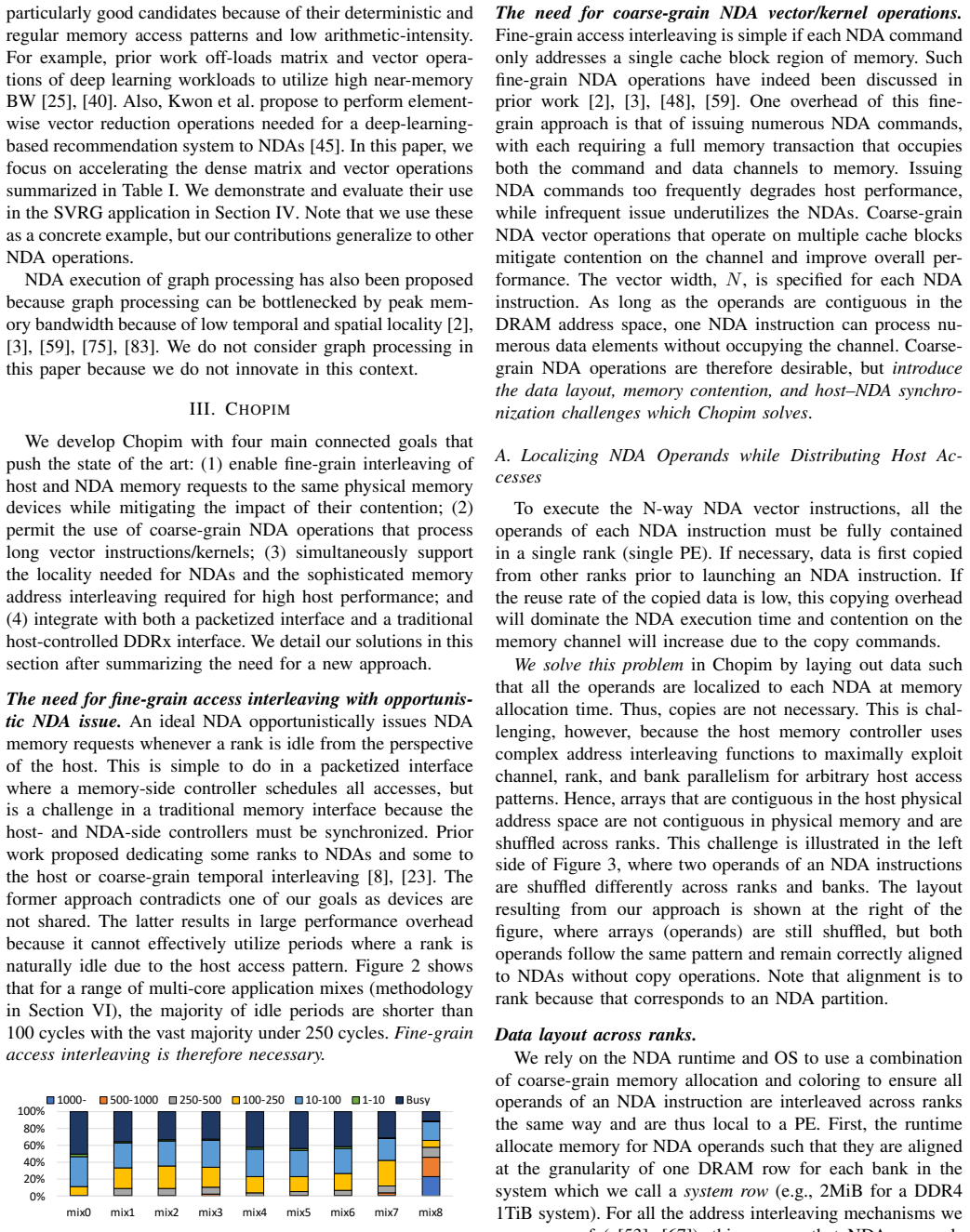
The discovery is that fine-grain temporal interleaving of host and NDA memory requests to the same physical DRAM devices is not only feasible but decisively better than dedicating ranks to each side or coarse time-multiplexing. Chopim achieves this by remapping addresses so that host-only memory never lands in banks reserved for shared data, by issuing NDA commands only into ranks that are momentarily idle while throttling NDA writes (via next-rank prediction or stochastic issue), and by placing all operands of an NDA instruction in the same rank through system-row-aligned allocation and physical-frame coloring. On the non-packetized DDR4 interface, the system replicates the memory-controller finite-state machine on both sides of the channel and synchronizes them with the DDR clock, so the host can predict NDA memory behavior from the (deterministic) NDA access pattern alone, without any NDA-to-host signaling. The paper reports up to 97% of unutilized rank bandwidth used by NDAs with host IPC preserved, and 2x/1.6x speedups for SVRG logistic regression versus host-only and non-concurrent baselines.
Load-bearing premise
The load-bearing premise is that the replicated memory-controller finite-state machines on the host and NDA sides stay perfectly synchronized using the DDR interface clock and deterministic NDA access patterns, with no explicit NDA-to-host signaling; if DRAM refresh, error handling, or timing uncertainty makes the states diverge, the non-packetized DDR4 mode fails, and the results also assume a dedicated pin for next-rank write prediction that is not implemented on real systems.
Editorial extensions
If this is right
- NDAs can be integrated into commodity DDR4 DIMMs without dedicating ranks, so the full memory capacity stays available to the host even during acceleration.
- Host and NDAs can collaborate on the same data concurrently without copying, enabling algorithm redesigns such as delayed-update SVRG that overlap phases and cut training time.
- Write-intensive NDA operations no longer force a severe host slowdown when combined with the throttling mechanisms.
- Scaling the system with more ranks improves NDA throughput more than rank partitioning does, because idle-rank opportunities grow with rank count.
- The bank-partitioning and layout techniques are compatible with huge pages and advanced address interleaving, removing a practical obstacle to near-data processing adoption.
Reading between the lines
- The replicated-FSM synchronization idea could generalize to other memory-side engines that have deterministic access patterns, potentially enabling concurrent host access with in-memory processing on future DRAM generations.
- The OS/compiler interface implied by Chopim—colored allocation and system-row alignment—suggests that memory allocation policies could be exposed to programming models so more applications obtain NDA locality automatically.
- Because the SVRG result depends on staleness, similar delayed-update variants of other iterative algorithms could benefit from concurrent host-NDA access, but their convergence guarantees would need separate analysis.
- If the dedicated pin for next-rank prediction is unacceptable, stochastic write throttling provides a fallback but with a performance trade-off; an in-band signaling scheme could eliminate the pin while retaining robustness.
Signed reviews
Editorial analysis
A structured set of objections, weighed in public.
Referee Report
Summary. The paper presents Chopim, a hardware/software co-design that enables concurrent access to main memory by a host CPU and near-data accelerators (NDAs) sharing the same DRAM ranks. The main contributions are: bank partitioning to prevent host accesses from reducing NDA row-buffer locality; mechanisms to throttle NDA writes (next-rank prediction and stochastic issue) to avoid read/write turnaround penalties; a data layout that keeps NDA operands locally aligned while preserving the host's sophisticated address interleaving; and replicated memory-controller FSMs that allow the host and NDA-side controllers to coordinate in a non-packetized DDR4 interface without NDA-to-host signaling. The evaluation, based on gem5+Ramulator simulations with SPEC2006/2017 host workloads and NDA microbenchmarks, reports up to 97% of unutilized rank bandwidth utilization for NDAs with preserved host IPC, and a 2x speedup (host-only baseline) or 1.6x speedup (non-concurrent baseline) for an SVRG logistic-regression case study.
Significance. If the mechanisms work as described, Chopim addresses real and largely unexplored challenges: fine-grain temporal interleaving of host and NDA requests to shared ranks, a bank-partitioning scheme compatible with huge pages and modern address hashing, and a data layout that enables colocated host/NDA collaboration without data copies. The evaluation is reasonably thorough, covering read- and write-intensive extremes, multiple host workload mixes, a scalable rank configuration, and a realistic machine-learning application. The main weakness is that the non-packetized DDR4 mode, which underpins all of the headline results, relies on an unvalidated replicated-FSM synchronization assumption, and the next-rank prediction mechanism depends on a dedicated sideband pin that is assumed but not modeled with physical delays.
major comments (2)
- [III-D, VII] The replicated-FSM design is load-bearing for the entire DDR4 evaluation, yet its correctness is only argued informally. Section III-D describes the FSMs staying synchronized via the DDR interface clock and deterministic NDA access patterns, and the text states that 'all our experiments rely on this.' However, deterministic NDA access patterns specify which commands an NDA will eventually issue, not the cycle-level timing of when those commands are issued. Host priority decisions, NDA write-buffer drain thresholds, and especially JEDEC refresh scheduling are controller policies whose outcomes must be identically predicted by both FSMs. The simulator does not model refresh, ECC scrubbing, or error handling, and no re-synchronization or divergence-recovery mechanism is presented. Without a formal argument or a simulated fault-injection/sensitivity study showing that the replicated state cannot diverge under these events, the correctness of concurrent host/NDA access in non-packetized DDR4 is not established, and the claimed 97% bandwidth utilization and SVRG speedups inherit this uncertainty.
- [III-B, VII] The next-rank prediction mechanism used for the rest of the paper depends on a dedicated sideband pin for the inhibit signal. Section III-B states, 'For now, we assume that this information is communicated over a dedicated pin and plan to develop other signaling mechanisms that can piggyback on existing host DRAM commands at a later time.' The simulation does not model the pin's propagation delay, the decision logic latency, or the command scheduling overhead of sending the inhibit signal ahead of the host transaction. Since Section VII states that next-rank prediction is used for the rest of the paper, and Figures 12 and 15 report results based on it, the reported host-IPC and SVRG numbers could change materially once this signaling path is modeled with realistic delays. The authors should either implement a delay model for the pin and predictor or provide a sensitivity analysis over the signal latency.
minor comments (5)
- [III-A] In the paragraph on data layout across ranks, 'we reply on OS page coloring' should read 'we rely on OS page coloring.'
- [VII, Takeaway 6] Takeaway 6 says collaborative SVRG is 'sped up by 50%,' while the abstract and Section IV say 2x over host-only execution, which is a 100% improvement. Please make the reported percentage and the speedup factors consistent.
- [III-C] The bank-partitioning scheme's real-system feasibility depends on the OS being able to split the physical address space and enforce page coloring as described. The evaluation appears to assume this OS behavior; a short discussion or simulation of allocator-induced fragmentation or of the cost of clearing memory before repartitioning would strengthen the claim of compatibility with huge pages.
- [III-A, V] The paper acknowledges that the proposed per-chip word layout relies on in-DRAM ECC with limited coverage and defers server-grade ECC to future work. Since the target is main memory in a server system, this limitation should at least be stated more prominently in the contributions or in the concluding discussion.
- [VI] The results for the nine mixes are presented without any indication of run-to-run variability or statistical significance. Since the same mixes are used across all evaluations, a brief statement about the sensitivity of the conclusions to the specific SimPoint choices would be useful.
Circularity Check
No circular derivation: Chopim's central claims are architectural mechanisms evaluated against independent baselines, with tuning confined to the SVRG case study.
full rationale
This is an engineering systems paper, not a derivation chain, and I find no step in which a claimed prediction or result reduces by construction to its own inputs. The bank-partitioning, write-throttling, replicated-FSM, and data-layout mechanisms are implemented in a gem5/Ramulator simulation and evaluated against concrete baselines: rank partitioning, idealized unutilized-rank-bandwidth, and host-only execution. The 'up to 97% of unutilized bandwidth' claim is a measured ratio against an explicitly idealized model, not a value produced by fitting that model. The SVRG case study uses 'best-tuned' learning rates and epoch sizes, but these hyperparameters tune the algorithm comparison; they are not used to fit or derive the architecture-level bandwidth or IPC results. The paper's self-citations, including the bank-partitioning prior work [36] with an overlapping author, are contextual and contrastive ('existing bank partitioning mechanisms [36], [52], [57] are incompatible...'), not load-bearing evidence for Chopim's correctness. The main caveats are assumptions rather than circularities: Section III-D assumes replicated host- and NDA-side memory-controller FSMs remain synchronized using the DDR interface clock and deterministic NDA access patterns without NDA-to-host signaling, and Section III-B assumes a dedicated pin for next-rank prediction. These are unvalidated implementation assumptions and correctness risks, but they are not reductions of the paper's conclusions to its premises. The paper is self-contained against external benchmarks and simulators, so no equation-level or self-citation-based circularity is present.
Assumptions & free parameters
free parameters (5)
- Number of banks reserved for NDAs =
1 bank per rank in evaluation (2-bank example in Section III-C)
- Stochastic write issue probability =
1/4 and 1/16
- Number of OS page colors =
8 colors, 4 GiB shared region each
- System-row allocation granularity =
2 MiB for a 1 TiB DDR4 system
- SVRG hyperparameters =
lambda=1e-3, momentum=0.9, learning rate 'best-tuned', epochs N, N/2, N/4
assumptions (7)
- domain assumption Ramulator and gem5 model DRAM timing, scheduling, and CPU behavior faithfully enough for the reported speedups.
- domain assumption The Intel Skylake address mapping is representative of modern interleaving, and all address mappings of interest are linear.
- domain assumption OS page coloring and coarse-grain memory allocation can be implemented with acceptable fragmentation.
- ad hoc to paper Replicated FSMs remain synchronized using the DDR interface clock and deterministic NDA access patterns, with no NDA-to-host signaling.
- domain assumption In-DRAM ECC with limited coverage is sufficient for NDA local accesses.
- domain assumption Coherence can be handled by explicit copies and memory fences because shared data is mostly read-only.
- domain assumption A rank cannot serve host and NDA requests simultaneously.
invented entities (2)
-
Replicated host and NDA memory controller FSMs
-
Dedicated sideband pin for next-rank prediction inhibit signal
Cite this review
Pith. "Pith review of Near Data Acceleration with Concurrent Host Access." pith.science (2026). https://pith.science/paper/RPQA5ZMS
@misc{pith2026190806362,
  author       = {Pith},
  title        = {Pith review of: Near Data Acceleration with Concurrent Host Access},
  year         = {2026},
  howpublished = {\url{https://pith.science/paper/RPQA5ZMS}},
  note         = {Machine review of arXiv:1908.06362}
}
read the original abstract
Near-data accelerators (NDAs) that are integrated with main memory have the potential for significant power and performance benefits. Fully realizing these benefits requires the large available memory capacity to be shared between the host and the NDAs in a way that permits both regular memory access by some applications and accelerating others with an NDA, avoids copying data, enables collaborative processing, and simultaneously offers high performance for both host and NDA. We identify and solve new challenges in this context: mitigating row-locality interference from host to NDAs, reducing read/write-turnaround overhead caused by fine-grain interleaving of host and NDA requests, architecting a memory layout that supports the locality required for NDAs and sophisticated address interleaving for host performance, and supporting both packetized and traditional memory interfaces. We demonstrate our approach in a simulated system that consists of a multi-core CPU and NDA-enabled DDR4 memory modules. We show that our mechanisms enable effective and efficient concurrent access using a set of microbenchmarks, and then demonstrate the potential of the system for the important stochastic variance-reduced gradient (SVRG) algorithm.
Figures

Figures from the paper (9 more)






Reference graph
Works this paper leans on
-
[1]
The design space of data-parallel memory systems
Jung Ho Ahn, Mattan Erez, and William J Dally. The design space of data-parallel memory systems. In SC06: Proceedings of the 2006 ACM/IEEE conference on Supercomputing , 2006
2006
-
[2]
A scalable processing-in-memory accelerator for parallel graph processing
Junwhan Ahn, Sungpack Hong, Sungjoo Yoo, Onur Mutlu, and Kiyoung Choi. A scalable processing-in-memory accelerator for parallel graph processing. In 2015 ACM/IEEE 42nd Annual International Symposium on Computer Architecture (ISCA) , pages 105–117, June 2015
2015
-
[3]
Pim-enabled instructions: a low-overhead, locality-aware processing- in-memory architecture
Junwhan Ahn, Sungjoo Yoo, Onur Mutlu, and Kiyoung Choi. Pim-enabled instructions: a low-overhead, locality-aware processing- in-memory architecture. In Computer Architecture (ISCA), 2015 ACM/IEEE 42nd Annual International Symposium on , pages 336–348. IEEE, 2015
2015
-
[4]
Berkin Akin, Franz Franchetti, and James C. Hoe. Data reorganization in memory using 3d-stacked dram. In Proceedings of the 42Nd Annual International Symposium on Computer Architecture , ISCA ’15, pages 131–143, New York, NY , USA, 2015. ACM
2015
-
[5]
Hamlet architecture for parallel data reorganization in memory
Berkin Akin, Franz Franchetti, and James C Hoe. Hamlet architecture for parallel data reorganization in memory. IEEE Micro, 36(1):14–23, Jan 2016
work page 2016
-
[6]
Netdimm: Low-latency near- memory network interface architecture
Mohammad Alian and Nam Sung Kim. Netdimm: Low-latency near- memory network interface architecture. In Proceedings of the 52nd An- nual IEEE/ACM International Symposium on Microarchitecture , pages 699–711. ACM, 2019
work page 2019
-
[7]
Application-transparent near-memory processing architecture with memory channel network,
Mohammad Alian, Seung Won Min, Hadi Asgharimoghaddam, Ashutosh Dhar, Dong Wang, Adam Roewer, Thomas McPadden, Oliver OHalloran, Deming Chen, Jinjun Xiong, Daehoon Kim, Wen-mei Hwu, and Nam Sung Kim. Application-transparent near-memory processing architecture with memory channel network,. In The 51st Annual IEEE/ACM International Symposium on Microarchitec...
work page 2018
-
[8]
Chameleon: Versatile and practical near-dram accel- eration architecture for large memory systems
Hadi Asghari-Moghaddam, Young Hoon Son, Jung Ho Ahn, and Nam Sung Kim. Chameleon: Versatile and practical near-dram accel- eration architecture for large memory systems. In Microarchitecture (MICRO), 2016 49th Annual IEEE/ACM International Symposium on , pages 1–13. IEEE, 2016
work page 2016
Show all 84 references
-
[9]
A neural probabilistic language model
Yoshua Bengio, R ´ejean Ducharme, Pascal Vincent, and Christian Jauvin. A neural probabilistic language model. Journal of machine learning research, 3(Feb):1137–1155, 2003
2003
-
[10]
The gem5 simulator
Nathan Binkert, Bradford Beckmann, Gabriel Black, Steven K Rein- hardt, Ali Saidi, Arkaprava Basu, Joel Hestness, Derek R Hower, Tushar Krishna, Somayeh Sardashti, et al. The gem5 simulator. ACM SIGARCH Computer Architecture News, 39(2):1–7, 2011
2011
-
[11]
Google workloads for consumer devices: Mitigating data movement bottlenecks
Amirali Boroumand, Saugata Ghose, Youngsok Kim, Rachata Ausavarungnirun, Eric Shiu, Rahul Thakur, Daehyun Kim, Aki Kuusela, Allan Knies, Parthasarathy Ranganathan, and Onur Mutlu. Google workloads for consumer devices: Mitigating data movement bottlenecks. In Proceedings of th...
2018
-
[12]
Malladi, Hongzhong Zheng, and Onur Mutlu
Amirali Boroumand, Saugata Ghose, Minesh Patel, Hasan Hassan, Bran- don Lucia, Rachata Ausavarungnirun, Kevin Hsieh, Nastaran Hajinazar, Krishna T. Malladi, Hongzhong Zheng, and Onur Mutlu. Conda: Effi- cient cache coherence support for near-data accelerators. In Proceedings of...
2019
-
[13]
Lazypim: An efficient cache coherence mechanism for processing-in-memory
Amirali Boroumand, Saugata Ghose, Minesh Patel, Hasan Hassan, Brandon Lucia, Kevin Hsieh, Krishna T Malladi, Hongzhong Zheng, and Onur Mutlu. Lazypim: An efficient cache coherence mechanism for processing-in-memory. IEEE Computer Architecture Letters , 16(1):46– 50, 2016
2016
-
[14]
Regan: A pipelined reram-based accelerator for generative adversarial networks
Fan Chen, Linghao Song, and Yiran Chen. Regan: A pipelined reram-based accelerator for generative adversarial networks. In Design Automation Conference (ASP-DAC), 2018 23rd Asia and South Pacific , pages 178–183. IEEE, 2018
2018
-
[15]
Cacti-3dd: Architecture-level modeling for 3d die-stacked dram main memory
Ke Chen, Sheng Li, Naveen Muralimanohar, Jung Ho Ahn, Jay B Brock- man, and Norman P Jouppi. Cacti-3dd: Architecture-level modeling for 3d die-stacked dram main memory. In Design, Automation & Test in Europe Conference & Exhibition (DATE), 2012 , pages 33–38. IEEE, 2012
2012
-
[16]
Prime: A novel processing-in-memory architecture for neural network computation in reram-based main mem- ory
Ping Chi, Shuangchen Li, Cong Xu, Tao Zhang, Jishen Zhao, Yongpan Liu, Yu Wang, and Yuan Xie. Prime: A novel processing-in-memory architecture for neural network computation in reram-based main mem- ory. In Proceedings of the 43rd International Symposium on Computer Architectu...
2016
-
[17]
Next big thing: Ddr4 3ds
JS Choi. Next big thing: Ddr4 3ds
-
[18]
Openmp: An industry-standard api for shared-memory programming
Leonardo Dagum and Ramesh Menon. Openmp: An industry-standard api for shared-memory programming. Computing in Science & Engi- neering, 5(1):46–55, 1998
1998
-
[19]
Large scale distributed deep networks
Jeffrey Dean, Greg Corrado, Rajat Monga, Kai Chen, Matthieu Devin, Mark Mao, Andrew Senior, Paul Tucker, Ke Yang, Quoc V Le, et al. Large scale distributed deep networks. In Advances in neural informa- tion processing systems , pages 1223–1231, 2012
2012
-
[20]
A white paper on the benefits of chipkill-correct ecc for pc server main memory
Timothy J Dell. A white paper on the benefits of chipkill-correct ecc for pc server main memory. IBM Microelectronics Division , 11:1–23, 1997
1997
-
[21]
The true processing in memory accelerator
Fabrice Devaux. The true processing in memory accelerator. In 2019 IEEE Hot Chips 31 Symposium (HCS) , pages 1–24. IEEE, 2019
2019
-
[22]
The mondrian data engine
Mario Drumond, Alexandros Daglis, Nooshin Mirzadeh, Dmitrii Ustiu- gov, Javier Picorel, Babak Falsafi, Boris Grot, and Dionisios Pnev- matikatos. The mondrian data engine. In Proceedings of the 44th Annual International Symposium on Computer Architecture , pages 639–
-
[23]
Nda: Near-dram acceleration architecture leveraging commodity dram devices and standard memory modules
Amin Farmahini-Farahani, Jung Ho Ahn, Katherine Morrow, and Nam Sung Kim. Nda: Near-dram acceleration architecture leveraging commodity dram devices and standard memory modules. In High Per- formance Computer Architecture (HPCA), 2015 IEEE 21st International Symposium on, page...
2015
-
[24]
Practical near-data processing for in-memory analytics frameworks
Mingyu Gao, Grant Ayers, and Christos Kozyrakis. Practical near-data processing for in-memory analytics frameworks. In Parallel Architecture and Compilation (PACT), 2015 International Conference on, pages 113–
2015
-
[25]
Tetris: Scalable and efficient neural network acceleration with 3d memory
Mingyu Gao, Jing Pu, Xuan Yang, Mark Horowitz, and Christos Kozyrakis. Tetris: Scalable and efficient neural network acceleration with 3d memory. In Proceedings of the Twenty-Second International Conference on Architectural Support for Programming Languages and Operating System...
2017
-
[26]
Processing in memory: The terasys massively parallel pim array
Maya Gokhale, Bill Holmes, and Ken Iobst. Processing in memory: The terasys massively parallel pim array. Computer, 28(4):23–31, 1995
1995
-
[27]
Understanding the Linux virtual memory manager
Mel Gorman. Understanding the Linux virtual memory manager . Prentice Hall Upper Saddle River, 2004
2004
-
[28]
3d- stacked memory-side acceleration: Accelerator and system design
Qi Guo, Nikolaos Alachiotis, Berkin Akin, Fazle Sadi, Guanglin Xu, Tze Meng Low, Larry Pileggi, James C Hoe, and Franz Franchetti. 3d- stacked memory-side acceleration: Accelerator and system design. In In the Workshop on Near-Data Processing (WoNDP)(Held in conjunction with M...
2014
-
[29]
Performance implications of nocs on 3d-stacked memories: Insights from the hybrid memory cube
Ramyad Hadidi, Bahar Asgari, Jeffrey Young, Burhan Ahmad Mudassar, Kartikay Garg, Tushar Krishna, and Hyesoon Kim. Performance implications of nocs on 3d-stacked memories: Insights from the hybrid memory cube. In 2018 IEEE International Symposium on Performance Analysis of Sys...
2018
-
[30]
Simpoint 3.0: Faster and more flexible program phase analysis
Greg Hamerly, Erez Perelman, Jeremy Lau, and Brad Calder. Simpoint 3.0: Faster and more flexible program phase analysis. Journal of Instruction Level Parallelism, 7(4):1–28, 2005
2005
-
[31]
Spec cpu2006 benchmark descriptions
John L Henning. Spec cpu2006 benchmark descriptions. ACM SIGARCH Computer Architecture News , 34(4):1–17, 2006
2006
-
[32]
Accelerating linked-list traversal through near-data processing
Byungchul Hong, Gwangsun Kim, Jung Ho Ahn, Yongkee Kwon, Hongsik Kim, and John Kim. Accelerating linked-list traversal through near-data processing. In Parallel Architecture and Compilation Tech- niques (PACT), 2016 International Conference on , 2016
2016
-
[33]
Hsieh, E
K. Hsieh, E. Ebrahim, G. Kim, N. Chatterjee, M. O’Connor, N. Vijayku- mar, O. Mutlu, and S. W. Keckler. Transparent offloading and mapping (tom): Enabling programmer-transparent near-data processing in gpu systems. In 2016 ACM/IEEE 43rd Annual International Symposium on Compute...
2016
-
[34]
Accelerating pointer chasing in 3d-stacked memory: Challenges, mechanisms, evaluation
Kevin Hsieh, Samira Khan, Nandita Vijaykumar, Kevin K Chang, Ami- rali Boroumand, Saugata Ghose, and Onur Mutlu. Accelerating pointer chasing in 3d-stacked memory: Challenges, mechanisms, evaluation. In 2016 IEEE 34th International Conference on Computer Design (ICCD) , pages ...
2016
-
[35]
Eigen: C++ template library for linear algebra, 2013
B Jacob, G Guennebaud, et al. Eigen: C++ template library for linear algebra, 2013
2013
-
[36]
Balancing dram locality and parallelism in shared memory cmp systems
Min Kyu Jeong, Doe Hyun Yoon, Dam Sunwoo, Mike Sullivan, Ikhwan Lee, and Mattan Erez. Balancing dram locality and parallelism in shared memory cmp systems. In High Performance Computer Architecture (HPCA), 2012 IEEE 18th International Symposium on , pages 1–12. IEEE, 2012
2012
-
[37]
Accelerating stochastic gradient descent using predictive variance reduction
Rie Johnson and Tong Zhang. Accelerating stochastic gradient descent using predictive variance reduction. In Advances in neural information processing systems, pages 315–323, 2013
2013
-
[38]
Cacti-io: Cacti with off-chip power-area-timing models
Norman P Jouppi, Andrew B Kahng, Naveen Muralimanohar, and Vaishnav Srinivas. Cacti-io: Cacti with off-chip power-area-timing models. IEEE Transactions on Very Large Scale Integration (VLSI) Systems, 23(7):1254–1267, 2015
2015
-
[39]
Flexram: Toward an advanced intelligent memory system
Yi Kang, Wei Huang, Seung-Moon Yoo, Diana Keen, Zhenzhou Ge, Vinh Lam, Pratap Pattnaik, and Josep Torrellas. Flexram: Toward an advanced intelligent memory system. In Proceedings 1999 IEEE International Conference on Computer Design: VLSI in Computers and Processors (Cat. No. ...
1999
-
[40]
Neurocube: A programmable digital neuromor- phic architecture with high-density 3d memory
Duckhwan Kim, Jaeha Kung, Sek Chai, Sudhakar Yalamanchili, and Saibal Mukhopadhyay. Neurocube: A programmable digital neuromor- phic architecture with high-density 3d memory. In Computer Architec- ture (ISCA), 2016 ACM/IEEE 43rd Annual International Symposium on , pages 380–39...
2016
-
[41]
Toward standardized near-data processing with unrestricted data place- ment for gpus
Gwangsun Kim, Niladrish Chatterjee, Mike O’Connor, and Kevin Hsieh. Toward standardized near-data processing with unrestricted data place- ment for gpus. In Proceedings of the International Conference for High Performance Computing, Networking, Storage and Analysis , page 24. ...
2017
-
[42]
Ramulator: A fast and extensible dram simulator
Yoongu Kim, Weikun Yang, and Onur Mutlu. Ramulator: A fast and extensible dram simulator. IEEE Computer architecture letters , 15(1):45–49, 2016
2016
-
[43]
Execube-a new architecture for scaleable mpps
Peter M Kogge. Execube-a new architecture for scaleable mpps. In 1994 International Conference on Parallel Processing Vol. 1, volume 1, pages 77–84. IEEE, 1994
1994
-
[44]
Processing in memory: Chips to petaflops
Peter M Kogge, Jay B Brockman, Thomas Sterling, and Guang Gao. Processing in memory: Chips to petaflops. In Workshop on Mixing Logic and DRAM: Chips that Compute and Remember at ISCA , volume 97. Citeseer, 1997
1997
-
[45]
Tensordimm: A practical near-memory processing architecture for embeddings and ten- sor operations in deep learning
Youngeun Kwon, Yunjae Lee, and Minsoo Rhu. Tensordimm: A practical near-memory processing architecture for embeddings and ten- sor operations in deep learning. In Proceedings of the 52nd Annual IEEE/ACM International Symposium on Microarchitecture , pages 740–
-
[46]
Coordinated and efficient huge page management with ingens
Youngjin Kwon, Hangchen Yu, Simon Peter, Christopher J Rossbach, and Emmett Witchel. Coordinated and efficient huge page management with ingens. In OSDI, volume 16, pages 705–721, 2016
2016
-
[47]
Slow learners are fast
John Langford, Alexander Smola, and Martin Zinkevich. Slow learners are fast. arXiv preprint arXiv:0911.0491 , 2009
2009 arXiv
-
[48]
Bssync: Processing near memory for machine learning workloads with bounded staleness consistency models
Joo Hwan Lee, Jaewoong Sim, and Hyesoon Kim. Bssync: Processing near memory for machine learning workloads with bounded staleness consistency models. In 2015 International Conference on Parallel Architecture and Compilation (PACT), pages 241–252, Oct 2015
2015
-
[49]
Drisa: A dram-based reconfigurable in-situ accelerator
Shuangchen Li, Dimin Niu, Krishna T Malladi, Hongzhong Zheng, Bob Brennan, and Yuan Xie. Drisa: A dram-based reconfigurable in-situ accelerator. In Proceedings of the 50th Annual IEEE/ACM International Symposium on Microarchitecture, pages 288–301. ACM, 2017
2017
-
[50]
Pinatubo: A processing-in-memory architecture for bulk bitwise operations in emerging non-volatile memories
Shuangchen Li, Cong Xu, Qiaosha Zou, Jishen Zhao, Yu Lu, and Yuan Xie. Pinatubo: A processing-in-memory architecture for bulk bitwise operations in emerging non-volatile memories. In Design Automation Conference (DAC), 2016 53nd ACM/EDAC/IEEE , pages 1–6. IEEE, 2016
2016
-
[51]
Processing-in-memory for energy-efficient neural network train- ing: A heterogeneous approach
Jiawen Liu, Hengyu Zhao, Matheus A Ogleari, Dong Li, and Jishen Zhao. Processing-in-memory for energy-efficient neural network train- ing: A heterogeneous approach. In 2018 51st Annual IEEE/ACM International Symposium on Microarchitecture (MICRO) , pages 655–
2018
-
[52]
A software memory partition approach for eliminating bank-level interference in multicore systems
Lei Liu, Zehan Cui, Mingjie Xing, Yungang Bao, Mingyu Chen, and Chengyong Wu. A software memory partition approach for eliminating bank-level interference in multicore systems. In Proceedings of the 21st international conference on Parallel architectures and compilation techni...
2012
-
[53]
Get out of the valley: power- efficient address mapping for gpus
Yuxi Liu, Xia Zhao, Magnus Jahre, Zhenlin Wang, Xiaolin Wang, Yingwei Luo, and Lieven Eeckhout. Get out of the valley: power- efficient address mapping for gpus. In 2018 ACM/IEEE 45th Annual International Symposium on Computer Architecture (ISCA) , pages 166–
2018
-
[54]
Concurrent data structures for near-memory computing
Zhiyu Liu, Irina Calciu, Maurice Herlihy, and Onur Mutlu. Concurrent data structures for near-memory computing. In Proceedings of the 29th ACM Symposium on Parallelism in Algorithms and Architectures , pages 235–245. ACM, 2017
2017
-
[55]
Reram-based processing-in-memory architecture for recurrent neural network accel- eration
Yun Long, Taesik Na, and Saibal Mukhopadhyay. Reram-based processing-in-memory architecture for recurrent neural network accel- eration. IEEE Transactions on Very Large Scale Integration (VLSI) Systems, 26(12), 2018
2018
-
[56]
The ibm z13 memory subsystem for big data
Patrick J Meaney, Lawrence D Curley, Glenn D Gilda, Mark R Hodges, Daniel J Buerkle, Robert D Siegl, and Roger K Dong. The ibm z13 memory subsystem for big data. IBM Journal of Research and Development, 59(4/5):4–1, 2015
2015
-
[57]
Software- hardware cooperative dram bank partitioning for chip multiprocessors
Wei Mi, Xiaobing Feng, Jingling Xue, and Yaocang Jia. Software- hardware cooperative dram bank partitioning for chip multiprocessors. In Proceedings the IFIP International Conference on Network and Parallel Computing, 2010
2010
-
[58]
Cacti 6.0: A tool to model large caches
Naveen Muralimanohar, Rajeev Balasubramonian, and Norman P Jouppi. Cacti 6.0: A tool to model large caches. HP laboratories , pages 22–31, 2009
2009
-
[59]
Graphpim: Enabling instruction-level pim offloading in graph computing frameworks
Lifeng Nai, Ramyad Hadidi, Jaewoong Sim, Hyojong Kim, Pranith Kumar, and Hyesoon Kim. Graphpim: Enabling instruction-level pim offloading in graph computing frameworks. In High Performance Computer Architecture (HPCA), 2017 IEEE International Symposium on, pages 457–468. IEEE, 2017
2017
-
[60]
Active memory cube: A processing-in- memory architecture for exascale systems
Ravi Nair, Samuel F Antao, Carlo Bertolli, Pradip Bose, Jose R Brunheroto, Tong Chen, C-Y Cher, Carlos HA Costa, Jun Doi, Con- stantinos Evangelinos, et al. Active memory cube: A processing-in- memory architecture for exascale systems. IBM Journal of Research and Development, ...
2015
-
[61]
Active pages: A computation model for intelligent memory
Mark Oskin, Frederic T Chong, and Timothy Sherwood. Active pages: A computation model for intelligent memory. In Proceedings. 25th Annual International Symposium on Computer Architecture , pages 192– 203, 1998
1998
-
[62]
Wait of a decade: Did spec cpu 2017 broaden the performance horizon? In 2018 IEEE International Symposium on High Performance Computer Architecture (HPCA), pages 271–282
Reena Panda, Shuang Song, Joseph Dean, and Lizy K John. Wait of a decade: Did spec cpu 2017 broaden the performance horizon? In 2018 IEEE International Symposium on High Performance Computer Architecture (HPCA), pages 271–282. IEEE, 2018
2017
-
[63]
A case for intelligent ram
David Patterson, Thomas Anderson, Neal Cardwell, Richard Fromm, Kimberly Keeton, Christoforos Kozyrakis, Randi Thomas, and Katherine Yelick. A case for intelligent ram. IEEE micro, 17(2):34–44, 1997
1997
-
[64]
Scheduling techniques for gpu architectures with processing-in-memory capabilities
Ashutosh Pattnaik, Xulong Tang, Adwait Jog, Onur Kayiran, Asit K Mishra, Mahmut T Kandemir, Onur Mutlu, and Chita R Das. Scheduling techniques for gpu architectures with processing-in-memory capabilities. In Proceedings of the 2016 International Conference on Parallel Archi- t...
2016
-
[65]
Hybrid memory cube (hmc)
J Thomas Pawlowski. Hybrid memory cube (hmc). In 2011 IEEE Hot Chips 23 Symposium (HCS) , pages 1–24. IEEE, 2011
2011
-
[66]
Reverse engineering intel dram addressing and exploitation
Peter Pessl, Daniel Gruss, Cl ´ementine Maurice, Michael Schwarz, and Stefan Mangard. Reverse engineering intel dram addressing and exploitation. arXiv preprint arXiv:1511.08756 , 2015
2015 arXiv
-
[67]
Drama: Exploiting dram addressing for cross-cpu attacks
Peter Pessl, Daniel Gruss, Cl ´ementine Maurice, Michael Schwarz, and Stefan Mangard. Drama: Exploiting dram addressing for cross-cpu attacks. In USENIX Security Symposium , pages 565–581, 2016
2016
-
[68]
Nu-minebench 2.0
Jayaprakash Pisharath, Ying Liu, Wei-keng Liao, Alok Choudhary, Gokhan Memik, and Janaki Parhi. Nu-minebench 2.0. Technical report, Technical report, Northwestern University, 2005
2005
-
[69]
Hog- wild: A lock-free approach to parallelizing stochastic gradient descent
Benjamin Recht, Christopher Re, Stephen Wright, and Feng Niu. Hog- wild: A lock-free approach to parallelizing stochastic gradient descent. In Advances in neural information processing systems , pages 693–701, 2011
2011
-
[70]
Dally, Ujval J
Scott Rixner, William J. Dally, Ujval J. Kapasi, Peter Mattson, and John D. Owens. Memory access scheduling. In Proceedings of the 27th Annual International Symposium on Computer Architecture , ISCA ’00, pages 128–138, New York, NY , USA, 2000. ACM
2000
-
[71]
Fast bulk bitwise and and or in dram
Vivek Seshadri, Kevin Hsieh, Amirali Boroum, Donghyuk Lee, Michael A Kozuch, Onur Mutlu, Phillip B Gibbons, and Todd C Mowry. Fast bulk bitwise and and or in dram. IEEE Computer Architecture Letters, 14(2):127–131, 2015
2015
-
[72]
Ambit: In-memory accelerator for bulk bitwise operations using commodity dram technology
Vivek Seshadri, Donghyuk Lee, Thomas Mullins, Hasan Hassan, Amirali Boroumand, Jeremie Kim, Michael A Kozuch, Onur Mutlu, Phillip B Gibbons, and Todd C Mowry. Ambit: In-memory accelerator for bulk bitwise operations using commodity dram technology. In Proceedings of the 50th A...
2017
-
[73]
Isaac: A convolutional neural network accelerator with in-situ analog arithmetic in crossbars
Ali Shafiee, Anirban Nag, Naveen Muralimanohar, Rajeev Balasubra- monian, John Paul Strachan, Miao Hu, R Stanley Williams, and Vivek Srikumar. Isaac: A convolutional neural network accelerator with in-situ analog arithmetic in crossbars. In Proceedings of the 43rd International...
2016
-
[74]
Pipelayer: A pipelined reram-based accelerator for deep learning
Linghao Song, Xuehai Qian, Hai Li, and Yiran Chen. Pipelayer: A pipelined reram-based accelerator for deep learning. In High Per- formance Computer Architecture (HPCA), 2017 IEEE International Symposium on, pages 541–552. IEEE, 2017
2017
-
[75]
Graphr: Accelerating graph processing using reram
Linghao Song, Youwei Zhuo, Xuehai Qian, Hai Li, and Yiran Chen. Graphr: Accelerating graph processing using reram. In High Per- formance Computer Architecture (HPCA), 2018 IEEE International Symposium on, pages 531–543. IEEE, 2018
2018
-
[76]
High bandwidth memory (hbm) dram
JEDEC Standard. High bandwidth memory (hbm) dram. JESD235, 2013
2013
-
[77]
A logic-in-memory computer
Harold S Stone. A logic-in-memory computer. IEEE Transactions on Computers, C-19(1):73–78, Jan 1970
1970
-
[78]
Hunter, and Lizy K
Jeffrey Stuecheli, Dimitris Kaseridis, David Daly, Hillery C. Hunter, and Lizy K. John. The virtual write queue: Coordinating dram and last- level cache policies. In Proceedings of the 37th Annual International Symposium on Computer Architecture , ISCA ’10, pages 72–82. ACM, 2010
2010
-
[79]
Energy-efficient sql query exploiting rram-based process-in-memory structure
Yuliang Sun, Yu Wang, and Huazhong Yang. Energy-efficient sql query exploiting rram-based process-in-memory structure. In Non-Volatile Memory Systems and Applications Symposium (NVMSA), 2017 IEEE 6th, pages 1–6. IEEE, 2017
2017
-
[80]
Data access optimization in a processing- in-memory system
Zehra Sura, Arpith Jacob, Tong Chen, Bryan Rosenburg, Olivier Sal- lenave, Carlo Bertolli, Samuel Antao, Jose Brunheroto, Yoonho Park, Kevin O’Brien, et al. Data access optimization in a processing- in-memory system. In Proceedings of the 12th ACM International Conference on C...
2015
-
[81]
Palloc: Dram bank-aware memory allocator for performance isolation on multicore platforms
Heechul Yun, Renato Mancuso, Zheng-Pei Wu, and Rodolfo Pellizzoni. Palloc: Dram bank-aware memory allocator for performance isolation on multicore platforms. In Real-Time and Embedded Technology and Applications Symposium (RTAS), 2014 IEEE 20th , pages 155–166. IEEE, 2014
2014
-
[82]
Top-pim: throughput- oriented programmable processing in memory
Dongping Zhang, Nuwan Jayasena, Alexander Lyashevsky, Joseph L Greathouse, Lifan Xu, and Michael Ignatowski. Top-pim: throughput- oriented programmable processing in memory. In Proceedings of the 23rd international symposium on High-performance parallel and distributed computi...
2014
-
[83]
Graphp: Reducing communication for pim-based graph processing with efficient data partition
Mingxing Zhang, Youwei Zhuo, Chao Wang, Mingyu Gao, Yongwei Wu, Kang Chen, Christos Kozyrakis, and Xuehai Qian. Graphp: Reducing communication for pim-based graph processing with efficient data partition. In High Performance Computer Architecture (HPCA), 2018 IEEE International...
2018
-
[84]
A permutation-based page interleaving scheme to reduce row-buffer conflicts and exploit data locality
Zhao Zhang, Zhichun Zhu, and Xiaodong Zhang. A permutation-based page interleaving scheme to reduce row-buffer conflicts and exploit data locality. In Proceedings 33rd Annual IEEE/ACM International Symposium on Microarchitecture. MICRO-33 2000, pages 32–41. IEEE, 2000
2000
Reviewed August 14, 2026 · model on record in the stance chip above.
Discussion (0). Continue with ORCID to comment.