REVIEW 4 major objections 6 minor 41 references
Robust DCD-Based Recursive Adaptive Algorithms
T0 review · 4 major / 6 minor · reviewed 2026-08-14 · deepseek-v4-flash
Pith's one-line read The paper extends the DCD algorithm to robust recursive least squares, deriving a unified update that yields three low-complexity filters that match their high-complexity counterparts under impulsive noise.
desk verdict A genuinely useful unification of DCD and robust M-estimation, but the key a priori/a posteriori error substitution is unanalyzed and the claimed RLM/RLpN comparisons are missing. read the letter →
The pith
A machine-rendered reading of the paper's core claim, the machinery that carries it, and where it could break.
The reading
What carries the argument
The load-bearing mechanism is the auxiliary linear system $R_n \Delta w_n = b_n$ with $b_n = \lambda r_{n-1} + f_n e_n x_n - (\delta_n - \lambda \delta_{n-1}) \hat{w}_{n-1}$, together with the DCD solver that updates one coordinate of $\Delta w_n$ at a time by powers of two. The robust cost enters only through the scalar weight $f_n = \phi'(e_n)/e_n$, which is tiny when a sample is an outlier, so an impulsive sample barely contaminates $R_n$ or $b_n$; the same recursion therefore serves every robust strategy. The claim of near-LMS complexity for tapped-delay inputs additionally rests on the approximation $f_n \approx f_{n-1}$, which lets the lower-right block of $R_n$ be copied from the previous time step and requires only the first column update (11).
What would settle it
On a fixed echo-channel identification task with $\alpha$-stable noise at $\alpha = 1.2$, compare the proposed DCD-RMCC against a variant that recomputes $f_n$ from the a posteriori error after each DCD update; if the recomputed variant achieves a systematically lower steady-state NMSD, the approximation (9) is the limiting step. For the complexity claim, count actual multiplications and additions on a tapped-delay input while alternating impulsive and clean segments; if the time per sample exceeds order $M$ when $f_n$ varies rapidly, the slow-variation assumption behind (11) is violated.
Extended reading notes
Core claim
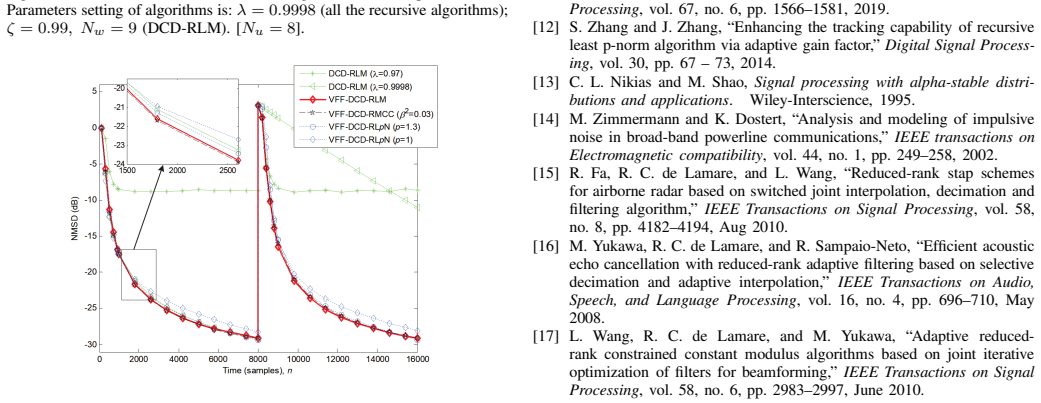
On its own terms, the paper claims that the DCD solver can be transplanted into robust exponentially weighted least squares by writing the normal equations as $R_n w_n = z_n$ with $R_n = \lambda R_{n-1} + f_n x_n x_n^T$ and $z_n = \lambda z_{n-1} + f_n d_n x_n$, where $f_n = \phi'(\epsilon_n)/\epsilon_n$ for the robust cost $\phi$. Because $f_n$ is not available before the update, the paper replaces the a posteriori error $\epsilon_n$ with the a priori error $e_n$, giving the closed-form update of Table I; each new time step is then an auxiliary linear system $R_n \Delta w_n = b_n$ that DCD solves with a handful of coordinate updates using only additions and bit-shifts. Instantiating $\phi$ for correntropy, a modified Huber M-estimate, and the $l_p$-norm produces the DCD-RMCC, DCD-RLM, and DCD-RLpN algorithms, and the paper reports that in $\alpha$-stable noise these match the steady-state NMSD of RMCC, RLM, and RLpN with as few as $N_u = 8$ DCD iterations, while the VFF rule (12) improves tracking after a sudden 12-sample shift of the echo channel.
Load-bearing premise
The recursion assumes that replacing the error after the update with the error before the update in the robust weight $f_n = \phi'(\epsilon_n)/\epsilon_n$ is accurate enough that the recursion still solves the robust least-squares problem; this is least reliable exactly at the large, impulsive error samples that the robust weights are designed to suppress.
Editorial extensions
If this is right
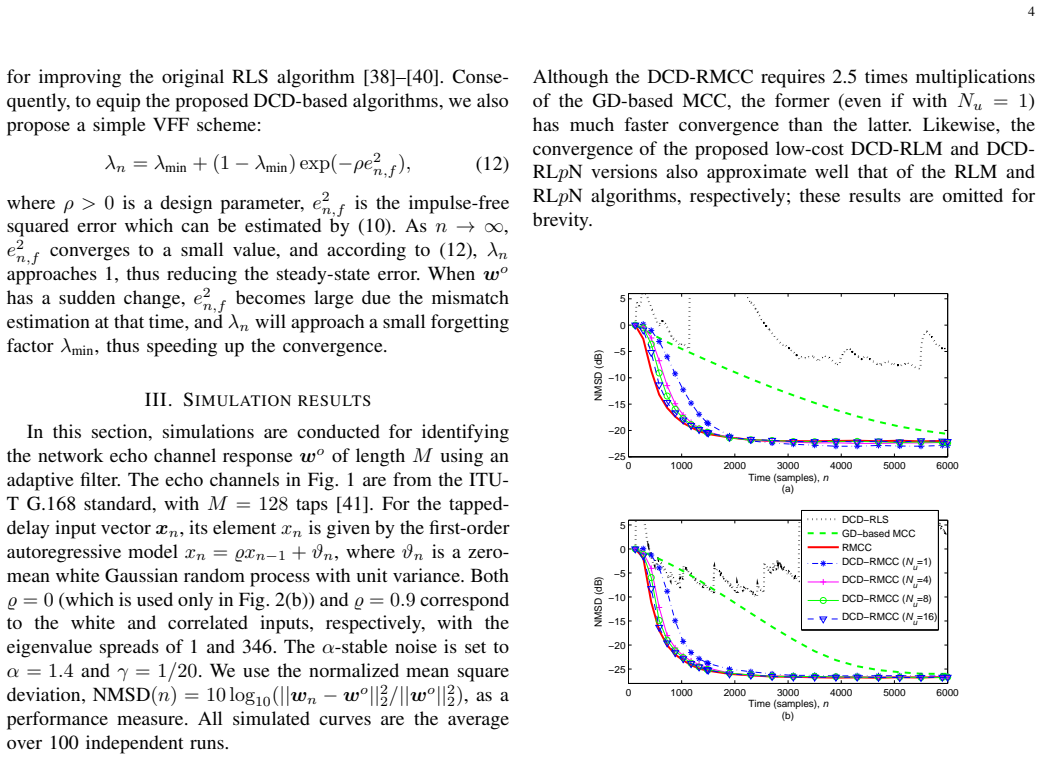
- DCD-RMCC with Nu = 8 reaches essentially the same steady-state NMSD as the full RMCC on both sparse and dispersive network echo channels under alpha-stable noise, while needing only a fraction of the arithmetic operations.
- The same Table I recursion, with only the robust cost swapped, reproduces RLM and RLpN behavior, so one software implementation covers three robust criteria.
- For tapped-delay inputs, the per-sample complexity drops to the same order as LMS, making robust recursive filtering practical for large filter lengths, such as echo cancellation.
- The VFF rule makes the forgetting factor approach 1 in steady state and drop toward a small minimum right after an abrupt change, lowering steady-state error without giving up tracking speed.
- Tuning the kernel width in DCD-RMCC interpolates between ordinary DCD-RLS at a large width and a frozen update at a small width, giving a graceful robustness and complexity trade-off.
Reading between the lines
- Beyond the paper: the unified scalar-weight form suggests any robust loss with a computable derivative could be dropped into Table I directly; a testable extension is to add other M-estimators and measure NMSD, which should require changing only the robust cost row.
- Beyond the paper: the a priori substitution (9) is probably the sharpest limit on performance under very heavy tails; recomputing the weight from the a posteriori error after the DCD update and comparing the two versions would isolate this effect.
- Beyond the paper: the order-M complexity claim for tapped-delay inputs depends on the weight varying slowly; in fast-tracking or frequent-impulse scenarios, one could measure the actual arithmetic count and NMSD to see where the approximation (11) breaks.
- Beyond the paper: the VFF uses the RLM variance estimate (10), but the same mechanism might need recalibration when used with MCC or lp-norm weights; a sensitivity study over the VFF design parameters would show whether the design is transferable.
Editorial analysis
A structured set of objections, weighed in public.
Referee Report
Summary. The paper proposes a family of low-complexity recursive adaptive algorithms for impulsive-noise environments. It starts from a unified robust exponentially weighted least-squares cost in Eq. (2), derives the normal equations (3)-(5), and uses DCD iterations to solve the auxiliary system (6) approximately, leading to the unified update in Table I. Robustness enters through the weight f_n = phi'(epsilon_n)/epsilon_n with the a posteriori error epsilon_n, which is approximated by the a priori error in Eq. (9). Three instantiations are given in Table III (DCD-RMCC, DCD-RLM, DCD-RLpN), and a variable forgetting factor in Eq. (12) is proposed for tracking abrupt system changes. Simulations for network echo-channel identification compare the DCD-based algorithms with DCD-RLS, GD-MCC, RMCC, and DCD-CMPN, and illustrate the VFF tracking behavior.
Significance. If the central claims are secured, the paper would be a useful practical contribution: DCD reduces the arithmetic complexity of recursive robust filters, uses mainly shift-and-add operations, and the unified formula in Table I covers several robust criteria. The derivation from a stated cost is transparent, and the DCD-RMCC curves in Fig. 2 agree well with the RMCC baseline at Nu = 8, which is positive evidence for that particular specialization. However, the main claims are not fully supported: the a priori-error substitution in Eq. (9) is unanalyzed and is least reliable at impulsive samples, the O(M) tapped-delay complexity rests on the unproved approximation f_n approx f_{n-1} in Eq. (11), the promised RLM and RLpN baseline comparisons are omitted from the simulations, and the RLpN weight in Table III is not exactly phi'(e)/e. These issues are fixable, but they affect the central advertised results rather than being purely editorial.
major comments (4)
- [Section II-A, Eq. (9)] The definition f_n = phi'(epsilon_n)/epsilon_n uses the a posteriori error epsilon_n = d_n - x_n^T w_n, which depends on the unknown w_n, so Eq. (3) is a fixed-point condition rather than an explicit linear system. Replacing epsilon_n with the a priori error e_n is not accompanied by any bound on |phi'(epsilon_n)/epsilon_n - phi'(e_n)/e_n| or by an analysis of how the mismatch propagates through R_n, b_n, and the DCD solution. The approximation is not uniformly benign: for DCD-RLM, f(e) is discontinuous at |e| = xi, so a one-sample misclassification flips f_n between 1 and 0; for DCD-RLpN, f(e)e is of order |e|^{p-1}, so an impulsive sample can produce a moderate right-hand-side term in Eq. (7) despite a small f_n. Consequently, Table I is at best a heuristic M-estimator recursion, and the claim that it solves the robust least-squares problem (2) is not established. I request either a quantitative error analysis or a revised statement that limits the claim to a heuristic recursion.
- [Section II-C, Eq. (11)] The O(M) complexity claim for tapped-delay inputs relies on the approximation f_n approx f_{n-1} in Eq. (11) to obtain the lower-right block of R_n by copying the corresponding block of R_{n-1}. By the algorithms' own design in Section II-B and Remark 1, f_n changes abruptly from about 1 to a very small value exactly when an impulse occurs, so the approximation error is largest precisely at the samples where the robust weighting is active. The paper should quantify the error incurred in R_n, or justify why a one-sample error in the recursion is harmless for subsequent DCD iterations; without this, the claimed complexity reduction for robust DCD in impulsive noise is not fully demonstrated.
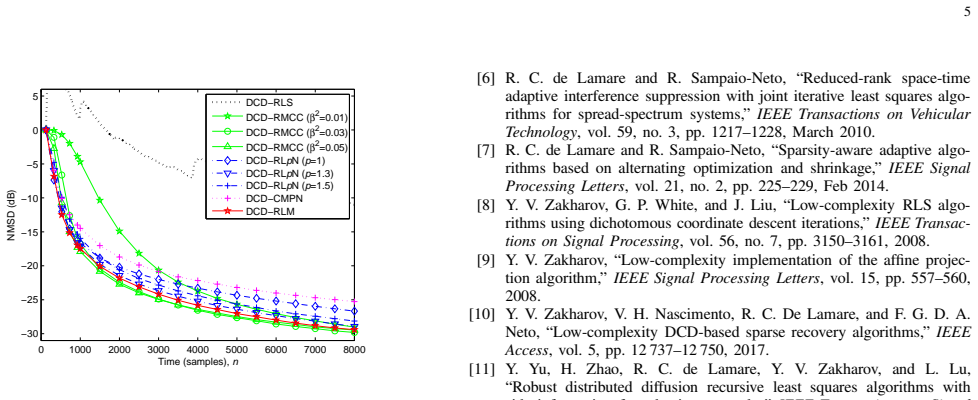
- [Section III, Fig. 2 and following text] The central equivalence claim that DCD-RLM and DCD-RLpN 'approximate well' the corresponding RLM and RLpN algorithms is not supported by any displayed simulation curve; the text says these results are 'omitted for brevity.' Figure 3 compares only DCD-based algorithms and DCD-CMPN. Please add the RLM and RLpN baseline curves, or explicitly restrict the empirical claim to DCD-RMCC. The abstract and conclusion currently assert similarity to RMCC, RLM, and RLpN, so the missing baselines are load-bearing for the paper's main claim.
- [Table III, DCD-RLpN row] For phi(e) = |e|^p, the definition in Eq. (9) yields f(e) = p|e|^{p-2} for e not equal to 0, whereas the table lists f(e) = |e|^p/(|e|^2 + epsilon), which is a different regularized weight and omits the factor p. The omitted factor is not completely harmless because the regularization term delta_n I_M in Eq. (4) breaks the scale invariance of the normal equations with respect to a common scaling of all f_i. Please state whether p is intentionally absorbed, define the behavior near e = 0, and identify the tabulated expression as an approximation to phi'(e)/e rather than the exact derivative ratio.
minor comments (6)
- [Eq. (10)] The initialization of sigma_hat_{e,0}^2 and the handling of the median window at startup are not specified; please state the initialization so that the DCD-RLM implementation is fully reproducible.
- [Eq. (12)] The term e_{n,f} is not defined; the sentence 'which can be estimated by (10)' is ambiguous because Eq. (10) is a recursion for the variance estimate sigma_hat_{e,n}^2, not an instantaneous impulse-free squared error. Please define e_{n,f} and its estimator explicitly.
- [Eq. (2)] The notation '0 << lambda < 1' should be '0 < lambda < 1'; the current expression is not a well-formed condition on lambda.
- [Table IV] The complexity table drops the cost of computing f_n; for RMCC this cost includes an exponential evaluation and for RLM it includes a median filter over a window, so the headline complexity comparison is incomplete unless these costs are argued to be negligible relative to M.
- [Section II-B, DCD-RLM item] The statement that 'fn becomes 0 to stop the update' assumes that |e_n| exceeds the threshold xi; for correlated inputs and after an abrupt channel change, |e_n| may remain above xi for many consecutive samples, which would freeze adaptation entirely. A brief comment on this transient behavior would help the reader assess the algorithm.
- [Fig. 3 caption] The caption contains a typo: '[Nu = 8]' should read 'Nu = 8', and the values of epsilon for DCD-RLpN and of any additional parameters for DCD-CMPN are not listed.
Circularity Check
No circularity: the unified recursion follows algebraically from the stated robust LS criterion, and all comparisons are against external baselines.
full rationale
The paper's derivation chain is not circular. Equation (2) defines a robust exponentially weighted least-squares criterion; differentiating it yields the normal equations (3) with f_n = phi'(epsilon_n)/epsilon_n, and equations (4)-(5) are the standard recursive forms of R_n and z_n. The auxiliary system (6) and the residual update (7) are algebraic rearrangements of these definitions, not restatements of the desired conclusion. The only substantive step is Eq. (9), which approximates the a posteriori error epsilon_n by the a priori error e_n so that f_n can be evaluated before solving the auxiliary system. This is an uncontrolled approximation and a genuine correctness risk, but it is not a concealed fit: it does not make the result equal its input by construction, and it does not turn a fitted parameter into a prediction. DCD-RMCC, DCD-RLM, and DCD-RLpN are instantiations of the same recursion with previously published robust cost functions, and the simulations compare them against independently defined RMCC/RLM/RLpN algorithms with hand-set parameters rather than parameters fitted to the target curves. The DCD solver is quoted from prior work but is also fully specified in Table II, so the self-citations to [8], [9], and [11] are not load-bearing evidence for the paper's novel claim. The variable forgetting factor (12) is stated as a heuristic and evaluated in simulation. The omission of the promised RLM and RLpN baseline curves is an evidentiary gap, not circularity. Thus the central claim is supported by an independent derivation plus external benchmarks, and no prediction reduces by definition to its inputs.
Assumptions & free parameters
free parameters (12)
- beta (MCC kernel width) =
beta^2 = 0.01, 0.03, 0.05 (Fig. 3)
- p (lp-norm exponent) =
p = 1, 1.3, 1.5 (Fig. 3)
- tau (RLM threshold multiplier) =
2.576
- zeta (variance estimate forgetting factor) =
0.99
- N_w (median window length) =
9
- rho (VFF sensitivity) =
3
- lambda_min (minimum forgetting factor) =
0.97
- N_u (DCD iteration limit) =
1, 4, 8, 16 (Fig. 2); 8 (Figs. 3-4)
- H, M_b (DCD fixed-point range/bit depth) =
H = 1, M_b = 16
- lambda (base forgetting factor) =
0.998 (Fig. 2), 0.9998 (Figs. 3-4)
- delta_0 (initial regularization) =
not specified
- epsilon (RLpN regularizer) =
not specified
assumptions (7)
- domain assumption Symmetric alpha-stable noise with characteristic function phi(t)=exp(-gamma|t|^alpha) (Eq. 1)
- domain assumption The robust objective (2) is differentiable and its minimizer satisfies the normal equations (3)
- ad hoc to paper The a priori error can replace the a posteriori error in f_n (Eq. 9)
- ad hoc to paper f_n varies slowly enough that Eq. (11) approximates R_n for tapped-delay inputs
- domain assumption DCD iterations from [8] solve R_n Delta w = b_n accurately enough with N_u <= 8
- domain assumption Median-based variance estimate in Eq. (10) provides a reliable sigma_hat_e,n
- ad hoc to paper The regularized f(e)=|e|^p/(|e|^2+epsilon) in Table III represents the lp-norm derivative
Cite this review
Pith. "Pith review of Robust DCD-Based Recursive Adaptive Algorithms." pith.science (2026). https://pith.science/paper/FI76SEBJ
@misc{pith2026190806369,
  author       = {Pith},
  title        = {Pith review of: Robust DCD-Based Recursive Adaptive Algorithms},
  year         = {2026},
  howpublished = {\url{https://pith.science/paper/FI76SEBJ}},
  note         = {Machine review of arXiv:1908.06369}
}
read the original abstract
The dichotomous coordinate descent (DCD) algorithm has been successfully used for significant reduction in the complexity of recursive least squares (RLS) algorithms. In this work, we generalize the application of the DCD algorithm to RLS adaptive filtering in impulsive noise scenarios and derive a unified update formula. By employing different robust strategies against impulsive noise, we develop novel computationally efficient DCD-based robust recursive algorithms. Furthermore, to equip the proposed algorithms with the ability to track abrupt changes in unknown systems, a simple variable forgetting factor mechanism is also developed. Simulation results for channel identification scenarios in impulsive noise demonstrate the effectiveness of the proposed algorithms.
Figures

Figures from the paper (1 more)
Reference graph
Works this paper leans on
-
[1]
A. H. Sayed, Fundamentals of adaptive filtering . John Wiley & Sons, 2003
work page 2003
-
[2]
Adaptive reduced-r ank mmse filtering with interpolated fir filters and adaptive interpol ators,
R. C. de Lamare and R. Sampaio-Neto, “Adaptive reduced-r ank mmse filtering with interpolated fir filters and adaptive interpol ators,” IEEE Signal Processing Letters , vol. 12, no. 3, pp. 177–180, March 2005
work page 2005
-
[3]
Reduced-rank adapt ive filtering based on joint iterative optimization of adaptive filters,
R. C. de Lamare and R. Sampaio-Neto, “Reduced-rank adapt ive filtering based on joint iterative optimization of adaptive filters,” IEEE Signal Processing Letters, vol. 14, no. 12, pp. 980–983, Dec 2007
work page 2007
-
[4]
R. C. de Lamare and P . S. R. Diniz, “Set-membership adapti ve al- gorithms based on time-varying error bounds for cdma interf erence suppression,” IEEE Transactions on V ehicular Technology, vol. 58, no. 2, pp. 644–654, Feb 2009
work page 2009
-
[5]
R. C. de Lamare and R. Sampaio-Neto, “Adaptive reduced-r ank process- ing based on joint and iterative interpolation, decimation , and filtering,” IEEE Transactions on Signal Processing , vol. 57, no. 7, pp. 2503–2514, July 2009
work page 2009
-
[6]
R. C. de Lamare and R. Sampaio-Neto, “Reduced-rank space -time adaptive interference suppression with joint iterative le ast squares algo- rithms for spread-spectrum systems,” IEEE Transactions on V ehicular Technology, vol. 59, no. 3, pp. 1217–1228, March 2010
work page 2010
-
[7]
Sparsity-aware ada ptive algo- rithms based on alternating optimization and shrinkage,
R. C. de Lamare and R. Sampaio-Neto, “Sparsity-aware ada ptive algo- rithms based on alternating optimization and shrinkage,” IEEE Signal Processing Letters, vol. 21, no. 2, pp. 225–229, Feb 2014
work page 2014
-
[8]
Low-complexity R LS algo- rithms using dichotomous coordinate descent iterations,
Y . V . Zakharov, G. P . White, and J. Liu, “Low-complexity R LS algo- rithms using dichotomous coordinate descent iterations,” IEEE Transac- tions on Signal Processing , vol. 56, no. 7, pp. 3150–3161, 2008
work page 2008
Show all 41 references
-
[9]
Low-complexity implementation of the a ffine projec- tion algorithm,
Y . V . Zakharov, “Low-complexity implementation of the a ffine projec- tion algorithm,” IEEE Signal Processing Letters , vol. 15, pp. 557–560, 2008
2008
-
[10]
Low-complexity DCD-based sparse recovery algorith ms,
Y . V . Zakharov, V . H. Nascimento, R. C. De Lamare, and F. G . D. A. Neto, “Low-complexity DCD-based sparse recovery algorith ms,” IEEE Access, vol. 5, pp. 12 737–12 750, 2017
2017
-
[11]
Robust distributed diffusion recursive least squares alg orithms with side information for adaptive networks,
Y . Y u, H. Zhao, R. C. de Lamare, Y . V . Zakharov, and L. Lu, “Robust distributed diffusion recursive least squares alg orithms with side information for adaptive networks,” IEEE Transactions on Signal Processing, vol. 67, no. 6, pp. 1566–1581, 2019
2019
-
[12]
Enhancing the tracking capabili ty of recursive least p-norm algorithm via adaptive gain factor,
S. Zhang and J. Zhang, “Enhancing the tracking capabili ty of recursive least p-norm algorithm via adaptive gain factor,” Digital Signal Process- ing, vol. 30, pp. 67 – 73, 2014
2014
-
[13]
C. L. Nikias and M. Shao, Signal processing with alpha-stable distri- butions and applications . Wiley-Interscience, 1995
1995
-
[14]
Analysis and modeling of impulsive noise in broad-band powerline communications,
M. Zimmermann and K. Dostert, “Analysis and modeling of impulsive noise in broad-band powerline communications,” IEEE transactions on Electromagnetic compatibility, vol. 44, no. 1, pp. 249–258, 2002
2002
-
[15]
Reduced-rank stap sc hemes for airborne radar based on switched joint interpolation, d ecimation and filtering algorithm,
R. Fa, R. C. de Lamare, and L. Wang, “Reduced-rank stap sc hemes for airborne radar based on switched joint interpolation, d ecimation and filtering algorithm,” IEEE Transactions on Signal Processing , vol. 58, no. 8, pp. 4182–4194, Aug 2010
2010
-
[16]
Efficie nt acoustic echo cancellation with reduced-rank adaptive filtering bas ed on selective decimation and adaptive interpolation,
M. Y ukawa, R. C. de Lamare, and R. Sampaio-Neto, “Efficie nt acoustic echo cancellation with reduced-rank adaptive filtering bas ed on selective decimation and adaptive interpolation,” IEEE Transactions on Audio, Speech, and Language Processing , vol. 16, no. 4, pp. 696–710, May 2008
2008
-
[17]
Adaptive reduce d- rank constrained constant modulus algorithms based on join t iterative optimization of filters for beamforming,
L. Wang, R. C. de Lamare, and M. Y ukawa, “Adaptive reduce d- rank constrained constant modulus algorithms based on join t iterative optimization of filters for beamforming,” IEEE Transactions on Signal Processing, vol. 58, no. 6, pp. 2983–2997, June 2010
2010
-
[18]
Distributed compr essed estimation based on compressive sensing,
S. Xu, R. C. de Lamare, and H. V . Poor, “Distributed compr essed estimation based on compressive sensing,” IEEE Signal Processing Letters, vol. 22, no. 9, pp. 1311–1315, Sep. 2015
2015
-
[19]
Adaptive link sele ction algorithms for distributed estimation,
S. Xu, R. C. de Lamare, and H. V . Poor, “Adaptive link sele ction algorithms for distributed estimation,” Eurasip Journal on Advances in Signal Processing, no. 86, pp. 1–22, 2015
2015
-
[20]
Distr ibuted spectrum estimation based on alternating mixed discrete-c ontinuous adaptation,
T. G. Miller, S. Xu, R. C. de Lamare, and H. V . Poor, “Distr ibuted spectrum estimation based on alternating mixed discrete-c ontinuous adaptation,” IEEE Signal Processing Letters , vol. 23, no. 4, pp. 551– 555, April 2016
2016
-
[21]
Robust adapti ve beam- forming algorithms using the constrained constant modulus criterion,
L. Landau, R. C. de Lamare, and M. Haardt, “Robust adapti ve beam- forming algorithms using the constrained constant modulus criterion,” IET Signal Processing , vol. 8, no. 5, pp. 447–457, July 2014
2014
-
[22]
Robust adaptive beamformin g using a low-complexity shrinkage-based mismatch estimation algo rithm,
H. Ruan and R. C. de Lamare, “Robust adaptive beamformin g using a low-complexity shrinkage-based mismatch estimation algo rithm,” IEEE Signal Processing Letters , vol. 21, no. 1, pp. 60–64, Jan 2014
2014
-
[23]
Robust adaptive beamformin g based on low-rank and cross-correlation techniques,
H. Ruan and R. C. de Lamare, “Robust adaptive beamformin g based on low-rank and cross-correlation techniques,” IEEE Transactions on Signal Processing, vol. 64, no. 15, pp. 3919–3932, Aug 2016
2016
-
[24]
Robust M-estimate adaptive fi ltering,
Y . Zou, S. Chan, and T. Ng, “Robust M-estimate adaptive fi ltering,” IEE Proceedings-Vision, Image and Signal Processing , vol. 148, no. 4, pp. 289–294, 2001
2001
-
[25]
Combination of rec ursive least p-norm algorithms for robust adaptive filtering in alpha-sta ble noise,
´A. Navia-V azquez and J. Arenas-Garcia, “Combination of rec ursive least p-norm algorithms for robust adaptive filtering in alpha-sta ble noise,” IEEE Transactions on Signal Processing , vol. 60, no. 3, pp. 1478–1482, 2012
2012
-
[26]
Continuous mixed p-norm adaptive algorithm for system identification,
H. Zayyani, “Continuous mixed p-norm adaptive algorithm for system identification,” IEEE Signal Processing Letters , vol. 21, no. 9, pp. 1108– 1110, 2014
2014
-
[27]
Recursive Gema n- mcclure estimator for implementing second-order Volterra filter,
L. Lu, W. Wang, X. Y ang, W. Wu, and G. Zhu, “Recursive Gema n- mcclure estimator for implementing second-order Volterra filter,” IEEE Transactions on Circuits and Systems II: Express Briefs , vol. 66, no. 7, pp. 1272–1276, 2019
2019
-
[28]
A variable step-size norma lized subband adaptive filter with a step-size scaler against impulsive me asurement 6 noise,
J. Hur, I. Song, and P . Park, “A variable step-size norma lized subband adaptive filter with a step-size scaler against impulsive me asurement 6 noise,” IEEE Transactions on Circuits and Systems II: Express Brief s, vol. 64, no. 7, pp. 842–846, 2016
2016
-
[29]
Generalized correntropy for robust adaptive filtering,
B. Chen, L. Xing, H. Zhao, N. Zheng, and J. C. Pr´ ıncipe, “ Generalized correntropy for robust adaptive filtering,” IEEE Transactions on Signal Processing, vol. 64, no. 13, pp. 3376–3387, 2016
2016
-
[30]
An improved variable k ernel width for maximum correntropy criterion algorithm,
L. Shi, H. Zhao, and Y . Zakharov, “An improved variable k ernel width for maximum correntropy criterion algorithm,” IEEE Transactions on Circuits and Systems II: Express Briefs , 2018
2018
-
[31]
Steady-state mean-square error analysis for adaptive filtering under the maximum correntropy criterion,
B. Chen, L. Xing, J. Liang, N. Zheng, and J. C. Principe, “ Steady-state mean-square error analysis for adaptive filtering under the maximum correntropy criterion,” IEEE signal processing letters , vol. 21, no. 7, pp. 880–884, 2014
2014
-
[32]
Convergence of a fixed-point algorithm under maximum correntropy criter ion,
B. Chen, J. Wang, H. Zhao, N. Zheng, and J. C. Pr´ ıncipe, “ Convergence of a fixed-point algorithm under maximum correntropy criter ion,” IEEE Signal Processing Letters , vol. 22, no. 10, pp. 1723–1727, 2015
2015
-
[33]
Recursive maximum corr entropy learning algorithm with adaptive kernel size,
H. Radmanesh and M. Hajiabadi, “Recursive maximum corr entropy learning algorithm with adaptive kernel size,” IEEE Transactions on Circuits and Systems II: Express Briefs , vol. 65, no. 7, pp. 958–962, 2018
2018
-
[34]
S. A. Kassam, Signal detection in non-Gaussian noise . Springer Science & Business Media, 2012
2012
-
[35]
A recursive least M-estimate algorithm for robust adaptive filtering in impulsive noise: fast algorith m and conver- gence performance analysis,
S.-C. Chan and Y .-X. Zou, “A recursive least M-estimate algorithm for robust adaptive filtering in impulsive noise: fast algorith m and conver- gence performance analysis,” IEEE Transactions on Signal Processing , vol. 52, no. 4, pp. 975–991, 2004
2004
-
[36]
Robust Huber adaptive filter,
P . Petrus, “Robust Huber adaptive filter,” IEEE Transactions on Signal Processing, vol. 47, no. 4, pp. 1129–1133, 1999
1999
-
[37]
Improved convergence analysis o f stochastic gradient adaptive filters using the sign algorithm,
V . Mathews and S. Cho, “Improved convergence analysis o f stochastic gradient adaptive filters using the sign algorithm,” IEEE Transactions on Acoustics, Speech, and Signal Processing , vol. 35, no. 4, pp. 450–454, 1987
1987
-
[38]
Fast tracking RLS algorithm using novel variable forgetting factor with unity zone,
D.-J. Park, B.-E. Jun, and J.-H. Kim, “Fast tracking RLS algorithm using novel variable forgetting factor with unity zone,” Electronics Letters , vol. 27, no. 23, pp. 2150–2151, 1991
1991
-
[39]
A robust var iable forgetting factor recursive least-squares algorithm for system ident ification,
C. Paleologu, J. Benesty, and S. Ciochina, “A robust var iable forgetting factor recursive least-squares algorithm for system ident ification,” IEEE Signal Processing Letters , vol. 15, pp. 597–600, 2008
2008
-
[40]
Low-compl exity variable forgetting factor mechanism for blind adaptive co nstrained constant modulus algorithms,
Y . Cai, R. C. de Lamare, M. Zhao, and J. Zhong, “Low-compl exity variable forgetting factor mechanism for blind adaptive co nstrained constant modulus algorithms,” IEEE Transactions on Signal Processing , vol. 60, no. 8, pp. 3988–4002, 2012
2012
-
[41]
ITU-TG.168 (V8), 2015
Digital Network Echo Cancellers Recommendation , Std. ITU-TG.168 (V8), 2015
2015
Reviewed August 14, 2026 · model on record in the stance chip above.
Discussion (0). Continue with ORCID to comment.