REVIEW 3 major objections 5 minor 43 references
Asynchronous Single-Photon 3D Imaging
T0 review · 3 major / 5 minor · reviewed 2026-08-14 · deepseek-v4-flash
Pith's one-line read Deliberately mismatching the SPAD detector window and the laser cycle averages out photon pileup and restores depth accuracy in bright ambient light.
desk verdict The empirical case for asynchronous SPAD 3D imaging is solid and the depth accuracy gains are real; the 'theoretically optimal' framing overstates what Result 1 proves, but that is fixable and does not change the verdict. read the letter →
The pith
A machine-rendered reading of the paper's core claim, the machinery that carries it, and where it could break.
The reading
What carries the argument
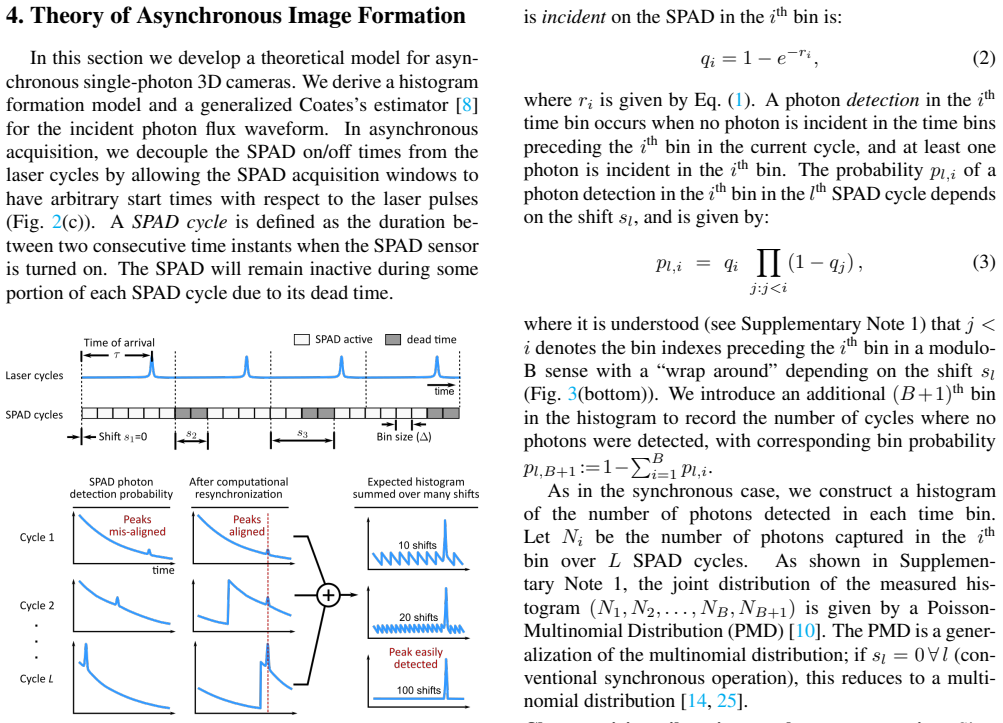
The load-bearing object is the denominator sequence $D_i$: the number of SPAD cycles in which histogram bin $i$ is still active, meaning no photon was detected before it. The generalized Coates estimator $q_i = N_i / D_i$ is the maximum-likelihood estimate of the per-bin photon-arrival probability, and pileup is exactly what drives $D_i$ to near zero in late bins. Uniform shifting makes the expected denominator $E[D_i]$ equal across bins, which the paper proves minimizes an upper bound on the probability of depth error and makes error roughly depth-invariant. The two companion mechanisms are the optimal active time $m_{opt}$, which maximizes total expected denominator under a fixed acquisition time, and photon-driven shifting, whose random cycle lengths drive the shift sequence to a uniform stationary distribution.
What would settle it
Measure the empirical per-bin denominator $E[D_i]$ under uniform shifting with a number of SPAD cycles not divisible by the number of bins; Result 2's approximation predicts these values are nearly equal, so if a deliberately non-uniform shift sequence with the same total denominator produces lower depth RMSE under the low-background-light, near-Gaussian regime, Result 1's optimality claim would be refuted.
Extended reading notes
Core claim
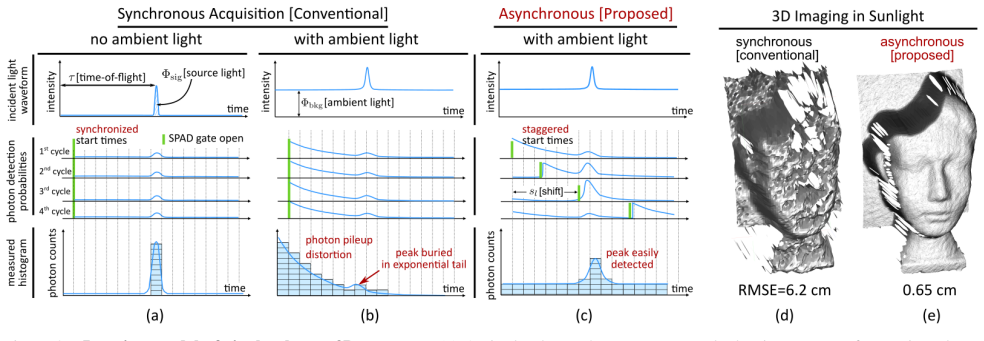
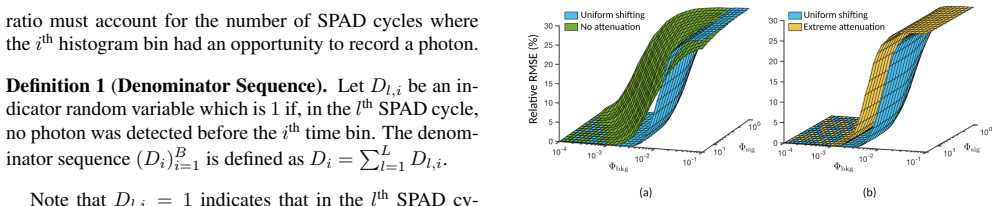
The central discovery is that photon pileup in SPAD time-of-flight depth cameras can be largely prevented at acquisition time instead of only corrected after the fact. Deliberately cycling the detector's timing window through offsets that span one full laser period redistributes the exponentially decaying bias caused by early-arriving ambient photons across all histogram bins, while the reflected laser pulse stays at a fixed bin and accumulates coherently. The paper proves that, in the low signal-to-background regime, a uniform shift sequence yields a constant expected denominator sequence (Result 2), which in turn minimizes an upper bound on the probability of depth error (Result 1), and that free-running photon-driven shifting produces the same uniformity asymptotically (Result 3). Simulations and experiments with a fast-gated SPAD show up to an order-of-magnitude lower depth RMSE than synchronous acquisition with extreme attenuation.
Load-bearing premise
The proof that uniform shifting is the optimal strategy assumes background photons dominate signal photons at every time bin, treats the estimator's error as roughly Gaussian, and uses an upper bound on the chance of choosing the wrong depth bin as a stand-in for actual depth error; if those approximations fail, some other shift pattern could beat uniform shifting.
Editorial extensions
If this is right
- SPAD-based LiDAR can recover accurate depth in strong ambient light without heavy optical attenuation, because asynchronous shifting redistributes pileup rather than merely correcting it.
- The generalized Coates estimator provides a closed-form, non-iterative way to estimate the incident flux waveform from arbitrarily shifted histograms, making real-time depth estimation feasible.
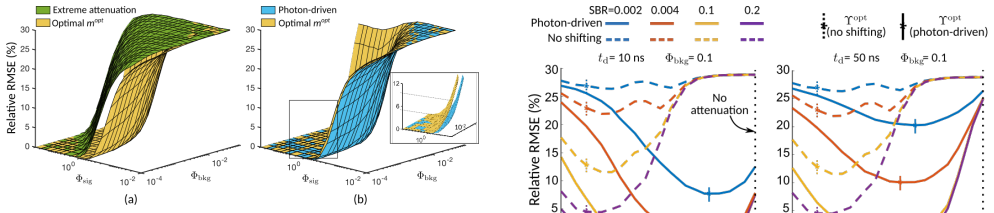
- Uniform shifting combined with the optimal SPAD active time gives up to a factor-of-6 RMSE improvement over using the full active window, and up to an order-of-magnitude improvement over synchronous methods overall.
- Photon-driven shifting adapts automatically to per-pixel albedo variations, so one acquisition setting works for both bright and dark objects without per-pixel attenuation tuning.
- Combining photon-driven shifting with optimal flux attenuation further reduces depth error, in some settings to near zero.
Reading between the lines
- Because the constant-denominator argument is independent of the true depth, asynchronous acquisition should make depth-error RMSE roughly flat across the full unambiguous range; this is testable by plotting per-depth-bin RMSE, and the paper's supplementary figure already shows this trend.
- The same 'shift to average out pileup' recipe should transfer to other TCSPC-based active imaging, for example fluorescence lifetime imaging or non-line-of-sight imaging, although the paper cautions that non-uniform shift sequences may be needed when the incident waveform is an exponential decay or an arbitrary transient rather than a periodic delta pulse.
- An online adaptive acquisition controller—estimate the ambient flux with a few early cycles, then switch between uniform shifting, photon-driven shifting, and optimal attenuation—would combine the regimes the paper analyzes separately and is a natural next step.
- The photon-driven uniformity result is asymptotic in the number of cycles, so quantifying its finite-time mixing rate would tell practitioners how long acquisition must run before the depth-dependent denominator bias disappears.
Signed reviews
Editorial analysis
A structured set of objections, weighed in public.
Referee Report
Summary. The paper proposes asynchronous acquisition for SPAD-based 3D imaging, in which the SPAD measurement windows are deliberately shifted relative to the laser pulse train, either by a deterministic uniform sequence or by a stochastic photon-driven sequence. The authors develop a Poisson-multinomial histogram formation model, derive a generalized Coates maximum-likelihood estimator for the incident flux waveform, and prove two results intended to show that uniform shifting yields a constant expected denominator sequence and that this minimizes an upper bound on the probability of depth error. They also analyze active-time optimization and flux attenuation, and validate the approach with Monte Carlo simulations and a hardware prototype. The central empirical claim is that asynchronous acquisition improves depth RMSE by up to an order of magnitude compared with synchronous acquisition with extreme attenuation, across a wide range of ambient-flux conditions.
Significance. If the results hold, this is a valuable contribution to SPAD-based LiDAR: it mitigates pileup during acquisition rather than only in post-processing, and the hardware demonstration under strong ambient light (BΦbkg = 11, SBR = 0.02) is compelling. The paper provides self-contained mathematical derivations for the deterministic-shift estimator, closed-form expressions for the optimal active time and attenuation fraction, and extensive Monte Carlo and experimental comparisons against a strong synchronous baseline. The empirical depth-accuracy gains are convincing and are not obtained by fitting parameters to the data. The main weakness is that the theoretical optimality claims are proved for a surrogate l0 upper bound under several approximations, while the paper's framing at times suggests a stronger optimality guarantee; this needs to be corrected and qualified.
major comments (3)
- [Supplementary Note 2, Eq. (S6)] The proof of Result 1 replaces the average over i≠τ of the union-bound terms by a double sum over all i and τ. For i=τ the exponent is zero and each diagonal term equals 1/2, so the displayed '≈' adds B/2 to the bound and makes the subsequent statement that the bound is dominated by the largest 1/E[D_i] invalid: the diagonal terms dominate and contain no denominator dependence. Please exclude the diagonal (or justify that its contribution is negligible) and re-derive the optimization of the bound. This is load-bearing because Result 1 is the stated basis for the uniform-shifting optimality claim.
- [Section 5, Results 1–2 and 'Interpreting Results 1 and 2'] Result 1 is carefully qualified in its formal statement as an upper bound on the average probability of depth error, but the interpretive paragraph claims that a constant expected denominator sequence 'will have lower depth error than all other shifting strategies.' That goes beyond what is proved, since the theorem is established only for a surrogate l0 upper bound under the low-SBR approximation r_i≈Φbkg, a central-limit approximation for q̂_i−q̂_τ, and a union bound. In addition, Result 2 is stated without the condition, supplied only in the proof, that L is a multiple of B; for the finite-L, L<B case used in the simulations (e.g., B=1000 with about 25 cycles), the expected denominator is only approximately uniform, with no bound on the approximation error. Please restate the results with their hypotheses and quantify or bound the finite-L nonuniformity before calling uniform shifting theoretically optimal. The empirical RMSE gains do not depend on exact optimality and can stand on their own.
- [Section 6.2 and Supplementary Note 5] The paper repeatedly refers to the generalized Coates estimator for photon-driven shifting, while footnote 6 concedes that the Poisson-multinomial model of Section 4 does not apply when the shift sequence is random. Supplementary Note 5 then asserts the same likelihood factorization 'as before' and gives the closed-form estimator in Eq. (S10) without deriving the likelihood from the actual dependent process, in which shifts are a deterministic function of previous photon arrival times. The estimator may be justifiable from the full likelihood of the arrival-time sequence, but that justification needs to be written out; as it stands, the claim that Eq. (S10) is a maximum-likelihood estimator for photon-driven acquisition is not supported. Please either provide the derivation or clearly label the photon-driven estimator as a heuristic that is validated empirically.
minor comments (5)
- [Figure 3 caption] The word 'aquisition' should be 'acquisition.'
- [Section 4, after Eq. (3)] The notation 'j<i in a modulo-B sense' is ambiguous; please define the set J_{l,i} in the main text as in Supplementary Note 1, and use it consistently in Eq. (3).
- [Supplementary Note 2, Eq. (S6)] Even after excluding the diagonal terms, the step 'dominated by the index i with the largest 1/E[D_i]' is informal; please state explicitly why, under the low-SBR model, the off-peak differences (q_i−q_τ) are identical for all i≠τ, so that the minimum denominator is the controlling quantity.
- [Section 6.1 and Supplementary Note 4] Equation (6) maximizes the total expected denominator, which is used as a surrogate for depth accuracy; the text should consistently say 'optimal active time under the l0 surrogate' rather than 'optimal active time,' especially in the opening of Section 6.1.
- [Supplementary Note 5, Result 3] The convergence of the empirical shift distribution to uniform is asymptotic; the practical statement that L≤50 cycles is sufficient should be supported by the denominator-bias simulations in Supplementary Figure 2 or by a mixing-time bound.
Circularity Check
No significant circularity; the optimality analysis is re-derived in the supplement and the headline RMSE gains are validated by independent simulations and hardware experiments.
full rationale
The paper's central derivation is self-contained. The asynchronous histogram model (Supp. Note 1, Eq. S3) is built from a Poisson-Multinomial likelihood, and the generalized Coates estimator is obtained as the element-wise MLE, not assumed. Result 1 is proved in Supp. Note 2 by a union bound, CLT and Chernoff bound on the estimator difference; the conclusion that a constant expected denominator minimizes the upper bound follows from the algebra, with only the standard variance formula sigma_i^2 = q_i(1-q_i)/E[D_i] attributed to the authors' prior work [13]. That self-citation is a subroutine, not the load-bearing conclusion, so it does not make the derivation circular. Result 2 is an algebraic calculation for uniform shifts under low SBR. The design quantities mopt and the attenuation fraction are parameter-free model predictions (Supp. Notes 4 and 7), and the RMSE improvements are then verified in Monte Carlo simulations and hardware experiments against an external synchronous baseline; no fitted quantity is renamed as a prediction. The main overstatement is semantic: uniform shifting is proved optimal only for an upper bound on l0 error under low-SBR/CLT approximations, while the paper calls it 'practically optimal'; that is a calibration or framing issue, not circularity. Score 2 reflects one minor non-load-bearing self-citation ('based on [13]'), with the central claims otherwise independent.
Assumptions & free parameters
assumptions (5)
- domain assumption Poisson statistics for incident photon flux and first-photon detection probability (Eqs. 1-3 in Section 3).
- domain assumption Ideal laser pulse modeled as a Dirac delta with one signal bin (Eq. 1).
- ad hoc to paper Low-SBR approximation ri approximately equals Phi_bkg for the theoretical optimality proofs (Supplementary Note 2, proof of Result 1).
- standard math Central limit theorem and Gaussian tail bound for the MLE difference in the l0 error upper bound (Supplementary Note 2).
- standard math Markov chain stationarity for photon-driven shifting (Supplementary Note 5, Result 3).
Cite this review
Pith. "Pith review of Asynchronous Single-Photon 3D Imaging." pith.science (2026). https://pith.science/paper/LBZ23Q3O
@misc{pith2026190806372,
  author       = {Pith},
  title        = {Pith review of: Asynchronous Single-Photon 3D Imaging},
  year         = {2026},
  howpublished = {\url{https://pith.science/paper/LBZ23Q3O}},
  note         = {Machine review of arXiv:1908.06372}
}
read the original abstract
Single-photon avalanche diodes (SPADs) are becoming popular in time-of-flight depth-ranging due to their unique ability to capture individual photons with picosecond timing resolution. However, ambient light (e.g., sunlight) incident on a SPAD-based 3D camera leads to severe non-linear distortions (pileup) in the measured waveform, resulting in large depth errors. We propose asynchronous single-photon 3D imaging, a family of acquisition schemes to mitigate pileup during data acquisition itself. Asynchronous acquisition temporally misaligns SPAD measurement windows and the laser cycles through deterministically predefined or randomized offsets. Our key insight is that pileup distortions can be "averaged out" by choosing a sequence of offsets that span the entire depth range. We develop a generalized image formation model and perform theoretical analysis to explore the space of asynchronous acquisition schemes and design high-performance schemes. Our simulations and experiments demonstrate an improvement in depth accuracy of up to an order of magnitude as compared to the state-of-the-art, across a wide range of imaging scenarios, including those with high ambient flux.
Figures

Figures from the paper (5 more)



Reference graph
Works this paper leans on
-
[1]
Giulia Acconcia, Alessandro Cominelli, Massimo Ghioni, and Ivan Rech. Fast fully-integrated front-end circuit to over- come pile-up limits in time-correlated single photon count- ing with single photon avalanche diodes. Opt. Express , 26(12):15398–15410, Jun 2018. 2, 3
work page 2018
-
[2]
Advanced time-correlated single photon counting applications, volume 111
Wolfgang Becker. Advanced time-correlated single photon counting applications, volume 111. Springer, 2015. 3
work page 2015
-
[3]
Background light rejection in spad-based lidar sensors by adaptive photon coincidence detection
Maik Beer, Jan Haase, Jennifer Ruskowski, and Rainer Kokozinski. Background light rejection in spad-based lidar sensors by adaptive photon coincidence detection. Sensors, 18(12):4338, Dec 2018. 2, 3
work page 2018
-
[4]
Single-photon spad imagers in biophotonics: Review and outlook
Claudio Bruschini, Harald Homulle, Ivan Michel Antolovic, Samuel Burri, and Edoardo Charbon. Single-photon spad imagers in biophotonics: Review and outlook. arXiv preprint, 2019. 1
work page 2019
-
[5]
Ar- chitecture and applications of a high resolution gated SPAD image sensor
Samuel Burri, Yuki Maruyama, Xavier Michalet, Francesco Regazzoni, Claudio Bruschini, and Edoardo Charbon. Ar- chitecture and applications of a high resolution gated SPAD image sensor. Optics Express, 22(14):17573, Jul 2014. 6
work page 2014
-
[6]
Mauro Buttafava, Gianluca Boso, Alessandro Ruggeri, Al- berto Dalla Mora, and Alberto Tosi. Time-gated single- photon detection module with 110 ps transition time and up to 80 mhz repetition rate. Review of Scientific Instruments , 85(8):083114, 2014. 3, 6, 7
work page 2014
-
[7]
Non-line-of-sight imaging using a time-gated single photon avalanche diode
Mauro Buttafava, Jessica Zeman, Alberto Tosi, Kevin Eli- ceiri, and Andreas Velten. Non-line-of-sight imaging using a time-gated single photon avalanche diode. Optics express, 23(16):20997–21011, 2015. 1, 3
work page 2015
-
[8]
P. B. Coates. The correction for photon ‘pile-up’ in the mea- surement of radiative lifetimes. Journal of Physics E: Scien- tific Instruments, 1(8):878, 1968. 3, 4, 5
work page 1968
Show all 43 references
-
[9]
High-speed and low- distortion solution for time-correlated single photon count- ing measurements: A theoretical analysis
Alessandro Cominelli, Giulia Acconcia, Pietro Peronio, Massimo Ghioni, and Ivan Rech. High-speed and low- distortion solution for time-correlated single photon count- ing measurements: A theoretical analysis. Review of Scien- tific Instruments, 88(12):123701, Dec 2017. 2, 3
2017
-
[10]
On the structure, covering, and learning of pois- son multinomial distributions
Constantinos Daskalakis, Gautam Kamath, and Christos Tzamos. On the structure, covering, and learning of pois- son multinomial distributions. arXiv preprint, 2015. 4
2015
-
[11]
Neale A. W. Dutton, Istvan Gyongy, Luca Parmesan, Sal- vatore Gnecchi, Neil Calder, Bruce R. Rae, Sara Pellegrini, Lindsay A. Grant, and Robert K. Henderson. A SPAD- based QVGA image sensor for single-photon counting and quanta imaging. IEEE Transactions on Electron Devices , ...
2016
-
[12]
Megapixel photon-counting color imaging using quanta image sensor
Abhiram Gnanasambandam, Omar Elgendy, Jiaju Ma, and Stanley H Chan. Megapixel photon-counting color imaging using quanta image sensor. Optics Express, 27(12):17298– 17310, 2019. 2
2019
-
[13]
Photon-flooded single-photon 3d cameras
Anant Gupta, Atul Ingle, Andreas Velten, and Mohit Gupta. Photon-flooded single-photon 3d cameras. In Proceedings of the IEEE CVPR, pages 6770–6779, 2019. 3, 5, 7, 8
2019
-
[14]
Sub-picosecond photon-efficient 3d imaging us- ing single-photon sensors
Felix Heide, Steven Diamond, David Lindell, and Gordon Wetzstein. Sub-picosecond photon-efficient 3d imaging us- ing single-photon sensors. Scientific Reports , 8(1), Dec
-
[15]
High flux pas- sive imaging with single photon sensors
Atul Ingle, Andreas Velten, and Mohit Gupta. High flux pas- sive imaging with single photon sensors. In Proc. CVPR, June 2019. 1
2019
-
[16]
Dead-time correction of fluorescence lifetime measurements and fluorescence lifetime imaging
Sebastian Isbaner, Narain Karedla, Daja Ruhlandt, Si- mon Christoph Stein, Anna Chizhik, Ingo Gregor, and J ¨org Enderlein. Dead-time correction of fluorescence lifetime measurements and fluorescence lifetime imaging. Optics ex- press, 24(9):9429–9445, 2016. 3
2016
-
[17]
Ad- vanced Photon Counting Applications, Methods, Instrumen- tation
Peter Kapusta, Michael Wahl, and Rainer Erdmann. Ad- vanced Photon Counting Applications, Methods, Instrumen- tation. Springer Series on Fluorescence, 15, 2015. 2, 3
2015
-
[18]
Progress in single- photon avalanche diode image sensors in standard cmos: From two-dimensional monolithic to three-dimensional- stacked technology
Myung-Jae Lee and Edoardo Charbon. Progress in single- photon avalanche diode image sensors in standard cmos: From two-dimensional monolithic to three-dimensional- stacked technology. Japanese Journal of Applied Physics , 57(10):1002A3, 2018. 2
2018
-
[19]
Single-Photon 3D Imaging with Deep Sensor Fusion
David Lindell, Matthew O’Toole, and Gordon Wetzstein. Single-Photon 3D Imaging with Deep Sensor Fusion. ACM Trans. Graph. (SIGGRAPH), 37(4), 2018. 2, 8
2018
-
[20]
Photon-number-resolving megapixel image sen- sor at room temperature without avalanche gain
Jiaju Ma, Saleh Masoodian, Dakota A Starkey, and Eric R Fossum. Photon-number-resolving megapixel image sen- sor at room temperature without avalanche gain. Optica, 4(12):1474–1481, 2017. 2
2017
-
[21]
Reconstructing transient images from single-photon sensors
Matthew O’Toole, Felix Heide, David Lindell, Kai Zang, Steven Diamond, and Gordon Wetzstein. Reconstructing transient images from single-photon sensors. In 2017 IEEE Conference on Computer Vision and Pattern Recognition (CVPR), pages 2289–2297, July 2017. 3
2017
-
[22]
Lindell, and Gordon Wetzstein
Matthew O’Toole, David B. Lindell, and Gordon Wetzstein. Confocal non-line-of-sight imaging based on the light-cone transform. Nature, 555:338–341, Mar 2018. 1
2018
-
[23]
Fluorescence decay data analysis correcting for detector pulse pile-up at very high count rates
Matthias Patting, Paja Reisch, Marcus Sackrow, Rhys Dowler, Marcelle Koenig, and Michael Wahl. Fluorescence decay data analysis correcting for detector pulse pile-up at very high count rates. Optical engineering, 57(3):031305,
-
[24]
Pawlikowska, Abderrahim Halimi, Robert A
Agata M. Pawlikowska, Abderrahim Halimi, Robert A. Lamb, and Gerald S. Buller. Single-photon three- dimensional imaging at up to 10 kilometers range. Optics Express, 25(10):11919, May 2017. 3
2017
-
[25]
Sig- nal processing based pile-up compensation for gated single- photon avalanche diodes
Adithya K Pediredla, Aswin C Sankaranarayanan, Mauro Buttafava, Alberto Tosi, and Ashok Veeraraghavan. Sig- nal processing based pile-up compensation for gated single- photon avalanche diodes. arXiv preprint arXiv:1806.07437,
-
[26]
Laser-based distance measure- ment using picosecond resolution time-correlated single- photon counting
Sara Pellegrini, Gerald S Buller, Jason M Smith, Andrew M Wallace, and Sergio Cova. Laser-based distance measure- ment using picosecond resolution time-correlated single- photon counting. Measurement Science and Technology , 11(6):712, 2000. 3
2000
-
[27]
A few photons among many: Unmixing signal and noise for photon-efficient ac- tive imaging
Joshua Rapp and Vivek Goyal. A few photons among many: Unmixing signal and noise for photon-efficient ac- tive imaging. IEEE Transactions on Computational Imaging, 3(3):445–459, Sept 2017. 2
2017
-
[29]
High speed lidar via GHz gated photon detector and locked but unequal optical pulse rates
Daniel Reilly and Gregory Kanter. High speed lidar via GHz gated photon detector and locked but unequal optical pulse rates. Optics Express, 22(13):15718, jun 2014. 3
2014
-
[30]
Single Photon Avalanche Diodes in CMOS Technology
Alexis Rochas. Single Photon Avalanche Diodes in CMOS Technology. PhD thesis, EPFL, 2003. 1
2003
-
[31]
Fast-gated single-photon counting technique widens dynamic range and speeds up acquisition time in time-resolved measurements
Alberto Tosi, Alberto Dalla Mora, Franco Zappa, Angelo Gulinatti, Davide Contini, Antonio Pifferi, Lorenzo Spinelli, Alessandro Torricelli, and Rinaldo Cubeddu. Fast-gated single-photon counting technique widens dynamic range and speeds up acquisition time in time-resolved mea...
2011
-
[32]
A 512x512 spad image sensor with inte- gratedgating for widefield flim
Arin Can Ulku, Claudio Bruschini, Ivan Michel Antolovic, Yung Kuo, Rinat Ankri, Shimon Weiss, Xavier Michalet, and Edoardo Charbon. A 512x512 spad image sensor with inte- gratedgating for widefield flim. IEEE Journal of Selected Topics in Quantum Electronics, 25(1):1–12, Jan 2019. 2, 3
2019
-
[33]
Time-Correlated Single Photon Counting,
Michael Wahl. Time-Correlated Single Photon Counting,
-
[34]
Coleman, and Shi- geo Minami
Xue Feng Wang, Teruo Uchida, David M. Coleman, and Shi- geo Minami. A two-dimensional fluorescence lifetime imag- ing system using a gated image intensifier. Applied Spec- troscopy, 45(3):360–366, mar 1991. 3
1991
-
[35]
Asynchronous Single-Photon 3D Imaging
Chao Zhang, Scott Lindner, Ivan Antolovic, Martin Wolf, and Edoardo Charbon. A CMOS SPAD Imager with Col- lision Detection and 128 Dynamically Reallocating TDCs for Single-Photon Counting and 3D Time-of-Flight Imaging. Sensors, 18(11):4016, Nov 2018. 3 10 Supplementary Documen...
2018
-
[36]
(Although not shown here, similar conclusion can be drawn for deterministic shifting as well.)
The performance gain from photon-driven acquisition is greater at longer distances. (Although not shown here, similar conclusion can be drawn for deterministic shifting as well.)
-
[37]
Reindeer
RMSE is approximately depth-invariant for photon-driven shifting. Achieving uniform error over all depths is not our primary goal, but a byproduct of our optimal acquisition schemes. We define optimality in terms of a surrogate of𝓁2 depth error metric which measures overall dep...
-
[38]
Murphy, Machine Learning: A Probabilistic Perspective
K. Murphy, Machine Learning: A Probabilistic Perspective. Cambridge, MA: MIT Press, 2012, pp. 35
2012
-
[39]
Daskalakis, G
C. Daskalakis, G. Kamath, and C. Tzamos. On the structure, covering, and learning of poisson multinomial distributions. arXiv preprint, 2015
2015
-
[40]
Gupta, A
A. Gupta, A. Ingle, A. Velten, and M. Gupta. Photon flooded single-photon 3d cameras. arXiv preprint arXiv:1903.08347, 2019
1903 arXiv
-
[41]
Kay, Fundamentals of Statistical Signal Processing: Estimation Theory
S. Kay, Fundamentals of Statistical Signal Processing: Estimation Theory. Upper Saddle River, NJ: Prentice Hall, 1993, pp. 173–174
1993
-
[42]
R. M. Corless, G. H. Gonnet, D. E. G. Hare, D. J. Jeffrey, and D. E. Knuth. On the LambertW function. Advances in Computational Mathematics, 5(1):329359, Dec 1996
1996
-
[43]
J. Rapp, Y . Ma, R. Dawson, and V . K. Goyal. Dead time compensation for high-flux ranging. arXiv preprint arXiv:1810.11145, 2018
2018 arXiv
-
[44]
Grimmett, D
G. Grimmett, D. Stirzaker, Probability and Random Processes. Oxford, UK: Oxford University Press, 2001, pp. 227. 16
2001
Reviewed August 14, 2026 · model on record in the stance chip above.
Discussion (0). Continue with ORCID to comment.