REVIEW 2 major objections 4 minor 58 references
Quantum light propagation in a uniformly moving dissipative slab
T0 review · 2 major / 4 minor · reviewed 2026-08-14 · deepseek-v4-flash
Pith's one-line read For quantum light normally incident on a moving lossy slab, the paper derives input-output relations in which near-light motion makes the slab a perfect mirror and slower motion injects Doppler-shifted thermal noise.
desk verdict New input-output formalism for moving lossy slabs, plausible at the core, but Eq. (39) has a sign error that must be fixed before the numerics can be trusted. read the letter →
The pith
A machine-rendered reading of the paper's core claim, the machinery that carries it, and where it could break.
The reading
What carries the argument
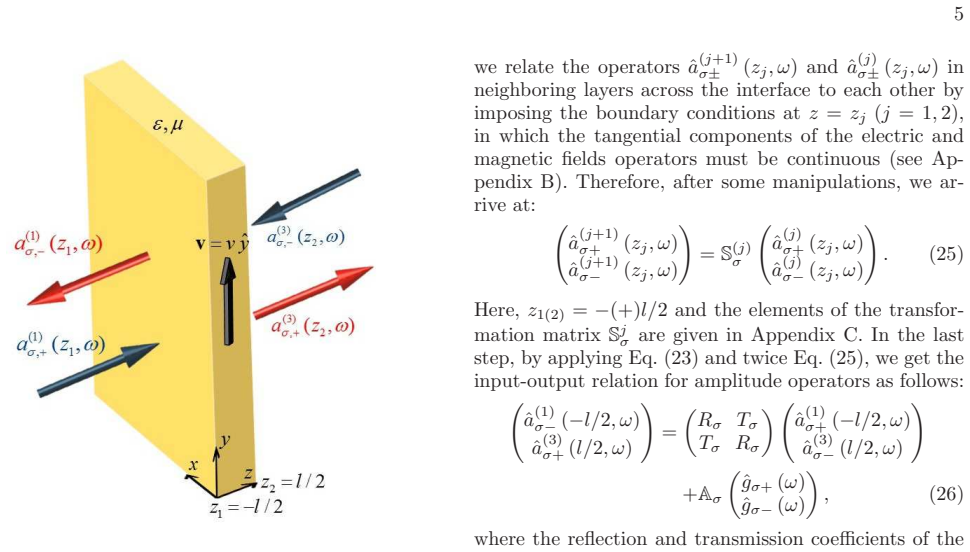
The load-bearing objects are the effective electric permittivity and magnetic permeability tensors, Eq. (5), obtained by rewriting the Minkowski constitutive relations for a moving medium in the form used for stationary media. They are anisotropic and nonsymmetric even though the slab is isotropic at rest, and they turn the moving-slab problem into the stationary-anisotropic-slab problem with refractive index $n_{\rm eff}=\gamma\sqrt{n^2-\beta^2}$. Alongside them, the noise polarization and magnetization operators of Eqs. (7) and (8) are what preserve the canonical field commutators; after the slab calculation they reappear as the bosonic noise operators $\hat{g}_{\sigma\pm}$ in Eq. (26), with the thermal correlation (32). The quantitative predictions for squeezing and photon statistics then follow from substituting the Lorentz-model permittivity and permeability, Eq. (35), into the transmission coefficient and noise correlation.
What would settle it
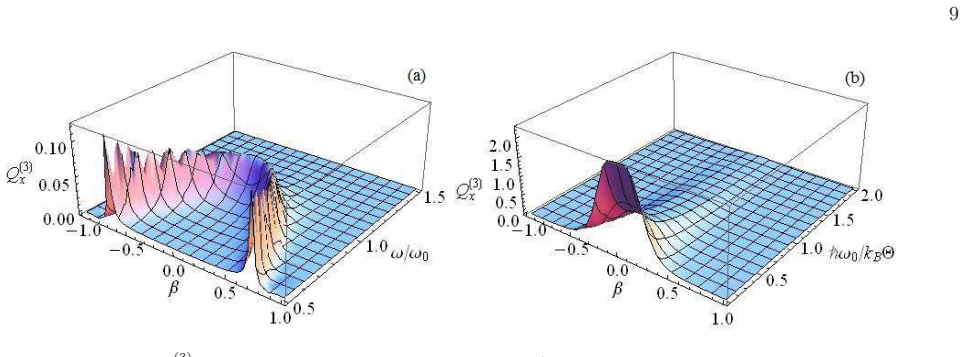
Measure the Mandel parameter of a coherent state transmitted through a magneto-dielectric slab moving at moderate speed ($\beta\approx 0.3$–$0.6$) at its resonance frequency: Eq. (39) predicts a positive value set by $(1-|R_\sigma|^2-|T_\sigma|^2)N(\gamma\omega,\Theta)$, so observing Poissonian statistics, or noise that does not grow with temperature, would contradict the noise correlation (32).
Extended reading notes
Core claim
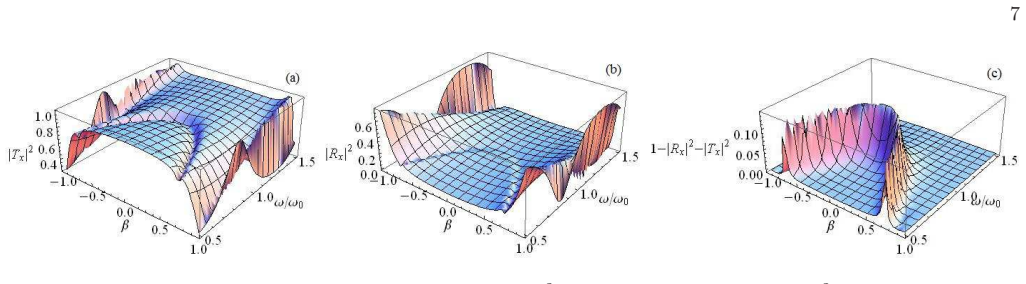
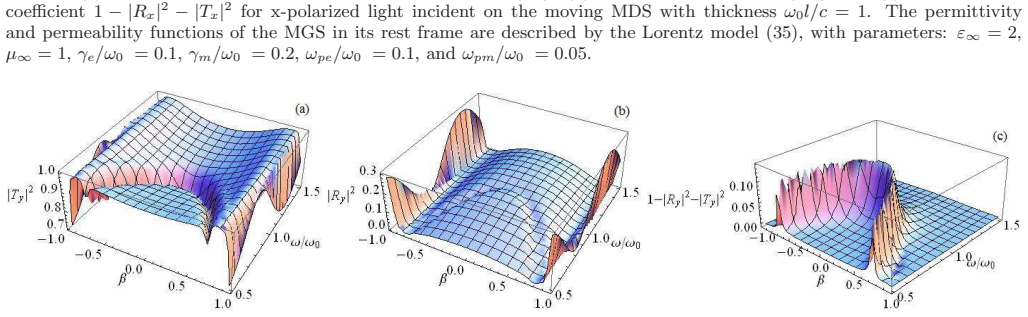
On the paper's own terms, the central discovery is Eq. (26): the outgoing field operators on both sides of the moving slab are linear combinations of the incoming operators plus noise, with reflection and transmission coefficients given by Eq. (27) and a noise correlation given by Eq. (32). The coefficients are the usual Fabry-Perot expressions evaluated with a laboratory refractive index $n_{\rm eff}=\gamma\sqrt{n^2-\beta^2}$ and polarization-dependent effective permeabilities; the noise correlation has the Planck factor $N(\gamma\omega,\Theta)$ multiplied by $1-|R_\sigma|^2-|T_\sigma|^2$, so absorption is the only source of added noise. The paper argues that an isotropic moving magneto-dielectric slab is equivalent, in the laboratory frame, to a stationary anisotropic slab with $\varepsilon_{yz}=\mu_{yz}=0$, which reduces the moving-medium problem to an already solved one. Numerically, for both polarizations, $|R_\sigma|^2$ tends to $1$ and $|T_\sigma|^2$ to $0$ as $\beta\to 1$, and the slab behaves as a perfectly conducting mirror; at low and moderate velocities the absorption around the resonance frequency produces a positive Mandel parameter and increased quadrature variance for a transmitted coherent state.
Load-bearing premise
The calculation assumes that the phenomenological quantization of unbounded moving media, namely the effective tensors of Eq. (5) and the noise current of Eq. (7), remains valid inside a finite slab and preserves the canonical commutation relations across its boundaries.
Editorial extensions
If this is right
- In the ultra-relativistic limit $\beta\to 1$, the moving slab becomes a perfect mirror: $|R_\sigma|^2\to 1$, $|T_\sigma|^2\to 0$, and the transmitted field approaches the quantum vacuum.
- At finite temperature and low-to-moderate velocities, absorption produces a noise flux $\langle \hat{F}^\dagger_{\sigma+}\hat{F}_{\sigma+}\rangle = N(\gamma\omega,\Theta)(1-|R_\sigma|^2-|T_\sigma|^2)$, which destroys the minimum-uncertainty character of a transmitted coherent state and makes its photon statistics super-Poissonian near resonance.
- At zero temperature, far from resonance, or in frequency windows where $|R_\sigma|^2+|T_\sigma|^2\approx 1$, the transmitted coherent state remains a coherent state with unchanged statistics.
- When the slab is at rest ($\beta=0$), the input-output relations reduce to the known stationary dielectric slab relations, so the moving-slab theory contains the rest-frame theory as a limit.
- The transmission, reflection, and absorption coefficients depend on $\beta$ through even powers, so reversing the direction of motion leaves these coefficients unchanged.
Reading between the lines
- The same effective-tensor reduction suggests a family of moving-slab scattering problems: at oblique incidence the off-diagonal entries of the Green tensor could mix the two polarizations, so the normal-incidence input-output relations are likely the simplest case, not the whole story.
- The appearance of $N(\gamma\omega,\Theta)$ rather than $N(\omega,\Theta)$ predicts a Doppler-shifted thermal noise spectrum in the laboratory frame; a frequency-resolved measurement of transmitted photon statistics as a function of slab speed would test this directly.
- Because the ultra-relativistic limit is lossless and perfectly reflecting, the scheme gives a controlled model for how a moving absorbing boundary interacts with quantum vacuum fluctuations; letting the velocity vary in time would be a natural next step toward photon-pair creation.
Signed reviews
Editorial analysis
A structured set of objections, weighed in public.
Referee Report
Summary. The paper develops a phenomenological quantization of the electromagnetic field interacting with a uniformly moving, absorptive and dispersive magneto-dielectric slab, with the velocity directed parallel to the slab surfaces. It derives quantum input-output relations for normally incident light, obtains velocity-dependent reflection and transmission coefficients, and analyzes the quadrature fluctuations and photon-counting statistics of a transmitted coherent state when the other input is vacuum and the slab is at finite temperature. The central results include the beta approaching 1 perfect-mirror limit and the statement that thermal noise degrades the quantum properties of the transmitted light at low and moderate velocities.
Significance. If the input-output relations are correct, the work extends established stationary-slab quantization to a uniformly moving lossy slab without introducing free parameters beyond the rest-frame Lorentz model; the beta = 0 limit reproduces known stationary results, and the beta approaching 1 limit is consistent with the classical perfect-mirror behavior. These are genuine strengths and make the formalism potentially useful. However, the quantum-statistical applications contain a sign error in the Mandel parameter and a mislabeled non-negative excess-noise parameter, so the quantitative and qualitative claims in Section III need correction before the results can be used.
major comments (2)
- [Sec. III.C, Eq. (39)] The Mandel parameter in Eq. (39) has the wrong sign in front of the noise-squared term. Writing the output mode as a_out = T alpha + F, with F a canonical thermal noise operator such that <F dagger F> = y = N(gamma omega, Theta)(1 - |R|^2 - |T|^2) and <F^2> = 0, and setting x = |T alpha|^2, Eq. (38) gives Q = y(2x + y)/(x + y). The printed Eq. (39) instead gives (2xy - y^2)/(x + y). The minus sign is unphysical: a displaced thermal state always has Q >= 0, while the printed formula becomes negative for y > 2x, incorrectly predicting sub-Poissonian statistics in parameter regions with small transmitted amplitude and finite absorption. Figure 5 and the discussion built on it should be recomputed with the corrected expression.
- [Sec. III.B, Eq. (37)] The quantity S = 4 Delta X^2 - 1 is called a squeezing parameter, but it can never be negative for the state considered here. Equations (37) give Delta X^2 = Delta Y^2 = (1/4)(1 + 2 <F dagger F>), so S = 2 <F dagger F> >= 0. The transmitted field is never quadrature-squeezed; S is an excess-noise parameter that measures thermal degradation. The discussion of Fig. 4, the abstract, and the conclusions should be revised to remove the claim that this setup predicts or exhibits quadrature squeezing.
minor comments (4)
- [Appendix A] The heading of Appendix A is 'Boundary Conditions', but the appendix actually gives the elements of the square root of the imaginary parts of the effective tensors; the boundary conditions appear in Appendix B. Please rename the appendices accordingly.
- [Fig. 2 caption] The caption of Fig. 2 says 'MGS' instead of 'MDS'; please correct the typo.
- [Sec. II.A, Eqs. (4)-(11)] The manuscript imports the unbounded moving-medium quantization of Refs. [48,49] and applies it to a bounded slab without an explicit justification that the noise operators (7) and the effective tensors (5) remain valid in the presence of the interfaces. A short argument or a direct check that the output commutation relations (34) follow from Eqs. (26)-(32) would strengthen the central derivation.
- [Sec. III.C, Eq. (38)] The Mandel parameter in Eq. (38) is written with the non-normal-ordered product <a dagger a a dagger a>; for clarity, please define n = a dagger a and use the standard expression Q = (Var(n) - <n>)/<n>.
Circularity Check
No significant circularity: the input–output derivation is self-contained modulo an external quantization scheme.
full rationale
The central derivation is not circular. Equations (26)-(31) are obtained by combining the phenomenological quantization of unbounded moving media (Matloob, Refs. [48,49], an external non-author source) with the slab Green's function (15) and the boundary-condition/absorption-matrix algebra of Appendices B-D; the input-output coefficients (27) are the classical Fresnel-type expressions for the moving slab and are not fitted to the quantum predictions. The noise correlation (32) is fixed by the bosonic commutation relations (31) and by the unitarity of the input-output transformation, not by matching the later squeezing or Mandel results. The v=0 reduction and the beta→1 perfect-mirror limit are presented as consistency checks against known stationary and classical results, not as derived predictions that secretly encode the target outputs. Self-citations [44-47,57] appear only for comparison and for the Lorentz model; they are not load-bearing, and no uniqueness theorem from the authors' prior work is invoked to force the choice of quantization. Accordingly, no specific step reduces by construction to its own input.
Assumptions & free parameters
free parameters (1)
- Lorentz model parameters =
epsilon_inf=2, mu_inf=1, gamma_e/omega0=0.1, gamma_m/omega0=0.2, omega_pe/omega0=0.1, omega_pm/omega0=0.05
assumptions (3)
- domain assumption Phenomenological quantization of the EM field in moving media according to Matloob [48,49] is valid for bounded media, including the noise current operator (7) and effective tensors (5).
- domain assumption The moving medium is homogeneous, isotropic, and locally responding in its rest frame, with Kramers-Kronig consistent epsilon(omega) and mu(omega) (Lorentz model (35) for numerics).
- domain assumption Quantum states propagate perpendicular to the slab and the slab velocity is parallel to the interface (v along y, k along z), reducing the problem to 1D normal incidence.
Cite this review
Pith. "Pith review of Quantum light propagation in a uniformly moving dissipative slab." pith.science (2026). https://pith.science/paper/LAJ2GVY5
@misc{pith2026190806385,
  author       = {Pith},
  title        = {Pith review of: Quantum light propagation in a uniformly moving dissipative slab},
  year         = {2026},
  howpublished = {\url{https://pith.science/paper/LAJ2GVY5}},
  note         = {Machine review of arXiv:1908.06385}
}
read the original abstract
Within the framework of a phenomenological quantization scheme, we present the quantization of the electromagnetic field in the presence of a moving absorptive and dispersive magneto-dielectric slab (MDS) with uniform velocity in the direction parallel to its interface. We derive the quantum input-output relations for the case that quantum states propagate perpendicularly to the moving MDS.We thoroughly investigate the impact of the motion of the movingMDS on quantum properties of the incident states. To illustrate this, by modeling the dispersive and dissipative effects of the slab by the Lorentz model in its rest frame, we compute the quadrature squeezing and the Mandel parameter for the transmitted state when the incident states from left and right sides are, respectively, the coherent and the quantum vacuum states. It is shown that how quantum features of the incident state are degraded when it is transmitted through the moving MDS.
Figures
Figures from the paper (2 more)

Reference graph
Works this paper leans on
- [1]
-
[2]
Sommerfeld, ”Electrodynamics”, (Academic, New York, 1964)
A. Sommerfeld, ”Electrodynamics”, (Academic, New York, 1964)
work page 1964
-
[3]
L. D. Landau, E. M. Lifshitz and L. P. Pitaevskii, ”Electrodynamics of Continuous Media” (Pergamon, Ox- ford,1984)
work page 1984
-
[4]
Gordon, Ann
W. Gordon, Ann. Phys. (Leipzig) 72, 421 (1923)
1923
- [5]
-
[6]
I. Carusotto, M. Artoni, G.C. La Rocca, F. Bassani, Phys. Rev. Lett. 86, 2549 (2001)
work page 2001
-
[7]
I. Carusotto, M. Artoni, G.C. La Rocca, F. Bassani, Phys. Rev. A 68, 063819 (2003)
work page 2003
-
[8]
D. Strekalov, A.B. Matsko. N. Yu., L. Maleki, Phys. Rev. Lett. 93, 023601 (2004)
work page 2004
Show all 58 references
-
[9]
B. D. Nag, and A. M. Sayied, Proc. R. Soc. London, Ser. A, 235, 544 (1956)
1956
-
[10]
J. A. Kong, Theory of Electromagnetic Waves (Wiley, New York, 1975)
1975
-
[11]
Pauli, TIzeory of Relativity [Pergamon, New York, 1958)
W. Pauli, TIzeory of Relativity [Pergamon, New York, 1958)
1958
-
[12]
Sommerfeld, Opfik, 2nd ed
A. Sommerfeld, Opfik, 2nd ed. (Akademische, Leipzig, 1959)
1959
-
[13]
C. Yeh, J. Appl. Phys. 36, 3513 (1965)
1965
-
[14]
C. Yeh, J. Appl. Phys. 37, 3079 (1966)
1966
-
[15]
Yeh and K
C. Yeh and K. F. Casey, Phys. Rev. 144, 665 (1966). 12
1966
-
[16]
V. P. Payati, J. Appl. Phys. 38, 652 (1967)
1967
-
[17]
T. K. Shiozawa, K. Hazawa, and N. Kumagai, J. Appl. Phys. 38, 4459 (1967)
1967
-
[18]
J. A. Kong and D. K. Cheng, J. Appl. Phys. 39, 2282 (1968)
1968
-
[19]
Shiozawa, and S
T. Shiozawa, and S. Seikai, IEEE Trans. Antennas Propag, 20, 455 (1972)
1972
-
[20]
Y. X. Huang, J. Appl. Phys. 76, 2575 (1994)
1994
-
[21]
Leonhardt, Nature (London) 415, 406 (2000)
U. Leonhardt, Nature (London) 415, 406 (2000)
2000
-
[22]
Fiurasek, U
J. Fiurasek, U. Leonhardt, and R. Parentani, Phys. Rev. A 65, 011802 (2002)
2002
-
[23]
R. J. Cook, H. Fearn and P. W. Milonni, Am. J. Phys. 63, 705 (1995)
1995
-
[24]
T. M. Grzegorczyk, J. A. Kong, Phys. Rev. B 74, 033102 (2006)
2006
-
[25]
H. X. Da, Z. Y. Li, Phys. Rev. B 76, 012409 (2007)
2007
-
[26]
Fumeron, P
S. Fumeron, P. Vaveliuk, E. Faudot, and F. Moraes, J. Opt. Soc. Am. B 28, 765 (2011)
2011
-
[27]
Sh. Lin, R. Zhang, Y. Zhai, J. Wei, Q. Zhao, J. Opt. 18, 085603 (2016)
2016
-
[28]
A. A. Svidzinsky, F. Li, and X. Zhang, Phys. Rev. Lett. 118, 012105 (2017)
2017
-
[29]
V. V. Dodonov, Phys. Scr. 82, 038105 (2010)
2010
-
[30]
M. G. Silveirinha, Phys. Rev. X 4, 031013 (2014)
2014
-
[31]
S. A. Fulling and P. C.W. Davies, Proc. R. Soc. A 348, 393 (1976)
1976
-
[32]
Barton, Ann
G. Barton, Ann. Phys. (N.Y.) 245, 361 (1996)
1996
-
[33]
A. I. Volokitin and B. N. J. Persson, Rev. Mod. Phys. 79, 1291 (2007)
2007
-
[34]
M. F. Maghrebi, R. L. Jaffe, and M. Kardar, Phys. Rev. Lett. 108, 230403 (2012)
2012
-
[35]
M. F. Maghrebi, R. Golestanian, and M. Kardar, Phys. Rev. D, 87, 025016 (2013)
2013
-
[36]
Manjavacas and F
A. Manjavacas and F. J. Garc ´ ıa de Abajo, Phys. Rev. Lett. 105, 113601 (2010)
2010
-
[37]
R. Zhao, A. Manjavacas, F. J. Garc ´ ıa de Abajo, J. B. Pendry, Phys. Rev. Lett. 109, 123604 (2012)
2012
-
[38]
Gruner and D.-G
T. Gruner and D.-G. Welsch, Phys. Rev. A 54, 1661 (1996)
1996
-
[39]
Artoni, R
M. Artoni, R. Loudon, Phys. Rev. A 55, 1347 (1997)
1997
-
[40]
Artoni, R
M. Artoni, R. Loudon, Phys. Rev. A 59, 2279 (1998)
1998
-
[41]
Artoni, R
M. Artoni, R. Loudon, Phys. Rev. A 57, 622 (1998)
1998
-
[42]
Matloob, G
R. Matloob, G. Pooseh, Opt. Commun. 181, 109 (2000)
2000
-
[43]
Khanbekyan, L
M. Khanbekyan, L. Kn¨ oll, and D.-G. Welsch, Phys. Rev. A 67, 063812 (2003)
2003
-
[44]
Amooghorban, N.A
E. Amooghorban, N.A. Mortensen, M. Wubs, Phys. Rev. Lett. 110, 153602 (2013)
2013
- [45]
-
[46]
Amooghorban and A
E. Amooghorban and A. Mahdifar, Iran. J. Phys. Res. 14, 7 (2014)
2014
-
[47]
Aghbolaghi, E
A. Aghbolaghi, E. Amooghorban, and A. Mahdifar, Eur. Phys. J. D 71, 272 (2017)
2017
-
[48]
Matloob, Phys
R. Matloob, Phys. Rev. A 71, 062105 (2005)
2005
-
[49]
Matloob, Phys
R. Matloob, Phys. Rev. A 72, 062103 (2005)
2005
-
[50]
Amooshahi, Phys
M. Amooshahi, Phys. Rev. A 54, 115 (2009)
2009
-
[51]
Kheirandish, and S
F. Kheirandish, and S. Salimi, Phys. Rev. A 84, 062122 (2011)
2011
-
[52]
S. A. R. Horsley, Phys. Rev. A 86, 023830 (2012)
2012
-
[53]
H. C. Chen, Theory of Electromagnetic Waves (McGraw- Hill, New York, 1983)
1983
-
[54]
Matloob, and R
R. Matloob, and R. Loudon, Phys. Rev. A 53, 4567 (1996)
1996
-
[55]
Knoll, S
L. Knoll, S. Scheel and D.-G. Welsch, in Coherence and Statistics of Photons and Atoms, edited by J. Perina (Wi- ley, New York, 2001)
2001
-
[56]
Dong, and X
Y. Dong, and X. Zhang, J. Opt. 13, 035401 (2011)
2011
-
[57]
Hoseinzadeh, E
M. Hoseinzadeh, E. Amooghorban, A. Mahdifar, Iran. J. Phys. Res. 16, 305 (2017)
2017
-
[58]
M. O. Scully and M. S. Zubairy, ”Quantum Op- tics”, (Cambridge University Press, Cambridge, England, 1997)
1997
Reviewed August 14, 2026 · model on record in the stance chip above.
Discussion (0). Continue with ORCID to comment.