REVIEW 3 major objections 4 minor 29 references
PANet: Few-Shot Image Semantic Segmentation with Prototype Alignment
T0 review · 3 major / 4 minor · reviewed 2026-08-14 · deepseek-v4-flash
Pith's one-line read A prototype alignment network improves few-shot semantic segmentation by re-segmenting support images from the query's own predicted mask.
desk verdict PANet is a clean, plausible few-shot segmentation method with an asymmetric evaluation protocol that makes the headline SOTA margins unverified. read the letter →
The pith
A machine-rendered reading of the paper's core claim, the machinery that carries it, and where it could break.
The reading
What carries the argument
The load-bearing mechanism is prototype alignment regularization (PAR), a training-only reverse pass: after the forward pass predicts a query mask from support prototypes, the query's own features are pooled with that predicted mask to form query prototypes, and those prototypes are used to re-segment the support images; the resulting loss forces support and query prototypes to occupy consistent positions in the embedding. Around it, the model is built on non-parametric metric learning, masked average pooling of features into one prototype per class followed by cosine-distance softmax labeling of each query pixel, with a shared convolutional feature extractor and no decoder or post-processing. The reverse pass adds no learnable parameters, so it acts purely as a regularizer on the shared embedding.
What would settle it
Run two ablations of PANet with PAR: in one, pool the query prototypes from ground-truth query masks during training; in the other, pool them from random masks. If the random-mask version matches the no-PAR baseline and the ground-truth version clearly beats PANet, then the reported gain is simply a ceiling effect of prediction quality; if the random-mask version also improves, the regularizer is not learning semantic alignment at all.
Extended reading notes
Core claim
The central claim is that consistent, class-specific prototypes are enough to drive few-shot segmentation, and that explicitly aligning support and query prototypes during training makes the embedding generalize. Concretely, PANet extracts a prototype for each class (including background) by masked average pooling of the support features, segments the query by softmax over cosine distances to these prototypes, then, in the reverse direction, pools prototypes from the query feature map using the network's own predicted query mask and uses them to classify the support image pixels. The extra reverse-pass loss LPAR pushes query and support prototypes toward the same embedding location. The paper demonstrates the alignment is real: the average Euclidean distance between query and support prototypes drops from 42.6 to 32.2 when PAR is used, training converges faster, and mean-IoU rises by 0.9 points (1-shot) and 0.8 points (5-shot) over the identical model without PAR. In its strongest reported setting, PANet beats the previous state of the art on PASCAL-5i by 8.6% in 5-shot mean-IoU.
Load-bearing premise
The reverse pass trusts the network's own predicted query mask as if it were ground truth, so if early predictions are largely wrong, the regularization can reinforce the model's errors instead of aligning prototypes toward the true class structure.
Editorial extensions
If this is right
- Because PANet's gap between 1-shot and 5-shot mean-IoU is 7.6%, against under 3.1% for prior methods, the prototype-pooling design makes additional support images genuinely useful rather than redundant.
- Removing PAR drops 1-shot mean-IoU from 48.1 to 47.2 and 5-shot from 55.7 to 54.9, so the entire gain of the regularizer comes with no extra inference cost or parameters.
- The same metric-learning framework works with weak support annotations: scribbles give 44.8 (1-shot) and 54.6 (5-shot), bounding boxes 45.1 and 52.8, so expensive pixel-level masks are not strictly required.
- On MS COCO, PANet improves binary-IoU over the prior best by 7.2 points (1-shot) and 8.2 points (5-shot), indicating the method scales beyond PASCAL-5i's 20 classes.
- In the 2-way setting, PANet's mean-IoU of 45.1/53.1 surpasses the prior prototype-learning method by more than 20%, showing the approach handles multi-class episodes without modification.
Reading between the lines
- An implicit consequence is that the same reverse-pass idea could apply to any dense prediction task with a pooled representation, such as few-shot detection or panoptic segmentation, where a coarse predicted mask could play the role of the query mask.
- A natural extension is to iterate the alignment (query to support to query), turning PAR into a cycle-consistency objective that could tighten prototypes further, though it would also risk compounding early prediction errors.
- The fixed cosine scaling (alpha = 20) suggests sensitivity to feature norms; a testable follow-up is to L2-normalize features before pooling, which would make the scaling redundant and possibly transfer across backbones.
- The 7.6% gain from 1-shot to 5-shot is the strongest signal that prototype pooling actually aggregates support evidence; evaluating larger K values, such as 10 or 20, would show whether the trend continues or saturates.
Signed reviews
Editorial analysis
A structured set of objections, weighed in public.
Referee Report
Summary. PANet is a few-shot semantic segmentation method based on prototype metric learning. Class prototypes are extracted from support features by masked average pooling over foreground and background, query pixels are classified by a cosine-distance softmax over these prototypes, and a prototype alignment regularization (PAR) runs the segmentation in reverse: the query image with its predicted mask is treated as a new support set and is used to segment the original support images. The VGG-16 backbone is trained end-to-end with L = L_seg + lambda * L_PAR, with no extra learnable parameters from PAR and no decoder at inference. On PASCAL-5i the paper reports mean-IoU of 48.1% (1-shot) and 55.7% (5-shot), exceeding SG-One by 1.8 and 8.6 points respectively, and reports a 7.6-point gain from 1-shot to 5-shot that is larger than the gains of prior methods. Ablations in Table 5 and the prototype-distance measurement in Section 4.3 support the effect of PAR. The manuscript also reports 2-way PASCAL-5i, MS COCO, and weak-annotation results.
Significance. If the reported numbers are reproducible, PANet is a strong and conceptually clean contribution: it shows that non-parametric prototype matching with an alignment regularizer can outperform parametric conditioning modules while using fewer parameters, and it demonstrates practical robustness to scribble and bounding-box support annotations. The internal evidence is largely convincing: Table 5 isolates the PAR contribution (48.1 vs 47.2 in 1-shot; 55.7 vs 54.9 in 5-shot), Figure 5 shows faster convergence, and Section 4.3 gives a direct measurement of support-query prototype alignment (Euclidean distance 32.2 with PAR vs 42.6 without). The main weaknesses are external: the headline comparison uses a different evaluation protocol from the baselines, and the printed PAR loss in Eq. (7) is not the loss described in the text. Neither flaw undermines the plausibility of the method, but both need to be addressed before the state-of-the-art claim can be taken at face value.
major comments (3)
- [Section 4.1, Table 1] The headline comparison to prior work is made under mismatched evaluation protocols. Section 4.1 states that previous methods randomly sample 1,000 test episodes, while PANet averages 5 runs of 1,000 episodes with different random seeds; Table 1 reports only the 5-run average for PANet and single-run published values for the baselines. Since the 1-shot margin over SG-One is only 1.8 mean-IoU, run-to-run variability or the different estimator could change the relative ordering. Please report per-seed results and standard deviations for PANet, and either re-evaluate the baselines under the same 5-run protocol or explicitly qualify the comparison as indicative rather than exact.
- [Section 3.5, Eq. (7)] Equation (7) is not the PAR loss described in the text and in Algorithm 1. As printed, it uses the query ground-truth mask M_q and the query prediction \tilde{M}_q, which duplicates L_seg; the surrounding prose and Eq. (6) require the support mask M_{c,k} and support prediction \tilde{M}_{c,k;j}. This makes the actually implemented loss under-specified. Please correct Eq. (7) and state whether gradients are stopped through the predicted query mask when pooling the query prototypes.
- [Section 3.5, Table 5] PAR trains against the model's own predicted query masks as pseudo-labels, so early in training these masks may be unreliable. The paper validates PAR only through final accuracy and convergence curves. I do not consider this fatal because Table 5 already gives direct positive evidence, but an ablation with oracle query masks, or a plot of pseudo-mask quality during training, would clarify how much of the gain comes from prototype alignment versus pseudo-label self-training.
minor comments (4)
- [Table 4, Section 4.2] The text says PANet improves over A-MCG by 8.2% for 5-shot on MS COCO, but the table shows 63.5 - 54.7 = 8.8; please correct the stated margin.
- [Table 3, Section 4.2] The statement that PANet outperforms PL by more than 20% rests on binary-IoU (64.2 vs 42.7); PL's mean-IoU is not reported, so the sentence should specify that the comparison is on binary-IoU only.
- [Sections 3.4 and 3.5] The hyperparameters alpha=20 and lambda=1 are described as empirically chosen; a small sensitivity table would help readers apply the method to new benchmarks.
- [Reproducibility] No code or trained models are mentioned in the paper; given the Eq. (7) misprint, releasing code would materially improve reproducibility.
Circularity Check
No significant circularity; PANet's benchmark results are external measurements, not derived from fitted parameters or self-citations.
full rationale
The paper's central claims are the mIoU numbers on PASCAL-5i and MS COCO, obtained by evaluating the trained model on held-out episodes; these are external benchmark measurements, not consequences of a fitted constant or of a self-citation. The prototype alignment regularization (PAR) uses the model's own predicted query mask to construct query prototypes for a reverse segmentation loss, which is a training objective rather than a derivation of the reported results, and its benefit is tested by an explicit ablation (Table 5). Hyperparameters α=20 and λ=1 are empirical settings, not predictions claimed to follow from the theory. The paper does invoke prior work for the prototypical-network formulation and the PASCAL-5i protocol, but these are standard external references and are not used to forbid alternatives or to import an unverified uniqueness claim. The evaluation averages 5 runs of 1,000 episodes while prior baselines are single-run published numbers; this is a protocol-comparison caveat, not circularity. The misprinted Eq. (7), which swaps the support mask and query probability, makes the printed PAR loss ill-posed, but that is a correctness/reproducibility issue rather than evidence that the derivation is equivalent to its inputs. Overall, the derivation chain is self-contained with respect to the benchmark claims, and no load-bearing step reduces to its own inputs by construction.
Assumptions & free parameters
free parameters (2)
- alpha (softmax temperature scaling) =
20
- lambda (PAR regularization weight) =
1
assumptions (3)
- domain assumption VGG-16 pre-trained on ImageNet provides transferable features for unseen classes.
- domain assumption Masked average pooling over the support set yields prototype representations that are sufficiently discriminative for metric segmentation.
- domain assumption The predicted query mask used in PAR is a sufficiently reliable pseudo-label for reverse segmentation supervision.
Cite this review
Pith. "Pith review of PANet: Few-Shot Image Semantic Segmentation with Prototype Alignment." pith.science (2026). https://pith.science/paper/YOWMPG5S
@misc{pith2026190806391,
  author       = {Pith},
  title        = {Pith review of: PANet: Few-Shot Image Semantic Segmentation with Prototype Alignment},
  year         = {2026},
  howpublished = {\url{https://pith.science/paper/YOWMPG5S}},
  note         = {Machine review of arXiv:1908.06391}
}
read the original abstract
Despite the great progress made by deep CNNs in image semantic segmentation, they typically require a large number of densely-annotated images for training and are difficult to generalize to unseen object categories. Few-shot segmentation has thus been developed to learn to perform segmentation from only a few annotated examples. In this paper, we tackle the challenging few-shot segmentation problem from a metric learning perspective and present PANet, a novel prototype alignment network to better utilize the information of the support set. Our PANet learns class-specific prototype representations from a few support images within an embedding space and then performs segmentation over the query images through matching each pixel to the learned prototypes. With non-parametric metric learning, PANet offers high-quality prototypes that are representative for each semantic class and meanwhile discriminative for different classes. Moreover, PANet introduces a prototype alignment regularization between support and query. With this, PANet fully exploits knowledge from the support and provides better generalization on few-shot segmentation. Significantly, our model achieves the mIoU score of 48.1% and 55.7% on PASCAL-5i for 1-shot and 5-shot settings respectively, surpassing the state-of-the-art method by 1.8% and 8.6%.
Figures


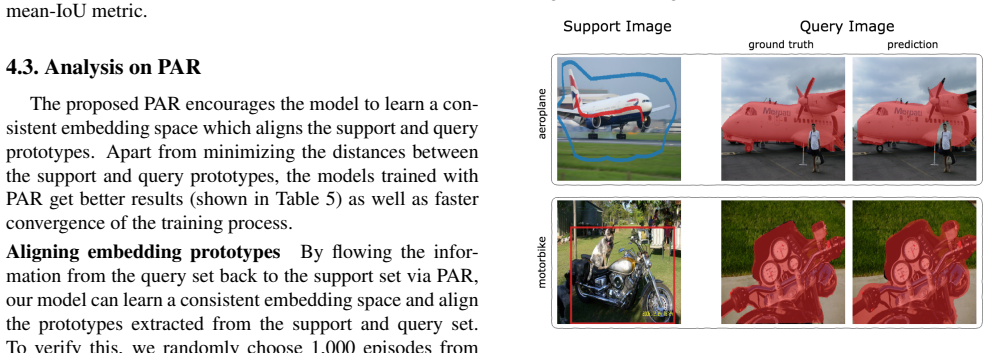
Figures from the paper (3 more)


Reference graph
Works this paper leans on
-
[1]
Segnet: A deep convolutional encoder-decoder architecture for image segmentation
Vijay Badrinarayanan, Alex Kendall, and Roberto Cipolla. Segnet: A deep convolutional encoder-decoder architecture for image segmentation. IEEE transactions on pattern anal- ysis and machine intelligence, 39(12):2481–2495, 2017
work page 2017
-
[2]
Deeplab: Semantic image segmentation with deep convolutional nets, atrous convolu- tion, and fully connected crfs
Liang-Chieh Chen, George Papandreou, Iasonas Kokkinos, Kevin Murphy, and Alan L Yuille. Deeplab: Semantic image segmentation with deep convolutional nets, atrous convolu- tion, and fully connected crfs. IEEE transactions on pattern analysis and machine intelligence, 40(4):834–848, 2018
2018
-
[3]
Boxsup: Exploit- ing bounding boxes to supervise convolutional networks for semantic segmentation
Jifeng Dai, Kaiming He, and Jian Sun. Boxsup: Exploit- ing bounding boxes to supervise convolutional networks for semantic segmentation. In Proceedings of the IEEE Inter- national Conference on Computer Vision, pages 1635–1643, 2015
work page 2015
-
[4]
Few-shot semantic segmen- tation with prototype learning
Nanqing Dong and Eric P Xing. Few-shot semantic segmen- tation with prototype learning. In BMVC, volume 3, page 4, 2018
work page 2018
-
[5]
The pascal visual object classes (voc) challenge
Mark Everingham, Luc Van Gool, Christopher KI Williams, John Winn, and Andrew Zisserman. The pascal visual object classes (voc) challenge. International journal of computer vision, 88(2):303–338, 2010
2010
-
[6]
Model- agnostic meta-learning for fast adaptation of deep networks
Chelsea Finn, Pieter Abbeel, and Sergey Levine. Model- agnostic meta-learning for fast adaptation of deep networks. In Proceedings of the 34th International Conference on Ma- chine Learning-Volume 70 , pages 1126–1135. JMLR. org, 2017
work page 2017
-
[7]
Semantic contours from inverse detectors
Bharath Hariharan, Pablo Arbel ´aez, Lubomir Bourdev, Subhransu Maji, and Jitendra Malik. Semantic contours from inverse detectors. 2011
work page 2011
-
[8]
Tao Hu, Pengwan, Chiliang Zhang, Gang Yu, Yadong Mu, and Cees G. M. Snoek. Attention-based multi-context guid- ing for few-shot semantic segmentation. 2018
work page 2018
Show all 29 references
-
[9]
Scribblesup: Scribble-supervised convolutional networks for semantic segmentation
Di Lin, Jifeng Dai, Jiaya Jia, Kaiming He, and Jian Sun. Scribblesup: Scribble-supervised convolutional networks for semantic segmentation. In Proceedings of the IEEE Con- ference on Computer Vision and Pattern Recognition, pages 3159–3167, 2016
2016
-
[10]
Refinenet: Multi-path refinement networks for high- resolution semantic segmentation
Guosheng Lin, Anton Milan, Chunhua Shen, and Ian Reid. Refinenet: Multi-path refinement networks for high- resolution semantic segmentation. In Proceedings of the IEEE conference on computer vision and pattern recogni- tion, pages 1925–1934, 2017
1925
-
[11]
Microsoft coco: Common objects in context
Tsung-Yi Lin, Michael Maire, Serge Belongie, James Hays, Pietro Perona, Deva Ramanan, Piotr Doll´ar, and C Lawrence Zitnick. Microsoft coco: Common objects in context. In European conference on computer vision , pages 740–755. Springer, 2014
2014
-
[12]
Learning to propagate labels: Transductive propagation network for few-shot learn- ing
Yanbin Liu, Juho Lee, Minseop Park, Saehoon Kim, Eunho Yang, Sung Ju Hwang, and Yi Yang. Learning to propagate labels: Transductive propagation network for few-shot learn- ing. 2018
2018
-
[13]
Fully convolutional networks for semantic segmentation
Jonathan Long, Evan Shelhamer, and Trevor Darrell. Fully convolutional networks for semantic segmentation. In Pro- ceedings of the IEEE conference on computer vision and pat- tern recognition, pages 3431–3440, 2015
2015
-
[14]
Tadam: Task dependent adaptive metric for improved few-shot learning
Boris Oreshkin, Pau Rodr ´ıguez L´opez, and Alexandre La- coste. Tadam: Task dependent adaptive metric for improved few-shot learning. In Advances in Neural Information Pro- cessing Systems, pages 719–729, 2018
2018
-
[15]
Weakly-and semi-supervised learning of a deep convolutional network for semantic image segmenta- tion
George Papandreou, Liang-Chieh Chen, Kevin P Murphy, and Alan L Yuille. Weakly-and semi-supervised learning of a deep convolutional network for semantic image segmenta- tion. In Proceedings of the IEEE international conference on computer vision, pages 1742–1750, 2015
2015
-
[16]
Conditional networks for few-shot semantic segmentation
Kate Rakelly, Evan Shelhamer, Trevor Darrell, Alyosha Efros, and Sergey Levine. Conditional networks for few-shot semantic segmentation. 2018
2018
-
[17]
Few-shot segmentation propagation with guided networks
Kate Rakelly, Evan Shelhamer, Trevor Darrell, Alexei A Efros, and Sergey Levine. Few-shot segmentation propagation with guided networks. arXiv preprint arXiv:1806.07373, 2018
2018 arXiv
-
[18]
Optimization as a model for few-shot learning
Sachin Ravi and Hugo Larochelle. Optimization as a model for few-shot learning. 2016
2016
-
[19]
Berg, and Li Fei-Fei
Olga Russakovsky, Jia Deng, Hao Su, Jonathan Krause, San- jeev Satheesh, Sean Ma, Zhiheng Huang, Andrej Karpathy, Aditya Khosla, Michael Bernstein, Alexander C. Berg, and Li Fei-Fei. ImageNet Large Scale Visual Recognition Chal- lenge. International Journal of Computer Vision ...
2015
-
[20]
Few-shot learning with graph neural networks
Victor Garcia Satorras and Joan Bruna Estrach. Few-shot learning with graph neural networks. In International Con- ference on Learning Representations, 2018
2018
-
[21]
One-shot learning for semantic segmentation
Amirreza Shaban, Shray Bansal, Zhen Liu, Irfan Essa, and Byron Boots. One-shot learning for semantic segmentation. arXiv preprint arXiv:1709.03410, 2017
2017 arXiv
-
[22]
Very deep convo- lutional networks for large-scale image recognition
Karen Simonyan and Andrew Zisserman. Very deep convo- lutional networks for large-scale image recognition. arXiv preprint arXiv:1409.1556, 2014
2014 arXiv
-
[23]
Prototypi- cal networks for few-shot learning
Jake Snell, Kevin Swersky, and Richard Zemel. Prototypi- cal networks for few-shot learning. In Advances in Neural Information Processing Systems, pages 4077–4087, 2017
2017
-
[24]
Learning to compare: Re- lation network for few-shot learning
Flood Sung, Yongxin Yang, Li Zhang, Tao Xiang, Philip HS Torr, and Timothy M Hospedales. Learning to compare: Re- lation network for few-shot learning. In Proceedings of the IEEE Conference on Computer Vision and Pattern Recogni- tion, pages 1199–1208, 2018
2018
-
[25]
Matching networks for one shot learning
Oriol Vinyals, Charles Blundell, Timothy Lillicrap, Daan Wierstra, et al. Matching networks for one shot learning. In Advances in neural information processing systems , pages 3630–3638, 2016
2016
-
[26]
Object region mining with adversarial erasing: A simple classification to semantic segmentation approach
Yunchao Wei, Jiashi Feng, Xiaodan Liang, Ming-Ming Cheng, Yao Zhao, and Shuicheng Yan. Object region mining with adversarial erasing: A simple classification to semantic segmentation approach. In Proceedings of the IEEE con- ference on computer vision and pattern recognition , ...
2017
-
[27]
Multi-scale context aggregation by dilated convolutions
Fisher Yu and Vladlen Koltun. Multi-scale context aggregation by dilated convolutions. arXiv preprint arXiv:1511.07122, 2015
2015 arXiv
-
[28]
Sg-one: Similarity guidance network for one-shot semantic segmentation
Xiaolin Zhang, Yunchao Wei, Yi Yang, and Thomas Huang. Sg-one: Similarity guidance network for one-shot semantic segmentation. arXiv preprint arXiv:1810.09091, 2018
2018 arXiv
-
[29]
Pyramid scene parsing network
Hengshuang Zhao, Jianping Shi, Xiaojuan Qi, Xiaogang Wang, and Jiaya Jia. Pyramid scene parsing network. In Proceedings of the IEEE conference on computer vision and pattern recognition, pages 2881–2890, 2017
2017
Reviewed August 14, 2026 · model on record in the stance chip above.
Discussion (0). Continue with ORCID to comment.