REVIEW 4 major objections 5 minor 36 references
Towards Understanding of eSports Athletes' Potentialities: The Sensing System for Data Collection and Analysis
T0 review · 4 major / 5 minor · reviewed 2026-08-14 · deepseek-v4-flash
Pith's one-line read This paper claims that professional and amateur CS:GO players can be separated by two measured behaviors: keeping gaze on the screen center rather than the radar, and avoiding forward movement while shooting.
desk verdict The platform is a real, reusable contribution; the pro-vs-amateur gaze finding is plausible but under-supported, and the unvalidated zone-mapping assumption is the main weakness. read the letter →
The pith
A machine-rendered reading of the paper's core claim, the machinery that carries it, and where it could break.
The reading
What carries the argument
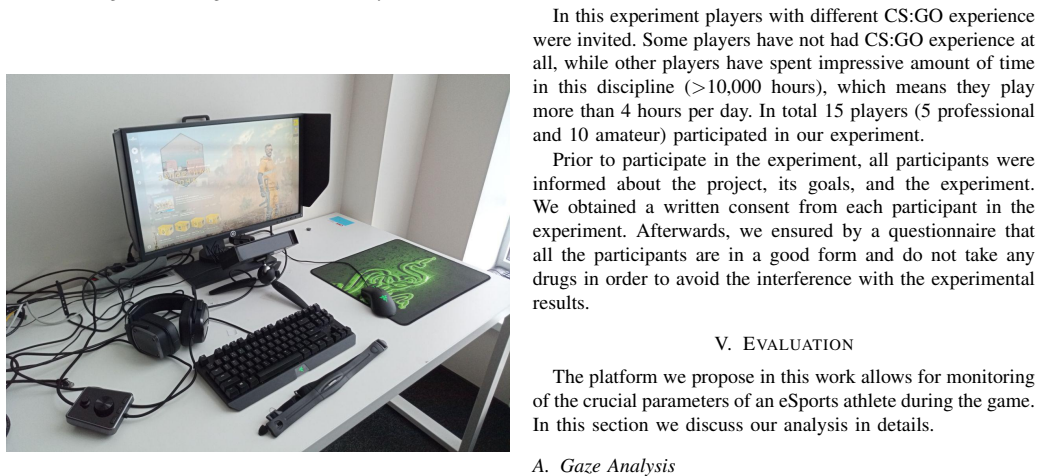
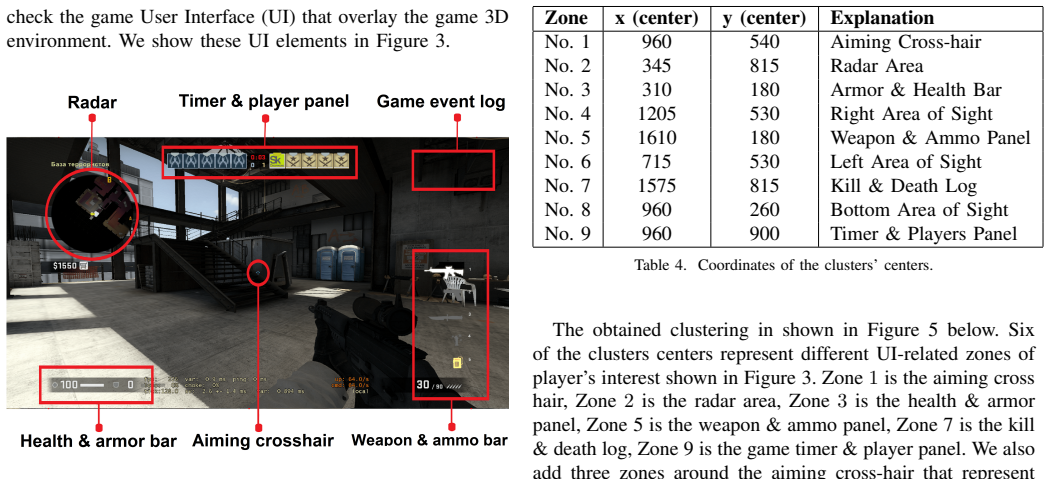
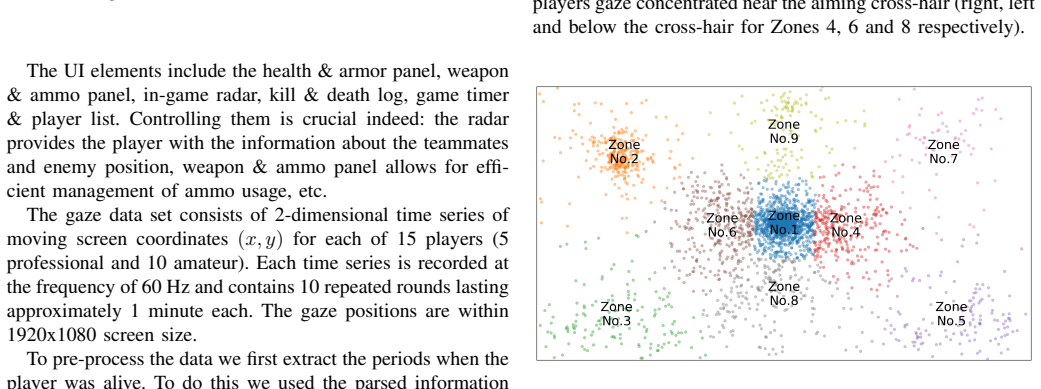
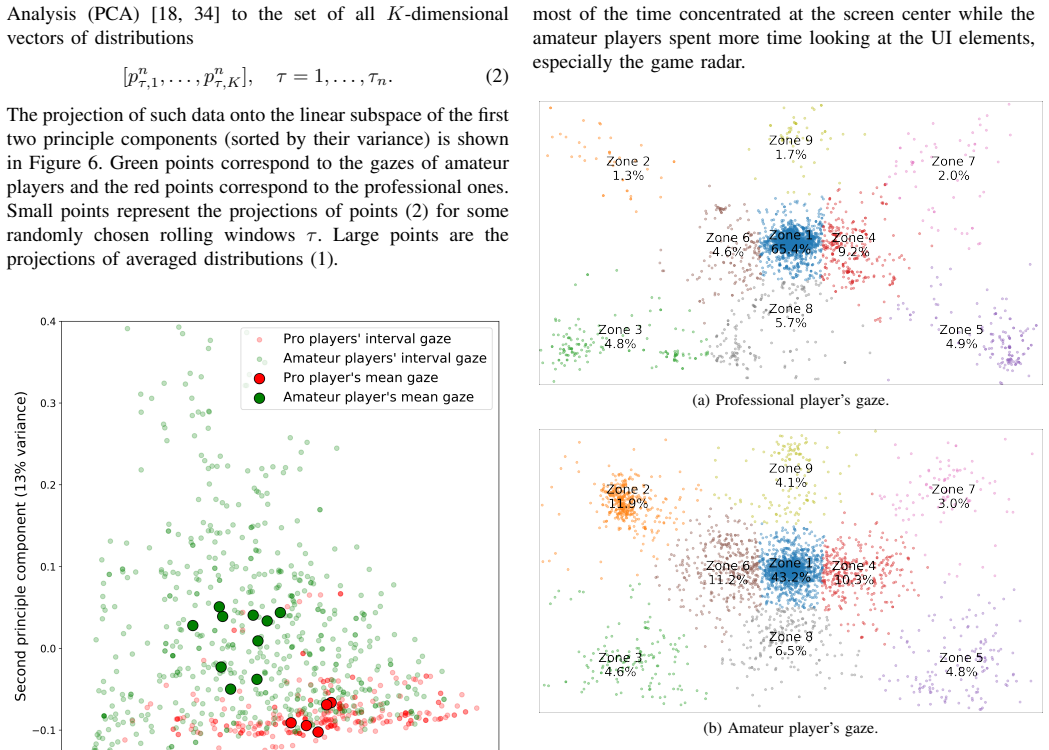
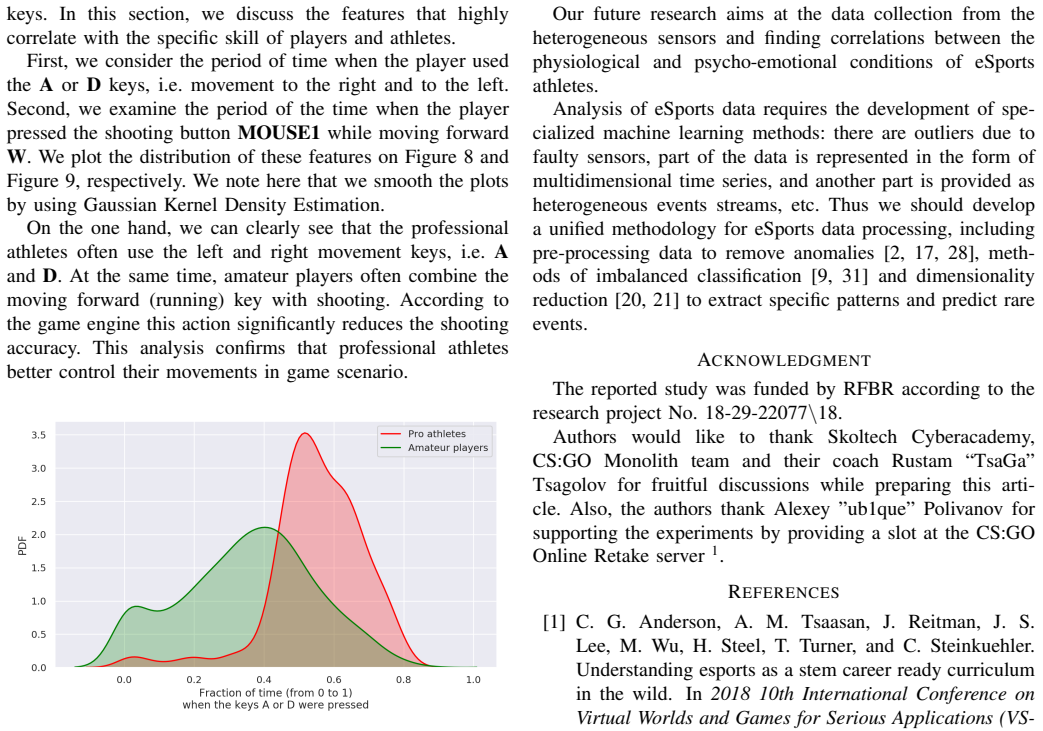
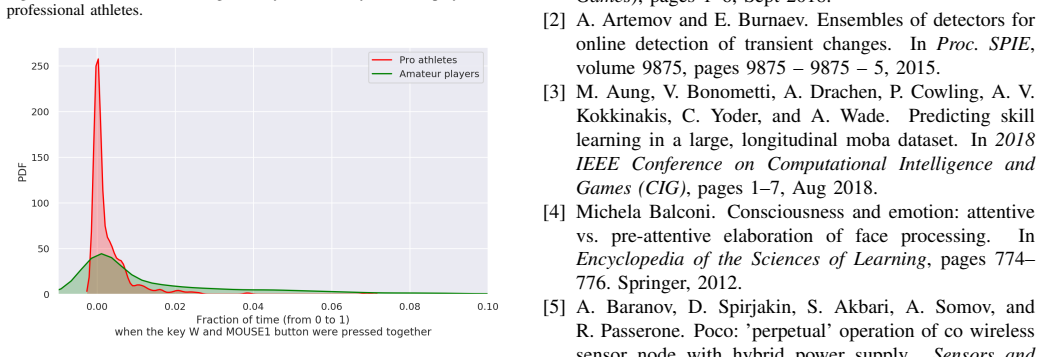
The load-bearing object is the zone-occupancy distribution: a vector of nine probabilities, one per screen zone, computed from raw gaze coordinates by k-center clustering with nine hand-selected cluster centers (crosshair, radar, health/armor panel, weapon/ammo panel, kill/log, timer/player panel, and three zones around the crosshair). Gaze gaps shorter than 0.1 seconds are linearly interpolated, and the frequency of gaze in each zone is counted over a 15-second rolling window. Principal component analysis is applied to these distributions; its first two components are nearly sparse, with the dominant coordinate of the first component being the crosshair zone and that of the second being the radar zone, which is what makes the professional-amateur separation interpretable. The supporting input analysis uses two simple features: time spent pressing A or D, and time spent pressing W and MOUSE1 together.
What would settle it
Run the same gaze pipeline on a round with a scripted enemy moving across the screen center: if eye-tracking samples that follow the moving enemy are assigned to the crosshair zone for both professionals and amateurs, then the claimed center-gaze difference may reflect target tracking rather than crosshair discipline, and the professional-amateur separation would need re-testing with the moving-target samples excluded.
Extended reading notes
Core claim
The central discovery is that professional and amateur CS:GO players can be distinguished by where they look and how they press keys, measured in a controlled Retake-mode scenario. The eye-tracker data are assigned to nine hand-chosen screen zones by k-center clustering, and the fraction of time spent in each zone is computed over 15-second windows; PCA on these zone-occupancy vectors shows a clear split between the two groups. The first principal component is dominated by the aiming-crosshair zone, and the second by the radar zone, leading the paper to conclude that professionals spend more time looking at the screen center and less time looking at the radar than amateurs. The input analysis adds that professionals use the left and right movement keys more often, whereas amateurs more often combine forward movement with shooting, which the game engine penalizes. The paper presents these as simple rules that can explain the skill difference observed in the data.
Load-bearing premise
The analysis assumes that each raw gaze position is mainly caused by one of the fixed on-screen zones, so gaze at moving enemies, empty space, or off-screen areas gets assigned to the nearest hand-picked cluster center; if that mapping is wrong, the center-versus-radar conclusion could be an artifact.
Editorial extensions
If this is right
- A scout or coach could use gaze-zone occupancy, especially the crosshair-versus-radar balance, as a quantitative indicator of FPS player experience in similar scenarios.
- The W+MOUSE1 simultaneous-press rate gives a second, independent behavioral marker that does not require an eye tracker.
- The same sensor stack can be applied to other game disciplines and to larger groups to test whether the center-gaze rule generalizes beyond CS:GO Retake.
- Amateur players could be given targeted feedback to reduce simultaneous run-and-shoot and to keep gaze near the crosshair, based directly on the observed professional pattern.
Reading between the lines
- If the crosshair-versus-radar axis is the main separator, a cheaper deployment could use a coarse per-second zone estimator from a low-frequency eye tracker and still reproduce the skill split.
- The fixed-zone model treats gaze as caused by static UI areas; mapping gaze onto 3D game-world objects (enemies, moving targets) would test whether center gaze is crosshair fixation or target tracking.
- The two behavioral rules (center gaze, no run-and-shoot) could be combined into a single low-dimensional skill score and validated against external performance metrics such as round win rate or kill-death ratio.
Signed reviews
Editorial analysis
A structured set of objections, weighed in public.
Referee Report
Summary. The paper presents a sensing platform for collecting heterogeneous data from eSports athletes, integrating an eye tracker, a heart-rate monitor, a mouse/keyboard logger, and CS:GO telemetry, and demonstrates it in a case study with 5 professional and 10 amateur players in the CS:GO Retake mode. The main analytical claims are that professional athletes spend more time looking at the screen center and less time looking at the radar than amateurs (Section V.A, Figures 6 and 7), and that professionals use strafe keys (A/D) more while amateurs combine forward movement (W) with shooting (MOUSE1) (Section V.B, Figures 8 and 9). The platform description and data collection methodology are plausible, but the comparative claims rest on visual inspection of PCA projections and unvalidated gaze-to-UI-zone assignments, with no inferential statistics reported.
Significance. If the platform and the gaze/input differences were rigorously established, this would be a useful contribution to eSports analytics and pervasive sensing: the system enables synchronized multimodal data collection from real professional athletes in a controlled scenario, and the proposed gaze-zone attribution approach could support coach feedback and scouting. The paper also includes a reproducible experimental protocol and a concrete dataset description. However, the analytical results are preliminary: the central comparative claims currently lack statistical support, and the key assumption that gaze coordinates are caused by fixed UI zones is not validated. The platform itself appears functional, so the contribution is primarily the sensing infrastructure and the case-study setup, not yet a demonstrated behavioral rule.
major comments (4)
- [Section V.A, Figure 6] The claim that professional athletes and amateur players are 'clearly' separated by the first two principal components is based entirely on visual inspection of a PCA projection of per-window gaze-zone distributions, with no statistical test, confidence intervals, or effect sizes. With only 5 professionals and 10 amateurs, and with multiple rolling windows per player (a repeated-measures structure), the apparent separation could be driven by individual differences or by non-independence of the windows. Please provide a formal test comparing the distributions of Zone 1 and Zone 2 occupancy between the two groups, for example a mixed-effects model with participant as a random effect, a permutation test that respects subject-level clustering, or a Mann-Whitney U test on per-player averages, and report effect sizes.
- [Section V.A, Table 4 and assumption before Eq. (1)] The gaze-to-zone mapping assumes that 'the gaze positions (x,y) are mainly caused by the specific zone of interest shown on the screen during the game,' but this assumption is not validated. The fixed nine cluster centers define a Voronoi-like partition of the 1920x1080 screen, so gaze at moving targets, empty world regions, or the weapon model will be assigned to the nearest UI-zone center (e.g., lower-left gaze is counted as radar, center gaze as crosshair). If professionals and amateurs differ in map position, round phase, or engagement distance, the reported center-versus-radar difference could reflect game-state differences rather than skill. Please validate the zone assignment (e.g., by comparing automated labels to manual annotation of gaze videos) or at minimum analyze the sensitivity of the conclusions to the choice of cluster centers and to the number of clusters k.
- [Section V.B, Figures 8 and 9] The mouse and keyboard analysis is qualitative: the claims that professionals 'often use' A/D keys and that amateurs 'often combine' W with MOUSE1 are supported only by visual inspection of two kernel-density plots, with no numerical summaries, no statistical tests, and no effect sizes. Please report quantitative features (e.g., fraction of time holding A/D, frequency or duration of W+MOUSE1 co-occurrence) for each group and test the group difference, ideally with the same repeated-measures care as recommended for the gaze data.
- [Section VI (Conclusion)] The conclusion states that 'Analysis of eSports data requires the development of specialized machine learning methods' and lists many open data-processing challenges, which is in tension with the strong comparative conclusions drawn earlier in Section V.A and V.B. Please either soften the claims (e.g., present the gaze and input results as exploratory) or provide the additional statistical evidence needed to support them.
minor comments (5)
- [Section III.A vs Section V.A] The sampling rate of the eye tracker is stated as 30 times per second in Section III.A but as 60 Hz in Section V.A; please reconcile these values and verify that the interpolation gap threshold of '6 missing consequent observations maximum' matches the actual sampling rate (0.1 s at 60 Hz, but 0.2 s at 30 Hz).
- [Section IV.B vs Section V.A] The game scenario in Section IV.B describes 12 rounds, while Section V.A refers to '10 repeated rounds'; please clarify the actual number of rounds used in the analysis.
- [Section V.A, Table 4] Zones 4, 6, and 8 are described as 'Right Area of Sight,' 'Left Area of Sight,' and 'Bottom Area of Sight' but are not visible in Figure 3; please explain the rationale for their placement and how they relate to the UI elements or to gameplay.
- [Section V.A, Figure 6] The caption says 'principle components' but the correct term is 'principal components'; similarly, 'prepossessed' in Section V.A should be 'preprocessed.'
- [Section V.A, Figures 8 and 9] The axes of the KDE plots in Figures 8 and 9 are not clearly labeled in the figure captions; please specify what quantity is plotted on each axis (e.g., time in seconds, probability density).
Circularity Check
No significant circularity: the gaze conclusions are measured cluster-occupancy statistics with a priori UI-defined zones; no fitted parameter or self-citation chain is load-bearing.
full rationale
The paper's central comparative claim is that professional athletes look more at the screen center and less at the radar than amateurs (Section V.A). This is derived by assigning raw gaze coordinates to nine fixed UI-zone cluster centers (Table 4) and computing zone-occupancy probabilities, then projecting the resulting distributions with PCA. No parameter needed for the conclusion is fitted to the outcome: the nine cluster centers are defined a priori from the CS:GO interface geometry, the Euclidean nearest-center assignment is deterministic, and the PCA is descriptive rather than a generative model with fitted coefficients. The conclusion 'professionals spend more time looking at the screen center' is simply a reading of the measured occupancy of the center zone, not a construction that presupposes the conclusion. The assumption that gaze positions are 'mainly caused by the specific zone of interest shown on the screen' is an untested modeling assumption, but it is not circular: it does not encode the professional-versus-amateur difference. The input-device analysis (Section V.B) compares raw key/mouse timing distributions and is similarly empirical. Self-citations in the reference list (e.g., [2,9,17,20,21,28,31]) appear only in the future-work discussion about generic preprocessing and classification methods and do not carry the paper's central claims. The absence of inferential statistics and effect sizes is a correctness/statistical weakness, not a circularity. The derivation chain is therefore self-contained and non-circular.
Assumptions & free parameters
free parameters (4)
- Number of gaze clusters k =
9
- Gaze cluster center coordinates =
Nine (x,y) pairs listed in Table 4
- Rolling window length =
15 seconds
- Interpolation gap threshold =
0.1 seconds
assumptions (4)
- domain assumption Gaze positions are mainly caused by the specific zone of interest shown on the screen during the game.
- domain assumption The nine manually defined gaze zones correspond to the functionally important regions of the CS:GO interface.
- domain assumption The Retake scenario with 10 rounds per player is representative of broader competitive CS:GO performance.
- standard math Standard PCA and k-center clustering are appropriate descriptions of the gaze distribution data.
Cite this review
Pith. "Pith review of Towards Understanding of eSports Athletes' Potentialities: The Sensing System for Data Collection and Analysis." pith.science (2026). https://pith.science/paper/2MUD6ZC4
@misc{pith2026190806403,
  author       = {Pith},
  title        = {Pith review of: Towards Understanding of eSports Athletes' Potentialities: The Sensing System for Data Collection and Analysis},
  year         = {2026},
  howpublished = {\url{https://pith.science/paper/2MUD6ZC4}},
  note         = {Machine review of arXiv:1908.06403}
}
read the original abstract
eSports is a developing multidisciplinary research area. At present, there is a lack of relevant data collected from real eSports athletes and lack of platforms which could be used for the data collection and further analysis. In this paper, we present a sensing system for enabling the data collection from professional athletes. Also, we report on the case study about collecting and analyzing the gaze data from Monolith professional eSports team specializing in Counter-Strike: Global Offensive (CS:GO) discipline. We perform a comparative study on assessing the gaze of amateur players and professional athletes. The results of our work are vital for ensuring eSports data collection and the following analysis in the scope of scouting or assessing the eSports players and athletes.
Figures

Figures from the paper (4 more)
Reference graph
Works this paper leans on
-
[1]
C. G. Anderson, A. M. Tsaasan, J. Reitman, J. S. Lee, M. Wu, H. Steel, T. Turner, and C. Steinkuehler. Understanding esports as a stem career ready curriculum in the wild. In 2018 10th International Conference on Virtual Worlds and Games for Serious Applications (VS- Games), pages 1–6, Sept 2018
work page 2018
-
[2]
A. Artemov and E. Burnaev. Ensembles of detectors for online detection of transient changes. In Proc. SPIE , volume 9875, pages 9875 – 9875 – 5, 2015
work page 2015
-
[3]
M. Aung, V . Bonometti, A. Drachen, P. Cowling, A. V . Kokkinakis, C. Yoder, and A. Wade. Predicting skill learning in a large, longitudinal moba dataset. In 2018 IEEE Conference on Computational Intelligence and Games (CIG), pages 1–7, Aug 2018
work page 2018
-
[4]
Consciousness and emotion: attentive vs
Michela Balconi. Consciousness and emotion: attentive vs. pre-attentive elaboration of face processing. In Encyclopedia of the Sciences of Learning , pages 774–
-
[5]
A. Baranov, D. Spirjakin, S. Akbari, A. Somov, and R. Passerone. Poco: ’perpetual’ operation of co wireless sensor node with hybrid power supply. Sensors and Actuators, A: Physical , 238:112–121, 2016. cited By 15
work page 2016
-
[6]
Eye tracking the user experience: A practical guide to research
Aga Bojko. Eye tracking the user experience: A practical guide to research. Rosenfeld Media, 2013
work page 2013
-
[7]
The pupil as a measure of emotional arousal and autonomic activation
Margaret M Bradley, Laura Miccoli, Miguel A Escrig, and Peter J Lang. The pupil as a measure of emotional arousal and autonomic activation. Psychophysiology, 45(4):602–607, 2008. 1http://ub1que.ru
work page 2008
-
[8]
D. Buckley, K. Chen, and J. Knowles. Predicting skill from gameplay input to a first-person shooter. In IEEE Conf. Comput. Intell. Games (CIG13) , pages 105–112, Aug. 2013
work page 2013
Show all 36 references
-
[9]
Burnaev, P
E. Burnaev, P. Erofeev, and A. Papanov. Influence of resampling on accuracy of imbalanced classification. In Proc. SPIE, volume 9875, pages 9875–9875–5, 2015
2015
-
[10]
E. Cambria. Affective computing and sentiment analysis. IEEE Intelligent Systems , 31(2):102–107, Mar 2016
2016
-
[11]
Choi and M
G. Choi and M. Kim. Eye gaze information and game level design according to fps gameplay beats. Journal of Information and Communication Convergence Engineer- ing, 16:189–196, 01 2018
2018
-
[12]
Eye-movement pattern by playing experience in combat system of fps game
GyuHyeok Choi and Mijin Kim. Eye-movement pattern by playing experience in combat system of fps game. pages 52–56, 06 2015
2015
-
[13]
Davies and S
N. Davies and S. Clinch. Pervasive data science. IEEE Pervasive Computing, 16(3):50–58, 2017
2017
-
[14]
Game analytics
Magy Seif El-Nasr, Anders Drachen, and Alessandro Canossa. Game analytics. Springer, 2016
2016
-
[15]
Affective computing in games
Benjamin Guthier, Ralf D ¨orner, and Hector P Martinez. Affective computing in games. In Entertainment Com- puting and Serious Games , pages 402–441. Springer, 2016
2016
-
[16]
Icarus: Source generator based real-time recognition of speech in noisy stressful and lombard effect environments
John HL Hansen and Douglas A Cairns. Icarus: Source generator based real-time recognition of speech in noisy stressful and lombard effect environments. Speech Com- munication, 16(4):391–422, 1995
1995
-
[17]
Ishimtsev, A
V . Ishimtsev, A. Bernstein, E. Burnaev, and I. Nazarov. Conformal k-nn anomaly detector for univariate data streams. In Alex Gammerman, Vladimir V ovk, Zhiyuan Luo, and Harris Papadopoulos, editors, Proceedings of the Sixth Workshop on Conformal and Probabilistic Pre- diction...
2017
-
[18]
Principal component analysis
Ian Jolliffe. Principal component analysis. In Interna- tional encyclopedia of statistical science , pages 1094–
-
[19]
Iden- tifying game players with mouse biometrics
Ryan Kaminsky, Miro Enev, and Erik Andersen. Iden- tifying game players with mouse biometrics. University of Washington, Tech. Rep, 2008
2008
-
[20]
Kuleshov, A
A. Kuleshov, A. Bernstein, and E. Burnaev. Kernel regression on manifold valued data. In Proceedings of IEEE 5th International Conference on Data Science and Advanced Analytics, pages 120–129, 2018
2018
-
[21]
Kuleshov, A
A. Kuleshov, A. Bernstein, and E. Burnaev. Manifold learning regression with non-stationary kernels. In Luca Pancioni, Friedhelm Schwenker, and Edmondo Trentin, editors, Artificial Neural Networks in Pattern Recogni- tion, pages 152–164, Cham, 2018. Springer International Publishing
2018
-
[22]
Methods for comparing scanpaths and saliency maps: strengths and weaknesses
Olivier Le Meur and Thierry Baccino. Methods for comparing scanpaths and saliency maps: strengths and weaknesses. Behavior research methods, 45(1):251–266, 2013
2013
-
[23]
Applying metrics driven development to mmo costs and risks
Larry Mellon. Applying metrics driven development to mmo costs and risks. Versant Corporation, 2009
2009
-
[24]
Internet of things: Vision, applications and research challenges
Daniele Miorandi, Sabrina Sicari, Francesco De Pelle- grini, and Imrich Chlamtac. Internet of things: Vision, applications and research challenges. Ad Hoc Networks , 10(7):1497 – 1516, 2012
2012
-
[25]
Global esports market report, 2018
Newzoo. Global esports market report, 2018
2018
-
[26]
An efficient real-time emotion detection using camera and facial landmarks
Binh T Nguyen, Minh H Trinh, Tan V Phan, and Hien D Nguyen. An efficient real-time emotion detection using camera and facial landmarks. In Information Science and Technology (ICIST), 2017 Seventh International Confer- ence on, pages 251–255. IEEE, 2017
2017
-
[27]
Adap- tive system to learn and recognize emotional state of mind
Neeru Rathee, Ashutosh Vaish, and Sagar Gupta. Adap- tive system to learn and recognize emotional state of mind. In Computing, Communication and Automation (ICCCA), 2016 International Conference on , pages 32–
2016
-
[28]
Safin and E
A. Safin and E. Burnaev. Conformal kernel expected similarity for anomaly detection in time-series data. Advances in Systems Science and Applications, 17(3):22– 33, 2017
2017
-
[29]
Sasidharan, A
S. Sasidharan, A. Somov, A.R. Biswas, and R. Giaffreda. Cognitive management framework for internet of things:- a prototype implementation. pages 538–543, 2014. cited By 12
2014
-
[30]
M. H. Schiller, G. Wallner, C. Schinnerl, A. Monte Calvo, J. Pirker, R. Sifa, and A. Drachen. Inside the group: Investigating social structures in player groups and their influence on activity. IEEE Transactions on Games , pages 1–1, 2018
2018
-
[31]
Smolyakov, A
D. Smolyakov, A. Korotin, P. Erofeev, A. Papanov, and E. Burnaev. Meta-learning for resampling recommen- dation systems. In Proc. SPIE 11041, Eleventh Inter- national Conference on Machine Vision (ICMV 2018), 110411S (15 March 2019) , 2019
2018
-
[32]
Review of iot applications in agro-industrial and environmental fields
Jess Martn Talavera, Luis Eduardo Tobn, Jairo Alejandro Gmez, Mara Alejandra Culman, Juan Manuel Aranda, Diana Teresa Parra, Luis Alfredo Quiroz, Adolfo Hoyos, and Luis Ernesto Garreta. Review of iot applications in agro-industrial and environmental fields. Computers and Electr...
2017
-
[33]
Learning policies for first person shooter games using inverse reinforcement learning
Bulent Tastan and Gita Reese Sukthankar. Learning policies for first person shooter games using inverse reinforcement learning. In AIIDE, 2011
2011
-
[34]
Princi- pal component analysis
Svante Wold, Kim Esbensen, and Paul Geladi. Princi- pal component analysis. Chemometrics and intelligent laboratory systems, 2(1-3):37–52, 1987
1987
-
[35]
Pupillary response based cognitive workload measurement under luminance changes
Jie Xu, Yang Wang, Fang Chen, and Eric Choi. Pupillary response based cognitive workload measurement under luminance changes. In IFIP Conference on Human- Computer Interaction, pages 178–185. Springer, 2011
2011
-
[36]
Improving aviation safety using synthetic vision system integrated with eye- tracking devices
Mingliang Xu, Yibo Guo, Bailin Yang, Wei Chen, Pei Lv, Liwei Fan, and Bin Zhou. Improving aviation safety using synthetic vision system integrated with eye- tracking devices. arXiv preprint arXiv:1803.02543, 2018
2018 arXiv
Reviewed August 14, 2026 · model on record in the stance chip above.
Discussion (0). Continue with ORCID to comment.