REVIEW 3 major objections 5 minor 23 references
Sensors and Game Synchronization for Data Analysis in eSports
T0 review · 3 major / 5 minor · reviewed 2026-08-14 · deepseek-v4-flash
Pith's one-line read A sensing system can synchronize eSports physiological, video, and telemetry data on a common timeline within 10 ms, with the gaming computer's clock aligned to 2–3 ms in CS:GO.
desk verdict A clever and practical post-synchronization trick for CS:GO demos, but the headline accuracy claim is not backed by ground-truth measurement and Equation (4) has a sign error. read the letter →
The pith
A machine-rendered reading of the paper's core claim, the machinery that carries it, and where it could break.
The reading
What carries the argument
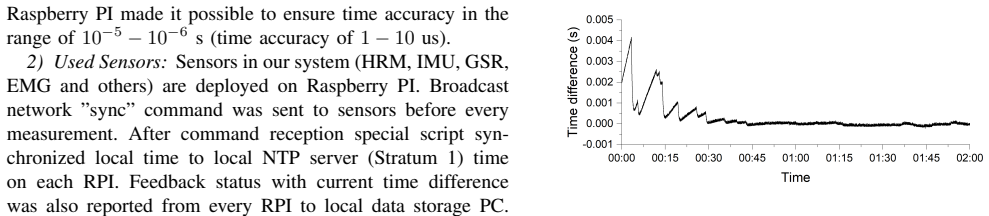
The load-bearing mechanism is the post-synchronization search over integer tick shifts: the binary fire series $f_m$ from the game demo and the binary left-mouse-button series $g_n$ from the mouse logger are aligned by maximizing their overlap, which reduces to $\operatorname{arg\,max}_s (f \star \tilde{g})_{-s}$ after reversing one series. This discrete-convolution identity turns a one-dimensional search into a near-linear-time computation and is what makes the demo-to-UTC mapping practical on long replays. The second mechanism is the common time base itself: a local GPS/PPS-disciplined NTP server that keeps the gaming PC and the sensor nodes on the same clock within a few milliseconds.
What would settle it
Run a controlled CS:GO session in which the player fires a single visible shot at a UTC moment marked by an external electrical pulse recorded by the same sensor network; compare the pulse-tagged UTC time with the demo-mapped time of that shot to measure the true post-synchronization error. A second check is to shift the mouse log by a known number of ticks, run the algorithm, and see whether the recovered shift matches the injected offset within the claimed 2–3 ms accuracy.
Extended reading notes
Core claim
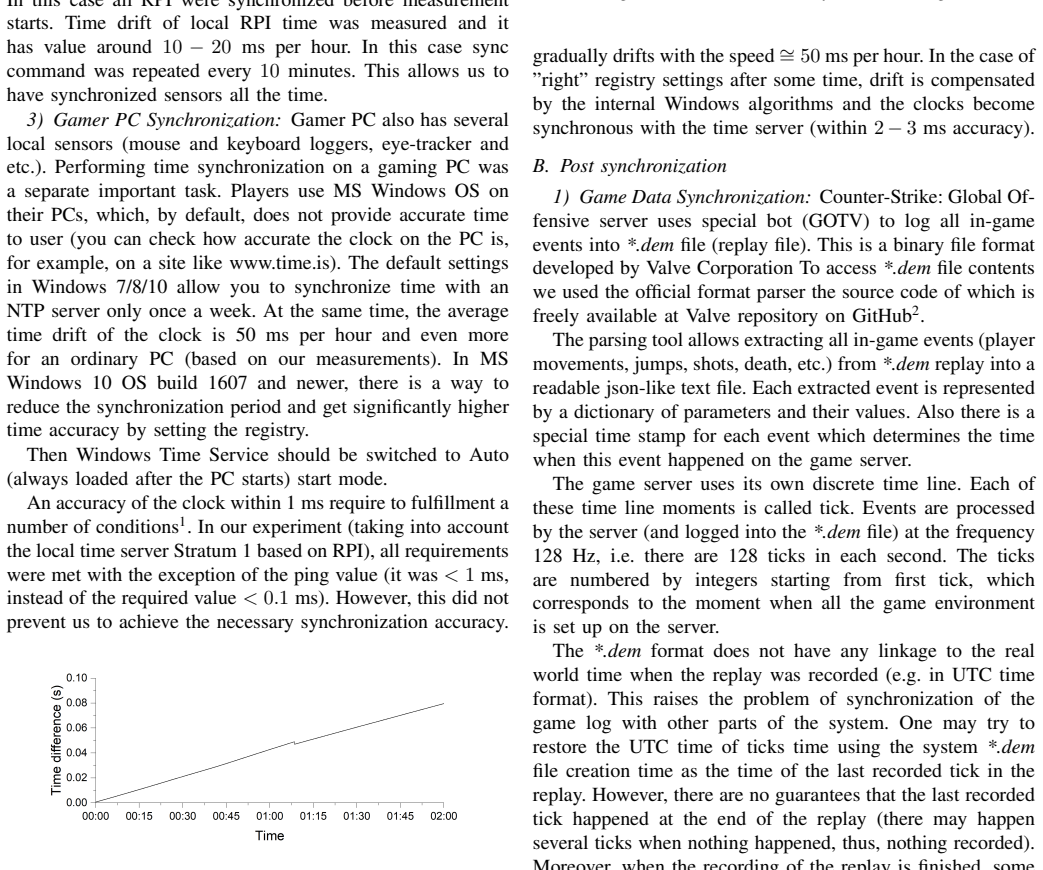
The paper's discovery is a practical synchronization recipe for truly heterogeneous eSports data: a local Stratum-1 NTP server disciplined by a GPS pulse-per-second signal provides a common time base for sensors and the gaming PC, while a post-synchronization algorithm maps the game demo timeline to real time. The demo records in-game fire events at 128 Hz ticks, and the mouse logger records left-button presses at the same rate with known UTC time. Representing both as binary time series, the algorithm finds the integer shift $s^*$ that maximizes $\sum_m f_m g_{m+s}$, the number of fire events coinciding with left-button presses; rewriting this sum as a discrete convolution lets it be computed in $O((M+N)\log(M+N))$ time. The authors report that, in their CS:GO experiments, the gaming computer's clock was synchronized to the time server within 2–3 ms, giving a system that supports sub-reaction-time analysis of player behavior.
Load-bearing premise
The post-synchronization algorithm assumes every weapon-fire event in the demo appears as a left-mouse-button press in the mouse log; if a player binds fire to another key, uses an unlogged mouse, or the demo omits shots, the overlap peak weakens, and the paper gives no ground-truth measurement of the post-synchronization alignment error.
Editorial extensions
If this is right
- Sensors, video, and game telemetry from one session can be analyzed as a single timeline with alignment well below one human reaction-time step.
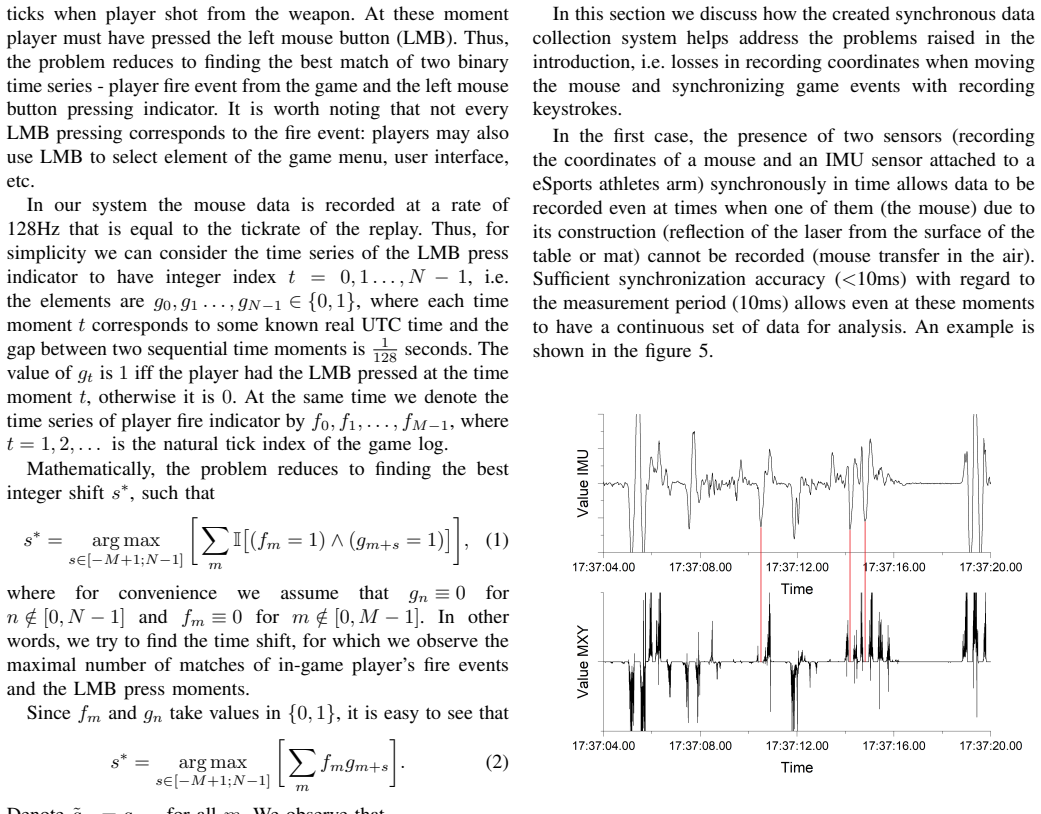
- Missing mouse-coordinate intervals, such as during a lift-and-recenter motion, can be filled or corroborated with IMU data because both streams share a 10 ms time grid.
- The convolution-based shift search scales almost linearly with replay and mouse-log length, so synchronization remains practical for long competitive matches.
- The approach is stated to transfer to other eSports disciplines and to adjacent fields such as medical monitoring, where heterogeneous sensors must share a precise clock.
Reading between the lines
- The paper measures the gaming PC's clock accuracy, but it does not report a ground-truth error for the demo-to-UTC alignment itself; a natural extension is to inject a known artificial time offset into one stream and check that the convolution recovers it within the claimed 3 ms.
- Because the correlation uses left-mouse-button presses, the algorithm would degrade for players who bind fire to the keyboard or scroll wheel; a testable variant would replace fire events with other game actions, such as jumps, and the keyboard log.
- A further consequence the authors leave implicit is that, once demo events are on the UTC timeline, analysts can compute per-event physiological responses, for example heart-rate or skin-conductance changes around a specific in-game shot, at sub-reaction-time resolution.
- The same shift-maximization idea could be applied to other 128 Hz tick-based games with binary event logs, provided a synchronously logged user-input stream exists; this is an extension of the method rather than a result tested in the paper.
Signed reviews
Editorial analysis
A structured set of objections, weighed in public.
Referee Report
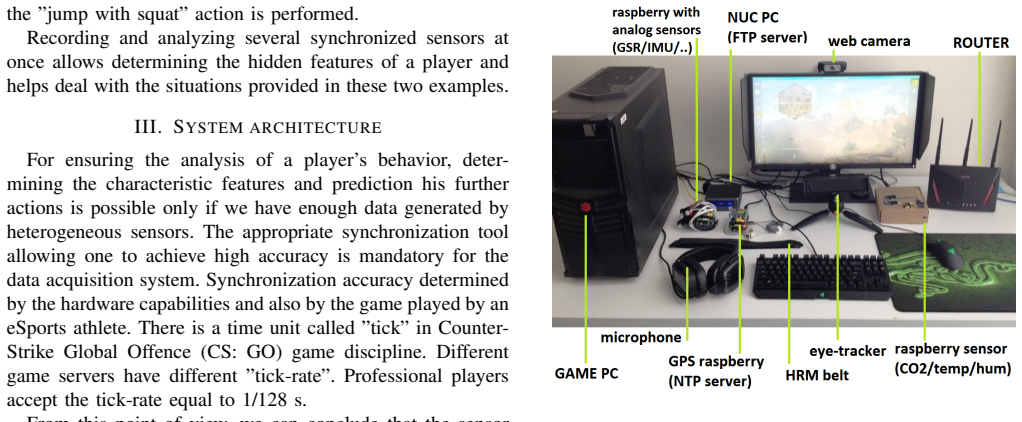
Summary. This paper describes a multimodal data collection system for eSports monitoring, integrating physiological, environmental, video, mouse/keyboard, and game telemetry data. The authors use a local GPS/PPS-based NTP server to synchronize Raspberry Pi sensor nodes and the gaming PC, with registry-tuned Windows time service to reach 2-3 ms clock accuracy. For the CS:GO demo file, which has no UTC timestamps, they propose a post-synchronization algorithm that aligns in-game weapon fire events with logged left mouse button presses by maximizing their overlap over an integer tick shift, computed efficiently via discrete convolution. The paper claims system-wide synchronization accuracy below 10 ms and presents qualitative results showing the feasibility of the approach.
Significance. If the synchronization claims are validated, the proposed system would be a low-cost and practical tool for collecting synchronized multimodal data in eSports training and player analysis. The post-synchronization method is simple, parameter-free, and efficient, and it leverages publicly available demo parsing tools; these are notable strengths. However, the central quantitative claim about game-log synchronization accuracy is not currently supported by a ground-truth measurement, and a sign error in the formal derivation needs correction. The paper is more of a systems/experience report than a rigorous algorithm-validation paper, but the underlying idea is sound and likely fixable within the manuscript's scope.
major comments (3)
- [Section IV-B.1, Eq. (4)] Equation (4) is mathematically inconsistent with the stated objective. Equations (1) and (2) correctly define s* as the arg max of the number of matching fire and LMB-press events, and Eq. (3) rewrites this objective as (f ⋆ g_tilde)_{-s}. Equation (4), however, writes s* = arg min_s (f ⋆ g_tilde)_{-s}, which minimizes the overlap rather than maximizing it. As printed, the derivation is contradictory and would lead to the shift with the fewest, not most, coincidences. Please change Eq. (4) to arg max, or equivalently express the result as arg max_k (f ⋆ g_tilde)_k with k = -s.
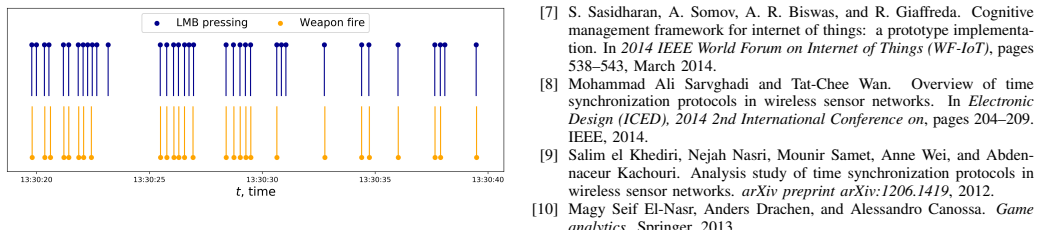
- [Section V, Fig. 6] The claim that post-synchronization achieves <10 ms accuracy for the game telemetry is not established by the presented evidence. The 2-3 ms figure in Section IV-A.3 concerns the Windows NTP clock on the gaming PC, not the residual error after aligning the demo timeline. Figure 6 is a qualitative overlay with no error bars, no independent reference times, and no quantitative residual analysis. Moreover, because s* is an integer number of 128 Hz ticks, the shift resolution is 1/128 s = 7.8125 ms, which alone nearly exhausts the advertised 10 ms budget; the true residual also includes mouse sampling latency, network transmission, server tick quantization, and demo event logging delays, none of which is measured here. Please provide a ground-truth validation, for example by recording a controlled event whose UTC time is independently known, or by comparing the estimated shift against a second synchronization method, and report the residual distribution.
- [Section IV-B.1] The post-synchronization algorithm relies on the assumption that every in-game fire event corresponds to a captured left mouse button press and that non-fire LMB presses (e.g., menu clicks) are rare or uncorrelated. If a player binds fire to a different key, uses a mouse whose output is not logged, or if the demo omits certain shots, the correlation peak is degraded; if non-fire clicks are correlated with fire events, the estimated shift can be biased. The authors should state this validity condition explicitly and ideally demonstrate robustness, for instance by randomly removing a fraction of fire events and measuring the stability of the estimated shift.
minor comments (5)
- [Abstract] There is a typo in the abstract: 'guarantying' should be 'guaranteeing'.
- [Section IV-B.1] The notation for the time indices is inconsistent: the mouse series is indexed from t = 0 and the fire series from t = 1, without a clear statement of whether the tick index starts at 0 or 1. Please align the index ranges and define N and M explicitly before Equation (1).
- [Section II] In the sentence beginning 'In [20] audio streams was captured...', the verb should agree with the plural subject; also 'This discussion demonstrates that there are no examples when many sensors are used at the same time' is not strictly supported by the cited literature and could be softened to 'few examples'.
- [Reference [23]] Reference [23] appears incomplete: 'C Sidney Burrus and TW Parks. and Convolution Algorithms' seems to be missing the beginning of the title and publisher information. Please correct it.
- [Section V, Fig. 5] The text states that the measurement period is 10 ms and the synchronization accuracy is <10 ms, but it does not explain why that is sufficient to fill the data-loss gaps shown in the figure. A more precise statement about interpolation or continuity would help the reader assess the claim.
Circularity Check
No circularity: the post-synchronization algorithm is self-contained and no fitted parameter is renamed as a prediction.
full rationale
The paper's central derivation is the post-synchronization of CS:GO demo telemetry with mouse-log UTC time (Section IV-B.1, Eqs. (1)-(4)). The game-log fire events f_m and the mouse LMB press series g_t are independent observed binary signals; the algorithm estimates a single integer shift s* by maximizing their overlap (Eq. (1), then rewritten as a convolution). This is a standard registration of two data streams and does not fit any parameter to the quantity it later claims to predict. The claimed 10 ms accuracy is not obtained by re-inserting the same data as ground truth; it is asserted from the 128 Hz sampling/tick resolution and from the separately measured 2-3 ms NTP clock alignment of the gaming PC (Section IV-A.3). No load-bearing self-citation appears: the cited prior works [5], [7] are background on sensor platforms, and there is no 'uniqueness' or 'forced' argument. The known weaknesses — no ground-truth validation of the post-sync shift, the arg min/arg max sign inconsistency in Eq. (4), and the 7.8125 ms quantization of a 128 Hz shift — are correctness/experimental-support issues, not circularity. Thus the derivation chain is self-contained and the circularity score is 0.
Assumptions & free parameters
assumptions (3)
- domain assumption CS:GO demo tick rate is 128 Hz and tick numbers are an integer time line independent of UTC.
- domain assumption Every in-game weapon fire event corresponds to a physical left mouse button press recorded by the mouse logger.
- domain assumption The local NTP server disciplined by GPS/PPS provides a stable time reference, and network and OS configurations allow clients to synchronize within a few milliseconds.
Cite this review
Pith. "Pith review of Sensors and Game Synchronization for Data Analysis in eSports." pith.science (2026). https://pith.science/paper/2T5HG6TS
@misc{pith2026190806404,
  author       = {Pith},
  title        = {Pith review of: Sensors and Game Synchronization for Data Analysis in eSports},
  year         = {2026},
  howpublished = {\url{https://pith.science/paper/2T5HG6TS}},
  note         = {Machine review of arXiv:1908.06404}
}
read the original abstract
eSports industry has greatly progressed within the last decade in terms of audience and fund rising, broadcasting, networking and hardware. Since the number and quality of professional team has evolved too, there is a reasonable need in improving skills and training process of professional eSports athletes. In this work, we demonstrate a system able to collect heterogeneous data (physiological, environmental, video, telemetry) and guarantying synchronization with 10 ms accuracy. In particular, we demonstrate how to synchronize various sensors and ensure post synchronization, i.e. logged video, a so-called demo file, with the sensors data. Our experimental results achieved on the CS:GO game discipline show up to 3 ms accuracy of the time synchronization of the gaming computer.
Figures

Figures from the paper (3 more)
Reference graph
Works this paper leans on
-
[1]
C. G. Anderson, A. M. Tsaasan, J. Reitman, J. S. Lee, M. Wu, H. Steel, T. Turner, and C. Steinkuehler. Understanding esports as a stem career ready curriculum in the wild. In 2018 10th International Conference on Virtual Worlds and Games for Serious Applications (VS-Games) , pages 1–6, Sept 2018
work page 2018
- [2]
-
[3]
Choice reaction time: Basic concepts
A Welford. Choice reaction time: Basic concepts. Reaction times, pages 73–128, 1980
work page 1980
-
[4]
Introduction: an historical background sketch
JMT Brebner. Introduction: an historical background sketch. Reaction times, 1980
work page 1980
-
[5]
D. Spirjakin, A. Baranov, A. Karelin, and A. Somov. Wireless multi- sensor gas platform for environmental monitoring. In 2015 IEEE Workshop on Environmental, Energy, and Structural Monitoring Systems (EESMS) Proceedings, pages 232–237, July 2015
work page 2015
-
[6]
C. C. Y . Poon, B. P. L. Lo, M. R. Yuce, A. Alomainy, and Y . Hao. Body sensor networks: In the era of big data and beyond. IEEE Reviews in Biomedical Engineering , 8:4–16, 2015
work page 2015
-
[7]
S. Sasidharan, A. Somov, A. R. Biswas, and R. Giaffreda. Cognitive management framework for internet of things: a prototype implementa- tion. In 2014 IEEE World F orum on Internet of Things (WF-IoT) , pages 538–543, March 2014
work page 2014
-
[8]
Overview of time synchronization protocols in wireless sensor networks
Mohammad Ali Sarvghadi and Tat-Chee Wan. Overview of time synchronization protocols in wireless sensor networks. In Electronic Design (ICED), 2014 2nd International Conference on , pages 204–209. IEEE, 2014
work page 2014
Show all 23 references
-
[9]
Analysis study of time synchronization protocols in wireless sensor networks
Salim el Khediri, Nejah Nasri, Mounir Samet, Anne Wei, and Abden- naceur Kachouri. Analysis study of time synchronization protocols in wireless sensor networks. arXiv preprint arXiv:1206.1419 , 2012
2012 arXiv
-
[10]
Game analytics
Magy Seif El-Nasr, Anders Drachen, and Alessandro Canossa. Game analytics. Springer, 2013
2013
-
[11]
Immersidata analysis: Four case studies
Cyrus Shahabi, Kiyoung Yang, Hyunjin Yoon, Albert A Rizzo, Margaret McLaughlin, Tim Marsh, and Minyoung Mun. Immersidata analysis: Four case studies. Computer, 40(7):45–52, 2007
2007
-
[12]
Arcade video game platform built upon multiple sensors
Hyoil Lee, Heekwon Jeong, and JungHyun Han. Arcade video game platform built upon multiple sensors. In Multisensor Fusion and Integration for Intelligent Systems, 2008. MFI 2008. IEEE International Conference on, pages 111–113. IEEE, 2008
2008
-
[13]
Wireless sensor networks: A new regime for time synchronization
Jeremy Elson and Kay R ¨omer. Wireless sensor networks: A new regime for time synchronization. ACM SIGCOMM Computer Communication Review, 33(1):149–154, 2003
2003
-
[14]
Clock synchronization for wireless sensor networks: a survey
Bharath Sundararaman, Ugo Buy, and Ajay D Kshemkalyani. Clock synchronization for wireless sensor networks: a survey. Ad hoc networks, 3(3):281–323, 2005
2005
-
[15]
Clock synchronization in wireless sensor networks: An overview
Ill-Keun Rhee, Jaehan Lee, Jangsub Kim, Erchin Serpedin, and Yik- Chung Wu. Clock synchronization in wireless sensor networks: An overview. Sensors, 9(1):56–85, 2009
2009
-
[16]
Time synchronization in sensor networks: a survey
Fikret Sivrikaya and B ¨ulent Yener. Time synchronization in sensor networks: a survey. IEEE network , 18(4):45–50, 2004
2004
-
[17]
A fast clock synchronization algorithm for wireless sensor networks
Kan Xie, Qianqian Cai, and Minyue Fu. A fast clock synchronization algorithm for wireless sensor networks. Automatica, 92:133–142, 2018
2018
-
[18]
Spacecraft attitude synchronization and formation keeping using line of sight measurements
Rakesh R Warier, Arpita Sinha, and Srikant Sukumar. Spacecraft attitude synchronization and formation keeping using line of sight measurements. IF AC Proceedings V olumes, 47(3):8311–8316, 2014
2014
-
[19]
Overview of control and grid synchronization for distributed power generation systems
Frede Blaabjerg, Remus Teodorescu, Marco Liserre, and Adrian V Timbus. Overview of control and grid synchronization for distributed power generation systems. IEEE Transactions on industrial electronics , 53(5):1398–1409, 2006
2006
-
[20]
Physiological measures for game evaluation
Regan L Mandryk. Physiological measures for game evaluation. Game usability: Advice from the experts for advancing the player experience , pages 207–235, 2008
2008
-
[21]
Waving real hand gestures recorded by wearable motion sensors to a virtual car and driver in a mixed-reality parking game
David Bannach, Oliver Amft, Kai S Kunze, Ernst A Heinz, Gerhard Tr¨oster, and Paul Lukowicz. Waving real hand gestures recorded by wearable motion sensors to a virtual car and driver in a mixed-reality parking game. In CIG, pages 32–39, 2007
2007
-
[22]
Multimodal emotion recognition using eeg and eye tracking data
Wei-Long Zheng, Bo-Nan Dong, and Bao-Liang Lu. Multimodal emotion recognition using eeg and eye tracking data. In Engineering in Medicine and Biology Society (EMBC), 2014 36th Annual International Conference of the IEEE , pages 5040–5043. IEEE, 2014
2014
-
[23]
and Convolution Algorithms
C Sidney Burrus and TW Parks. and Convolution Algorithms . Citeseer, 1985
1985
Reviewed August 14, 2026 · model on record in the stance chip above.
Discussion (0). Continue with ORCID to comment.