REVIEW 2 major objections 5 minor 1 cited by
Towards low-temperature peculiarities of thermodynamic quantities for decorated spin chains
T0 review · 2 major / 5 minor · reviewed 2026-08-14 · deepseek-v4-flash
Pith's one-line read The sharp low-temperature peaks in decorated spin chains—the pseudo-transition—are finite-temperature remnants of the standard Ising chain's critical point at $H=0$, $T=0$, reached because the effective parameters of the chain are…
desk verdict A clean derivation of pseudo-critical exponents from the Ising-chain critical point, with the caveat that the 'universal' exponents assume a linear zero of the effective field. read the letter →
The pith
A machine-rendered reading of the paper's core claim, the machinery that carries it, and where it could break.
The reading
What carries the argument
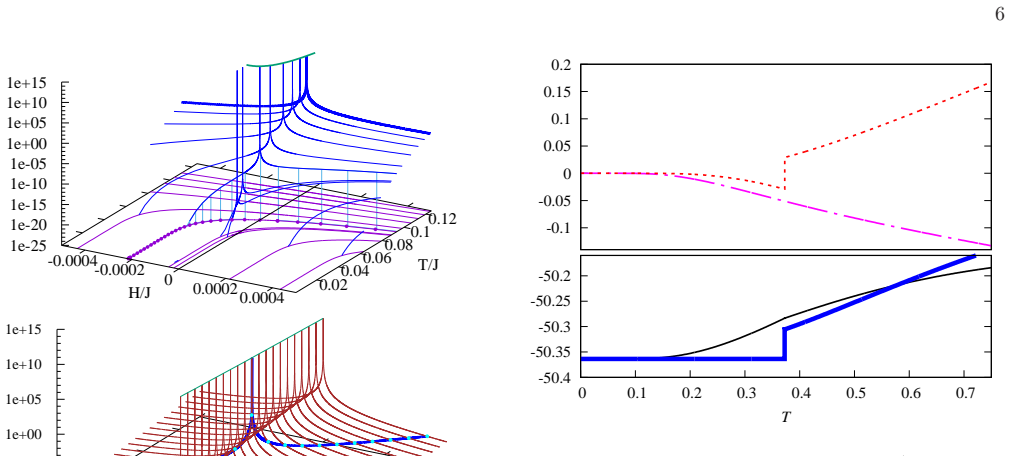
The load-bearing object is the mapping of a decorated spin chain to the effective Ising Hamiltonian (2.1), $H_{\rm eff}=C(T)-J_{\rm eff}(T)\sum_n\sigma_n\sigma_{n+1}-H_{\rm eff}(T)\sum_n\sigma_n$, with $J_{\rm eff}>0$ and $H_{\rm eff}$ changing sign at $T_p$. The transfer-matrix eigenvalues of this temperature-dependent Ising chain (2.5) yield all thermodynamic quantities; the decisive feature is the trajectory in the $H/J$–$T/J$ plane, which crosses $H=0$ at low temperature. Near $T_p$, the correlation length and susceptibility scale as $\xi\propto |H_{\rm eff}|^{-1}$ and $\chi\propto |H_{\rm eff}|^{-3}$, and the specific heat inherits the susceptibility peak through $c^{(8)}=T\chi(H'_{\rm eff})^2$. The linear form $H_{\rm eff}\approx A(T-T_p)$, Eq. (4.1), is what turns those power laws into the universal exponents.
What would settle it
For any candidate decorated chain, compute $J_{\rm eff}(T)$ and $H_{\rm eff}(T)$ from the exact decimation and test whether $H_{\rm eff}(T_p)=0$ with $2J_{\rm eff}(T_p)/T_p\gg1$; if a sharp peak in $\chi(T)$ or $c(T)$ still appears when the crossing occurs at high temperature or with $2J_{\rm eff}(T_p)/T_p$ of order one, the claimed sufficient condition is wrong.
Extended reading notes
Core claim
The paper's central claim is that the pseudo-transition—the sharp low-temperature peaks in thermodynamic quantities of certain decorated spin chains—is a finite-temperature echo of the critical point of the standard ferromagnetic Ising chain at $H=0$, $T=0$. After the decorated degrees of freedom are traced out, each model reduces exactly to an Ising chain with temperature-dependent parameters (2.1); the pseudo-critical temperature $T_p$ is where the effective field vanishes, $H_{\rm eff}(T_p)=0$. When $2J_{\rm eff}(T_p)/T_p\gg1$, the system's trajectory in the $H/J$–$T/J$ plane passes close to that critical point, producing a large correlation length, a near-saturated magnetization jump, and peaks in susceptibility and specific heat. Because $H_{\rm eff}(T)\approx A(T-T_p)$ near $T_p$, the peak widths are controlled by a single slope $A$, and the universal pseudo-critical exponents $\alpha=\gamma=3$, $\nu=1$ follow directly. The same mechanism explains why the specific-heat peak can be quenched when the slope $A$ is tiny.
Load-bearing premise
The sharp pseudo-transition peaks require that the effective exchange $J_{\rm eff}(T)$ stay ferromagnetic and slowly varying while the effective field $H_{\rm eff}(T)$ crosses zero at a low temperature with a finite nonzero slope; if the crossing temperature is not low or the slope is extremely small, the peaks broaden or are quenched.
Editorial extensions
If this is right
- The universal exponents $\alpha=\gamma=3$, $\nu=1$ are a direct consequence of the linear vanishing of $H_{\rm eff}$ at $T_p$, so they should appear in every decorated chain whose effective parameters obey (2.2) and (3.10).
- The specific-heat peak can disappear even when the susceptibility peak remains large, controlled by the factor $T_p A^2$; thermodynamic measurements that see only $c(T)$ may miss the pseudo-transition.
- The magnetization jump at $T_p$ forces jumps in internal energy and entropy through the temperature derivatives of the effective parameters, linking magnetic and thermal anomalies.
- The mapping gives a search criterion: new decorated spin chains with pseudo-transitions can be found by looking for effective Ising parameters whose zero-field crossing lies at low temperature.
- The same logic suggests extensions to higher-spin effective Ising chains and to two-dimensional decorated lattices whose trajectories pass near the square-lattice Ising critical point.
Reading between the lines
- If the mechanism is generic, then measuring $\chi(T)$ and $c(T)$ simultaneously in a candidate material provides a direct estimate of the slope $A=dH_{\rm eff}/dT|_{T_p}$, which is not otherwise experimentally accessible.
- The explanation implies that pseudo-transitions are smoother in systems where the effective-field crossing temperature cannot be made small; for instance, the higher of the two zero-crossings in the coupled spin-electron double-tetrahedral chain should show no sharp anomalies, which could be checked numerically.
- The same trajectory picture might be applied to quasi-one-dimensional compounds with slow parameter variation, where the sharp peaks would appear as finite-size or impurity-broadened remnants rather than true transitions.
Signed reviews
Editorial analysis
A structured set of objections, weighed in public.
Referee Report
Summary. The paper proposes an explanation for the low-temperature pseudo-transitions observed in one-dimensional decorated spin chains. It shows that after exactly tracing out the decorated degrees of freedom, the models reduce to a standard ferromagnetic Ising chain with temperature-dependent effective exchange Jeff(T) and effective field Heff(T). The pseudo-critical temperature Tp is defined by Heff(Tp)=0, and the authors argue that when Tp is low enough that 2Jeff(Tp)/Tp is large, the decorrelated chain inherits remnants of the Ising critical point at H=0, T=0. They derive explicit formulas for internal energy, entropy, and specific heat that include derivatives of the effective parameters, and they identify the term c(8)=Tχ(H'_eff)^2 as the dominant contribution to the specific-heat peak. Under the assumption Heff(T)≈A(T−Tp), they recover the pseudo-critical exponents α=γ=3ν=3 reported earlier. The argument is illustrated for the spin-1/2 Ising-XYZ diamond chain, the coupled spin-electron double-tetrahedral chain, and the spin-1/2 Ising-Heisenberg double-tetrahedral chain. The paper also documents a case in which a small slope A suppresses the specific-heat peak even though the susceptibility still peaks.
Significance. If the claims are accepted, the paper provides a useful conceptual unification: the mysterious pseudo-transitions of several decorated spin chains are attributed to trajectories in the H/J−T/J plane passing near the critical point of the standard Ising chain. The reduction for each of the three examples is exact and parameter-free, and the resulting expressions for e, s, and c in terms of Jeff and Heff are internally consistent and clearly stated. The paper also gives a falsifiable criterion—Eq. (3.10) plus the slope condition—for identifying decorated models that should display sharp low-temperature features, and it explicitly connects the earlier numerical exponents of Ref. [10] to a simple analytic mechanism. The main weakness is that the stated sufficient condition for a pseudo-transition is too strong when applied to the specific heat, and the claimed universality of exponents is conditional on a linear zero of Heff. These issues are significant but can be addressed by clarifying the conditions and the scope of the universality statement.
major comments (2)
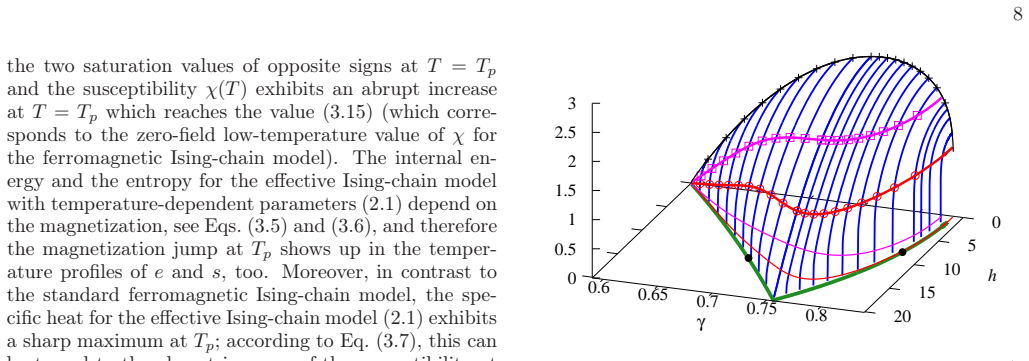
- [Section V and Eq. (3.10)] The paper calls Eq. (3.10), together with Eq. (2.2), a sufficient condition for occurrence of the pseudo-transition. However, the example in Fig. 10 (γ=0.82, h=7.916228) satisfies Heff(Tp)=0 and has Tp/J_eff≈0.0999, so 2Jeff(Tp)/Tp≈20, yet the specific heat shows no peak because TpA^2 is about 10^-15. Thus Eq. (2.2) plus Eq. (3.10) is not sufficient for the specific-heat signature. The authors themselves note this in the text around Fig. 10, but the conclusion in Section V still states the two conditions as sufficient without qualification. Please either define the pseudo-transition by the correlation-length, susceptibility, and magnetization signatures—for which Eq. (3.10) is indeed controlling—and state separately that a specific-heat peak additionally requires TpA^2 not to be too small, or include the slope condition explicitly in the sufficiency statement.
- [Section IV, Eq. (4.1)] The derivation of the universal exponents α=γ=3ν=3 uses the assumption Heff(T)≈A(T−Tp) with finite nonzero A. This is an additional property of the decorated model and is not a consequence of the Ising critical point alone. If Heff has a quadratic zero, Heff≈B(T−Tp)^2, then Eqs. (3.14) and (3.16) give ν=2 and γ=6, and the c(8) term behaves as |T−Tp|^{-4} (or is modified by the Jacobian). The paper does acknowledge the role of A in suppressing the specific-heat peak, but Section IV would be clearer if it stated explicitly that the universal exponent set applies only to linear crossings and, ideally, if it verified the linear-crossing condition for the three models under discussion.
minor comments (5)
- [Eqs. (3.14) and (3.16)] The notation "T≈Tp, (3.12)" used in Eqs. (3.14) and (3.16) is confusing, because the asymptotic formulas diverge at Tp while the exact expressions at Tp are finite. Please rephrase to say that these hold in the range where inequality (3.12) is satisfied but not exactly at Tp.
- [Fig. 10] The red dashed curves with up-triangles and down-triangles are hard to distinguish in grayscale print; please use more clearly distinct line styles or colors and ensure the caption identifies which curve is (H'_eff)^2 and which is Tχ.
- [Abstract] The abstract contains a spurious space in "q uantities"; similar typographical artifacts appear elsewhere and should be cleaned up.
- [Introduction, Ref. [13]] The parenthetical footnote [13] lists several unrelated examples of extra low-temperature peaks in other spin systems; the connection to the pseudo-transition discussed here is not developed and the list may be trimmed or made more specific.
- [Section III, discussion after Eq. (3.11)] The statement that ξ(Tp) tends to infinity only for 2Jeff(Tp)/Tp→∞ is correct, but the subsequent phrase "under this assumption Eq. (3.9) gives the estimate" could be clarified: Eq. (3.11) is an asymptotic estimate valid for large 2Jeff(Tp)/Tp, not an exact identity.
Circularity Check
No circularity: the pseudo-critical exponents are derived from the exact effective-Ising mapping and the textbook Ising transfer matrix, not fitted or self-cited into existence.
full rationale
The paper's central derivation is self-contained. The reduction of each decorated model to the effective Ising chain (2.1) is carried out explicitly in Appendices A-C, yielding closed forms for C(T), J_eff(T), and H_eff(T). The subsequent analysis uses the standard Ising-chain transfer-matrix solution (Baxter, an external textbook result) and differentiates the resulting free energy with respect to T, with Eqs. (3.5)-(3.7) following from the chain rule, not from any fitted target quantity. The pseudo-critical temperature is defined, not fitted, by H_eff(T_p)=0 in Eq. (2.2), and the correlation-length, susceptibility, and specific-heat peaks are obtained from the exact eigenvalues under the stated asymptotic condition (3.12). The universal exponents alpha=gamma=3, nu=1 follow from H_eff(T) approximately A(T-T_p), Eq. (4.1), which is exhibited for the specific models rather than imposed as the desired result. Self-citations to Refs. [5,8,9,10] occur for model definitions and for previously observed numerical exponents, but those citations are not load-bearing: the explanation in Sections III-IV is analytic and would stand even without them. The Fig. 10 caveat, where a very small slope A quenches the specific-heat peak despite Eqs. (2.2) and (3.10), is an acknowledged limitation of the sufficient condition and concerns the scope of the claim, not a circular reduction of the derivation to its inputs. There is therefore no step in which a prediction reduces by construction to a fitted parameter, a self-citation chain, or a definitional equivalence.
Assumptions & free parameters
assumptions (4)
- standard math Transfer-matrix solution of the one-dimensional Ising chain, including eigenvalues (2.5) and the H=0, T=0 critical point structure.
- domain assumption The reduction of the three decorated models to the effective Ising model (2.1) with C(T), Jeff(T), Heff(T) is exact.
- domain assumption Heff(T) is analytic at Tp and crosses zero with finite nonzero slope A, so Heff(T) approximately equals A(T-Tp).
- domain assumption Long-distance correlation decay of the original decorated spins is governed by the same ratio lambda-/lambda+ as the effective Ising spins.
Cite this review
Pith. "Pith review of Towards low-temperature peculiarities of thermodynamic quantities for decorated spin chains." pith.science (2026). https://pith.science/paper/J7Q45M2N
@misc{pith2026190806419,
  author       = {Pith},
  title        = {Pith review of: Towards low-temperature peculiarities of thermodynamic quantities for decorated spin chains},
  year         = {2026},
  howpublished = {\url{https://pith.science/paper/J7Q45M2N}},
  note         = {Machine review of arXiv:1908.06419}
}
abstract
We discuss the origin of an enigmatic low-temperature behavior of one-dimensional decorated spin systems which was coined the pseudo-transition. Tracing out the decorated parts results in the standard Ising-chain model with temperature-dependent parameters and the unexpected low-temperature behavior of thermodynamic quantities and correlations of the decorated spin chains can be tracked down to the critical point of the standard Ising-chain model at ${\sf H}=0$ and ${\sf T}=0$. We illustrate this perspective using as examples the spin-1/2 Ising-XYZ diamond chain, the coupled spin-electron double-tetrahedral chain, and the spin-1/2 Ising-Heisenberg double-tetrahedral chain.
Figures


Figures from the paper (13 more)






Forward citations
Cited by 1 Pith paper
-
Peculiarities in pseudo-transitions of a mixed spin-$(1/2,1)$ Ising-Heisenberg double-tetrahedral chain in an external magnetic field
An exactly solved 1D mixed-spin chain shows finite-temperature pseudo-transitions near five ground-state phase boundaries, including an interface between two non-degenerate ferrimagnetic phases.
Reference graph
Works this paper leans on
-
[10]
I. M. Carvalho, J. Torrico, S. M. de Souza, O. Rojas, and O. Derzhko, Annals of Physics 402, 45 (2019)
work page 2019
- [1]
-
[2]
in the H/ J − T/ J plane should also exhibit interesting behav- ior conditioned by that critical point. As a candidate for such a decorated two-dimensional spin model we may suggest a diamond-like-decorated square lattice [16]. Acknowledgments The authors gratefully acknowledge helpful discussions with Yu. Holovatch, A. Honecker, J. Richter, A. Shvaika, I...
work page 2017
-
[3]
5892 and γ ≈ 0. 8314. For further details see Ref. [8]. Appendix A: Spin-1/2 Ising-XYZ diamond chain We consider the spin-1/2 Ising-XYZ diamond chain with the Hamiltonian (we use notations of Ref. [8]): H = N∑ i=1 Hi, Hi = −J(1+ γ)Sx a,i Sx b,i − J(1−γ)Sy a,i Sy b,i − JzSz a,i Sz b,i −J0(Sz a,i + Sz b,i )(σi + σi+1) −hz(Sz a,i + Sz b,i ) − h 2 (σi + σi+1)...
-
[4]
J. Torrico, M. Rojas, S. M. de Souza, and O. Rojas, Phys. Lett. A 380, 3655 (2016)
work page 2016
- [5]
-
[6]
J. Strečka, R. C. Alécio, M. L. Lyra, and O. Rojas, J. Magn. Magn. Mater. 409, 124 (2016)
work page 2016
-
[7]
S. M. de Souza and O. Rojas, Solid State Communica- tions 269, 131 (2018)
work page 2018
Show all 24 references
-
[8]
See also P. N. Timonin, J. Exp. Theor. Phys. 113, 251 (2011); X. Ma, S. Cambré, W. Wenseleers, S. K. Doorn, and H. Htoon, Phys. Rev. Lett. 118, 027402 (2017); R. A. Stancioli and L. A. S. Mól, Phys. Rev. B 100, 024432 (2019)
2011
-
[9]
I. M. Carvalho, J. Torrico, S. M. de Souza, M. Rojas, and O. Rojas, J. Magn. Magn. Mater. 465, 323 (2018)
2018
- [11]
-
[12]
Rojas, J
O. Rojas, J. Strečka, M. L. Lyra, and S. M. de Souza, Phys. Rev. E 99, 042117 (2019)
2019
- [13]
-
[14]
Rojas, J
O. Rojas, J. Strečka, O. Derzhko, and S. M. de Souza, Peculiarities in pseudo-transitions of a mixed spin-(1/2,
-
[15]
Ising-Heisenberg double-tetrahedral chain in an exter- nal magnetic field , to be submitted (2019)
2019
-
[16]
Misguich and B
Interestingly, an extra low-temperature peak is obser ved in a number of spin systems and its study is a hot topic nowadays, see, for instance, G. Misguich and B. Bernu, Phys. Rev. B 71, 014417 (2005); J. Schnack, J. Schulenburg, and J. Richter, Phys. Rev. B 98, 094423 (2018);...
2005 arXiv
-
[17]
Van den Heuvel and L
W. Van den Heuvel and L. F. Chibotaru, Phys. Rev. B 82, 174436 (2010)
2010
-
[18]
R. J. Baxter, Exactly Solved Models in Statistical Me- chanics (Academic Press, 1982)
1982
-
[19]
Hirose, A
Y. Hirose, A. Oguchi, and Y. Fukumoto, J. Phys. Soc. Jpn. 86, 014002 (2017)
2017
-
[20]
Mambrini, J
M. Mambrini, J. Trébosc, and F. Mila, Phys. Rev. B 59, 13806 (1999)
1999
-
[21]
Rojas and F
O. Rojas and F. C. Alcaraz, Phys. Rev. B 67, 174401 (2003)
2003
-
[22]
Maksymenko, O
M. Maksymenko, O. Derzhko, and J. Richter, Acta Physica Polonica A 119, 860 (2011); M. Maksymenko, O. Derzhko, and J. Richter, Eur. Phys. J. B 84, 397 (2011)
2011
-
[23]
Ohanyan, Condensed Matter Physics 12, 343 (2009)
V. Ohanyan, Condensed Matter Physics 12, 343 (2009)
2009
-
[24]
Antonosyan, S
D. Antonosyan, S. Bellucci, and V. Ohanyan, Phys. Rev. B 79, 014432 (2009)
2009
Reviewed August 14, 2026 · model on record in the stance chip above.
Discussion (0). Continue with ORCID to comment.