REVIEW 3 major objections 6 minor 26 references
Scene Classification in Indoor Environments for Robots using Context Based Word Embeddings
T0 review · 3 major / 6 minor · reviewed 2026-08-14 · deepseek-v4-flash
Pith's one-line read The paper claims that re-ranking a CNN's top-5 scene predictions by the cosine similarity between detected objects and scene labels, under a GPS-based environment taxonomy, improves indoor scene-classification accuracy for robots on…
desk verdict Plausible word2vec re-ranking for indoor scene classification, but the reported 1-2 point gains are not statistically supported by the autocorrelated test set. read the letter →
The pith
A machine-rendered reading of the paper's core claim, the machinery that carries it, and where it could break.
The reading
What carries the argument
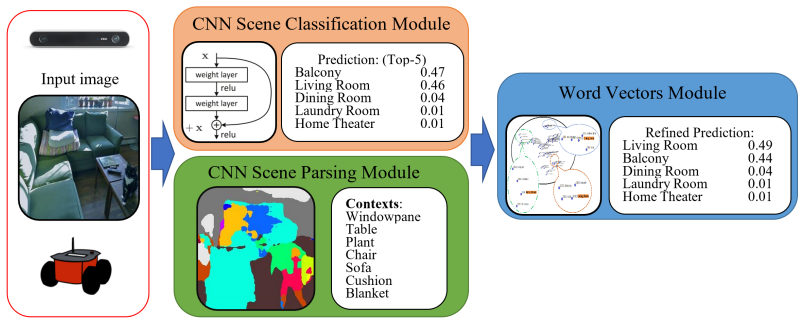
The carrying mechanism is a per-candidate context-vector scoring step, the procedure at the heart of Algorithm 1. For each candidate scene $s_j$ among the CNN's top-5 predictions, the image is represented as a weighted sum of the detected object vectors, $I_k(j) = \sum_i w_{i,j} o_i$; the weight matrix $W$ and the vocabulary vectors $V$ are themselves learned with a hinge-loss cosine-similarity training model, initialized from word2vec embeddings and tf-idf statistics. The refined ranking is produced by multiplying the CNN confidence $ACC_k$ by the normalized cosine similarity between $I_k(j)$ and the scene vector $s_j$, then sorting descending. The taxonomy is the second supporting mechanism: it prunes the Places365 label set to a small per-environment list, turning a 365-way classification problem into a 14-to-31-way problem for the chosen environment.
What would settle it
Run the same ResNet plus word-embedding re-ranker on the authors' test images while withholding the environment taxonomy, so every image is classified against all 365 Places classes or against the wrong environment's short list. If top-1 accuracy stays near 92%, the taxonomy is not load-bearing; if it collapses, the reported result is a pruned-search effect rather than a general scene-classification gain.
Extended reading notes
Core claim
On the paper's own terms, the discovery is that the context of a scene—the objects a scene-parsing network finds in the image—carries signal that the scene classifier's top-5 confidence scores leave unused. The method represents each detected object and each candidate scene label as word vectors, forms an image vector per candidate as a weighted sum of the object vectors, and multiplies the CNN's confidences by normalized cosine similarities to those scene vectors. After this re-ranking, top-1 accuracy on the authors' test set rises from 90.33% to 92.25% for school and from 92.03% to 93.27% for home, while shopping mall stays essentially flat at 87.39%. The authors attribute the flat mall result to the scene-parsing model's failure to detect distinguishing objects such as shoes, watches, and hats. The method presumes a taxonomy that tells the robot which broad environment it is in, so the full set of 365 Places classes is reduced to 24 school scenes, 14 home scenes, or 31 mall scenes before classification.
Load-bearing premise
The method assumes the robot already knows which broad environment it is in (school, home, or shopping mall), so the scene classifier only has to choose among a short pruned list; if that prior is wrong or absent, the reported accuracies do not apply.
Editorial extensions
If this is right
- In a known environment, the taxonomy cuts the classification problem from 365 classes to 14–31 classes, which is what makes the system fast enough for a robot.
- The word-embedding refinement can break near-ties in the CNN's top-5 confidence scores, as in the chemistry-lab example where the CNN split its confidence across physics lab, chemistry lab, and gymnasium.
- The refinement does not help when the scene parser cannot see the objects that separate the candidate scenes, as happened in the shopping-mall environment.
- The same pipeline, with a per-environment ResNet and the context re-ranker, runs on a Pioneer3AT robot with a ZED camera and a laptop GPU.
Reading between the lines
- Beyond the paper, the same re-ranking step could apply to any top-k classifier whose candidate labels can be paired with an object vocabulary, for example video scene tagging or indoor navigation landmark recognition.
- The paper does not test transfer, but because the object and scene vectors are learned from a shared embedding space, the learned weights might transfer to new indoor scene labels without retraining the CNN.
- A soft alternative the paper leaves untested is to replace the hard GPS environment prior with a probability distribution over environments, which would reveal how gracefully accuracy degrades when the robot is unsure where it is.
- The flat shopping-mall result points to a concrete bottleneck the paper names but does not fix: the scene parser misses small distinguishing objects such as shoes and hats, so improving small-object detection is the direct route to gains there.
Signed reviews
Editorial analysis
A structured set of objections, weighed in public.
Referee Report
Summary. The paper proposes a two-stage indoor scene classification pipeline for robots. A taxonomy prunes the 365 Places classes down to a per-environment list (e.g., school, home, shopping mall). A ResNet50 trained on the reduced Places365 subset produces top-5 predictions; a pre-trained scene parsing model detects objects; word2vec embeddings are used to compute a weighted object vector for the image and cosine similarity to each predicted scene label, re-ranking the CNN scores. The weight matrix W and the refined embeddings are learned on the reduced Places365 training set. The authors evaluate on a self-built dataset of 10,000 images from 69 places (plus YouTube frames) and on a Places365 validation subset, reporting top-1 accuracy in Table II. They also describe a deployment on a Pioneer3AT robot.
Significance. If the reported gains are real, the paper makes a modest but useful contribution: fusing object-level context via word embeddings improves top-1 accuracy by 1-2 percentage points on the authors' test set for school and home scenes, while leaving shopping mall essentially unchanged, and the method is simple and compatible with a real-time robot pipeline. The ResNet50 baseline under the same reduced taxonomy is a fair comparison, and the algorithm is described clearly enough to reimplement. The strengths are the explicit algorithm, the use of standard components, and the honest acknowledgment that the shopping mall refinement is not noticeable. However, the evidence is currently not strong enough: the test set is small in effective size and not released, and the Places365 validation results show negligible or negative gains. The paper would be substantially strengthened by per-place accuracy, statistical tests, and full training details.
major comments (3)
- [Section V, Table II] The central claim that the word2vec refinement improves accuracy is not statistically supported. The test set consists of 10,000 images from 69 places, captured as GoPro sequences (Section IV), so adjacent frames are near-duplicates and the effective sample size is far smaller than 10,000. The reported gains are 1.92 and 1.24 percentage points for school and home, while shopping mall is essentially unchanged (87.31% to 87.39%). On the Places365 validation subset the gains are only 0.46, 0.21, and -0.03 percentage points. No confidence intervals, per-place accuracy, or significance tests are given. The authors should report per-place and per-video-sequence numbers, a paired statistical test (e.g., McNemar or paired bootstrap), and a discussion of why the effect appears only on the self-built test set.
- [Section III-C] The training of the weight matrix W and the refined vectors V is underspecified. Equation (1) defines the image vector as a weighted sum of object vectors, but the text does not state the optimization objective beyond "hinge loss with margin equal to 0.1", nor the learning rate, number of epochs, embedding dimension, or whether W and V are learned per environment or globally. It also does not specify whether the CNN predictions used to train W come from the same ResNet50 models evaluated in Table II, nor whether any validation data (including the self-built test set) is used to tune hyperparameters. Without these details, the reported accuracy gain cannot be reproduced or checked for possible leakage.
- [Section I and Section III-A] The method assumes the environment type is known before classification, using GPS to prune the taxonomy. The paper never evaluates robustness to an incorrect or absent prior, and the conclusion states that robots can recognize places "with high confidence/accuracy" without this qualifier. The authors should either restrict their claims to the known-environment setting or report experiments with a mis-specified or open-set prior.
minor comments (6)
- [Throughout] There are several typographical errors: "dinning room" in Section I, "representaion" in Section II, "predefined paces" in Section II, and inconsistent use of "Place365" vs "Places365".
- [Figure 4] In the caption, "Column AxB" should be typeset as "Column A × B" or "Column A*B" to avoid confusion.
- [Section III-C] The notation "W = {w1,1, ..wi,j, ..w150,n}" has a typographical issue in the indexing display, and "IV ector k(j) = < 0 > vector" would be clearer as "IV ector k(j) = 0" with a zero vector.
- [Section IV] The description of the YouTube images is vague: no sources, licenses, or frame selection procedure are given, which affects the reproducibility of the test set.
- [Section V, Table II] Table II would benefit from reporting the number of test images per environment and per class, since class imbalance can distort aggregate top-1 accuracy.
- [Section III-A] The sentence "The code and model parameters can be downloaded from this link" points to the Places365 website rather than a code repository; please correct or clarify the link.
Circularity Check
No significant circularity: the word2vec refinement is a supervised reranker trained on separate data, and the reported accuracy gain is not forced by construction.
full rationale
The paper's central claim is an empirical comparison between a ResNet50 baseline and a ResNet50-plus-word2vec reranker, and the derivation chain does not reduce to its own inputs. The object and scene vectors V and the weight matrix W are learned on the reduced Places365 training set (Section III-C: 'We pre-compute the training predictions, T, ACC and objects in images, IO. We feed this information into our cosine similarity training model ... to learn the weights, W and Vocabulary, V'), using a hinge loss, and are then evaluated on a separately captured GoPro/YouTube test set described in Section IV. The reranking rule RT_k = descendingOrder(ACC_k * Similarity) in Algorithm 1 combines CNN confidences with a cosine similarity computed from learned vectors, but nothing in that equation forces the final top-1 label to match the ground truth; the method can and does fail on some examples (Figure 4, rows 5-7), and the shopping-mall accuracy is essentially unchanged (87.31% vs 87.39%, Table II), confirming the comparison is not tautological. The only self-citations ([4], [20]) appear in related-work context and are not load-bearing for the method or the evaluation. Concerns about autocorrelated test sequences, small effective sample size, and missing error bars are statistical-validity concerns rather than circularity, so they do not raise the circularity score.
Assumptions & free parameters
free parameters (3)
- hinge loss margin =
0.1
- word embedding dimension =
not stated
- word2vec fine-tuning learning rate and epochs =
not stated
assumptions (3)
- domain assumption The robot knows its broad environment (school, home, shopping mall) before classification, enabling taxonomy pruning.
- domain assumption The ADE20K scene parser's 150 object categories can detect the objects needed to discriminate scenes within an environment.
- domain assumption The reduced, merged version of Places365 remains a valid training distribution for real-world indoor images captured with a GoPro.
Cite this review
Pith. "Pith review of Scene Classification in Indoor Environments for Robots using Context Based Word Embeddings." pith.science (2026). https://pith.science/paper/GFS3FKAR
@misc{pith2026190806422,
  author       = {Pith},
  title        = {Pith review of: Scene Classification in Indoor Environments for Robots using Context Based Word Embeddings},
  year         = {2026},
  howpublished = {\url{https://pith.science/paper/GFS3FKAR}},
  note         = {Machine review of arXiv:1908.06422}
}
read the original abstract
Scene Classification has been addressed with numerous techniques in computer vision literature. However, with the increasing number of scene classes in datasets in the field, it has become difficult to achieve high accuracy in the context of robotics. In this paper, we implement an approach which combines traditional deep learning techniques with natural language processing methods to generate a word embedding based Scene Classification algorithm. We use the key idea that context (objects in the scene) of an image should be representative of the scene label meaning a group of objects could assist to predict the scene class. Objects present in the scene are represented by vectors and the images are re-classified based on the objects present in the scene to refine the initial classification by a Convolutional Neural Network (CNN). In our approach we address indoor Scene Classification task using a model trained with a reduced pre-processed version of the Places365 dataset and an empirical analysis is done on a real-world dataset that we built by capturing image sequences using a GoPro camera. We also report results obtained on a subset of the Places365 dataset using our approach and additionally show a deployment of our approach on a robot operating in a real-world environment.
Figures


Figures from the paper (1 more)

Reference graph
Works this paper leans on
-
[1]
Places: A 10 million image database for scene recognition,
B. Zhou, A. Lapedriza, A. Khosla, A. Oliva, and A. Torralba, “Places: A 10 million image database for scene recognition,” IEEE Transac- tions on Pattern Analysis and Machine Intelligence , 2017
2017
-
[2]
Sun database: Large-scale scene recognition from abbey to zoo,
J. Xiao, J. Hays, K. A. Ehinger, A. Oliva, and A. Torralba, “Sun database: Large-scale scene recognition from abbey to zoo,” in Com- puter vision and pattern recognition (CVPR), 2010 IEEE conference on. IEEE, 2010, pp. 3485–3492
work page 2010
-
[3]
Deep learning based place recognition for challenging environments,
D. Kumar, “Deep learning based place recognition for challenging environments,” Master’s thesis, University of Waterloo, 2016
work page 2016
-
[4]
Indoor place recognition system for localization of mobile robots,
R. Sahdev and J. K. Tsotsos, “Indoor place recognition system for localization of mobile robots,” in Computer and Robot Vision (CRV), 2016 13th Conference on . IEEE, 2016, pp. 53–60
work page 2016
-
[5]
Beyond bags of features: Spatial pyramid matching for recognizing natural scene categories,
S. Lazebnik, C. Schmid, and J. Ponce, “Beyond bags of features: Spatial pyramid matching for recognizing natural scene categories,” in Computer vision and pattern recognition, 2006 IEEE computer society conference on, vol. 2. IEEE, 2006, pp. 2169–2178
work page 2006
-
[6]
Efficient estimation of word representations in vector space,
T. Mikolov, K. Chen, G. Corrado, and J. Dean, “Efficient estimation of word representations in vector space,”arXiv preprint arXiv:1301.3781, 2013
arXiv 2013
-
[7]
L.-J. Li, H. Su, L. Fei-Fei, and E. P. Xing, “Object bank: A high- level image representation for scene classification & semantic feature sparsification,” in Advances in neural information processing systems , 2010, pp. 1378–1386
work page 2010
-
[8]
Evaluating bag-of-visual-words representations in scene classification,
J. Yang, Y .-G. Jiang, A. G. Hauptmann, and C.-W. Ngo, “Evaluating bag-of-visual-words representations in scene classification,” in Pro- ceedings of the international workshop on Workshop on multimedia information retrieval. ACM, 2007, pp. 197–206
work page 2007
Show all 26 references
-
[9]
Scene classification using a hybrid generative/discriminative approach,
A. Bosch, A. Zisserman, and X. Mu ˜noz, “Scene classification using a hybrid generative/discriminative approach,” IEEE transactions on pattern analysis and machine intelligence , vol. 30, no. 4, pp. 712– 727, 2008
2008
-
[10]
Imagenet classification with deep convolutional neural networks,
A. Krizhevsky, I. Sutskever, and G. E. Hinton, “Imagenet classification with deep convolutional neural networks,” in Advances in neural information processing systems , 2012, pp. 1097–1105
2012
-
[11]
Very deep convolutional networks for large-scale image recognition,
K. Simonyan and A. Zisserman, “Very deep convolutional networks for large-scale image recognition,” arXiv preprint arXiv:1409.1556 , 2014
2014 arXiv
-
[12]
Going deeper with convolutions,
C. Szegedy, W. Liu, Y . Jia, P. Sermanet, S. Reed, D. Anguelov, D. Erhan, V . Vanhoucke, and A. Rabinovich, “Going deeper with convolutions,” in Proceedings of the IEEE conference on computer vision and pattern recognition , 2015, pp. 1–9
2015
-
[13]
Scene categorization with spec- tral features,
S. H. Khan, M. Hayat, and F. Porikli, “Scene categorization with spec- tral features,” in Proceedings of the IEEE Conference on Computer Vision and Pattern Recognition , 2017, pp. 5638–5648
2017
-
[14]
Segnet: A deep convolutional encoder-decoder architecture for image segmentation,
V . Badrinarayanan, A. Kendall, and R. Cipolla, “Segnet: A deep convolutional encoder-decoder architecture for image segmentation,” IEEE Transactions on Pattern Analysis and Machine Intelligence , 2017
2017
-
[15]
Scene parsing through ade20k dataset,
B. Zhou, H. Zhao, X. Puig, S. Fidler, A. Barriuso, and A. Torralba, “Scene parsing through ade20k dataset,” in Proceedings of the IEEE Conference on Computer Vision and Pattern Recognition , 2017
2017
-
[16]
Yolo9000: better, faster, stronger,
J. Redmon and A. Farhadi, “Yolo9000: better, faster, stronger,” arXiv preprint arXiv:1612.08242, 2016
2016 arXiv
-
[17]
Glove: Global vectors for word representation,
J. Pennington, R. Socher, and C. Manning, “Glove: Global vectors for word representation,” in Proceedings of the 2014 conference on empirical methods in natural language processing (EMNLP) , 2014, pp. 1532–1543
2014
-
[18]
Bidirectional lstm-crf models for sequence tagging,
Z. Huang, W. Xu, and K. Yu, “Bidirectional lstm-crf models for sequence tagging,” arXiv preprint arXiv:1508.01991 , 2015
2015 arXiv
-
[19]
Neural architectures for named entity recognition,
G. Lample, M. Ballesteros, S. Subramanian, K. Kawakami, and C. Dyer, “Neural architectures for named entity recognition,” arXiv preprint arXiv:1603.01360, 2016. Fig. 4. Column A is the top-5 confidences obtained from the CNN Scene Classification module. Column B is the cosine si...
2016 arXiv
-
[20]
Detecting the magnitude of events from news articles,
A. Agrawal, R. Sahdev, H. Davoudi, F. Khonsari, A. An, and S. Mc- Grath, “Detecting the magnitude of events from news articles,” in Web Intelligence (WI), 2016 IEEE/WIC/ACM International Conference on . IEEE, 2016, pp. 177–184
2016
-
[21]
A local detection approach for named entity recognition and mention detection,
M. Xu, H. Jiang, and S. Watcharawittayakul, “A local detection approach for named entity recognition and mention detection,” in Proceedings of the 55th Annual Meeting of the Association for Computational Linguistics (Volume 1: Long Papers), vol. 1, 2017, pp. 1237–1247
2017
-
[22]
Bocnf: efficient image matching with bag of convnet features for scalable and robust visual place recognition,
Y . Hou, H. Zhang, and S. Zhou, “Bocnf: efficient image matching with bag of convnet features for scalable and robust visual place recognition,” Autonomous Robots, pp. 1–17, 2017
2017
-
[23]
Illumination invariant representation of natural images for visual place recognition,
M. Shakeri and H. Zhang, “Illumination invariant representation of natural images for visual place recognition,” in Intelligent Robots and Systems (IROS), 2016 IEEE/RSJ International Conference on . IEEE, 2016, pp. 466–472
2016
-
[24]
Learning deep features for scene recognition using places database,
B. Zhou, A. Lapedriza, J. Xiao, A. Torralba, and A. Oliva, “Learning deep features for scene recognition using places database,” inAdvances in neural information processing systems , 2014, pp. 487–495
2014
-
[25]
The pascal visual object classes (voc) challenge,
M. Everingham, L. Van Gool, C. K. Williams, J. Winn, and A. Zisser- man, “The pascal visual object classes (voc) challenge,” International journal of computer vision , vol. 88, no. 2, pp. 303–338, 2010
2010
-
[26]
Microsoft coco: Common objects in context,
T.-Y . Lin, M. Maire, S. Belongie, J. Hays, P. Perona, D. Ramanan, P. Doll ´ar, and C. L. Zitnick, “Microsoft coco: Common objects in context,” in European conference on computer vision. Springer, 2014, pp. 740–755
2014
Reviewed August 14, 2026 · model on record in the stance chip above.
Discussion (0). Continue with ORCID to comment.