REVIEW 2 major objections 5 minor 60 references
Unsupervised Learning of Landmarks by Descriptor Vector Exchange
T0 review · 2 major / 5 minor · reviewed 2026-08-14 · deepseek-v4-flash
Pith's one-line read This paper claims that a landmark detector is just a local image descriptor made invariant across instances of a category, and that this invariance can be enforced directly by exchanging descriptor vectors between images before geometric…
desk verdict DVE is a genuinely new loss that makes dense equivariant embeddings instance-invariant, with solid benchmarks, but the text slightly overstates Table 1 and the auxiliary-image overlap assumption goes untested. read the letter →
The pith
A machine-rendered reading of the paper's core claim, the machinery that carries it, and where it could break.
The reading
What carries the argument
The central mechanism is Descriptor Vector Exchange (DVE): replacing the source embedding $\Phi_u(x)$ with the reconstruction $\hat\Phi_u(x|x_\alpha) = \int \Phi_w(x_\alpha) p(w|u; \Phi, x, x_\alpha) dw$ before enforcing geometric consistency via the loss $L(\Phi; x, x', g) = \frac{1}{|\Omega|^2}\int\int \|v - gu\| p(v|u; \Phi, x, x') du dv$. The matching probabilities are softmax-normalized cosine similarities of the embedding vectors. The reconstruction is what does the work: it couples the equivariance constraint to cross-instance compatibility, and pooling a small set of auxiliary images stabilizes it when no single auxiliary image fully corresponds.
What would settle it
Train DVE on a category with no consistent part layout, such as random texture patches or object instances with no shared landmarks, and check whether cross-instance matching error stays at chance while the training loss decreases. If the loss drops without any improvement in cross-instance transfer, the exchange loss is not actually enforcing intra-category invariance.
Extended reading notes
Core claim
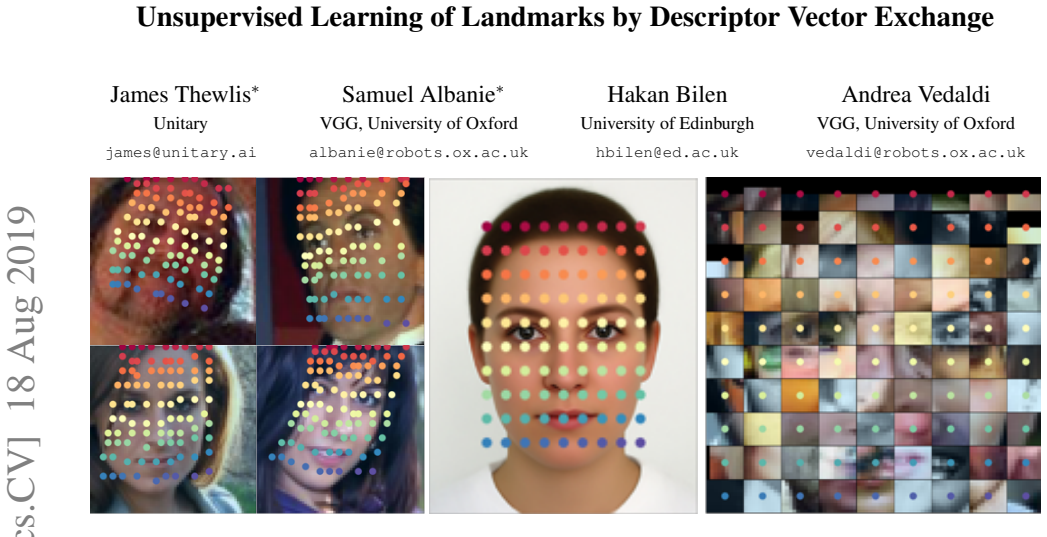
The central claim is that intra-category invariance, not low dimensionality, is what turns a descriptor into a landmark. Building on the dense equivariant formulation that learns pixel embeddings by requiring consistency under synthetic warps, DVE relaxes the output to arbitrary $C$-dimensional vectors and inserts an exchange step: for a source image $x$, a warped copy $x' = gx$, and an auxiliary image $x_\alpha$ of the same category, each source embedding $\Phi_u(x)$ is replaced by $\hat\Phi_u(x|x_\alpha)$, a soft weighted average of auxiliary embeddings with weights $p(w|u; \Phi, x, x_\alpha)$ from the softmax-normalized cosine similarity. The equivariance loss then matches these reconstructed vectors to $\Phi_v(x')$. Since a reconstruction from mismatched vectors would be distorted and unmatchable, minimizing the loss forces the embedding set to be exchangeable across instances; the same vectors must serve every identity. This yields a single representation that is simultaneously an instance-level descriptor and a category-level landmark.
Load-bearing premise
The load-bearing assumption is that the auxiliary images share actual object parts with the source image; if the auxiliary pool is too dissimilar, the reconstruction in eq. (5) can be satisfied with distorted embeddings without the vectors ever acquiring true cross-instance validity.
Editorial extensions
If this is right
- High-dimensional embeddings no longer hurt cross-instance matching: with DVE, 16, 32, and 64-dimensional embeddings match different identities more accurately than the 3D embedding used by the prior equivariant method.
- A single learned representation can be used both to match different views of the same instance and to find the same landmark across different instances, eliminating the need to choose between descriptor quality and landmark generalisation.
- Unsupervised fine-tuning on the target dataset improves landmark regression, and DVE embeddings support accurate landmark detectors even when only a handful of manual annotations are available.
- Because the auxiliary pool provides cross-instance signal, some configurations can learn useful embeddings from identical image pairs (identity warp), suggesting transformation equivariance and cross-instance exchange are partially interchangeable sources of supervision.
- On animal faces, the same mechanism localizes semantically analogous parts across species, indicating the method does not depend on a single object category.
Reading between the lines
- The exchange step is a form of cycle consistency in embedding space (source -> auxiliary -> target); combining it with an explicit round-trip reconstruction could yield a stronger self-supervised objective, though the paper does not test this.
- The auxiliary image set acts as a non-parametric memory bank, so scaling its size and category diversity should push embeddings toward more canonical landmarks; ablating those two factors would tell how much of the gain comes from memory coverage versus the exchange mechanism itself.
- The paper's descriptor-landmark duality suggests a tunable continuum: by varying the embedding dimension or the strength of the exchange loss, one could interpolate between instance-specific matching and category-level landmark localization, which might be useful for retrieval versus alignment tasks.
- Applying DVE to video frames, where temporal neighbours serve as auxiliary images, would give cross-instance variation for free and is a natural testable extension beyond still image collections.
Signed reviews
Editorial analysis
A structured set of objections, weighed in public.
Referee Report
Summary. The paper introduces Descriptor Vector Exchange (DVE), an unsupervised method for learning dense landmark embeddings. DVE extends the equivariance-based learning of [45] by reconstructing each source-pixel embedding as a soft combination of embeddings from one or more auxiliary images before matching against the warped target image. This encourages the embedding to be invariant across object instances. The authors evaluate on facial landmark benchmarks (MAFL, 300W, AFLW), animal faces, and a robotic-arm dataset, reporting that DVE matches or surpasses prior unsupervised methods and allows high-dimensional embeddings to serve as both descriptors and landmarks.
Significance. If the results hold, DVE provides a conceptually clean way to inject intra-category invariance into equivariant descriptor learning, and a practical mechanism to obtain the benefits of both low-dimensional landmarks and high-dimensional descriptors. The paper includes a well-specified loss, external evaluation on standard benchmarks, and public code, and it does not exhibit any circularity in its evaluation protocol. The main claims are supported by multiple experiments, though one textual claim is contradicted by Table 1 and the sensitivity of the method to the auxiliary-image mechanism is under-analyzed.
major comments (2)
- [§4.1, Table 1] The sentence 'Overall, the embeddings learned with DVE have both better intra-class and intra-instance matching performance than [45]' is contradicted by Table 1. For same-identity pairs, the DVE column reports slightly higher mean pixel error than the [45] column in every row (1.36 vs 1.33 for C=3; 1.28 vs 1.25 for C=16; 1.29 vs 1.26 for C=32; 1.28 vs 1.25 for C=64). The data show that DVE substantially improves different-identity matching but slightly degrades same-identity matching. Please correct the claim or qualify it explicitly.
- [§3.4 and §4.1] The mechanism in Eq. (5) is only informative if the auxiliary image pool has pixel-level correspondence with the source image; if the softmax in Eq. (2) is nearly uniform, the reconstructed embedding becomes approximately independent of the source pixel u, and the loss can be reduced without learning true landmarks. Section 3.4 motivates pooling multiple auxiliary images to address this, and the animal experiments use 5 auxiliary images per pair, but the face experiments (Section 4.1) state only that 'one or more' auxiliary images are sampled and provide no ablation of this number or of the similarity of the auxiliary pool. Since DVE is defined by this exchange operation, please add an experiment that varies the number of auxiliary images, and if possible includes an out-of-category control, to demonstrate that the reported gains are attributable to the exchange mechanism and not to the auxiliary set composition.
minor comments (5)
- [§4.1, Landmark regression] The text says the softargmax layer produces '2C x-y pairs'; since the number of intermediate heatmaps is 50, this should presumably be 2 × 50 (or 2P) pairs.
- [§4.1, Implementation details] Please state the exact number of auxiliary images sampled for the face experiments rather than 'one or more', so that the results are reproducible.
- [Table 3 caption] The notation 'without/with finetuning' is ambiguous; consider labeling the columns explicitly as 'without finetuning' and 'with finetuning'.
- [Appendix D] Typo: 'Houglass' should be 'Hourglass'.
- [§3.4, citation [59]] The connection to [59] is only sketched; a sentence explaining how the grouping mechanism in [59] carries over to this setting would improve readability.
Circularity Check
No significant circularity: the DVE objective is a self-consistent training loss evaluated on external benchmarks, not a prediction forced by construction.
full rationale
The paper's derivation chain is self-contained rather than circular. The DVE objective combines the equivariance loss of Eq. (3) with the auxiliary-image reconstruction of Eq. (5), where the source embedding is replaced by a soft combination of auxiliary embeddings using the same probabilistic matching defined in Eq. (2). The resulting loss in Eq. (6) is a genuine training objective whose optimum is not known in advance; the paper demonstrates empirically that optimizing it improves cross-instance matching, and this improvement is not guaranteed by construction. The only supervised components are the final linear regressors fitted on MAFL, 300W, and AFLW after the embeddings are frozen, and the paper states explicitly that 'the signal is not back-propagated further so the embeddings remain fully unsupervised' and that 'we use MAFL annotations only for evaluation and never for training of the embedding function.' Thus the landmark errors are external probes rather than fitted outputs. The auxiliary-image overlap concern raised in Section 3.4 is a stated assumption and testable failure mode, not a circular reduction: if the auxiliary set is too dissimilar, the reconstruction becomes uninformative and the method may fail, which is the opposite of a tautology. Self-citations to [45] and [46] are used to set up the baseline, network architecture, and data protocols, but the cited work is published and independently reproducible, and no load-bearing claim rests on an unverified self-citation. I therefore find no circular step.
Assumptions & free parameters
free parameters (3)
- Embedding dimensionality C =
64 (tested 3, 16, 32, 64)
- Number of auxiliary images =
1 for faces, 5 per pair for animal faces
- Unsupervised finetuning on target dataset =
50 epochs on AFLW for AFLW results; optional for 300W
assumptions (4)
- domain assumption Images of an object category share a common landmark structure (eyes and noses correspond across identities and species).
- domain assumption Synthetic TPS warps g generate correct pixel correspondences between x and x'=gx.
- domain assumption Auxiliary image x_alpha is from the same category and has at least partial pixel correspondences with x.
- standard math Softmax over pixels defines a valid probabilistic matching and the integrals are tractable via sampling.
Cite this review
Pith. "Pith review of Unsupervised Learning of Landmarks by Descriptor Vector Exchange." pith.science (2026). https://pith.science/paper/3UEP6IX5
@misc{pith2026190806427,
  author       = {Pith},
  title        = {Pith review of: Unsupervised Learning of Landmarks by Descriptor Vector Exchange},
  year         = {2026},
  howpublished = {\url{https://pith.science/paper/3UEP6IX5}},
  note         = {Machine review of arXiv:1908.06427}
}
read the original abstract
Equivariance to random image transformations is an effective method to learn landmarks of object categories, such as the eyes and the nose in faces, without manual supervision. However, this method does not explicitly guarantee that the learned landmarks are consistent with changes between different instances of the same object, such as different facial identities. In this paper, we develop a new perspective on the equivariance approach by noting that dense landmark detectors can be interpreted as local image descriptors equipped with invariance to intra-category variations. We then propose a direct method to enforce such an invariance in the standard equivariant loss. We do so by exchanging descriptor vectors between images of different object instances prior to matching them geometrically. In this manner, the same vectors must work regardless of the specific object identity considered. We use this approach to learn vectors that can simultaneously be interpreted as local descriptors and dense landmarks, combining the advantages of both. Experiments on standard benchmarks show that this approach can match, and in some cases surpass state-of-the-art performance amongst existing methods that learn landmarks without supervision. Code is available at www.robots.ox.ac.uk/~vgg/research/DVE/.
Figures


Figures from the paper (5 more)


Reference graph
Works this paper leans on
-
[45]
Unsupervised learning of object frames by dense equivariant image labelling
James Thewlis, Hakan Bilen, and Andrea Vedaldi. Unsupervised learning of object frames by dense equivariant image labelling. InAdvances in Neural In- formation Processing Systems, pages 844–855, 2017. 2, 3, 4, 5, 6, 7, 8, 12, 13
work page 2017
-
[46]
Unsupervised learning of object landmarks by factor- ized spatial embeddings
James Thewlis, Hakan Bilen, and Andrea Vedaldi. Unsupervised learning of object landmarks by factor- ized spatial embeddings. In ICCV, pages 5916–5925,
-
[1]
Dis- criminative learning of local image descriptors.PAMI,
Matthew Brown, Gang Hua, and Simon Winder. Dis- criminative learning of local image descriptors.PAMI,
-
[2]
V oxceleb2: Deep speaker recognition
Joon Son Chung, Arsha Nagrani, and Andrew Zisser- man. V oxceleb2: Deep speaker recognition. In IN- TERSPEECH, 2018. 6
work page 2018
-
[3]
Timothy F. Cootes, Christopher J. Taylor, David H. Cooper, and Jim Graham. Active shape models: their training and application. CVIU, 1995. 3
work page 1995
-
[4]
Histograms of Ori- ented Gradients for Human Detection
Navneet Dalal and Bill Triggs. Histograms of Ori- ented Gradients for Human Detection. InCVPR, 2005. 3
work page 2005
-
[5]
Pedro F. Felzenszwalb, Ross B. Girshick, David McAllester, and Deva Ramanan. Object Detection with Discriminatively Trained Part Based Models. PAMI, 2010. 3
work page 2010
-
[6]
Wing loss for robust facial landmark localisation with convolutional neural networks
Zhen-Hua Feng, Josef Kittler, Muhammad Awais, Pa- trik Huber, and Xiao-Jun Wu. Wing loss for robust facial landmark localisation with convolutional neural networks. In CVPR, pages 2235–2245, 2018. 6
work page 2018
Show all 60 references
-
[7]
Object class recognition by unsupervised scale- invariant learning
Rob Fergus, Pietro Perona, and Andrew Zisser- man. Object class recognition by unsupervised scale- invariant learning. In CVPR, 2003. 3
2003
-
[8]
Average faces
Martin Grundl. Average faces. http: //www.beautycheck.de/cmsms/index. php/durchschnittsgesichter. [Online; accessed 2019]. 1
2019
-
[9]
Densereg: Fully convolutional dense shape regression in-the-wild
Rıza Alp G ¨uler, George Trigeorgis, Epameinondas Antonakos, Patrick Snape, Stefanos Zafeiriou, and Ia- sonas Kokkinos. Densereg: Fully convolutional dense shape regression in-the-wild. In CVPR, pages 6799– 6808, 2017. 2
2017
-
[10]
Proposal flow
Bumsub Ham, Minsu Cho, Cordelia Schmid, and Jean Ponce. Proposal flow. In CVPR, 2016. 3
2016
-
[11]
On sifts and their scales
Tal Hassner, Viki Mayzels, and Lihi Zelnik-Manor. On sifts and their scales. In CVPR, pages 1522–1528. IEEE, 2012. 3
2012
-
[12]
Spatial Transformer Net- works
Max Jaderberg, Karen Simonyan, Andrew Zisserman, and Koray Kavukcuoglu. Spatial Transformer Net- works. In NeurIPS, 2015. 3
2015
-
[13]
Unsupervised learning of object land- marks through conditional image generation
Tomas Jakab, Ankush Gupta, Hakan Bilen, and An- drea Vedaldi. Unsupervised learning of object land- marks through conditional image generation. In Ad- vances in Neural Information Processing Systems , pages 4020–4031, 2018. 3, 6
2018
-
[14]
Learning landmarks from un- aligned data using image translation
Tomas Jakab, Ankush Gupta, Hakan Bilen, and Andrea Vedaldi. Learning landmarks from un- aligned data using image translation. arXiv preprint arXiv:1907.02055, 2019. 6
1907 arXiv
-
[15]
Self-supervised fea- ture learning by learning to spot artifacts
Simon Jenni and Paolo Favaro. Self-supervised fea- ture learning by learning to spot artifacts. In CVPR, pages 2733–2742, 2018. 1
2018
-
[16]
Jacobs, and Manmohan Chandraker
Angjoo Kanazawa, David W. Jacobs, and Manmohan Chandraker. WarpNet: Weakly supervised matching for single-view reconstruction. In CVPR, 2016. 3
2016
-
[17]
Rotationnet: Joint object categorization and pose estimation using multiviews from unsupervised viewpoints
Asako Kanezaki, Yasuyuki Matsushita, and Yoshifumi Nishida. Rotationnet: Joint object categorization and pose estimation using multiviews from unsupervised viewpoints. In CVPR, pages 5010–5019, 2018. 1
2018
-
[18]
Ira Kemelmacher-Shlizerman and Steven M. Seitz. Collection flow. In CVPR, 2012. 3
2012
-
[19]
Adam: A method for stochastic optimization
Diederik Kingma and Jimmy Ba. Adam: A method for stochastic optimization. In ICLR, 2015. 5
2015
-
[20]
Roth, and Horst Bischof
Martin Koestinger, Paul Wohlhart, Peter M. Roth, and Horst Bischof. Annotated facial landmarks in the wild. In ICCV workshops, 2011. 7
2011
-
[21]
Data driven image models through continuous joint alignment
Erik G Learned-Miller. Data driven image models through continuous joint alignment. PAMI, 2006. 3
2006
-
[22]
Combined object categorization and segmentation with an implicit shape model
Bastian Leibe, Ales Leonardis, and Bernt Schiele. Combined object categorization and segmentation with an implicit shape model. In ECCV Workshops,
-
[23]
Learning covariant feature detectors
Karel Lenc and Andrea Vedaldi. Learning covariant feature detectors. In ECCV Workshop on Geometry Meets Deep Learning, 2016. 2
2016
-
[24]
SIFT Flow: Dense correspondence across scenes and its ap- plications
Ce Liu, Jenny Yuen, and Antonio Torralba. SIFT Flow: Dense correspondence across scenes and its ap- plications. PAMI, 2011. 3
2011
-
[25]
Deep learning face attributes in the wild
Ziwei Liu, Ping Luo, Xiaogang Wang, and Xiaoou Tang. Deep learning face attributes in the wild. In ICCV, 2015. 5
2015
-
[26]
Do convnets learn correspondence? In Advances in Neural Information Processing Systems, pages 1601– 1609, 2014
Jonathan L Long, Ning Zhang, and Trevor Darrell. Do convnets learn correspondence? In Advances in Neural Information Processing Systems, pages 1601– 1609, 2014. 3
2014
-
[27]
Distinctive image features from scale- invariant keypoints
David G Lowe. Distinctive image features from scale- invariant keypoints. IJCV, 60(2):91–110, 2004. 2, 3
2004
-
[28]
A comparison of affine region detectors
Krystian Mikolajczyk, Tinne Tuytelaars, Cordelia Schmid, Andrew Zisserman, Jiri Matas, Frederik Schaffalitzky, Timor Kadir, and Luc Van Gool. A comparison of affine region detectors. IJCV, 65(1- 2):43–72, 2005. 2
2005
-
[29]
Hossein Mobahi, Ce Liu, and William T. Freeman. A Compositional Model for Low-Dimensional Image Set Representation. CVPR, 2014. 3
2014
-
[30]
V oxceleb: a large-scale speaker identification dataset
Arsha Nagrani, Joon Son Chung, and Andrew Zisser- man. V oxceleb: a large-scale speaker identification dataset. In INTERSPEECH, 2017. 6
2017
-
[31]
Dynamicfusion: Reconstruction and tracking of non-rigid scenes in real-time
Richard A Newcombe, Dieter Fox, and Steven M Seitz. Dynamicfusion: Reconstruction and tracking of non-rigid scenes in real-time. In CVPR, 2015. 3
2015
-
[32]
Stacked hourglass networks for human pose estimation
Alejandro Newell, Kaiyu Yang, and Jia Deng. Stacked hourglass networks for human pose estimation. In European conference on computer vision, pages 483–
-
[33]
Self-supervised learning of geomet- rically stable features through probabilistic introspec- tion
David Novotny, Samuel Albanie, Diane Larlus, and Andrea Vedaldi. Self-supervised learning of geomet- rically stable features through probabilistic introspec- tion. In CVPR, pages 3637–3645, 2018. 3
2018
-
[34]
Learning 3d object categories by looking around them
David Novotny, Diane Larlus, and Andrea Vedaldi. Learning 3d object categories by looking around them. In ICCV, pages 5218–5227, 2017. 3
2017
-
[35]
Cats and dogs
Omkar M Parkhi, Andrea Vedaldi, Andrew Zisserman, and CV Jawahar. Cats and dogs. In 2012 IEEE con- ference on computer vision and pattern recognition , pages 3498–3505. IEEE, 2012. 8
2012
-
[36]
Local convolutional features with unsupervised training for image retrieval
Mattis Paulin, Matthijs Douze, Zaid Harchaoui, Julien Mairal, Florent Perronin, and Cordelia Schmid. Local convolutional features with unsupervised training for image retrieval. In ICCV, pages 91–99, 2015. 2
2015
-
[37]
Rasl: Robust alignment by sparse and low-rank decomposition for linearly correlated im- ages
Yigang Peng, Arvind Ganesh, John Wright, Wenli Xu, and Yi Ma. Rasl: Robust alignment by sparse and low-rank decomposition for linearly correlated im- ages. PAMI, 34(11), 2012. 3
2012
-
[38]
Wide base- line stereo matching
Philip Pritchett and Andrew Zisserman. Wide base- line stereo matching. In ICCV, pages 754–760. IEEE,
-
[39]
Convolutional neural network architecture for geomet- ric matching
Ignacio Rocco, Relja Arandjelovic, and Josef Sivic. Convolutional neural network architecture for geomet- ric matching. In CVPR, pages 6148–6157, 2017. 3
2017
-
[40]
300 faces in-the-wild challenge: The first facial landmark localization chal- lenge
Christos Sagonas, Georgios Tzimiropoulos, Stefanos Zafeiriou, and Maja Pantic. 300 faces in-the-wild challenge: The first facial landmark localization chal- lenge. In CVPR-W, 2013. 7
2013
-
[41]
Self-supervised visual descriptor learning for dense correspondence
Tanner Schmidt, Richard Newcombe, and Dieter Fox. Self-supervised visual descriptor learning for dense correspondence. IEEE Robotics and Automation Let- ters, 2(2):420–427, 2017. 3
2017
-
[42]
Deforming autoencoders: Unsupervised disen- tangling of shape and appearance
Zhixin Shu, Mihir Sahasrabudhe, Rıza Alp G ¨uler, Dimitris Samaras, Nikos Paragios, and Iasonas Kokki- nos. Deforming autoencoders: Unsupervised disen- tangling of shape and appearance. In ECCV, pages 650–665, 2018. 2, 3, 6
2018
-
[43]
Learning hy- brid image templates (HIT) by information projection
Zhangzhang Si and Song-Chun Zhu. Learning hy- brid image templates (HIT) by information projection. PAMI, 2012. 7
2012
-
[44]
Dense point trajectories by gpu-accelerated large displacement optical flow
Narayanan Sundaram, Thomas Brox, and Kurt Keutzer. Dense point trajectories by gpu-accelerated large displacement optical flow. In ECCV, pages 438–
-
[47]
A fast local descriptor for dense matching
Engin Tola, Vincent Lepetit, and Pascal Fua. A fast local descriptor for dense matching. In CVPR, pages 1–8. IEEE, 2008. 2
2008
-
[48]
Matching of affinely invariant regions for visual servoing
Tinne Tuytelaars, Luc Van Gool, Luk D’haene, and Reinhard Koch. Matching of affinely invariant regions for visual servoing. In ICRA, volume 2, pages 1601– 1606, 1999. 2
1999
-
[49]
Wiles, A
O. Wiles, A. S. Koepke, and A. Zisserman. Self- supervised learning of a facial attribute embedding from video. In Proc. BMVC, 2018. 3, 6
2018
-
[50]
Robust Facial Landmark Detection via Recurrent Attentive- Refinement Networks
Shengtao Xiao, Jiashi Feng, Junliang Xing, Hanjiang Lai, Shuicheng Yan, and Ashraf Kassim. Robust Facial Landmark Detection via Recurrent Attentive- Refinement Networks. In ECCV, 2016. 6
2016
-
[51]
Disambiguating visual relations using loop constraints
Christopher Zach, Manfred Klopschitz, and Marc Pollefeys. Disambiguating visual relations using loop constraints. In CVPR, pages 1426–1433. IEEE, 2010. 3
2010
-
[52]
Learning to compare image patches via convolutional neural net- works
Sergey Zagoruyko and Nikos Komodakis. Learning to compare image patches via convolutional neural net- works. In CVPR, pages 4353–4361. IEEE, 2015. 2
2015
-
[53]
Cat head detection - How to effectively exploit shape and tex- ture features
Weiwei Zhang, Jian Sun, and Xiaoou Tang. Cat head detection - How to effectively exploit shape and tex- ture features. In ECCV, 2008. 8
2008
-
[54]
Unsupervised discov- ery of object landmarks as structural representations
Yuting Zhang, Yijie Guo, Yixin Jin, Yijun Luo, Zhiyuan He, and Honglak Lee. Unsupervised discov- ery of object landmarks as structural representations. In CVPR, 2018. 3, 5, 6, 7
2018
-
[55]
Facial landmark detection by deep multi-task learning
Zhanpeng Zhang, Ping Luo, Chen Change Loy, and Xiaoou Tang. Facial landmark detection by deep multi-task learning. In ECCV, 2014. 6, 7
2014
-
[56]
Learning Deep Representation for Face Alignment with Auxiliary Attributes
Zhanpeng Zhang, Ping Luo, Chen Change Loy, and Xiaoou Tang. Learning Deep Representation for Face Alignment with Auxiliary Attributes. PAMI, 2016. 5, 6, 7
2016
-
[57]
Flowweb: Joint image set alignment by weaving consistent, pixel-wise correspondences
Tinghui Zhou, Yong Jae Lee, Stella X Yu, and Alyosha A Efros. Flowweb: Joint image set alignment by weaving consistent, pixel-wise correspondences. In CVPR, pages 1191–1200, 2015. 3
2015
-
[58]
Learning dense correspondence via 3d-guided cycle consistency
Tinghui Zhou, Philipp Krahenbuhl, Mathieu Aubry, Qixing Huang, and Alexei A Efros. Learning dense correspondence via 3d-guided cycle consistency. In CVPR, pages 117–126, 2016. 3
2016
-
[59]
Attend in groups: a weakly-supervised deep learning framework for learning from web data
Bohan Zhuang, Lingqiao Liu, Yao Li, Chunhua Shen, and Ian Reid. Attend in groups: a weakly-supervised deep learning framework for learning from web data. In CVPR, pages 1878–1887, 2017. 5 Figure 8: Additional images querying manual annotations on a human and finding the matchin...
2017
-
[499]
Springer, 2016. 5, 13
2016
Reviewed August 14, 2026 · model on record in the stance chip above.
Discussion (0). Continue with ORCID to comment.