REVIEW 4 major objections 4 minor 1 cited by
Holographic Subregion Complexity in General Vaidya Geometry
T0 review · 4 major / 4 minor · reviewed 2026-08-14 · deepseek-v4-flash
Pith's one-line read Holographic subregion complexity after a sudden quench grows in three stages: linear growth, slower linear growth, then either linear growth or linear decrease depending on the transition.
desk verdict Genuinely useful analytic three-stage computation of a subregion volume in Vaidya, but the paper never shows the surface is an extremum of the volume functional. read the letter →
The pith
A machine-rendered reading of the paper's core claim, the machinery that carries it, and where it could break.
The reading
What carries the argument
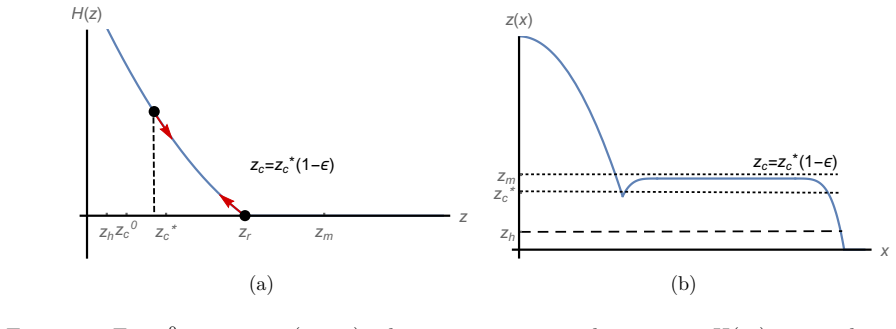
The central object is the codimension-one extremal volume $\Gamma_A$ whose boundary is the strip $A$ on the AdS boundary together with the HRT surface $\gamma_A$; the subregion CV conjecture sets $C_A = V(\Gamma_A)/(R G_N)$. The argument is carried by the conserved quantity $z^{d-1} L_S = C$, the matching conditions at the null shell $v'_+=v'_-$ and $z'_+ = (1-\tfrac12 g(z_c))z'_+$, and the critical HRT surface at $z_c=z_c^*(1-\epsilon)$ near which the function $H(z)$ develops a double zero at $z_m$. This double zero produces a logarithmic divergence in $\epsilon$ that links time, strip width, and the tip depth $z_t$; expanding time and on-shell volume in $1/z_t$ and $\epsilon$ around that critical configuration yields the three linear rates.
What would settle it
Compute the full $\Delta V(t)$ numerically in $d=2$ Schwarzschild-AdS for a very large strip half-width $l$ near the critical configuration $z_c=z_c^*(1-\epsilon)$ and check whether the slope tends to zero as $l\to\infty$; a nonzero surviving linear slope would invalidate the claim that the leading rate vanishes, while a zero slope would confirm that the linear growth is carried by uncontrolled subleading terms.
Extended reading notes
Core claim
On its own terms, the central claim is that in the large-size limit the change in on-shell volume $\Delta V(t)$ of the extremal surface $\Gamma_A$ bounded by the strip and its HRT surface follows three analytic regimes. At early times, $\Delta V(t) = A_A R_{\mathrm{AdS}}^d (\omega/2) t + \cdots$, independent of the strip size, with $\omega$ fixed by $g(z)\sim\omega z^d$ near the boundary. At the intermediate stage, when the HRT surface is near its critical configuration $z_c=z_c^*(1-\epsilon)$ with $l\gg t\gg z_h$, the growth is again linear; for Schwarzschild-AdS in $d\ge 3$ it reads $\Delta V(t)=A_A R_{\mathrm{AdS}}^d \sqrt{d(d-2)/(2(d-1))}\, z_h^{-d}\, t$. At late times, if the transition is discontinuous the growth remains linear all the way to equilibrium, while if it is continuous the subtracted volume decreases linearly with coefficient $C_s$ in Eq. (116), which the paper argues is negative. The reason subregion CV differs from global CV even for an infinite strip is that in the global case the maximal-volume surface is always a Cauchy surface, whereas the subregion surface's tip always descends to a finite equilibrium value $z_s$.
Load-bearing premise
The intermediate- and late-time calculation assumes the hierarchy $z_c^*/z_t$, $z_m/z_t$, and $z_c^*|\log\epsilon|$ are all much smaller than one and that the leading logarithmic terms dominate the expansions of $t$ and $l$; in the $d=2$ SAdS case the leading rate vanishes as $l\to\infty$, so the claimed linear behavior would have to come from subleading terms that the paper does not systematically control.
Editorial extensions
If this is right
- For any thin-shell holographic quench whose metric satisfies the stated properties, a large strip's subregion complexity grows linearly at early and intermediate times, with rates fixed only by the asymptotic falloff $\omega$ and the final horizon scale $z_h$.
- In Schwarzschild-AdS with $d\ge3$, the early-time rate can saturate the Lloyd bound for a suitable length scale, while the intermediate rate is strictly below the bound for every finite dimension.
- Subregion CV complexity is not a large-region limit of global CV complexity: even as the strip covers the whole boundary, the difference persists because the extremal surface's tip behaves differently.
- Late-time behavior is controlled by the nature of the transition: a discontinuous jump of the tip gives continued linear growth, while a continuous approach to equilibrium gives a linear decrease near $t_s$.
- The equilibrium time of the HRT surface from the referenced analysis applies directly to subregion complexity evolution, since the extremal volume and the surface share the same equilibrium time.
Reading between the lines
- The paper does not derive the subregion CA (complexity-equals-action) analogue, but the same three-stage structure should appear there without the arbitrary length-scale ambiguity, so a direct CA calculation would be a natural test of the mechanism.
- The late-time linear decrease, if taken literally, conflicts with any monotonic second law of complexity for mixed states; this suggests the apparent decrease may encode reference-state dependence or a limitation of the subregion CV measure rather than a true decrease of pure-state complexity.
- In the $d=2$ Schwarzschild-AdS case the leading intermediate growth rate vanishes as $l\to\infty$, so the claimed linear behavior must be carried by subleading corrections; exact numerics for large $l$ could show whether a residual linear slope survives or the growth is genuinely sublinear.
- Because the early-time rate depends only on $\omega$ while the intermediate rate depends on $z_h$ and the dimension, comparing thermal and electromagnetic quenches in the same spacetime should give different intermediate rates, providing a sharp observable signature of the quench type.
Editorial analysis
A structured set of objections, weighed in public.
Referee Report
Summary. The paper studies holographic subregion complexity (HSC) under the subregion CV conjecture in a general Vaidya-AdS spacetime describing a thin-shell quench. For a strip subregion of large half-width l, it claims that the evolution of HSC has three distinct stages: an early-time linear growth with rate (1/2)A_A R_AdS^d ω t, an intermediate-time linear growth with a dimension-dependent rate (e.g., Eq. (83) for d≥3), and a late-time stage that is either continued linear growth (discontinuous transition) or linear decrease (continuous transition). The paper also compares the growth rates with the Lloyd bound and argues that subregion CV differs from global CV even in the large-size limit.
Significance. If the central claim were established, the paper would provide a useful analytic characterization of mixed-state complexity growth during holographic thermalization, with explicit dimension-dependent rates that could be checked by numerics and field-theoretic models. The general Vaidya setup, the clear three-stage picture, and the step-by-step asymptotic expansions are valuable. However, the central quantity is computed without solving the volume-extremization problem for Γ_A, and the asymptotic control in the intermediate stage is incomplete. These issues currently block the main claim, so the paper needs substantial revision before its results can be accepted as holographic subregion complexity.
major comments (4)
- [Sec. 2.5, Eqs. (35)-(38)] The volume functional is evaluated on the HRT profile v(z)=v_HRT(z) without solving the variational problem for the subregion CV surface. Equation (1) requires Γ_A to extremize the volume subject to ∂Γ_A = A ∪ γ_A. For a general embedding v=V(z,x), the induced metric contains V_x-dependent terms, and the stationarity condition for (38) differs from the HRT area equations (12)-(13). The ansatz V_x=0, V=v_HRT(z) satisfies the boundary conditions but is not shown to be a solution of the volume Euler-Lagrange equation. Unless this gap is closed, the rates in Eqs. (55), (83), and (116) are volumes of an arbitrary off-shell surface, not necessarily the HSC defined by the subregion CV conjecture.
- [Sec. 3.2, Eqs. (61)-(69) and (90)-(91)] The intermediate-stage derivation relies on the hierarchy in Eq. (61) and on keeping only the leading log ϵ terms in t and l. The paper does not bound the subleading corrections. In d=2 this is not a technicality: Eq. (90)-(91) show that the leading linear growth rate vanishes as l→∞, so the claimed linear growth near the critical configuration must be carried by terms of higher order, which are not computed. The text acknowledges this point for d=2, but the abstract and Sec. 3.2 state the three-stage linear-growth picture without qualification for the general Vaidya setup (d≥2). The d=2 case must either be excluded from the claim or treated to the order that supports the linear rate.
- [Sec. 3.3.2, Eqs. (117)-(119)] The late-time linear decrease for the continuous transition follows from the sign of C_s. The sign is decided by the inequality I'(z_s)/F'(z_s) > (1/z_s^{d-1}) ∫_0^1 dz z^{-d}/h(z_s z) in Eq. (119), but I'(z_s) and F'(z_s) are defined as limits of expressions that each contain a 1/θ divergence, and the finite parts are not computed. The inequality between the finite parts is not demonstrated; it appears to be inferred from the integrands rather than derived. Since the negative sign of C_s is the basis of the late-time decrease, this step needs a controlled derivation or a numerical check.
- [Sec. 3.1, Eq. (59)] The early-time saturation of the Lloyd bound is enforced by the choice R_AdS/R = (d-1)/(4π²) in Eq. (59). Since R is the free length scale in the CV formula (1), this choice sets the rate to 2M/π by construction. The statement that the Lloyd bound is 'always saturated' at early time is therefore a choice of convention rather than a dynamical result, and the comparison with the Lloyd bound does not provide independent evidence for the proposed growth law.
minor comments (4)
- [Sec. 2.3, Eq. (15)] There is a typo: 'anothor' should be 'another'.
- [Sec. 3.2, Eq. (91)] Equation (91) appears garbled in the typeset version: the square-root symbol is rendered as an integral sign. Please correct the typesetting.
- [General] The closely related work by Auzzi et al., 'On volume subregion complexity in Vaidya spacetime' (reference [14]), should be discussed explicitly so that the reader can see the relation and the differences between the two computations.
- [Sec. 1 and Sec. 3.1] The notation for the two length scales R and R_AdS is confusing: Eq. (1) uses R, while Eq. (2) and most of the paper use R_AdS. Please clarify the distinction and the role of R consistently.
Circularity Check
The three-stage HSC evolution is derived from the Vaidya metric and HRT equations; only the reported Lloyd-bound saturation is fixed by choosing the arbitrary CV length scale from the authors' earlier work.
-
self definitional
[Sec. 3.1, Eqs. (57)-(60); also Sec. 3.2, Eqs. (84)-(87)]
"In addition, if one sets the length scale as mentioned in [35]: RAdS/R = d−1 4π2 , (59) where we have set ℏ = 1. Then the result reduces to dC/dt = 2M π , (60) which is satisfied with the Lloyd bound at early time."
Every complexity rate computed here carries the undetermined prefactor RAdS/R (Eq. (57)). Equation (59) is not a derived relation; it is a choice of the arbitrary length scale R, taken from [35] (whose authors include two coauthors of this paper). Substituting this choice into Eq. (57) makes dC/dt = 2M/π by algebra, so the statement that the Lloyd bound is saturated at early time is logically identical to the chosen normalization. The same choice is reused at the intermediate stage (Eqs. (84)-(87)) to report sub-Lloyd rates. This is circular only for the Lloyd-bound comparison, not for the three-stage volume evolution: Eqs. (55), (83), and (116) are obtained from the metric and extremal-surface equations independently of R.
full rationale
The central chain of the paper is self-contained: with the Vaidya metric (2), the HRT equations (12)-(13), the matching conditions (21)-(22), and the volume functional (38), the early-time rate (55), the intermediate rate (83), and the late-time coefficient (116) are obtained by explicit expansion rather than by fitting or by importing the target result. The critical-surface analysis in Sec. 2.4 follows the independent Liu-Suh strategy [31], not a self-citation chain. No uniqueness theorem or ansatz is smuggled in solely through the authors' prior work. The only construction-by-definition step is the Lloyd-bound saturation: because the CV volume is normalized by an arbitrary scale R, Eq. (59) fixes R so that the prefactor in Eq. (57) equals 2/π, making the resulting 'saturation' an identity rather than a prediction. This is peripheral to the three-stage claim and is acknowledged in the text's sensitivity statement. The separate concern that Sec. 2.5 evaluates the volume on the HRT profile without solving the volume Euler-Lagrange equations is an omitted-extremization proof, not a circularity, so it does not raise the circularity score. Overall the derivation is analytically substantial and only the Lloyd-bound comparison reduces to its input by construction; score 2.
Assumptions & free parameters
free parameters (1)
- Length scale R in the CV formula =
R = R_AdS (d-1)/(4π^2) chosen to saturate Lloyd bound
assumptions (6)
- domain assumption Subregion CV conjecture: complexity of a boundary region A is V(Γ_A)/(R G_N) (Eq. 1).
- domain assumption Thin-shell Vaidya metric with f(v,z)=1-θ(v)g(z) (Eq. 3) accurately models a sudden quench.
- domain assumption Properties of g(z): g(z_h)=1, monotonic increase, g(z)→ω z^d as z→0 (Sec. 2.1).
- domain assumption HRT surface prescription and the matching conditions (Eqs. 21-22) across the null shell.
- ad hoc to paper Asymptotic expansions in the large-size limit, specifically the hierarchy Eq. (61) and dominance of log ϵ terms.
- standard math Calculus of variations and conserved quantities from translation invariance of the action (Eqs. 12-15).
Cite this review
Pith. "Pith review of Holographic Subregion Complexity in General Vaidya Geometry." pith.science (2026). https://pith.science/paper/DBGY2AMY
@misc{pith2026190806432,
  author       = {Pith},
  title        = {Pith review of: Holographic Subregion Complexity in General Vaidya Geometry},
  year         = {2026},
  howpublished = {\url{https://pith.science/paper/DBGY2AMY}},
  note         = {Machine review of arXiv:1908.06432}
}
read the original abstract
We investigate general features of the evolution of holographic subregion complexity (HSC) on Vaidya-AdS metric with a general form. The spacetime is dual to a sudden quench process in quantum system and HSC is a measure of the ``difference'' between two mixed states. Based on the subregion CV (Complexity equals Volume) conjecture and in the large size limit, we extract out three distinct stages during the evolution of HSC: the stage of linear growth at the early time, the stage of linear growth with a slightly small rate during the intermediate time and the stage of linear decrease at the late time. The growth rates of the first two stages are compared with the Lloyd bound. We find that with some choices of certain parameter, the Lloyd bound is always saturated at the early time, while at the intermediate stage, the growth rate is always less than the Lloyd bound. Moreover, the fact that the behavior of CV conjecture and its version of the subregion in Vaidya spacetime implies that they are different even in the large size limit.
Figures


Forward citations
Cited by 1 Pith paper
-
On volume subregion complexity in Vaidya spacetime
In the AdS3 Vaidya geometry, the extremal volume defining holographic subregion complexity is genuinely x-dependent during the quench, so the standard x-independent ansatz fails at intermediate times; early and late t...
Reference graph
Works this paper leans on
-
[1]
Complexity and Shock Wave Geometries,
D. Stanford and L. Susskind, “Complexity and Shock Wave Geometries,” Phys. Rev. D 90, no. 12, 126007 (2014) [arXiv:1406.2678 [hep-th]]
arXiv 2014
-
[2]
Holographic Complexity Equals Bulk Action?,
A. R. Brown, D. A. Roberts, L. Susskind, B. Swingle and Y. Zhao, “Holographic Complexity Equals Bulk Action?,” Phys. Rev. Lett. 116, no. 19, 191301 (2016) [arXiv:1509.07876 [hep-th]]
arXiv 2016
-
[3]
M. Alishahiha, “Holographic Complexity,” Phys. Rev. D 92, no. 12, 126009 (2015) [arXiv:1509.06614 [hep-th]]
arXiv 2015
-
[4]
Comments on Holographic Complexity,
D. Carmi, R. C. Myers and P. Rath, “Comments on Holographic Complexity,” JHEP 1703, 118 (2017) [arXiv:1612.00433 [hep-th]]. 24
arXiv 2017
-
[5]
Holographic Subregion Complexity for Singular Surfaces,
E. Bakhshaei, A. Mollabashi and A. Shirzad, “Holographic Subregion Complexity for Singular Surfaces,” Eur. Phys. J. C 77, no. 10, 665 (2017) [arXiv:1703.03469 [hep-th]]
arXiv 2017
-
[6]
A note on holographic subregion complexity and QCD phase transition,
M. Lezgi and M. Ali-Akbari, “A note on holographic subregion complexity and QCD phase transition,” arXiv:1908.01303 [hep-th]
arXiv 1908
-
[7]
Entanglement Entropy and Subregion Complexity in Thermal Perturbations around Pure-AdS,
A. Bhattacharya, K. T. Grosvenor and S. Roy, “Entanglement Entropy and Subregion Complexity in Thermal Perturbations around Pure-AdS,” arXiv:1905.02220 [hep-th]
arXiv 1905
-
[8]
Evolutions of entanglement and complexity after a thermal quench in massive gravity theory,
Y. T. Zhou, M. Ghodrati, X. M. Kuang and J. P. Wu, “Evolutions of entanglement and complexity after a thermal quench in massive gravity theory,” Phys. Rev. D 100, no. 6, 066003 (2019) [arXiv:1907.08453 [hep-th]]
arXiv 2019
Show all 41 references
-
[9]
Subregion complexity in holographic thermalization with dS boundary,
S. J. Zhang, “Subregion complexity in holographic thermalization with dS boundary,” Eur. Phys. J. C 79, no. 8, 715 (2019) [arXiv:1905.10605 [hep-th]]
2019 arXiv
-
[10]
Holographic subregion complexity of a (1+1)-dimensional p-wave supercon- ductor,
M. Fujita, “Holographic subregion complexity of a (1+1)-dimensional p-wave supercon- ductor,” PTEP 2019, no. 6, 063B04 (2019) [arXiv:1810.09659 [hep-th]]
2019 arXiv
-
[11]
Holographic complexity of boosted black brane and Fisher information,
S. Karar, R. Mishra and S. Gangopadhyay, “Holographic complexity of boosted black brane and Fisher information,” Phys. Rev. D 100, no. 2, 026006 (2019) [arXiv:1904.13090 [hep-th]]
2019 arXiv
-
[12]
Subsystem complexity in warped AdS,
R. Auzzi, S. Baiguera, A. Mitra, G. Nardelli and N. Zenoni, “Subsystem complexity in warped AdS,” JHEP 1909, 114 (2019) [arXiv:1906.09345 [hep-th]]
2019 arXiv
-
[13]
Inhomogeneous Jacobi equation and Holographic subregion complexity,
A. Ghosh and R. Mishra, “Inhomogeneous Jacobi equation and Holographic subregion complexity,” arXiv:1907.11757 [hep-th]
1907 arXiv
-
[14]
On volume subregion complexity in Vaidya spacetime,
R. Auzzi, G. Nardelli, F. I. Schaposnik Massolo, G. Tallarita and N. Zenoni, “On volume subregion complexity in Vaidya spacetime,” arXiv:1908.10832 [hep-th]
1908 arXiv
-
[15]
Complexity in the presence of a boundary,
P. Braccia, A. L. Cotrone and E. Tonni, “Complexity in the presence of a boundary,” arXiv:1910.03489 [hep-th]
1910 arXiv
-
[16]
Subsystem Complexity and Holography,
C. A. Ag´ on, M. Headrick and B. Swingle, “Subsystem Complexity and Holography,” arXiv:1804.01561 [hep-th]
-
[17]
Complexity-action of subregions with corners,
E. Caceres and M. L. Xiao, “Complexity-action of subregions with corners,” arXiv:1809.09356 [hep-th]
-
[18]
Subregion Action and Complexity,
M. Alishahiha, K. Babaei Velni and M. R. Mohammadi Mozaffar, “Subregion Action and Complexity,” arXiv:1809.06031 [hep-th]. 25
-
[19]
On Volumes of Subregions in Holography and Complexity,
O. Ben-Ami and D. Carmi, “On Volumes of Subregions in Holography and Complexity,” JHEP 1611, 129 (2016) [arXiv:1609.02514 [hep-th]]
2016 arXiv
-
[20]
Holo- graphic Subregion Complexity from Kinematic Space,
R. Abt, J. Erdmenger, M. Gerbershagen, C. M. Melby-Thompson and C. Northe, “Holo- graphic Subregion Complexity from Kinematic Space,” arXiv:1805.10298 [hep-th]
-
[21]
Holographic complexity of the disk subregion in (2+1)-dimensional gapped systems,
L. P. Du, S. F. Wu and H. B. Zeng, “Holographic complexity of the disk subregion in (2+1)-dimensional gapped systems,” arXiv:1803.08627 [hep-th]
-
[22]
Topological Complexity in AdS3/CFT2,
R. Abt, J. Erdmenger, H. Hinrichsen, C. M. Melby-Thompson, R. Meyer, C. Northe and I. A. Reyes, “Topological Complexity in AdS3/CFT2,” arXiv:1710.01327 [hep-th]
-
[23]
Subregion holographic complexity and renormalization group flows,
P. Roy and T. Sarkar, “Subregion holographic complexity and renormalization group flows,” Phys. Rev. D 97, no. 8, 086018 (2018) [arXiv:1708.05313 [hep-th]]
2018 arXiv
-
[24]
Connecting Fisher information to bulk en- tanglement in holography,
S. Banerjee, J. Erdmenger and D. Sarkar, “Connecting Fisher information to bulk en- tanglement in holography,” JHEP 1808, 001 (2018) [arXiv:1701.02319 [hep-th]]
2018 arXiv
-
[25]
Entanglement Entropy and Complex- ity for One-Dimensional Holographic Superconductors,
M. Kord Zangeneh, Y. C. Ong and B. Wang, “Entanglement Entropy and Complex- ity for One-Dimensional Holographic Superconductors,” Phys. Lett. B 771, 235 (2017) [arXiv:1704.00557 [hep-th]]
2017 arXiv
-
[26]
Holographic Entanglement Entropy, Subregion Complex- ity and Fisher Information metric of ’black’ Non-SUSY D3 Brane,
A. Bhattacharya and S. Roy, “Holographic Entanglement Entropy, Subregion Complex- ity and Fisher Information metric of ’black’ Non-SUSY D3 Brane,” arXiv:1807.06361 [hep-th]
-
[27]
Subregion complexity and confinement-deconfinement transition in a holo- graphic QCD model,
S. J. Zhang, “Subregion complexity and confinement-deconfinement transition in a holo- graphic QCD model,” arXiv:1808.08719 [hep-th]
-
[28]
Note on subregion holographic complexity,
P. Roy and T. Sarkar, “Note on subregion holographic complexity,” Phys. Rev. D 96, no. 2, 026022 (2017) [arXiv:1701.05489 [hep-th]]
2017 arXiv
-
[29]
Holographic subregion complexity under a thermal quench,
B. Chen, W. M. Li, R. Q. Yang, C. Y. Zhang and S. J. Zhang, “Holographic subregion complexity under a thermal quench,” JHEP 1807, 034 (2018) [arXiv:1803.06680 [hep- th]]
2018 arXiv
-
[30]
Holographic Subregion Complexity in Einstein-Born- Infeld theory,
Y. Ling, Y. Liu and C. Y. Zhang, “Holographic Subregion Complexity in Einstein-Born- Infeld theory,” arXiv:1808.10169 [hep-th]
-
[31]
Entanglement growth during thermalization in holographic sys- tems,
H. Liu and S. J. Suh, “Entanglement growth during thermalization in holographic sys- tems,” Phys. Rev. D 89, no. 6, 066012 (2014) [arXiv:1311.1200 [hep-th]]
2014 arXiv
-
[32]
Thermalization of Strongly Coupled Field Theories,
V. Balasubramanian et al., “Thermalization of Strongly Coupled Field Theories,” Phys. Rev. Lett. 106, 191601 (2011) [arXiv:1012.4753 [hep-th]]. 26
2011 arXiv
-
[33]
Holographic Thermalization,
V. Balasubramanian et al. , “Holographic Thermalization,” Phys. Rev. D 84, 026010 (2011) [arXiv:1103.2683 [hep-th]]
2011 arXiv
-
[34]
Holographic complexity in Vaidya space- times. Part I,
S. Chapman, H. Marrochio and R. C. Myers, “Holographic complexity in Vaidya space- times. Part I,” JHEP 1806, 046 (2018) [arXiv:1804.07410 [hep-th]]
2018 arXiv
-
[35]
Comparison of holographic and field theoretic complexities for time dependent thermofield double states,
R. Q. Yang, C. Niu, C. Y. Zhang and K. Y. Kim, “Comparison of holographic and field theoretic complexities for time dependent thermofield double states,” JHEP 1802, 082 (2018) [arXiv:1710.00600 [hep-th]]
2018 arXiv
-
[36]
Switchbacks and the Bridge to Nowhere,
L. Susskind and Y. Zhao, “Switchbacks and the Bridge to Nowhere,” arXiv:1408.2823 [hep-th]
-
[37]
New Concepts for Old Black Holes,
L. Susskind, “New Concepts for Old Black Holes,” arXiv:1311.3335 [hep-th]
-
[38]
Second law of quantum complexity,
A. R. Brown and L. Susskind, “Second law of quantum complexity,” Phys. Rev. D 97, no. 8, 086015 (2018) doi:10.1103/PhysRevD.97.086015 [arXiv:1701.01107 [hep-th]]
2018 arXiv
-
[39]
Holographic Purification Complexity,
E. C´ aceres, J. Couch, S. Eccles and W. Fischler, “Holographic Purification Complexity,” arXiv:1811.10650 [hep-th]
-
[40]
Complexity as a novel probe of quantum quenches: universal scalings and purifications,
H. A. Camargo, P. Caputa, D. Das, M. P. Heller and R. Jefferson, “Complexity as a novel probe of quantum quenches: universal scalings and purifications,” arXiv:1807.07075 [hep-th]
-
[41]
The connection between holographic entanglement and complexity of purification,
M. Ghodrati, X. M. Kuang, B. Wang, C. Y. Zhang and Y. T. Zhou, “The connection between holographic entanglement and complexity of purification,” arXiv:1902.02475 [hep-th]. 27
1902 arXiv
Reviewed August 14, 2026 · model on record in the stance chip above.
Discussion (0). Continue with ORCID to comment.