REVIEW 4 major objections 4 minor 25 references
Slowly rotating Bose-Einstein Condensate confronted with the rotation curves of 12 dwarf galaxies
T0 review · 4 major / 4 minor · reviewed 2026-08-14 · deepseek-v4-flash
Pith's one-line read A slowly rotating Bose–Einstein condensate dark matter model fits the rotation curves of 11 of 12 dwarf galaxies with one shared halo radius parameter.
desk verdict The paper's headline particle mass is off by ~17 orders of magnitude from its own Eq. (18); the baryonic modeling is competent, but the central constraint cannot stand. read the letter →
The pith
A machine-rendered reading of the paper's core claim, the machinery that carries it, and where it could break.
The reading
What carries the argument
The load-bearing object is the first-order slowly rotating BEC halo model of Zhang et al. (2018): a rigidly rotating condensate whose tangential velocity squared is given by $v^2_{\mathrm{srBEC}}(r) = \frac{4G\rho_c r^2}{\pi} \left[ (1-\Omega^2)\left(\frac{\sin(\pi r/R)}{\pi r/R} - \cos(\pi r/R)\right) + \frac{\Omega^2}{3}(\pi r/R)^2 \right]$, writing $r$ for the cylindrical radial coordinate and $R$ for the static halo radius, with $\Omega^2 = \omega^2/(2\pi G\rho_c)$. The argument runs on the finite-size cutoff: the halo is only considered physical where its density first reaches zero, and this imposes an upper bound on $\omega$ for each $\rho_c$, turning the fitted $\omega$ values into meaningful statements about halo rotation. The static halo radius $R = \pi/k$, with $k = \sqrt{Gm^3/(a\hbar^2)}$, carries the universality of the particle parameters; this is the quantity that the paper averages over the sample.
What would settle it
Measure the rotation curve of a dwarf galaxy at several radii beyond the fitted finite-halo radius: the srBEC model predicts the rotational velocity drops sharply after the density cutoff, while common cusped halo models predict a much flatter falloff. A single well-measured dwarf galaxy with a flat rotation curve extending well beyond the radius where a finite BEC halo would end would contradict the model.
Extended reading notes
Core claim
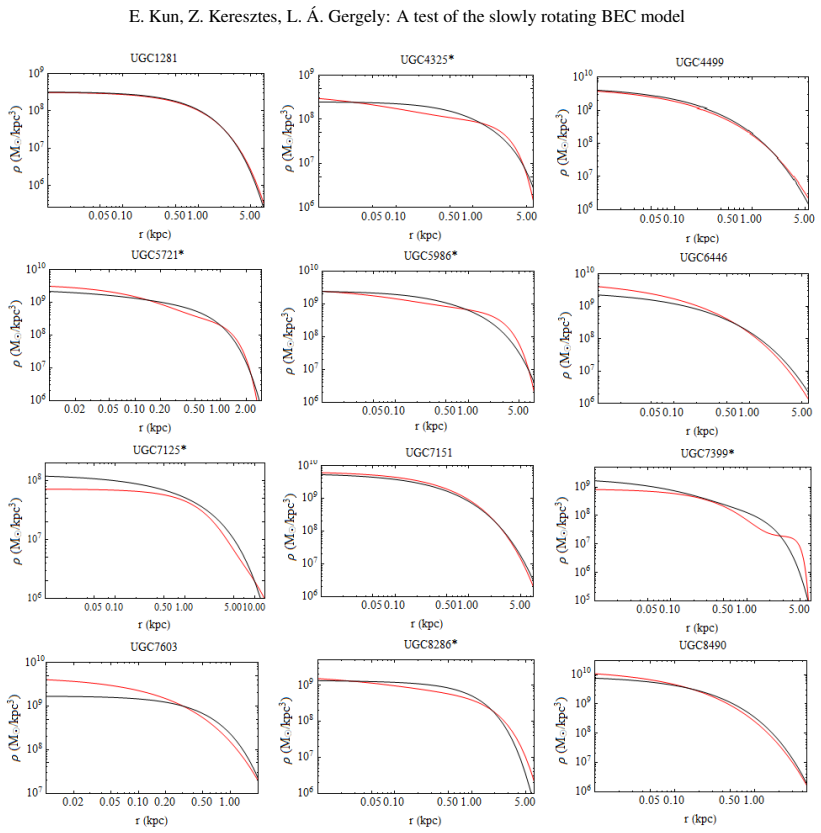
The central claim is that the slowly rotating BEC dark matter model, with three free parameters (central density ρ_c, static halo radius R, and angular velocity ω), fits the rotation curves of 11 of the 12 dwarf galaxies in the sample at the 1σ level, while the static BEC model fits only 10. Restricting attention to halos with finite size eliminates fast-rotation solutions whose density stays positive to infinity; the surviving best fits all have ω < 2.2 × 10⁻¹⁶ s⁻¹. The fitted static radius R is approximately the same from galaxy to galaxy, with mean 7.51 kpc and standard deviation 2.96 kpc, supporting the idea that R depends only on the particle mass and scattering length. From the relation between R and the particle parameters, the paper infers m ∈ [1.26 × 10⁻¹⁷, 3.08 × 10⁻¹⁷] eV/c² for a ≈ 10⁶ fm, a slightly tighter range than in the static case.
Load-bearing premise
The entire analysis stands on the assumption that a realistic dark matter halo must have a finite radius where its density first drops to zero, and that faster-rotating halos with positive density extending to infinity are unphysical; the paper does not derive this cutoff from the condensate equations.
Editorial extensions
If this is right
- The srBEC model becomes a viable dark matter candidate for dwarf galaxies, joining the family of core-forming dark matter models that avoid the cusp problem of collisionless cold dark matter.
- A single static halo radius R̄ ≈ 7.5 kpc across galaxies implies a single particle mass–scattering length relation, and the ±3 kpc scatter indicates the same boson could describe most dwarfs.
- The upper bound ω < 2.2 × 10⁻¹⁶ s⁻¹ means the dark matter halos of these dwarf galaxies are slow rotators unless a different physical cutoff is imposed, a prediction that can be checked with kinematic data beyond the rotation curve.
- Because the srBEC model fits one more galaxy than the static model, rotation plays a measurable role in matching rotation curves, not just a mathematical extension.
Reading between the lines
- If the finite-size cutoff is taken literally, the model predicts that the halo density drops discontinuously to zero at a fitted radius; this could be tested by gravitational lensing or stellar kinematics that probe the dark matter distribution at large radii.
- The spread in R across the sample, if not due to fitting noise, could constrain the scattering length a once m is measured independently (for instance from structure formation or direct detection experiments).
- The single failing galaxy (UGC 8490) might be accommodated by a more flexible baryonic model or a non-rigid rotation profile, a direct extension of the present analysis.
Signed reviews
Editorial analysis
A structured set of objections, weighed in public.
Referee Report
Summary. The paper confronts the slowly rotating Bose-Einstein Condensate (srBEC) dark matter halo model of Zhang et al. (2018) with the rotation curves of 12 dwarf galaxies drawn from the SPARC database, supplementing the 3.6 micron photometry with R-band data from the Westerbork survey. The baryonic contribution is modeled with Tempel-Tenjes bulge/disk luminosity profiles and a truncated exponential gas disk. The free parameters in the combined fit are the baryonic mass-to-light ratios, the srBEC central density rho_c, the static BEC radius R, and the halo angular velocity omega. The authors report that the srBEC model fits 11 of 12 galaxies within their stated 1 sigma criterion, improving on 10 of 12 for the static BEC model, and that the best-fit static radii scatter around R = 7.51 +/- 2.96 kpc. They further claim angular velocities below 2.2e-16 s^-1 for finite-size halos and a BEC particle mass in the range [1.26e-17, 3.08e-17] eV/c^2 for scattering length a = 1e6 fm.
Significance. If established, the paper's claims would strengthen the case for a rotating BEC dark matter model with a near-universal static halo radius and would give a particle-mass constraint tied to rotation-curve data. The work has clear strengths: it uses public, well-documented SPARC rotation curves and photometry, it introduces a more flexible stellar density model than the default exponential disk, it performs explicit chi-square minimization, and it provides a direct comparison against the non-rotating BEC model. The headline quantitative results (omega upper bound, R universality, and particle mass range) are falsifiable and amenable to checking from the tables and equations. However, as detailed below, the internal consistency of the reported particle-mass range, the ad hoc nature of the finite-size cutoff, and the under-documented 1 sigma criterion currently prevent the results from being accepted as stated.
major comments (4)
- [Section 5, Eq. (18) and Abstract] The reported particle-mass range is internally inconsistent with Eq. (18). Inserting a = 1e6 fm and the two extreme fitted radii, R = 14.381 kpc and R = 3.793 kpc (from Table 3, UGC 7125 and UGC 7603), into m = 6.73e-2 [a(fm)]^{1/3} [R(kpc)]^{-2/3} eV gives m ≈ 1.14 eV and m ≈ 2.77 eV, respectively. The Abstract and Section 5 instead quote m in [1.26e-17, 3.08e-17] eV/c^2, which differs by roughly 17 orders of magnitude. This is not a units mismatch; it is a direct numerical contradiction. Since the particle mass is a headline quantitative result, the authors must correct either Eq. (18) or the quoted range and abstract.
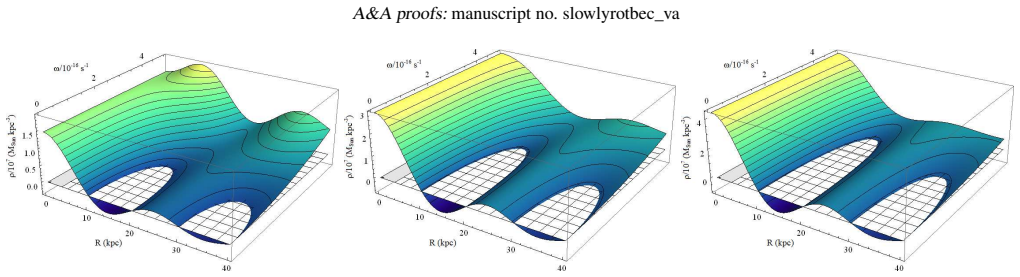
- [Section 3.2, Figs. 3 and 4] The upper bound on the angular velocity and the exclusion of fast-rotating halos rest entirely on the imposed finite-size criterion: the density profile is truncated at its first zero, and solutions that remain positive to infinity are discarded. This criterion is not derived from the Gross-Pitaevskii equation or from any physical boundary condition presented in the paper; it is introduced as a model-selection rule. Because this rule restricts the parameter space during the fit and is what makes the omega upper limit meaningful, a physical justification is needed. If the infinite-halo solutions were admitted, the best-fit parameters, the chi-square values, and the reported omega constraints could all change.
- [Section 4, Table 3] The 'within 1 sigma' criterion used to compare the srBEC model (11/12) with the static BEC model (10/12) is not documented. Table 3 lists a '1 sigma' threshold for each galaxy, but the paper gives no definition of this threshold (e.g., chi-square critical value for the relevant number of degrees of freedom), no number of data points, and no parameter uncertainties for the best-fit values of rho_c, R, omega, or the mass-to-light ratios. Without a precise statistical definition, the 11 versus 10 comparison and the claim that the srBEC model is an improvement cannot be evaluated. The authors should specify the degrees of freedom, the construction of the 1 sigma threshold, and provide covariance-based parameter errors.
- [Section 5 and Eq. (18)] The claim of universality of the static halo radius R is based on the scatter of best-fit R values (7.51 +/- 2.96 kpc) with no parameter uncertainties and no statistical test of dispersion beyond the reported standard deviation. Moreover, the particle-mass range is obtained by plugging the two extreme fitted R values into Eq. (18), so it is a re-expression of the fitted scatter rather than an independent prediction. Since the fitted R values are free parameters, the width of the derived mass range should not be presented as a new constraint. A formal test, accounting for fit uncertainties, is needed to support the universality claim.
minor comments (4)
- [Abstract and Section 5] The phrase 'less then' should be 'less than' in both the abstract and the summary paragraph.
- [Table 3, UGC 5721] The gas truncation radius is listed as R_t = 0 for UGC 5721, which conflicts with the text definition of R_t as the radius outside which the gaseous component is taken into account; please clarify whether zero denotes 'no truncation'.
- [Section 4] The fitting description states that weights proportional to error^-2 are used, but it does not specify how the reported chi-square is normalized or how the '1 sigma' thresholds in Table 3 were obtained; this could be clarified with a short formula or a reference.
- [References] The reference to Zhang et al. (2018) is listed as 'ArXiv e-prints' without a preprint number; if it has been published, a journal citation would be more useful.
Circularity Check
No significant circularity: the srBEC model, baryonic photometry, and rotation-curve fits are externally sourced and independent; the derived particle-mass range is a transparent re-expression of fitted halo radii, not a circular prediction.
full rationale
The derivation chain is self-contained against external inputs. The srBEC rotation-curve formula is taken from Zhang et al. (2018), an independent external source; the baryonic components are constructed from SPARC 3.6 micron and R-band photometry with Tempel-Tenjes models; the fit then determines rho_c, R, and omega from the observed rotation curves. Eq. (18) is quoted from Bohmer & Harko (2007) and converts the fitted static halo radius R into a particle mass m, with the paper explicitly stating the range is 'based on the best-fits of the srBEC model' -- i.e., a derived parameter constraint, not an independent prediction. The finite-size halo cutoff in Section 3.2 is an imposed physical prior, not fitted from the data, so it does not feed back into the model equation. The claim of universality of R is weakened by being inferred from the scatter of per-galaxy free fits rather than a common-R fit, but that is a statistical limitation, not circularity. No load-bearing self-citation chain appears: prior work by the same authors is cited only as background and is not used to justify the central result. One non-circular correctness concern: the quoted range m in [1.26e-17, 3.08e-17] eV/c^2 appears numerically inconsistent with Eq. (18) as written, since inserting a = 10^6 fm and the Table 3 extremes R = 3.793 and 14.381 kpc gives m ~ 1.1-2.8 eV; this is an arithmetic or unit issue, not a circularity issue.
Assumptions & free parameters
free parameters (6)
- Disk mass-to-light ratio (Upsilon_d) =
0.10 to 2.63 in solar units (Table 3)
- Bulge mass-to-light ratio (Upsilon_b) =
0.09 to 4.12 where applicable (Table 3)
- Central density of srBEC halo (rho_c) =
0.105 to 2.692 x 10^-24 g/cm^3 (Table 3)
- Static BEC halo radius (R) =
3.793 to 14.381 kpc (Table 3)
- Angular velocity of srBEC halo (omega) =
0.063 to 2.193 x 10^-16 1/s (Table 3)
- Gas disk parameters (Sigma_0, R_d, R_t) =
Table 3, columns 2-4
assumptions (6)
- domain assumption Dark matter forms a non-relativistic Newtonian BEC described by the Gross-Pitaevskii equation with barotropic equation of state (Böhmer and Harko 2007).
- domain assumption The srBEC halo rotates rigidly with constant angular velocity omega (Zhang et al. 2018).
- domain assumption The first-order perturbative expression for v_srBEC, Eqs. (15)-(16), is valid for the fitted parameter range.
- ad hoc to paper The halo density profile is cut off at the first zero to give finite size; faster rotators with positive density to infinity are excluded.
- domain assumption 3.6 micron surface brightness traces stellar mass with a constant M/L ratio (taken as 0.5 in Section 2.3, but left free in the final fits).
- domain assumption The galaxy is axisymmetric and the observed rotation curve equals the circular velocity in the equatorial plane.
Cite this review
Pith. "Pith review of Slowly rotating Bose-Einstein Condensate confronted with the rotation curves of 12 dwarf galaxies." pith.science (2026). https://pith.science/paper/LCRF6VQH
@misc{pith2026190806489,
  author       = {Pith},
  title        = {Pith review of: Slowly rotating Bose-Einstein Condensate confronted with the rotation curves of 12 dwarf galaxies},
  year         = {2026},
  howpublished = {\url{https://pith.science/paper/LCRF6VQH}},
  note         = {Machine review of arXiv:1908.06489}
}
abstract
We assemble a database of 12 dwarf galaxies, for which optical (R-band) and near-infrared ($3.6\mu m$) surface brightness density together with spectroscopic rotation curve data are available, in order to test the slowly rotating Bose-Einstein Condensate (srBEC) dark matter model. We aim to establish the angular velocity range compatible with observations, bounded from above by the requirement of finite size halos, to check the modelfits with the dataset, and the universality of the BEC halo parameter $\mathcal{R}$. We construct the spatial luminosity density of the stellar component of the dwarf galaxies based on their $3.6\mu m$ and R-band surface brightness profiles, assuming an axisymmetric baryonic mass distribution. We build up the gaseous component by employing a truncated disk model. We fit a baryonic plus dark matter combined model, parametrized by the M/L ratios of the baryonic components and parameters of the srBEC (the central density $\rho_c$, size of the static BEC halo $\mathcal{R}$, angular velocity $\omega$) to the rotation curves. The $3.6\mu m$ surface brightness of 6 galaxies indicates the presence of a bulge and a disk component. The shape of the $3.6\mu m$ and R-band spatial mass density profiles being similar is consistent with the stellar mass of the galaxies emerging wavelength-independent. The srBEC model fits the rotation curve of 11 galaxies out of 12 within $1\sigma$ significance level, with the average of $\mathcal{R}$ as 7.51 kpc and standard deviation of 2.96 kpc. This represents an improvement over the static BEC modelfit. For the well-fitting 11 galaxies the angular velocities allowing for a finite size srBEC halo are $<2.2\times 10^{-16}$ 1/s. For a scattering length of the BEC particle of $a\approx 10^6$ fm, the mass of the BEC particle is slightly better constrained than in the static case as $m\in[1.26\times10^{-17}\div3.08\times10^{-17}]$ eV/c$^2$.
Figures

Figures from the paper (2 more)


Reference graph
Works this paper leans on
-
[1]
Bell, E. F. & de Jong, R. S. 2001, ApJ, 550, 212
2001
-
[2]
F., McIntosh, D
Bell, E. F., McIntosh, D. H., Katz, N., & Weinberg, M. D. 2003, ApJS, 149, 289
2003
- [3]
-
[4]
Binney, J. & Tremaine, S. 1987, Galactic dynamics Böhmer, C. G. & Harko, T. 2007, JCAP , 6, 025
work page 1987
-
[5]
Bosma, A., van der Hulst, J. M., & Sullivan, III, W. T. 1977, A& A, 57, 373
work page 1977
-
[6]
Chudaykin, A., Gorbunov, D., & Tkachev, I. 2016, Phys. Rev. D ., 94, 023528
work page 2016
-
[7]
Dwornik, M., Keresztes, Z., & Gergely, L. Á. 2015, in Thirtee nth Marcel Grossmann Meeting: On Recent Developments in Theoretical a nd Experi- mental General Relativity, Astrophysics and Relativistic Field Theories, ed. K. Rosquist, 1279–1281
work page 2015
- [8]
Show all 25 references
-
[9]
Gunn, J. E. & Gott, III, J. R. 1972, ApJ, 176, 1
1972
-
[10]
2018, Symmetry , 10, 520
Kun, E., Keresztes, Z., Das, S., & Gergely, L. 2018, Symmetry , 10, 520
2018
-
[11]
Kun, E., Keresztes, Z., Simkó, A., Sz˝ ucs, G., & Gergely, L. Á. 2017, A&A, 608, A42
2017
-
[12]
S., & Schombert, J
Lelli, F., McGaugh, S. S., & Schombert, J. M. 2016, AJ, 152, 15 7
2016
-
[13]
McGaugh, S. S. & Schombert, J. M. 2014, AJ, 148, 77
2014
-
[14]
F., Frenk, C
Navarro, J. F., Frenk, C. S., & White, S. D. M. 1996, AJ, 462, 56 3 Planck Collaboration, Ade, P . A. R., Aghanim, N., et al. 2016 , A&A, 594, A13 Planck Collaboration, Aghanim, N., Akrami, Y ., et al. 2018, arXiv e-prints
1996
-
[15]
2004, ApJ, 617, 1059
Rhee, G., V alenzuela, O., Klypin, A., Holtzman, J., & Moorth y, B. 2004, ApJ, 617, 1059
2004
-
[16]
C., Marra, V ., del Popolo, A., & Davari, Z
Rodrigues, D. C., Marra, V ., del Popolo, A., & Davari, Z. 2018 , Nature Astron- omy, 2, 668
2018
-
[17]
C., Thonnard, N., & Ford, Jr., W
Rubin, V . C., Thonnard, N., & Ford, Jr., W. K. 1978, ApJL, 225, L107
1978
-
[18]
Swaters, R. A. 1999, PhD thesis, , Rijksuniversiteit Gronin gen, (1999)
1999
-
[19]
Swaters, R. A. & Balcells, M. 2002, A&A, 390, 863
2002
-
[20]
A., Sancisi, R., van Albada, T
Swaters, R. A., Sancisi, R., van Albada, T. S., & van der Hulst, J. M. 2009, A&A, 493, 871
2009
-
[21]
& Tenjes, P
Tamm, A. & Tenjes, P . 2005, A&A, 433, 31
2005
-
[22]
& Tenjes, P
Tempel, E. & Tenjes, P . 2006, MNRAS, 371, 1269 V erheijen, M. A. W. 2001, ApJ, 563, 694
2006
-
[23]
2016, MNRAS, 463, 557
Wegg, C., Gerhard, O., & Portail, M. 2016, MNRAS, 463, 557
2016
-
[24]
H., Harko, T., Liang, S.-D., & Leung, C
Zhang, X., Chan, M. H., Harko, T., Liang, S.-D., & Leung, C. S. 2018, ArXiv e-prints
2018
-
[25]
1937, ApJ, 86, 217 Article number, page 9 of 9
Zwicky, F. 1937, ApJ, 86, 217 Article number, page 9 of 9
1937
Reviewed August 14, 2026 · model on record in the stance chip above.
Discussion (0). Continue with ORCID to comment.