REVIEW 2 major objections 7 minor 50 references
Neural Dynamics on Complex Networks
T0 review · 2 major / 7 minor · reviewed 2026-08-14 · deepseek-v4-flash
Pith's one-line read Integrating a graph neural network over continuous time yields a model that learns a networked system's evolution from data alone, covering arbitrary-time prediction, sequence forecasting, and node classification in one framework.
desk verdict A sound and influential combination of GNNs and Neural ODEs whose dynamics claims outrun the evidence: every experiment uses one initial condition, so the paper demonstrates trajectory forecasting, not vector-field recovery. read the letter →
The pith
A machine-rendered reading of the paper's core claim, the machinery that carries it, and where it could break.
The reading
What carries the argument
The carrying mechanism is the graph differential equation $dX_h(t)/dt = \mathrm{ReLU}(\Phi X_h(t) W + b)$ — a graph-convolution-like layer reinterpreted as an instantaneous rate of change — embedded in an optimal-control objective that minimizes a running loss plus a terminal loss subject to that equation. The normalized graph Laplacian $\Phi = D^{-1/2}(D - A)D^{-1/2}$ is the diffusion operator that injects the network's structure into every integration step, while the encoder and decoder ($f_e$ and $f_d$) lift the raw signal into a hidden space in which the learned dynamics operate. The integral $X(t) = X(0) + \int_0^t f(X_h, G, W_h, \tau)\, d\tau$ converts discrete layer depth into continuous physical time, the forward pass is executed by a numerical solver (Euler or the Dormand–Prince DOPRI5 method), and gradients are back-propagated through the integration. The real-valued terminal time $T$ therefore acts as a continuous depth, and the classification experiments show accuracy rising and falling around a best value of $T$.
What would settle it
Fit NDCN to trajectories from a real networked system whose dynamics include explicit time-dependent forcing or higher-order terms, such as epidemic spread on a contact network, and check whether extrapolation error stays in the single-digit range reported on the three simulated benchmarks. The same run can be made decisive by comparing the learned vector field $\mathrm{ReLU}(\Phi X_h W + b)$ against the measured $dX/dt$ at sampled states; a large residual would show the model fits the training window without recovering the dynamics, which would sink the unified-framework claim.
Extended reading notes
Core claim
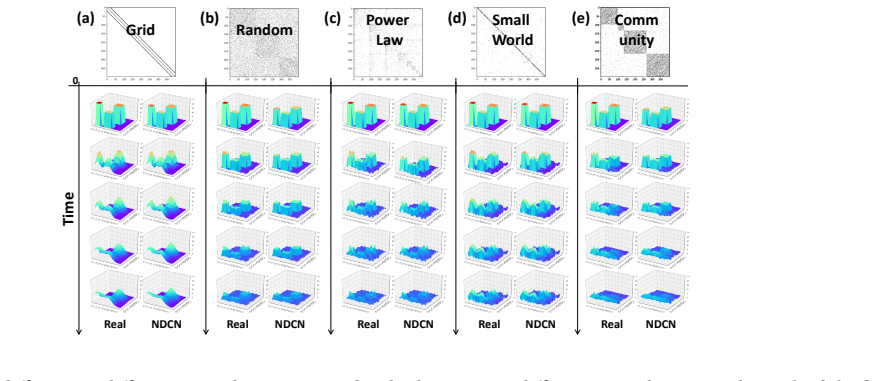
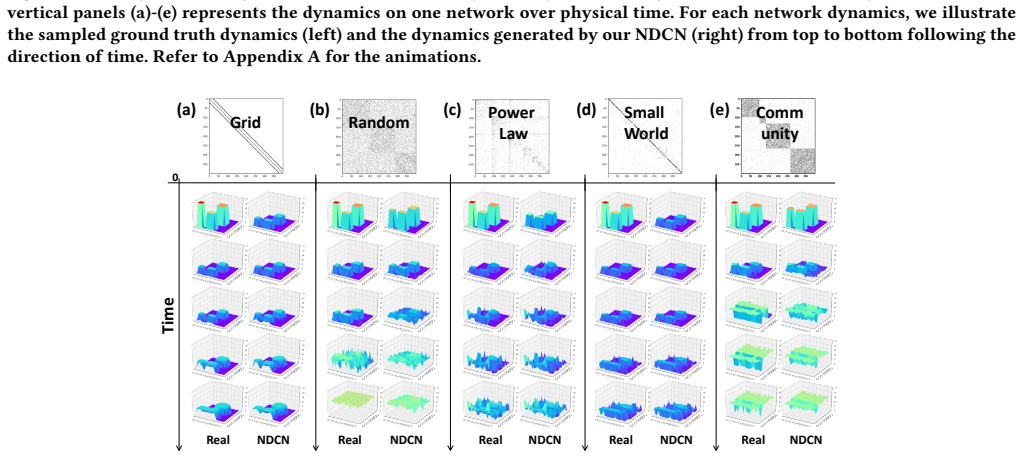
The paper's central claim is that a graph neural network whose forward pass is a numerical integration of a learned differential equation — the Neural Dynamics on Complex Networks (NDCN) model — can learn the continuous-time evolution of networked systems in a purely data-driven way, and that one framework covers three tasks usually treated separately. The evolution law is $dX_h(t)/dt = \mathrm{ReLU}(\Phi X_h(t) W + b)$, where $\Phi = D^{-1/2}(D - A)D^{-1/2}$ is the normalized graph Laplacian of the network and $W, b$ are parameters shared across time, with the raw signal $X$ first encoded into a hidden space $X_h$ and decoded back after integration. Because any future state is obtained by integrating this law from the initial state, the model returns predictions at arbitrary real-valued times rather than at discrete layers. On 400-node networks with five topologies, the paper reports that NDCN extrapolates heat, mutualistic, and gene-regulatory dynamics with normalized $\ell^1$ errors in the low single digits to the mid-twenties, far below the three ablation variants; that it forecasts regularly sampled sequences with lower error than temporal-GNN baselines in nearly all settings while using roughly one to four percent of their parameter counts; and that at a real-valued terminal time it reaches 83.3%, 73.1%, and 79.8% accuracy on Cora, Citeseer, and Pubmed, matching or exceeding the GCN, AGNN, and GAT baselines.
Load-bearing premise
The load-bearing premise is that real network evolution can always be squeezed into one fixed functional form — a single nonlinear diffusion step with a frozen graph operator and time-constant weights, applied in a learned hidden space — an expressiveness assumption the paper asserts but does not test on any system beyond its three simulated examples.
Editorial extensions
If this is right
- If a system's evolution is well approximated by the learned form, one trained NDCN returns the full network state at any real-valued time from the initial state alone, so irregularly sampled observations can be interpolated and the future extrapolated without retraining.
- Regularly sampled sequence forecasting needs no separate recurrent cell: the same model run with unit time steps undercuts the LSTM-GNN, GRU-GNN, and RNN-GNN baselines on nearly all tested dynamics-network pairs while using 901 parameters, about 1-4% of the baselines' counts.
- Node classification becomes a labeling dynamics: features and known labels diffuse over continuous time, and accuracy follows a rise-and-fall curve in the terminal time, meaning the optimal depth of a graph network is a real number, not an integer layer count.
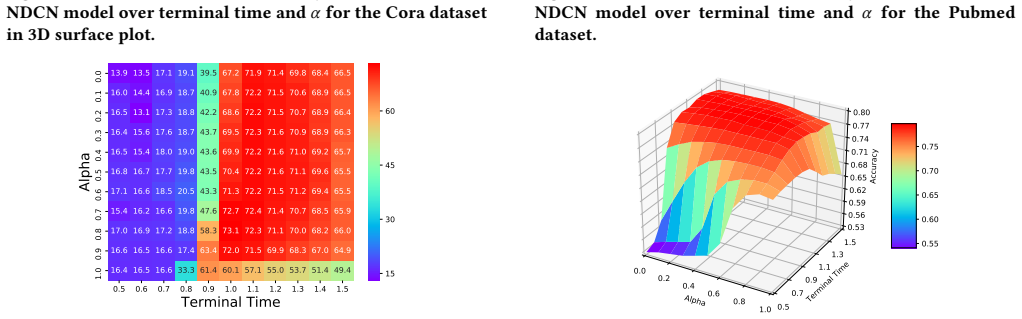
- Because the classification variant spreads information through the diffusion operator, the framework gives a physical interpretation to depth and to the choice of how long to let labels propagate; under-diffusion and over-diffusion both degrade accuracy, as the reported heatmaps show.
Reading between the lines
- An implication the authors leave implicit: the same integrate-in-continuous-time construction can wrap any message-passing rule, not just the Laplacian diffusion used here; swapping in attention-based or heterophilic propagation would test whether the citation-network accuracy survives on graphs where neighbors are dissimilar.
- Because the learned dynamics are autonomous (time-invariant $W$), a natural extension the paper notes but does not pursue is time-varying weights, which would be needed for systems with seasonality or external forcing; all three test dynamics are autonomous, so the claim has not been shown beyond that class.
- The classification results suggest a principled handle on depth: if the accuracy-versus-$T$ curve reflects genuine diffusion, the optimal terminal time might be predictable from spectral properties of the graph such as mixing time, turning what is currently a grid search into a computed quantity.
Signed reviews
Editorial analysis
A structured set of objections, weighed in public.
Referee Report
Summary. The paper proposes NDCN, a graph-neural-ODE model that models the instantaneous change of node states as a graph neural network in a hidden space and integrates it over continuous time. The same framework is applied to three tasks: continuous-time network dynamics prediction on simulated heat-diffusion, mutualistic-interaction, and gene-regulatory dynamics over five network topologies; regularly sampled structured-sequence prediction compared with temporal GNNs; and node semi-supervised classification on Cora, Citeseer, and Pubmed compared with GCN, AGNN, and GAT. The authors claim that NDCN learns continuous-time dynamics on complex networks accurately and serves as a unified framework for capturing structure and dynamics in a data-driven manner.
Significance. If the central dynamics-learning claim were fully supported, this would be a solid and timely contribution: it gives a clean continuous-depth interpretation of GNNs, unifies trajectory prediction, sequence prediction, and node classification in one model, and the paper provides open-source code plus experiments across several dynamics, network models, and ablations. The trajectory-level interpolation and extrapolation results in Tables 1 and 2 are strong relative to the ablation baselines, and the parameter-efficiency comparison in Section 5 is a concrete strength. The main obstacle is that the evidence does not yet establish vector-field learning, because all experiments use a single initial condition per dynamics/network.
major comments (2)
- [§4.2 Experimental setup] The experimental setup states "We set the initial value X(0) the same for all the experiments"; therefore the 80 training snapshots and the interpolation/extrapolation test snapshots in Tables 1 and 2 all lie on a single trajectory for each dynamics/network pair. This setup can validate trajectory-level interpolation and continuation, but it does not establish that the model recovers the vector field f in Eq. (1): one trajectory generally underdetermines the parameters of Eq. (5), and a model can fit one orbit without generalizing to other initial conditions. Because the abstract, Section 1, and Section 7 claim that NDCN "learns continuous-time dynamics on various complex networks accurately" as a general capability, this is a load-bearing gap. Please add held-out initial-condition experiments (train on one or several X0, test on unseen X0) or perturbation/control tests, and adjust the claims to match the measured scope.
- [Eq. (5) and §4.1] The model assumes that the unknown dynamics can be represented as dXh/dt = ReLU(Phi Xh W + b) with a fixed normalized Laplacian Phi and time-invariant W, and the text near Eq. (5) states that this can learn "any unknown network dynamics." The paper provides no analysis or experiment on the expressiveness of this function class; the three simulated dynamics (heat diffusion, mutualistic interaction, gene regulation) all fall in the pairwise diffusion family. If a real system has explicit time dependence, higher-order derivatives, or non-pairwise interactions, the extrapolation/interpolation claims would not hold. Please test on at least one dynamics outside this family, or restate the claim as a modeling assumption with a clearly bounded scope.
minor comments (7)
- [§4.2, heat diffusion equation] The term k_{i,j} in the heat diffusion equation is undefined and the subscript is inconsistent; please define the heat capacity and use a consistent index.
- [§3.1, first problem bullet] The task is phrased as predicting dX/dt, but the experiments evaluate prediction of the state X(t); please align the wording.
- [Eq. (5), constraint line] The constraint line "subject to Xh(t) = tanh(X(t)We + be)W0 + b0, X0" appears malformed; likely Xh(0) = ... and X(0) = X0 are intended as separate constraints.
- [Table 3, mutualistic interaction rows] Several entries report standard deviations larger than the mean (e.g., GRU-GNN on Random, 1.0±3.6), which is implausible for a nonnegative normalized ℓ1 error; please verify the aggregation and report it correctly.
- [§6.2] The grid search over T and α is not explicitly tied to the validation split; please state that model selection uses validation so that the test-set numbers are not selected.
- [Typography and references] There are typos and formatting issues: "Erdós" should be "Erdős–Rényi", "We lean" should be "We learn", and several references contain corrupted characters (e.g., "HOâĂŹN Roe", "âĂŸsmall-worldâĂŹnetworks").
- [Table 5 and §6.2] The claim of outperforming many GNN models is too strong given that NDCN is below AGNN on Pubmed (79.8 vs 79.9) and the Cora margin over AGNN is only 0.2 points; recommend describing the result as competitive and reporting significance.
Circularity Check
No significant circularity; NDCN's predictions are out-of-sample trajectory fits and its self-citations are contextual.
full rationale
The paper's central derivation is not circular. Equation (5) posits dXh/dt = ReLU(Phi Xh W + b) as an ansatz, and Equations (3)-(4) define a supervised learning objective with a running loss over observed snapshots; Tables 1-3 then report errors on time points that were not used for training, so the interpolation and extrapolation results are genuine out-of-sample losses rather than identities forced by the fit. In the classification setting (Section 6), the terminal time T and alpha are grid-searched hyperparameters, and the reported accuracies are test-set numbers; the observation that the best accuracy occurs at a real-number time is a post-hoc description of that search, not a fitted parameter relabeled as a prediction. The self-citations [46]-[49] appear only as background examples and a logistic-growth reference, and none is load-bearing for the NDCN derivation. The expressiveness assumption that ReLU(Phi X W + b) can represent arbitrary unknown network dynamics is an unproven modeling assumption and a generalization risk (compounded by the lack of a held-out initial-condition experiment), but it is a correctness concern rather than circularity under the definitional or fitted-input criteria.
Assumptions & free parameters
free parameters (5)
- ODE weights and bias W, b in dXh/dt = ReLU(Phi Xh W + b) =
Learned by Adam; no closed-form value
- Encoder and decoder parameters We, W0, Wd, be, b0, bd =
Learned by Adam
- Terminal time T for classification =
1.2 (Cora), 1.0 (Citeseer), 1.1 (Pubmed)
- Diffusion mixing parameter alpha =
0 (Cora), 0.8 (Citeseer), 0.4 (Pubmed)
- L2 regularization multipliers =
Per dataset and network, e.g. 1e-3, 1e-6, 1e-4
assumptions (4)
- domain assumption The evolution of a complex networked system is described by a first-order ODE dX/dt = f(X, G, W, t) (Eq. 1).
- ad hoc to paper The vector field f can be represented by a GNN of the form ReLU(Phi Xh W + b) in a hidden space (Eq. 5).
- domain assumption The normalized graph Laplacian Phi captures the structural interactions that drive dynamics (Eq. 5 and Section 6.1).
- standard math Numerical integrators such as Euler and DOPRI5 approximate the exact ODE solution sufficiently well (Section 3.2 and Section 4.2).
Cite this review
Pith. "Pith review of Neural Dynamics on Complex Networks." pith.science (2026). https://pith.science/paper/3K2NPMZ4
@misc{pith2026190806491,
  author       = {Pith},
  title        = {Pith review of: Neural Dynamics on Complex Networks},
  year         = {2026},
  howpublished = {\url{https://pith.science/paper/3K2NPMZ4}},
  note         = {Machine review of arXiv:1908.06491}
}
read the original abstract
Learning continuous-time dynamics on complex networks is crucial for understanding, predicting and controlling complex systems in science and engineering. However, this task is very challenging due to the combinatorial complexities in the structures of high dimensional systems, their elusive continuous-time nonlinear dynamics, and their structural-dynamic dependencies. To address these challenges, we propose to combine Ordinary Differential Equation Systems (ODEs) and Graph Neural Networks (GNNs) to learn continuous-time dynamics on complex networks in a data-driven manner. We model differential equation systems by GNNs. Instead of mapping through a discrete number of neural layers in the forward process, we integrate GNN layers over continuous time numerically, leading to capturing continuous-time dynamics on graphs. Our model can be interpreted as a Continuous-time GNN model or a Graph Neural ODEs model. Our model can be utilized for continuous-time network dynamics prediction, structured sequence prediction (a regularly-sampled case), and node semi-supervised classification tasks (a one-snapshot case) in a unified framework. We validate our model by extensive experiments in the above three scenarios. The promising experimental results demonstrate our model's capability of jointly capturing the structure and dynamics of complex systems in a unified framework.
Figures

Figures from the paper (5 more)


Reference graph
Works this paper leans on
-
[1]
Warder Clyde Allee, Orlando Park, Alfred Edwards Emerson, Thomas Park, Karl Patterson Schmidt, et al. 1949. Principles of animal ecology. Technical Report. Saunders Company Philadelphia, Pennsylvania, USA
work page 1949
-
[2]
Uri Alon. 2006. An introduction to systems biology: design principles of biological circuits. Chapman and Hall/CRC
work page 2006
-
[3]
Albert-László Barabási and Réka Albert. 1999. Emergence of scaling in random networks. science 286, 5439 (1999), 509–512
1999
-
[4]
Baruch Barzel, Yang-Yu Liu, and Albert-László Barabási. 2015. Constructing minimal models for complex system dynamics. Nature communications (2015)
work page 2015
-
[5]
Amir Bashan, Travis E Gibson, Jonathan Friedman, Vincent J Carey, Scott T Weiss, Elizabeth L Hohmann, and Yang-Yu Liu. 2016. Universality of human microbial dynamics. Nature 534, 7606 (2016), 259
work page 2016
-
[6]
Martin Benning, Elena Celledoni, Matthias J Ehrhardt, Brynjulf Owren, and Carola-Bibiane Schönlieb. 2019. Deep learning as optimal control problems: models and numerical methods. arXiv preprint arXiv:1904.05657 (2019)
arXiv 2019
-
[7]
William E Boyce, Richard C DiPrima, and Douglas B Meade. 1992. Elementary differential equations and boundary value problems . Vol. 9. Wiley New York
work page 1992
-
[8]
Tian Qi Chen, Yulia Rubanova, Jesse Bettencourt, and David K Duvenaud. 2018. Neural ordinary differential equations. In Advances in Neural Information Pro- cessing Systems. 6571–6583
work page 2018
Show all 50 references
-
[9]
John R Dormand. 1996. Numerical methods for differential equations: a computa- tional approach. Vol. 3. CRC Press
1996
-
[10]
Emilien Dupont, Arnaud Doucet, and Yee Whye Teh. 2019. Augmented neural odes. arXiv preprint arXiv:1904.01681 (2019)
2019 arXiv
-
[11]
P Erdos and A Renyi. 1959. On random graphs I. Publ. Math. Debrecen 6 (1959)
1959
-
[12]
Santo Fortunato. 2010. Community detection in graphs. Physics reports 486, 3-5 (2010), 75–174
2010
-
[13]
Jianxi Gao, Baruch Barzel, and Albert-László Barabási. 2016. Universal resilience patterns in complex networks. Nature 530, 7590 (2016), 307
2016
-
[14]
Wulfram Gerstner, Werner M Kistler, Richard Naud, and Liam Paninski. 2014. Neuronal dynamics: From single neurons to networks and models of cognition . Cambridge University Press
2014
-
[15]
Jiequn Han, Qianxiao Li, et al. 2018. A mean-field optimal control formulation of deep learning. arXiv preprint arXiv:1807.01083 (2018)
2018 arXiv
-
[16]
Kaiming He, Xiangyu Zhang, Shaoqing Ren, and Jian Sun. 2016. Deep residual learning for image recognition. In Proceedings of the IEEE conference on computer vision and pattern recognition . 770–778
2016
-
[17]
Seyed Mehran Kazemi, Rishab Goel, Kshitij Jain, Ivan Kobyzev, Akshay Sethi, Peter Forsyth, and Pascal Poupart. 2019. Relational Representation Learning for Dynamic (Knowledge) Graphs: A Survey. arXiv preprint arXiv:1905.11485 (2019)
2019 arXiv
-
[18]
Kingma and Jimmy Ba
Diederik P. Kingma and Jimmy Ba. 2015. Adam: A Method for Stochastic Opti- mization. In ICLR 2015
2015
-
[19]
Kipf and Max Welling
Thomas N. Kipf and Max Welling. 2017. Semi-Supervised Classification with Graph Convolutional Networks. In ICLR 2017
2017
-
[20]
Yann LeCun, Yoshua Bengio, and Geoffrey Hinton. 2015. Deep learning. nature 521, 7553 (2015), 436
2015
-
[21]
Haoyang Li, Peng Cui, Chengxi Zang, Tianyang Zhang, Wenwu Zhu, and Yishi Lin. 2019. Fates of Microscopic Social Ecosystems: Keep Alive or Dead?. In Proceedings of the 25th ACM SIGKDD International Conference on Knowledge Discovery & Data Mining . 668–676
2019
-
[22]
Qimai Li, Zhichao Han, and Xiao-Ming Wu. 2018. Deeper insights into graph convolutional networks for semi-supervised learning. In Thirty-Second AAAI Conference on Artificial Intelligence
2018
-
[23]
Zachary C Lipton, John Berkowitz, and Charles Elkan. 2015. A critical review of recurrent neural networks for sequence learning. preprint arXiv:1506.00019 (2015)
2015 arXiv
-
[24]
Yunfei Lu, Linyun Yu, Tianyang Zhang, Chengxi Zang, Peng Cui, Chaoming Song, and Wenwu Zhu. 2018. Collective Human Behavior in Cascading System: Discovery, Modeling and Applications. In 2018 IEEE International Conference on Data Mining (ICDM). IEEE, 297–306
2018
-
[25]
Yiping Lu, Aoxiao Zhong, Quanzheng Li, and Bin Dong. 2017. Beyond finite layer neural networks: Bridging deep architectures and numerical differential equations. arXiv preprint arXiv:1710.10121 (2017)
2017 arXiv
-
[26]
A v Luikov. 2012. Analytical heat diffusion theory. Elsevier
2012
-
[27]
Niall M Mangan, Steven L Brunton, Joshua L Proctor, and J Nathan Kutz. 2016. Inferring biological networks by sparse identification of nonlinear dynamics. IEEE Transactions on Molecular, Biological and Multi-Scale Communications 2, 1 (2016), 52–63
2016
-
[28]
Apurva Narayan and Peter HOâĂŹN Roe. 2018. Learning graph dynamics using deep neural networks. IFAC-PapersOnLine 51, 2 (2018), 433–438
2018
-
[29]
Mark Newman. 2010. Networks: an introduction. Oxford U. press
2010
-
[30]
Mark Newman, Albert-Laszlo Barabasi, and Duncan J Watts. 2011. The structure and dynamics of networks . Vol. 12. Princeton University Press
2011
-
[31]
Tong Qin, Kailiang Wu, and Dongbin Xiu. 2018. Data driven governing equations approximation using deep neural networks. arXiv preprint arXiv:1811.05537 (2018)
2018 arXiv
-
[32]
Maziar Raissi. 2018. Deep hidden physics models: Deep learning of nonlinear partial differential equations. The Journal of Machine Learning Research 19, 1 (2018), 932–955
2018
-
[33]
Maziar Raissi, Paris Perdikaris, and George Em Karniadakis. 2018. Multistep neural networks for data-driven discovery of nonlinear dynamical systems.arXiv preprint arXiv:1801.01236 (2018)
2018 arXiv
-
[34]
Samuel H Rudy, Steven L Brunton, Joshua L Proctor, and J Nathan Kutz. 2017. Data-driven discovery of partial differential equations. Science Advances 3, 4 (2017), e1602614
2017
-
[35]
Lars Ruthotto and Eldad Haber. 2018. Deep neural networks motivated by partial differential equations. arXiv preprint arXiv:1804.04272 (2018)
2018 arXiv
-
[36]
Youngjoo Seo, Michaël Defferrard, Pierre Vandergheynst, and Xavier Bresson
-
[37]
Jean-Jacques E Slotine, Weiping Li, et al. 1991. Applied nonlinear control. Vol. 199. Prentice hall Englewood Cliffs, NJ
1991
-
[38]
Steven H Strogatz. 2018. Nonlinear Dynamics and Chaos with Student Solutions Manual: With Applications to Physics, Biology, Chemistry, and Engineering
2018
-
[39]
Kiran K Thekumparampil, Chong Wang, Sewoong Oh, and Li-Jia Li. 2018. Attention-based graph neural network for semi-supervised learning. arXiv preprint arXiv:1803.03735 (2018)
2018 arXiv
-
[40]
Petar Veličković, Guillem Cucurull, Arantxa Casanova, Adriana Romero, Pietro Lio, and Yoshua Bengio. 2017. Graph attention networks. arXiv preprint arXiv:1710.10903 (2017)
2017 arXiv
-
[41]
Duncan J Watts and Steven H Strogatz. 1998. Collective dynamics of âĂŸsmall- worldâĂŹnetworks. nature 393, 6684 (1998), 440
1998
-
[42]
Souza Jr., Christopher Fifty, Tao Yu, and Kilian Q
Felix Wu, Tianyi Zhang, Amauri H. Souza Jr., Christopher Fifty, Tao Yu, and Kilian Q. Weinberger. 2019. Simplifying Graph Convolutional Networks. CoRR (2019)
2019
-
[43]
Zonghan Wu, Shirui Pan, Fengwen Chen, Guodong Long, Chengqi Zhang, and Philip S Yu. 2019. A comprehensive survey on graph neural networks. arXiv preprint arXiv:1901.00596 (2019)
2019 arXiv
-
[44]
Cohen, and Ruslan Salakhutdinov
Zhilin Yang, William W. Cohen, and Ruslan Salakhutdinov. 2016. Revisiting Semi-Supervised Learning with Graph Embeddings. In ICML 2016. 40–48
2016
-
[45]
Bing Yu, Haoteng Yin, and Zhanxing Zhu. 2017. Spatio-temporal graph con- volutional networks: A deep learning framework for traffic forecasting. arXiv preprint arXiv:1709.04875 (2017)
2017 arXiv
-
[46]
Chengxi Zang, Peng Cui, and Christos Faloutsos. 2016. Beyond sigmoids: The nettide model for social network growth, and its applications. In Proceedings of the 22nd ACM SIGKDD international conference on knowledge discovery and data mining. 2015–2024
2016
-
[47]
Chengxi Zang, Peng Cui, Christos Faloutsos, and Wenwu Zhu. 2018. On Power Law Growth of Social Networks. IEEE Transactions on Knowledge and Data Engineering 30, 9 (2018), 1727–1740
2018
-
[48]
Chengxi Zang, Peng Cui, Chaoming Song, Wenwu Zhu, and Fei Wang. 2019. Uncovering Pattern Formation of Information Flow. In Proceedings of the 25th ACM SIGKDD International Conference on Knowledge Discovery & Data Mining . 1691–1699
2019
-
[49]
Chengxi Zang, Peng Cui, Wenwu Zhu, and Fei Wang. 2019. Dynamical Origins of Distribution Functions. In Proceedings of the 25th ACM SIGKDD International Conference on Knowledge Discovery & Data Mining . 469–478. APPENDIX: A ANIMATIONS OF THE REAL-WORLD DYNAMICS ON DIFFERENT NET...
2019
-
[2018]
In International Conference on Neural Information Processing
Structured sequence modeling with graph convolutional recurrent net- works. In International Conference on Neural Information Processing . 362–373
Reviewed August 14, 2026 · model on record in the stance chip above.
Discussion (0). Continue with ORCID to comment.