REVIEW 1 major objections 5 minor 27 references
Signature Cumulants, Ordered Partitions, and Independence of Stochastic Processes
T0 review · 1 major / 5 minor · reviewed 2026-08-14 · deepseek-v4-flash
Pith's one-line read Signature cumulants — the tensor logarithm of a process's expected signature — characterise independence of coordinate projections and admit unbiased minimum-variance estimators.
desk verdict Solid paper: new ordered-partition cumulants for path signatures with a correct but conditional independence theorem; the abstract overstates the if-and-only-if. read the letter →
The pith
A machine-rendered reading of the paper's core claim, the machinery that carries it, and where it could break.
The reading
What carries the argument
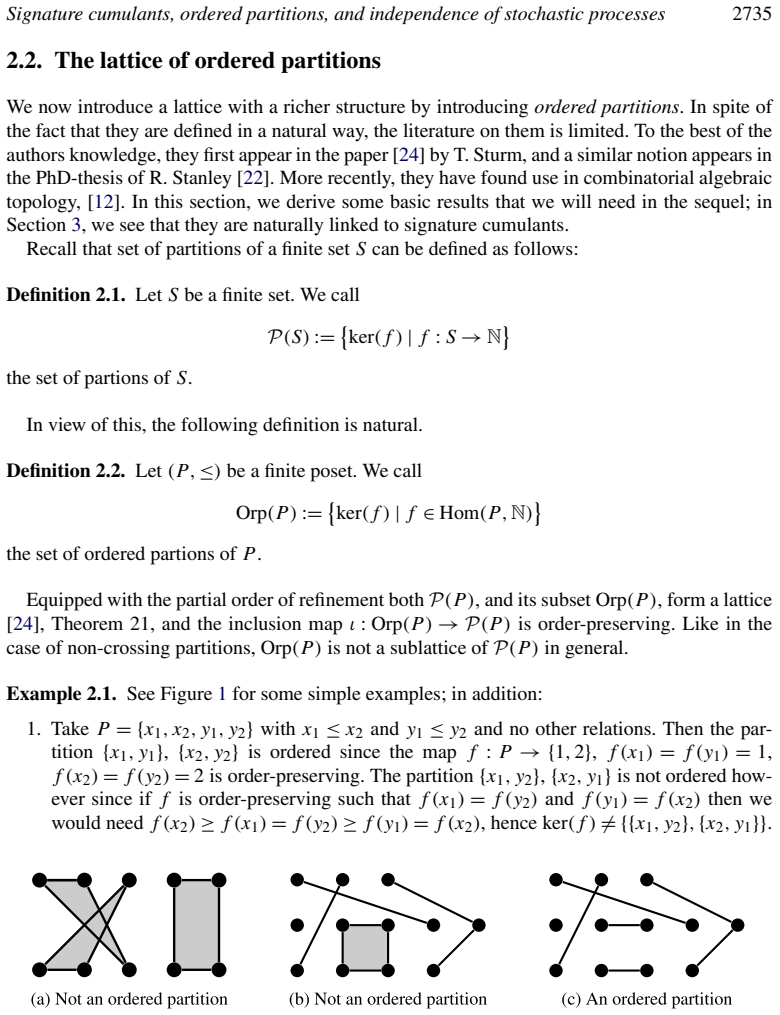
The central object is the lattice of ordered partitions of a finite poset: a partition $a = \{a_1,\dots,a_k\}$ of the letters of a tuple (or tuple of tuples) that is the kernel of an order-preserving map to a chain, i.e. a partition whose blocks do not interleave against the partial order. For tuples $\tau_1,\dots,\tau_k$, the underlying poset is $P(|\tau_1|,\dots,|\tau_k|)$, a disjoint union of chains. The argument rides on Möbius inversion in this lattice: generalised signature moments and cumulants are related by $\mu_X(a) = \sum_{b \le a,\, a \in A(b)} \kappa_X(b)$, and the coefficients $d(a) = \sum_{b \in A(a)} (-1)^{|b|-1} b!/|b|$ telescope to zero except on degenerate blocks (Proposition 2.2), which is exactly what forces the independence criterion to reduce to classical cross-cumulants plus higher-order corrections that vanish pairwise. The shuffle product appears because it is dual to the deconcatenation coproduct, letting the log-exponential identity in the tensor algebra expand into these ordered partitions.
What would settle it
Take a non-degenerate random variable $Z$ whose moments are all zero (such laws exist, e.g. via the log-normal moment problem), and set $X_t(\omega) = Z(\omega)t$ on $[0,1]$. Then $X|_I$ and $X|_J$ are the same process for $I=J=\{1\}$, hence dependent, yet the expected signature is the identity and every shuffle cross-cumulant vanishes. This directly shows the moment-determinacy hypothesis in Theorem 3.6 cannot be dropped.
Extended reading notes
Core claim
The paper's central discovery is a path-space version of the classical cumulant theorems. For a random weakly geometric rough path $X$ with expected signature $\mu_X = E[X_{0,T}]$, define the signature cumulant $\kappa_X = \log E[X_{0,T}]$. Theorem 3.6 establishes three consequences. First, signature cumulants are compensated moments: $\langle \kappa_X, e_{\tau_1} \shuffle \cdots \shuffle e_{\tau_k} \rangle$ equals a sum over ordered partitions of the tuple $(\tau_1,\dots,\tau_k)$ with coefficients $(-1)^{|a|-1} a!/|a|$ times generalised signature moments. Second, the map $\kappa_X \mapsto \mu_X$ is a bijection via Möbius inversion on the ordered-partition lattice, so signature cumulants characterise the law whenever signature moments do. Third, and most importantly, if $I,J$ are coordinate sets and the joint law of $(X|_I, X|_J)$ is determined by its mixed signature moments, then $X|_I$ and $X|_J$ are independent if and only if $\langle \kappa_X, e_{\tau_1} \shuffle e_{\tau_2} \rangle = 0$ for every $\tau_1 \in I^*$, $\tau_2 \in J^*$. On the estimation side, Proposition 4.2 shows the signature polykay $\hat\kappa_n(\tau)$ is an unbiased estimator of the shuffle-product cumulant, has minimum variance among unbiased polynomial estimators, converges almost surely and in $L^p$, and is asymptotically normal.
Load-bearing premise
That the joint law of the two coordinate projections is fully determined by its mixed signature moments; if the process has heavy tails such that this fails, vanishing cross-cumulants need not imply independence.
Editorial extensions
If this is right
- Independence of two coordinate blocks of a process can now be tested by estimating the shuffle-product signature cumulants and checking whether they vanish; no parametric model for the process is required.
- Because signature cumulants determine the law whenever signature moments do, the estimators can be used for parameter estimation and goodness-of-fit for stochastic differential equations, generalising the method of signature moments.
- The classical cumulant theory for random vectors is recovered by tensor symmetrisation, so the paper gives a single combinatorial framework covering both classical and path-valued cumulants.
- The variance comparison for a constant-drift, constant-volatility diffusion indicates that signature-cumulant estimators are preferable to signature-moment estimators when the drift is large relative to volatility, echoing the classical superiority of cumulants.
- Since the signature polykays are minimum-variance unbiased estimators, they provide efficient building blocks for hypothesis testing about the law of a stochastic process from observed sample paths.
Reading between the lines
- The combinatorial core is just a poset with chains, so the same formulae should transfer to any time-indexed or hierarchically ordered data structure, not only to coordinate blocks of one rough path.
- The signature polykays are U-statistics, so non-asymptotic concentration inequalities for them can likely be derived; the paper proves asymptotic normality but does not pursue finite-sample bounds.
- The paper's remark that normalised signatures also characterise laws suggests a ready route to a fully non-parametric independence test for heavy-tailed or black-box settings, since the exponential-moment condition of Theorem 3.6 can then be bypassed.
- The ordered-partition viewpoint could also clarify why different non-commutative cumulants (free, Boolean, monotone) use different partition lattices: each may correspond to a different choice of partial order on the index set.
Signed reviews
Editorial analysis
A structured set of objections, weighed in public.
Referee Report
Summary. The paper develops a combinatorial theory of signature cumulants for random geometric rough paths. It introduces the lattice of ordered partitions of a poset, proves Möbius-inversion formulas connecting generalized signature moments and cumulants (Theorem 3.6(1)-(2)), and gives an independence criterion: for coordinate sets I,J, under the hypothesis that the joint law of the two coordinate projections is characterized by mixed signature moments, independence is equivalent to vanishing of shuffle-product signature cumulants (Theorem 3.6(3)). It then constructs signature polykays, U-statistic-type estimators of signature cumulants, proving unbiasedness, a minimum-variance property among unbiased polynomial estimators, almost sure and Lp convergence, and asymptotic normality (Proposition 4.2), and it illustrates an efficiency gain over signature moment estimators in a constant-drift, constant-volatility diffusion example.
Significance. If the results hold, this is a useful and well-motivated bridge between classical cumulant theory and path-signature statistics. The ordered-partition combinatorics is new in this application and is developed in a largely self-contained way: Proposition 3.3 rests on an explicit counting argument, and Remark 3.2 supplies an independent algebraic proof of the crucial moment-cumulant equivalence, which strengthens confidence in the result. Proposition 4.2 gives concrete estimators with standard U-statistic guarantees, and Example 4.3 yields a clear and falsifiable efficiency comparison. The main theorems are correctly stated as conditional on a moment-characterisation hypothesis, and Appendix A provides sufficient exponential-integrability conditions under which that hypothesis holds. The main defect is that the abstract and introduction present the independence criterion without this condition.
major comments (1)
- [Abstract; Section 1; Theorem 3.6(3)] The abstract and the introductory discussion after Example 1.1 claim an unconditional equivalence: "signature cumulants between stochastic processes vanish if and only if the stochastic processes are independent." The theorem itself is conditional: Theorem 3.6(3) requires that the joint law (X|I, X|J) be characterized by the mixed signature moments. Proposition 3.5 proves only that vanishing cross shuffle-cumulants are equivalent to factorization of mixed signature moments; independence follows only under the added determinacy hypothesis. The hypothesis is essential: for moment-indeterminate real variables U,V with a non-independent coupling having the same joint moments as an independent coupling, embed them as linear paths Z_t = (Ut, Vt) on [0,1]. The signature coefficient of the word with a copies of 1 and b copies of 2 is U^a V^b / (a+b)!, so factorization of the joint moments of (U,V) implies factorization of all mixed signature moments; by Proposition 3.5 all cross-cumulants vanish, although Z|{1} and Z|{2} are dependent. The Appendix A exponential-integrability conditions exclude such examples, so the theorem is not internally inconsistent. However, the unqualified headline claim is false in the larger class of processes that do not satisfy the moment-characterisation condition. I recommend amending the abstract and introduction to state the criterion with this hypothesis (or with the Appendix A sufficient condition), while keeping Theorem 3.6(3) unchanged.
minor comments (5)
- [Footnote 5, Section 3.3] The convention that all indices are treated as distinct even when the same letter appears in several tuples is stated only in a footnote; please state this convention in the main text near Definition 3.4, since Proposition 3.3 and Theorem 3.6 are formulated for arbitrary tuples.
- [Theorem 1.2 and surrounding text] The sentence "we will in see in Example 3.3" contains a typo; it should read "we will see in Example 3.3."
- [Definition 4.1] In Definition 4.1 the tuple is written as (τ1,...,τ_n), but the number of tuple entries is denoted by k in Proposition 4.2; please use a consistent index, e.g., (τ1,...,τ_k).
- [Proposition 4.2(4)] Please state the normalisation explicitly, e.g., √n (κ̂_n(τ) − θ) ⇒ N(0,V), so that the reader knows V is the asymptotic covariance rather than the covariance of the estimator itself.
- [Appendix C] The displayed formulas contain terms with 1/(N−1); please state explicitly that the estimators and variance formulas in Example 4.3 and Appendix C require N ≥ 2, as the expressions are undefined for N=1.
Circularity Check
No significant circularity: the signature-cumulant identities are derived from log/exp and Möbius inversion, and the independence theorem is explicitly conditional on moment-characterisation of the joint law.
full rationale
The paper's central derivation chain is self-contained rather than circular. Lemma 3.2 derives the signature-moment/cumulant relations directly from log(1+μ)=Σ(−1)^{n−1}μ^⊗n/n and exp(κ)=Σκ^⊗n/n!, identifying coordinates by de-concatenations; Proposition 3.3 proves the shuffle-product formula using a counting argument over order-preserving maps, with Proposition 2.2 supplying the needed combinatorial identity d(a)=0; Proposition 3.5 establishes that vanishing shuffle-product cross-cumulants are equivalent to factorisation of mixed signature moments, by induction on word lengths. Theorem 3.6(3) then adds the explicitly stated hypothesis that the joint law (X|I, X|J) is characterised by the mixed signature moments, so independence is not being asserted from the cumulant vanishing alone. The paper itself flags the scope caveat: 'A sufficient condition for Item 3 is that the individual signature moments decay sufficiently fast, see Appendix A', and Appendix A proves such a sufficient condition using external results. The only self-citation of the present authors is [6], used for an alternative 'normalised signatures' route in the remark after Theorem 3.6; this is not load-bearing for the main theorem or estimator results. The estimator Proposition 4.2 relies on the standard U-statistics fact that unbiased polynomial minimum-variance estimators are U-statistics, and the target quantity is defined by the same Orp formula whose sample analogue is shown to be a U-statistic; this is a legitimate statistical application, not a fitted-input-called-prediction. Example 4.3 treats b and σ as model inputs, not as fitted constants. The reader's log-normal counterexample concerns moment-indeterminacy and shows that the hypothesis in Theorem 3.6(3) is essential; the theorem states that hypothesis conditionally, so the concern is about the scope of the abstract's compressed 'if and only if' phrasing, not about a circular derivation.
Assumptions & free parameters
assumptions (4)
- standard math Möbius inversion on finite posets is valid and applicable to partition lattices.
- domain assumption Signature moments characterize the (joint) law of the process under exponential integrability conditions.
- domain assumption The map X to X_{0,T} is injective on the space of unparametrised weakly geometric rough paths.
- standard math U-statistics are minimum variance in the class of unbiased polynomial estimators.
Cite this review
Pith. "Pith review of Signature Cumulants, Ordered Partitions, and Independence of Stochastic Processes." pith.science (2026). https://pith.science/paper/UPDXDAXY
@misc{pith2026190806496,
  author       = {Pith},
  title        = {Pith review of: Signature Cumulants, Ordered Partitions, and Independence of Stochastic Processes},
  year         = {2026},
  howpublished = {\url{https://pith.science/paper/UPDXDAXY}},
  note         = {Machine review of arXiv:1908.06496}
}
read the original abstract
The sequence of so-called signature moments describes the laws of many stochastic processes in analogy with how the sequence of moments describes the laws of vector-valued random variables. However, even for vector-valued random variables, the sequence of cumulants is much better suited for many tasks than the sequence of moments. This motivates us to study so-called signature cumulants. To do so, we develop an elementary combinatorial approach and show that in the same way that cumulants relate to the lattice of partitions, signature cumulants relate to the lattice of so-called "ordered partitions". We use this to give a new characterisation of independence of multivariate stochastic processes; finally we construct a family of unbiased minimum-variance estimators of signature cumulants.
Figures

Reference graph
Works this paper leans on
-
[1]
Boedihardjo, H., Geng, X., Lyons, T. and Yang, D. (2016). The signature of a rough path: Uniqueness. Adv. Math. 293 720–737. MR3474333 https://doi.org/10.1016/j.aim.2016.02.011
-
[2]
Bogachev, V .I. (2007). Measure Theory. Vol. I, II. Berlin: Springer. MR2267655 https://doi.org/10. 1007/978-3-540-34514-5
work page 2007
-
[3]
Brightwell, G. and Winkler, P. (1991). Counting linear extensions. Order 8 225–242. MR1154926 https://doi.org/10.1007/BF00383444
-
[4]
Chen, K.-T. (1958). Integration of paths – A faithful representation of paths by non-commutative for- mal power series. Trans. Amer. Math. Soc. 89 395–407. MR0106258 https://doi.org/10.2307/1993193
doi:10.2307/1993193 1958
-
[5]
Chevyrev, I. and Lyons, T. (2016). Characteristic functions of measures on geometric rough paths. Ann. Probab. 44 4049–4082. MR3572331 https://doi.org/10.1214/15-AOP1068
-
[6]
Chevyrev, I. and Oberhauser, H. (2018). Signature moments to characterize laws of stochastic pro- cesses. Preprint. Available at arXiv:1810.10971
arXiv 2018
-
[7]
Ebrahimi-Fard, K. and Patras, F. (2015). Cumulants, free cumulants and half-shuffles. Proc. A 471 20140843, 18. MR3325207 https://doi.org/10.1098/rspa.2014.0843
-
[8]
Ebrahimi-Fard, K., Patras, F., Tapia, N. and Zambotti, L. (2018). Hopf-algebraic deformations of products and Wick polynomials. Int. Math. Res. Not. 12
work page 2018
Show all 27 references
-
[9]
and Hairer, M
Friz, P.K. and Hairer, M. (2014). A Course on Rough Paths: With an Introduction to Regularity Struc- tures. Universitext. Cham: Springer.MR3289027 https://doi.org/10.1007/978-3-319-08332-2
2014 doi
-
[10]
and Lyons, T
Hambly, B. and Lyons, T. (2010). Uniqueness for the signature of a path of bounded variation and the reduced path group. Ann. of Math.( 2 )171 109–167. MR2630037 https://doi.org/10.4007/annals. 2010.171.109
2010 doi
-
[11]
and Lehner, F
Hasebe, T. and Lehner, F. (2017). Cumulants, spreadability and the Campbell–Baker–Hausdorff series. Preprint. Available at arXiv:1711.00219
2017 arXiv
-
[12]
and Sarkoci, P
Jen ˇca, G. and Sarkoci, P. (2014). Linear extensions and order-preserving poset partitions. J. Combin. Theory Ser. A 122 28–38. MR3127676 https://doi.org/10.1016/j.jcta.2013.09.010
2014 doi
-
[13]
and Lévy, T
Lyons, T.J., Caruana, M. and Lévy, T. (2007). Differential Equations Driven by Rough Paths. Lecture Notes in Math. 1908. Berlin: Springer. MR2314753
2007
-
[14]
McCullagh, P. (2018). Tensor Methods in Statistics. Monographs on Statistics and Applied Probabil- ity. London: CRC Press. MR0907286
2018
-
[15]
and Speicher, R
Nica, A. and Speicher, R. (2006). Lectures on the Combinatorics of Free Probability . London Mathematical Society Lecture Note Series 335. Cambridge: Cambridge Univ. Press. MR2266879 https://doi.org/10.1017/CBO9780511735127
2006 doi
-
[16]
and Ladroue, C
Papavasiliou, A. and Ladroue, C. (2011). Parameter estimation for rough differential equations. Ann. Statist. 39 2047–2073. MR2893861 https://doi.org/10.1214/11-AOS893
2011 doi
-
[17]
and Taqqu, M.S
Peccati, G. and Taqqu, M.S. (2011). Wiener Chaos: Moments, Cumulants and Diagrams: A Sur- vey with Computer Implementation. Bocconi & Springer Series 1. Milan: Springer. MR2791919 https://doi.org/10.1007/978-88-470-1679-8
2011 doi
-
[18]
Reutenauer, C. (1993). Free Lie Algebras. London Mathematical Society Monographs. New Series 7. Oxford: The Clarendon Press. MR1231799 Signature cumulants, ordered partitions, and independence of stochastic processes 2757
1993
-
[19]
Speed, T.P. (1983). Cumulants and partition lattices. Aust. J. Stat. 25 378–388. MR0725217
1983
-
[20]
Speed, T.P. (1984). Cumulants and partition lattices II. Aust. J. Stat
1984
-
[21]
Speicher, R. (1997). Free probability theory and non-crossing partitions. Sém. Lothar. Combin. 39 Art. B39c, 38 pp.. MR1490288
1997
-
[22]
Stanley, R.P. (1972). Ordered Structures and Partitions. Memoirs of the American Mathematical So- ciety 119. Providence, RI: Amer. Math. Soc. MR0332509
1972
-
[23]
Stanley, R.P. (1986). Enumerative Combinatorics, Cambridge Studies in Advanced Mathematics 49. Cambridge: Cambridge Univ. Press. MR2868112
1986
-
[24]
Sturm, T. (1972). Verbände von Kernen isotoner Abbildungen. Czechoslovak Math. J. 22(97) 126–
1972
-
[25]
Sturm, T. (1977). On the lattices of kernels of isotonic mappings. II. Czechoslovak Math. J. 27(102) 258–295. MR0498298
1977
-
[26]
Tukey, J.W. (1956). Keeping moment-like sampling computations simple. Ann. Math. Stat. 27 37–54. MR0076236 https://doi.org/10.1214/aoms/1177728349
1956
-
[27]
van der Vaart, A.W. (2000). Asymptotic Statistics . Cambridge Series in Statistical and Proba- bilistic Mathematics 3. Cambridge: Cambridge Univ. Press. MR1652247 https://doi.org/10.1017/ CBO9780511802256 Received September 2019 and revised January 2020
2000
Reviewed August 14, 2026 · model on record in the stance chip above.
Discussion (0). Continue with ORCID to comment.