REVIEW 2 major objections 5 minor 14 references
Influence of hydrogen radicals treatment on layers and solar cells made of solution-processed amorphous silicon
T0 review · 2 major / 5 minor · reviewed 2026-08-14 · deepseek-v4-flash
Pith's one-line read A hydrogen-radical treatment triples the efficiency of solution-processed amorphous silicon solar cells.
desk verdict Useful before/after study of H radical treatment on solution-processed a-Si, but the central 'hydrogen alone' attribution needs an anneal-only control. read the letter →
The pith
A machine-rendered reading of the paper's core claim, the machinery that carries it, and where it could break.
The reading
What carries the argument
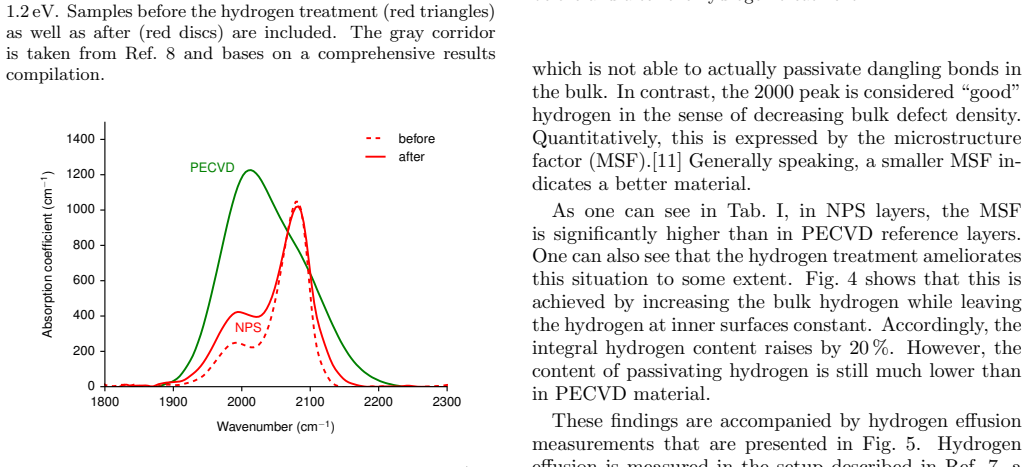
The mechanism is dangling-bond passivation by hydrogen radicals. The hot filament dissociates H$_2$ into atomic hydrogen; the radicals enter the layer and bind to silicon dangling bonds, converting them from recombination centres into electrically inert Si–H bonds. The paper's diagnostic fulcrum is the distinction between two infrared absorption bands: hydrogen in the $2000~\mathrm{cm}^{-1}$ configuration is bonded in the bulk and passivates dangling bonds, whereas hydrogen in the $2080~\mathrm{cm}^{-1}$ configuration sits at inner surfaces and does not. Infrared absorption and hydrogen effusion show that the added hydrogen is almost entirely of the $2000~\mathrm{cm}^{-1}$ type, but effusion locates this added hydrogen close to the surface rather than deep in the film. This passivation mechanism is what links the observed microstructural, optical, and electrical improvements.
What would settle it
Run the full thermal sequence with an inert gas such as argon or nitrogen in place of hydrogen—same holder, same 370 °C hour, same 1350 °C filament at 6.8 mm for two hours—and measure defect density, photo/dark conductivity, and cell efficiency. If these improve nearly as much as with hydrogen, the central attribution to radical chemistry is falsified; if they stay at untreated levels, the hydrogen-radical mechanism is confirmed.
Extended reading notes
Core claim
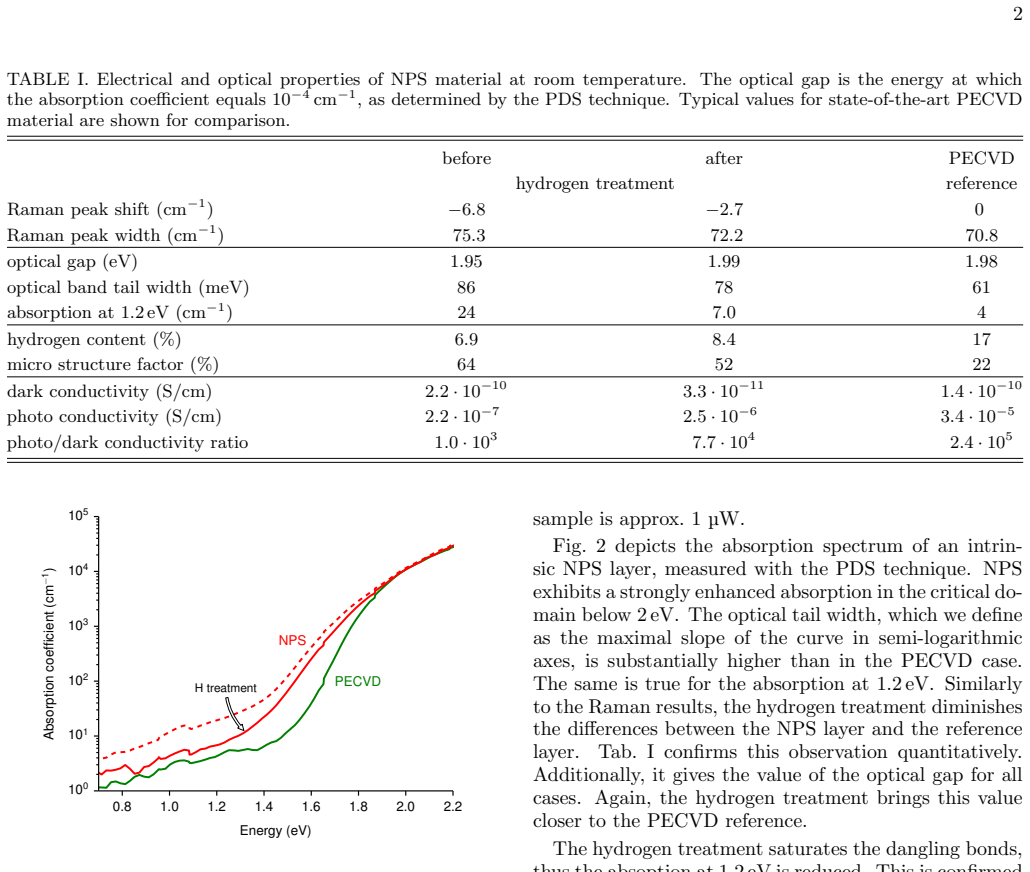
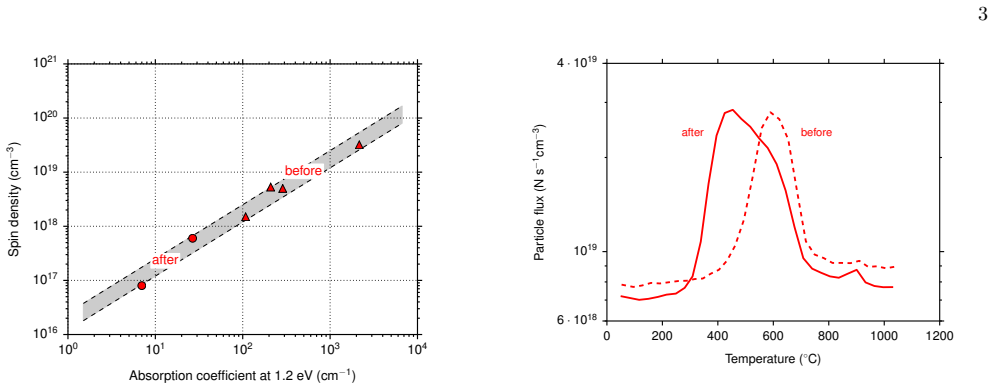
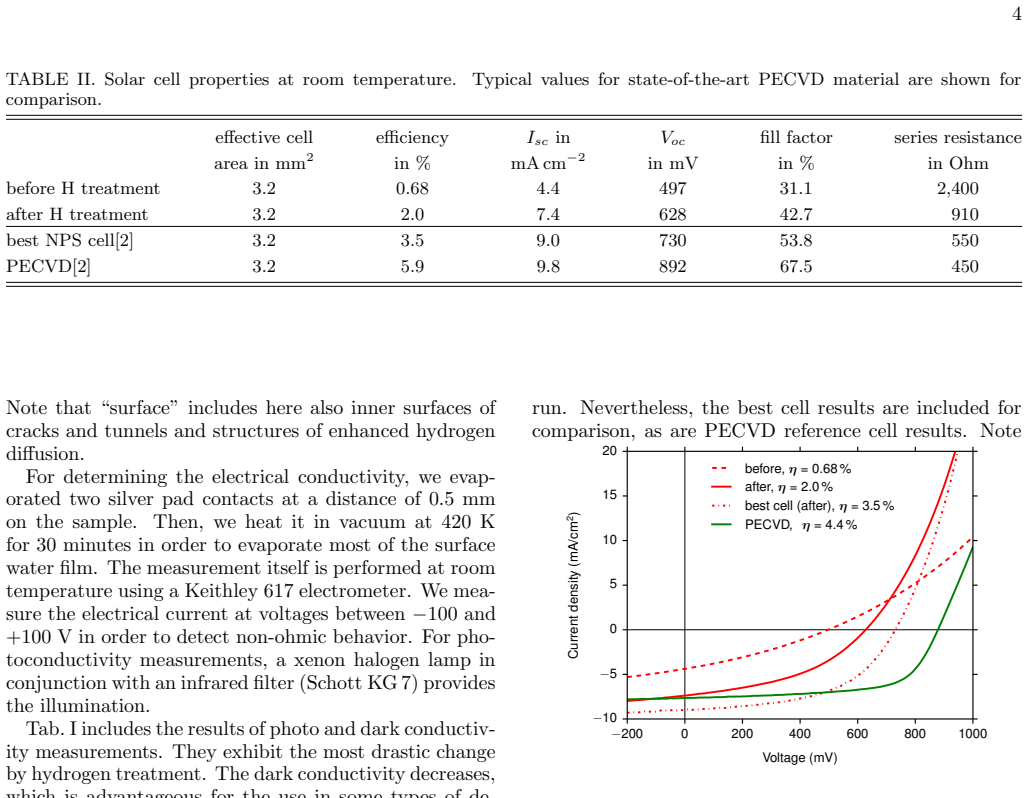
The central claim is that the hydrogen radical treatment alone transforms solution-processed amorphous silicon from a poor absorber into a working photovoltaic material. The paper reports that after two hours of exposure to atomic hydrogen produced by a 1350 °C tantalum filament, the hydrogen content of the layer rises by about 20%, entirely in the "good" $2000~\mathrm{cm}^{-1}$ Si–H configuration, so that the microstructure factor drops from 64% to 52%. Electron spin resonance and photothermal deflection spectroscopy agree that the defect density falls, the sub-gap absorption at 1.2 eV drops from 24 to $7.0~\mathrm{cm}^{-1}$, and the optical band tail narrows. Electrically, the dark conductivity decreases while the photoconductivity rises, improving the photo/dark ratio from about $10^3$ to $7.7 \times 10^4$. In finished cells, the short-circuit current, open-circuit voltage, and fill factor all improve, and the efficiency jumps by a factor of three, from 0.68% to 2.0%; the paper attributes this entire improvement to the hydrogen treatment alone.
Load-bearing premise
The load-bearing premise is that the improvements come from hydrogen radical chemistry rather than from the thermal budget of the process: the sample is heated to 370 °C for an hour and then kept near a 1350 °C filament for two hours, the filament's extra heating was not measured, and no sample was annealed under identical conditions without hydrogen radicals.
Editorial extensions
If this is right
- If the hydrogen-radical effect is real, the treatment is an independent lever: a threefold efficiency gain can be added on top of other optimizations such as light trapping, thickness tuning, and interface engineering.
- Because the added hydrogen sits only near the surface, the current cells still underperform PECVD material, and pushing passivation deeper into the bulk should raise fill factor and open-circuit voltage further.
- The nearly 100-fold improvement in photo/dark conductivity makes solution-processed amorphous silicon a viable absorber for low-cost cells, not just a research curiosity.
- The remaining gap to PECVD reference cells is quantified in defect density and band-tail width, giving concrete targets for process improvement.
Reading between the lines
- Inference, not in the paper: the treatment's surface-limited character suggests a testable scaling law—cell efficiency should improve with the fraction of absorber thickness that is passivated, so thinner absorbers should show the largest relative gain from the same treatment.
- Inference: because the filament's extra heating was not measured and no anneal-only control was run, a fair comparison should include a control held at the same temperature for the same time with an inert gas; such a control would separate thermal annealing from radical chemistry.
- Inference: the Raman shift toward the PECVD reference after treatment is read as stress reduction, but the authors note crack behaviour is unchanged; substrate curvature measurements before and after treatment would directly test whether stress relief is real and relevant.
- Inference: the same passivation step might apply to other solution-processed semiconductor films with dangling-bond defects, not only silicon; the infrared distinction between bulk and surface hydrogen could serve as a general quality metric.
Signed reviews
Editorial analysis
A structured set of objections, weighed in public.
Referee Report
Summary. The manuscript reports a post-deposition hydrogen radical treatment for solution-processed amorphous silicon made from neopentasilane (NPS). The authors characterize intrinsic layers and solar cells before and after treatment using Raman spectroscopy, photothermal deflection spectroscopy (PDS), electron spin resonance (ESR), infrared absorption, hydrogen effusion, dark and photo conductivity, and solar-cell current-voltage measurements. They report that the treatment increases hydrogen content, reduces the microstructure factor by increasing the beneficial 2000 cm-1 Si-H configuration, lowers the defect density as seen in PDS/ESR, raises the photo/dark conductivity ratio by almost two decades, and triples the solar cell efficiency from 0.68% to 2.0%. The paper attributes the improvement to hydrogen radicals alone and states that this improvement is orthogonal to other optimization techniques.
Significance. If the causal attribution is correct, the result is significant for the field of solution-processed silicon photovoltaics because it identifies a treatment that markedly improves a material whose as-processed quality is otherwise poor. The experimental evidence is internally consistent: Raman peak position and width, optical tail width, absorption at 1.2 eV, spin density, hydrogen bonding configuration, conductivity, and device parameters all improve in the same direction after treatment. The PDS-ESR data fall within the external calibration corridor of Ref. 8, which is a useful quantitative cross-check. The main weakness is that the treatment cycle includes a substantial thermal component—one hour at 370 °C plus two hours near a 1350 °C filament—and no control sample was subjected to the same thermal history without hydrogen radicals. The paper itself states that the filament's additional thermal impact was not measured, so the central attribution to hydrogen radicals alone needs further support.
major comments (2)
- [Experimental section, 'For the hydrogen radicals treatment' paragraph] The central causal claim—'the massive improvement in cell performance is attributed to the hydrogen treatment alone'—is not fully supported by the experimental design. The treatment consists of a one-hour temper at 370 °C followed by two hours with the sample close to a tantalum filament at 1350 °C, and the authors state that the filament's additional thermal impact 'has not been measured.' No control sample was annealed under the same thermal cycle without hydrogen radicals, so thermal annealing alone could account for part or all of the observed improvements in Tables I and II: the reduced Raman shift and width, the narrower optical tail, the lower 1.2 eV absorption, the reduced spin density, the increased photo/dark conductivity ratio, and the improved cell efficiency. Because thermal annealing is known to relax amorphous silicon networks and reduce metastable defect densities, a no-radical control (or at least a measurement of the actual sample temperature during the filament step) is required to support the attribution to hydrogen radical chemistry. This is a load-bearing missing control rather than a stylistic issue.
- [Infrared absorption and hydrogen effusion section] The statement that 'virtually the complete additional hydrogen is passivating dangling bonds' is quantitatively unsupported. The infrared data show an increase in the 2000 cm-1 band and a decrease in defect density, but no calculation links the additional bonded hydrogen content to the measured defect reduction; the effusion data in Fig. 5 indicate that much of the added hydrogen remains surface-near, so the word 'complete' overstates what can be concluded from the present measurements. This point should be rephrased as an inference with a quantitative estimate or removed.
minor comments (5)
- [Abstract and text] The abstract contains 'Using electron spin resonance and and photothermal deflection spectroscopy spectra' with a duplicated 'and'; other typos include 'substracted', 'specra', and 'absoption'. These should be corrected in a proofreading pass.
- [Throughout the text] The degree sign appears as '/uni2103' in the provided text; the final typeset version should use the proper degree symbol.
- [Table I and 'optical tail width' definition] The optical tail width is defined as 'the maximal slope of the curve in semi-logarithmic axes,' but the reported values in meV indicate an inverse-slope (Urbach-like) definition. Please state the exact conversion used so readers can compare with literature values.
- [Table I] The term 'micro structure factor' is used in Table I while the text uses 'microstructure factor'; unify the terminology and define the factor explicitly in the text or a footnote.
- [Figure 3] The caption identifies before-treatment samples as red triangles and after-treatment samples as red discs, but no error bars or measurement uncertainties are shown. Given the strong quantitative claim about the PDS-ESR correlation, adding uncertainties or stating their magnitude would improve the presentation.
Circularity Check
No circular derivation: the claimed improvements are direct before/after measurements, and the cited prior work is used only as processing context and benchmark comparison.
full rationale
The paper's central claim is that a hydrogen-radical treatment changes a set of measured properties (Raman spectra, PDS absorption, ESR spin density, IR hydrogen content, hydrogen effusion, conductivity, and solar-cell IV curves) of solution-processed amorphous silicon. There is no fitted parameter later renamed as a prediction, no quantity that is defined in terms of the outcome it is supposed to explain, and no load-bearing uniqueness theorem imported from the authors' prior work. The before/after comparisons in Tables I and II are direct experimental measurements made on the same material before and after the treatment. The PDS-ESR proportionality in Fig. 3 is taken from independent literature (Refs. 8 and 9) and is used as an external calibration, not as an output of the model or as evidence generated by the treatment itself. Ref. 2, which overlaps with the present authors, supplies sample-preparation details and a benchmark 'best NPS cell' for comparison; it is not the logical basis for concluding that the treatment improves the material, since that conclusion rests on the present before/after data. The statement 'the massive improvement in cell performance is attributed to the hydrogen treatment alone' can be questioned on causal-inference grounds, because the authors admit that the filament's additional thermal impact 'has not been measured' and no control sample was annealed without hydrogen radicals; however, that is a missing-control threat to external validity, not a circularity in the derivation. No step reduces by construction to its own input, so the circularity score is 0.
Assumptions & free parameters
assumptions (3)
- domain assumption The proportionality between sub-gap absorption at 1.2 eV and ESR spin density established in Ref. 8 holds for solution-processed NPS amorphous silicon.
- domain assumption The 2000 cm-1 IR peak corresponds to beneficial bulk Si-H bonds and the 2080 cm-1 peak to hydrogen at internal surfaces, following Refs. 10 and 11.
- domain assumption Hydrogen effusion peak temperatures (400 °C versus 600 °C) indicate different bonding or location of incorporated hydrogen.
Cite this review
Pith. "Pith review of Influence of hydrogen radicals treatment on layers and solar cells made of solution-processed amorphous silicon." pith.science (2026). https://pith.science/paper/65XVZXND
@misc{pith2026190806513,
  author       = {Pith},
  title        = {Pith review of: Influence of hydrogen radicals treatment on layers and solar cells made of solution-processed amorphous silicon},
  year         = {2026},
  howpublished = {\url{https://pith.science/paper/65XVZXND}},
  note         = {Machine review of arXiv:1908.06513}
}
read the original abstract
Solution-processed amorphous silicon is a promising material for semiconductor devices. Unfortunately, its manufacturing leaves a high density of defects in the layer, which can be reduced by a treatment with hydrogen radicals. Here, we present an optimized hydrogen treatment, which is used for best performing solar cells made of solution-processed amorphous silicon. We examine the amount and the nature of hydrogen incorporation using infrared absorption and hydrogen effusion. The hydrogen treatment not only increases hydrogen content significantly, it also enlarges the fraction of hydrogen in a bonding configuration which is known to be advantageous for electronic properties, albeit only close to the surface. Using electron spin resonance and and photothermal deflection spectroscopy spectra, we confirm a reduction of defect density. Regarding the electrical properties, the ratio of photo and dark conductivity is increased by almost two decades. This leads to a greatly enhanced performance of solar cell devices which use the material as the absorber layer. In particular, the efficiency jumps by a factor of three.
Figures

Figures from the paper (2 more)
Reference graph
Works this paper leans on
-
[1]
T. Shimoda, Y. Matsuki, M. Furusawa, T. Aoki, I. Yu- dasaka, H. Tanaka, H. Iwasawa, D. Wang, M. Miyasaka, and Y. Takeuchi, Nature 440, 783 (2006)
work page 2006
-
[2]
T. Bronger, P. H. W¨ obkenberg, J. W¨ ordenweber, S. Muthmann, U. W. Paetzold, V. Smirnov, S. Traut, ¨U. Dagkaldiran, S. Wieber, M. C¨ olle, et al. , Advanced Energy Materials (2014)
work page 2014
- [3]
- [4]
-
[5]
T. Sontheimer, D. Amkreutz, K. Schulz, P. H. W¨ obkenberg, C. Guenther, V. Bakumov, J. Erz, C. Mader, S. Traut, F. Ruske, et al. , Advanced Mate- rials Interfaces 1 (2014)
work page 2014
- [6]
-
[7]
Hydrogen effusion exper- iments,
W. Beyer and F. Einsele, “Hydrogen effusion exper- iments,” in Advanced Characterization Techniques for Thin Film Solar Cells (Wiley, 2011) Chap. 17
work page 2011
- [8]
Show all 14 references
-
[9]
W. B. Jackson and N. M. Amer, Physical Review B 25, 5559 (1982)
1982
-
[10]
Cardona, physica status solidi (b) 118, 463 (1983)
M. Cardona, physica status solidi (b) 118, 463 (1983)
1983
-
[11]
Mahan, P
A. Mahan, P. Raboisson, D. Williamson, and R. Tsu, Solar Cells 21, 117 (1987)
1987
-
[12]
Gerbi, P
J. Gerbi, P. Voyles, M. Treacy, J. Gibson, and J. Abel- son, Applied physics letters 82, 3665 (2003)
2003
-
[13]
Abeles, G
B. Abeles, G. Cody, Y. Goldstein, T. Tiedje, and C. Wronski, Thin Solid Films 90, 441 (1982)
1982
-
[14]
Tiedje, Applied Physics Letters 40, 627 (1982)
T. Tiedje, Applied Physics Letters 40, 627 (1982)
1982
Reviewed August 14, 2026 · model on record in the stance chip above.
Discussion (0). Continue with ORCID to comment.