REVIEW 3 major objections 3 minor 61 references
Modeling Islamist Extremist Communications on Social Media using Contextual Dimensions: Religion, Ideology, and Hate
T0 review · 3 major / 3 minor · reviewed 2026-08-14 · deepseek-v4-flash
Pith's one-line read A three-dimensional religion–ideology–hate model identifies Islamist extremist tweets with 97% precision and cuts false labeling of non-extremist Muslims.
desk verdict The tri-dimensional embedding idea is genuinely new and worth engaging, but the reported precision gains are not trustworthy because imputation happens before the split. read the letter →
The pith
A machine-rendered reading of the paper's core claim, the machinery that carries it, and where it could break.
The reading
What carries the argument
The load-bearing mechanism is a set of three domain-specific Word2Vec embedding spaces, one per contextual dimension. Religion is represented by embeddings trained on the Qur'an and two major Hadith collections; ideology by embeddings trained on ISIS magazines and the books and transcribed lectures of extremist ideologues; hate by embeddings trained on an existing social-media hate-speech corpus. A user's tweets are reduced to the average embedding of their n-grams in each dimension, the three vectors are concatenated and projected to 300 dimensions via singular value decomposition, and the resulting representation is classified with Random Forest or Naive Bayes. Two supporting steps do essential work: hierarchical density-based clustering removes likely non-extremist outliers from the positive class, and LDA-based topical imputation fills in missing dimension vectors for users whose posts are sparse in one context.
What would settle it
Obtain the original baseline's lexicon and reproduce its method on the same 1,027-user dataset; if the original baseline reaches precision at or above 0.97 on that data, the paper's claimed improvement collapses. Alternatively, an independent replication on a fresh sample of verified pro-ISIS and mainstream accounts that does not remove the same outlier users should be run to test whether the precision gain depends on the outlier-removal step.
Extended reading notes
Core claim
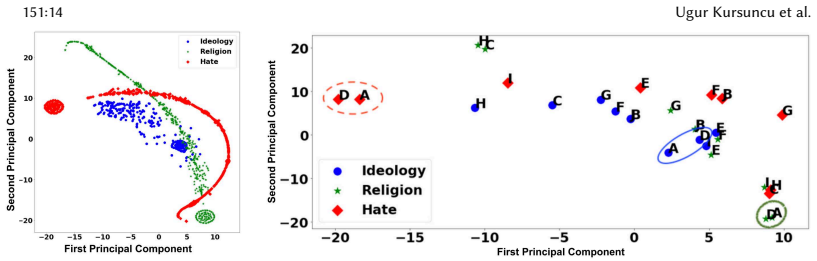
The paper's central claim is that the three-dimensional Religion–Ideology–Hate (RIH) representation, after removing likely outliers and imputing sparse user vectors, yields a Random Forest classifier with 0.97 precision, 0.89 recall, and 0.93 F1-score on their Twitter dataset. Compared with their re-implemented baseline, this is a 10.2% relative gain in precision, an 8.5% gain in recall, and a 10.7% gain in F1. The paper also finds that the religion dimension alone is the weakest discriminator, that ideology and hate carry the most signal, and that the full three-dimension combination outperforms every one- or two-dimension alternative in precision. The authors interpret this as evidence that radicalization is best modeled as a gradual process in which religious references, ideological propaganda, and hate speech appear in different proportions over time.
Load-bearing premise
The paper's claimed edge over the state of the art rests on a best-effort re-implementation of the baseline whose proprietary lexicon could not be obtained; if that re-implementation understates the baseline's true performance, the 10.2% precision improvement is not supported.
Editorial extensions
If this is right
- If the RIH representation is as discriminative as reported, automated screening pipelines can be tuned for precision and handed to human reviewers, so fewer non-extremist Muslim accounts are investigated.
- The finding that religion alone classifies poorly implies that any deployment relying mainly on religious vocabulary will over-label; flagging should require ideology or hate signals alongside religion.
- Because the three dimensions track different stages of persuasion, the same representations could be used to estimate where a user sits on a radicalization trajectory, not just whether they are extreme.
- The combination of all three dimensions still beats the best two-dimension pair in precision, so the paper's framework argues for keeping the dimensions separate rather than merging them into one generic text vector.
- Removing outlier users and imputing sparse representations are presented as necessary for the precision gain; models without these steps are considerably weaker.
Reading between the lines
- The paper's 10.2% precision gain is measured against a best-effort re-implementation of the baseline model, whose proprietary lexicon was unavailable; if that re-implementation understates the original baseline, the headline advantage over the true state of the art is not yet established.
- The same three-context architecture could be carried to other radicalization settings, such as far-right extremism, by substituting domain corpora; the authors do not test this, and a matched negative class would be required.
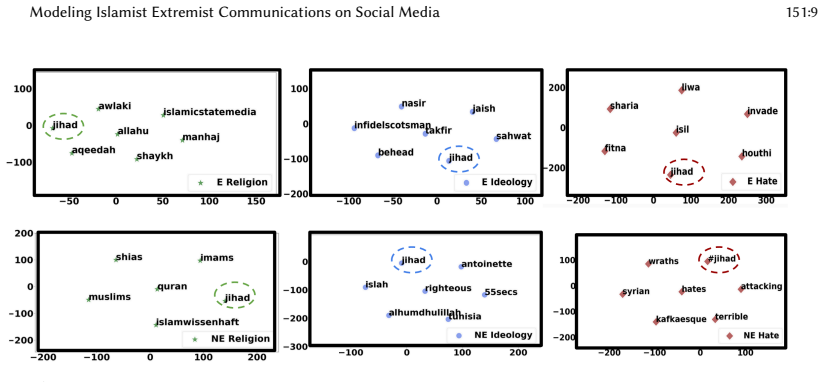
- The nearest-neighbor structure around ambiguous words differs across the three embedding spaces, so the method could double as a device for building context-aware dictionaries; that use is not explored in the paper.
- Because the positive class consists of verified pro-ISIS accounts, the reported precision may not transfer to newer or different extremist movements, and dimension weights would likely need re-estimation.
Signed reviews
Editorial analysis
A structured set of objections, weighed in public.
Referee Report
Summary. The paper proposes a context-aware approach to classifying Islamist extremist users on Twitter by representing each user along three contextual dimensions—religion, ideology, and hate—derived from domain-specific word embedding models built from the Qur'an and Hadith, extremist ideologue texts, and a hate speech corpus. Sparse user representations are addressed through LDA-based imputation, likely outlier users are removed via hierarchical density-based clustering and expert validation, and the resulting representations are classified with Random Forest and Naive Bayes. The central claim is that the tri-dimensional RIH model with imputation achieves precision 0.97, recall 0.89, and F1-score 0.93 (Table 5), outperforming a re-implemented baseline by 10.2% in precision.
Significance. If the reported results were valid, the approach would have practical value for a socially sensitive classification task where precision is prioritized to avoid mislabeling non-extremist Muslim users. The use of domain-specific corpora and the decomposition into religion, ideology, and hate dimensions is a reasonable and potentially useful modeling idea, and the exploratory analyses in Section 4 offer informative descriptive insights. However, the paper's central empirical claims are undermined by a likely train/test leakage in the imputation procedure and by an unvalidated baseline re-implementation; these issues affect both the absolute performance numbers and the comparative claim against prior work. The manuscript also has no public code or data, with resources only 'available upon request,' limiting reproducibility. The strengths of the conceptual framework do not compensate for the current experimental validity problems.
major comments (3)
- [Section 5.2, Section 5.3, Algorithm 1] The imputation step is performed before the train/test split, creating direct feature-label leakage. Algorithm 1 lines 4-5 choose, for each sparse user, the donor maximizing topic overlap over all extremist users and then copy the donor's vector; Section 5.3 confirms that 'we start with 1027 users with imputation ... and then create a hold-out dataset of 300 users.' Consequently, a hold-out user can receive an exact copy of a training user's vector, and the classifier can memorize that vector's label. No nested cross-validation or donor-exclusion scheme is described. This leakage can inflate the reported RIH precision of 0.97 in Table 5 and the headline 10.2% precision gain, so the absolute and comparative results are unreliable as reported.
- [Section 5.3, Section 6, Table 5] The 'competitive baseline' is an unvalidated re-implementation of Fernandez et al. [28] on the authors' own dataset. The authors state that they 'were unable to secure their proprietary resources (i.e., lexicon)' and made a 'best effort' replication, but provide no evidence that this re-implementation faithfully reproduces the original method. If the re-implementation is weaker than the actual Fernandez et al. system, the claimed improvement over state of the art is unsupported. Additionally, the headline comparison uses the Random Forest variant of the proposed model against a Naive Bayes baseline; Figure 10 explicitly notes that the baseline was not tested with RF, so the comparison conflates representation changes with classifier changes.
- [Section 5.1, Section 5.3] The outlier-removal procedure is not specified precisely enough to rule out selection bias. The HDBC clustering identifies 99, 48, and 141 likely outlier users for religion, ideology, and hate, respectively, and the text then states 'we obtained the set of 49 outlier users' after expert validation, without explaining how the per-dimension outlier sets were intersected or combined, nor how the 76-user validation sample was drawn. Because the same expert informed the choice of contextual dimensions and validated the outlier labels, and because removing the 49 users changes the evaluation set, a clear and independent outlier-removal rule is needed to avoid circularity in the data construction.
minor comments (3)
- [Section 6] The text states that the tri-dimensional model improves precision over the baseline by 9.3%, while the abstract and conclusion state 10.2%; the values in Table 5 (0.97 vs 0.88) correspond to approximately 10.2%, so the Section 6 description should be corrected for internal consistency.
- [Section 7] The paper says the dataset and domain-specific corpora are 'available upon request,' which is not a public reproducibility guarantee; providing a public release or a detailed data availability statement would strengthen the work.
- [Equation 1] The denominator in Equation 1 is the cardinality of the intersection between a user's n-grams and the dimension vocabulary, but the paper does not explicitly state how users with empty intersections are handled before imputation; this is relevant because Section 5.2 reports zero vectors for sparse users.
Circularity Check
Imputation before the hold-out split copies training-user vectors into the test set, so the reported 0.97 precision is partly leakage.
-
fitted input called prediction
[Section 5.2 (Algorithm 1, lines 4–5) and Section 5.3 (Modeling)]
"Section 5.3: 'we start with 1027 users with imputation and 879 users without imputation, and then create a hold-out dataset of 300 users.' Section 5.2: 'We compute topical similarity between users with sparse representations ÛE and users with dense representations ... Then, we generate the embeddings of e_u_d, resulting the imputed user representations, in line 5 of Algorithm 1.'"
The imputation step runs before the hold-out split, and its donor pool is all users U_d^E, which includes users who later fall in the training folds. For every held-out user whose representation is sparse, Algorithm 1 line 5 sets that user's vector equal to the donor's vector. The classifier can then memorize the donor's training label and reproduce it on the duplicate held-out vector, so the reported RIH precision of 0.97 (Table 5) and the headline precision gain are partly forced by construction for imputed users rather than by the contextual representation. This is feature/label leakage: the 'prediction' on imputed hold-out users is statistically a copy of training information, not an independent test.
full rationale
This is an empirical classification study, not a formal derivation, and most of the pipeline (domain-specific embeddings, RIH concatenation, SVD, RF/NB) is not definitionally tied to the labels. There is no load-bearing self-citation chain: the baseline is an external re-implementation of Fernandez et al., and the authors' own prior work is not used to force the central result. The circularity-adjacent defect is the evaluation protocol: imputation is applied to the full 1027-user set before creating the 300-user hold-out, and Algorithm 1 replaces a sparse user's vector with that of a donor selected from the entire extremist user set. Any held-out sparse user thereby receives an exact copy of a training user's vector, allowing the classifier to memorize and transfer labels. This can inflate the absolute precision and the 10.2% gain over baseline. The unvalidated baseline reimplementation is a separate validity concern about the comparison, not circularity. Because the headline precision claim is partly an artifact of this train/test leakage, the central claim is partially circular/forced by construction.
Assumptions & free parameters
free parameters (4)
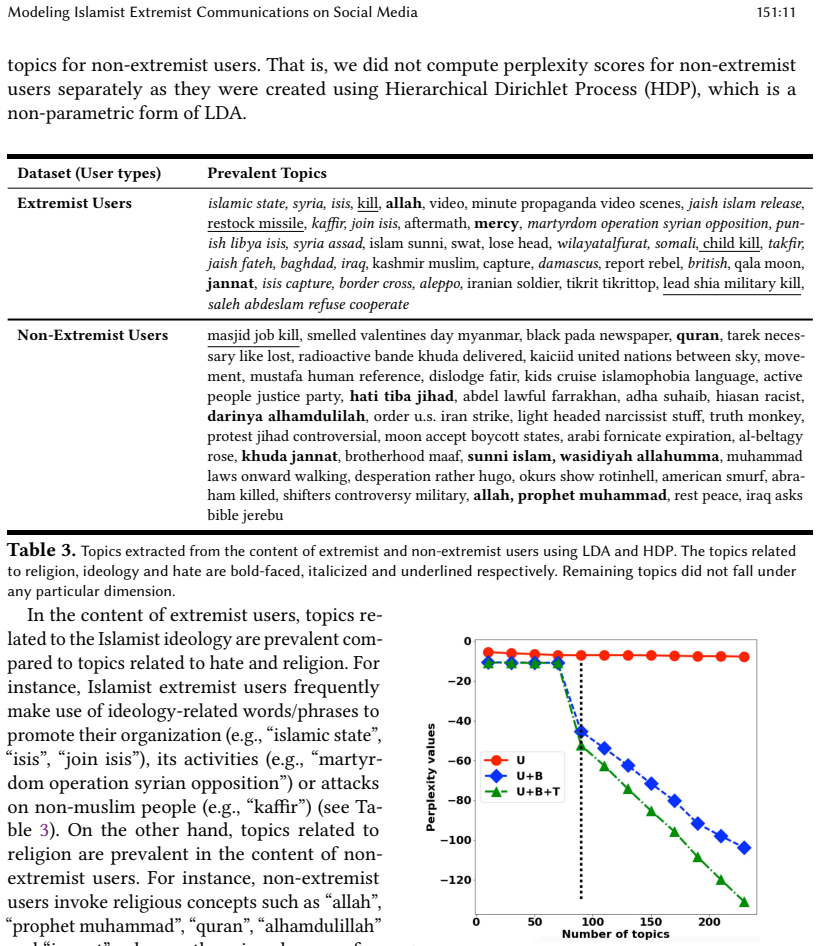
- Number of LDA topics =
90
- SVD output dimension =
300
- HDBC clustering parameters =
not specified
- Threshold for sparse representations =
148 users
assumptions (5)
- domain assumption The three contextual dimensions R, I, H adequately capture the radicalization process for online Islamist extremism.
- domain assumption The selected domain corpora (Qur'an/Hadith for R, ISIS magazines/ideologue books for I, hate speech corpus for H) are representative of the language in each dimension.
- domain assumption The negative class dataset (mainstream Muslim users from Chen et al. 2014) is a valid proxy for non-extremist users.
- domain assumption The positive class labels (Pro-ISIS and Lucky Troll Club datasets) are correct.
- ad hoc to paper The re-implementation of the Fernandez et al. baseline is faithful despite the missing proprietary lexicon.
Cite this review
Pith. "Pith review of Modeling Islamist Extremist Communications on Social Media using Contextual Dimensions: Religion, Ideology, and Hate." pith.science (2026). https://pith.science/paper/ZALPNJ4U
@misc{pith2026190806520,
  author       = {Pith},
  title        = {Pith review of: Modeling Islamist Extremist Communications on Social Media using Contextual Dimensions: Religion, Ideology, and Hate},
  year         = {2026},
  howpublished = {\url{https://pith.science/paper/ZALPNJ4U}},
  note         = {Machine review of arXiv:1908.06520}
}
read the original abstract
Terror attacks have been linked in part to online extremist content. Although tens of thousands of Islamist extremism supporters consume such content, they are a small fraction relative to peaceful Muslims. The efforts to contain the ever-evolving extremism on social media platforms have remained inadequate and mostly ineffective. Divergent extremist and mainstream contexts challenge machine interpretation, with a particular threat to the precision of classification algorithms. Our context-aware computational approach to the analysis of extremist content on Twitter breaks down this persuasion process into building blocks that acknowledge inherent ambiguity and sparsity that likely challenge both manual and automated classification. We model this process using a combination of three contextual dimensions -- religion, ideology, and hate -- each elucidating a degree of radicalization and highlighting independent features to render them computationally accessible. We utilize domain-specific knowledge resources for each of these contextual dimensions such as Qur'an for religion, the books of extremist ideologues and preachers for political ideology and a social media hate speech corpus for hate. Our study makes three contributions to reliable analysis: (i) Development of a computational approach rooted in the contextual dimensions of religion, ideology, and hate that reflects strategies employed by online Islamist extremist groups, (ii) An in-depth analysis of relevant tweet datasets with respect to these dimensions to exclude likely mislabeled users, and (iii) A framework for understanding online radicalization as a process to assist counter-programming. Given the potentially significant social impact, we evaluate the performance of our algorithms to minimize mislabeling, where our approach outperforms a competitive baseline by 10.2% in precision.
Figures

Figures from the paper (7 more)




Reference graph
Works this paper leans on
-
[28]
Miriam Fernandez, Moizzah Asif, and Harith Alani. 2018. Understanding the roots of radicalisation on twitter. In Proceedings of the 10th ACM Conference on Web Science
work page 2018
-
[1]
Dilshod Achilov and Sedat Sen. 2017. Got political Islam? Are politically moderate Muslims really different from radicals? International Political Science Review (2017)
work page 2017
-
[2]
Swati Agarwal and Ashish Sureka. 2014. A focused crawler for mining hate and extremism promoting videos on YouTube.. In Proceedings of the 25th ACM conference on Hypertext and social media
work page 2014
-
[3]
Swati Agarwal and Ashish Sureka. 2015. Using knn and svm based one-class classifier for detecting online radicalization on twitter. In International Conference on Distributed Computing and Internet Technology
work page 2015
-
[4]
Swati Agarwal and Ashish Sureka. 2016. Spider and the flies: Focused crawling on tumblr to detect hate promoting communities. arXiv preprint arXiv:1603.09164 (2016)
work page Pith review arXiv 2016
-
[5]
Swati Agarwal, Ashish Sureka, and Vikram Goyal. 2015. Open source social media analytics for intelligence and security informatics applications. In International Conference on Big Data Analytics
work page 2015
-
[6]
Séraphin Alava, Divina Frau-Meigs, and Ghayda Hassan. 2017. Youth and violent extremism on social media: mapping the research
work page 2017
-
[7]
Nikolaos Aletras and Mark Stevenson. 2014. Measuring the similarity between automatically generated topics. In Proceedings of the 14th Conference of the European Chapter of the Association for Computational Linguistics, volume 2: Short Papers. 22–27
work page 2014
Show all 61 references
-
[8]
Tarique Anwar and Muhammad Abulaish. 2015. Ranking radically influential web forum users. IEEE Transactions on Information Forensics and Security (2015)
2015
-
[9]
I Budak Arpinar, Ugur Kursuncu, and Dilshod Achilov. 2016. Social media analytics to identify and counter islamist extremism: Systematic detection, evaluation, and challenging of extremist narratives online. In 2016 International Conference on Collaboration Technologies and Sy...
2016
-
[10]
Michael Ashcroft, Ali Fisher, Lisa Kaati, Enghin Omer, and Nico Prucha. 2015. Detecting jihadist messages on twitter. In 2015 European Intelligence and Security Informatics Conference
2015
-
[11]
Ben Athiwaratkun, Andrew Gordon Wilson, and Anima Anandkumar. 2018. Probabilistic fasttext for multi-sense word embeddings. arXiv preprint arXiv:1806.02901 (2018)
2018 arXiv
-
[12]
Imran Awan. 2017. Cyber-extremism: Isis and the power of social media. Society 54, 2 (2017), 138–149
2017
-
[13]
Adam Badawy and Emilio Ferrara. 2018. The rise of jihadist propaganda on social networks. Journal of Computational Social Science (2018)
2018
-
[14]
Jonathon M Berger and Jonathon Morgan. 2015. The ISIS Twitter Census: Defining and describing the population of ISIS supporters on Twitter. The Brookings Project on US Relations with the Islamic World (2015)
2015
-
[15]
Phil Blunsom, Kyunghyun Cho, Shay Cohen, Edward Grefenstette, Karl Moritz Hermann, Laura Rimell, Jason Weston, and Scott Wen-tau Yih. 2016. Proceedings of the 1st Workshop on Representation Learning for NLP. In Proceedings of the 1st Workshop on Representation Learning for NLP
2016
-
[16]
Piotr Bojanowski, Edouard Grave, Armand Joulin, and Tomas Mikolov. 2017. Enriching word vectors with subword information. Transactions of the Association for Computational Linguistics 5 (2017), 135–146
2017
-
[17]
Gerlof Bouma. 2009. Normalized (pointwise) mutual information in collocation extraction. Proceedings of GSCL (2009), 31–40. Proc. ACM Hum.-Comput. Interact., Vol. 3, No. CSCW, Article 151. Publication date: November 2019. Modeling Islamist Extremist Communications on Social Me...
2009
-
[18]
Bérénice Boutin, Grégory Chauzal, Jessica Dorsey, Marjolein Jegerings, Christophe Paulussen, Johanna Pohl, Alastair Reed, and Sofia Zavagli. 2016. The foreign fighters phenomenon in the European Union. Profiles, threats & policies. The International Centre for Counter-Terroris...
2016
-
[19]
Lorraine Bowman-Grieve and Maura Conway. 2012. Exploring the form and function of dissident Irish Republican online discourses. Media, War & Conflict (2012)
2012
-
[20]
Gary R Bunt. 2003. Islam in the digital age: E-jihad, online fatwas and cyber Islamic environments . Pluto Press
2003
-
[21]
Ricardo JGB Campello, Davoud Moulavi, and Jörg Sander. 2013. Density-based clustering based on hierarchical density estimates. In Pacific-Asia conference on knowledge discovery and data mining
2013
-
[22]
Amparo Elizabeth Cano Basave, Yulan He, Kang Liu, and Jun Zhao. 2013. A weakly supervised bayesian model for violence detection in social media. (2013)
2013
-
[23]
Lu Chen, Ingmar Weber, and Adam Okulicz-Kozaryn. 2014. US religious landscape on Twitter. In International Conference on Social Informatics
2014
-
[24]
David Cook. 2015. Understanding jihad. Univ of California Press
2015
-
[25]
Thomas Davidson, Dana Warmsley, Michael Macy, and Ingmar Weber. 2017. Automated Hate Speech Detection and the Problem of Offensive Language. In Proceedings of the 11th International AAAI Conference on Web and Social Media (ICWSM ’17). 512–515
2017
-
[26]
Seran De Leede, Renate Haupfleisch, Katja Korolkova, and Monika Natter. 2017. Radicalisation and Violent Extremism- Focus on Women: How Women Become Radicalised, and how to Empower Them to Prevent Radicalisation
2017
-
[27]
Miriam Fernandez and Harith Alani. 2018. Contextual Semantics for Radicalisation Detection on Twitter. (2018)
2018
-
[29]
Emilio Ferrara, Wen-Qiang Wang, Onur Varol, Alessandro Flammini, and Aram Galstyan. 2016. Predicting online extremism, content adopters, and interaction reciprocity. In International conference on social informatics
2016
-
[30]
Martyn Frampton, Ali Fisher, Nico Prucha, and David H Petraeus. 2017. The new Netwar: Countering extremism online . Policy Exchange
2017
-
[31]
Manas Gaur, Amanuel Alambo, Joy Prakash Sain, Ugur Kursuncu, Krishnaprasad Thirunarayan, Ramakanth Kavuluru, Amit Sheth, Randy Welton, and Jyotishman Pathak. 2019. Knowledge-aware assessment of severity of suicide risk for early intervention. In The World Wide Web Conference. ...
2019
-
[32]
Manas Gaur, Ugur Kursuncu, Amanuel Alambo, Amit Sheth, Raminta Daniulaityte, Krishnaprasad Thirunarayan, and Jyotishman Pathak. 2018. Let Me Tell You About Your Mental Health!: Contextualized Classification of Reddit Posts to DSM-5 for Web-based Intervention. In Proceedings of...
2018
-
[33]
Mohammed Hafez and Creighton Mullins. 2015. The radicalization puzzle: A theoretical synthesis of empirical approaches to homegrown extremism. Studies in Conflict & Terrorism (2015)
2015
-
[34]
Scott Helfstein. 2012. Edges of radicalization: Ideas, individuals and networks in violent extremism . Technical Report. MILITARY ACADEMY WEST POINT NY COMBATING TERRORISM CENTER
2012
-
[35]
Ghaffar Hussain and Erin Marie Saltman. 2014. Jihad trending: A comprehensive analysis of online extremism and how to counter it
2014
-
[36]
Lisa Kaati, Enghin Omer, Nico Prucha, and Amendra Shrestha. 2015. Detecting multipliers of jihadism on twitter. In 2015 IEEE International Conference on Data Mining Workshop (ICDMW)
2015
-
[37]
Ugur Kursuncu, Manas Gaur, Usha Lokala, Anurag Illendula, Krishnaprasad Thirunarayan, Raminta Daniulaityte, Amit Sheth, and I Budak Arpinar. 2018. What’s ur Type? Contextualized Classification of User Types in Marijuana-Related Communications Using Compositional Multiview Embe...
2018
-
[38]
Ugur Kursuncu, Manas Gaur, Usha Lokala, Krishnaprasad Thirunarayan, Amit Sheth, and I Budak Arpinar. 2019. Predictive Analysis on Twitter: Techniques and Applications. In Emerging Research Challenges and Opportunities in Computational Social Network Analysis and Mining . Sprin...
2019
-
[39]
Wagdy Loza. 2007. The psychology of extremism and terrorism: A Middle-Eastern perspective. Aggression and Violent Behavior (2007)
2007
-
[40]
Laurens van der Maaten and Geoffrey Hinton. 2008. Visualizing data using t-SNE. Journal of machine learning research (2008)
2008
-
[41]
Mary L McHugh. 2012. Interrater reliability: the kappa statistic. Biochemia medica: Biochemia medica (2012)
2012
-
[42]
Alexander Meleagrou-Hitchens, Seamus Hughes, and Bennett Clifford. 2018. The travelers: American jihadists in Syria and Iraq
2018
-
[43]
Tomas Mikolov, Kai Chen, Greg Corrado, and Jeffrey Dean. 2013. Efficient estimation of word representations in vector space. arXiv preprint arXiv:1301.3781 (2013). Proc. ACM Hum.-Comput. Interact., Vol. 3, No. CSCW, Article 151. Publication date: November 2019. 151:22 Ugur Kur...
2013 arXiv
-
[44]
Tomas Mikolov, Ilya Sutskever, Kai Chen, Greg S Corrado, and Jeff Dean. 2013. Distributed representations of words and phrases and their compositionality. In Advances in neural information processing systems
2013
-
[45]
Jeffrey Pennington, Richard Socher, and Christopher Manning. 2014. Glove: Global vectors for word representation. In Proceedings of the 2014 conference on empirical methods in natural language processing (EMNLP) . 1532–1543
2014
-
[46]
Jialun Qin, Yilu Zhou, Edna Reid, Guanpi Lai, and Hsinchun Chen. 2007. Analyzing terror campaigns on the internet: Technical sophistication, content richness, and Web interactivity. International Journal of Human-Computer Studies 65, 1 (2007), 71–84
2007
-
[47]
Matthew Rowe and Hassan Saif. 2016. Mining pro-ISIS radicalisation signals from social media users. In Tenth International AAAI Conference on Web and Social Media
2016
-
[48]
Hassan Saif, Thomas Dickinson, Leon Kastler, Miriam Fernandez, and Harith Alani. 2017. A semantic graph-based approach for radicalisation detection on social media. In European semantic web conference
2017
-
[49]
Prathusha K Sarma, Yingyu Liang, and William A Sethares. 2018. Domain Adapted Word Embeddings for Improved Sentiment Classification. arXiv preprint arXiv:1805.04576 (2018)
2018 arXiv
-
[50]
Jacob R Scanlon and Matthew S Gerber. 2014. Automatic detection of cyber-recruitment by violent extremists. Security Informatics (2014)
2014
-
[51]
Jacob R Scanlon and Matthew S Gerber. 2015. Forecasting violent extremist cyber recruitment. IEEE Transactions on Information Forensics and Security (2015)
2015
-
[52]
Joseph A Schafer. 2002. Spinning the web of hate: Web-based hate propagation by extremist organizations. Journal of Criminal Justice and Popular Culture (2002)
2002
-
[53]
Amit Sheth, Sujan Perera, Sanjaya Wijeratne, and Krishnaprasad Thirunarayan. 2017. Knowledge will propel machine understanding of content: extrapolating from current examples. In Proceedings of the International Conference on Web Intelligence. ACM, 1–9
2017
-
[54]
Jamin Shin, Andrea Madotto, and Pascale Fung. 2018. Interpreting Word Embeddings with Eigenvector Analysis. (2018)
2018
-
[55]
PK Srijith, Mark Hepple, Kalina Bontcheva, and Daniel Preotiuc-Pietro. 2017. Sub-story detection in Twitter with hierarchical Dirichlet processes. Information Processing & Management (2017)
2017
-
[56]
Ashish Sureka and Swati Agarwal. 2014. Learning to classify hate and extremism promoting tweets. In 2014 IEEE Joint Intelligence and Security Informatics Conference
2014
-
[57]
Yee W Teh, Michael I Jordan, Matthew J Beal, and David M Blei. 2005. Sharing clusters among related groups: Hierarchical Dirichlet processes. In Advances in neural information processing systems
2005
-
[58]
Alain Van Hiel and Ivan Mervielde. 2003. The measurement of cognitive complexity and its relationship with political extremism. Political Psychology (2003)
2003
-
[59]
Lorenzo Vidino and Seamus Hughes. 2015. ISIS in America: From retweets to Raqqa
2015
-
[60]
Pooja Wadhwa and MPS Bhatia. 2013. Tracking on-line radicalization using investigative data mining. In2013 National Conference on Communications (NCC)
2013
-
[61]
Haijun Zhang, Zhoujun Li, Yan Chen, Xiaoming Zhang, and Senzhang Wang. 2014. Exploit latent dirichlet allocation for one-class collaborative filtering. In Proceedings of the 23rd ACM International Conference on Conference on Information and Knowledge Management. Received April...
2014
Reviewed August 14, 2026 · model on record in the stance chip above.
Discussion (0). Continue with ORCID to comment.