REVIEW 5 minor 17 references
The fate of quantum shock waves at late times
T0 review · 0 major / 5 minor · reviewed 2026-08-14 · deepseek-v4-flash
Pith's one-line read Weak generic interactions make a fermionic shock wave's amplitude decay exponentially while preserving its shape away from the front.
desk verdict A careful analytic derivation that gives the first concrete picture of how weak interactions dissolve a free-fermion shock; the linearized Boltzmann closure is the softest step, but it is handled honestly. read the letter →
The pith
A machine-rendered reading of the paper's core claim, the machinery that carries it, and where it could break.
The reading
What carries the argument
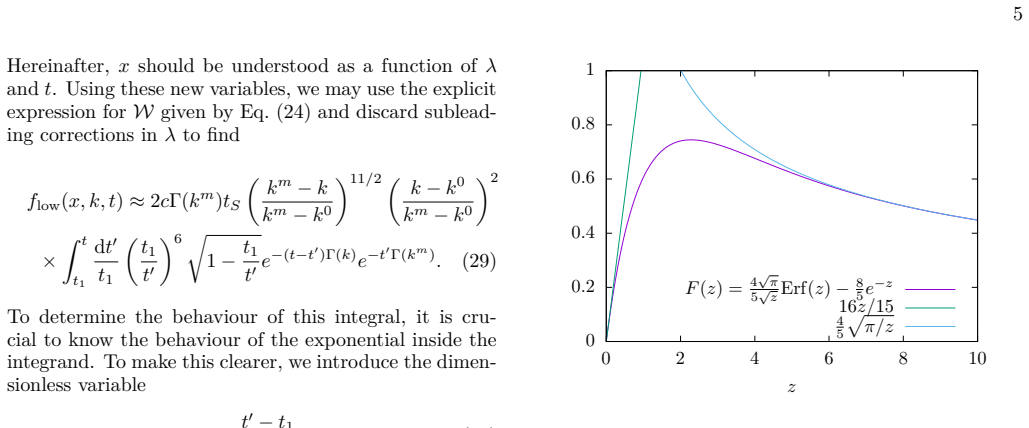
The carrying object is the linearized Boltzmann equation $(\partial_t+\frac{k}{m}\partial_x)f=J-\Gamma(k)f$, obtained by splitting the three-particle collision integral into a source $J$ from high-energy particles decaying into low energies and a loss term with the perturbative single-particle decay rate. The high-energy branch is the free-fermion step function times $e^{-t\Gamma(k)}$, and $J$ is approximated by integrating that branch against $W_{p\to k}\propto (k-k_0)^2/(p-k)^5$. This turns the collisional problem into an integral along characteristics; the scaling variable $\lambda t\Gamma(k_m)$ emerges from the competition between ballistic motion and decay, and the function $F$ is the integral that survives averaging over the shock's momentum interval.
What would settle it
A numerical simulation of weakly interacting one-dimensional fermions (or of the full three-particle Boltzmann equation) initialized as a smooth density bump would settle the claim: plot $\delta\rho(\lambda,t)/[(k_m-k_0)e^{-t\Gamma(k_m)}t_S\sqrt{\lambda}/(t\pi)]$ against $\lambda t\Gamma(k_m)$ for $t\gg t_S$. Collapse onto $1+F(\lambda t\Gamma(k_m))$ supports Eq. (38); a systematic deviation, or a low-energy source contribution growing beyond the stated $\sim 2\%$, falsifies the linearization and decay-rate closure.
Extended reading notes
Core claim
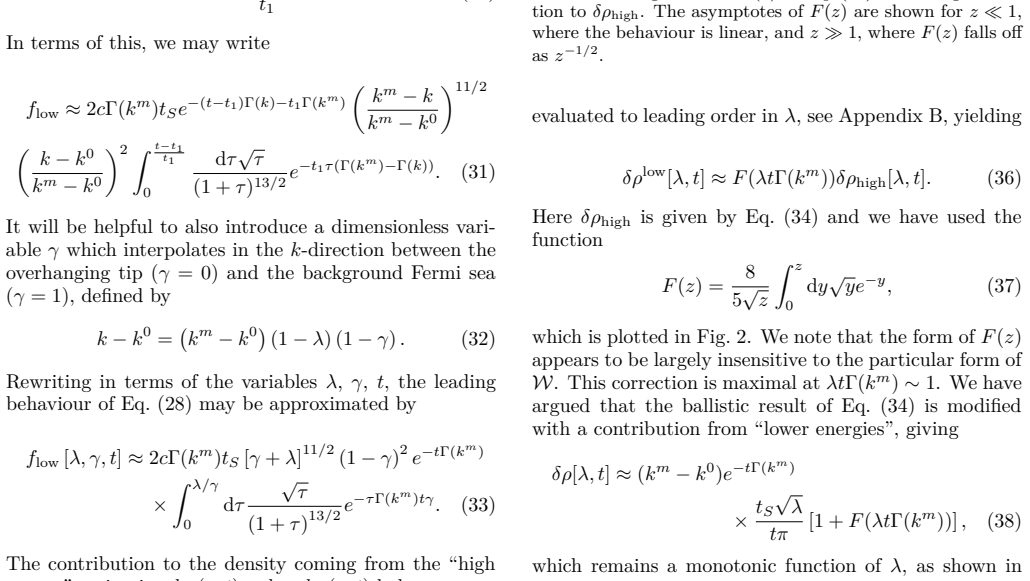
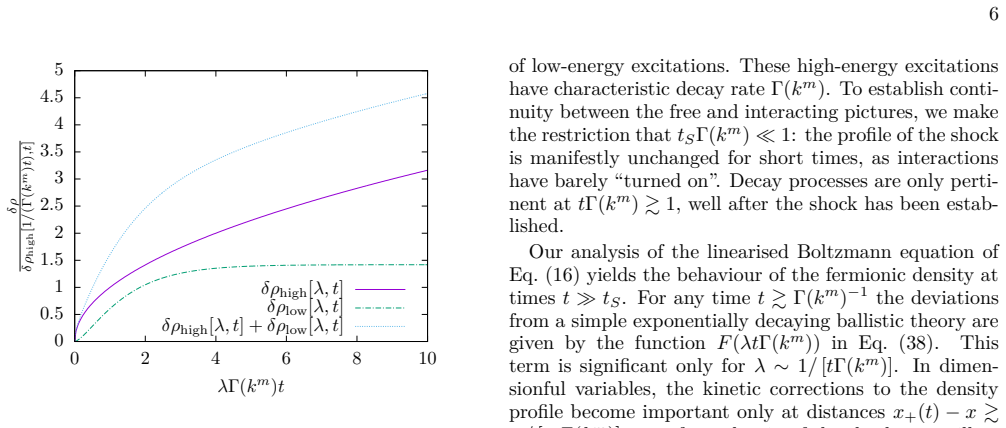
The central claim is Eq. (38). Starting from the Wigner function and a local Fermi surface, the authors argue that for times well after shock formation the high-energy branch of the distribution is $\theta(k-k_-(x,t))\theta(k_+(x,t)-k)e^{-t\Gamma(k)}$, and that this branch alone sources the low-energy particles through the golden-rule rate $W_{p\to k}$. Solving the linearized kinetic equation along ballistic characteristics gives $\delta\rho \approx (k_m-k_0)e^{-t\Gamma(k_m)}\frac{t_S\sqrt{\lambda}}{t\pi}[1+F(\lambda t\Gamma(k_m))]$, with $F(z)=\frac{8}{5\sqrt{z}}\int_0^z dy\,\sqrt{y}e^{-y}$. In plain terms: away from the front the shock keeps its free-fermion shape and decays exponentially, and only in the window $\lambda t\Gamma(k_m)\sim 1$ does the low-energy correction reshape it, on a time-independent physical scale $x_+(t)-x\sim w/(\Gamma(k_m)t_S)$.
Load-bearing premise
The late-time profile rests on the assumption that the interacting shock is accurately described by the linearized Boltzmann equation with a perturbative single-particle decay rate $\Gamma(k)$ and with the source $J$ fed only by the overhanging high-energy branch; the authors' check of this closure in Appendix C is perturbative and estimates the neglected contribution as at most about 2%.
Editorial extensions
If this is right
- At $\Gamma(k_m)t\gg 1$ the shock amplitude is exponentially small, but away from the front the profile follows the same $t^{-1}$ ballistic decay as free fermions, so interactions erase the shock by decay rather than by diffusive spreading.
- Inside the window $\lambda t\Gamma(k_m)\sim 1$, the low-energy contribution is comparable to the high-energy one, so the profile there is set by the universal function $F$ rather than by the naive ballistic formula.
- The region of quantum ripples occupies a fixed fraction $\sim(\Delta N)^{-2/3}$ of the shock, so Eq. (38) is the legitimate classical description until $t\Gamma(k_m)\sim(\Delta N)^{2/3}$, by which time the amplitude is exponentially small.
- The total density remains a monotonic function of $\lambda$, so the shock front retains its ordering even while its amplitude decays.
Reading between the lines
- Extending the authors' stated conjecture, the same scaling function should control the late-time density of weakly interacting spinful fermions, because the $(p-k)^{-5}$ suppression comes from the small low-energy density of states and survives spin; a numerical simulation with spin would test whether $F$ appears with the same scaling argument.
- Equation (38) implies that the shape of the shock survives for a time set by the decay rate rather than by diffusion, so in a weakly interacting one-dimensional gas the structure is erased on a scale $\sim\Gamma(k_m)^{-1}\ln(\Delta N)$ once the exponentially small amplitude is accounted for.
- A cold-atom quench experiment that images the density after creating a localized bump could measure $F$ directly: plotting the rescaled deviation against $\lambda t\Gamma(k_m)$ should collapse data taken at different times onto one curve.
- If a non-perturbative treatment in the spirit of the nonlinear Luttinger liquid framework mentioned in the paper produced a different scaling function, that would mark the point where the perturbative decay-rate closure breaks down at stronger coupling.
Signed reviews
Editorial analysis
A structured set of objections, weighed in public.
Referee Report
Summary. The paper studies the late-time fate of a quantum shock wave in a one-dimensional spinless fermion system after weak generic (non-integrable) interactions are turned on. For free fermions, the authors recap the known result that the shock front carries quantum Airy-function ripples only in a parametrically small window, while the bulk of the shock is classical. They then add weak interactions through a linearized Boltzmann equation with a single-particle decay rate Γ(k) and compute the resulting density profile. The central result, Eq. (38), states that the density deviation is approximately (k_m−k_0)e^{−tΓ(k_m)}(t_S√λ)/(tπ)[1+F(λtΓ(k_m))], with F(z)=(8/(5√z))∫_0^z dy√y e^{−y}. Thus the shock height decays exponentially with the single-particle decay rate, while a universal low-energy correction reshapes the profile only in a window λtΓ(k_m)∼1; away from that window the free-fermion shape is preserved on a time-independent spatial scale. The result is explicitly restricted to t≫t_S, 1≫λ≫λ_cr, t_SΓ(k_m)≪1, and tΓ(k_m)≪(ΔN)^{2/3}. The paper includes a self-consistency check (Appendix C) showing that neglecting the low-energy feedback into the source term is numerically small, at most about 2%.
Significance. If the result holds, this is a valuable analytic prediction for a regime that is not accessible by the free-fermion Airy-function theory: it describes how a shock wave decays and deforms under generic weak interactions. The scaling function F(z) in Eq. (38) is parameter-free, and the only external input, the single-particle decay rate Γ(k_m), is taken from independent perturbation theory (Ref. 15). The derivation is explicit and the paper carefully states and respects its validity window, including the eventual breakdown when quantum ripples catch up with the kinetic correction. The main residual risk is that the linearized Boltzmann closure, especially the source approximation in Eq. (21), is controlled only by an a posteriori numerical check rather than a fully rigorous asymptotic estimate. However, the authors themselves flag this limitation at the end of Section III and in Appendix C, and their estimate that the neglected low-energy source contributes at most about 2% is adequate within the stated regime. Overall, the paper is a solid, self-contained contribution that identifies a falsifiable late-time scaling prediction.
minor comments (5)
- [Equations (30) and (33)] The symbol τ is used for two different quantities: in Eq. (30) it denotes (t′−t_1)/t_1, while in Eq. (33) it is reused as a dummy integration variable. Please rename one of them to avoid confusion.
- [Equation (33)] The integration limits in Eq. (33) are printed ambiguously as “∫λ/γ 0”; they should be typeset as ∫_0^{λ/γ}.
- [Appendix A, Eq. (A12)] Eq. (A12) contains an extra closing parenthesis after (k_m−k_0) and unbalanced parentheses in the oscillatory term; the typesetting should be corrected.
- [Equation (24)] The kernel W_{p→k} in Eq. (24) appears singular at p=k, while Γ(p) in Eq. (17) is defined as an integral of W up to p and is finite. A sentence clarifying the region of validity of the expression in Eq. (24) or its regularization would prevent an apparent inconsistency.
- [Equation (25)] The midpoint replacement in Eq. (25) is justified only by the condition t≫t_S√λ; it would be helpful to state explicitly that the error is confined to a boundary layer and is suppressed by powers of λ, as can be inferred from the estimate I_1=λ^5G in Appendix B.
Circularity Check
No significant circularity: the central late-time shock profile is derived from an external single-particle decay rate and an explicitly checked linearized Boltzmann closure, not from a fit or self-referential definition.
full rationale
Walking the derivation chain: the free-fermion shock baseline is not imported as an unverified black box; Appendix A rederives the asymptotic bulk profile (Eqs. A1-A12) and connects it to Eq. (11)/(14). The interacting part begins from the Boltzmann equation (15), linearizes it in Eq. (16), and splits the distribution into high- and low-energy branches. The decay rate Gamma(k) and transition rate W_{p->k} are taken from Ref. 15, an independent perturbative Fermi Golden Rule calculation, and are not fitted to the shock density or to the final profile. The high-energy solution Eq. (20) is the free evolution multiplied by e^{-t Gamma(k)}, the source Eq. (21) is the high-energy branch contribution, and Eq. (22) is the exact integral solution of the linearized equation. The subsequent integral is evaluated asymptotically in Appendix B, producing the scaling function F(z) of Eq. (37), which is then combined with the high-energy contribution to give Eq. (38). No step defines its target in terms of the target, no fitted parameter is renamed as a prediction, and the cited prior results are either rederived here or are external, independently derived results. The paper's own caveats, namely that the high-energy-only source approximation is not asymptotically small and that the numerical correction is stated as at most about 2% (Appendix C, Eq. C3), and that the result ceases to be valid when quantum ripples overtake the kinetic scale (Sec. IV), are explicit limitations rather than circular dependencies. The score of 1 acknowledges the presence of two self-citations (Refs. 6 and 15 include Glazman) but they are not load-bearing in a circular way.
Assumptions & free parameters
assumptions (6)
- domain assumption The Wigner function in the classical limit is the local Fermi-surface step function of Eq. (7).
- domain assumption Left-moving fermions may be neglected for t >> t_LR with t_LR << t_S.
- domain assumption The three-particle collision integral linearizes to the form of Eq. (16) with source J and decay rate Gamma.
- domain assumption The transition rate W_{p to k} has the scaling form of Eq. (24).
- domain assumption The initial state is of the sudden-perturbation form of Eq. (9) with a smooth, small and wide density perturbation.
- standard math Standard asymptotic mathematics, including Airy functions and stationary phase, is valid.
Cite this review
Pith. "Pith review of The fate of quantum shock waves at late times." pith.science (2026). https://pith.science/paper/LZWKNLSK
@misc{pith2026190806522,
  author       = {Pith},
  title        = {Pith review of: The fate of quantum shock waves at late times},
  year         = {2026},
  howpublished = {\url{https://pith.science/paper/LZWKNLSK}},
  note         = {Machine review of arXiv:1908.06522}
}
read the original abstract
Shock waves are an ubiquitous feature of hydrodynamic theories. Given that fermionic quantum many-body systems admit hydrodynamical descriptions on length scales large compared to the Fermi wavelength, it is natural to ask what the status of shock waves is in such systems. Free fermions provide a solvable yet non-trivial example, and here we generalise to include generic (non-integrable) weak interactions to understand how a shock wave decays and changes its shape well after forming.
Figures

Figures from the paper (2 more)

Reference graph
Works this paper leans on
- [15]
-
[1]
G. B. Whitham, Linear and nonlinear waves, John Wiley & Sons (2011)
work page 2011
-
[2]
I. V. Protopopov, D.B. Gutman, P. Schmitteckert, A. D. Mirlin, Phys. Rev. B 87 , 045112 (2013);\\ I. V. Protopopov, D.B. Gutman, M. Oldenburg, A. D. Mirlin, Phys. Rev. B 89 , 161104 (2014)
work page 2013
-
[3]
A. G. Abanov, P. B. Wiegmann, Phys. Rev. Lett. 95 , 076402 (2005)
work page 2005
-
[4]
A. G. Abanov, E. Bettelheim, P. Wiegmann, J. Phys. A: Math. Theor. 42 , 135201 (2009)
work page 2009
-
[5]
E. Bettelheim, A. G. Abanov, P. Wiegmann, Phys. Rev. Lett. 97 , 246401 (2006). 161104(R) (2014)
work page 2006
- [6]
-
[7]
B. Bertini, M. Collura, J. De Nardis, M. Fagotti, Phys. Rev. Lett. 117 , 207201 (2016)
work page 2016
Show all 17 references
-
[8]
Doyon, T
B. Doyon, T. Yoshimura, SciPost Phys. 2 , 014 (2017)
2017
-
[9]
Doyon, J
B. Doyon, J. Dubail, R. Konik, T. Yoshimura, Phys. Rev. Lett. 119 , 195301 (2017)
2017
-
[10]
O. A. Castro-Alvaredo, B. Doyon, T. Yoshimura, Phys. Rev. X 6 , 041065 (2016)
2016
-
[11]
D. H. Cobden, B. A. Muzykantskii, Phys. Rev. Lett. 75 , 4274 (1995)
1995
-
[12]
E. M. Lifshitz, L. P. Pitaevskii, Statistical Physics, Part 2 (Elsevier, Oxford, 1980)
1980
-
[13]
K. A. Matveev, Z. Ristivojevic, Phys. Rev. B 99 , 155428 (2019).\\ W. DeGottardi, K. A. Matveev, arXiv:1904.07389
2019 arXiv
-
[14]
K. A. Matveev, A. Furusaki, Physical Rev. Let. 111 , 256401 (2013)
2013
-
[16]
Imambekov, T
A. Imambekov, T. L. Schmidt, L. I. Glazman, Rev. Mod. Phys. 84 , 1253 (2012)
2012
-
[17]
E. G. Idrisov, T. L. Schmidt, arXiv:1906.11191. references Evaluating the bulk profile app:bulk The approach we take to understand the time-evolved behaviour of Eq. ( eq:Wt0 ) for times t t_S is to consider a quadratic profile k_F(x) = cases k^m - ( k^m - k^0 ) ( x w )^2, & |x...
1906 arXiv
Reviewed August 14, 2026 · model on record in the stance chip above.
Discussion (0). Continue with ORCID to comment.