REVIEW 3 major objections 4 minor 12 references
Two-photon absorption in a two-level system enabled by noise
T0 review · 3 major / 4 minor · reviewed 2026-08-14 · deepseek-v4-flash
Pith's one-line read Noise switches on forbidden two-photon absorption in a driven spin.
desk verdict The noise-enabled two-photon mechanism is real, but the zero-detuning dip is an artifact of the second-order cumulant; the paper needs a major revision, not a desk reject. read the letter →
The pith
A machine-rendered reading of the paper's core claim, the machinery that carries it, and where it could break.
The reading
What carries the argument
The central object is the effective two-level Hamiltonian produced after eliminating intermediate Floquet states, together with the random-telegraph-noise model of the environment: a single fluctuator whose magnetic-field vector flips between $\pm(b_x,b_y,b_z)$ at random times, so its components fluctuate in phase. The in-phase property is what makes the correlator $K(T)$ in Eq. (15) a difference of two exponentials rather than a sum; that difference makes the leading linear-in-time broadening term vanish at zero detuning and is responsible for the central dip. The dimensionless parameter $\beta=2\tilde{b}_x^2/b_z^2$, proportional to the fourth power of the drive amplitude, sets the line shape.
What would settle it
Numerically simulate or experimentally measure the two-photon absorption spectrum at fixed weak drive while decorrelating the transverse and longitudinal noise components, for example by using two independent telegraph processes with the same rates; if a central dip at $\Delta=0$ still appears, the claimed mechanism is wrong, whereas a Lorentzian spectrum corroborates the in-phase requirement. A second direct check: at $\Delta=0$ the weakly driven absorption should vanish exactly, so any residual resonance there would falsify the line-shape prediction.
Extended reading notes
Core claim
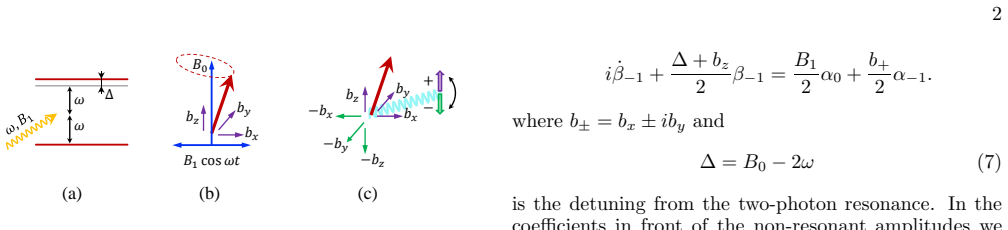
The central claim is that coupling to a fluctuating environment enables resonant two-photon absorption in a two-level system driven by a linearly polarized field, an absorption channel strictly forbidden by the Floquet selection rule in the isolated system. In the single-fluctuator model, the random field $\mathbf{b}(t)$ switches between $\pm(b_x,b_y,b_z)$ at Poisson-distributed times; eliminating the non-resonant Floquet amplitudes reduces the dynamics to the effective Hamiltonian $\hat{H}_{\rm eff}=(\Delta+b_z(t))S_z+\tilde{b}_x(t)S_x$ with $\tilde{b}_x(t)=2B_1^2 b_x(t)/B_0^2$, where $\Delta=B_0-2\omega$ is the two-photon detuning. The in-phase switching of $b_x$ and $b_z$ makes the noise correlation function a difference of two exponentials, so the leading broadening term vanishes at $\Delta=0$; the absorption spectrum is then non-Lorentzian, with a two-peak structure and a central dip at weak drive, controlled by $\beta=2\tilde{b}_x^2/b_z^2\propto B_1^4$, and a monotonic single peak at strong drive. The paper further shows that the same noise-induced channel cannot be captured by Bloch-equation descriptions with a single relaxation time and proposes organic-semiconductor magnetic resonance as an observable setting.
Load-bearing premise
The central result assumes that the transverse and longitudinal components of the random magnetic field flip sign together at the same random telegraph times; if those components fluctuate independently, the two-peak spectrum with its central dip collapses to a Lorentzian line.
Editorial extensions
If this is right
- At weak drive, the two-photon absorption spectrum shows two peaks flanking a dip exactly at resonance; the absorption at zero detuning vanishes.
- As the drive amplitude grows, the spectrum crosses over to a single monotonic peak whose width depends only weakly on drive amplitude.
- If the transverse and longitudinal noise components fluctuate independently rather than in phase, the shape reverts to a Lorentzian and the two-photon dip disappears.
- The two-photon absorption amplitude scales as the fourth power of the drive-to-field ratio, so it is weak but should be detectable in electrically detected magnetic resonance experiments on organic light-emitting diodes.
- Bloch-equation treatments with a single spin-lattice relaxation time cannot produce this resonance; a microscopic noise model with synchronous components is required.
Reading between the lines
- Editorial inference: an ensemble of many independent fluctuators whose transverse and longitudinal fields all flip in phase should preserve the two-peak shape, since the correlator retains the difference-of-exponentials structure.
- Editorial inference: the in-phase condition could be tested directly in a driven superconducting qubit by engineering a control pulse that flips transverse and longitudinal noise simultaneously, converting the predicted line shape into a spectroscopic signature of noise correlations.
- Editorial inference: the Franck-Condon analogy drawn in the paper suggests that in molecular systems where the same vibration modulates both level splitting and transition matrix element, an analogous noise-enabled absorption channel may exist beyond spin systems.
- Editorial inference: the depth of the central dip at fixed drive could serve as a direct estimate of the ratio of transverse to longitudinal noise amplitudes, making the line shape a noise-correlation detector.
Signed reviews
Editorial analysis
A structured set of objections, weighed in public.
Referee Report
Summary. The paper studies a spin-1/2 in a dc field B0 with a linearly polarized ac drive, where even-photon absorption is forbidden in the absence of noise. The authors argue that coupling to a single telegraph fluctuator, with in-phase transverse and longitudinal random-field components, effectively generates a transverse term proportional to the drive squared and thereby enables two-photon absorption. They derive an effective Hamiltonian, compute the absorption line shape using a second-order cumulant expansion, and predict a non-Lorentzian spectrum that develops a dip at zero detuning for weak drive. They propose that this effect could be observed in electrically detected magnetic resonance in organic semiconductors.
Significance. If correct, the paper would establish a conceptually new mechanism for enabling a forbidden multiphoton transition through environmental noise, with a parameter-free, falsifiable line-shape prediction. The derivation of the effective Hamiltonian is transparent, the model assumptions are explicit, and the paper correctly flags its own domain of applicability in Eq. (31). The experimental proposal, however, is inconsistent with the weak-drive assumption used in the derivation, and, more importantly, the central zero-detuning dip is contradicted by an exact solution of the model at Δ=0. The underlying idea that noise can enable two-photon absorption remains plausible, but the paper's headline quantitative prediction does not survive scrutiny.
major comments (3)
- [§III.B, Eq. (25); §IV.A2] The central prediction of a dip at zero detuning is an artifact of the second-order cumulant expansion. For Δ=0 the effective Hamiltonian in Eq. (10) becomes H_eff(t)=f(t)(b_z S_z + btilde_x S_x) with f(t)=±1, so all H_eff(t) commute with one another. The exact normalized correlation is <S_z(0)S_z(t)> = cos^2θ + sin^2θ E[cos(2Ω∫_0^t f(s)ds)], where θ=arctan(btilde_x/b_z) and Ω=sqrt(b_z^2+btilde_x^2). In the spectral-narrowing regime the characteristic function decays as e^{-Γt} with Γ=2Ω^2τ, so the broad part of I(Δ) is a positive Lorentzian centered at Δ=0, in addition to a delta peak at Δ=0; there is no minimum. The paper's statement in Sec. IV.A2 that 'there is no absorption' at Δ=0 is therefore not supported by the exact solution: the vanishing of the linear term in Eq. (19) only removes the leading long-time decay, whereas the subleading terms in Eq. (21) leave a nonzero long-time limit of the correlation. The finite dip in Fig. 2 comes from the integration by parts leading to Eq. (27), which discards this non-decaying component.
- [§III.C, Eq. (31); §III.B, Eq. (25)] The regime where the dip appears is outside the controlled domain of the calculation. The reduction of Eq. (29) to Eq. (30) assumes that <S_z(t)> decays much more slowly than K(t), but at δ=0 the exact <S_z(t)> does not decay to zero while K(t) decays on the time scale τ_s, so the second-order cumulant is not controlled exactly at the point of the claimed dip. The validity condition β < (1+δ^2)/δ^2 in Eq. (31) is vacuous at δ=0, since the right-hand side diverges there. Consistent with this, Eq. (25) as printed is not integrable at δ=0: the second exponent approaches e^{β} at large t, and even if the sign is corrected to match Eq. (21), the correlation still has a constant tail e^{-β}, making I(0) divergent. The numerical curves of Fig. 2 therefore rely on an uncontrolled approximation precisely in the region (small δ) where the two-peak structure is claimed.
- [§IV.B2] The proposed experimental conditions are outside the assumptions of the derivation. The effective Hamiltonian Eq. (10) and the neglect of ˙α_n and ˙β_n for the non-resonant amplitudes are derived under the weak-drive condition B_1≪B_0 and under ωτ≫1. Section IV.B2 instead calls for strong drive with B_0 of order B_1 and with both frequencies comparable to the noise frequency. No argument is given that the line shape survives in this regime, so the OLED feasibility claim does not follow from the calculation presented.
minor comments (4)
- [Title and abstract] The title contains a typographical artifact ('nois e'), and the abstract says 'multiple odd numbers of photons is possible'; these should be corrected.
- [Introduction, Eq. (2)] The text refers to 'the system Eq. (28)' when reducing the driven two-level equations, but the relevant system is Eq. (2); the section cross-reference appears to be a typo.
- [Fig. 2] The caption states that the spectra are calculated numerically from Eq. (25), but Eq. (25) diverges at δ=0 as written; please state explicitly how the divergence is regularized or restricted in the numerical evaluation.
- [§IV.A2] The discussion of the zero-detuning limit should be reconciled with the exact commuting-Hamiltonian solution; as written, the assertion that the spin 'oscillates with time' and that this implies no absorption is not self-evident and is in fact misleading.
Circularity Check
No circularity: the two-photon absorption lineshape is derived from an explicit telegraph-noise model with no fitted parameters; self-citations are only examples.
full rationale
The derivation chain is self-contained and parameter-free. The effective Hamiltonian (Eq. 10) is obtained by algebraic elimination of intermediate Floquet amplitudes from the truncated system (Eq. 6), with the effective transverse field btilde_x = 2 B1^2 bx / B0^2 (Eq. 11). No target line shape is used as an input; btilde_x is the natural second-order coupling generated by the drive. The correlator K(T) (Eq. 15) is computed from the telegraph-noise model in the Appendix, using only the specified Poisson switching statistics and the in-phase sign-flip rule encoded by (-1)^n in Eq. (32). The absorption spectrum I(Delta) is then obtained from the cumulant expression (Eq. 12) and the definition (Eq. 17); no constant is fitted to I(Delta), and the dimensionless parameter beta = 2 btilde_x^2 / bz^2 is a defined combination of model parameters, not an adjustable output. The paper explicitly contrasts the in-phase case with the independent-fluctuation case (Refs. 13,15,16), where the line shape is Lorentzian, so the central assumption has discriminating predictive content rather than being defined so as to produce the claimed dip. The self-citations (Refs. 23,40,50) are used only as examples or general context and are not load-bearing for the main derivation. A skeptical concern that the zero-detuning dip may be an artifact of the second-order cumulant expansion or of the integration by parts leading to Eq. (27) is a correctness or approximation-validity issue, not a circularity issue: the paper never defines the dip into the model, and even if Eq. (25) misbehaves at delta = 0, that would mean the approximation fails, not that the output was assumed. No circular step of the kinds enumerated (self-definitional, fitted input called prediction, load-bearing self-citation, imported uniqueness, ansatz smuggled by citation, or renaming a known result) is present.
Assumptions & free parameters
assumptions (5)
- domain assumption The environment is modeled as a single fluctuator producing random telegraph noise with Poisson-distributed switching times p(t_i) = (1/tau) exp(-t_i/tau).
- domain assumption The transverse and longitudinal noise components bx(t) and bz(t) fluctuate in phase, switching sign simultaneously.
- domain assumption The drive amplitude is weak (B1 << B0) and the noise is slow (omega*tau >> 1), justifying the truncation of the Floquet system to six amplitudes and neglect of higher-order derivatives.
- domain assumption The cumulant expansion is valid: btilde_x * tau << 1 and the spin correlation decays slower than the noise kernel K(t).
- standard math Standard quantum mechanics: the two-level system obeys the time-dependent Schroedinger equation, and the absorption is given by the cosine transform of the spin autocorrelation function.
Cite this review
Pith. "Pith review of Two-photon absorption in a two-level system enabled by noise." pith.science (2026). https://pith.science/paper/BEAE6XA5
@misc{pith2026190806534,
  author       = {Pith},
  title        = {Pith review of: Two-photon absorption in a two-level system enabled by noise},
  year         = {2026},
  howpublished = {\url{https://pith.science/paper/BEAE6XA5}},
  note         = {Machine review of arXiv:1908.06534}
}
read the original abstract
We address the textbook problem of dynamics of a spin placed in a dc magnetic field and subjected to an ac drive. If the drive is polarized in the plane perpendicular to the dc field, the drive photons are resonantly absorbed when the spacing between the Zeeman levels is close to the photon energy. This is the only resonance when the drive is circularly polarized. For linearly polarized drive, additional resonances corresponding to absorption of three, five, and multiple odd numbers of photons is possible. Interaction with the environment causes the broadening of the absorption lines. We demonstrate that the interaction with environment enables the forbidden two-photon absorption. We adopt a model of the environment in the form of random telegraph noise produced by a single fluctuator. As a result of the synchronous time fluctuations of different components of the random field, the shape of the two-photon absorption line is non-Lorentzian and depends dramatically on the drive amplitude. This shape is a monotonic curve at strong drive, while, at weak drive, it develops a two-peak structure reminiscent of an induced transparency on resonance.
Figures

Reference graph
Works this paper leans on
-
[1]
The phenomenon of two-photon absorption is widely used in many different domains of science and en- gineering, primarily due to its non-linear dependency on intensity which opens the possibility of depth resolution in light-matter interaction, but it is usually considered in the context of electronic dipole transitions. Because of the angular momentum of t...
-
[2]
While our result of the absence of absorption at zero detuning bears some superficial resemblance of conven- tional electromagnetically induced transparency (EIT), analogues of which can also be generated in magnetic- resonant systems, 3,21 we stress that the origin is com- pletely different. In EIT, quantum interference occurs between different transition p...
-
[3]
In addition to superconducting qubits 5–11,22 , a nat- ural setup to verify our predictions is nuclear magnetic resonance, see e.g. Ref. 23, although identification of in- dividual spectral lines requires very high sensitivity and 6 selectivity which can be hard to achieve given the lim- its imposed on sampling frequency by the small nuclear gyromagnetic r...
-
[4]
Experimental observation of the predicted effect ne- cessitates strong drive conditions where the carrier-wave frequency B0 is of order of the Rabi frequency B1 and, in addition, both frequencies are comparable to that of the noise. Since MHz magnetic resonances are detectable electrically in OLEDs, 30 such systems should offer an av- enue for observing for...
-
[5]
In contrast to other well-defined spin systems such as color centers in diamond, spin-1/2 paramagnetic species in organic semiconductors do not experience any appreciable zero-field splitting. As a consequence, mag- netic resonance can even occur at zero external field, me- diated alone by the local hyperfine fields. 30 Electrically detected magnetic resonance...
-
[6]
Since an OLED operates by spin-dependent recom- bination of electrons and holes, EDMR does not, strictly, probe a two-level system, but two effectively degenerate two-level systems of the Zeeman-split electron and hole spin levels. Under strong drive, when the drive ampli- tude exceeds the variation in the expectation value of the hyperfine fields, electron ...
-
[7]
In spirit, the noise-induced absorption bares some similarity to the hyperfine-induced excitation of the elec- tron spin resonance predicted and observed in Ref. 37. In simple terms, the idea of Ref. 37 can be explained as follows. Suppose that the driving field, B1, is absent, but the quantum dot confining an electron is “shaken” in space by an ac electric ...
-
[8]
Description of the ac absorption within the Bloch equations,39 where the bath is modeled by the spin-lattice relaxation time, T1, does not capture the two-photon res- onance. In order to replicate a number of nontrivial ef- fects, a microscopic model of the environment must be specified. Moreover, it is necessary to go beyond the Bloch-Redfield description,...
Show all 12 references
-
[9]
Usually, as, e.g., in Refs
While we have used the language of a spin driven by an ac magnetic field, the results apply quite gener- ally for any driven two-level system. Usually, as, e.g., in Refs. 41–49, the effect of the environment on multipho- ton absorption is studied under the conditions where this ...
-
[10]
Thus, each interaction with the drive is ac- companied by a spin-flip
Qualitative explanation of the absence of even- photon resonances without an interaction with the bath is that linearly polarized drive has matrix elements | ↓⟩ → | ↑⟩ and | ↑⟩ → | ↓⟩ , but not | ↓⟩ → | ↓⟩ or | ↑⟩ → | ↑⟩ . Thus, each interaction with the drive is ac- companied...
-
[11]
The argument of the cosine in the correlator Eq
A formal reason why in-phase fluctuations of bx(t) and bz(t) result in an unconventional shape of the two- photon absorption is the following. The argument of the cosine in the correlator Eq. (13) contains the integral ∫ T 0 dtbz(t), and the prefactor has the form ˜bx(0)˜bx(t)....
-
[12]
Stark Effect in Rapidly Varying Fields,
It is instructive to put our results into a more gen- eral perspective of spectral narrowing 17–19. The random- ness of bz emulates the spectral narrowing. However, if bx fluctuates in phase with bz, the effect of spectral nar- rowing is undone. The same effect can be reformulate...
1955 arXiv
Reviewed August 14, 2026 · model on record in the stance chip above.
Discussion (0). Continue with ORCID to comment.