REVIEW 4 major objections 5 minor 18 references
Influence of chemical stability on the fabrication of MnGa-based devices
T0 review · 4 major / 5 minor · reviewed 2026-08-14 · deepseek-v4-flash
Pith's one-line read Water and common acids dissolve MnGa films within minutes, while acetone, ethanol, and brief developer exposure leave them intact.
desk verdict A useful empirical first look at MnGa chemical stability with a plausible core finding, though the resistance proxy needs validation before quantitative safe-window claims are taken at face value. read the letter →
The pith
A machine-rendered reading of the paper's core claim, the machinery that carries it, and where it could break.
The reading
What carries the argument
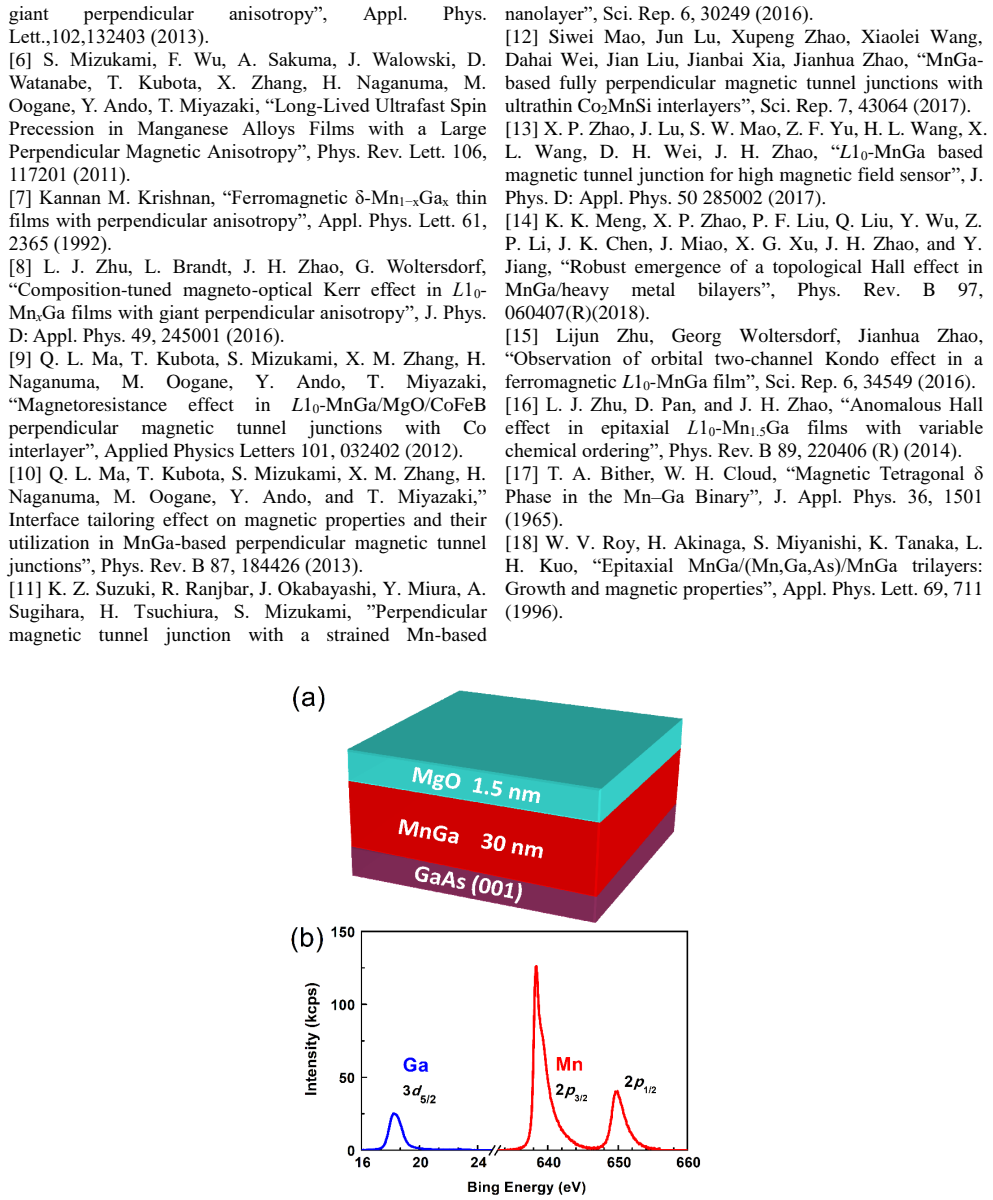
The load-bearing measurement is the electrical resistance of the MnGa layer used as a quantitative proxy for chemical attack: a patterned strip's resistance rises as the conductive film is consumed, so time-resolved resistance curves convert 'the film is attacked' into a number. The supporting material platform is a 30-nm epitaxial MnGa film on semi-insulating GaAs with a 1.5-nm MgO cap, which keeps the as-grown surface intact until each chemical test. Resistance monitoring is what allows the authors to separate benign solvents (constant R), violent corrosives (R reaching 20 MΩ in minutes), slow attack (TMAOH, factor-of-10 rise only after prolonged soaking), and surface passivation (oxygen plasma oxidation) within a single experiment.
What would settle it
Soak a fresh 30-nm MnGa film in deionized water for five minutes, then measure the remaining film thickness and composition by cross-section electron microscopy and XPS: if the resistance has jumped to 20 MΩ while the film thickness and Mn:Ga ratio are unchanged, the resistance-based measure of attack is wrong. Conversely, finding a corresponding thickness loss would confirm the corrosion picture.
Extended reading notes
Core claim
The central claim is that the chemical compatibility of MnGa with standard microfabrication is governed by a few simple rules: water and acid solutions corrode the film aggressively, while organic solvents do not. Measured on 30-nm L10-MnGa films capped with 1.5 nm MgO, the resistance of a 3 mm by 6 mm strip stays constant in acetone and ethanol, rises to 20 MΩ in deionized water within five minutes, changes negligibly in 75% TMAOH developer for the first three minutes but climbs by a factor of ten after extended soaking, and responds to 200 W oxygen plasma by surface oxidation that passivates the film. The paper concludes that acids should be avoided whenever possible, water-based steps reduced to quick rinses, short TMAOH development is safe, and argon-ion milling is the reliable patterning route.
Load-bearing premise
The paper's quantitative timelines assume that the MnGa film's resistance faithfully measures the degree of chemical attack, without an independent calibration against actual thickness loss, composition change, or contact resistance effects.
Editorial extensions
If this is right
- MnGa device fabrication should not use acid wet etching: HCl, H3PO4, and H2SO4 solutions undercut the resist and remove supposedly protected patterns before unprotected regions are gone.
- Cleaning and lift-off with acetone or ethanol are safe; these solvents do not change the film resistance at all.
- Photoresist development in TMAOH is acceptable if kept under about one minute; extended soaking raises the film resistance tenfold and should be avoided.
- Deionized-water rinses should be replaced by quick dips followed by nitrogen drying; a five-minute water soak can drive the resistance to 20 MΩ.
- Oxygen plasma can be used to passivate the MnGa surface by oxidation, but the effect is substantial for ultrathin films and negligible for thick ones, so film thickness must be considered.
Reading between the lines
- The same resistance-monitoring protocol could screen other easily corroded magnetic alloys, such as MnAl or MnBi, against standard fab chemicals before device integration.
- Because the paper's own lithography flow already includes a ten-second deionized-water rinse, the violent water reaction implies even short rinses may etch edges; minimizing rinse time or switching to an alcohol rinse is a testable extension.
- Oxygen-plasma passivation may alter magnetic properties, not just resistance; measuring anisotropy or coercivity before and after plasma exposure would show whether the passivating oxide is magnetically benign.
- The 20 MΩ saturation in water suggests the corrosion product is insulating and may spread through grain boundaries; electron microscopy of the corroded film could identify the attack path and inform protective barrier designs.
Signed reviews
Editorial analysis
A structured set of objections, weighed in public.
Referee Report
Summary. The manuscript reports an experimental study of the chemical stability of 30 nm L10-ordered MnGa films, capped with 1.5 nm MgO and grown on GaAs, in contact with acids (HCl, H3PO4, H2SO4), acetone, ethanol, deionized water, TMAOH developer, and oxygen plasma. The authors conclude that acetone and ethanol are safe; deionized water and acids attack the films severely; TMAOH attack is slow, with development times below 1 min considered safe; and oxygen plasma oxidizes and passivates the surface. The conclusions are based on optical microscopy of wet-etched patterns (Section 2.2) and on resistance-versus-time measurements of unpatterned films (Section 2.3). The authors recommend avoiding water and acids in MnGa device fabrication whenever possible and provide guidance on TMAOH development and oxygen plasma exposure.
Significance. If the conclusions are supported, the paper would provide practically important processing guidelines for MnGa-based spintronic devices, a topic for which published chemical-stability data are scarce. The systematic comparison of standard cleanroom chemicals, the use of a well-characterized Mn50Ga50 film with XPS verification, and the explicit caution about water exposure are useful contributions. The practical recommendations (avoid water and acids, limit TMAOH development time, use oxygen plasma for passivation) are falsifiable and directly relevant to device integration. However, the significance is conditional: the central quantitative evidence rests on an uncalibrated resistance proxy and on qualitative microscopy, so the strength of the practical claims is not yet established. The paper does not include replicates, error bars, or validated measures of material loss, which limits its current value as a quantitative reference.
major comments (4)
- [Section 2.3, Figure 3] The central quantitative evidence is the change in resistance of the 30 nm MnGa film during soaking. The paper does not establish that resistance is a faithful proxy for chemical attack. An increase in resistance could result from loss of conductive cross-section, but equally from surface oxidation, delamination, or degradation of the electrical contact between the probes and the film. No calibration is provided against film thickness loss (e.g., XRR, TEM, or profilometry), composition change (e.g., XPS before and after), or surface morphology (e.g., AFM). Without such validation, the quantitative statements such as "R reaches 20 MΩ in 5 minutes" in deionized water and the claim that TMAOH development under 1 min is safe are not fully supported. Please add a direct measure of attack for at least one representative condition (e.g., DI water and TMAOH) and describe the measurement geometry, contact method, and number of replicates.
- [Section 2.2, Figure 2] The acid etching study is presented only qualitatively. The text states that HCl, H3PO4, and H2SO4 solutions produce strong sidewall etching "regardless of the combination of different volume ratio and etching time," but no concentrations, temperatures, or etching times are listed, and no quantitative etch rate, undercut distance, or reproducibility data are shown. The optical images in Figure 2(c) are evocative but cannot support the severity ranking between acids or the statement that wet etching is non-uniform without controlled experiments. Please specify the acid concentration and temperature for each test and provide quantitative measures of attack (e.g., step height or sheet resistance change) in addition to optical images.
- [Section 2.3 and Section 2.2] The chemical conditions are under-specified, which limits reproducibility. The developer is described as "TMAOH solution (TMAOH:H2O=4:1)" in Section 2.2 but as "75% TMAH developer" in Section 2.3; the deionized water resistivity is not given; the oxygen plasma process is specified only as "power of 200 W" with no pressure, gas flow, or time dependence of the passivation effect. In addition, the resistance measurement geometry in Figure 3(a) is not described in the text (two-point vs four-point, probe arrangement, contact stability). Please report these parameters so that the soaking and plasma conditions can be reproduced.
- [Section 2.3, sample structure] All studied films have a 1.5 nm MgO capping layer, so the measured resistance changes reflect attack of the MgO/MnGa stack rather than of MnGa alone. The interpretation of the resistance increase in water and TMAOH could be influenced by pinholes, edge attack, or delamination of the cap, and the conclusions are phrased as intrinsic MnGa stability. Please discuss the role of the MgO cap or provide measurements on films without a cap or with different cap thicknesses to separate cap effects from the intrinsic chemical stability of MnGa.
minor comments (5)
- [Abstract] The phrase "has unsettled" is grammatically incorrect; consider "has remained unsettled" or "is not settled."
- [Section 2.2, paragraph 1] The phrase "we first exam" should read "we first examine."
- [Section 2.3, Figure 3] Figure 3(b) shows curves without error bars or replicate symbols; please state whether each curve is from a single sample and whether multiple samples gave consistent results.
- [Section 2.1, Figure 1(b)] The XPS composition verification is only described as "asymmetric elemental XPS peaks" and a stated Mn:Ga ratio of 1:1; please report the quantified atomic percentages obtained with the stated sensitivity factors so the reader can verify the composition measurement.
- [Section 2.3, oxygen plasma] The statement that oxygen plasma "can passivate the MnGa surface" is based on a resistance change after 1 min, but the resistivity or sheet resistance is not reported; please state the magnitude and sign of the resistance change and clarify whether the passivation was confirmed by any surface analysis (e.g., XPS of the oxide layer).
Circularity Check
No significant circularity: the chemical stability conclusions are directly supported by the paper's own resistance and microscopy measurements.
full rationale
This is an experimental study with no derivation chain, no fitting of parameters that are later renamed as predictions, and no theoretical claim that reduces to its inputs by construction. The central findings—that MnGa is stable in acetone and ethanol, attacked by deionized water and acids, slowly attacked by TMAOH, and passivated by oxygen plasma—are stated as direct observations from resistance monitoring and optical microscopy. The use of electrical resistance as a proxy for chemical attack is an experimental assumption that could affect validity, but it is not circular: the resistance is measured, not derived from the conclusions, and the qualitative microscopy in Section 2.2 independently supports the acid-attack claim. The paper's self-citations appear in the introduction and in descriptions of sample growth and magnetic properties; they are background context and are not load-bearing for the new chemical stability results. No equation is shown to equal another by construction, and no fitted input is presented as a prediction. Therefore the circularity score is 0.
Assumptions & free parameters
assumptions (3)
- domain assumption Resistance of the MnGa film is a valid measure of the degree of chemical attack.
- domain assumption The observed resistance changes are attributable to the MnGa layer itself, not to degradation of the electrical contacts or the MgO capping layer.
- domain assumption The tested acid and TMAH solutions are representative of the entire classes named, and the conclusions generalize to other concentrations or related chemicals.
Cite this review
Pith. "Pith review of Influence of chemical stability on the fabrication of MnGa-based devices." pith.science (2026). https://pith.science/paper/R3TFC6TE
@misc{pith2026190806536,
  author       = {Pith},
  title        = {Pith review of: Influence of chemical stability on the fabrication of MnGa-based devices},
  year         = {2026},
  howpublished = {\url{https://pith.science/paper/R3TFC6TE}},
  note         = {Machine review of arXiv:1908.06536}
}
read the original abstract
Ferromagnetic films of L10-ordered MnGa have shown promise not only in the applications in ultrahigh-density magnetic recording and spintronic memories, oscillators, and sensors, but also in controllable studies of novel electrical transport phenomena. However, the stability of MnGa in chemicals and oxygen plasma that are commonly used in the standard micro-/nano-fabrication process has unsettled. In this work, we report a systematic study on the chemical stability of the MnGa films in acids, acetone, ethanol, deionized water, tetramethylammonium hydroxide (TMAOH) and oxygen plasma. We find that MnGa is very stable in acetone and ethanol, while can be attacked substantially if soaked in TMAOH solution for sufficiently long time. Deionized water and acids (e.g., HCl, H3PO4 and H2SO4 solutions) attack MnGa violently and should be avoided whenever possible. In addition, oxygen plasma can passivate the MnGa surface by oxidizing the surface. These results provide important information for the fabrication and the integration of MnGa based spintronic devices.
Figures
Reference graph
Works this paper leans on
-
[1]
L. J. Zhu and J. H. Zhao, “Perpendicularly magnetized MnxGa films: a kind of promising material for future spintronic devices, magnetic recording and permanent magnets”, Appl. Phys. A, 111, 379 (2013)
work page 2013
-
[2]
Recent progress in perpendicularly magnetized Mn -based binary alloy films
L. J. Zhu, S. H. Nie, and J. H. Zhao, “Recent progress in perpendicularly magnetized Mn -based binary alloy films”, Chin. Phys. B 22,118505 (2013)
work page 2013
-
[3]
Electrical Transport of perpendicularly magnetized L10-MnGa and MnAl films
L. J. Zhu, J. H. Zhao, “Electrical Transport of perpendicularly magnetized L10-MnGa and MnAl films”, Spin 7, 1730001(2017)
work page 2017
-
[4]
Lijun Zhu, Shuaihua Nie, Kangkang Meng, Dong Pan, Jianhua Zhao, and H ouzhi Zheng, “Multifunctional L10- Mn1.5Ga Films with ultrahigh coercivity, giant perpendicular magnetocrystalline anisotropy and large magnetic energy product”, Adv. Mater., 24, 4547 (2012)
work page 2012
-
[5]
Tailoring magnetism of multifunctional Mn xGa films with 3 giant perpendicular anisotr opy
L. J. Zhu, D. Pan, S. H. Nie, J. Lu, and J. H. Zhao, “Tailoring magnetism of multifunctional Mn xGa films with 3 giant perpendicular anisotr opy”, Appl. Phys. Lett.,102,132403 (2013)
work page 2013
-
[6]
S. Mizukami, F. Wu, A. Sakuma, J. Walowski, D. Watanabe, T. Kubota, X. Zhang, H. Naganuma, M. Oogane, Y . Ando, T. Miyazaki, “Long-Lived Ultrafast Spin Precession in Manganese Alloys Films with a Large Perpendicular Magnetic Anisotropy ”, Phys. Rev. Lett. 106, 117201 (2011)
work page 2011
-
[7]
Ferromagnetic δ-Mn1−xGax thin films with perpendicular anisotropy
Kannan M. Krishnan, “Ferromagnetic δ-Mn1−xGax thin films with perpendicular anisotropy ”, Appl. Phys. Lett. 61, 2365 (1992)
work page 1992
-
[8]
L. J. Zhu, L. Brandt, J. H. Zhao, G. Woltersdorf, “Composition-tuned magneto -optical Kerr effect in L10- MnxGa films with giant perpendicular anisotropy ”, J. Phys. D: Appl. Phys. 49, 245001 (2016)
work page 2016
Show all 18 references
-
[9]
Magnetoresistance effect in L10-MnGa/MgO/CoFeB perpendicular magnetic tunnel junctions with Co interlayer
Q. L. Ma, T. Kubota, S. Mizukami, X. M. Zhang, H. Naganuma, M. Oogane, Y. Ando, T. Miyazaki, “Magnetoresistance effect in L10-MnGa/MgO/CoFeB perpendicular magnetic tunnel junctions with Co interlayer”, Applied Physics Letters 101, 032402 (2012)
2012
-
[10]
Q. L. Ma, T. Kubota, S. Mizukami, X. M. Zhang, H. Naganuma, M. Oogane, Y. Ando, and T. Miyazaki,” Interface tai loring effect on magnetic properties and their utilization in MnGa -based perpendicular magnetic tunnel junctions”, Phys. Rev. B 87, 184426 (2013)
2013
-
[11]
K. Z. Suzuki, R. Ranjbar, J. Okabayashi, Y. Miura, A. Sugihara, H. Tsuchiura, S. Mizukami, ”Perpendicula r magnetic tunnel junction with a strained Mn -based nanolayer”, Sci. Rep. 6, 30249 (2016)
2016
-
[12]
MnGa- based fully perpendicular magnetic tunnel junctions with ultrathin Co2MnSi interlayers
Siwei Mao, Jun Lu, Xupeng Zhao, Xiaolei Wang, Dahai Wei, Jian Liu, Jianbai Xia, Jianhua Zhao, “MnGa- based fully perpendicular magnetic tunnel junctions with ultrathin Co2MnSi interlayers”, Sci. Rep. 7, 43064 (2017)
2017
-
[13]
L10-MnGa based magnetic tunnel junction for high magnetic field sensor
X. P. Zhao, J. Lu, S. W. Mao, Z. F. Yu, H. L. Wang, X. L. Wang, D. H. Wei , J. H. Zhao, “L10-MnGa based magnetic tunnel junction for high magnetic field sensor ”, J. Phys. D: Appl. Phys. 50 285002 (2017)
2017
-
[14]
Robust emergence of a topological Hall effect in MnGa/heavy metal bilayers
K. K. Meng, X. P. Zhao, P. F. Liu, Q. Liu, Y. Wu, Z. P. Li, J. K. Chen, J. Miao, X. G. Xu, J. H. Zhao, and Y. Jiang, “Robust emergence of a topological Hall effect in MnGa/heavy metal bilayers ”, Phys. Rev. B 97, 060407(R)(2018)
2018
-
[15]
Observation of orbital two -channel Kondo effect in a ferromagnetic L10-MnGa film
L ijun Zhu, G eorg Woltersdorf, J ianhua Zhao, “Observation of orbital two -channel Kondo effect in a ferromagnetic L10-MnGa film”, Sci. Rep. 6, 34549 (2016)
2016
-
[16]
Anomalous Hall effect in epitaxial L10-Mn1.5Ga films with variable chemical ordering
L. J. Zhu, D. Pan, and J. H. Zhao, “Anomalous Hall effect in epitaxial L10-Mn1.5Ga films with variable chemical ordering”, Phys. Rev. B 89, 220406 (R) (2014)
2014
-
[17]
Magnetic Tetragonal δ Phase in the Mn –Ga Binary
T. A. Bither, W. H. Cloud, “Magnetic Tetragonal δ Phase in the Mn –Ga Binary ”, J. Appl. Phys. 36, 1501 (1965)
1965
-
[18]
Epitaxial MnGa/(Mn,Ga,As)/MnGa trilayers: Growth and magnetic properties
W. V. Roy, H. Akinaga, S. Miyanishi, K. Tanaka, L. H. Kuo, “Epitaxial MnGa/(Mn,Ga,As)/MnGa trilayers: Growth and magnetic properties”, Appl. Phys. Lett. 69, 711 (1996). Figure 1. (a) Schematic of the sample structure. (b) XPS patterns of the MnGa layer, indicating a Mn: Ga ato...
1996
Reviewed August 14, 2026 · model on record in the stance chip above.
Discussion (0). Continue with ORCID to comment.