REVIEW 2 major objections 5 minor 54 references
Hyperpixel Flow: Semantic Correspondence with Multi-layer Neural Features
T0 review · 2 major / 5 minor · reviewed 2026-08-14 · deepseek-v4-flash
Pith's one-line read A handful of selected CNN layers, matched by Hough voting, outperforms trained deep matchers in real time.
desk verdict The core claim holds up: a validation-tuned handful of CNN layers plus Hough voting beats trained correspondence networks on standard benchmarks, and SPair-71k is a genuinely useful dataset; but the SPair-71k baseline-finetuning protocol is sloppy and the FCN row overstates the method's advantage. read the letter →
The pith
A machine-rendered reading of the paper's core claim, the machinery that carries it, and where it could break.
The reading
What carries the argument
The hyperpixel is the core object: at each spatial position, a hyperimage is built by upsampling a small subset of selected convolutional feature maps to a common base resolution and concatenating them along channels, so each pixel carries multi-scale information from both early and late layers. The layer set is selected by a variant of beam search (Algorithm 1) that evaluates candidate layer combinations by the matching method's PCK on a validation split. The matching engine is regularized Hough matching (RHM), an adaptation of probabilistic Hough matching in which appearance confidence p(ma) = ReLU(cosine similarity)^d is accumulated into a two-dimensional offset space, enforcing geometric consistency across all candidate matches. This combination of condensed multi-layer features and fast geometric voting is what carries the argument.
What would settle it
If, on a new dataset or a held-out subset, the layer set tuned on a different validation split performs no better than a randomly selected set of the same size, the claimed advantage of layer search would be refuted. Concretely, one could take the SPair-71k-tuned layers for ResNet-101 and evaluate them on PF-WILLOW's test pairs, comparing against random 8-layer combinations; a failure to beat the random baseline would show the selection does not generalize.
Extended reading notes
Core claim
The central claim is that multi-layer neural features, when their constituent layers are carefully selected rather than used in full, provide a powerful and efficient representation for dense semantic correspondence. The paper shows that only five to eight convolutional layers, chosen by beam search over a validation split, are sufficient to outperform methods that train deep networks end-to-end on the correspondence task. Matching is carried out by regularized Hough matching, which treats each hyperpixel as a voting unit in a two-dimensional offset space, using an exponentiated cosine similarity with exponent d=3. The same validation-tuned layer sets transfer to other benchmarks, and the method is faster and more accurate than previous region-proposal or global-alignment approaches.
Load-bearing premise
The layer sets chosen by beam search on a validation split are assumed to transfer to the test split and to other datasets, and the assumption is that these few layers, rather than the full feature hierarchy, carry the information needed for correspondence.
Editorial extensions
If this is right
- Semantic correspondence can be solved at interactive speeds without task-specific training, since layer selection on a tiny validation set (as few as one pair per class) already gives state-of-the-art results.
- The set of selected layers is more important than the sheer number of layers: using all CNN layers degrades performance, while a few carefully chosen layers improve it.
- The method's two-dimensional Hough space, enabled by grid-aligned hyperpixels, makes dense matching practical where region-proposal voting required heavier three-dimensional spaces.
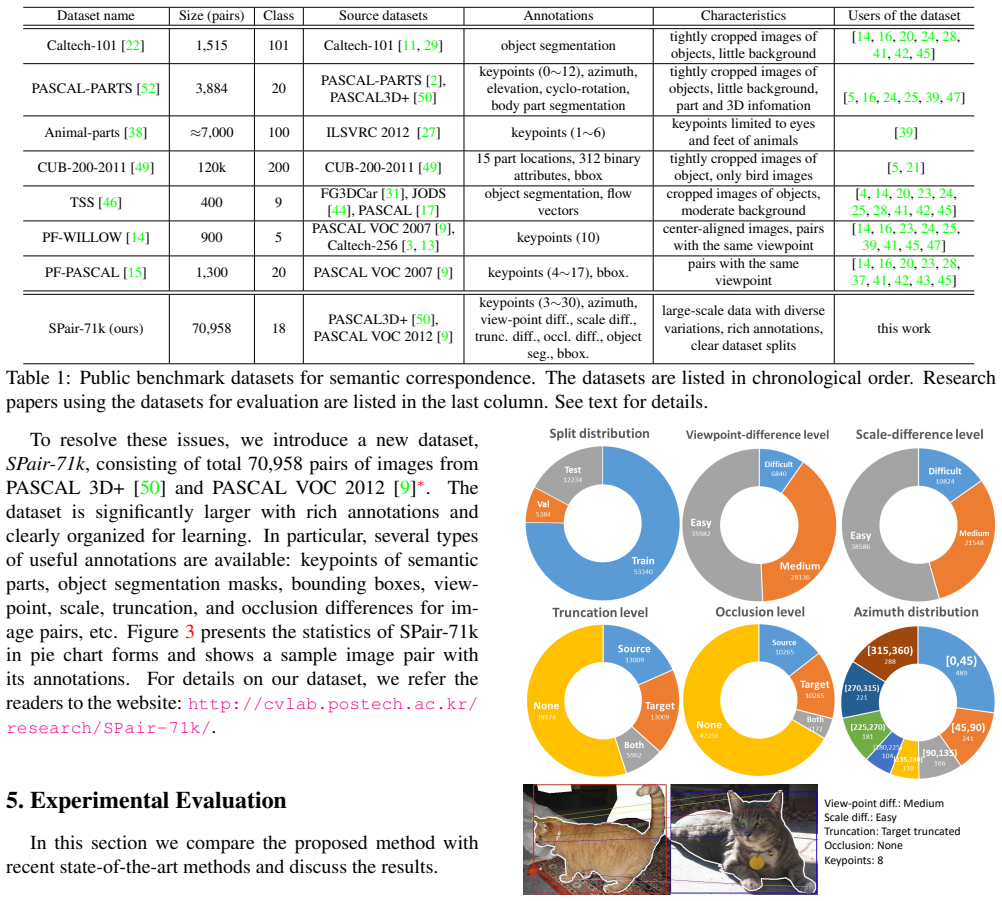
- The new SPair-71k dataset provides a larger, more diverse, and more richly annotated testbed, with difficulty annotations for viewpoint, scale, truncation, and occlusion that allow failure modes of correspondence methods to be analyzed separately.
Reading between the lines
- Beyond the paper: the validation-based layer search could be applied to other pretrained backbones or even to video frames, suggesting that layer selection may generalize across tasks more broadly than the specific correspondence benchmarks tested here.
- Beyond the paper: because replacing the searched layers with random layers sharply drops PCK, the search appears to be finding a genuinely functional set of features rather than merely a configuration that avoids redundancy; a natural test would be to compare the searched layers against layers chosen by a simple heuristic such as maximal receptive-field diversity.
- Beyond the paper: the method's speed and small supervision burden make it a plausible building block for online or interactive systems, for example in image editing or robot perception, where correspondence must be computed on the fly.
- Beyond the paper: the paper's ablation with exponent d suggests that moderate sharpening of similarity scores helps voting; one could test whether the optimal exponent depends on the number or diversity of hyperpixel layers rather than being fixed at 3.
Signed reviews
Editorial analysis
A structured set of objections, weighed in public.
Referee Report
Summary. The paper introduces hyperpixel flow, a dense semantic correspondence method that represents each pixel by a small set of features selected from early and late CNN layers (hyperpixels), and matches these hyperpixels via a regularized Hough voting scheme (RHM). The layer set is determined by beam search on a validation split, and the method requires no end-to-end training. The paper also introduces a new large-scale dataset, SPair-71k, with richer annotations than existing benchmarks. Experiments report state-of-the-art results on PF-PASCAL, PF-WILLOW, Caltech-101, and SPair-71k, with real-time inference on a GPU.
Significance. If the claims hold, the method is notable for combining a simple, validation-only tuned representation with a fast voting-based matcher, outperforming trained deep matching networks while running at interactive speeds. The SPair-71k dataset is a valuable contribution with its size and annotation richness. The small-set experiments (k=1,2,3) and the random-layer baseline provide useful evidence that the layer search is effective and that the method does not require large amounts of supervision. However, the headline state-of-the-art claim on PF-PASCAL depends on a backbone pretrained on a superset of the target dataset, and the SPair-71k comparison includes non-reproducible fine-tuning results that the authors themselves report as failed.
major comments (2)
- [§5.3, Table 2] The claim of a new state of the art on PF-PASCAL is only achieved by HPF_res101-FCN, whose backbone is pretrained on PASCAL VOC 2012, which the paper describes as a superset of the target dataset PF-PASCAL. With the ImageNet-only ResNet-101 backbone, HPF_res101 obtains 84.8 PCK@α=0.1, which is lower than the 85.7 reported for NN-Cyc_res101 under the same backbone family. Therefore the abstract's assertion of "a new state of the art on three standard benchmarks" is not supported for PF-PASCAL when backbones are restricted to ImageNet-only pretraining; the FCN-based result should either be presented as a separate, explicitly labeled setting or the claim should be revised.
- [§5.3, Table 3] The rows labeled "SPair-71k trained models" for WeakAlign [42] and NC-Net [43] are based on fine-tuning performed by the authors, who explicitly state "We fail to successfully train the method of [42, 43] on SPair-71k so that their performances drop when trained." The phrase "with our best efforts" is not a reproducible training protocol, and these numbers do not constitute a valid comparison that can be used to support a state-of-the-art claim. Since the transferred-model rows (using official checkpoints) already show HPF ahead of the baselines, the failed fine-tuning rows should be removed or replaced with a properly specified protocol, such as using official training code and standard hyperparameters.
minor comments (5)
- [§1, Contribution list] The claim "achieves a speed of more than 50 fps on a GPU for 300×200 image pairs" is only demonstrated for the HPF_res50* variant (19 ms per pair in Table 4); the default HPF_res101 configuration runs at 63 ms, which is about 16 fps. Please clarify which configuration the speed claim refers to.
- [§6, Conclusion] The word "vadidation" should be "validation".
- [Table 2] The FCN row should clearly indicate in the table caption or a footnote that the backbone is pretrained on PASCAL VOC 2012, not just in the main text, so that readers do not mistake it for an ImageNet-only result.
- [Algorithm 1] The condition "l > min(L′)" in line 13 is not explained. Please clarify why candidate layers are restricted to those with index greater than the current minimum in the selected set, and how this affects the search space.
- [§5.3] There is a typo in the sentence "futher evaluated on PF-WILLOW and Caltech-101"; it should be "further".
Circularity Check
No circularity: hyperpixel layer search and exponent d are validation-tuned hyperparameters, and all headline results are test-set or cross-dataset evaluations against external methods.
full rationale
The paper's claimed derivation is self-contained and non-circular. The hyperpixel representation (Eq. 1) concatenates selected CNN feature maps; the layer set is chosen by beam search (Algorithm 1) using only validation-split PCK, and the similarity exponent d=3 is fixed from PF-PASCAL validation. Neither of these choices uses test labels or the final benchmark numbers, so the later PCK results are genuine evaluations rather than fitted quantities renamed as predictions. The RHM voting formula (Eq. 3) is adapted from the externally published PHM of Cho et al. [4], not from an unverified self-citation chain, and no uniqueness theorem is invoked to force the method. The admitted failure to fine-tune WeakAlign and NC-Net on SPair-71k (Section 5.3) and the FCN-backbone pretrained on PASCAL VOC 2012 are legitimate comparison-protocol concerns that bear on the strength of the SOTA claim, but they are not circularity: the proposed method's outputs are not defined in terms of, nor equivalent by construction to, the baseline results or the benchmark labels.
Assumptions & free parameters
free parameters (6)
- Similarity exponent d =
3
- ResNet-101 hyperpixel layers for PF-PASCAL =
(2,17,21,22,25,26,28)
- ResNet-50 hyperpixel layers for PF-PASCAL =
(2,7,11,12,13)
- ResNet-101 hyperpixel layers for SPair-71k =
(0,8,20,21,26,28,29,30)
- ResNet-50 hyperpixel layers for SPair-71k =
(0,9,10,11,12,13)
- Beam size Nbeam and max layers Kmax =
Nbeam=4, Kmax=8
assumptions (5)
- domain assumption ImageNet-pretrained CNN features transfer to semantic correspondence
- domain assumption Keypoint and difficulty annotations in PF-WILLOW, PF-PASCAL, and SPair-71k are accurate and consistent
- domain assumption Validation-set layer selection generalizes to test splits and other datasets
- domain assumption Hough voting with local displacement consistency is sufficient for geometric verification
- domain assumption PASCAL VOC 2012 pretraining does not leak test information for PF-PASCAL
invented entities (1)
-
Hyperpixel representation
independent evidence
Cite this review
Pith. "Pith review of Hyperpixel Flow: Semantic Correspondence with Multi-layer Neural Features." pith.science (2026). https://pith.science/paper/SL3SACPN
@misc{pith2026190806537,
  author       = {Pith},
  title        = {Pith review of: Hyperpixel Flow: Semantic Correspondence with Multi-layer Neural Features},
  year         = {2026},
  howpublished = {\url{https://pith.science/paper/SL3SACPN}},
  note         = {Machine review of arXiv:1908.06537}
}
read the original abstract
Establishing visual correspondences under large intra-class variations requires analyzing images at different levels, from features linked to semantics and context to local patterns, while being invariant to instance-specific details. To tackle these challenges, we represent images by "hyperpixels" that leverage a small number of relevant features selected among early to late layers of a convolutional neural network. Taking advantage of the condensed features of hyperpixels, we develop an effective real-time matching algorithm based on Hough geometric voting. The proposed method, hyperpixel flow, sets a new state of the art on three standard benchmarks as well as a new dataset, SPair-71k, which contains a significantly larger number of image pairs than existing datasets, with more accurate and richer annotations for in-depth analysis.
Figures


Figures from the paper (2 more)


Reference graph
Works this paper leans on
-
[42]
End-to- end weakly-supervised semantic alignment
Ignacio Rocco, Relja Arandjelovi, and Josef Sivic. End-to- end weakly-supervised semantic alignment. In Proc. IEEE Conference on Computer Vision and Pattern Recognition (CVPR), 2018. 1, 2, 4, 5, 6, 7, 8
work page 2018
-
[43]
Neighbourhood con- sensus networks
Ignacio Rocco, Mircea Cimpoi, Relja Arandjelovi ´c, Akihiko Torii, Tomas Pajdla, and Josef Sivic. Neighbourhood con- sensus networks. In Proc. Neural Information Processing Systems (NeurIPS), pages 1656–1667, 2018. 2, 4, 5, 6, 7, 8
work page 2018
-
[1]
Dense semantic correspondence where every pixel is a classifier
Hilton Bristow, Jack Valmadre, and Simon Lucey. Dense semantic correspondence where every pixel is a classifier. In Proc. IEEE International Conference on Computer Vision (ICCV), 2015. 2
work page 2015
-
[2]
Detect what you can: De- tecting and representing objects using holistic models and body parts
Xianjie Chen, Roozbeh Mottaghi, Xiaobai Liu, Sanja Fidler, Raquel Urtasun, and Alan Yuille. Detect what you can: De- tecting and representing objects using holistic models and body parts. In Proc. IEEE Conference on Computer Vision and Pattern Recognition (CVPR), 2014. 4, 5
work page 2014
-
[3]
Minsu Cho, Karteek Alahari, and Jean Ponce. Learning graphs to match. In Proc. IEEE International Conference on Computer Vision (ICCV), 2013. 5
work page 2013
-
[4]
Minsu Cho, Suha Kwak, Cordelia Schmid, and Jean Ponce. Unsupervised object discovery and localization in the wild: Part-based matching with bottom-up region proposals. In Proc. IEEE Conference on Computer Vision and Pattern Recognition (CVPR), 2015. 2, 4, 5
work page 2015
-
[5]
Universal correspondence network
Christopher B Choy, JunYoung Gwak, Silvio Savarese, and Manmohan Chandraker. Universal correspondence network. In Proc. Neural Information Processing Systems (NeurIPS), pages 2414–2422, 2016. 1, 2, 5, 6
work page 2016
-
[6]
Histograms of oriented gradi- ents for human detection
Navneet Dalal and Bill Triggs. Histograms of oriented gradi- ents for human detection. InProc. IEEE Conference on Com- puter Vision and Pattern Recognition (CVPR) , pages 886– 893, 2005. 2
work page 2005
Show all 54 references
-
[7]
Imagenet: A large-scale hierarchical image database
Jia Deng, Wei Dong, Richard Socher, Li-Jia Li, Kai Li, and Li Fei-Fei. Imagenet: A large-scale hierarchical image database. In Proc. IEEE Conference on Computer Vision and Pattern Recognition (CVPR), pages 248–255, 2009. 5
2009
-
[8]
Approximate thin plate spline mappings
Gianluca Donato and Serge Belongie. Approximate thin plate spline mappings. In Proc. European Conference on Computer Vision (ECCV), 2002. 1
2002
-
[9]
Mark Everingham, S. M. Ali Eslami, Luc Van Gool, Christo- pher K. I. Williams, John Winn, and Andrew Zisserman. The pascal visual object classes challenge: A retrospective.Inter- national Journal of Computer Vision (IJCV), 111(1):98–136, Jan 2015. 5, 6
2015
-
[10]
Hierarchical metric learning and matching for 2d and 3d geometric correspon- dences
Mohammed E Fathy, Quoc-Huy Tran, M Zeeshan Zia, Paul Vernaza, and Manmohan Chandraker. Hierarchical metric learning and matching for 2d and 3d geometric correspon- dences. In Proc. European Conference on Computer Vision (ECCV), pages 803–819, 2018. 2
2018
-
[11]
Learning gener- ative visual models from few training examples: An incre- mental bayesian approach tested on 101 object categories
Li Fei-Fei, Rob Fergus, and Pietro Perona. Learning gener- ative visual models from few training examples: An incre- mental bayesian approach tested on 101 object categories. In Proc. IEEE Conference on Computer Vision and Pattern Recognition Workshops (CVPRW), page 178, 2004. 5
2004
-
[12]
Deformable part models are convolutional neural net- works
Ross Girshick, Forrest Iandola, Trevor Darrell, and Jitendra Malik. Deformable part models are convolutional neural net- works. In Proc. IEEE Conference on Computer Vision and Pattern Recognition (CVPR), pages 437–446, 2015. 2
2015
-
[13]
Caltech-256 object category dataset
Gregory Griffin, Alex Holub, and Pietro Perona. Caltech-256 object category dataset. CalTech Report, 2007. 5
2007
-
[14]
Proposal flow
Bumsub Ham, Minsu Cho, Cordelia Schmid, and Jean Ponce. Proposal flow. In Proc. IEEE Conference on Com- puter Vision and Pattern Recognition (CVPR), pages 3475– 3484, 2016. 2, 4, 5, 6, 7
2016
-
[15]
Proposal flow: Semantic correspondences from ob- ject proposals
Bumsub Ham, Minsu Cho, Cordelia Schmid, and Jean Ponce. Proposal flow: Semantic correspondences from ob- ject proposals. IEEE Transactions on Pattern Analysis and Machine Intelligence (TPAMI), 40(7):1711–1725, 2018. 4, 5
2018
-
[16]
Scnet: Learning semantic correspondence
Kai Han, Rafael S Rezende, Bumsub Ham, Kwan-Yee K Wong, Minsu Cho, Cordelia Schmid, and Jean Ponce. Scnet: Learning semantic correspondence. In Proc. IEEE Interna- tional Conference on Computer Vision (ICCV) , 2017. 1, 2, 4, 5, 6, 7
2017
-
[17]
Semantic contours from inverse detectors
Bharath Hariharan, Pablo Arbel ´aez, Lubomir Bourdev, Subhransu Maji, and Jitendra Malik. Semantic contours from inverse detectors. InProc. IEEE International Conference on Computer Vision (ICCV), 2011. 5
2011
-
[18]
Hypercolumns for object segmentation and fine-grained localization
Bharath Hariharan, Pablo Arbel ´aez, Ross Girshick, and Ji- tendra Malik. Hypercolumns for object segmentation and fine-grained localization. In Proc. IEEE Conference on Com- puter Vision and Pattern Recognition (CVPR) , pages 447– 456, 2015. 1, 2
2015
-
[19]
Deep residual learning for image recognition
Kaiming He, Xiangyu Zhang, Shaoqing Ren, and Jian Sun. Deep residual learning for image recognition. In Proc. IEEE Conference on Computer Vision and Pattern Recognition (CVPR), pages 770–778, 2016. 2, 5
2016
-
[20]
Parn: Pyramidal affine regression net- works for dense semantic correspondence
Sangryul Jeon, Seungryong Kim, Dongbo Min, and Kwanghoon Sohn. Parn: Pyramidal affine regression net- works for dense semantic correspondence. In Proc. Euro- pean Conference on Computer Vision (ECCV) , pages 351– 366, 2018. 2, 5, 6
2018
-
[21]
Warpnet: Weakly supervised matching for single- view reconstruction
Angjoo Kanazawa, David W Jacobs, and Manmohan Chan- draker. Warpnet: Weakly supervised matching for single- view reconstruction. In Proc. IEEE Conference on Computer Vision and Pattern Recognition (CVPR) , pages 3253–3261,
-
[22]
De- formable spatial pyramid matching for fast dense correspon- dences
Jaechul Kim, Ce Liu, Fei Sha, and Kristen Grauman. De- formable spatial pyramid matching for fast dense correspon- dences. In Proc. IEEE Conference on Computer Vision and Pattern Recognition (CVPR), pages 2307–2314, 2013. 2, 4, 5
2013
-
[23]
Recurrent transformer networks for semantic correspondence
Seungryong Kim, Stephen Lin, Sangryul Jeon, Dongbo Min, and Kwanghoon Sohn. Recurrent transformer networks for semantic correspondence. In Proc. Neural Information Pro- cessing Systems (NeurIPS), 2018. 1, 2, 5, 6, 7
2018
-
[24]
Fcss: Fully con- volutional self-similarity for dense semantic correspondence
Seungryong Kim, Dongbo Min, Bumsub Ham, Sangryul Jeon, Stephen Lin, and Kwanghoon Sohn. Fcss: Fully con- volutional self-similarity for dense semantic correspondence. In Proc. IEEE Conference on Computer Vision and Pattern Recognition (CVPR), pages 6560–6569, 2017. 1, 2, 5, 6
2017
-
[25]
Dctm: Discrete-continuous transforma- tion matching for semantic flow
Seungryong Kim, Dongbo Min, Stephen Lin, and Kwanghoon Sohn. Dctm: Discrete-continuous transforma- tion matching for semantic flow. InProc. IEEE International Conference on Computer Vision (ICCV), volume 6, 2017. 2, 5
2017
-
[26]
Hypernet: Towards accurate region proposal generation and joint object detection
Tao Kong, Anbang Yao, Yurong Chen, and Fuchun Sun. Hypernet: Towards accurate region proposal generation and joint object detection. In Proc. IEEE Conference on Com- puter Vision and Pattern Recognition (CVPR) , pages 845– 853, 2016. 2
2016
-
[27]
Imagenet classification with deep convolutional neural net- works
Alex Krizhevsky, Ilya Sutskever, and Geoffrey E Hinton. Imagenet classification with deep convolutional neural net- works. In Proc. Neural Information Processing Systems (NeurIPS), pages 1097–1105, 2012. 5
2012
-
[28]
Se- mantic matching by weakly supervised 2d point set registra- tion
Zakaria Laskar, Hamed R Tavakoli, and Juho Kannala. Se- mantic matching by weakly supervised 2d point set registra- tion. arXiv preprint arXiv:1901.08341, 2019. 5, 6
1901 arXiv
-
[29]
One-shot learning of object categories
Fei-Fei Li, Rob Fergus, and Pietro Perona. One-shot learning of object categories. IEEE Transactions on Pattern Analysis and Machine Intelligence (TPAMI), 28(4):594–611, 2006. 5
2006
-
[30]
Feature pyramid networks for object detection
Tsung-Yi Lin, Piotr Doll ´ar, Ross Girshick, Kaiming He, Bharath Hariharan, and Serge Belongie. Feature pyramid networks for object detection. In Proc. IEEE Conference on Computer Vision and Pattern Recognition (CVPR), pages 2117–2125, 2017. 2, 6
2017
-
[31]
Jointly optimizing 3d model fitting and fine-grained classification
Yen-Liang Lin, Vlad I Morariu, Winston Hsu, and Larry S Davis. Jointly optimizing 3d model fitting and fine-grained classification. In Proc. European Conference on Computer Vision (ECCV), pages 466–480, 2014. 5
2014
-
[32]
Sift flow: Dense correspondence across scenes and its applications
Ce Liu, Jenny Yuen, and Antonio Torralba. Sift flow: Dense correspondence across scenes and its applications. In Proc. European Conference on Computer Vision (ECCV), 2008. 2
2008
-
[33]
DARTS: Differentiable architecture search
Hanxiao Liu, Karen Simonyan, and Yiming Yang. DARTS: Differentiable architecture search. In Proc. International Conference on Learning Representations (ICLR), 2019. 2
2019
-
[34]
Do con- vnets learn correspondence? In Proc
Jonathan L Long, Ning Zhang, and Trevor Darrell. Do con- vnets learn correspondence? In Proc. Neural Information Processing Systems (NeurIPS), pages 1601–1609, 2014. 2
2014
-
[35]
Prime object proposals with randomized prim’s algorithm
Santiago Manen, Matthieu Guillaumin, and Luc Van Gool. Prime object proposals with randomized prim’s algorithm. In Proc. IEEE International Conference on Computer Vision (ICCV), pages 2536–2543, 2013. 4
2013
-
[36]
Medress, F.S
M.F. Medress, F.S. Cooper, J.W. Forgie, C.C. Green, D.H. Klatt, M.H. O’Malley, E.P. Neuburg, A. Newell, D.R. Reddy, B. Ritea, J.E. Shoup-Hummel, D.E. Walker, and W.A. Woods. Speech understanding systems: Report of a steer- ing committee. Artificial Intelligence, 9(3):307 – 316, 1977. 3
1977
-
[37]
Self-supervised learning of geometrically stable features through probabilistic introspection
David Novotny, Samuel Albanie, Diane Larlus, and Andrea Vedaldi. Self-supervised learning of geometrically stable features through probabilistic introspection. In Proc. IEEE Conference on Computer Vision and Pattern Recognition (CVPR), pages 3637–3645, 2018. 2, 5
2018
-
[38]
I have seen enough: Transferring parts across categories
David Novotny, Diane Larlus, and Andrea Vedaldi. I have seen enough: Transferring parts across categories. In Proc. British Machine Vision Conference (BMVC), 2016. 5
2016
-
[39]
An- chornet: A weakly supervised network to learn geometry- sensitive features for semantic matching
David Novotny, Diane Larlus, and Andrea Vedaldi. An- chornet: A weakly supervised network to learn geometry- sensitive features for semantic matching. In Proc. IEEE Conference on Computer Vision and Pattern Recognition (CVPR), pages 2867–2876, 2017. 2, 5
2017
-
[40]
Multiscale combinatorial grouping for image segmentation and object proposal gener- ation
Jordi Pont-Tuset, Pablo Arbelaez, Jonathan T Barron, Fer- ran Marques, and Jitendra Malik. Multiscale combinatorial grouping for image segmentation and object proposal gener- ation. IEEE Transactions on Pattern Analysis and Machine Intelligence (TPAMI), 39(1):128–140, 2017. 4
2017
-
[41]
Convo- lutional neural network architecture for geometric matching
Ignacio Rocco, Relja Arandjelovic, and Josef Sivic. Convo- lutional neural network architecture for geometric matching. In Proc. IEEE Conference on Computer Vision and Pattern Recognition (CVPR), 2017. 1, 2, 5, 6, 7, 8
2017
-
[44]
Unsupervised joint object discovery and segmentation in internet images
Michael Rubinstein, Armand Joulin, Johannes Kopf, and Ce Liu. Unsupervised joint object discovery and segmentation in internet images. In Proc. IEEE Conference on Computer Vision and Pattern Recognition (CVPR) , pages 1939–1946,
1939
-
[45]
Attentive semantic alignment with offset-aware correlation kernels
Paul Hongsuck Seo, Jongmin Lee, Deunsol Jung, Bohyung Han, and Minsu Cho. Attentive semantic alignment with offset-aware correlation kernels. In Proc. European Confer- ence on Computer Vision (ECCV), 2018. 1, 2, 5, 6, 7, 8
2018
-
[46]
Joint re- covery of dense correspondence and cosegmentation in two images
Tatsunori Taniai, Sudipta N Sinha, and Yoichi Sato. Joint re- covery of dense correspondence and cosegmentation in two images. In Proc. IEEE Conference on Computer Vision and Pattern Recognition (CVPR), pages 4246–4255, 2016. 2, 4, 5
2016
-
[47]
Deep semantic feature matching
Nikolai Ufer and Bj ¨orn Ommer. Deep semantic feature matching. In Proc. IEEE Conference on Computer Vision and Pattern Recognition (CVPR) , pages 5929–5938, 2017. 2, 5
2017
-
[48]
Selective search for ob- ject recognition
Jasper RR Uijlings, Koen EA Van De Sande, Theo Gev- ers, and Arnold WM Smeulders. Selective search for ob- ject recognition. International Journal of Computer Vision (IJCV), 104(2):154–171, 2013. 4
2013
-
[49]
C. Wah, S. Branson, P. Welinder, P. Perona, and S. Belongie. The Caltech-UCSD Birds-200-2011 Dataset. Technical Re- port CNS-TR-2011-001, California Institute of Technology,
2011
-
[50]
Beyond pascal: A benchmark for 3d object detection in the wild
Yu Xiang, Roozbeh Mottaghi, and Silvio Savarese. Beyond pascal: A benchmark for 3d object detection in the wild. Proc. Winter Conference on Applications of Computer Vision (WACV), pages 75–82, 2014. 5
2014
-
[51]
Girshick, and Kaiming He
Saining Xie, Alexander Kirillov, Ross B. Girshick, and Kaiming He. Exploring randomly wired neural networks for image recognition. arXiv preprint arXiv:1904.01569, 2019. 2
1904 arXiv
-
[52]
FlowWeb: Joint image set alignment by weaving con- sistent, pixel-wise correspondences
Tinghui Zhou, Yong Jae Lee, Stella X Yu, and Alyosha A Efros. FlowWeb: Joint image set alignment by weaving con- sistent, pixel-wise correspondences. In Proc. IEEE Confer- ence on Computer Vision and Pattern Recognition (CVPR) , pages 1191–1200, 2015. 5
2015
-
[53]
Neural architecture search with reinforcement learning
Barret Zoph and Quoc V Le. Neural architecture search with reinforcement learning. In Proc. International Conference on Learning Representations (ICLR), 2017. 2
2017
-
[54]
Barret Zoph, Vijay Vasudevan, Jonathon Shlens, and Quoc V . Le. Learning transferable architectures for scalable image recognition. In Proc. IEEE Conference on Computer Vision and Pattern Recognition (CVPR), June 2018. 2
2018
Reviewed August 14, 2026 · model on record in the stance chip above.
Discussion (0). Continue with ORCID to comment.