REVIEW 3 major objections 8 minor 1 cited by
HumanMeshNet: Polygonal Mesh Recovery of Humans
T0 review · 3 major / 8 minor · reviewed 2026-08-14 · deepseek-v4-flash
Pith's one-line read HumanMeshNet recovers a full 3D human mesh from a single image by directly regressing a fixed-topology template mesh's vertices, matching state-of-the-art accuracy at a fraction of the computational cost.
desk verdict Useful engineering variant of direct mesh regression, but the paper's 'comparable to SoA' claim rests on the oracle variant with ground-truth segmentation masks; the deployable model clearly lags cited baselines. read the letter →
The pith
A machine-rendered reading of the paper's core claim, the machinery that carries it, and where it could break.
The reading
What carries the argument
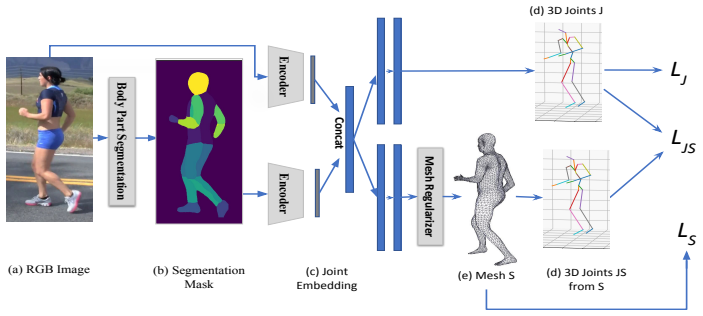
The central object is the 'structured point cloud': a template mesh with fixed topology (the SMPL surface), whose vertices are regressed directly rather than through SMPL's non-linear parameters. The mechanism that carries the argument is the multi-branch multi-task network: two ResNet-18 encoders (RGB and segmentation) feed a shared embedding, from which one branch predicts 3D joints and another predicts vertices; a consistency loss aligns the branch-predicted joints with joints regressed from the mesh via the SMPL joint regressor, and a Laplacian smoothing step (replacing each vertex by the mean of its neighbors) enforces surface smoothness before the surface loss is computed. Together these components let the network learn the implicit skinning structure of the body instead of the highly non-linear pose space.
What would settle it
Train a weight-matched baseline that regresses SMPL pose and shape parameters from the same joint embedding, with the same multi-task losses (surface, joint, consistency), and compare surface error on SURREAL against HMNetOracle. If the parametric regressor matches or beats the vertex regressor, the paper's central 'easier than SMPL parameters' claim is refuted. A second, cheaper test: replace the DensePose masks with random-permuted labels; if surface error does not degrade, the claimed dependence on segmentation is falsified.
Extended reading notes
Core claim
The central claim, stated on the paper's own terms, is that an implicitly structured point cloud—a set of mesh vertices that share a fixed topological template—is an easier learning target than the SMPL parameter vector, because each vertex is a sparse linear combination of joint-induced transformations (the skinning function), so the network implicitly learns the skinning function rather than the non-linear axis-angle pose representation. HumanMeshNet embodies this by regressing 6,890 template vertices and 3D joints in a multi-task, multi-branch architecture, with a loss that combines vertex-wise surface error, joint error, and a cross-branch consistency term, plus a mesh-topology-based smoothing regularizer. The paper reports comparable surface and joint accuracy to state-of-the-art methods on three datasets, at far lower model complexity and feed-forward cost (28 FPS with off-the-shelf body-part segmentation, 173 FPS with ground-truth masks).
Load-bearing premise
The central claim depends on the availability of an accurate body-part segmentation mask at test time: with off-the-shelf DensePose masks HumanMeshNet's surface error on UP-3D is 130.4 mm, while with ground-truth masks (HMNetOracle) it drops to 60.3 mm, so the method's 'comparable to state-of-the-art' result is carried by the oracle setup.
Editorial extensions
If this is right
- If direct vertex regression is genuinely easier than parameter regression, the same template-mesh approach should scale to higher-resolution meshes and capture local shape variations (e.g., gender-specific or expression-driven deformations) that the PCA space of parametric models cannot represent.
- The method's low computational cost suggests that full-body mesh reconstruction can run in real time on consumer GPUs, enabling AR/VR, animation, and e-commerce applications that currently rely on slower optimization-based fitting.
- The consistent joint/surface training provides accurate 3D joints as a byproduct, so a single forward pass yields both a smooth mesh and pose.
- The demonstrated transfer to hand-mesh reconstruction indicates the paradigm is not body-specific: any articulated structure with a fixed template mesh can be recovered by the same pipeline.
- With ground-truth segmentation masks (HMNetOracle) the surface error drops dramatically on UP-3D (60.3 mm vs 130.4 mm), implying that improving the segmentation front-end is a direct route to state-of-the-art accuracy in real-world settings.
Reading between the lines
- If the gap between HMNet and HMNetOracle is mostly due to segmentation quality, then pairing the regressor with a faster and more accurate real-time segmentation network (the authors cite one running at 120 FPS) could make the full pipeline both more accurate and real-time—a direction the paper only mentions in passing.
- The fixed-template assumption means the output is not directly animatable without a separate skinning step; an inference beyond the paper is that adding a lightweight inverse-kinematics or linear-blend-skinning layer on top of the predicted vertices could turn the mesh into an animatable avatar while keeping the regression simple.
- The 'structured point cloud' hypothesis is testable beyond humans: if a template topology is the key prior, the same architecture should work for faces, animals, or clothing items with known template meshes, and the benefit should increase with mesh resolution.
Editorial analysis
A structured set of objections, weighed in public.
Referee Report
Summary. The paper proposes HumanMeshNet, a multi-branch, multi-task network that directly regresses the vertices of a fixed-topology SMPL mesh from a monocular RGB image and a body-part segmentation mask, with auxiliary 3D-joint regression and a mesh-smoothing operation. The model is evaluated on SURREAL, UP-3D, Human3.6M, and a synthetic MANO hand dataset. The authors claim comparable accuracy to state-of-the-art methods at much lower computational cost. Two variants are introduced: HMNet, which uses off-the-shelf DensePose masks, and HMNetOracle, which uses ground-truth segmentation masks at test time.
Significance. The idea of direct vertex regression with fixed topology plus joint-consistency regularization is worth exploring, and the paper provides a clean ablation isolating the role of segmentation quality. The oracle results (60.3 mm on UP-3D and 63.5 mm on SURREAL surface error) suggest that, given accurate part segmentation, direct mesh regression can compete with volumetric and parametric baselines, and the oracle variant is very fast. However, the significance is limited by the fact that the deployable non-oracle model is clearly below the cited state of the art on the surface-error benchmarks, and the paper's headline claims do not qualify this. The loss decomposition and the distinction between HMNet and HMNetOracle are clearly presented, and no circularity is apparent: both branches are supervised by ground-truth targets, and the consistency loss only encourages agreement between the two supervised branches.
major comments (3)
- [Abstract, Section 4.3 (Tables 1 and 2)] The central claim that HumanMeshNet achieves 'comparable performance with SoA' is not supported for the deployable variant. HMNet's surface error is 130.4 mm on UP-3D and 86.6 mm on SURREAL, whereas the cited BodyNet baselines are 80.1 mm and 65.8 mm; on SURREAL, Tung et al. (74.5 mm) and SMPLR (75.4 mm) also beat HMNet. Only HMNetOracle, which is given ground-truth segmentation masks at test time, reaches state-of-the-art-level numbers (60.3 mm and 63.5 mm). Since the abstract and the contribution list state the claim without this qualifier, the paper's main result currently describes an oracle upper bound rather than the proposed pipeline. Please either reframe the contribution around this analysis and address the segmentation bottleneck, or supply a realistic segmentation module that closes the gap.
- [Section 4.3, Table 5] The claim of far lower computational cost is likewise only true for the oracle variant. In Table 5, the full HMNet pipeline runs at 28.01 FPS, essentially tied with HMR at 25 FPS, while HMNetOracle runs at 173.17 FPS because it omits the DensePose segmentation step. The paper should report the total pipeline runtime for the deployable model and qualify the speed advantage accordingly.
- [Tables 1 and 2 vs. Table 3] The closest related baseline, CMR [12], which also regresses mesh vertices, is missing from the surface-error comparisons. CMR appears only in the Human3.6M joint-error table (Table 3), where it reports 50.1 mm PA-joint error versus HMNet's 60.9 mm. Since CMR is the most direct competitor for the claimed paradigm, the surface-error tables should either include CMR's reported numbers on UP-3D and SURREAL or explicitly justify their absence. Without this, the state-of-the-art comparison is incomplete for the paper's central claim.
minor comments (8)
- [Abstract] 'en-commerce' should read 'e-commerce'.
- [Section 4.2] The citation [21] for the Orthogonal Procrustes problem points to the CAESAR anthropometry report, not to a Procrustes reference; please cite the original source (e.g., Schönemann, 1966).
- [Section 3, Eq. (3)] Clarify whether the smoothing operation in Eq. (3) is applied during inference as well as training. As written, it is a preprocessing step on the predicted vertices before computing LS, not an additive penalty term; if it is training-only, state this explicitly.
- [Table 3] HMNet is pretrained on SURREAL with mesh supervision and only fine-tuned on Human3.6M with joint loss, so labeling it under 'No' mesh supervision is true only for the Human3.6M training data; add a footnote to clarify.
- [Section 4.4] The hand-mesh average surface error of 1 mm is reported without a protocol description or comparison to existing hand-mesh methods; label it as a proof-of-concept and specify the evaluation setup.
- [Table 4] Spell out the 'SM DP' and 'SM GT' column abbreviations and specify that the 34.7 mm reduction refers to PA surface error; without this, the text is ambiguous.
- [Section 4.2] The paper uses ground-truth bounding boxes for all datasets; this should be stated as a limitation, since a detector would be needed in a deployable system.
- [Section 1] The abstract and introduction say 'three publicly available datasets,' but the hand-mesh experiment uses a fourth synthetic dataset; clarify that the three-dataset claim refers to body reconstruction.
Circularity Check
No circularity: all losses are supervised by external ground truth or fixed linear regressors.
full rationale
The derivation chain is self-contained and externally grounded. The surface loss LS (Eq. 2) directly compares predicted vertices to ground-truth vertices; the joint loss LJ (Eq. 4) compares predicted joints to ground-truth joints; the consistency loss LJS (Eq. 5) only enforces agreement between the joint branch and the fixed SMPL regressor applied to the mesh branch, with both branches independently supervised by ground-truth data. The Laplacian smoothing regularizer (Eq. 3, from Sorkine et al. 2004) is a standard prior and does not encode the target reconstruction. The SMPL joint regressor is a fixed external linear mapping, not a fitted parameter of this paper. The strong dependence of final accuracy on segmentation-mask quality (HMNetOracle vs HMNet in Tables 1, 2, and 4) is an empirical limitation of the deployable pipeline and a correctness/overclaim concern, not a circular definition or fitted-input prediction. No claim is justified solely by a self-citation, and no equation reduces to its own input. Hence score 0.
Assumptions & free parameters
free parameters (1)
- lambda_1 and lambda_2 loss weights =
not reported
assumptions (4)
- domain assumption SMPL template topology and vertex-to-joint regressor are valid for the target humans and hands
- domain assumption Body part segmentation masks from DensePose [1] are available and reliable at test time
- standard math Laplacian averaging is a valid smoothness prior for human body meshes
- domain assumption Ground-truth meshes in the training datasets are accurate SMPL registrations
Cite this review
Pith. "Pith review of HumanMeshNet: Polygonal Mesh Recovery of Humans." pith.science (2026). https://pith.science/paper/MCTNF5GY
@misc{pith2026190806544,
  author       = {Pith},
  title        = {Pith review of: HumanMeshNet: Polygonal Mesh Recovery of Humans},
  year         = {2026},
  howpublished = {\url{https://pith.science/paper/MCTNF5GY}},
  note         = {Machine review of arXiv:1908.06544}
}
read the original abstract
3D Human Body Reconstruction from a monocular image is an important problem in computer vision with applications in virtual and augmented reality platforms, animation industry, en-commerce domain, etc. While several of the existing works formulate it as a volumetric or parametric learning with complex and indirect reliance on re-projections of the mesh, we would like to focus on implicitly learning the mesh representation. To that end, we propose a novel model, HumanMeshNet, that regresses a template mesh's vertices, as well as receives a regularization by the 3D skeletal locations in a multi-branch, multi-task setup. The image to mesh vertex regression is further regularized by the neighborhood constraint imposed by mesh topology ensuring smooth surface reconstruction. The proposed paradigm can theoretically learn local surface deformations induced by body shape variations and can therefore learn high-resolution meshes going ahead. We show comparable performance with SoA (in terms of surface and joint error) with far lesser computational complexity, modeling cost and therefore real-time reconstructions on three publicly available datasets. We also show the generalizability of the proposed paradigm for a similar task of predicting hand mesh models. Given these initial results, we would like to exploit the mesh topology in an explicit manner going ahead.
Figures


Figures from the paper (6 more)



Forward citations
Cited by 1 Pith paper
-
DeepHuMS: Deep Human Motion Signature for 3D Skeletal Sequences
A Siamese RNN trained with a trajectory-based contrastive loss produces a 3D human motion descriptor that outperforms prior retrieval and recognition embeddings on NTU RGB+D and HDM05.
Reference graph
Works this paper leans on
-
[12]
N. Kolotouros, G. Pavlakos, and K. Daniilidis. Convolu- tional mesh regression for single-image human shape recon- struction. In CVPR, 2019. 2, 3, 5, 6, 8
work page 2019
-
[1]
R. Alp G ¨uler, N. Neverova, and I. Kokkinos. Densepose: Dense human pose estimation in the wild. In Proceedings of the IEEE Conference on Computer Vision and Pattern Recognition, pages 7297–7306, 2018. 2, 3, 4
work page 2018
-
[2]
D. Anguelov, P. Srinivasan, D. Koller, S. Thrun, J. Rodgers, and J. Davis. Scape: shape completion and animation of people. ACM Transaction on Graphics , 24:408–416, 2005. 1
work page 2005
-
[3]
F. Bogo, A. Kanazawa, C. Lassner, P. Gehler, J. Romero, and M. J. Black. Keep it SMPL: Automatic estimation of 3D human pose and shape from a single image. In European Conference on Computer Vision (ECCV), 2016. 2, 3, 4, 5, 8
work page 2016
-
[4]
F. Bogo, A. Kanazawa, C. Lassner, P. Gehler, J. Romero, and M. J. Black. Keep it smpl: Automatic estimation of 3d human pose and shape from a single image. In European Conference on Computer Vision , pages 561–578. Springer,
-
[5]
A. Boukhayma, R. de Bem, and P. H. Torr. 3d hand shape and pose from images in the wild. arXiv preprint arXiv:1902.03451, 2019. 3
arXiv 1902
-
[6]
J. J. Charles, I. Budvytis, and R. Cipolla. Real-time factored convnets: Extracting the x factor in human parsing. 2018. 8
work page 2018
-
[7]
M. Dou, S. Khamis, Y . Degtyarev, P. Davidson, S. R. Fanello, A. Kowdle, S. O. Escolano, C. Rhemann, D. Kim, J. Taylor, P. Kohli, V . Tankovich, and S. Izadi. Fusion4d: Real-time performance capture of challenging scenes. ACM Transac- tion on Graphics, 35(4):114:1–114:13, July 2016. 8
work page 2016
Show all 35 references
-
[8]
L. Ge, Z. Ren, Y . Li, Z. Xue, Y . Wang, J. Cai, and J. Yuan. 3d hand shape and pose estimation from a single rgb image. In Proceedings of the IEEE Conference on Computer Vision and Pattern Recognition, pages 10833–10842, 2019. 3, 8
2019
-
[9]
P. Guan, A. Weiss, A. O. Balan, and M. J. Black. Estimating human shape and pose from a single image. In Computer Vision, 2009 IEEE 12th International Conference on , pages 1381–1388. IEEE, 2009. 2, 3
2009
-
[10]
Ionescu, D
C. Ionescu, D. Papava, V . Olaru, and C. Sminchisescu. Human3. 6m: Large scale datasets and predictive meth- ods for 3d human sensing in natural environments. IEEE transactions on pattern analysis and machine intelligence , 36(7):1325–1339, 2014. 4, 5, 6
2014
-
[11]
Kanazawa, M
A. Kanazawa, M. J. Black, D. W. Jacobs, and J. Malik. End- to-end recovery of human shape and pose. 2, 3, 5, 6, 7, 8
-
[13]
Lassner, J
C. Lassner, J. Romero, M. Kiefel, F. Bogo, M. J. Black, and P. V . Gehler. Unite the people: Closing the loop between 3d and 2d human representations. 2, 3, 4, 6, 8
-
[14]
Loper, N
M. Loper, N. Mahmood, J. Romero, G. Pons-Moll, and M. J. Black. SMPL: A skinned multi-person linear model. ACM Trans. Graphics (Proc. SIGGRAPH Asia) , 34(6):248:1– 248:16, Oct. 2015. 1, 2, 4
2015
-
[15]
Madadi, H
M. Madadi, H. Bertiche, and S. Escalera. Smplr: Deep smpl reverse for 3d human pose and shape recovery. arXiv preprint arXiv:1812.10766, 2018. 6
2018 arXiv
-
[16]
Malik, A
J. Malik, A. Elhayek, F. Nunnari, K. Varanasi, K. Tamaddon, A. Heloir, and D. Stricker. Deephps: End-to-end estimation of 3d hand pose and shape by learning from synthetic depth. arXiv preprint arXiv:1808.09208, 2018. 3
2018 arXiv
-
[17]
Mandikal, N
P. Mandikal, N. K. L., M. Agarwal, and V . B. Radhakrish- nan. 3d-lmnet: Latent embedding matching for accurate and diverse 3d point cloud reconstruction from a single image. In British Machine Vision Conference, page 55, 2018. 2
2018
-
[18]
Omran, C
M. Omran, C. Lassner, G. Pons-Moll, P. V . Gehler, and B. Schiele. Neural body fitting: Unifying deep learning and model-based human pose and shape estimation. arXiv preprint arXiv:1808.05942, 2018. 2, 3, 6
2018 arXiv
-
[19]
Pavlakos, L
G. Pavlakos, L. Zhu, X. Zhou, and K. Daniilidis. Learning to estimate 3d human pose and shape from a single color image. arXiv preprint arXiv:1805.04092, 2018. 2, 3, 5, 6, 8
2018 arXiv
-
[20]
Ramakrishna, T
V . Ramakrishna, T. Kanade, and Y . Sheikh. Reconstructing 3d human pose from 2d image landmarks. InEuropean Con- ference on Computer Vision, pages 573–586. Springer, 2012. 6
2012
-
[21]
K. M. Robinette, S. Blackwell, H. Daanen, M. Boehmer, and S. Fleming. Civilian american and european surface anthro- pometry resource (caesar), final report. volume 1. summary. Technical report, SYTRONICS INC DAYTON OH, 2002. 4, 5
2002
-
[22]
Romero, D
J. Romero, D. Tzionas, and M. J. Black. Embodied hands: Modeling and capturing hands and bodies together. ACM Transactions on Graphics (TOG), 36(6):245, 2017. 1, 3, 8
2017
-
[23]
Sigal, A
L. Sigal, A. Balan, and M. J. Black. Combined discrimi- native and generative articulated pose and non-rigid shape estimation. In Advances in neural information processing systems, pages 1337–1344, 2008. 2, 3
2008
-
[24]
Sorkine, D
O. Sorkine, D. Cohen-Or, Y . Lipman, M. Alexa, C. R ¨ossl, and H.-P. Seidel. Laplacian surface editing. In Proceedings of the 2004 Eurographics/ACM SIGGRAPH symposium on Geometry processing, pages 175–184. ACM, 2004. 4
2004
-
[25]
J. S. Supancic, G. Rogez, Y . Yang, J. Shotton, and D. Ra- manan. Depth-based hand pose estimation: data, methods, and challenges. In Proceedings of the IEEE international conference on computer vision, pages 1868–1876, 2015. 3
2015
-
[26]
V . Tan, I. Budvytis, and R. Cipolla. Indirect deep structured learning for 3d human body shape and pose prediction. 2
-
[27]
Tung, H.-W
H.-Y . Tung, H.-W. Tung, E. Yumer, and K. Fragkiadaki. Self-supervised learning of motion capture. In Advances in Neural Information Processing Systems , pages 5236–5246,
-
[28]
Varol, D
G. Varol, D. Ceylan, B. Russell, J. Yang, E. Yumer, I. Laptev, and C. Schmid. Bodynet: V olumetric inference of 3d human body shapes. arXiv preprint arXiv:1804.04875 , 2018. 1, 2, 3, 5, 6
2018 arXiv
-
[29]
Varol, J
G. Varol, J. Romero, X. Martin, N. Mahmood, M. J. Black, I. Laptev, and C. Schmid. Learning from synthetic humans. In Proceedings of the IEEE Conference on Computer Vision and Pattern Recognition, pages 109–117, 2017. 4, 5, 6
2017
-
[30]
Venkat, S
A. Venkat, S. S. Jinka, and A. Sharma. Deep tex- tured 3d reconstruction of human bodies. arXiv preprint arXiv:1809.06547, 2018. 1, 5
2018 arXiv
-
[31]
Y . Xia, Y . Zhang, D. Zhou, X. Huang, C. Wang, and R. Yang. Realpoint3d: Point cloud generation from a single image with complex background. CoRR, abs/1809.02743, 2018. 2
2018 arXiv
-
[32]
Xiang, H
D. Xiang, H. Joo, and Y . Sheikh. Monocular total capture: Posing face, body, and hands in the wild. arXiv preprint arXiv:1812.01598, 2018. 2
2018 arXiv
-
[33]
K. Xu, W. Hu, J. Leskovec, and S. Jegelka. How powerful are graph neural networks? In International Conference on Learning Representations, 2019. 3
2019
-
[34]
S. Yuan, G. Garcia-Hernando, B. Stenger, G. Moon, J. Yong Chang, K. Mu Lee, P. Molchanov, J. Kautz, S. Honari, L. Ge, et al. Depth-based 3d hand pose esti- mation: From current achievements to future goals. In The IEEE Conference on Computer Vision and Pattern Recogni- tion (C...
2018
-
[35]
X. Zhou, S. Leonardos, X. Hu, and K. Daniilidis. 3d shape estimation from 2d landmarks: A convex relaxation ap- proach. In proceedings of the IEEE conference on computer vision and pattern recognition, pages 4447–4455, 2015. 6
2015
Reviewed August 14, 2026 · model on record in the stance chip above.
Discussion (0). Continue with ORCID to comment.