REVIEW 3 major objections 6 minor 95 references
Revisiting Heterogeneous Defect Prediction: How Far Are We?
T0 review · 3 major / 6 minor · reviewed 2026-08-14 · deepseek-v4-flash
Pith's one-line read Across 962 setups, no-label baselines beat trained defect predictors
desk verdict Solid replication with a cautionary result that probably holds for simple baselines, but the strongest 'all five unsupervised methods win' claim rides on an oracle baseline and should be fixed before publication. read the letter →
The pith
A machine-rendered reading of the paper's core claim, the machinery that carries it, and where it could break.
The reading
What carries the argument
The machinery that carries the argument is a comparison protocol rather than a single theorem. Each HDP method and each unsupervised method is evaluated under one shared experimental setup on 962 source-to-target combinations, and performance is ranked by the Scott-Knott test (a recursive clustering of methods into statistically distinct rank groups), with pairwise differences checked by the Benjamini-Hochberg-corrected Wilcoxon signed-rank test and Cliff's delta effect sizes. The load-bearing baselines are ManualUp/ManualDown from Zhou et al., which sort modules by lines of code and label the top half defective, plus UDP5, a variant that picks the metric achieving the best performance on each target project and performance measure. The diversity analysis uses McNemar's test on paired predictions to decide whether two methods identify the same defective modules. What this machinery does is convert the research question into a falsifiable ranking: if a supervised HDP method cannot land in a top Scott-Knott rank group against methods that ignore labels, then its transfer machinery is not delivering measurable value on these datasets.
What would settle it
Re-run the same 962 comparisons with UDP5 either deleted or redefined to pick its metric using only source-project information or a fixed label-free rule; the central claim would be falsified if, without UDP5, HDP methods occupy the top Scott-Knott rank group on F1 or AUC, and it would be strengthened if the unsupervised methods still dominate.
Extended reading notes
Core claim
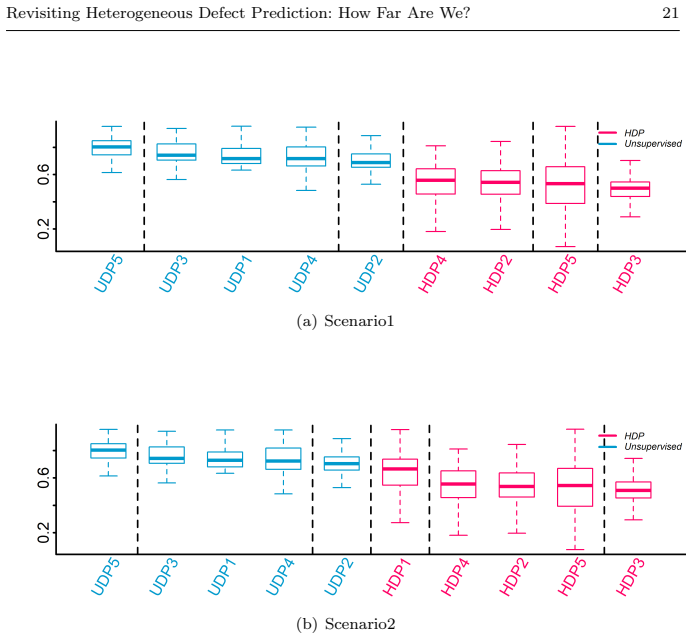
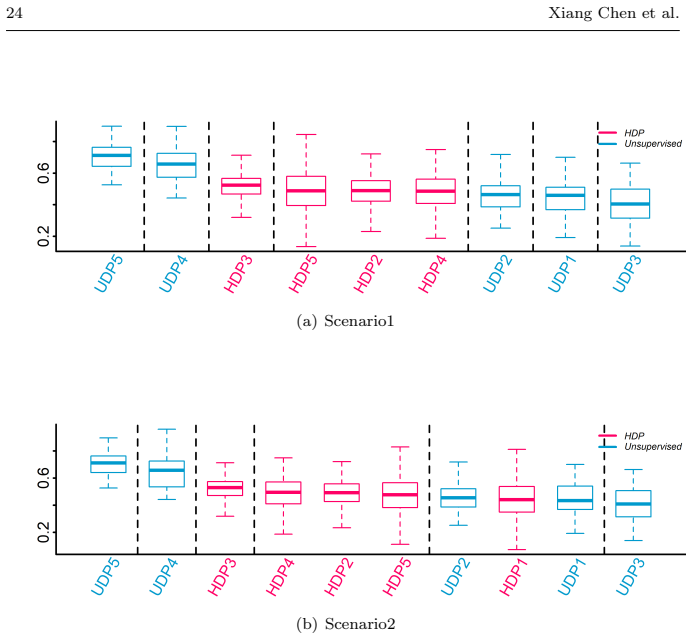
On the paper's own terms, the central discovery is that the current generation of heterogeneous defect prediction methods has not established an advantage over methods that need no labeled training data. Across 962 cross-project combinations, the five HDP methods—metric selection and matching, EMKCA, CTKCCA, TSEL, and distribution-characteristic mapping—fail to rank above the five unsupervised methods in Scott-Knott analyses for any of the six performance measures. For F1 and AUC specifically, every unsupervised method lands in a significantly better rank group than every HDP method, with the win/tie/loss tables showing the unsupervised methods winning the large majority of the 34 target-project comparisons. For effort-aware measures, the two size-based ranking methods (ManualUp/ManualDown and its metric-selection variant UDP5) are the clear leaders, while the other unsupervised methods remain competitive. The authors also find through McNemar's test that HDP and unsupervised predictions diverge on defective modules more than within-family comparisons do, and that a substantial fraction of defective modules are missed by both families, which they read as evidence that HDP research still has a long way to go.
Load-bearing premise
Section 3.2 introduces UDP5 by letting it choose, for every target project and performance measure, the metric that performs best using that target project's labels; if that oracle-like construction is not a legitimate baseline, the global Scott-Knott rankings and the claim that all five unsupervised methods beat HDP collapse, though the simpler LOC-based baselines may still stand.
Editorial extensions
If this is right
- Future HDP studies that report gains over older supervised methods but omit unsupervised baselines should not be read as progress; the default comparison should include ManualUp/ManualDown and comparable label-free rankers.
- Because HDP and unsupervised predictions flag different defective modules, ensembling the two families is a concrete, testable route to better recall; the paper explicitly points toward ensemble learning as a likely next step.
- The low satisfactory ratios under both criteria (precision and recall above 75%, or recall above 70% with precision above 50%) imply that HDP models are not yet dependable enough to drive defect-inspection effort on the studied project types.
- The result extends the earlier cross-project finding that simple size-based ranking beats complex models: the same pattern survives when source and target projects use different metric sets, which is the harder heterogeneous setting.
Reading between the lines
- Editorial inference: the headline result leans on UDP5, which uses target-project labels to choose its metric; if UDP5 is excluded, the strong claim that all five unsupervised methods beat HDP weakens, though the simpler LOC-based baselines would still be competitive.
- Editorial inference: the diversity result implies a cheap experiment the paper does not run—combining one HDP model with a LOC-based ranker in a simple ensemble and testing whether the union beats either alone; the McNemar tables suggest headroom for exactly this kind of hybrid.
- Editorial inference: if the pattern replicates beyond these 34 projects, the practical implication is that research effort may be better spent on deciding when labels help, rather than on ever more elaborate kernel or domain-adaptation machinery.
- Editorial inference: a further testable extension would be to run the same comparison with effort-aware measures on change-level (just-in-time) data, since the earlier unsupervised-baseline debates originated there and the present study's effort-aware results may or may not carry over.
Signed reviews
Editorial analysis
A structured set of objections, weighed in public.
Referee Report
Summary. This paper reports a large-scale replication study comparing five heterogeneous defect prediction (HDP) methods with five unsupervised baselines on 962 source-target combinations drawn from 34 projects in five dataset groups. Across F1, AUC, ACC, Popt, PMI@20%, and IFA, the authors conclude that HDP methods do not significantly outperform the unsupervised methods, and that simple baselines such as ManualUp/ManualDown (UDP4) should be included in future HDP evaluations. The paper also reports McNemar-based diversity analyses suggesting that HDP and unsupervised methods identify partially complementary defective modules, and a satisfactory-ratio analysis indicating that HDP methods rarely meet previously proposed precision/recall criteria.
Significance. If the main result is correct, the paper provides a valuable and potentially field-changing negative result: it would show that the gains attributed to HDP methods over the past five years are not visible relative to simple unsupervised baselines, and it would justify changing standard evaluation practice. The study has a large and diverse subject pool (962 combinations, 34 projects, five groups), considers both effort-aware and non-effort-aware measures, and uses standard statistical tools such as Scott-Knott, Wilcoxon with BH correction, and Cliff's delta. The central weakness is that one of the five 'unsupervised' baselines, UDP5, is not actually unsupervised: its metric is selected using target-project labels. Because UDP5 appears in the global rankings, win/tie/loss tables, diversity analysis, and satisfactory-ratio analysis, several of the strongest claims currently overstate what the data show. The UDP4-based conclusion is more defensible and may survive revision. The paper would also benefit from releasing artifacts; no permanent code or data link is currently provided.
major comments (3)
- [Section 3.2, Section 5.1, Figures 2-3, Tables 4-7] UDP5 is defined in Section 3.2 as the variant that chooses, for each target project and each performance measure, the metric that achieves the best performance in the target project. This is an oracle baseline because the selection uses the target labels, not just the target feature values. The paper nonetheless counts UDP5 among the 'five unsupervised methods' and uses it in the Scott-Knott rankings of Figures 2 and 3 and in the win/tie/loss tables (Tables 4-7). Section 5.1's claim that 'all the 5 unsupervised methods can significantly perform better than supervised methods' therefore depends on a baseline that no practitioner could deploy. Please exclude UDP5 from the main comparisons, or explicitly re-label it as an upper-bound reference, and recompute all rankings, win/tie/loss counts, and the statements in the abstract and Section 5.1 accordingly.
- [Tables 4 and 5, Section 5.3] The influence of UDP5 is visible in the 34/34 win counts reported in Tables 4 and 5. Since UDP5's per-measure metric is selected using target labels, these wins are partly self-fulfilling and cannot be used as evidence that an unsupervised method outperforms the HDP methods. The same dependence affects the diversity analysis in Section 5.3, where UDP5-A and UDP5-F choose metrics by AUC and F1 performance on the target; the resulting pairwise diversity counts (Tables 11 and 12) may reflect the oracle's adaptation to the target rather than a property of unsupervised predictions. The paper should re-run the analysis with only the deployable unsupervised baselines (UDP1-UDP4) and state what changes.
- [Section 5.4] Table 14 includes UM5 in the satisfactory-ratio analysis. The high ratios for UM5 (e.g., 66.67% on PROMISE under SC2) are not achievable by an unsupervised method under the same protocol, because the metric is selected using the target labels. The qualitative conclusion that the satisfactory ratios of HDP methods are pessimistic may survive, but the UM5 rows should be removed or explicitly marked as oracle results.
minor comments (6)
- [Section 5.1, Table 5 text] The sentence 'the UDP methods can win HDP1, HDP2, HDP3, HDP4 and HDP5 at least 26, 30, 29, 30, 30 and 26 times' lists six minima for five HDP methods; please correct the enumeration.
- [Footnote 2] Footnote 2 is a placeholder and no artifact link is provided; because this is a replication study, please provide a permanent URL to code, data, and detailed results.
- [Section 5.3] The sentence about the mcnemar function mixing 'statsmodel' and 'R package exact2 × 26' is garbled; please clarify which implementation and version was used.
- [Section 4.3.2, Figures 6-7] For IFA and PMI@20%, state explicitly whether larger values are better or worse; the current text says UM4 has the 'highest IFA value' without noting that high IFA is usually considered undesirable.
- [Section 4.2] The derivation of 962 HDP combinations is spread over two sentences and depends on per-project metric sets inside NASA; a short formula or table would help reproducibility.
- [Section 5.3, Tables 10-12] Report whether any multiple-comparison correction was applied to the McNemar tests; uncorrected p<0.05 on hundreds of comparisons per method pair will produce many 'significant' combinations by chance.
Circularity Check
Oracle-based UDP5 makes the 'all five unsupervised methods beat HDP' finding self-fulfilling; the UDP4-based conclusion remains independent.
-
fitted input called prediction
[Section 3.2 (UDP5), applied in Section 5.1, Figures 2-3, Tables 4-5, and Section 5.3 (UDP5-A/UDP5-F)]
"Therefore, we consider the fifth unsupervised methods, which is a variant of the method UDP4. In particular, given a specific performance measure, we choose the metric, which can achieve the best performance in the target project. We use UDP5 to denote this method."
UDP5 is constructed by selecting, for each target project and each evaluation measure, the metric that performs best on the target project's labels. It is therefore an oracle baseline, not a label-free unsupervised method. Section 5.1 then reports that 'all the 5 unsupervised methods can significantly perform better than supervised methods' on AUC and F1 and that 'UM5 can achieve the best performance'; Tables 4 and 5 show UDP5 winning 34/34 target combinations. These wins are forced by the construction: the metric choice was fitted to the same labels and the same performance measure used in the evaluation. The Scott-Knott rankings in Figures 2-3 and the RQ3 diversity analysis using UDP5-A/UDP5-F also inherit this label-based selection.
full rationale
The paper's central negative result has two layers. The layer supported by UDP4 (ManualDown/ManualUp) is a legitimate, label-free size-based ranking baseline proposed by Zhou et al.; if the paper had only claimed that HDP methods do not beat such simple baselines, the study would be self-contained and non-circular. The circularity is concentrated in UDP5: Section 3.2 defines UDP5 as choosing, for each target project and each performance measure, the metric that gives the best performance on the target project's known labels. This is an oracle selection, yet the paper counts UDP5 among its five unsupervised methods and uses it for the strongest comparative claims: that all five unsupervised methods significantly outperform HDP methods on AUC and F1, that UM5 achieves the best performance, and the Scott-Knott rankings in Figures 2 and 3. UDP5's perfect 34/34 win counts in Tables 4 and 5 are a direct consequence of the construction, not an independent empirical discovery. Removing UDP5 does not destroy the UDP4-based conclusion, but it does invalidate the 'all five' and 'best' statements and could change the global rankings. No other load-bearing step reduces to its inputs: the HDP methods are replicated from external prior work, and self-citations in the related work are not load-bearing. The lack of released code/data is a reproducibility concern, not an additional circularity.
Assumptions & free parameters
free parameters (1)
- UDP5 optimal metric selection =
per target project and per performance measure; the metric with highest performance on the target labels
assumptions (3)
- domain assumption Defective modules tend to have larger metric values than non-defective modules, used by UDP1-UDP4.
- domain assumption The implementations of HDP1-HDP4 obtained from previous studies are correct and faithful to the original methods.
- domain assumption The five public dataset groups, AEEEM, ReLink, PROMISE, NASA, and SOFTLAB, are representative and their labels are reliable.
Cite this review
Pith. "Pith review of Revisiting Heterogeneous Defect Prediction: How Far Are We?." pith.science (2026). https://pith.science/paper/FTQCPYOZ
@misc{pith2026190806560,
  author       = {Pith},
  title        = {Pith review of: Revisiting Heterogeneous Defect Prediction: How Far Are We?},
  year         = {2026},
  howpublished = {\url{https://pith.science/paper/FTQCPYOZ}},
  note         = {Machine review of arXiv:1908.06560}
}
read the original abstract
Until now, researchers have proposed several novel heterogeneous defect prediction HDP methods with promising performance. To the best of our knowledge, whether HDP methods can perform significantly better than unsupervised methods has not yet been thoroughly investigated. In this article, we perform a replication study to have a holistic look in this issue. In particular, we compare state-of-the-art five HDP methods with five unsupervised methods. Final results surprisingly show that these HDP methods do not perform significantly better than some of unsupervised methods (especially the simple unsupervised methods proposed by Zhou et al.) in terms of two non-effort-aware performance measures and four effort-aware performance measures. Then, we perform diversity analysis on defective modules via McNemar's test and find the prediction diversity is more obvious when the comparison is performed between the HDP methods and the unsupervised methods than the comparisons only between the HDP methods or between the unsupervised methods. This shows the HDP methods and the unsupervised methods are complementary to each other in identifying defective models to some extent. Finally, we investigate the feasibility of five HDP methods by considering two satisfactory criteria recommended by previous CPDP studies and find the satisfactory ratio of these HDP methods is still pessimistic. The above empirical results implicate there is still a long way for heterogeneous defect prediction to go. More effective HDP methods need to be designed and the unsupervised methods should be considered as baselines.
Figures


Figures from the paper (4 more)


Reference graph
Works this paper leans on
-
[1]
Journal of the royal statistical society
Benjamini, Y., Hochberg, Y.: Controlling the false discovery rate: a practical and pow- erful approach to multiple testing. Journal of the royal statistical society. Series B (Methodological) pp. 289–300 (1995)
1995
-
[2]
In: Proceedings of the Working Conference on Mining Software Repositories, pp
Bettenburg, N., Nagappan, M., Hassan, A.E.: Think locally, act globally: Improving defect and effort prediction models. In: Proceedings of the Working Conference on Mining Software Repositories, pp. 60–69 (2012)
2012
-
[3]
Bettenburg, N., Nagappan, M., Hassan, A.E.: Towards improving statistical modeling of software engineering data: think locally, act globally! Empirical Software Engineering 20(2), 294–335 (2015)
2015
-
[4]
354–363 (2017)
Bin, Y., Zhou, K., Lu, H., Zhou, Y., Xu, B.: Training data selection for cross-project defection prediction: which approach is better? In: Proceedings of the International Symposium on Empirical Software Engineering and Measurement, pp. 354–363 (2017)
2017
-
[5]
Bowes, D., Hall, T., Petri´ c, J.: Software defect prediction: do different classifiers find the same defects? Software Quality Journal 26(2), 525–552 (2018)
2018
-
[6]
In: Proceedings of the International Sympo- sium on Empirical Software Engineering and Measurement, pp
Camargo Cruz, A.E., Ochimizu, K.: Towards logistic regression models for predicting fault-prone code across software projects. In: Proceedings of the International Sympo- sium on Empirical Software Engineering and Measurement, pp. 460–463 (2009) 2 The website will be given when the manuscript is accepted. 36 Xiang Chen et al
2009
-
[7]
In: Proceedings of the International Conference on Software Testing, Verification and Validation, pp
Canfora, G., De Lucia, A., Di Penta, M., Oliveto, R., Panichella, A., Panichella, S.: Multi-objective cross-project defect prediction. In: Proceedings of the International Conference on Software Testing, Verification and Validation, pp. 252–261 (2013)
2013
-
[8]
Software Testing, Verification and Reliability 25(4), 426–459 (2015)
Canfora, G., Lucia, A.D., Penta, M.D., Oliveto, R., Panichella, A., Panichella, S.: Defect prediction as a multiobjective optimization problem. Software Testing, Verification and Reliability 25(4), 426–459 (2015)
2015
Show all 95 references
-
[9]
Journal of Artificial Intelligence Research 16(1), 321–357 (2002)
Chawla, N.V., Bowyer, K.W., Hall, L.O., Kegelmeyer, W.P.: Smote: synthetic minority over-sampling technique. Journal of Artificial Intelligence Research 16(1), 321–357 (2002)
2002
-
[10]
Information and Software Technology 62, 67–77 (2015)
Chen, L., Fang, B., Shang, Z., Tang, Y.: Negative samples reduction in cross-company software defects prediction. Information and Software Technology 62, 67–77 (2015)
2015
-
[11]
Information and Software Technology 93, 1–13 (2018)
Chen, X., Zhao, Y., Wang, Q., Yuan, Z.: Multi: Multi-objective effort-aware just-in-time software defect prediction. Information and Software Technology 93, 1–13 (2018)
2018
-
[12]
IEEE Transactions on Software Engineering 43(7), 641–657 (2016)
Da Costa, D.A., McIntosh, S., Shang, W., Kulesza, U., Coelho, R., Hassan, A.E.: A framework for evaluating the results of the szz approach for identifying bug-introducing changes. IEEE Transactions on Software Engineering 43(7), 641–657 (2016)
2016
-
[13]
In: Proceedings of the Working Conference on Mining Software Repositories, pp
D’Ambros, M., Lanza, M., Robbes, R.: An extensive comparison of bug prediction ap- proaches. In: Proceedings of the Working Conference on Mining Software Repositories, pp. 31–41 (2010)
2010
-
[14]
Neural computation 10(7), 1895–1923 (1998)
Dietterich, T.G.: Approximate statistical tests for comparing supervised classification learning algorithms. Neural computation 10(7), 1895–1923 (1998)
1998
-
[15]
In: Proceedings of the Asia-Pacific Software Engineering Conference (2018)
Feng Wang, J.H., Ma, Y.: A top-k learning to rank approach to cross-project software defect prediction. In: Proceedings of the Asia-Pacific Software Engineering Conference (2018)
2018
-
[16]
In: Proceedings of the Working Conference on Mining Software Repositories, pp
Fukushima, T., Kamei, Y., McIntosh, S., Yamashita, K., Ubayashi, N.: An empirical study of just-in-time defect prediction using cross-project models. In: Proceedings of the Working Conference on Mining Software Repositories, pp. 172–181 (2014)
2014
-
[17]
In: Proceedings of the 37th International Conference on Software Engineering-Volume 1, pp
Ghotra, B., McIntosh, S., Hassan, A.E.: Revisiting the impact of classification techniques on the performance of defect prediction models. In: Proceedings of the 37th International Conference on Software Engineering-Volume 1, pp. 789–800 (2015)
2015
-
[18]
IEEE Transactions on Software Engineering 38(6), 1276–1304 (2011)
Hall, T., Beecham, S., Bowes, D., Gray, D., Counsell, S.: A systematic literature review on fault prediction performance in software engineering. IEEE Transactions on Software Engineering 38(6), 1276–1304 (2011)
2011
-
[19]
Information & Software Technology 59, 170–190 (2015)
He, P., Li, B., Liu, X., Chen, J., Ma, Y.: An empirical study on software defect prediction with a simplified metric set. Information & Software Technology 59, 170–190 (2015)
2015
-
[20]
CoRR abs/1411.4228 (2014)
He, P., Li, B., Ma, Y.: Towards cross-project defect prediction with imbalanced feature sets. CoRR abs/1411.4228 (2014)
2014 arXiv
-
[21]
Automated Software Engineering 19(2), 167–199 (2012)
He, Z., Shu, F., Yang, Y., Li, M., Wang, Q.: An investigation on the feasibility of cross- project defect prediction. Automated Software Engineering 19(2), 167–199 (2012)
2012
-
[22]
In: Proceedings of International Conference on Predictive Models in Software Engineering, pp
Herbold, S.: Training data selection for cross-project defect prediction. In: Proceedings of International Conference on Predictive Models in Software Engineering, pp. 6:1–6:10 (2013)
2013
-
[23]
local models for cross-project defect prediction
Herbold, S., Trautsch, A., Grabowski, J.: Global vs. local models for cross-project defect prediction. Empirical Software Engineering 22(4), 1866–1902 (2017)
2017
-
[24]
IEEE Transactions on Software Engineering44(9), 811 – 833 (2018)
Herbold, S., Trautsch, A., Grabowski, J.: A comparative study to benchmark cross- project defect prediction approaches. IEEE Transactions on Software Engineering44(9), 811 – 833 (2018)
2018
-
[25]
IEEE Transactions on Software Engineering 45(2), 111 – 147 (2019)
Hosseini, S., Turhan, B., Gunarathna, D.: A systematic literature review and meta- analysis on cross project defect prediction. IEEE Transactions on Software Engineering 45(2), 111 – 147 (2019)
2019
-
[26]
In: Proceedings of the International Conference on Predictive Models in Software Engineering, pp
Hosseini, S., Turhan, B., M¨ antyl¨ a, M.: Search based training data selection for cross project defect prediction. In: Proceedings of the International Conference on Predictive Models in Software Engineering, pp. 3:1–3:10 (2016)
2016
-
[27]
Information and Software Technology 95, 296–312 (2018)
Hosseini, S., Turhan, B., M¨ antyl¨ a, M.: A benchmark study on the effectiveness of search- based data selection and feature selection for cross project defect prediction. Information and Software Technology 95, 296–312 (2018)
2018
-
[28]
In: Proceedings of the International Conference on Software Maintenance and Evolution, pp
Huang, Q., Xia, X., Lo, D.: Supervised vs unsupervised models: A holistic look at effort- aware just-in-time defect prediction. In: Proceedings of the International Conference on Software Maintenance and Evolution, pp. 159–170 (2017) Revisiting Heterogeneous Defect Prediction: ...
2017
-
[29]
Empirical Software Engineering pp
Huang, Q., Xia, X., Lo, D.: Revisiting supervised and unsupervised models for effort- aware just-in-time defect prediction. Empirical Software Engineering pp. 1–40 (2018)
2018
-
[30]
TEMA (S˜ ao Carlos)15(1), 3–17 (2014)
Jelihovschi, E.G., Faria, J.C., Allaman, I.B.: Scottknott: a package for performing the scott-knott clustering algorithm in r. TEMA (S˜ ao Carlos)15(1), 3–17 (2014)
2014
-
[31]
In: Proceedings of Joint Meeting of the European Software Engineering Conference and the Symposium on Foundations of Software Engineering (2015)
Jing, X., Fei, W., Dong, X., Qi, F., Xu, B.: Heterogeneous cross-company defect predic- tion by unified metric representation and cca-based transfer learning. In: Proceedings of Joint Meeting of the European Software Engineering Conference and the Symposium on Foundations of So...
2015
-
[32]
IEEE Trans- actions on Software Engineering 43(4), 321–339 (2017)
Jing, X.Y., Wu, F., Dong, X., Xu, B.: An improved sda based defect prediction frame- work for both within-project and cross-project class-imbalance problems. IEEE Trans- actions on Software Engineering 43(4), 321–339 (2017)
2017
-
[33]
In: Proceedings of the International Conference on Predictive Models in Software Engineering, pp
Jureczko, M., Madeyski, L.: Towards identifying software project clusters with regard to defect prediction. In: Proceedings of the International Conference on Predictive Models in Software Engineering, pp. 9:1–9:10 (2010)
2010
-
[34]
Empirical Software Engineering 21(5), 2072–2106 (2016)
Kamei, Y., Fukushima, T., McIntosh, S., Yamashita, K., Ubayashi, N., Hassan, A.E.: Studying just-in-time defect prediction using cross-project models. Empirical Software Engineering 21(5), 2072–2106 (2016)
2016
-
[35]
In: Proceedings of the International Conference on Software Maintenance, pp
Kamei, Y., Matsumoto, S., Monden, A., Matsumoto, K.i., Adams, B., Hassan, A.E.: Revisiting common bug prediction findings using effort-aware models. In: Proceedings of the International Conference on Software Maintenance, pp. 1–10 (2010)
2010
-
[36]
In: Proceedings of the International Conference on Software Analysis, Evolution, and Reengineering, pp
Kamei, Y., Shihab, E.: Defect prediction: Accomplishments and future challenges. In: Proceedings of the International Conference on Software Analysis, Evolution, and Reengineering, pp. 33–45 (2016)
2016
-
[37]
IEEE Transactions on Software Engineering 39(6), 757–773 (2013)
Kamei, Y., Shihab, E., Adams, B., Hassan, A.E., Mockus, A., Sinha, A., Ubayashi, N.: A large-scale empirical study of just-in-time quality assurance. IEEE Transactions on Software Engineering 39(6), 757–773 (2013)
2013
-
[38]
In: Proceedings of the International Symposium on Software Testing and Analysis, pp
Kochhar, P.S., Xia, X., Lo, D., Li, S.: Practitioners’ expectations on automated fault localization. In: Proceedings of the International Symposium on Software Testing and Analysis, pp. 165–176 (2016)
2016
-
[39]
IEEE Transactions on Software Engineering (2018)
Krishna, R., Menzies, T.: Bellwethers: A baseline method for transfer learning. IEEE Transactions on Software Engineering (2018)
2018
-
[40]
In: Proceedings of International Conference on Automated Software Engineering, pp
Krishna, R., Menzies, T., Fu, W.: Too much automation? the bellwether effect and its implications for transfer learning. In: Proceedings of International Conference on Automated Software Engineering, pp. 122–131 (2016)
2016
-
[41]
Automated Software Engineering 25(2), 201–245 (2018)
Li, Z., Jing, X.Y., Wu, F., Zhu, X., Xu, B., Ying, S.: Cost-sensitive transfer kernel canonical correlation analysis for heterogeneous defect prediction. Automated Software Engineering 25(2), 201–245 (2018)
2018
-
[42]
Software Testing Verification and Reliability 28(1), 1–22 (2018)
Li, Z., Jing, X.Y., Zhu, X.: Heterogeneous fault prediction with cost sensitive domain adaptation. Software Testing Verification and Reliability 28(1), 1–22 (2018)
2018
-
[43]
In: Proceedings of the International Conference on Software Maintenance and Evolution, pp
Li, Z., Jing, X.Y., Zhu, X., Zhang, H.: Heterogeneous defect prediction through multiple kernel learning and ensemble learning. In: Proceedings of the International Conference on Software Maintenance and Evolution, pp. 91–102 (2017)
2017
-
[44]
IEEE Transactions on Software Engineering PP(99), 1–1 (2017)
Li, Z., Jing, X.Y., Zhu, X., Zhang, H., Xu, B., Shi, Y.: On the multiple sources and privacy preservation issues for heterogeneous defect prediction. IEEE Transactions on Software Engineering PP(99), 1–1 (2017)
2017
-
[45]
Automated Software Engineering (2019)
Li, Z., Jing, X.Y., Zhu, X., Zhang, H., Xu, B., Ying, S.: Heterogeneous defect prediction with two-stage ensemble learning. Automated Software Engineering (2019)
2019
-
[46]
Information and Software Technology 100, 87–102 (2018)
Limsettho, N., Bennin, K.E., Keung, J.W., Hata, H., Matsumoto, K.: Cross project defect prediction using class distribution estimation and oversampling. Information and Software Technology 100, 87–102 (2018)
2018
-
[47]
Information and Software Technology 107, 125–136 (2019)
Liu, C., Yang, D., Xia, X., Yan, M., Zhang, X.: A two-phase transfer learning model for cross-project defect prediction. Information and Software Technology 107, 125–136 (2019)
2019
-
[48]
IEEE Transactions on Reliability 65(1), 38–53 (2015)
Liu, W., Liu, S., Gu, Q., Chen, J., Chen, X., Chen, D.: Empirical studies of a two- stage data preprocessing approach for software fault prediction. IEEE Transactions on Reliability 65(1), 38–53 (2015)
2015
-
[49]
Information and Software Technology 54(3), 248–256 (2012) 38 Xiang Chen et al
Ma, Y., Luo, G., Zeng, X., Chen, A.: Transfer learning for cross-company software defect prediction. Information and Software Technology 54(3), 248–256 (2012) 38 Xiang Chen et al
2012
-
[50]
IEEE Transactions on software engineering 39(6), 822–834 (2013)
Menzies, T., Butcher, A., Cok, D., Marcus, A., Layman, L., Shull, F., Turhan, B., Zimmermann, T.: Local versus global lessons for defect prediction and effort estimation. IEEE Transactions on software engineering 39(6), 822–834 (2013)
2013
-
[51]
global models for effort estimation and defect prediction
Menzies, T., Butcher, A., Marcus, A., Zimmermann, T., Cok, D.: Local vs. global models for effort estimation and defect prediction. In: Proceedings of International Conference on Automated Software Engineering, pp. 343–351 (2011)
2011
-
[52]
IEEE Transactions on Software Engineering 33(1), 2–13 (2007)
Menzies, T., Greenwald, J., Frank, A.: Data mining static code attributes to learn defect predictors. IEEE Transactions on Software Engineering 33(1), 2–13 (2007)
2007
-
[53]
In: Proceedings of the International Symposium on Foundations of Software Engineering, pp
Meyer, A.N., Fritz, T., Murphy, G.C., Zimmermann, T.: Software developers’ percep- tions of productivity. In: Proceedings of the International Symposium on Foundations of Software Engineering, pp. 19–29 (2014)
2014
-
[54]
IEEE Transactions on Software Engineering (2017)
Nam, J., Fu, W., Kim, S., Menzies, T., Tan, L.: Heterogeneous defect prediction. IEEE Transactions on Software Engineering (2017)
2017
-
[55]
In: Proceedings of International Conference on Automated Software Engineering, pp
Nam, J., Kim, S.: Clami: Defect prediction on unlabeled datasets. In: Proceedings of International Conference on Automated Software Engineering, pp. 452–463 (2015)
2015
-
[56]
In: Proceedings of Joint Meeting of the European Software Engineering Conference and the Symposium on Foundations of Software Engineering, pp
Nam, J., Kim, S.: Heterogeneous defect prediction. In: Proceedings of Joint Meeting of the European Software Engineering Conference and the Symposium on Foundations of Software Engineering, pp. 508–519 (2015)
2015
-
[57]
In: Proceedings of the International Conference on Software Engineering, pp
Nam, J., Pan, S.J., Kim, S.: Transfer defect learning. In: Proceedings of the International Conference on Software Engineering, pp. 382–391 (2013)
2013
-
[58]
Journal of Systems and Soft- ware 152, 215–238 (2019)
Ni, C., Chen, X., Wu, F., Shen, Y., Gu, Q.: An empirical study on pareto based multi- objective feature selection for software defect prediction. Journal of Systems and Soft- ware 152, 215–238 (2019)
2019
-
[59]
In: Proceedings of Annual Computer Software and Applications Conference, pp
Ni, C., Liu, W., Gu, Q., Chen, X., Chen, D.: Fesch: A feature selection method using clusters of hybrid-data for cross-project defect prediction. In: Proceedings of Annual Computer Software and Applications Conference, pp. 51–56 (2017)
2017
-
[60]
Journal of Computer Science and Technology 32(6), 1090–1107 (2017)
Ni, C., Liu, W.S., Chen, X., Gu, Q., Chen, D.X., Huang, Q.G.: A cluster based feature selection method for cross-project software defect prediction. Journal of Computer Science and Technology 32(6), 1090–1107 (2017)
2017
-
[61]
IEEE Transactions on Neural Networks 22(2), 199–210 (2011)
Pan, S.J., Tsang, I.W., Kwok, J.T., Yang, Q.: Domain adaptation via transfer compo- nent analysis. IEEE Transactions on Neural Networks 22(2), 199–210 (2011)
2011
-
[62]
IEEE Transactions on Knowledge and Data Engineering 22(10), 1345–1359 (2010)
Pan, S.J., Yang, Q.: A survey on transfer learning. IEEE Transactions on Knowledge and Data Engineering 22(10), 1345–1359 (2010)
2010
-
[63]
In: Proceedings of the International Conferencce on Software Maintenance, Reengineering and Reverse Engineering, pp
Panichella, A., Oliveto, R., De Lucia, A.: Cross-project defect prediction models: L’union fait la force. In: Proceedings of the International Conferencce on Software Maintenance, Reengineering and Reverse Engineering, pp. 164–173 (2014)
2014
-
[64]
199–209 (2011)
Parnin, C., Orso, A.: Are automated debugging techniques actually helping program- mers? In: Proceedings of the international symposium on software testing and analysis, pp. 199–209 (2011)
2011
-
[65]
In: Proceed- ings of the Working Conference on Mining Software Repositories, pp
Peters, F., Menzies, T., Marcus, A.: Better cross company defect prediction. In: Proceed- ings of the Working Conference on Mining Software Repositories, pp. 409–418 (2013)
2013
-
[66]
In: Proceedings of the International Conference on Software Quality, Reliability and Security, pp
Poon, W.N., Bennin, K.E., Huang, J., Phannachitta, P., Keung, J.W.: Cross-project defect prediction using a credibility theory based naive bayes classifier. In: Proceedings of the International Conference on Software Quality, Reliability and Security, pp. 434– 441 (2017)
2017
-
[67]
Information and software technology 55(8), 1397–1418 (2013)
Radjenovi´ c, D., Heriˇ cko, M., Torkar, R.,ˇZivkoviˇ c, A.: Software fault prediction metrics: A systematic literature review. Information and software technology 55(8), 1397–1418 (2013)
2013
-
[68]
In: Proceedings of the International Symposium on Foundations of Software Engineering, pp
Rahman, F., Posnett, D., Devanbu, P.: Recalling the imprecision of cross-project defect prediction. In: Proceedings of the International Symposium on Foundations of Software Engineering, pp. 61:1–61:11 (2012)
2012
-
[69]
Applied Soft Computing 49, 1062–1077 (2016)
Ryu, D., Baik, J.: Effective multi-objective na¨ ıve bayes learning for cross-project defect prediction. Applied Soft Computing 49, 1062–1077 (2016)
2016
-
[70]
Empirical Software Engineering 21(1), 43–71 (2016)
Ryu, D., Choi, O., Baik, J.: Value-cognitive boosting with a support vector machine for cross-project defect prediction. Empirical Software Engineering 21(1), 43–71 (2016)
2016
-
[71]
Journal of Computer Science and Technology 30(5), 969–980 (2015) Revisiting Heterogeneous Defect Prediction: How Far Are We? 39
Ryu, D., Jang, J.I., Baik, J.: A hybrid instance selection using nearest-neighbor for cross-project defect prediction. Journal of Computer Science and Technology 30(5), 969–980 (2015) Revisiting Heterogeneous Defect Prediction: How Far Are We? 39
2015
-
[72]
Software Quality Journal 25(1), 235–272 (2017)
Ryu, D., Jang, J.I., Baik, J.: A transfer cost-sensitive boosting approach for cross-project defect prediction. Software Quality Journal 25(1), 235–272 (2017)
2017
-
[73]
IEEE Transactions on Software Engineering 39(9), 1208–1215 (2013)
Shepperd, M., Song, Q., Sun, Z., Mair, C.: Data quality: Some comments on the nasa software defect datasets. IEEE Transactions on Software Engineering 39(9), 1208–1215 (2013)
2013
-
[74]
1–5 (2005)
´Sliwerski, J., Zimmermann, T., Zeller, A.: When do changes induce fixes? In: Proceed- ings of the International Workshop on Mining Software Repositories, pp. 1–5 (2005)
2005
-
[75]
In: Proceedings of the International Conference on Software Engineering, pp
Tantithamthavorn, C., McIntosh, S., Hassan, A.E., Matsumoto, K.: Automated parame- ter optimization of classification techniques for defect prediction models. In: Proceedings of the International Conference on Software Engineering, pp. 321–332 (2016)
2016
-
[76]
Empirical Software Engineering 17(1-2), 62–74 (2012)
Turhan, B.: On the dataset shift problem in software engineering prediction models. Empirical Software Engineering 17(1-2), 62–74 (2012)
2012
-
[77]
Empirical Software Engineer- ing 14(5), 540–578 (2009)
Turhan, B., Menzies, T., Bener, A.B., Di Stefano, J.: On the relative value of cross- company and within-company data for defect prediction. Empirical Software Engineer- ing 14(5), 540–578 (2009)
2009
-
[78]
Information and Software Technology 55(6), 1101– 1118 (2013)
Turhan, B., Mısırlı, A.T., Bener, A.: Empirical evaluation of the effects of mixed project data on learning defect predictors. Information and Software Technology 55(6), 1101– 1118 (2013)
2013
-
[79]
Universidad de Cantabria (2010)
Vaerenbergh, S.v., et al.: Kernel methods for nonlinear identification, equalization and separation of signals. Universidad de Cantabria (2010)
2010
-
[80]
IEEE Transactions on Software Engineering (2018)
Wan, Z., Xia, X., Hassan, A.E., Lo, D., Yin, J., Yang, X.: Perceptions, expectations, and challenges in defect prediction. IEEE Transactions on Software Engineering (2018)
2018
-
[81]
IEEE Transactions on Software Engineering pp
Wang, S., Liu, T., Nam, J., Tan, L.: Deep semantic feature learning for software defect prediction. IEEE Transactions on Software Engineering pp. 1–1 (2018)
2018
-
[82]
IEEE Transactions on Software Engineering 42(8), 707–740 (2016)
Wong, W.E., Gao, R., Li, Y., Abreu, R., Wotawa, F.: A survey on software fault local- ization. IEEE Transactions on Software Engineering 42(8), 707–740 (2016)
2016
-
[83]
IEEE Transactions on Reliability 67(2), 581 – 597 (2018)
Wu, F., Jing, X.Y., Sun, Y., Sun, J., Huang, L., Cui, F., Sun, Y.: Cross-project and within-project semisupervised software defect prediction: A unified approach. IEEE Transactions on Reliability 67(2), 581 – 597 (2018)
2018
-
[84]
In: Proceedings of Joint Meeting of the European Software Engineering Con- ference and the Symposium on Foundations of Software Engineering, pp
Wu, R., Zhang, H., Kim, S., Cheung, S.C.: Relink: recovering links between bugs and changes. In: Proceedings of Joint Meeting of the European Software Engineering Con- ference and the Symposium on Foundations of Software Engineering, pp. 15–25 (2011)
2011
-
[85]
IEEE Transactions on Software Engineering 42(10), 977– 998 (2016)
Xia, X., David, L., Pan, S.J., Nagappan, N., Wang, X.: Hydra: Massively compositional model for cross-project defect prediction. IEEE Transactions on Software Engineering 42(10), 977– 998 (2016)
2016
-
[86]
In: Proceedings of the International Conference on Program Comprehension, pp
Xu, Z., Li, S., Tang, Y., Luo, X., Zhang, T., Liu, J., Xu, J.: Cross version defect pre- diction with representative data via sparse subset selection. In: Proceedings of the International Conference on Program Comprehension, pp. 132–143 (2018)
2018
-
[87]
In: Proceedings of the International Symposium on Foundations of Software Engineering, pp
Yang, Y., Zhou, Y., Liu, J., Zhao, Y., Lu, H., Xu, L., Xu, B., Leung, H.: Effort-aware just-in-time defect prediction: simple unsupervised models could be better than su- pervised models. In: Proceedings of the International Symposium on Foundations of Software Engineering, pp....
2016
-
[88]
Journal of Systems and Software 132, 366–378 (2017)
Yu, Q., Jiang, S., Zhang, Y.: A feature matching and transfer approach for cross- company defect prediction. Journal of Systems and Software 132, 366–378 (2017)
2017
-
[89]
Empirical Software Engineering 22(6), 3186–3218 (2017)
Zhang, F., Keivanloo, I., Zou, Y.: Data transformation in cross-project defect prediction. Empirical Software Engineering 22(6), 3186–3218 (2017)
2017
-
[90]
In: Proceedings of the International Confer- ence on Software Engineering, pp
Zhang, F., Zheng, Q., Zou, Y., Hassan, A.E.: Cross-project defect prediction using a connectivity-based unsupervised classifier. In: Proceedings of the International Confer- ence on Software Engineering, pp. 309–320 (2016)
2016
-
[91]
In: Proceedings of Annual Computer Software and Ap- plications Conference, pp
Zhang, Y., Lo, D., Xia, X., Sun, J.: An empirical study of classifier combination for cross-project defect prediction. In: Proceedings of Annual Computer Software and Ap- plications Conference, pp. 264–269 (2015)
2015
-
[92]
Automated Software Engineering 24(1), 47–69 (2017)
Zhang, Z.W., Jing, X.Y., Wang, T.J.: Label propagation based semi-supervised learning for software defect prediction. Automated Software Engineering 24(1), 47–69 (2017)
2017
-
[93]
ACM Transactions on Software Engineering and Methodology 27(1), 1:1–1:51 (2018) 40 Xiang Chen et al
Zhou, Y., Yang, Y., Lu, H., Chen, L., Li, Y., Zhao, Y., Qian, J., Xu, B.: How far we have progressed in the journey? an examination of cross-project defect prediction. ACM Transactions on Software Engineering and Methodology 27(1), 1:1–1:51 (2018) 40 Xiang Chen et al
2018
-
[94]
Chapman and Hall/CRC (2012)
Zhou, Z.H.: Ensemble methods: foundations and algorithms. Chapman and Hall/CRC (2012)
2012
-
[95]
domain vs
Zimmermann, T., Nagappan, N., Gall, H., Giger, E., Murphy, B.: Cross-project defect prediction: a large scale experiment on data vs. domain vs. process. In: Proceedings of Joint Meeting of the European Software Engineering Conference and the Symposium on Foundations of Softwar...
2009
Reviewed August 14, 2026 · model on record in the stance chip above.
Discussion (0). Continue with ORCID to comment.