REVIEW 3 major objections 5 minor 42 references
PolyGAN: High-Order Polynomial Generators
T0 review · 3 major / 5 minor · reviewed 2026-08-14 · deepseek-v4-flash
Pith's one-line read The paper establishes that a GAN generator built as a high-order polynomial with coupled tensor decompositions can approximate data distributions without activation functions and improve over standard GAN generators.
desk verdict Solid tensor-decomposition core and a clean network-equivalence result; the 'no activations' headline only holds for low-dimensional synthetic data and the SOTA gains are from nonlinear PolyGAN variants, so the abstract oversells but the paper deserves referee attention. read the letter →
The pith
A machine-rendered reading of the paper's core claim, the machinery that carries it, and where it could break.
The reading
What carries the argument
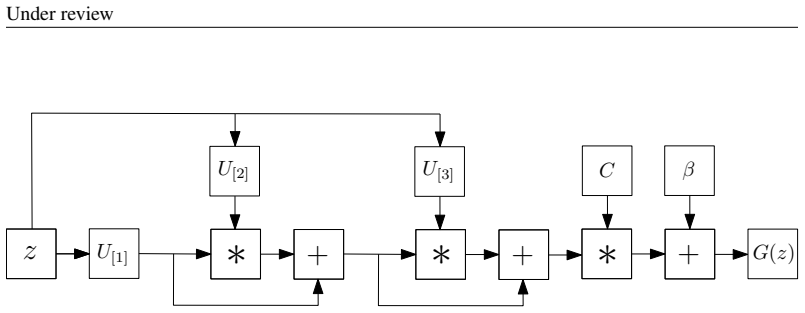
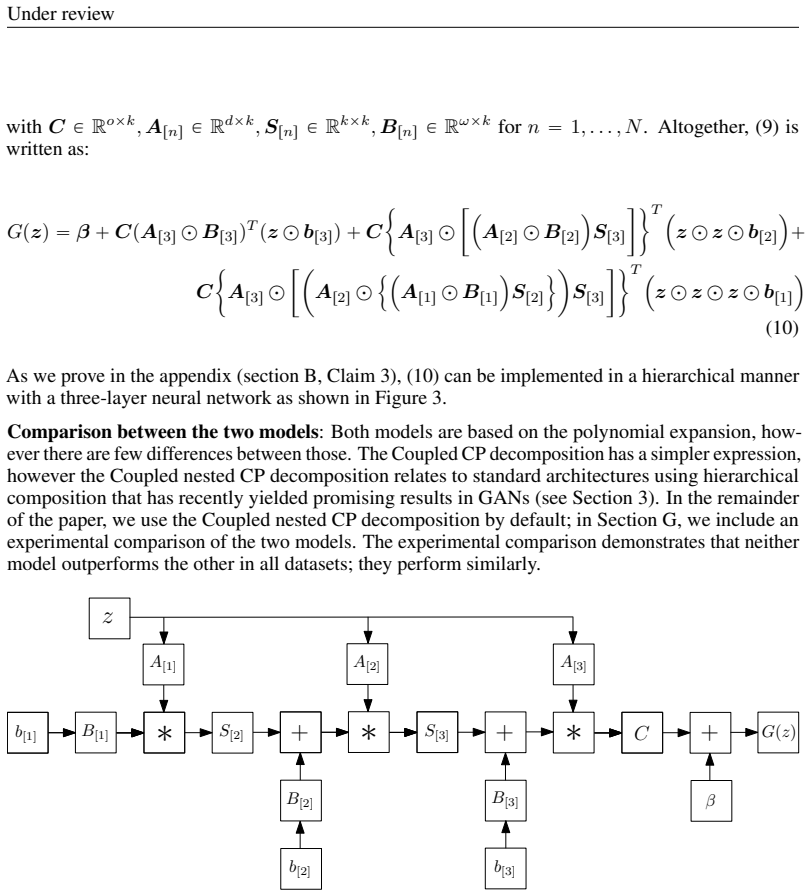
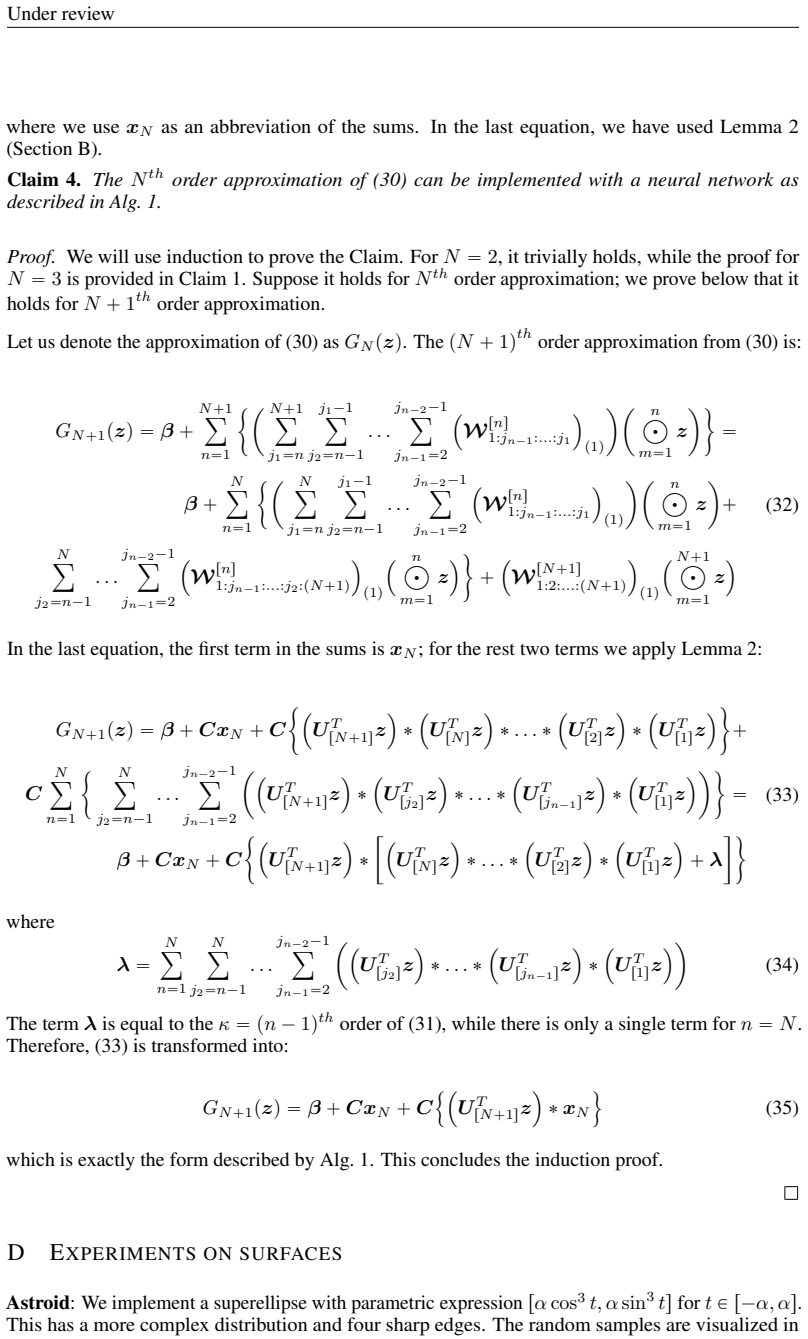
The load-bearing object is the coupled CP decomposition: each $n$th-order coefficient tensor of the polynomial is written as a sum of rank-one tensors, with the factor matrices belonging to lower-order terms reused by higher-order terms (e.g., $W^{[1]}=CU_{[1]}^T$, $W^{[2]}_{(1)}=C(U_{[3]}\odot U_{[1]})^T+C(U_{[2]}\odot U_{[1]})^T$, and so on). The identity that lets these factorized tensors execute as networks is the Khatri-Rao/Hadamard rule $\left(\bigodot_{\nu=1}^N A_\nu\right)^T\left(\bigodot_{\nu=1}^N B_\nu\right)= (A_1^T B_1)\ast\cdots\ast(A_N^T B_N)$, which converts a product of many factors into a sequence of Hadamard products with small linear maps. Algorithms 1 and 2 turn this identity into hierarchical generators: the nested variant computes $\kappa=((B^{[1]})^T b^{[1]})\ast((A^{[1]})^T v)$ and then iterates $\kappa=(S^{[n]}\kappa+(B^{[n]})^T b^{[n]})\ast((A^{[n]})^T v)$, finishing with $x=\beta+C\kappa$, so each added polynomial order is one extra Hadamard-plus-linear block.
What would settle it
Train a PolyGAN with small rank $k$ on a synthetic distribution that is, by construction, a high-rank polynomial generator (e.g., $G^*(z)=\sum_{r=1}^{1000} c_r (a_r^\top z)^4$ with random $a_r$); if full-rank polynomial generators fit it but PolyGAN's FID stays far above the full model even as the order and width grow, the coupled low-rank assumption fails and the image results are dataset-specific rather than a universal property.
Extended reading notes
Core claim
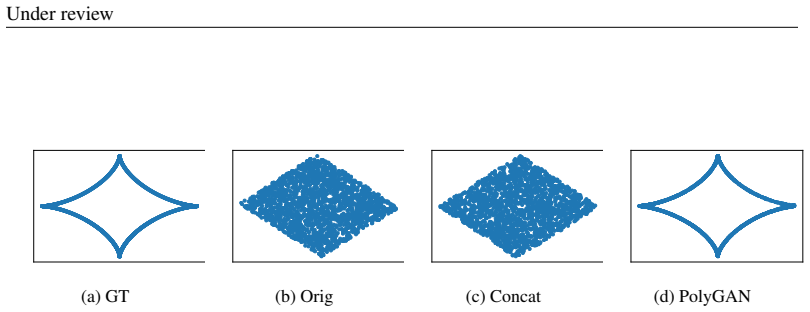
The central claim is that universal approximation by GAN generators does not require elementwise nonlinearities: a generator $G(z)=\beta+\sum_{n=1}^N \mathcal{W}^{[n]}\prod_{j=2}^{n+1}\times_j z$ with tensor-valued weights can serve as a data generator, provided the tensors $\mathcal{W}^{[n]}$ are coupled through a CP-type decomposition with shared factors. The paper introduces two such decompositions, the coupled CP decomposition and the coupled nested CP decomposition, and proves (Claims 1–4) that each is exactly reproduced by a stack of linear or convolutional blocks with Hadamard products, so the polynomial can be trained end-to-end as an ordinary GAN generator. The authors state that this gives the first demonstration of a GAN generator approximating a data distribution without activation functions, and support it by experiments on analytic 2D/3D manifolds, MNIST digits, YaleB faces, CIFAR-10, and ImageNet, where PolyGAN improves Inception Score and FID over the corresponding DCGAN, SNGAN, and SAGAN baselines.
Load-bearing premise
The entire construction rests on the assumption that the polynomial coefficient tensors for real image generators lie close to the low-rank, shared-factor family of the coupled CP decomposition; the proofs only show the architectures compute the polynomial, not that this restricted class can approximate every distribution a standard GAN can fit.
Editorial extensions
If this is right
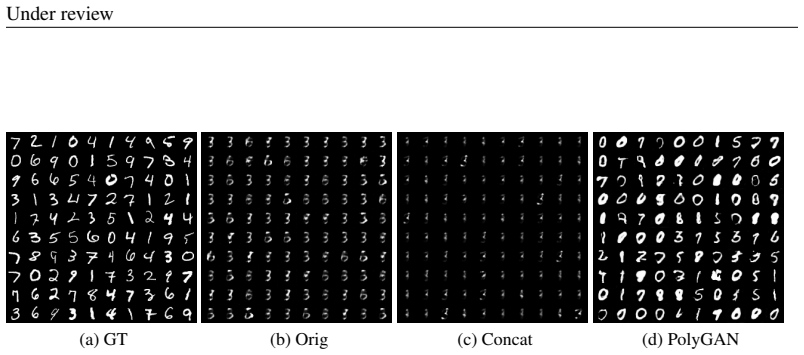
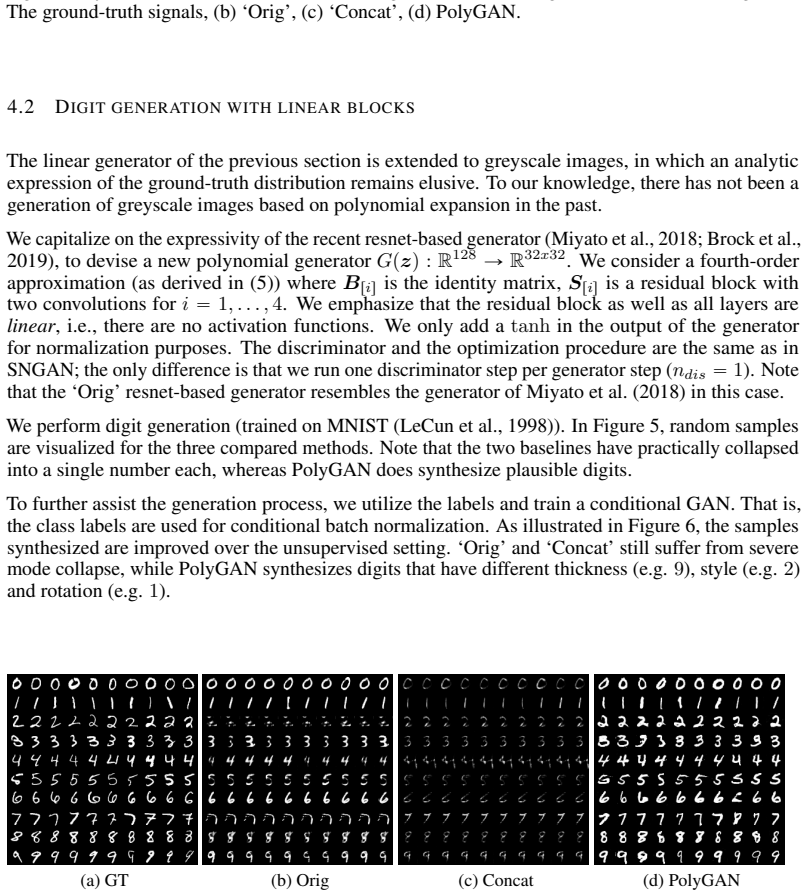
- A generator built solely from linear/convolutional blocks can learn nontrivial image distributions: the paper reports plausible digits and faces with a single output tanh and no hidden activations.
- Adding one polynomial order adds one hierarchical block, so PolyGAN offers an architecture-independent knob for model capacity: the paper shows that removing the fourth-order term removes fine detail.
- PolyGAN improves Inception Score and FID over DCGAN, SNGAN, and SAGAN with roughly a 2–3% increase in generator parameters, whereas concatenating noise at each block adds many more parameters without the same gain.
- The polynomial structure carries over to arbitrary decoder designs: replacing the standard generator in DCGAN, SNGAN, or SAGAN by its polynomial counterpart improves the reported scores.
- Because no activations are required, the entire generator is a polynomial map, so existing machinery for polynomial approximation, not just neural-network training, can be applied to GANs.
Reading between the lines
- The coupled-CP parameterization makes the generator linear in its final-layer coefficients $C$, which suggests that convergence analyses for deep linear networks (in the regime where the factors are fixed or convexified) might transfer to GAN training; the paper does not make this claim.
- The expressivity that matters is that of the low-rank shared-factor family, not of arbitrary polynomials. A high-rank interaction among the latent dimensions would be exactly representable by an unconstrained polynomial but only approximately by PolyGAN at fixed rank $k$, so performance on a given dataset depends on how much of the true generator's mass sits in the coupled low-rank subspace.
- A testable consequence of interpreting StyleGAN's gains as polynomial refinements rather than style transfer would be that the same base generator should match StyleGAN's image-quality curve as the polynomial order increases, without adaptive instance normalization; the authors suggest the interpretation but do not run this comparison.
- Since every generated pixel is an analytic function of the latent vector, PolyGAN cannot represent distributions supported on lower-dimensional manifolds with sharp boundaries exactly; near such boundaries accuracy should improve only as polynomial order grows, which is a falsifiable prediction the paper does not address.
Signed reviews
Editorial analysis
A structured set of objections, weighed in public.
Referee Report
Summary. The paper proposes PolyGAN, a GAN generator expressed as an N-th order multivariate polynomial in the latent code z, with the polynomial parameters organized as tensors. Two coupled CP-type decompositions with shared factors are introduced, and the authors prove (Lemmas 1-2 and Claims 1-4) that the factorized expansions can be implemented as hierarchical networks built from linear/convolutional blocks and Hadamard products (Algorithms 1-2). Experiments cover a 2D sinusoid, several 3D manifolds, MNIST/CIFAR/YaleB generation with linear blocks plus a final tanh, and CIFAR/ImageNet generation using DCGAN/SNGAN/SAGAN backbones modified with multiplicative noise injections; the latter are reported as outperforming the baselines in Inception Score and FID. The paper also compares the two proposed decompositions qualitatively in an appendix.
Significance. If the claims are appropriately scoped, the paper makes a useful conceptual contribution by connecting polynomial expansions, coupled tensor decompositions, and hierarchical linear networks. The algebraic equivalence proofs are explicit and checkable, and the experimental section reports mean and standard deviation over 10 runs and includes parameter counts, which is a strength. However, the headline claims currently outrun the evidence: the no-activation result is only demonstrated on low-dimensional manifolds, and the state-of-the-art comparisons use nonlinear generators that are not polynomial maps. The core derivation appears sound, but the paper needs a careful reframing before publication.
major comments (3)
- [Abstract; Section 4.2; Appendix E] The abstract claims that 'a GAN generator can approximate the data distribution without using any activation functions,' but the image experiments use a tanh at the generator output. Section 4.2 states 'We only add a tanh in the output of the generator for normalization purposes,' and Figure 5 is captioned 'with a single activation in the generator.' A tanh is an activation function, and a tanh composed with a polynomial is not a polynomial map. The no-activation claim is therefore established only for the low-dimensional synthetic setups of Sections 4.1, D, and G; the abstract and contribution 3 should be revised to state that the no-activation result applies to those settings, not to high-dimensional image generation.
- [Section F; Algorithms 3-4; Tables 11-12] The state-of-the-art comparisons do not test polynomial generators. In Algorithm 4, v = phi(Linear(z)) with phi = ReLU, h = phi(Linear(v)), and the original nonlinear residual blocks are retained. This is a multiplicative-feature-modulation variant of SNGAN, not the polynomial generator of Eqs. (7) and (10), and it is not equivalent to any polynomial map. Consequently, the IS/FID improvements over DCGAN, SNGAN, and SAGAN in Tables 11 and 12 cannot be attributed to the polynomial expansion; they may be due to the noise-injection mechanism alone. The authors should either rename these variants (e.g., 'modulated SNGAN') or provide an ablation that isolates the polynomial structure from the multiplicative injection mechanism before claiming that PolyGAN improves upon these architectures.
- [Section 2.2; Eqs. (5)-(10)] The Stone-Weierstrass motivation applies to the full polynomial model in Eq. (5), while the implemented models are the low-rank coupled CP subclasses of Eqs. (6), (7), and (10). No approximation-error or expressivity analysis is provided for the rank-k factors shared across orders; the statement 'assume that the weights exhibit redundancy and hence the parameter tensors are of low-rank' is an assumption, not a guarantee. The abstract's 'universal function approximator' language should therefore be limited to the full polynomial or explicitly qualified as an empirical hypothesis for the low-rank coupled form.
minor comments (5)
- [Section 4.2; Appendix E; Figure 5] The section title 'Digit Generation with Linear Blocks' is contradicted by Figure 5's caption 'with a single activation in the generator' and by Appendix E's statement that there is 'a single activation function only on the output (i.e., tanh)'. Please make the wording consistent.
- [Section F.4] The SAGAN comparison is run for 400,000 iterations with batch size 64 instead of the original batch size 256, so the baseline is under-trained relative to the published SAGAN results; the abstract's 'state of the art' should be qualified with these computational budgets.
- [Tables 11-12] Standard deviations are reported but no significance tests are given; several FID intervals overlap (e.g., conditional SNGAN FID 14.70 +/- 0.97 vs. 13.52 +/- 0.60 in Table 12), so the improvement claim should be tempered or accompanied by paired comparisons across the 10 seeds.
- [Section F.1; References] There is a typo in Section F.1 ('WThe rest details remain the same'), the word 'acrhitectures' appears in Section F, and the reference list duplicates the Sidiropoulos et al. (2017) entry; these should be corrected.
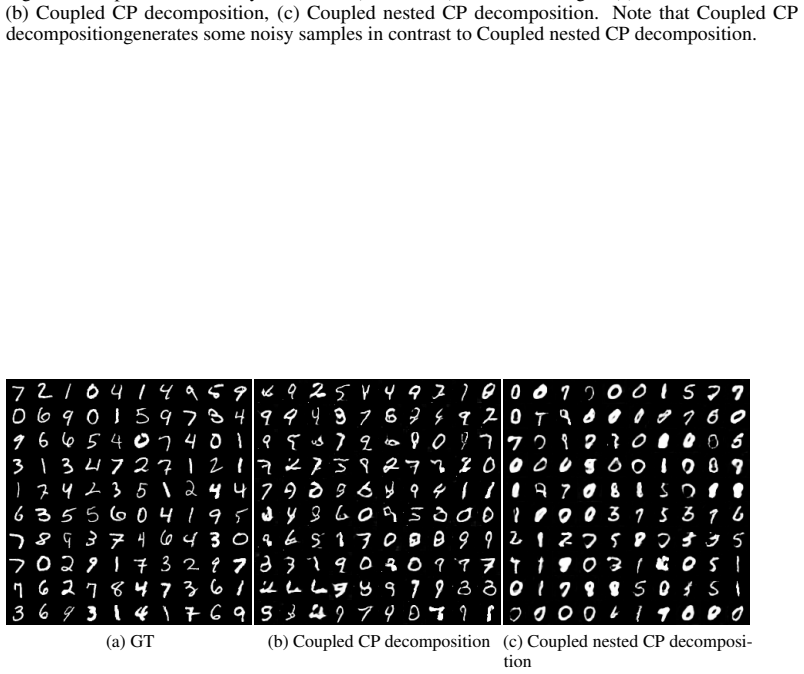
- [Appendix G] The comparison between the Coupled CP and Coupled nested CP decompositions is qualitative; reporting quantitative metrics (e.g., IS/FID or a distributional distance) would support the claim that 'they perform similarly.'
Circularity Check
No circularity: the generator-to-architecture equivalence is a direct algebraic derivation, and the empirical gains are benchmark comparisons rather than fitted quantities relabeled as predictions.
full rationale
The paper's central derivation (Eq. 5 to Eqs. 7/10 and Algorithms 1/2) is an algebraic identity: applying Lemma 2, the Khatri-Rao/Hadamard identity, to the CP-factorized polynomial expansion yields the hierarchical linear-block implementation. The coupled low-rank factorizations are introduced explicitly as modeling assumptions, not as consequences of the experiments, and the appendix proves the network recursion from the polynomial form by induction (Claim 4). No fitted parameter is renamed as a prediction: the IS/FID tables compare trained PolyGAN variants against re-run baselines, and choices such as polynomial order and rank are engineering settings reported in the experimental section, not outputs of the derivation. The only load-bearing external premise, Stone-Weierstrass, is used to motivate polynomials generally, not to prove the specific result. One concern belongs to correctness rather than circularity: the abstract's claim of 'without using any activation functions' is not supported by the image experiments, since Section 4.2 and Appendix E/G add a final tanh (an activation), and Section F uses ReLU and nonlinear residual blocks; a tanh composed with a polynomial is not a polynomial map. That inconsistency does not make the derivation circular.
Assumptions & free parameters
free parameters (3)
- Polynomial order N =
N=12 (sinusoid), 8/12 (model comparison), 4 (MNIST), 5 (YaleB/CIFAR10)
- Decomposition rank / layer width k =
Width 15 for sinusoid; 256 channels for MNIST/CIFAR; residual block widths for ImageNet
- Learnable scaling vectors b[n] =
Learned, values not reported
assumptions (4)
- standard math Any continuous function on a closed interval can be uniformly approximated by polynomials (Stone-Weierstrass).
- domain assumption The parameter tensors W[n] admit low-rank coupled CP decompositions with shared factors.
- domain assumption GAN adversarial training reaches a useful equilibrium for the proposed generator.
- domain assumption Inception Score and FID are valid proxies for generation quality.
Cite this review
Pith. "Pith review of PolyGAN: High-Order Polynomial Generators." pith.science (2026). https://pith.science/paper/XEQJT7FN
@misc{pith2026190806571,
  author       = {Pith},
  title        = {Pith review of: PolyGAN: High-Order Polynomial Generators},
  year         = {2026},
  howpublished = {\url{https://pith.science/paper/XEQJT7FN}},
  note         = {Machine review of arXiv:1908.06571}
}
read the original abstract
Generative Adversarial Networks (GANs) have become the gold standard when it comes to learning generative models for high-dimensional distributions. Since their advent, numerous variations of GANs have been introduced in the literature, primarily focusing on utilization of novel loss functions, optimization/regularization strategies and network architectures. In this paper, we turn our attention to the generator and investigate the use of high-order polynomials as an alternative class of universal function approximators. Concretely, we propose PolyGAN, where we model the data generator by means of a high-order polynomial whose unknown parameters are naturally represented by high-order tensors. We introduce two tensor decompositions that significantly reduce the number of parameters and show how they can be efficiently implemented by hierarchical neural networks that only employ linear/convolutional blocks. We exhibit for the first time that by using our approach a GAN generator can approximate the data distribution without using any activation functions. Thorough experimental evaluation on both synthetic and real data (images and 3D point clouds) demonstrates the merits of PolyGAN against the state of the art.
Figures

Figures from the paper (16 more)



Reference graph
Works this paper leans on
-
[1]
write newline
" write newline "" before.all 'output.state := FUNCTION n.dashify 't := "" t empty not t #1 #1 substring "-" = t #1 #2 substring "--" = not "--" * t #2 global.max substring 't := t #1 #1 substring "-" = "-" * t #2 global.max substring 't := while if t #1 #1 substring * t #2 global.max substring 't := if while FUNCTION format.date year duplicate empty "emp...
-
[2]
@esa (Ref
\@ifxundefined[1] #1\@undefined \@firstoftwo \@secondoftwo \@ifnum[1] #1 \@firstoftwo \@secondoftwo \@ifx[1] #1 \@firstoftwo \@secondoftwo [2] @ #1 \@temptokena #2 #1 @ \@temptokena \@ifclassloaded agu2001 natbib The agu2001 class already includes natbib coding, so you should not add it explicitly Type <Return> for now, but then later remove the command n...
-
[3]
\@lbibitem[] @bibitem@first@sw\@secondoftwo \@lbibitem[#1]#2 \@extra@b@citeb \@ifundefined br@#2\@extra@b@citeb \@namedef br@#2 \@nameuse br@#2\@extra@b@citeb \@ifundefined b@#2\@extra@b@citeb @num @parse #2 @tmp #1 NAT@b@open@#2 NAT@b@shut@#2 \@ifnum @merge>\@ne @bibitem@first@sw \@firstoftwo \@ifundefined NAT@b*@#2 \@firstoftwo @num @NAT@ctr \@secondoft...
-
[4]
@open @close @open @close and [1] URL: #1 \@ifundefined chapter * \@mkboth \@ifxundefined @sectionbib * \@mkboth * \@mkboth\@gobbletwo \@ifclassloaded amsart * \@ifclassloaded amsbook * \@ifxundefined @heading @heading NAT@ctr thebibliography [1] @ \@biblabel @NAT@ctr \@bibsetup #1 @NAT@ctr @ @openbib .11em \@plus.33em \@minus.07em 4000 4000 `\.\@m @bibit...
-
[5]
Towards principled methods for training generative adversarial networks
Martin Arjovsky and L \'e on Bottou. Towards principled methods for training generative adversarial networks. In International Conference on Learning Representations (ICLR), 2017
work page 2017
-
[6]
A convergence analysis of gradient descent for deep linear neural networks
Sanjeev Arora, Nadav Cohen, Noah Golowich, and Wei Hu. A convergence analysis of gradient descent for deep linear neural networks. In International Conference on Learning Representations (ICLR), 2019
work page 2019
-
[7]
Began: Boundary equilibrium generative adversarial networks
David Berthelot, Thomas Schumm, and Luke Metz. Began: Boundary equilibrium generative adversarial networks. arXiv preprint arXiv:1703.10717, 2017
arXiv 2017
-
[8]
Large scale gan training for high fidelity natural image synthesis
Andrew Brock, Jeff Donahue, and Karen Simonyan. Large scale gan training for high fidelity natural image synthesis. In International Conference on Learning Representations (ICLR), 2019
work page 2019
Show all 42 references
-
[9]
Generative adversarial networks: An overview
Antonia Creswell, Tom White, Vincent Dumoulin, Kai Arulkumaran, Biswa Sengupta, and Anil A Bharath. Generative adversarial networks: An overview. IEEE Signal Processing Magazine, 35 0 (1): 0 53--65, 2018
2018
-
[10]
From few to many: Illumination cone models for face recognition under variable lighting and pose
Athinodoros S Georghiades, Peter N Belhumeur, and David J Kriegman. From few to many: Illumination cone models for face recognition under variable lighting and pose. IEEE Transactions on Pattern Analysis and Machine Intelligence (T-PAMI) , 0 (6): 0 643--660, 2001
2001
-
[11]
Generative adversarial nets
Ian Goodfellow, Jean Pouget-Abadie, Mehdi Mirza, Bing Xu, David Warde-Farley, Sherjil Ozair, Aaron Courville, and Yoshua Bengio. Generative adversarial nets. In Advances in neural information processing systems (NIPS), 2014
2014
-
[12]
Improved training of wasserstein gans
Ishaan Gulrajani, Faruk Ahmed, Martin Arjovsky, Vincent Dumoulin, and Aaron C Courville. Improved training of wasserstein gans. In Advances in neural information processing systems (NIPS), pp.\ 5767--5777, 2017
2017
-
[13]
Identity matters in deep learning
Moritz Hardt and Tengyu Ma. Identity matters in deep learning. In International Conference on Learning Representations (ICLR), 2017
2017
-
[14]
Gans trained by a two time-scale update rule converge to a local nash equilibrium
Martin Heusel, Hubert Ramsauer, Thomas Unterthiner, Bernhard Nessler, and Sepp Hochreiter. Gans trained by a two time-scale update rule converge to a local nash equilibrium. In Advances in neural information processing systems (NIPS), pp.\ 6626--6637, 2017
2017
-
[15]
Emerging convolutions for generative normalizing flows
Emiel Hoogeboom, Rianne van den Berg, and Max Welling. Emerging convolutions for generative normalizing flows. In International Conference on Machine Learning (ICML), 2019
2019
-
[16]
Arbitrary style transfer in real-time with adaptive instance normalization
Xun Huang and Serge Belongie. Arbitrary style transfer in real-time with adaptive instance normalization. In IEEE Proceedings of International Conference on Computer Vision (ICCV) , pp.\ 1501--1510, 2017
2017
-
[17]
Minimax estimation of neural net distance
Kaiyi Ji and Yingbin Liang. Minimax estimation of neural net distance. In Advances in neural information processing systems (NIPS), pp.\ 3845--3854, 2018
2018
-
[18]
Progressive growing of gans for improved quality, stability, and variation
Tero Karras, Timo Aila, Samuli Laine, and Jaakko Lehtinen. Progressive growing of gans for improved quality, stability, and variation. In International Conference on Learning Representations (ICLR), 2018
2018
-
[19]
A style-based generator architecture for generative adversarial networks
Tero Karras, Samuli Laine, and Timo Aila. A style-based generator architecture for generative adversarial networks. In IEEE Proceedings of International Conference on Computer Vision and Pattern Recognition (CVPR) , 2019
2019
-
[20]
Tensor decompositions and applications
Tamara G Kolda and Brett W Bader. Tensor decompositions and applications. SIAM review, 51 0 (3): 0 455--500, 2009
2009
-
[21]
The cifar-10 dataset
Alex Krizhevsky, Vinod Nair, and Geoffrey Hinton. The cifar-10 dataset. online: http://www. cs. toronto. edu/kriz/cifar. html, 55, 2014
2014
-
[22]
An analytic theory of generalization dynamics and transfer learning in deep linear networks
Andrew K Lampinen and Surya Ganguli. An analytic theory of generalization dynamics and transfer learning in deep linear networks. In International Conference on Learning Representations (ICLR), 2019
2019
-
[23]
Deep linear networks with arbitrary loss: All local minima are global
Thomas Laurent and James Brecht. Deep linear networks with arbitrary loss: All local minima are global. In International Conference on Machine Learning (ICML), 2018
2018
-
[24]
Gradient-based learning applied to document recognition
Yann LeCun, L \'e on Bottou, Yoshua Bengio, Patrick Haffner, et al. Gradient-based learning applied to document recognition. Proceedings of the IEEE, 86 0 (11): 0 2278--2324, 1998
1998
-
[25]
Are gans created equal? a large-scale study
Mario Lucic, Karol Kurach, Marcin Michalski, Sylvain Gelly, and Olivier Bousquet. Are gans created equal? a large-scale study. In Advances in neural information processing systems (NIPS), pp.\ 700--709, 2018
2018
-
[26]
Least squares generative adversarial networks
Xudong Mao, Qing Li, Haoran Xie, Raymond YK Lau, Zhen Wang, and Stephen Paul Smolley. Least squares generative adversarial networks. In IEEE Proceedings of International Conference on Computer Vision (ICCV) , pp.\ 2813--2821. IEEE, 2017
2017
-
[27]
Learning functions: when is deep better than shallow
Hrushikesh Mhaskar, Qianli Liao, and Tomaso Poggio. Learning functions: when is deep better than shallow. arXiv preprint arXiv:1603.00988, 2016
2016 arXiv
-
[28]
Spectral normalization for generative adversarial networks
Takeru Miyato, Toshiki Kataoka, Masanori Koyama, and Yuichi Yoshida. Spectral normalization for generative adversarial networks. In International Conference on Learning Representations (ICLR), 2018
2018
-
[29]
f-gan: Training generative neural samplers using variational divergence minimization
Sebastian Nowozin, Botond Cseke, and Ryota Tomioka. f-gan: Training generative neural samplers using variational divergence minimization. In Advances in neural information processing systems (NIPS), pp.\ 271--279, 2016
2016
-
[30]
Is generator conditioning causally related to gan performance? In International Conference on Machine Learning (ICML), 2018
Augustus Odena, Jacob Buckman, Catherine Olsson, Tom B Brown, Christopher Olah, Colin Raffel, and Ian Goodfellow. Is generator conditioning causally related to gan performance? In International Conference on Machine Learning (ICML), 2018
2018
-
[31]
Turbo-smt: Parallel coupled sparse matrix-tensor factorizations and applications
Evangelos E Papalexakis, Tom M Mitchell, Nicholas D Sidiropoulos, Christos Faloutsos, Partha Pratim Talukdar, and Brian Murphy. Turbo-smt: Parallel coupled sparse matrix-tensor factorizations and applications. Statistical Analysis and Data Mining: The ASA Data Science Journal,...
2016
-
[32]
Unsupervised representation learning with deep convolutional generative adversarial networks
Alec Radford, Luke Metz, and Soumith Chintala. Unsupervised representation learning with deep convolutional generative adversarial networks. arXiv preprint arXiv:1511.06434, 2015
2015 arXiv
-
[33]
Imagenet large scale visual recognition challenge
Olga Russakovsky, Jia Deng, Hao Su, Jonathan Krause, Sanjeev Satheesh, Sean Ma, Zhiheng Huang, Andrej Karpathy, Aditya Khosla, Michael Bernstein, et al. Imagenet large scale visual recognition challenge. International Journal of Computer Vision (IJCV), 115 0 (3): 0 211--252, 2015
2015
-
[34]
Improved techniques for training gans
Tim Salimans, Ian Goodfellow, Wojciech Zaremba, Vicki Cheung, Alec Radford, and Xi Chen. Improved techniques for training gans. In Advances in neural information processing systems (NIPS), pp.\ 2234--2242, 2016
2016
-
[35]
Exact solutions to the nonlinear dynamics of learning in deep linear neural networks
Andrew M Saxe, James L McClelland, and Surya Ganguli. Exact solutions to the nonlinear dynamics of learning in deep linear neural networks. In International Conference on Learning Representations (ICLR), 2014
2014
-
[36]
N. D. Sidiropoulos , L. De Lathauwer , X. Fu , K. Huang , E. E. Papalexakis , and C. Faloutsos . Tensor decomposition for signal processing and machine learning. IEEE Transactions on Signal Processing, 65 0 (13): 0 3551--3582, 2017
2017
-
[37]
Tensor decomposition for signal processing and machine learning
Nicholas D Sidiropoulos, Lieven De Lathauwer, Xiao Fu, Kejun Huang, Evangelos E Papalexakis, and Christos Faloutsos. Tensor decomposition for signal processing and machine learning. IEEE Transactions on Signal Processing, 65 0 (13): 0 3551--3582, 2017
2017
-
[38]
The generalized weierstrass approximation theorem
Marshall H Stone. The generalized weierstrass approximation theorem. Mathematics Magazine, 21 0 (5): 0 237--254, 1948
1948
-
[39]
Going deeper with convolutions
Christian Szegedy, Wei Liu, Yangqing Jia, Pierre Sermanet, Scott Reed, Dragomir Anguelov, Dumitru Erhan, Vincent Vanhoucke, and Andrew Rabinovich. Going deeper with convolutions. In IEEE Proceedings of International Conference on Computer Vision and Pattern Recognition (CVPR) ...
2015
-
[40]
A note on the evaluation of generative models
Lucas Theis, A \"a ron van den Oord, and Matthias Bethge. A note on the evaluation of generative models. In International Conference on Learning Representations (ICLR), 2016
2016
-
[41]
Non-local neural networks
Xiaolong Wang, Ross Girshick, Abhinav Gupta, and Kaiming He. Non-local neural networks. In IEEE Proceedings of International Conference on Computer Vision and Pattern Recognition (CVPR) , pp.\ 7794--7803, 2018
2018
-
[42]
Self-attention generative adversarial networks
Han Zhang, Ian Goodfellow, Dimitris Metaxas, and Augustus Odena. Self-attention generative adversarial networks. In International Conference on Machine Learning (ICML), 2019
2019
Reviewed August 14, 2026 · model on record in the stance chip above.
Discussion (0). Continue with ORCID to comment.