REVIEW 3 major objections 5 minor 82 references
Exploring the role of electronic structure on photo-catalytic behavior of carbon-nitride polymorphs
T0 review · 3 major / 5 minor · reviewed 2026-08-14 · deepseek-v4-flash
Pith's one-line read Gamma-C3N4, dynamically unstable at ambient pressure, becomes a dynamically stable and better-aligned photocatalyst for water splitting above 275 GPa.
desk verdict A useful LDA+vLB versus HSE benchmark across C3N4 polymorphs, but the 275 GPa photocatalytic claim compares band edges to water redox potentials that do not exist at that pressure. read the letter →
The pith
A machine-rendered reading of the paper's core claim, the machinery that carries it, and where it could break.
The reading
What carries the argument
The device that carries the argument is the vLB-corrected local-density exchange-correlation functional, which mimics exact exchange at semi-local cost and gives the correct -1/r asymptotic behavior; it is used in full-potential NMTO calculations to obtain structural parameters and band gaps. For the photocatalytic ranking, the crucial tool is a slab work-function calculation that aligns bulk and slab electrostatic potentials through a macroscopic-average shift, yielding valence and conduction band positions relative to vacuum and then to the standard water redox potentials at pH 0 and pH 7. For the pressure claim, the deciding mechanism is density-functional perturbation theory: phonon dispersions computed at 0 GPa show imaginary frequencies, and at 275 GPa those frequencies turn real, with elastic constants satisfying the Born criteria. Together these connect electronic structure to a functional outcome—whether photogenerated electrons and holes have enough energy to split water.
What would settle it
Compute or measure the water oxidation and reduction potentials at 275 GPa; if those potentials shift by more than the roughly 0.4 eV margin in band-edge alignment, the predicted photocatalytic improvement for gamma-C3N4 under pressure fails.
Extended reading notes
Core claim
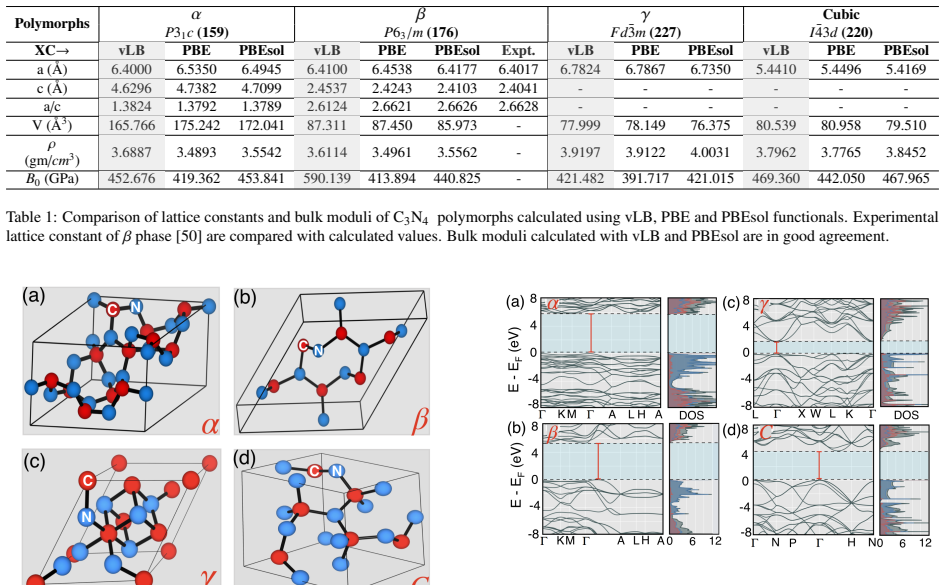
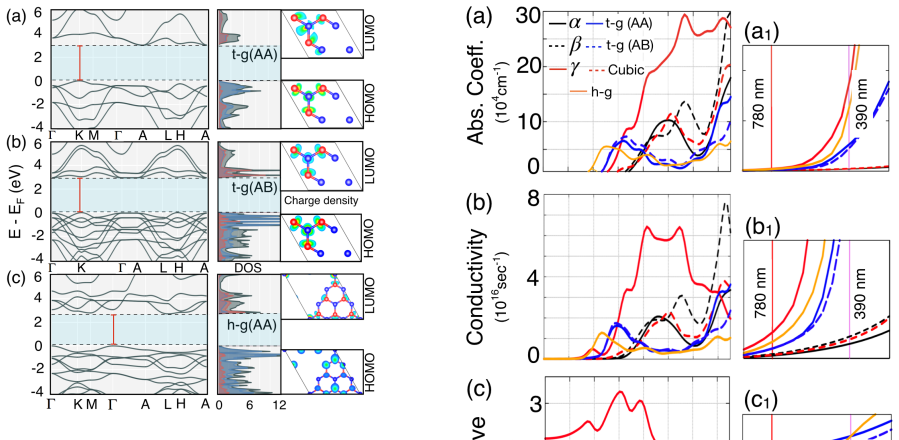
The central discovery is that gamma-C3N4, the spinel phase of carbon nitride, is the standout photocatalyst among the seven polymorphs studied, and that its photocatalytic performance improves further once it is pressurized into dynamical stability. The phase has a direct band gap of 1.95 eV, an electron effective mass of 0.016 m0, higher optical conductivity in the visible range than the graphitic phases, and a (110) surface with band edges straddling the water oxidation and reduction potentials. Because the phase is dynamically unstable at ambient pressure, the paper establishes a second result: under hydrostatic pressure above 275 GPa the imaginary phonon frequencies disappear, the Born stability criteria are satisfied, and the (110) band edges, with and without water, cover a wider photocatalytic range versus the water redox levels. The paper presents this pressure-stabilized gamma-C3N4 as a new candidate for visible-light photocatalytic water splitting.
Load-bearing premise
The load-bearing premise is that the standard water redox potentials (1.23 V and 0 V versus NHE at pH 0, and 0.81 V and -0.41 V at pH 7) remain valid at 275 GPa, so band edges computed for the compressed crystal can be compared directly with ambient aqueous electrochemistry.
Editorial extensions
If this is right
- Gamma-C3N4 becomes a specific synthesis target for high-pressure or nonhydrostatic-loading experiments, with the paper noting that uniaxial loading lowered the required pressure for silicon by a factor of 21.
- The vLB functional offers a screening tool: band gaps and band-edge alignments for other metal-free photocatalysts can be computed at semi-local cost with hybrid-functional accuracy.
- Among the graphitic phases, AB-stacked triazine and heptazine remain viable, but the pressure-stabilized gamma phase combines a direct gap, low electron effective mass, and wider band-edge alignment, which should improve charge separation and solar absorption.
- If the pressure route can be reduced to experimentally accessible values, gamma-C3N4 would provide a non-toxic, earth-abundant alternative to metal-based water-splitting photocatalysts.
Reading between the lines
- A fully consistent electrochemical treatment would recompute water's oxidation and reduction potentials at 275 GPa rather than importing ambient values; until then, the improved photocatalytic range is a thermodynamic extrapolation.
- The same work-function/band-edge method could be applied to strained or doped gamma-C3N4, searching for lower critical pressures or wider pH windows without extreme conditions.
- The paper's silicon analogy suggests a concrete testable extension: nonhydrostatic or uniaxial loading might stabilize gamma-C3N4 at pressures well below 275 GPa, and phonon calculations under such stress could verify it.
- A photocatalytic improvement in band alignment does not by itself guarantee high quantum efficiency; carrier lifetimes and surface reaction kinetics would need experimental photoelectrochemical measurement, likely on recovered metastable samples.
Signed reviews
Editorial analysis
A structured set of objections, weighed in public.
Referee Report
Summary. The paper presents a first-principles study of seven C3N4 polymorphs (α, β, γ, cubic, and three graphitic forms) using a self-consistent LDA+vLB functional implemented in FP-NMTO, cross-checked against QE-HSE hybrid-functional calculations and, for γ-C3N4, a non-self-consistent G0W0 gap. It reports structural parameters, band gaps, effective masses, optical spectra, work functions, and band-edge positions relative to water redox potentials, and it investigates the dynamical stability of γ-C3N4 by phonon calculations as a function of pressure. The central claims are that γ-C3N4 is the best photocatalytic candidate among the polymorphs, that it is dynamically unstable at zero pressure, and that above 275 GPa hydrostatic pressure it becomes dynamically stable and shows improved photocatalytic behavior relative to water reduction and oxidation potentials.
Significance. The systematic comparison of seven C3N4 polymorphs with consistent functionals is a useful contribution, and the cross-validation of LDA+vLB against HSE and G0W0 for band gaps (e.g., γ-C3N4: 1.81 vs 1.95 vs 2.01 eV in Table 2) strengthens confidence in the electronic-structure part of the work. The phonon analysis of γ-C3N4 and the prediction of dynamical stabilization under pressure are also of interest. However, the headline photocatalytic-improvement claim depends on comparing band edges computed at 275 GPa with ambient aqueous redox potentials, an assumption that is neither stated nor justified. If that claim is removed or properly qualified, the remaining comparative study of structure, gaps, optical properties, and stability has value, but as written the central conclusion is not supported.
major comments (3)
- [§3.5, Fig. 12]
- [§3.4, Fig. 7]
- [§3.5, Fig. 9]
minor comments (5)
- [§1]
- [Fig. 12 caption]
- [§3.5]
- [§2 and Table 2]
- [Table 1]
Circularity Check
No circular derivation: C3N4 gaps, phonons, and pressure-dependent band alignment are independent calculations; only minor, non-load-bearing self-citation of the vLB functional.
full rationale
The central claims are self-contained against external benchmarks. The LDA+vLB potential (Eqs. 1-2, beta=0.05) is authored by the same group, but it is not fitted to C3N4; the paper validates it on graphene and bulk Si: 'We demonstrate that the LDA+vLB predicts band-structure and work-function for well-studied 2D-graphene and bulk-Si in very good agreement with experiments, and more exact hybrid functional (HSE) calculations.' The C3N4 band gaps in Table 2 are checked against external HSE, GW, mBJ, and experimental values, and gamma's phonon instability and its removal at 275 GPa (Fig. 9) are computed, not imported. Fig. 12 compares freshly computed VBM/CBM positions with fixed NHE water redox potentials; those potentials are external references, not parameters fitted from the same band edges. The limitation that gamma-C3N4 is metastable and structurally unstable at ambient conditions is acknowledged by the paper: 'Although, the stability of γ-C3N4 is an issue [81,82], the use of hydrostatic pressure in this work is an effort to provide theoretical understanding of metastable (structurally unstable) γ-C3N4.' The physical worry that 275 GPa band edges are compared with ambient liquid-water potentials is a correctness risk, not a circularity, because it does not make the output identical to an input by construction. Score 2 reflects only minor self-citations to the vLB functional and a speculative synthesis-route citation (Ref. 78), neither of which carries the central result.
Assumptions & free parameters
free parameters (2)
- beta in LDA+vLB exchange correction =
0.05
- Gamma interband broadening in dielectric function =
unspecified small positive value
assumptions (5)
- domain assumption Kohn-Sham DFT with approximate exchange-correlation functionals (LDA, PBE, PBEsol, LDA+vLB) provides a valid description of ground-state structure and electronic structure for C3N4 polymorphs.
- domain assumption The LDA+vLB functional with the fixed beta parameter accurately reproduces HSE-level band gaps across the materials studied.
- domain assumption HSE hybrid functional and non-self-consistent G0W0 are reliable reference methods for band gaps and band positions in these materials.
- domain assumption Absolute band edges can be obtained from slab work-function calculations with four-layer slabs and 15 A vacuum using macroscopic averaging.
- ad hoc to paper Standard water oxidation and reduction potentials at pH 0 and pH 7 remain valid when comparing band edges at 275 GPa.
Cite this review
Pith. "Pith review of Exploring the role of electronic structure on photo-catalytic behavior of carbon-nitride polymorphs." pith.science (2026). https://pith.science/paper/LCPZXL23
@misc{pith2026190806596,
  author       = {Pith},
  title        = {Pith review of: Exploring the role of electronic structure on photo-catalytic behavior of carbon-nitride polymorphs},
  year         = {2026},
  howpublished = {\url{https://pith.science/paper/LCPZXL23}},
  note         = {Machine review of arXiv:1908.06596}
}
abstract
A fully self-consistent density-functional theory (DFT) with improved functionals is used to provide a comprehensive account of structural, electronic, and optical properties of C$_{3}$N$_{4}$ polymorphs. Using our recently developed van Leeuwen-Baerends (vLB) corrected local-density approximation (LDA), we implemented LDA+vLB within full-potential N$^{th}$-order muffin-tin orbital (FP-NMTO) method and show that it improves structural properties and band gaps compared to semi-local functionals (LDA/GGA). We demonstrate that the LDA+vLB predicts band-structure and work-function for well-studied 2D-graphene and bulk-Si in very good agreement with experiments, and more exact hybrid functional (HSE) calculations as implemented in the Quantum-Espresso (QE) package. The structural and electronic-structure (band gap) properties of C$_{3}$N$_{4}$ polymorphs calculated using FP-NMTO-LDA+vLB is compared with more sophisticated hybrid-functional calculations. We also perform detailed investigation of photocatalytic behavior using QE-HSE method of C$_{3}$N$_{4}$ polymorphs through work-function, band (valence and conduction) position with respect to water reduction and oxidation potential. Our results show $\gamma$-C$_{3}$N$_{4}$ as the best candidate for photocatalysis among all the C$_{3}$N$_{4}$~polymorphs but it is dynamically unstable at `zero' pressure. We show that $\gamma$-C$_{3}$N$_{4}$ can be stabilized under hydrostatic-pressure, which improves its photocatalytic behavior relative to water reduction and oxidation potentials.
Figures


Figures from the paper (5 more)


Reference graph
Works this paper leans on
-
[1]
X. Wang, K. Maeda, A. Thomas, K. Takanabe, G. Xin, J. M. Carlsson, K. Domen and M. Antonietti, Nature materials, 2009, 8, 76–80
2009
-
[2]
X. Wang, K. Maeda, X. Chen, K. Takanabe, K. Domen, Y . Hou, X. Fu and M. Antonietti, Journal of the American Chemical Society, 2009, 131, 1680–1681
2009
-
[3]
K. Li, X. Xie and W.-D. Zhang, Carbon, 2016, 110, 356–366
work page 2016
- [4]
-
[5]
J. Fu, J. Yu, C. Jiang and B. Cheng, Advanced Energy Materials, 2018, 8, 1701503
work page 2018
-
[6]
B. Zhu, L. Zhang, B. Cheng and J. Yu, Applied Catalysis B: Environmental, 2018, 224, 983–999
work page 2018
-
[7]
X. Ma, Y . Lv, J. Xu, Y . Liu, R. Zhang and Y . Zhu,The Journal of Physical Chemistry C, 2012, 116, 23485–23493
work page 2012
-
[8]
G. Liu, C. Y . Jimmy, G. Q. M. Lu and H.-M. Cheng, Chemical Communications, 2011, 47, 6763–6783
work page 2011
Show all 82 references
-
[9]
Shayeganfar and R
F. Shayeganfar and R. Shahsavari, Carbon, 2016, 99, 523–532
2016
-
[10]
Lan, H.-T
D.-H. Lan, H.-T. Wang, L. Chen, C.-T. Au and S.-F. Yin, Carbon, 2016, 100, 81–89. 11
2016
-
[11]
X. Li, J. Yu, J. Low, Y . Fang, J. Xiao and X. Chen, Journal of Materials Chemistry A, 2015, 3, 2485–2534
2015
-
[12]
D. M. Teter and R. J. Hemley, Science, 1996, 271, 53–55
1996
-
[13]
Guo and W
Y . Guo and W. A. Goddard, Chemical Physics Letters, 1995, 237, 72–76
1995
-
[14]
J. P. Perdew, K. Burke and M. Ernzerhof, Physical Review Letters, 1996, 77, 3865–3868
1996
-
[15]
Perdew, Phys
J. Perdew, Phys. Rev. Lett., 2008, 100, 136406
2008
-
[16]
Mattesini, S
M. Mattesini, S. F. Matar and J. Etourneau, Journal of Materials Chemistry, 2000, 10, 709–713
2000
-
[17]
Yao and W
H. Yao and W. Ching, Physical Review B, 1994, 50, 11231
1994
-
[18]
Molina and L
B. Molina and L. Sansores, Modern physics letters B, 1999, 13, 193–201
1999
-
[19]
Singh, M
P. Singh, M. K. Harbola, M. Hemanadhan, A. Mookerjee and D. D. Johnson, Phys. Rev. B, 2016, 93, 085204
2016
-
[20]
R. V . Leeuwen and E. J. Baerends, Physical Review A, 1994, 49, 2421–2431
1994
-
[21]
Jepsen, http://www.mpi-stuttgart.mpg.de/andersen/, 2000
O. Jepsen, http://www.mpi-stuttgart.mpg.de/andersen/, 2000
2000
-
[22]
Nohara and O
Y . Nohara and O. Andersen, Physical Review B, 2016, 94, 085148
2016
-
[23]
Tran and P
F. Tran and P. Blaha, Phys. Rev. Lett., 2009, 102, 226401
2009
-
[24]
Datta, P
S. Datta, P. Singh, C. B. Chaudhuri, D. Jana, M. K. Har- bola, D. D. Johnson and A. Mookerjee, Journal of Physics: Condensed Matter, 2019, 31, 495502
2019
-
[25]
Singh, M
P. Singh, M. K. Harbola, B. Sanyal and A. Mookerjee, Phys. Rev. B, 2013, 87, 235110
2013
-
[26]
Singh, M
P. Singh, M. Harbola and A. Mookerjee, in Modeling, Characterization, and Production of Nanomaterials, Elsevier, 2015, pp. 407–418
2015
-
[27]
Singh, M
P. Singh, M. K. Harbola and D. D. Johnson, Journal of Physics: Condensed Matter, 2017, 29, 424001
2017
-
[28]
Sadhukhan, P
B. Sadhukhan, P. Singh, A. Nayak, S. Datta, D. D. Johnson and A. Mookerjee, Phys. Rev. B, 2017, 96, 054203
2017
-
[29]
J. W. Precker and M. A. da Silva, American Journal of Physics, 2002, 70, 1150–1153
2002
-
[30]
Heyd and G
J. Heyd and G. E. Scuseria, The Journal of chemical physics, 2004, 121, 1187–1192
2004
-
[31]
Giannozzi, S
P. Giannozzi, S. Baroni, N. Bonini, M. Calandra, R. Car, C. Cavazzoni, D. Ceresoli, G. L. Chiarotti, M. Cococ- cioni, I. Dabo, A. D. Corso, S. de Gironcoli, S. Fab- ris, G. Fratesi, R. Gebauer, U. Gerstmann, C. Gougoussis, A. Kokalj, M. Lazzeri, L. Martin-Samos, N. Marzari, F....
2009
-
[32]
Giannozzi, O
P. Giannozzi, O. Andreussi, T. Brumme, O. Bunau, M. B. Nardelli, M. Calandra, R. Car, C. Cavazzoni, D. Ceresoli, M. Cococcioni, N. Colonna, I. Carnimeo, A. D. Corso, S. de Gironcoli, P. Delugas, R. A. DiStasio, A. Ferretti, A. Floris, G. Fratesi, G. Fugallo, R. Gebauer, U. Ger...
2017
-
[33]
Ziegler, P
D. Ziegler, P. Gava, J. G ¨uttinger, F. Molitor, L. Wirtz, M. Lazzeri, A. Saitta, A. Stemmer, F. Mauri and C. Stampfer, Physical Review B, 2011, 83, 235434
2011
-
[34]
Hollinger and F
G. Hollinger and F. Himpsel, Journal of Vacuum Science & Technology A: Vacuum,Surfaces, and Films, 1983, 1, 640–645
1983
-
[35]
Andersen, C
O. Andersen, C. Arcangeli, R. Tank, T. Saha-Dasgupta, G. Krier, O. Jepsen and I. Dasgupta, MRS Online Proceedings Library Archive, 1997
1997
-
[36]
Kraisler and L
E. Kraisler and L. Kronik, The Journal of chemical physics, 2014, 140, 18A540
2014
-
[37]
Almbladh and U
C.-O. Almbladh and U. von Barth, Phys. Rev. B, 1985, 31, 3231–3244
1985
-
[38]
D. G. Anderson, J. ACM, 1965, 12, 547–560
1965
-
[39]
Wooten, Optical properties of solids, Academic press, 2013
F. Wooten, Optical properties of solids, Academic press, 2013
2013
-
[40]
N. Feng, F. Liu, M. Huang, A. Zheng, Q. Wang, T. Chen, G. Cao, J. Xu, J. Fan and F. Deng, Scientific reports, 2016, 6, 34765
2016
-
[41]
C. Fall, N. Binggeli and A. Baldereschi, Journal of Physics: Condensed Matter, 1999, 11, 2689
1999
-
[42]
Baldereschi, Phys
A. Baldereschi, Phys. Rev. Lett., 1988, 61, 734
1988
-
[43]
N. E. Singh-Miller and N. Marzari, Physical Review B, 2009, 80, 235407
2009
-
[44]
Togo and I
A. Togo and I. Tanaka, Scr. Mater., 2015, 108, 1–5
2015
-
[45]
Soldano, A
C. Soldano, A. Mahmood and E. Dujardin, Carbon, 2010, 48, 2127 – 2150
2010
-
[46]
S. Jana, A. Bandyopadhyay and D. Jana, Physical Chemistry Chemical Physics, 2019
2019
-
[47]
M. T. Lusk and L. Carr, Carbon, 2009, 47, 2226 – 2232
2009
-
[48]
S.-D. Mo, L. Ouyang, W. Ching, I. Tanaka, Y . Koyama and R. Riedel, Physical Review Letters, 1999, 83, 5046
1999
-
[49]
Jiang, F
J. Jiang, F. Kragh, D. Frost, H. Lindelov et al., Journal of Physics: Condensed Matter, 2001, 13, L515
2001
-
[50]
J. Z. Y . Tan, N. M. Nursam, F. Xia, M.-A. Sani, W. Li, X. Wang and R. A. Caruso, ACS Applied Materials & Interfaces, 2017, 9, 4540–4547
2017
-
[51]
L. Yang, P. W. May, L. Yin, J. A. Smith and K. N. Rosser, Journal of Nanoparticle Research, 2007, 9, 1181–1185
2007
-
[52]
Qiu and L
Y . Qiu and L. Gao, Chemical Communications, 2003, 2378– 2379
2003
-
[53]
F. D. Murnaghan, Proceedings of the National Academy of Sciences, 1944, 30, 244–247
1944
-
[54]
Birch, Journal of Geophysical Research, 1952, 57, 227–286
F. Birch, Journal of Geophysical Research, 1952, 57, 227–286
1952
-
[55]
J. L. Corkill and M. L. Cohen, Physical Review B, 1993, 48, 17622
1993
-
[56]
Xu and S.-P
Y . Xu and S.-P. Gao,International Journal of Hydrogen Energy, 2012, 37, 11072–11080
2012
-
[57]
Makaremi, S
M. Makaremi, S. Grixti, K. T. Butler, G. A. Ozin and C. V . Singh, ACS Applied Materials & Interfaces, 2018, 10, 11143– 11151
2018
-
[58]
A. H. Reshak, S. A. Khan and S. Auluck, RSC Adv., 2014, 4, 11967–11974
2014
-
[59]
V . N. Khabashesku, J. L. Zimmerman and J. L. Margrave, Chemistry of materials, 2000, 12, 3264–3270
2000
-
[60]
Y . Wang, J. Zhang, X. Wang, M. Antonietti and H. Li, Angewandte Chemie International Edition, 2010, 49, 3356– 3359
2010
-
[61]
Algara-Siller, N
G. Algara-Siller, N. Severin, S. Y . Chong, T. Bj ¨orkman, R. G. Palgrave, A. Laybourn, M. Antonietti, Y . Z. Khimyak, A. V . Krasheninnikov, J. P. Rabe et al., Angewandte Chemie International Edition, 2014, 53, 7450–7455
2014
-
[62]
M. Dong, C. He and W. Zhang, Journal of Materials Chemistry C, 2017, 5, 3830–3837
2017
-
[63]
X. Li, Y . Dai, Y . Ma, S. Han and B. Huang,Physical Chemistry Chemical Physics, 2014, 16, 4230–4235
2014
-
[64]
J. A. Herron, J. Kim, A. A. Upadhye, G. W. Huber and C. T. Maravelias, Energy & Environmental Science, 2015, 8, 126– 157
2015
-
[65]
P. Nath, S. Chowdhury, D. Sanyal and D. Jana, Carbon, 2014, 73, 275–282
2014
-
[66]
Shockley and H
W. Shockley and H. J. Queisser, Journal of Applied Physics, 1961, 32, 510–519
1961
-
[67]
Meda and L
L. Meda and L. Abbondanza, Reviews in Advanced Sciences 12 and Engineering, 2013, 2, 200–207
2013
-
[68]
Jafari, E
T. Jafari, E. Moharreri, A. Amin, R. Miao, W. Song and S. Suib, Molecules, 2016, 21, 900
2016
-
[69]
J. R. Bolton, S. J. Strickler and J. S. Connolly, Nature, 1985, 316, 495
1985
-
[70]
F. Yang, V . Kuznietsov, M. Lublow, C. Merschjann, A. Steigert, J. Klaer, A. Thomas and T. Schedel-Niedrig, Journal of Materials Chemistry A, 2013, 1, 6407–6415
2013
-
[71]
Ong, L.-L
W.-J. Ong, L.-L. Tan, Y . H. Ng, S.-T. Yong and S.-P. Chai, Chemical reviews, 2016, 116, 7159–7329
2016
-
[72]
X. Yu, T. Fan, W. Chen, Z. Chen, Y . Dong, H. Fan, W. Fang and X. Yi, Carbon, 2019, 144, 649–658
2019
-
[73]
Chandrasekaran, C
S. Chandrasekaran, C. Bowen, P. Zhang, Z. Li, Q. Yuan, X. Ren and L. Deng,Journal of Materials Chemistry A, 2018, 6, 11078– 11104
2018
-
[74]
H. Dong, A. R. Oganov, Q. Zhu and G.-R. Qian, Scientific reports, 2015, 5, 9870
2015
-
[75]
Marqu ´es, J
M. Marqu ´es, J. Osorio, R. Ahuja, M. Fl ´orez and J. Recio, Physical Review B, 2004, 70, 104114
2004
-
[76]
Andrade, B
E. Andrade, B. Costa, C. Chaves, A. de Paula, L. Cury, A. Malachias and G. Safar, Ultrasonics sonochemistry, 2018, 40, 742–747
2018
-
[77]
Mouhat and F
F. Mouhat and F. m. c.-X. Coudert, Phys. Rev. B, 2014, 90, 224104
2014
-
[78]
N. A. Zarkevich, H. Chen, V . I. Levitas and D. D. Johnson,Phys. Rev. Lett., 2018, 121, 165701
2018
-
[79]
X. Dong, A. R. Oganov, A. F. Goncharov, E. Stavrou, S. Lobanov, G. Saleh, G.-R. Qian, Q. Zhu, C. Gatti, V . L. Deringer, R. Dronskowski, X.-F. Zhou, V . B. Prakapenka, Z. Konpkov, I. A. Popov, A. I. Boldyrev and H.-T. Wang,Nature Chemistry, 2017, 9, 440–445
2017
-
[80]
H. Wu, X. Luo, L. Wen, H. Sun and C. Chen, Carbon, 2019, 144, 161 – 170
2019
-
[81]
G. K. Pradhan, A. Kumar, S. K. Deb, U. V . Waghmare and C. Narayana, Phys. Rev. B, 2010, 82, 144112
2010
-
[82]
Marqu ´es, J
M. Marqu ´es, J. Osorio, R. Ahuja, M. Fl ´orez and J. M. Recio, Phys. Rev. B, 2004, 70, 104114. 13
2004
Reviewed August 14, 2026 · model on record in the stance chip above.
Discussion (0). Continue with ORCID to comment.