REVIEW 3 major objections 5 minor 42 references
SPA-GAN: Spatial Attention GAN for Image-to-Image Translation
T0 review · 3 major / 5 minor · reviewed 2026-08-14 · deepseek-v4-flash
Pith's one-line read SPA-GAN claims that feeding the discriminator's spatial attention map back into the generator produces more realistic unpaired image translations than existing attention-guided GANs.
desk verdict A solid, cheap CycleGAN modification that reports large, consistent empirical gains; the 'attention localizes objects' story is plausible but not directly measured. read the letter →
The pith
A machine-rendered reading of the paper's core claim, the machinery that carries it, and where it could break.
The reading
What carries the argument
The central object is the spatial attention map $A_{DX}(x) = \sum_i |F_i|$, formed by summing the absolute activations over channels of a chosen discriminator layer. It is normalized, upsampled to the input size, and applied by elementwise product to define the attended input $x_a = A_{DX}(x) \odot x$, which is what the generator consumes. The map carries the argument because it is the only pathway by which the discriminator's real-versus-fake knowledge reaches the generator. The secondary mechanism is the feature map loss, an L1 penalty between first-decoder-layer feature maps of the attended real and attended generated images, which the paper says preserves domain-specific features; the loss is computed in both translation directions.
What would settle it
Take the trained SPA-GAN attention map for a held-out zebra image and threshold it to a binary mask; if its intersection-over-union with the zebra's ground-truth object mask is close to zero, or if replacing the attention map with a random fixed mask at inference leaves the translated outputs essentially unchanged, then the claimed mechanism is not what produces the reported gains.
Extended reading notes
Core claim
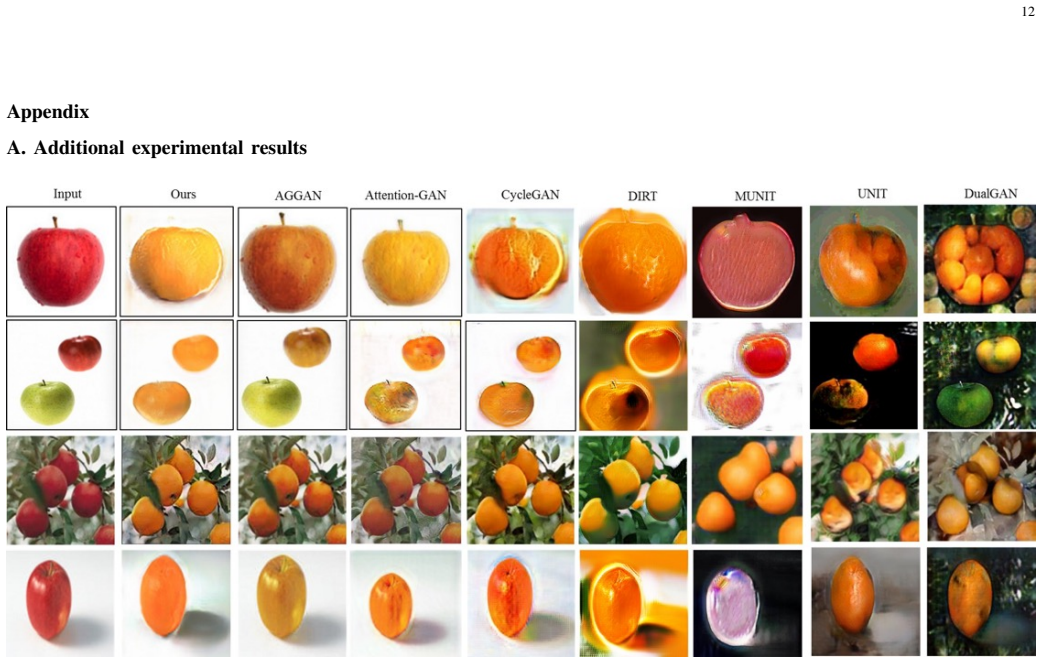
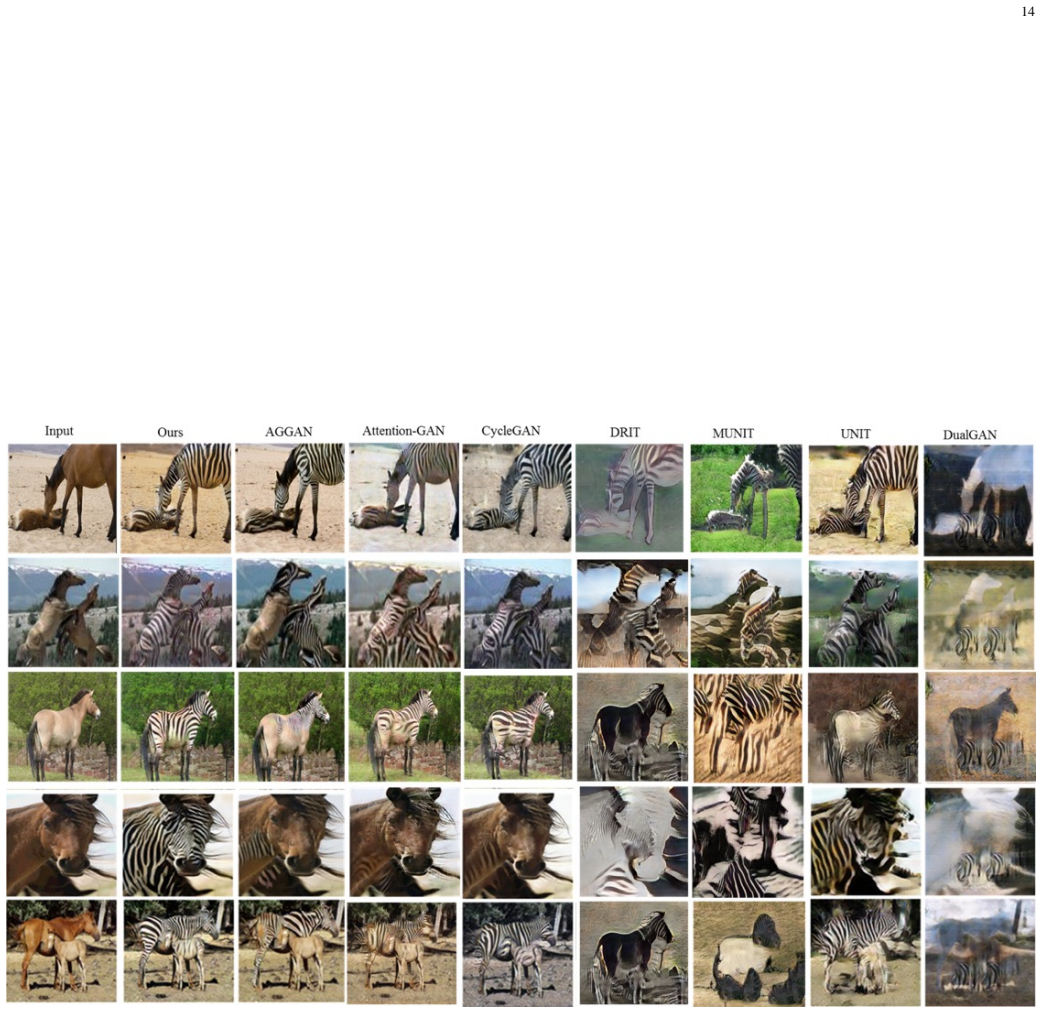
SPA-GAN's central claim is that the discriminator's spatial attention map, defined as the sum of absolute values of activation maps across channels from a mid-level layer, marks the regions of an input image that distinguish the source from the target domain; multiplying this map into the input before the generator, $x' = G(A_{DX}(x) \odot x)$, makes the translation focus on the meaningful object parts and produces more realistic outputs. The claim is supported by an additional feature map loss that matches first-decoder-layer features of the attended real and generated images, enforcing consistency of high-level domain-specific semantics. On the three benchmark datasets, the paper reports the lowest target-only KID on all six translation directions, the highest classification accuracy on all six directions, and the majority of user-study votes, while using the same generator/discriminator architecture and training cost as CycleGAN.
Load-bearing premise
The whole attention story rests on the premise that the discriminator's activation map, trained only to tell real from fake, highlights exactly the regions of the source image that should be translated into the target object.
Editorial extensions
If this is right
- Because attention is computed inside the discriminator, SPA-GAN adds no extra attention network or supervision, so its training cost stays similar to CycleGAN while improving output quality.
- The feature map loss at the first decoder layer is responsible for part of the gain: ablation shows removing it raises KID and lowers classification accuracy.
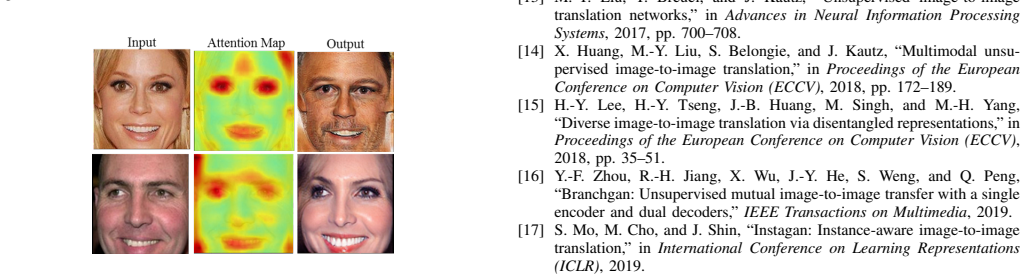
- Attention maps transfer across settings: for object-centric datasets they concentrate on the target object, while for holistic translations like Winter↔Summer and gender conversion they highlight semantically meaningful regions such as trees and facial features.
- The reported target-domain KID improvements on all six translation directions imply that generated images are statistically closer to real target images than those of all compared methods, under the KID metric.
Reading between the lines
- The authors do not test this, but the same discriminator-attention feedback could be transferred to any GAN that already has a real-versus-fake classifier, turning the classifier into an attention source without architectural additions.
- One testable consequence left implicit is whether the attention maps double as weakly supervised object localizers: if they align with segmentation masks, they would provide free localization supervision for other tasks.
- Since SPA-GAN permits different attention maps in the forward and inverse mappings, it may handle asymmetric layouts between domains better than methods that share a single attention map; this could be checked on datasets where objects appear in different positions.
Signed reviews
Editorial analysis
A structured set of objections, weighed in public.
Referee Report
Summary. The paper proposes SPA-GAN, an unsupervised image-to-image translation model built on the CycleGAN backbone. Its two main modifications are (i) a spatial attention map extracted from the discriminator (the sum of absolute activation maps at a selected layer, Eq. (1)) that is multiplied into the generator input, x' = G(A_DX(x) ⊙ x) (Eq. (2)), and (ii) an L1 feature-map loss that matches the first-layer decoder features of attended real and attended generated samples (Eqs. (3)-(4)). The full objective combines adversarial, modified cycle-consistency, and feature-map losses (Eq. (8)). The paper reports ablations and comparisons on Horse↔Zebra, Apple↔Orange, and Lion↔Tiger, plus holistic tasks (Winter↔Summer, Facescrub, GTA↔Cityscapes). Quantitative evaluation uses target-domain KID (Table II), both-domain KID (Table III), top-1 classification accuracy (Table IV), and a three-method forced-choice user study (Table V); SPA-GAN is best on all six directions for target-domain KID and classification accuracy, and receives roughly 70% of user-study votes.
Significance. The work is significant if its claims hold: SPA-GAN is conceptually simple and lightweight, requiring no additional attention network or supervision, and the reported gains are large and consistent across three independent measures (target-domain KID, classification accuracy, and user study). The ablation in Table I cleanly separates the presence of the attention pathway and the feature-map loss, and the authors are transparent about the less favorable both-domain KID results in Table III. The main weakness is that the central conceptual claim—that the discriminator attention map localizes the objects to be translated—is only supported qualitatively; if that interpretation fails, the contribution degrades to an unexplained input modulation that empirically helps, although the benchmark numbers would still stand.
major comments (3)
- [III-A, Eq. (2), Fig. 3, Table I] The paper's central claim is that A_DX(x) localizes the discriminative object regions and that this localization drives the large gains in Tables II and IV. This is currently supported only by qualitative examples (Fig. 3) and by an ablation that removes the mask entirely (Table I). The ablation cannot rule out the alternative that any smooth multiplicative input modulation with similar marginal statistics produces the improvement, because the attention map is never compared against ground-truth foreground/object masks and no control mask is tested. Please add a quantitative localization evaluation (for example, IoU or precision-recall curves of thresholded attention against segmentation masks or saliency maps on Horse↔Zebra and Apple↔Orange) and a control experiment using a fixed or random smooth mask in place of A_DX(x) in Eq. (2). Without these, the stated mechanism is not established, even though the empirical improvements would remain.
- [III-B, Eqs. (3)-(4)] The feature-map loss is a second novel component and is used in all reported models, but the symbols x'_a and y'_a in Eqs. (3) and (4) are never formally defined. From the text and Fig. 1, I infer x'_a = G(x_a) and y'_a = F(y_a), but this should be stated explicitly, including how the attended generated samples are computed and whether the discriminator attention is reapplied at each stage of the cycle. As written, the loss is not reproducible.
- [III-C, Eq. (7), Table I] The modified cycle-consistency loss, which reconstructs x_a and y_a rather than x and y, is listed as a contribution, but the ablations in Table I do not isolate its effect. SPA-GAN-wo-AD removes the attention pathway and with it the modified cycle loss, while SPA-GAN-wo-L_fm retains both the attention input modulation and the modified cycle loss. Please add an ablation that keeps the attention input modulation but uses the original cycle-consistency loss on x and y, so that the contribution of the modified cycle loss can be assessed separately.
minor comments (5)
- [III-A, Eq. (5)] There is a typo in Eq. (5): the logarithmic term for the fake sample is missing a closing parenthesis, and 'upsampeled' in Section III-A should be 'upsampled'.
- [II-B, Reference [20]] The name 'Minh et al.' in the related-work paragraph should be 'Mnih et al.', matching the actual citation.
- [IV-B, Tables II-IV] Please specify the train/test split used for the KID and classification-accuracy evaluations, and whether the reported numbers are computed on a held-out test set or on the training set; this is important for reproducibility and for fair comparison with the baselines.
- [IV-F, Table V] The user study compares SPA-GAN only with CycleGAN and AGGAN, not with the other five baselines; the text should be careful not to imply a user-study comparison against all methods, and ideally pairwise comparisons against at least one additional strong baseline (e.g., DRIT or MUNIT) should be added.
- [IV-C, Table I] In the description of SPA-GAN-wo-AD, the feature-map loss is said to be kept, but Eq. (4) defines the loss on attended samples; please state explicitly whether x_a and y_a are replaced by x and y when the attention pathway is removed, since otherwise the ablation configuration is underspecified.
Circularity Check
No circularity: SPA-GAN's attention transfer, feature-map loss, and benchmark comparisons are empirical results, not derivations that reduce to their inputs.
full rationale
The paper's derivation chain is self-contained and non-circular. The spatial attention map A_D(x) is defined from discriminator activations in Eq. 1, imported from the external work of Zagoruyko and Komodakis [9], and the generator input x' = G(A_D(x) ⊙ x) in Eq. 2 is a novel architectural construction, not a restatement of the output. The feature-map loss in Eqs. 3-4 is a new regularizer, and the full objective Eq. 8 combines adversarial, cycle-consistency, and feature-map terms with no term defined in terms of the reported evaluation metrics. The reported KID values, classification accuracies, and user-study votes in Tables II-V are measurements on test data, not quantities algebraically forced by the model equations. There are no self-citations and no imported uniqueness theorem that selects the model. The empirically chosen values of λ_fm and the decoder layer for the feature-map loss are hyperparameter/model selections made on one benchmark, not fitted parameters renamed as predictions; this is a statistical evaluation concern rather than circularity. The skeptic's concern about whether A_D(x) actually localizes the object is an empirical validity question about the attention mechanism, not a circularity of the derivation. Therefore the circularity score is 0.
Assumptions & free parameters
free parameters (5)
- λ_fm =
1
- λ_cyc =
10
- feature-map-loss layer =
first decoder layer (D1)
- attention layer in discriminator =
second-to-last layer
- learning rate =
0.0002
assumptions (4)
- domain assumption The CycleGAN two-generator/two-discriminator adversarial and cycle-consistency losses are a sufficient base for unpaired translation, and attention can be layered onto this base without changing the game.
- domain assumption The sum of absolute activation maps over channels (Eq. 1, from [9]) measures where the discriminator looks when classifying real vs. fake, and this spatial map is the right region selector for translation.
- ad hoc to paper Matching first-decoder-layer feature maps between an attended real sample and an attended generated sample preserves domain-specific features and improves realism.
- domain assumption Target-domain KID, per-task fine-tuned Inception classification accuracy, and a 10-participant forced-choice user study are faithful measures of translation quality.
Cite this review
Pith. "Pith review of SPA-GAN: Spatial Attention GAN for Image-to-Image Translation." pith.science (2026). https://pith.science/paper/JEYQV23Q
@misc{pith2026190806616,
  author       = {Pith},
  title        = {Pith review of: SPA-GAN: Spatial Attention GAN for Image-to-Image Translation},
  year         = {2026},
  howpublished = {\url{https://pith.science/paper/JEYQV23Q}},
  note         = {Machine review of arXiv:1908.06616}
}
read the original abstract
Image-to-image translation is to learn a mapping between images from a source domain and images from a target domain. In this paper, we introduce the attention mechanism directly to the generative adversarial network (GAN) architecture and propose a novel spatial attention GAN model (SPA-GAN) for image-to-image translation tasks. SPA-GAN computes the attention in its discriminator and use it to help the generator focus more on the most discriminative regions between the source and target domains, leading to more realistic output images. We also find it helpful to introduce an additional feature map loss in SPA-GAN training to preserve domain specific features during translation. Compared with existing attention-guided GAN models, SPA-GAN is a lightweight model that does not need additional attention networks or supervision. Qualitative and quantitative comparison against state-of-the-art methods on benchmark datasets demonstrates the superior performance of SPA-GAN.
Figures


Figures from the paper (12 more)






Reference graph
Works this paper leans on
-
[1]
Image-to-image translation with conditional adversarial networks,
P. Isola, J.-Y . Zhu, T. Zhou, and A. A. Efros, “Image-to-image translation with conditional adversarial networks,” in Proceedings of the IEEE conference on computer vision and pattern recognition , 2017, pp. 1125– 1134
2017
-
[2]
Photo-realistic single image super-resolution using a generative adversarial network,
C. Ledig, L. Theis, F. Husz ´ar, J. Caballero, A. Cunningham, A. Acosta, A. Aitken, A. Tejani, J. Totz, Z. Wang et al. , “Photo-realistic single image super-resolution using a generative adversarial network,” in Proceedings of the IEEE conference on computer vision and pattern recognition, 2017, pp. 4681–4690
2017
-
[3]
Quality-aware unpaired image- to-image translation,
L. Chen, L. Wu, Z. Hu, and M. Wang, “Quality-aware unpaired image- to-image translation,” IEEE Transactions on Multimedia , 2019
work page 2019
-
[4]
Image to image translation for domain adaptation,
Z. Murez, S. Kolouri, D. Kriegman, R. Ramamoorthi, and K. Kim, “Image to image translation for domain adaptation,” in Proceedings of the IEEE Conference on Computer Vision and Pattern Recognition , 2018, pp. 4500–4509
work page 2018
-
[5]
Unpaired image-to-image translation using cycle-consistent adversarial networks,
J.-Y . Zhu, T. Park, P. Isola, and A. A. Efros, “Unpaired image-to-image translation using cycle-consistent adversarial networks,” in Proceedings of the IEEE International Conference on Computer Vision , 2017, pp. 2223–2232
2017
-
[6]
Dualgan: Unsupervised dual learning for image-to-image translation,
Z. Yi, H. Zhang, P. Tan, and M. Gong, “Dualgan: Unsupervised dual learning for image-to-image translation,” in Proceedings of the IEEE International Conference on Computer Vision , 2017, pp. 2849–2857
work page 2017
-
[7]
Un- supervised attention-guided image-to-image translation,
Y . A. Mejjati, C. Richardt, J. Tompkin, D. Cosker, and K. I. Kim, “Un- supervised attention-guided image-to-image translation,” in Advances in Neural Information Processing Systems , 2018, pp. 3697–3707
work page 2018
-
[8]
Attention-gan for object trans- figuration in wild images,
X. Chen, C. Xu, X. Yang, and D. Tao, “Attention-gan for object trans- figuration in wild images,” in Proceedings of the European Conference on Computer Vision (ECCV) , 2018, pp. 164–180
work page 2018
Show all 42 references
-
[9]
Paying more attention to attention: Improving the performance of convolutional neural networks via atten- tion transfer,
S. Zagoruyko and N. Komodakis, “Paying more attention to attention: Improving the performance of convolutional neural networks via atten- tion transfer,” in International Conference on Learning Representations (ICLR), 2017
2017
-
[10]
Coupled generative adversarial networks,
M.-Y . Liu and O. Tuzel, “Coupled generative adversarial networks,” in Advances in neural information processing systems , 2016, pp. 469–477
2016
-
[11]
Learning to discover cross-domain relations with generative adversarial networks,
T. Kim, M. Cha, H. Kim, J. K. Lee, and J. Kim, “Learning to discover cross-domain relations with generative adversarial networks,” in Proceedings of the 34th International Conference on Machine Learning- V olume 70. JMLR. org, 2017, pp. 1857–1865
2017
-
[12]
Harmonic unpaired image-to-image translation,
R. Zhang, T. Pfister, and J. Li, “Harmonic unpaired image-to-image translation,” in International Conference on Learning Representations (ICLR), 2019
2019
-
[13]
Unsupervised image-to-image translation networks,
M.-Y . Liu, T. Breuel, and J. Kautz, “Unsupervised image-to-image translation networks,” in Advances in Neural Information Processing Systems, 2017, pp. 700–708
2017
-
[14]
Multimodal unsu- pervised image-to-image translation,
X. Huang, M.-Y . Liu, S. Belongie, and J. Kautz, “Multimodal unsu- pervised image-to-image translation,” in Proceedings of the European Conference on Computer Vision (ECCV) , 2018, pp. 172–189
2018
-
[15]
Diverse image-to-image translation via disentangled representations,
H.-Y . Lee, H.-Y . Tseng, J.-B. Huang, M. Singh, and M.-H. Yang, “Diverse image-to-image translation via disentangled representations,” in Proceedings of the European Conference on Computer Vision (ECCV) , 2018, pp. 35–51
2018
-
[16]
Branchgan: Unsupervised mutual image-to-image transfer with a single encoder and dual decoders,
Y .-F. Zhou, R.-H. Jiang, X. Wu, J.-Y . He, S. Weng, and Q. Peng, “Branchgan: Unsupervised mutual image-to-image transfer with a single encoder and dual decoders,” IEEE Transactions on Multimedia , 2019
2019
-
[17]
Instagan: Instance-aware image-to-image translation,
S. Mo, M. Cho, and J. Shin, “Instagan: Instance-aware image-to-image translation,” in International Conference on Learning Representations (ICLR), 2019
2019
-
[18]
The dynamic representation of scenes,
R. A. Rensink, “The dynamic representation of scenes,” Visual cognition, vol. 7, no. 1-3, pp. 17–42, 2000
2000
-
[19]
Neural machine translation by jointly learning to align and translate,
D. Bahdanau, K. Cho, and Y . Bengio, “Neural machine translation by jointly learning to align and translate,” in International Conference on Learning Representations (ICLR) , 2015
2015
-
[20]
Recurrent models of visual attention,
V . Mnih, N. Heess, A. Graves et al. , “Recurrent models of visual attention,” in Advances in neural information processing systems , 2014, pp. 2204–2212
2014
-
[21]
Residual attention network for image classification,
F. Wang, M. Jiang, C. Qian, S. Yang, C. Li, H. Zhang, X. Wang, and X. Tang, “Residual attention network for image classification,” in Proceedings of the IEEE Conference on Computer Vision and Pattern Recognition, 2017, pp. 3156–3164
2017
-
[22]
Attention to scale: Scale-aware semantic image segmentation,
L.-C. Chen, Y . Yang, J. Wang, W. Xu, and A. L. Yuille, “Attention to scale: Scale-aware semantic image segmentation,” in Proceedings of the IEEE conference on computer vision and pattern recognition , 2016, pp. 3640–3649
2016
-
[23]
Show, attend and tell: Neural image caption generation with visual attention,
K. Xu, J. Ba, R. Kiros, K. Cho, A. Courville, R. Salakhudinov, R. Zemel, and Y . Bengio, “Show, attend and tell: Neural image caption generation with visual attention,” in International conference on machine learning , 2015, pp. 2048–2057
2015
-
[24]
Describing videos by exploiting temporal structure,
L. Yao, A. Torabi, K. Cho, N. Ballas, C. Pal, H. Larochelle, and A. Courville, “Describing videos by exploiting temporal structure,” in Proceedings of the IEEE international conference on computer vision , 2015, pp. 4507–4515
2015
-
[25]
Stacked attention networks for image question answering,
Z. Yang, X. He, J. Gao, L. Deng, and A. Smola, “Stacked attention networks for image question answering,” in Proceedings of the IEEE conference on computer vision and pattern recognition , 2016, pp. 21– 29
2016
-
[26]
Learning deep features for discriminative localization,
B. Zhou, A. Khosla, A. Lapedriza, A. Oliva, and A. Torralba, “Learning deep features for discriminative localization,” inProceedings of the IEEE conference on computer vision and pattern recognition , 2016, pp. 2921– 2929
2016
-
[27]
Recurrent attentional networks for saliency detection,
J. Kuen, Z. Wang, and G. Wang, “Recurrent attentional networks for saliency detection,” inProceedings of the IEEE Conference on Computer Vision and Pattern Recognition , 2016, pp. 3668–3677
2016
-
[28]
Self-attention generative adversarial networks,
H. Zhang, I. Goodfellow, D. Metaxas, and A. Odena, “Self-attention generative adversarial networks,” in International Conference on Ma- chine Learning , 2019
2019
-
[29]
Lr-gan: Layered recursive generative adversarial networks for image generation,
J. Yang, A. Kannan, D. Batra, and D. Parikh, “Lr-gan: Layered recursive generative adversarial networks for image generation,” in International Conference on Learning Representations (ICLR) , 2017
2017
-
[30]
High-resolution image synthesis and semantic manipulation with condi- tional gans,
T.-C. Wang, M.-Y . Liu, J.-Y . Zhu, A. Tao, J. Kautz, and B. Catanzaro, “High-resolution image synthesis and semantic manipulation with condi- tional gans,” in Proceedings of the IEEE conference on computer vision and pattern recognition , 2018, pp. 8798–8807
2018
-
[31]
Imagenet: A large-scale hierarchical image database,
J. Deng, W. Dong, R. Socher, L.-J. Li, K. Li, and L. Fei-Fei, “Imagenet: A large-scale hierarchical image database,” in 2009 IEEE conference on computer vision and pattern recognition . Ieee, 2009, pp. 248–255. 11
2009
-
[32]
A data-driven approach to cleaning large face datasets,
H.-W. Ng and S. Winkler, “A data-driven approach to cleaning large face datasets,” in 2014 IEEE International Conference on Image Processing (ICIP). IEEE, 2014, pp. 343–347
2014
-
[33]
Playing for data: Ground truth from computer games,
S. R. Richter, V . Vineet, S. Roth, and V . Koltun, “Playing for data: Ground truth from computer games,” in European conference on com- puter vision . Springer, 2016, pp. 102–118
2016
-
[34]
The cityscapes dataset for semantic urban scene understanding,
M. Cordts, M. Omran, S. Ramos, T. Rehfeld, M. Enzweiler, R. Be- nenson, U. Franke, S. Roth, and B. Schiele, “The cityscapes dataset for semantic urban scene understanding,” in Proceedings of the IEEE conference on computer vision and pattern recognition , 2016, pp. 3213– 3223
2016
-
[35]
Adam: A method for stochastic optimization,
D. P. Kingma and J. Ba, “Adam: A method for stochastic optimization,” in International Conference on Learning Representations (ICLR) , 2015
2015
-
[36]
Least squares generative adversarial networks,
X. Mao, Q. Li, H. Xie, R. Y . Lau, Z. Wang, and S. Paul Smolley, “Least squares generative adversarial networks,” in Proceedings of the IEEE International Conference on Computer Vision , 2017, pp. 2794–2802
2017
-
[37]
Demysti- fying mmd gans,
M. Bi ´nkowski, D. J. Sutherland, M. Arbel, and A. Gretton, “Demysti- fying mmd gans,” in International Conference on Learning Representa- tions (ICLR) , 2018
2018
-
[38]
Gans trained by a two time-scale update rule converge to a local nash equilibrium,
M. Heusel, H. Ramsauer, T. Unterthiner, B. Nessler, and S. Hochreiter, “Gans trained by a two time-scale update rule converge to a local nash equilibrium,” in Advances in Neural Information Processing Systems , 2017, pp. 6626–6637
2017
-
[39]
Generative image modeling using style and structure adversarial networks,
X. Wang and A. Gupta, “Generative image modeling using style and structure adversarial networks,” in European Conference on Computer Vision. Springer, 2016, pp. 318–335
2016
-
[40]
Colorful image colorization,
R. Zhang, P. Isola, and A. A. Efros, “Colorful image colorization,” in European conference on computer vision . Springer, 2016, pp. 649–666
2016
-
[41]
Rethinking the inception architecture for computer vision,
C. Szegedy, V . Vanhoucke, S. Ioffe, J. Shlens, and Z. Wojna, “Rethinking the inception architecture for computer vision,” in Proceedings of the IEEE conference on computer vision and pattern recognition , 2016, pp. 2818–2826. 12 Appendix A. Additional experimental results Fig...
2016
-
[42]
The generated objects by CycleGAN, Attention-GAN and AGGAN are mixed with parts from the target as well as the source domain
Attention-GAN and CycleGAN generate images with unnatural skin pattern (horizontal patterns) in row 2, 3 and 5. The generated objects by CycleGAN, Attention-GAN and AGGAN are mixed with parts from the target as well as the source domain. 15 Fig. 13. Zebra → Horse translation r...
Reviewed August 14, 2026 · model on record in the stance chip above.
Discussion (0). Continue with ORCID to comment.