REVIEW 3 major objections 5 minor 56 references
The trans-Neptunian object (84922) 2003 VS2 through stellar occultations
T0 review · 3 major / 5 minor · reviewed 2026-08-14 · deepseek-v4-flash
Pith's one-line read Occultations give the Kuiper Belt object 2003 VS2 a shape that fluid equilibrium cannot explain.
desk verdict Solid occultation size and astrometry for 2003 VS2, but the headline non-Jacobi shape claim is conditional on an unmeasured albedo/shape partition and should be softened. read the letter →
The pith
A machine-rendered reading of the paper's core claim, the machinery that carries it, and where it could break.
The reading
What carries the argument
The load-bearing model is a triaxial ellipsoid with axes $a > b > c$ and aspect angle $\theta$ between the $c$-axis and the observer. Two relations carry the argument: the projection equation $b'^2 = c^2 \sin^2\theta + b^2 \cos^2\theta$, which maps the true axes onto the observed limb ellipse, and the light-curve relation $\Delta m = -1.25\,\log_{10}\left[\frac{1+\gamma^2\tan^2\theta}{1+(\gamma/\beta)^2\tan^2\theta}\right]$, which ties rotational brightness variation to the axis ratios $\beta = b/a$ and $\gamma = c/a$. Because the occultation occurred at a brightness maximum, the apparent semi-major axis equals the true long axis, removing one unknown; the two equations then constrain $\beta$, $\gamma$, and $\theta$. The final step is to compare the allowed $\beta$--$\gamma$ pairs with the Jacobi equilibrium ellipsoid sequence, and the absence of an intersection is what produces the paper's central non-Jacobi conclusion.
What would settle it
A second multi-chord stellar occultation at a substantially different rotational phase would measure the projected ellipse again; if the published axes and aspect angle cannot reproduce the new ellipse, the shape-albedo decomposition fails. More directly, a thermal-infrared light curve taken over the full 7.4-hour rotation would show whether the optical brightness variation is geometric or albedo-driven, because thermal emission tracks projected area rather than surface albedo.
Extended reading notes
Core claim
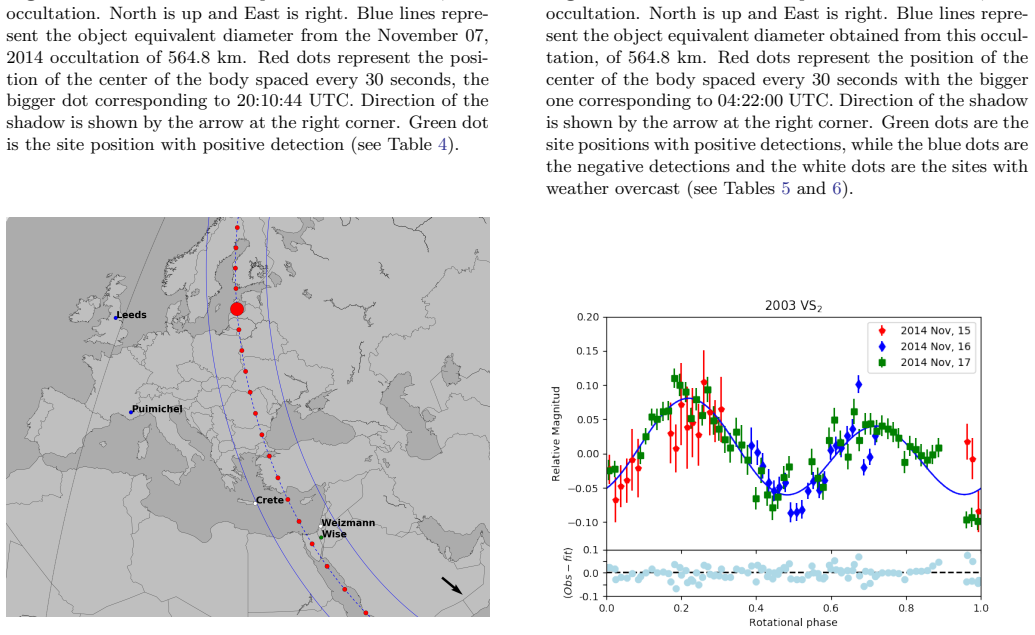
The occultation shadow on November 7, 2014 is best matched by an ellipse with apparent semi-major axis $a' = 313.8 \pm 7.1$ km and apparent oblateness $\epsilon' = 0.190$, for an equivalent radius of 282.4 km. Photometry obtained a few days later, folded at the known 7.4175285-hour rotation period, shows a peak-to-peak amplitude of $0.141 \pm 0.009$ mag and places the occultation near a brightness maximum, so the longest physical axis $a$ is perpendicular to the line of sight and equals $a'$. Combining the projection relation between the apparent minor axis and the true axes with the light-curve amplitude formula, the paper derives $a = 313.8 \pm 7.1$ km, $b = 265.5^{+8.8}_{-9.8}$ km, and $c = 247.3^{+26.6}_{-43.6}$ km, with the $c$-axis tilted $\theta = 65^{+15}_{-10}$ degrees to the line of sight. These axes give a spherical volume-equivalent diameter of $548.3^{+29.5}_{-44.6}$ km and an implied geometric albedo near 0.13. Because the derived ratios $\beta = b/a = 0.846$ and $\gamma = c/a = 0.788$ never intersect the Jacobi equilibrium sequence for any aspect angle, the paper concludes that the body is not a Jacobi triaxial equilibrium figure. Under the alternative assumption that the body is an oblate Maclaurin spheroid, the rotation period implies a density of $1400^{+1000}_{-300}$ kg m$^{-3}$.
Load-bearing premise
The inference about the $b$ and $c$ axes, and therefore the claim that the shape is not a Jacobi equilibrium figure, assumes that the entire $0.141 \pm 0.009$ mag rotational light-curve amplitude comes from the body's triaxial shape rather than from darker or brighter surface patches; the paper itself shows that if only $\Delta m = 0.015$ mag is shape-driven, a Jacobi solution with $\beta = 0.908$, $\gamma = 0.553$, and $\theta = 75^\circ$ is allowed.
Editorial extensions
If this is right
- If the triaxial solution is correct, 2003 VS2 becomes a benchmark object whose size, shape, and rotation are known geometrically rather than assumed from thermal models.
- Under the shape-driven light-curve interpretation, the surface albedo must be relatively uniform at the level of the 0.141 mag amplitude; if bright or dark patches contribute significantly, the axes must be re-derived.
- The 3-sigma upper limit of about 1 microbar for a pure-nitrogen atmosphere, together with the absence of confirmed rings or satellites, places this object in the class of bare, atmosphere-less Kuiper Belt bodies.
- The Maclaurin-spheroid assumption yields a density of $1400^{+1000}_{-300}$ kg m$^{-3}$, consistent with an ice-rock composition, but the density estimate is degenerate with the assumed oblate shape.
- The three occultations provide accurate astrometric positions that improve the ephemeris of 2003 VS2, making future event predictions more reliable.
Reading between the lines
- If the no-albedo assumption survives later tests, the non-Jacobi result implies that a body of only about 550 km can hold a non-fluid shape against gravity and rotation, which would push the practical threshold for hydrostatic relaxation in icy Kuiper Belt objects upward and favor interiors with finite strength or rubble-pile structure.
- The albedo-versus-shape degeneracy exposed by the paper's sensitivity test could be broken observationally: a thermal-infrared light curve at the same rotation period would be dominated by projected area rather than albedo spots and would independently verify the inferred axes.
- The 0.09 flux drop seen in only the NTT light curve, if real, points either to a close stellar companion or to diffuse material near 2003 VS2; the paper's own data cannot distinguish these, so a future high-cadence occultation is the decisive observation.
Signed reviews
Editorial analysis
A structured set of objections, weighed in public.
Referee Report
Summary. This paper reports three stellar occultations by the plutino (84922) 2003 VS2: two single-chord events in December 2013 and March 2014, used for astrometry, and a multi-chord event on 2014 November 7 with four positive detections, used to fit an apparent limb ellipse with semi-axes a'=313.8±7.1 km and b'=254.8(+25.0/-21.7) km, position angle 5±7°, and area-equivalent diameter 564.8 km. From the rotational light curve (peak-to-peak amplitude 0.141±0.009 mag) and the adopted rotation period, the authors derive principal semi-axes a=313.8±7.1 km, b=265.5(+8.8/-9.8) km, and c=247.3(+26.6/-43.6) km, with the c axis inclined at θ=65(+15/-10)°, and conclude that the shape is not consistent with a Jacobi triaxial equilibrium figure. Under an alternative Maclaurin-oblate assumption they derive a density of 1400(+1000/-300) kg m^-3, and they report a geometric albedo of 0.131(+0.024/-0.013) in the main text (0.123(+0.015/-0.014) in the abstract). The data also set an upper limit of about 1 microbar for a pure N2 atmosphere and reveal a marginal secondary event in one NTT light curve that cannot be confirmed.
Significance. The observational core is solid and valuable: the multi-chord limb fit is carefully modelled using a sharp-edge model convolved with Fresnel diffraction, finite stellar diameter, and finite integration time, giving χ² per degree of freedom of 0.78; the chord timings are reported transparently; and the two single-chord events provide useful astrometric positions. If the derived 3D shape is correct, this is one of the few direct deconvolved size/shape measurements of a TNO and would be physically interesting for testing hydrostatic-equilibrium expectations. The paper also gives useful upper limits on an atmosphere and on rings or satellites. However, the headline non-Jacobi conclusion is conditional on the unmeasured assumption that the entire 0.141 mag light-curve amplitude is shape-induced; the authors' own sensitivity check in Appendix A shows that a modest albedo contribution would restore a Jacobi solution. The numeric inconsistency in the quoted albedo and the internal inconsistency in the Appendix A sensitivity example must be fixed before the central claim can be accepted as stated.
major comments (3)
- [Abstract, §4.1, Appendix A] The headline conclusion that 2003 VS2 is 'not consistent with a Jacobi triaxial equilibrium figure' rests entirely on the assumption that the full 0.141 ± 0.009 mag rotational light-curve amplitude is produced by the changing projected area of a uniform-albedo triaxial ellipsoid. The paper itself shows in Appendix A that if only Δm = 0.015 mag is shape-induced, a Jacobi solution with β = 0.908 and γ = 0.553 exists; the remaining 0.126 mag is an entirely plausible albedo contribution, as the paper's own Maclaurin alternative invokes a roughly 100 km spot covering ~16% of the area. The available photometry therefore cannot distinguish a shape-induced amplitude of 0.141 mag from one of about 0.015 mag. The abstract and Section 5 should state the non-Jacobi claim with an explicit caveat, for example 'under the assumption that the full light-curve amplitude is shape-induced', or the conclusion should be weakened accordingly.
- [Appendix A (Eq. A2)] The numerical Jacobi example quoted for Δm = 0.015 mag is internally inconsistent. With a' = 313.8 km, b' = 254.8 km, β = 0.908, γ = 0.553, and θ = 75°, Eq. (A2) gives γ ≈ 0.80, not 0.553; a value of θ ≈ 35° would satisfy the equation. Please correct the quoted θ and any dependent statements, and re-verify the corresponding figures, because the sensitivity test as printed does not demonstrably reproduce the observed limb while yielding a Jacobi solution.
- [Abstract vs. §4.1 and Table 10] The geometric albedo quoted in the Abstract (0.123(+0.015/-0.014)) differs from the value derived in Section 4.1 and listed in Table 10 (0.131(+0.024/-0.013)). These numbers cannot both be the result of the same calculation; please reconcile them and state which absolute magnitude and uncertainty were used.
minor comments (5)
- [Section 2.1] The sentence 'refine the the astrometric positions' contains a duplicated article; please correct it.
- [Abstract and Section 2.3] The sentence 'The rotational light curve present a peak-to-peak amplitude' should be 'presents a peak-to-peak amplitude'; the manuscript would benefit from a careful proofreading pass.
- [Appendix A] The typos 'Jabobi-shape object' and 'Suplemmentary Information' should be corrected, and 'tg2θ' should be typeset as tan^2 θ.
- [Section 3.2] The abbreviation 'pdf' for 'per degree of freedom' is nonstandard and could be confused with probability density function; consider using 'dof' instead.
- [Section 4.1 and Table 10] The distinction between the area-equivalent diameter of the projected ellipse (564.8 km) and the volume-equivalent spherical diameter of the 3D body (548.3 km) should be stated explicitly where both numbers appear, to avoid apparent inconsistency.
Circularity Check
No significant circularity: the shape is derived from independent occultation geometry and photometry, with the albedo/shape partition explicitly caveated.
full rationale
The paper's central derivation chain is observational and self-contained. Chord timings (Table 8) give a best-fit ellipse a' = 313.8 ± 7.1 km, b' = 254.8 km (Section 3.2), an independent geometric measurement. The 3D axes are then obtained from Eqs. A1-A3 of Appendix A, using the measured light-curve amplitude Δm = 0.141 ± 0.009 mag and the assumption that the occultation occurred near maximum brightness, justified by the folded photometry of Section 2.3. The rotational period P = 7.4175285 ± 0.00001 h is cited from Santos-Sanz et al. (2017), a self-citation with overlapping authors, but it is an independently measured external quantity, also consistent with the present photometric data, and it is not fitted to the shape result; hence it does not force the conclusion. The headline 'not consistent with a Jacobi equilibrium figure' is conditional on the explicitly stated assumption that the full Δm is shape-induced with negligible albedo contribution. The paper itself flags this in Appendix A: 'In fact we are assuming that some of the light curve contribution is due to VS2's shape and some due to albedo variation in the surface. When we try values for Δm smaller than 0.141 the lines in Fig. 12 will move to the right... For Δm = 0.015 mag we find a Jacobi solution with β = 0.908 (b = 284.9 km), γ = 0.553 (c = 173.5 km) and θ = 75°.' This is a sensitivity analysis of a modeling assumption, not a circular reduction: the size, ellipse, albedo, and density estimates follow from distinct observable inputs (occultation geometry, photometry amplitude, period, absolute magnitude). No equation is defined in terms of the quantity it is used to predict, and no fitted parameter is renamed as a prediction. Therefore the appropriate finding is no significant circularity.
Assumptions & free parameters
free parameters (6)
- a' apparent semi-major axis of the limb ellipse =
313.8 ± 7.1 km
- b' apparent semi-minor axis of the limb ellipse =
254.8 (+25.0/-21.7) km
- P' position angle of the apparent pole =
5 ± 7 deg
- (f_c, g_c) center offsets relative to ephemeris =
(-1558.1 ± 8.1, -634.6 ± 11.0) km
- Delta m rotational light curve peak-to-peak amplitude =
0.141 ± 0.009 mag
- theta aspect angle of the c-axis =
65 (+15/-10) deg
assumptions (6)
- domain assumption Limb is a perfect ellipse
- domain assumption Occultation happened at rotational maximum so a' = a
- domain assumption Light curve amplitude is entirely shape-induced in the reference triaxial solution
- standard math Jacobi/Maclaurin equilibrium theory describes a strengthless fluid body
- domain assumption Rotation period of 7.4175285 h is correct and the light curve is stable across the 8 days from occultation to photometry
- domain assumption Star flux drops to zero during occultation; no residual light from the TNO
Cite this review
Pith. "Pith review of The trans-Neptunian object (84922) 2003 VS2 through stellar occultations." pith.science (2026). https://pith.science/paper/JKYUPMDX
@misc{pith2026190806645,
  author       = {Pith},
  title        = {Pith review of: The trans-Neptunian object (84922) 2003 VS2 through stellar occultations},
  year         = {2026},
  howpublished = {\url{https://pith.science/paper/JKYUPMDX}},
  note         = {Machine review of arXiv:1908.06645}
}
abstract
We present results from three world-wide campaigns that resulted in the detections of two single-chord and one multi-chord stellar occultations by the Plutino object (84922) 2003~VS$_2$. From the single-chord occultations in 2013 and 2014 we obtained accurate astrometric positions for the object, while from the multi-chord occultation on November 7th, 2014, we obtained the parameters of the best-fitting ellipse to the limb of the body at the time of occultation. We also obtained short-term photometry data for the body in order to derive its rotational phase during the occultation. The rotational light curve present a peak-to-peak amplitude of 0.141 $\pm$ 0.009 mag. This allows us to reconstruct the three-dimensional shape of the body, with principal semi-axes $a = 313.8 \pm 7.1$ km, $b = 265.5^{+8.8}_{-9.8}$ km, and $c = 247.3^{+26.6}_{-43.6}$ km, which is not consistent with a Jacobi triaxial equilibrium figure. The derived spherical volume equivalent diameter of $548.3 ^{+29.5}_{-44.6}$ km is about 5\% larger than the radiometric diameter of 2003~VS$_2$ derived from Herschel data of $523 \pm 35$ km, but still compatible with it within error bars. From those results we can also derive the geometric albedo ($0.123 ^{+0.015}_{-0.014}$) and, under the assumption that the object is a Maclaurin spheroid, the density $\rho = 1400^{+1000}_{-300}$ for the plutino. The disappearances and reappearances of the star during the occultations do not show any compelling evidence for a global atmosphere considering a pressure upper limit of about 1 microbar for a pure nitrogen atmosphere, nor secondary features (e.g. rings or satellite) around the main body.
Figures


Figures from the paper (9 more)


Reference graph
Works this paper leans on
-
[1]
Alvarez-Candal, A.; Pinilla-Alonso, N.; Ortiz, J. L.; et al., 2016, A&A, V. 586, id.A155
work page 2016
-
[2]
Anglada, G., Amado, P. J., Ortiz, J. L., et al., 2017, ApJL, 850, L6 Assafin, M.; Camargo, J. I. B.; Vieira Martins, R.; et al., 2010, A&A, V. 515 Assafin, M.; Vieira-Martins, R.; Camargo, J. I. B.; et al., 2011, GAIA FUN-SSO workshop proccedings, 85, gfun.conf Assafin, M.; Camargo, J. I. B.; Vieira Martins, R.; et al., 2012, A&A, V. 541
work page 2017
- [3]
-
[4]
Barucci, M. A.; Dotto, E. & Levasseur-Regourd, A. C., 2011, A&A Rv, V.19, id.48
work page 2011
- [5]
- [6]
-
[7]
AJ, V. 152, Issue 6, id. 156 B´ erard, D.; Sicardy, B.; Camargo, J. I. B.; et al., 2017, AJ, V. 154, Issue 4, id. 144
work page 2017
-
[8]
Binzel, R. P.; Farinella, P.; Zappala, V. & Cellino, A., 1989, in Asteroids II (eds Binzel, R. P. et al.), 416441, Univ. Arizona Press
work page 1989
Show all 56 references
-
[9]
L.; et al., 2013, ApJ, 773, id
Braga-Ribas, F.; Sicardy, B.; Ortiz, J. L.; et al., 2013, ApJ, 773, id. 26
2013
-
[10]
L.; et al., 2014, Nature, 508, 7494 Brandeker & Cataldi, 2019, A&A, 621, A86
Braga-Ribas, F.; Sicardy, B.; Ortiz, J. L.; et al., 2014, Nature, 508, 7494 Brandeker & Cataldi, 2019, A&A, 621, A86
2014
-
[11]
W.; Keller, J
Buie, M. W.; Keller, J. M., 2016, AJ, V. 151, Issue 3
2016
-
[12]
Camargo, J. I. B.; Vieira-Martins, R.; Assafin, M.; et al., 2014, A&A, V. 561, id.A37
2014
-
[13]
Camargo, J. I. B.; Desmars, J.; Braga-Ribas, F., et al., 2018, Planet. Space Sci., V. 154, p. 59-62 Occultations by the TNO 2003 VS2 21
2018
-
[14]
Chandrasekhar, S., 1969, Ellipsoidal Figures of
1969
-
[15]
Chandrasekhar, S., 1987, Ellipsoidal Figures of Equilibrium (New York: Dover)
1987
-
[16]
& Brunette, G., 2001, in Using NTP to Control and Synchronize System Clocks Part I: Introduction to NTP (Sun BluePrintsTM), OnLine 2001 July
Deeths, D. & Brunette, G., 2001, in Using NTP to Control and Synchronize System Clocks Part I: Introduction to NTP (Sun BluePrintsTM), OnLine 2001 July
2001
-
[17]
L.; et al., 2017, AJ, V
Dias-Oliveira, A.; Sicardy, B.; Ortiz, J. L.; et al., 2017, AJ, V. 154, id. 22 Duffard, R.; Ortiz, J. L.; Santos Sanz, P.; et al., 2008, A&A, V. 479, Issue 3 Fern´ andez-Valenzuela, E.; Ortiz, J. L.; Duffard, R.; et al., 2016, MNRAS, 456, Issue 3 Fern´ andez-Valenzuela, E.; Orti...
2017 arXiv
-
[18]
Gladman, B.; Marsden, B. G. & Vanlaerhoven, C., 2008, in The Solar System Beyond Neptune, M. A. Barucci, H
2008
-
[19]
et al., 2009,
Guilbert, A.; Alvarez-Candal, A.; Merlin, F. et al., 2009,
2009
-
[20]
A.; Moore, J
Hamilton, Douglas P.; Stern, S. A.; Moore, J. M. et al., 2016, Nature, V. 540, Issue 7631, pp. 97-99
2016
-
[21]
P., Linscott, I
Hinson, D. P., Linscott, I. R., Young, L. A., et al., 2017, Icarus, 290, 96
2017
-
[22]
& Luu, J., 1993, Nature, 362, 6422
Jewitt, D. & Luu, J., 1993, Nature, 362, 6422
1993
-
[23]
& Rauer, H., 2008, in Trans-Neptunian Objects and Comets, Saas-Fee Advanced Course 35, 2008, XII
Jewitt, D.; Morbidelli, A. & Rauer, H., 2008, in Trans-Neptunian Objects and Comets, Saas-Fee Advanced Course 35, 2008, XII
2008
-
[24]
C., 2007, AJ, V
Lacerda, P.; Jewitt, D. C., 2007, AJ, V. 133, Issue 4, pp. 1393, id. 159
2007
-
[25]
Leiva, R.; Sicardy, B.; Camargo, J. I. B.; et al., 2017, AJ, V. 154, Issue 4, id. 159
2017
-
[26]
B.; Sicardy, B.; et al., 1986,
Lellouch, E.; Hubbard, W. B.; Sicardy, B.; et al., 1986,
1986
-
[27]
324, Nov
Nature, V. 324, Nov. 20, 1986, p. 227-231
1986
-
[28]
L.; et al., 2002, A&A, V
Lellouch, E.; Moreno, R.; Ortiz, J. L.; et al., 2002, A&A, V. 391
2002
-
[29]
Lellouch, E.; Santos-Sanz, P.; Lacerda, P.; et al., 2013, A&A, V. 557
2013
-
[30]
S.; Mukai, T., 2008, AJ, 135, 4, 1161-1200 Minor Planet Center Electronic Circular 2006-X45
Lykawka, P. S.; Mukai, T., 2008, AJ, 135, 4, 1161-1200 Minor Planet Center Electronic Circular 2006-X45
2008
-
[31]
W.; Kiss, C.; et al., 2012, A&A, V
Mommert, M.; Harris, A. W.; Kiss, C.; et al., 2012, A&A, V. 541, A93
2012
-
[32]
Moorwood, A.; Cuby, J.-G.; Biereichel, P.; et al., 1998, The
1998
-
[33]
Moorwood, A.; Cuby, J.-G.; Lidman, C., 1998, The
1998
-
[34]
F.; & Gomes, R., 2008, in The Solar System Beyond Neptune, M
Morbidelli, A.; Levison, H. F.; & Gomes, R., 2008, in The Solar System Beyond Neptune, M. A. Barucci, H
2008
-
[35]
L.; Baumont, S.; Guti´ errez, P
Ortiz, J. L.; Baumont, S.; Guti´ errez, P. J.; et al., 2002, A&A, V. 388
2002
-
[36]
L.; Sota, A.; Moreno, R.; et al., 2004, A&A, V
Ortiz, J. L.; Sota, A.; Moreno, R.; et al., 2004, A&A, V. 420
2004
-
[37]
L.; Guti´ errez, P
Ortiz, J. L.; Guti´ errez, P. J.; Santos-Sanz, P.; et al., 2006, A&A, V. 447, Issue 3
2006
-
[38]
L.; Santos Sanz, P.; Guti´ errez, P
Ortiz, J. L.; Santos Sanz, P.; Guti´ errez, P. J.; et al., 2007, A&A, V. 468, Issue 1
2007
-
[39]
L.; Cikota, A.; Cikota, S.; et al., 2011, A&A, V
Ortiz, J. L.; Cikota, A.; Cikota, S.; et al., 2011, A&A, V. 525, id. A31
2011
-
[40]
L.; Sicardy, B.; Braga-Ribas, F.; et al., 2012,
Ortiz, J. L.; Sicardy, B.; Braga-Ribas, F.; et al., 2012,
2012
-
[41]
L.; Duffard, R.; Pinilla-Alonso, N.; et al., 2015, A&A, V
Ortiz, J. L.; Duffard, R.; Pinilla-Alonso, N.; et al., 2015, A&A, V. 576, id. A18
2015
-
[42]
L.; Santos-Sanz, P.; Sicardy, B.; et al., 2017, Nature, 550, 7675
Ortiz, J. L.; Santos-Sanz, P.; Sicardy, B.; et al., 2017, Nature, 550, 7675
2017
-
[43]
H., 2015, Icarus, 247, 112-125
Parker, A. H., 2015, Icarus, 247, 112-125
2015
-
[44]
A.; Fornasier, S.; et al., 2010, A&A, V
Perna, D.; Barucci, M. A.; Fornasier, S.; et al., 2010, A&A, V. 510, id. A53
2010
-
[45]
G.; Pinilla-Alonso, N.; et al., 2016, PASP, 128, 959, 018011
Santos-Sanz, P.; French, R. G.; Pinilla-Alonso, N.; et al., 2016, PASP, 128, 959, 018011
2016
-
[46]
Santos-Sanz, P.; Lellouch, E.; Groussin, O.; et al., 2017, A&A, V. 604, id. A95
2017
-
[47]
S., 2007, AJ, 134, 787-798
Sheppard, S. S., 2007, AJ, 134, 787-798
2007
-
[48]
L.; Assafin, M.; et al., 2011, Nature, 478, 493
Sicardy, B.; Ortiz, J. L.; Assafin, M.; et al., 2011, Nature, 478, 493
2011
-
[49]
Stansberry, J.; Grundy, W.; Brown, M.; et al., 2008, in The Solar System Beyond Neptune, M. A. Barucci, H
2008
-
[50]
Stern, A.; Bagenal, F.; Ennico, K.; et al., 2015, Science, 350, 6258, id.aad1815 S. A. Stern; H. A. Weaver; J. R. Spencer; et al., 2019,
2015
-
[51]
99, 191-222
Stetson, Peter B., 1987, PASP, V. 99, 191-222
1987
-
[52]
& Favre, S
Tancredi, G. & Favre, S. 2008, Icarus, V. 195, Issue 2
2008
-
[53]
L.; Duffard, R.; et al., 2010, A&A, V
Thirouin, A.; Ortiz, J. L.; Duffard, R.; et al., 2010, A&A, V. 522, id. A93
2010
-
[54]
T., 1999, PASP, V
Thirouin, A., 2013, Study of Trans-Neptunian Objects using photometric techniques and numerical simulations (Granada, Spain: Universidad de Granada) van Belle, G. T., 1999, PASP, V. 111, Issue 766 22 Benedetti-Rossi et al. van Leeuwen, F.; de Bruijne, J. H. J.; Arenou, F.; et ...
2013
-
[55]
199, Issue 2
Widemann, T.; Sicardy, B.; Dusser, R.; et al., 2009, Icarus, V. 199, Issue 2
2009
-
[56]
G.; Levine, S
Zacharias, N.; Monet, D. G.; Levine, S. E.; et al., 2004, AAS Meeting 205, id.48.15; Bulletin of the American Astronomical Society, Vol. 36, Icarus 228, 301314
2004
Reviewed August 14, 2026 · model on record in the stance chip above.
Discussion (0). Continue with ORCID to comment.