REVIEW 3 major objections 5 minor 65 references
Graph-Based Object Classification for Neuromorphic Vision Sensing
T0 review · 3 major / 5 minor · reviewed 2026-08-14 · deepseek-v4-flash
Pith's one-line read Representing neuromorphic spike streams as a radius-neighborhood graph and classifying them with residual graph CNNs yields top-1 accuracy matching or beating prior event-based methods on six datasets while using less computation and…
desk verdict Event-camera paper with a genuinely useful graph representation and the ASL-DVS dataset, but the state-of-the-art claim rests on accuracy gaps that are within run-to-run noise. read the letter →
The pith
A machine-rendered reading of the paper's core claim, the machinery that carries it, and where it could break.
The reading
What carries the argument
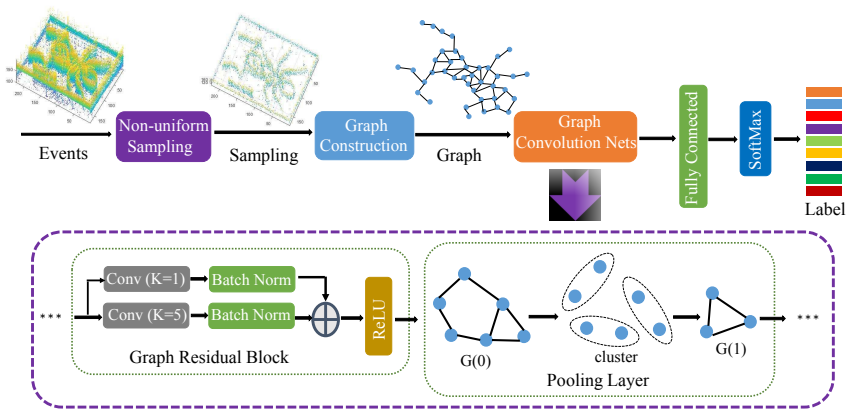
The central object is the radius-neighborhood graph built from sampled spike events. Each node is an event with coordinates $(x_i,y_i,t_i)$ and polarity feature $p_i \in \{+1,-1\}$; edges connect nodes whose weighted spatio-temporal distance $d_{i,j} = \sqrt{\alpha(|x_i-x_j|^2+|y_i-y_j|^2)+\beta|t_i-t_j|^2}$ is at most $R$, with maximum degree $D_{\max}$. Graph convolution uses a B-spline kernel $g_l(u)$ over pseudo-coordinates $u(i,j) = [|x_i-x_j|, |y_i-y_j|]$ to aggregate neighbor features, followed by batch normalization and ReLU; residual graph blocks add a kernel-size-one shortcut to the main convolution, and max pooling over coordinate clusters coarsens the graph. This machinery preserves the spatio-temporal geometry of spikes while letting standard gradient training work.
What would settle it
Compare per-class accuracy on the released ASL-DVS data with block sizes $k=1$ and $k=8$: if the visually similar letter pairs lose accuracy disproportionately while well-separated letters hold, the random sampling has removed the discriminative cues the method relies on.
Extended reading notes
Core claim
At the center of the paper is a representation: take a 30 ms window of spikes, discard all but one event from each space-time block of up to $k=8$ events, then treat the survivors as nodes of a radius-neighborhood graph with edge weight $d_{i,j}$ and polarity as the node feature. A stack of residual graph convolution layers with B-spline kernels, batch normalization, max pooling over coordinate clusters, and two fully connected layers maps the graph to a class label. The reported RG-CNN accuracies are $0.990$ on N-MNIST, $0.986$ on MNIST-DVS, $0.657$ on N-Caltech101, $0.540$ on CIFAR10-DVS, $0.914$ on N-CARS, and $0.901$ on the new ASL-DVS dataset; by the authors' accounting this is a new state of the art on five datasets and within $0.001$ of the best published result on N-MNIST. The cost is small: on N-Caltech101 the input graph averages roughly 1,000 nodes against 86,400 pixels in the two-channel event image, and the whole RG-CNN runs at 0.79 GFLOPs with 19.46 MB of parameters.
Load-bearing premise
The load-bearing premise is that randomly keeping just one event from each space-time block of up to eight spikes retains enough of the motion detail that separates classes.
Editorial extensions
If this is right
- Event cameras could be used directly with gradient-trained deep networks on raw spike streams, removing the need to aggregate spikes into frames.
- The compact graph input means inference on high-resolution sensors may stay cheap: the paper reports roughly 1,000 graph nodes versus 86,400 frame pixels for N-Caltech101.
- The reported accuracy on five of six datasets suggests graph-based methods, not frame conversion or spiking networks, may be the most practical route for neuromorphic classification.
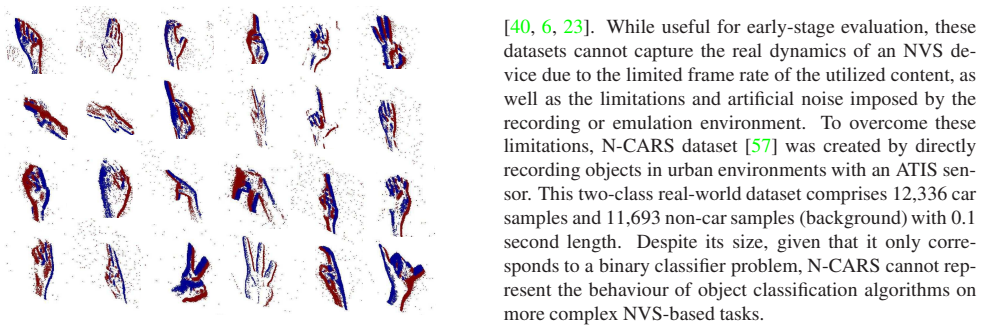
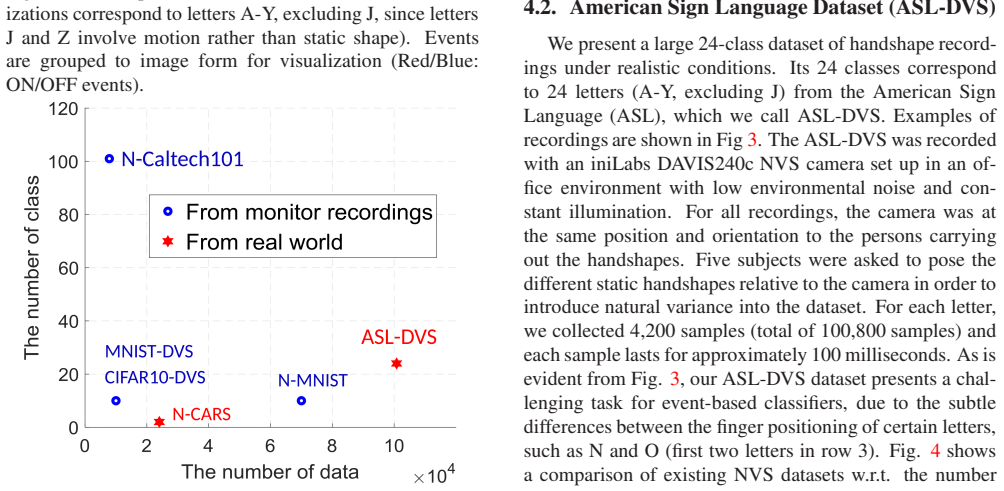
- The released 24-class, 100,800-sample ASL-DVS recording gives the field a larger real-world benchmark to train and compare event-based classifiers.
- If the accuracy-versus-compression tradeoff holds, the approach can scale to long or dense event streams by sampling more aggressively without retraining the architecture.
Reading between the lines
- The paper leaves implicit that the same graph construction could transfer to other event-stream tasks, such as detection or tracking, because the graph is defined by spatio-temporal distance rather than a fixed pixel grid.
- A natural testable extension is a content-aware sampling rule: instead of picking one event at random per space-time block, the selector could favor motion boundaries, potentially recovering the k=1 accuracy at k=8 cost.
- Because FLOPs depend on node and edge counts rather than image resolution, the approach may scale more gracefully to high-resolution neuromorphic sensors than frame-based CNNs, which the paper does not directly demonstrate.
- The 30-ms window and k=8 settings were tuned on N-Caltech101; applying the pipeline to longer recordings would require a temporal segmentation strategy that the paper does not specify.
Signed reviews
Editorial analysis
A structured set of objections, weighed in public.
Referee Report
Summary. The paper proposes a graph-based representation for neuromorphic vision sensor (NVS) event streams and uses residual graph convolutional networks (RG-CNNs) for object classification. Events are first compressed by non-uniform sampling, then mapped to a radius-neighborhood graph with weighted spatio-temporal distances, and processed by spatial graph convolutions with B-spline kernels, cluster pooling, residual blocks, and fully connected layers. The authors evaluate on N-MNIST, MNIST-DVS, N-Caltech101, CIFAR10-DVS, and N-CARS, and introduce a new 100k-sample, 24-class real-world dataset, ASL-DVS. They report top-1 accuracies that match or exceed prior event-based methods and frame-based deep CNNs, with substantially lower FLOPs and model sizes.
Significance. The graph-based representation is a natural and potentially valuable bridge between asynchronous event data and gradient-trained deep networks, and the paper's complexity analysis in Table 3 makes a concrete quantitative case for the approach. The release of ASL-DVS, described as one of the largest labeled NVS datasets under real-world conditions, is a useful community contribution. If the reported accuracy advantages withstand repeated evaluation, the method would be a meaningful step for neuromorphic object classification. However, the headline state-of-the-art claim is not yet statistically supported: the margins over HATS are close to run-to-run noise and key hyperparameters were selected on the same N-Caltech101 test set used for the main comparison. With proper repeated-split, multi-seed reporting, the paper's central claim could be substantiated; as written, the evidence supports 'competitive with HATS at lower computational cost' more strongly than 'new state-of-the-art.'
major comments (3)
- [§5.1, Table 1] The headline state-of-the-art claim is not supported by the reported statistics. The decisive margins over HATS are 1.5 points on N-Caltech101 (0.657 vs 0.642), 1.6 points on CIFAR10-DVS (0.540 vs 0.524), and 1.2 points on N-CARS (0.914 vs 0.902). For test sets of the size used here, the standard error of a proportion is roughly one percentage point, and the paper reports no repeated random splits, no multiple training seeds, and no confidence intervals. The evidence as reported cannot distinguish RG-CNN from HATS on these datasets. Please report mean and standard deviation (or confidence intervals) over multiple splits and seeds and temper the 'new state-of-the-art' wording accordingly.
- [§7 (Supplementary), Tables 4–8, and §5.1] Several key hyperparameters (k, R, time-window length, network depth, and kernel size) are selected by maximizing accuracy on N-Caltech101 in the supplementary material, and Table 1 then reports N-Caltech101 accuracy using the selected values. This is selection on the test set and is likely to bias the reported N-Caltech101 number optimistically. The supplementary text itself states that all ablation experiments were conducted on N-Caltech101, so the issue is self-acknowledged. Please move hyperparameter selection to a validation split that is never used for the final comparison, or fix hyperparameters before any test labels are used, and disclose the selection procedure.
- [§5.1, Table 1] The text states that RG-CNNs 'consistently outperform' prior methods and 'set a new state-of-the-art' on five of six datasets, but Table 1 shows RG-CNN at 0.990 versus HATS at 0.991 on N-MNIST, and ASL-DVS has no HATS entry. This wording overstates the results. The claim should be corrected to 'matches or exceeds' or the comparison set should be specified precisely.
minor comments (5)
- [§3.1 and §3.2] The graph is introduced as directed, but the radius-neighborhood construction yields symmetric edges and the convolution definition in Eq. (3) does not use edge direction. Please clarify whether edges are directed and, if so, how direction enters the aggregation.
- [§3.4, Eq. (8)] The fully connected layer formula is not written correctly; the weight tensor F^{P×Min×Q} lacks explicit indices and the feature notation f^p_l is ambiguous. Please rewrite with explicit summation indices.
- [Table 3 and Table 9] Inception V4 is reported as 12.25 GFLOPs in Table 3 but 9.24 GFLOPs in Table 9 for the same 224×224 input; please harmonize the FLOPs accounting or explain the difference.
- [§5.2] The statement that frame-based CNNs are below state-of-the-art 'since event images contain far less information' is a causal claim not established by the experiments; please rephrase it as an observation rather than an explanation.
- [Tables 1 and 2] There are typos in the table headings: 'acccuracy' should be 'accuracy' and 'RG-CNNNs' should be 'RG-CNNs'.
Circularity Check
No circularity found; the central claims are empirical and benchmarked against external datasets and previously published methods.
full rationale
The paper's derivation chain is not equation-level circular. RG-CNN accuracy is obtained by training on six publicly available NVS datasets and compared with published numbers for HATS, HOTS, H-First, SNN and with frame-based CNNs retrained by the authors (Tables 1-2); the graph construction uses non-uniform grid sampling from Lee et al. [31], SplineCNN B-spline kernels from Fey et al. [22], and residual connections from He et al. [24], all external. The only self-citation, Pix2NVS [6], is cited as an example of emulator-based dataset generation and is not load-bearing for the classification result. Hyperparameters (k, R, depth, kernel size) are tuned in the supplementary on N-Caltech101, so reporting N-Caltech101 accuracy with those choices is a potential selection-bias issue, but it is not circular: the reported numbers are measured outcomes, not quantities defined to equal the tuning criterion. There is no fitted parameter renamed as a prediction, no uniqueness theorem, and no ansatz smuggled in via self-citation.
Assumptions & free parameters
free parameters (9)
- alpha (spatial weight) =
1
- beta (temporal weight) =
0.5e-5
- R (radius distance) =
3
- Dmax (max degree) =
32
- k (sampling grid occupancy) =
8
- time window =
30 ms
- kernel size =
5
- network depth =
2 blocks for N-MNIST and MNIST-DVS, 3 blocks for others, 4 layers for N-Caltech101
- pooling cluster sizes =
per-dataset values
assumptions (4)
- domain assumption NVS events can be embedded as points in spatio-temporal Euclidean space with distance Eq (2)
- domain assumption Event polarity alone is a sufficient initial node feature
- domain assumption Previously published baseline accuracies (for example, HATS in [57]) are reliable and comparable
- domain assumption Randomly sampling one event per space-time volume retains enough information
Cite this review
Pith. "Pith review of Graph-Based Object Classification for Neuromorphic Vision Sensing." pith.science (2026). https://pith.science/paper/7WP6HQ44
@misc{pith2026190806648,
  author       = {Pith},
  title        = {Pith review of: Graph-Based Object Classification for Neuromorphic Vision Sensing},
  year         = {2026},
  howpublished = {\url{https://pith.science/paper/7WP6HQ44}},
  note         = {Machine review of arXiv:1908.06648}
}
read the original abstract
Neuromorphic vision sensing (NVS)\ devices represent visual information as sequences of asynchronous discrete events (a.k.a., ``spikes'') in response to changes in scene reflectance. Unlike conventional active pixel sensing (APS), NVS allows for significantly higher event sampling rates at substantially increased energy efficiency and robustness to illumination changes. However, object classification with NVS streams cannot leverage on state-of-the-art convolutional neural networks (CNNs), since NVS does not produce frame representations. To circumvent this mismatch between sensing and processing with CNNs, we propose a compact graph representation for NVS. We couple this with novel residual graph CNN architectures and show that, when trained on spatio-temporal NVS data for object classification, such residual graph CNNs preserve the spatial and temporal coherence of spike events, while requiring less computation and memory. Finally, to address the absence of large real-world NVS datasets for complex recognition tasks, we present and make available a 100k dataset of NVS recordings of the American sign language letters, acquired with an iniLabs DAVIS240c device under real-world conditions.
Figures

Figures from the paper (1 more)
Reference graph
Works this paper leans on
-
[1]
Truenorth: Design and tool flow of a 65 mw 1 million neuron pro- grammable neurosynaptic chip
Filipp Akopyan, Jun Sawada, Andrew Cassidy, Rodrigo Alvarez-Icaza, John Arthur, Paul Merolla, Nabil Imam, Y u- taka Nakamura, Pallab Datta, Gi-Joon Nam, et al. Truenorth: Design and tool flow of a 65 mw 1 million neuron pro- grammable neurosynaptic chip. IEEE Transactions on Computer-Aided Design of Integrated Circuits and Systems , 34(10):1537–1557, 2015. 2
work page 2015
-
[2]
Diffusion-convolutional neural networks
James Atwood and Don Towsley. Diffusion-convolutional neural networks. In Advances in Neural Information Pro- cessing Systems, pages 1993–2001, 2016. 3
work page 1993
-
[3]
Contour motion estimation for asynchronous event- driven cameras
Francisco Barranco, Cornelia Ferm¨ uller, and Yiannis A loi- monos. Contour motion estimation for asynchronous event- driven cameras. Proceedings of the IEEE , 102(10):1537– 1556, 2014. 2
work page 2014
-
[4]
Bio-inspired motion estimation with event-driven sensors
Francisco Barranco, Cornelia Fermuller, and Yiannis Al oi- monos. Bio-inspired motion estimation with event-driven sensors. In International W ork-Conference on Artificial Neu- ral Networks, pages 309–321. Springer, 2015. 2
work page 2015
-
[5]
Ryad Benosman, Charles Clercq, Xavier Lagorce, Sio-Hoi Ieng, and Chiara Bartolozzi. Event-based visual flow. IEEE transactions on neural networks and learning systems , 25(2):407–417, 2014. 2
work page 2014
-
[6]
Pix2nvs: Parameterize d conversion of pixel-domain video frames to neuromorphic vision streams
Yin Bi and Yiannis Andreopoulos. Pix2nvs: Parameterize d conversion of pixel-domain video frames to neuromorphic vision streams. In 2017 IEEE International Conference on Image Processing (ICIP), pages 1990–1994. IEEE, 2017. 2, 6
work page 2017
-
[7]
Olivier Bichler, Damien Querlioz, Simon J Thorpe, Jean- Philippe Bourgoin, and Christian Gamrat. Extraction of temporally correlated features from dynamic vision sensor s with spike-timing-dependent plasticity. Neural Networks , 32:339–348, 2012. 2
work page 2012
-
[8]
Learning shape correspondence with anisotropic convolutional neural networks
Davide Boscaini, Jonathan Masci, Emanuele Rodol` a, and Michael Bronstein. Learning shape correspondence with anisotropic convolutional neural networks. In Advances in Neural Information Processing Systems , pages 3189–3197, 2016. 3, 4
work page 2016
Show all 65 references
-
[9]
Geometric deep learning: going beyond euclidean data
Michael M Bronstein, Joan Bruna, Yann LeCun, Arthur Szlam, and Pierre V andergheynst. Geometric deep learning: going beyond euclidean data. IEEE Signal Processing Mag- azine, 34(4):18–42, 2017. 4
2017
-
[10]
On event-based optical flow detection
Tobias Brosch, Stephan Tschechne, and Heiko Neumann. On event-based optical flow detection. Frontiers in neuro- science, 9:137, 2015. 2
2015
-
[11]
Spectral networks and locally connected networks on graphs
Joan Bruna, Wojciech Zaremba, Arthur Szlam, and Yann Le - Cun. Spectral networks and locally connected networks on graphs. arXiv preprint arXiv:1312.6203, 2013. 3, 4
2013 arXiv
-
[12]
Attention mechanisms for object recognition with event-based cameras
Marco Cannici, Marco Ciccone, Andrea Romanoni, and Matteo Matteucci. Attention mechanisms for object recognition with event-based cameras. arXiv preprint arXiv:1807.09480, 2018. 1, 2
2018 arXiv
-
[13]
Event-based convolutional networks for object detection in neuromorphic cameras
Marco Cannici, Marco Ciccone, Andrea Romanoni, and Matteo Matteucci. Event-based convolutional networks for object detection in neuromorphic cameras. arXiv preprint arXiv:1805.07931, 2018. 1, 2
2018 arXiv
-
[14]
Asyn- chronous event-based corner detection and matching
Xavier Clady, Sio-Hoi Ieng, and Ryad Benosman. Asyn- chronous event-based corner detection and matching. Neural Networks, 66:91–106, 2015. 2
2015
-
[15]
A motion-based feature for event-based pattern recognition
Xavier Clady, Jean-Matthieu Maro, S´ ebastien Barr´ e, and Ryad B Benosman. A motion-based feature for event-based pattern recognition. Frontiers in neuroscience, 10:594, 2017. 1, 2
2017
-
[16]
Event-based feature detection, recog- nition and classification
Gregory Kevin Cohen. Event-based feature detection, recog- nition and classification . PhD thesis, Paris 6, 2016. 1, 2
2016
-
[17]
Convolutional neural networks on graphs with fast localized spectral filtering
Micha¨ el Defferrard, Xavier Bresson, and Pierre V an- dergheynst. Convolutional neural networks on graphs with fast localized spectral filtering. In Advances in neural infor- mation processing systems , pages 3844–3852, 2016. 3, 4, 7
2016
-
[18]
Neuromorphic vision sensing and proces s- ing
Tobi Delbruck. Neuromorphic vision sensing and proces s- ing. In Europ. Solid-State Dev. Res. Conf, pages 7–14, 2016. 1
2016
-
[19]
Unsupervised learning of digit recognition using spike-timing-dependent plasti city
Peter U Diehl and Matthew Cook. Unsupervised learning of digit recognition using spike-timing-dependent plasti city. Frontiers in computational neuroscience, 9:99, 2015. 2
2015
-
[20]
Fast-classifying, hi gh- accuracy spiking deep networks through weight and thresh- old balancing
Peter U Diehl, Daniel Neil, Jonathan Binas, Matthew Coo k, Shih-Chii Liu, and Michael Pfeiffer. Fast-classifying, hi gh- accuracy spiking deep networks through weight and thresh- old balancing. In 2015 International Joint Conference on Neural Networks (IJCNN), pages 1–8. IEEE, 2015. 3
2015
-
[21]
Convolutional networks on graphs for learn- ing molecular fingerprints
David K Duvenaud, Dougal Maclaurin, Jorge Iparraguirr e, Rafael Bombarell, Timothy Hirzel, Al´ an Aspuru-Guzik, and Ryan P Adams. Convolutional networks on graphs for learn- ing molecular fingerprints. In Advances in neural informa- tion processing systems, pages 2224–2232, 2015. 3
2015
-
[22]
Splinecnn: Fast geometric deep learning with continuous b-spline kernels
Matthias Fey, Jan Eric Lenssen, Frank Weichert, and Hei n- rich M¨ uller. Splinecnn: Fast geometric deep learning with continuous b-spline kernels. In Proceedings of the IEEE Conference on Computer Vision and Pattern Recognition , pages 869–877, 2018. 3, 4, 8, 10
2018
-
[23]
pydvs: An extensible, real-time dynamic vision sensor emulator using off-the-shelf hardware
Garibaldi Pineda Garc´ ıa, Patrick Camilleri, Qian Liu , and Steve Furber. pydvs: An extensible, real-time dynamic vision sensor emulator using off-the-shelf hardware. In 2016 IEEE Symposium Series on Computational Intelligence (SSCI), pages 1–7. IEEE, 2016. 2, 6
2016
-
[24]
Deep residual learning for image recognition
Kaiming He, Xiangyu Zhang, Shaoqing Ren, and Jian Sun. Deep residual learning for image recognition. In Proceed- ings of the IEEE conference on computer vision and pattern recognition, pages 770–778, 2016. 1, 2, 5, 7, 8
2016
-
[25]
Dvs benchmark datasets for object tracking, action recognition, and object recognition
Y uhuang Hu, Hongjie Liu, Michael Pfeiffer, and Tobi Del - bruck. Dvs benchmark datasets for object tracking, action recognition, and object recognition. Frontiers in neuro- science, 10:405, 2016. 2
2016
-
[26]
Batch normalizati on: Accelerating deep network training by reducing internal co - variate shift
Sergey Ioffe and Christian Szegedy. Batch normalizati on: Accelerating deep network training by reducing internal co - variate shift. ICML, 2015. 5
2015
-
[27]
Semi-supervised classi- fication with graph convolutional networks
Thomas N Kipf and Max Welling. Semi-supervised classi- fication with graph convolutional networks. ICLR, 2017. 3, 7
2017
-
[28]
Imagenet classification with deep convolutional neural net - works
Alex Krizhevsky, Ilya Sutskever, and Geoffrey E Hinton . Imagenet classification with deep convolutional neural net - works. In Advances in neural information processing sys- tems, pages 1097–1105, 2012. 1
2012
-
[29]
Hots: a hierarchy of event-based time-surfaces for pattern recognition
Xavier Lagorce, Garrick Orchard, Francesco Galluppi, Bertram E Shi, and Ryad B Benosman. Hots: a hierarchy of event-based time-surfaces for pattern recognition. IEEE transactions on pattern analysis and machine intelligence , 39(7):1346–1359, 2017. 1, 2, 7
2017
-
[30]
Tra in- ing deep spiking neural networks using backpropagation
Jun Haeng Lee, Tobi Delbruck, and Michael Pfeiffer. Tra in- ing deep spiking neural networks using backpropagation. Frontiers in neuroscience, 10:508, 2016. 2, 7
2016
-
[31]
Point data reduction using 3d grids
KH Lee, H Woo, and T Suk. Point data reduction using 3d grids. The International Journal of Advanced Manufacturing Technology, 18(3):201–210, 2001. 4
2001
-
[32]
Cayleynets: Graph convolutional neural networks with complex rational spectral filters
Ron Levie, Federico Monti, Xavier Bresson, and Michael M Bronstein. Cayleynets: Graph convolutional neural networks with complex rational spectral filters. IEEE Transactions on Signal Processing, 67(1):97–109, 2017. 3
2017
-
[33]
Cifar10-dvs: an event-stream dataset for ob- ject classification
Hongmin Li, Hanchao Liu, Xiangyang Ji, Guoqi Li, and Luping Shi. Cifar10-dvs: an event-stream dataset for ob- ject classification. Frontiers in neuroscience, 11:309, 2017. 2, 6
2017
-
[34]
Deeper insight s into graph convolutional networks for semi-supervised learn- ing
Qimai Li, Zhichao Han, and Xiao-Ming Wu. Deeper insight s into graph convolutional networks for semi-supervised learn- ing. In Thirty-Second AAAI Conference on Artificial Intelli- gence, 2018. 5, 9
2018
-
[35]
A 128x128, 120 db 30mw latency asynchronous temporal contrast vision sensor
Patrick Lichtsteiner, Christoph Posch, and Tobi Delbr uck. A 128x128, 120 db 30mw latency asynchronous temporal contrast vision sensor. IEEE journal of solid-state circuits , 43(2):566–576, 2008. 6
2008
-
[36]
Geodesic convolutional neural net- works on riemannian manifolds
Jonathan Masci, Davide Boscaini, Michael Bronstein, a nd Pierre V andergheynst. Geodesic convolutional neural net- works on riemannian manifolds. In Proceedings of the IEEE international conference on computer vision work- shops, pages 37–45, 2015. 3, 4
2015
-
[37]
Pruning convolutional neural networks for resource efficient inference
Pavlo Molchanov, Stephen Tyree, Tero Karras, Timo Aila , and Jan Kautz. Pruning convolutional neural networks for resource efficient inference. ICLR, 2017. 8
2017
-
[38]
Geometric deep learning on graphs and manifolds using mixture model cnns
Federico Monti, Davide Boscaini, Jonathan Masci, Emanuele Rodola, Jan Svoboda, and Michael M Bronstein. Geometric deep learning on graphs and manifolds using mixture model cnns. In Proceedings of the IEEE Confer- ence on Computer Vision and Pattern Recognition , pages 5115–512...
2017
-
[39]
Fast event-based corner detection
Elias Mueggler, Chiara Bartolozzi, and Davide Scaramu zza. Fast event-based corner detection. In British Machine Vis. Conf.(BMVC), volume 1, 2017. 2
2017
-
[40]
The event-camera dataset and simulator: Event-based data for pose estimation, visua l odometry, and slam
Elias Mueggler, Henri Rebecq, Guillermo Gallego, Tobi Del- bruck, and Davide Scaramuzza. The event-camera dataset and simulator: Event-based data for pose estimation, visua l odometry, and slam. The International Journal of Robotics Research, 36(2):142–149, 2017. 2, 6
2017
-
[41]
Event-driven contrastive divergence for spiking neuromorphic systems
Emre Neftci, Srinjoy Das, Bruno Pedroni, Kenneth Kreut z- Delgado, and Gert Cauwenberghs. Event-driven contrastive divergence for spiking neuromorphic systems. Frontiers in neuroscience, 7:272, 2014. 2
2014
-
[42]
Neuromorph ic engineering
E Neftci, C Posch, E Chicca, and H Ishibuchi. Neuromorph ic engineering. Computational Intelligence, 2:278, 2015. 1
2015
-
[43]
Phas ed lstm: Accelerating recurrent network training for long or event-based sequences
Daniel Neil, Michael Pfeiffer, and Shih-Chii Liu. Phas ed lstm: Accelerating recurrent network training for long or event-based sequences. In Advances in Neural Information Processing Systems, pages 3882–3890, 2016. 7
2016
-
[44]
Real-time classification and sensor f u- sion with a spiking deep belief network
Peter O’Connor, Daniel Neil, Shih-Chii Liu, Tobi Delbr uck, and Michael Pfeiffer. Real-time classification and sensor f u- sion with a spiking deep belief network. Frontiers in neuro- science, 7:178, 2013. 3
2013
-
[45]
Bioin- spired visual motion estimation
Garrick Orchard and Ralph Etienne-Cummings. Bioin- spired visual motion estimation. Proceedings of the IEEE , 102(10):1520–1536, 2014. 2
2014
-
[46]
Converting static image datasets to spiking neuromorphic datasets using saccades
Garrick Orchard, Ajinkya Jayawant, Gregory K Cohen, an d Nitish Thakor. Converting static image datasets to spiking neuromorphic datasets using saccades. Frontiers in neuro- science, 9:437, 2015. 6
2015
-
[47]
Hfirst: a temporal approach to object recognition
Garrick Orchard, Cedric Meyer, Ralph Etienne-Cumming s, Christoph Posch, Nitish Thakor, and Ryad Benosman. Hfirst: a temporal approach to object recognition. IEEE transactions on pattern analysis and machine intelligence , 37(10):2028–2040, 2015. 7
2015
-
[48]
Bag of events: an efficient probability-based feature extracti on method for aer image sensors
Xi Peng, Bo Zhao, Rui Yan, Huajin Tang, and Zhang Yi. Bag of events: an efficient probability-based feature extracti on method for aer image sensors. IEEE transactions on neural networks and learning systems , 28(4):791–803, 2017. 2
2017
-
[49]
Mapping from frame-driven to frame-free event-driven vision systems by low-rate rate coding and coincidence processing–application to feedfor - ward convnets
Jos´ e Antonio P´ erez-Carrasco, Bo Zhao, Carmen Serran o, Begona Acha, Teresa Serrano-Gotarredona, Shouchun Chen, and Bernab´ e Linares-Barranco. Mapping from frame-driven to frame-free event-driven vision systems by low-rate rate coding and coincidence processing–application...
2013
-
[50]
The NURBS book
Les Piegl and Wayne Tiller. The NURBS book . Springer Science & Business Media, 2012. 4
2012
-
[51]
A qvga 143 db dynamic range frame-free pwm image sensor with lossless pixel-level video compression and time-domain cds
Christoph Posch, Daniel Matolin, and Rainer Wohlgenan nt. A qvga 143 db dynamic range frame-free pwm image sensor with lossless pixel-level video compression and time-domain cds. IEEE Journal of Solid-State Circuits , 46(1):259–275, 2011. 1, 6
2011
-
[52]
Discrete sign al processing on graphs
Aliaksei Sandryhaila and Jos´ e MF Moura. Discrete sign al processing on graphs. IEEE transactions on signal process- ing, 61(7):1644–1656, 2013. 3, 4
2013
-
[53]
Poker-dvs and mnist-dvs
Teresa Serrano-Gotarredona and Bernab´ e Linares-Barranco. Poker-dvs and mnist-dvs. their history, how they were made, and other details. Frontiers in neuroscience, 9:481, 2015. 2, 6
2015
-
[54]
The emerging field of signal processing on graphs: Extending high-dimensiona l data analysis to networks and other irregular domains
David I Shuman, Sunil K Narang, Pascal Frossard, Anto- nio Ortega, and Pierre V andergheynst. The emerging field of signal processing on graphs: Extending high-dimensiona l data analysis to networks and other irregular domains. arXiv preprint arXiv:1211.0053, 2012. 3, 4
2012 arXiv
-
[55]
Dynamic edge- conditioned filters in convolutional neural networks on graphs
Martin Simonovsky and Nikos Komodakis. Dynamic edge- conditioned filters in convolutional neural networks on graphs. In Proceedings of the IEEE Conference on Computer Vision and Pattern Recognition, pages 3693–3702, 2017. 5
2017
-
[56]
V ery deep convo- lutional networks for large-scale image recognition
Karen Simonyan and Andrew Zisserman. V ery deep convo- lutional networks for large-scale image recognition. arXiv preprint arXiv:1409.1556, 2014. 7, 8
2014 arXiv
-
[57]
Hats: histograms of aver- aged time surfaces for robust event-based object classifica - tion
Amos Sironi, Manuele Brambilla, Nicolas Bourdis, Xavi er Lagorce, and Ryad Benosman. Hats: histograms of aver- aged time surfaces for robust event-based object classifica - tion. In Proceedings of the IEEE Conference on Computer Vision and Pattern Recognition, pages 1731–1740, ...
2018
-
[58]
Scal- able energy-efficient, low-latency implementations of tra ined spiking deep belief networks on spinnaker
Evangelos Stromatias, Daniel Neil, Francesco Gallupp i, Michael Pfeiffer, Shih-Chii Liu, and Steve Furber. Scal- able energy-efficient, low-latency implementations of tra ined spiking deep belief networks on spinnaker. In 2015 Interna- tional Joint Conference on Neural Networks...
2015
-
[59]
Inception-v4, inception-resnet and the impact of residual connections on learning
Christian Szegedy, Sergey Ioffe, Vincent V anhoucke, a nd Alexander A Alemi. Inception-v4, inception-resnet and the impact of residual connections on learning. In Thirty-First AAAI Conference on Artificial Intelligence , 2017. 7, 8
2017
-
[60]
Ben ch- marking neuromorphic vision: lessons learnt from computer vision
Cheston Tan, Stephane Lallee, and Garrick Orchard. Ben ch- marking neuromorphic vision: lessons learnt from computer vision. Frontiers in neuroscience, 9:374, 2015. 1
2015
-
[61]
Fast event-based harris corner detection exploiting the advantages of event-driven cameras
V alentina V asco, Arren Glover, and Chiara Bartolozzi. Fast event-based harris corner detection exploiting the advantages of event-driven cameras. In 2016 IEEE/RSJ International Conference on Intelligent Robots and Systems (IROS) , pages 4144–4149. IEEE, 2016. 2
2016
-
[62]
Local spec- tral graph convolution for point set feature learning
Chu Wang, Babak Samari, and Kaleem Siddiqi. Local spec- tral graph convolution for point set feature learning. In Pro- ceedings of the European Conference on Computer Vision (ECCV), pages 52–66, 2018. 3, 4
2018
-
[63]
How powerful are graph neural networks? ICLR, 2019
Keyulu Xu, Weihua Hu, Jure Leskovec, and Stefanie Jegel ka. How powerful are graph neural networks? ICLR, 2019. 7
2019
-
[64]
Exploit all the layers: Fast and accurate cnn object detector with scale de- pendent pooling and cascaded rejection classifiers
Fan Yang, Wongun Choi, and Y uanqing Lin. Exploit all the layers: Fast and accurate cnn object detector with scale de- pendent pooling and cascaded rejection classifiers. In Pro- ceedings of the IEEE conference on computer vision and pat- tern recognition, pages 2129–2137, 2016. 5
2016
-
[65]
Ev-flownet: self-supervised optical flow estimation for event-based cameras
Alex Zihao Zhu, Liangzhe Y uan, Kenneth Chaney, and Kostas Daniilidis. Ev-flownet: self-supervised optical flow estimation for event-based cameras. arXiv preprint arXiv:1802.06898, 2018. 1, 2, 7
2018 arXiv
Reviewed August 14, 2026 · model on record in the stance chip above.
Discussion (0). Continue with ORCID to comment.