REVIEW 4 major objections 5 minor 7 references
Air shower reconstruction using HAWC and the Outrigger array
T0 review · 4 major / 5 minor · reviewed 2026-08-14 · deepseek-v4-flash
Pith's one-line read Outrigger array improves HAWC shower core resolution by about threefold.
desk verdict A clean status report for the HAWC outrigger upgrade: the first combined reconstruction results are shown, but the performance numbers are closure tests of one simulation, and the paper says so itself. read the letter →
The pith
A machine-rendered reading of the paper's core claim, the machinery that carries it, and where it could break.
The reading
What carries the argument
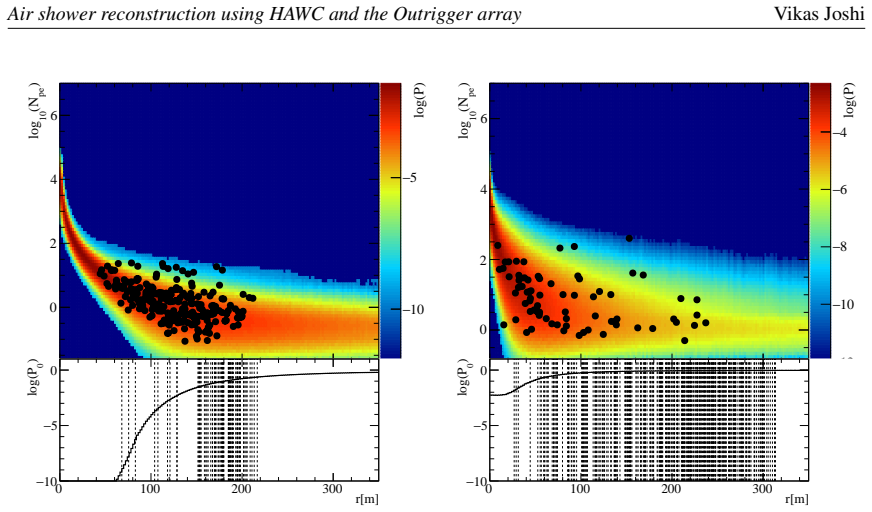
The central mechanism is a template-based maximum-likelihood lateral-distribution fit: for a fixed assumed arrival direction, the algorithm predicts the probability distribution of photoelectrons in each tank as a function of distance from the shower axis, using PDFs from a full air-shower simulation plus the detector simulation, binned in primary energy, Xmax, and zenith angle. It then minimizes the negative log-likelihood of the observed photoelectrons per tank, including zero-signal outriggers, to jointly estimate the energy and core location. This is what lets detectors with different sizes, photomultiplier gains, and signal scales be combined naturally in one fit.
What would settle it
Take a sample of real events landing on the outrigger array and compare reconstructed cores against independently known core positions, for example from shower timing planes or a coincident detector; if the data discrepancy distribution is not consistent with the simulated 68 percent containment radii, the simulation-template assumption is wrong. A calibration check of single-tank photoelectron response against laser or muon signals would also reveal whether the outrigger response model is realistic.
Extended reading notes
Core claim
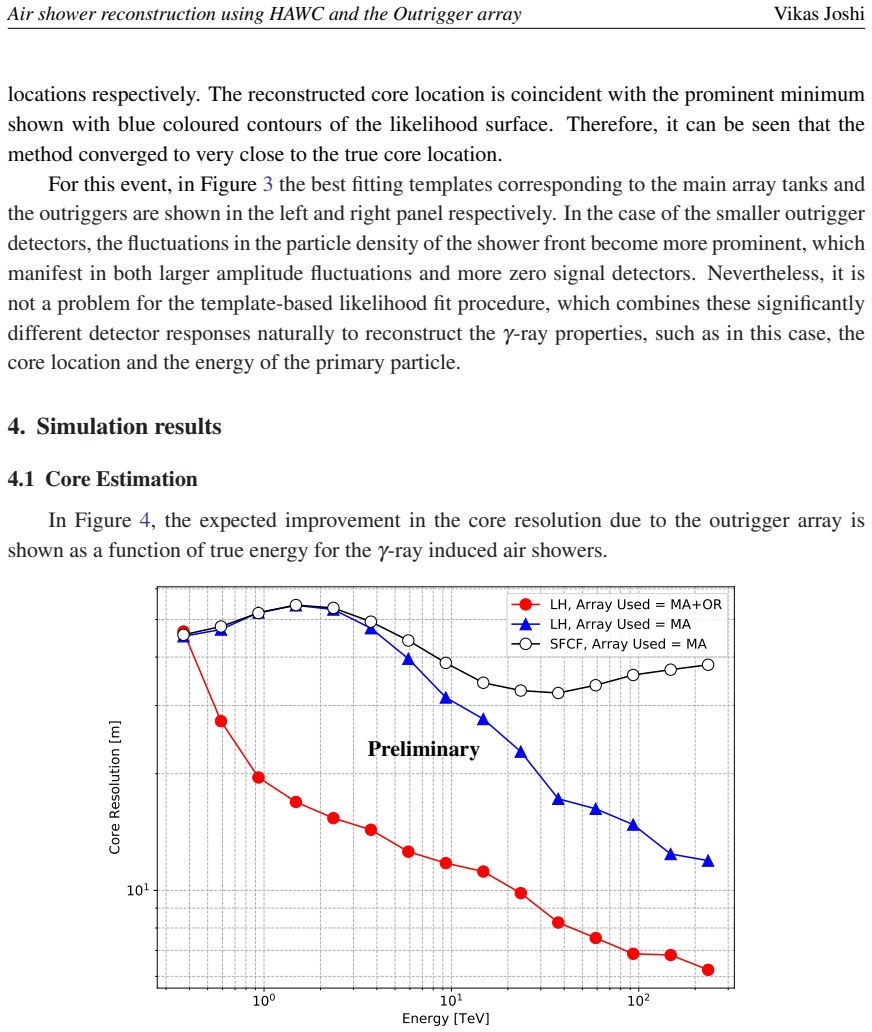
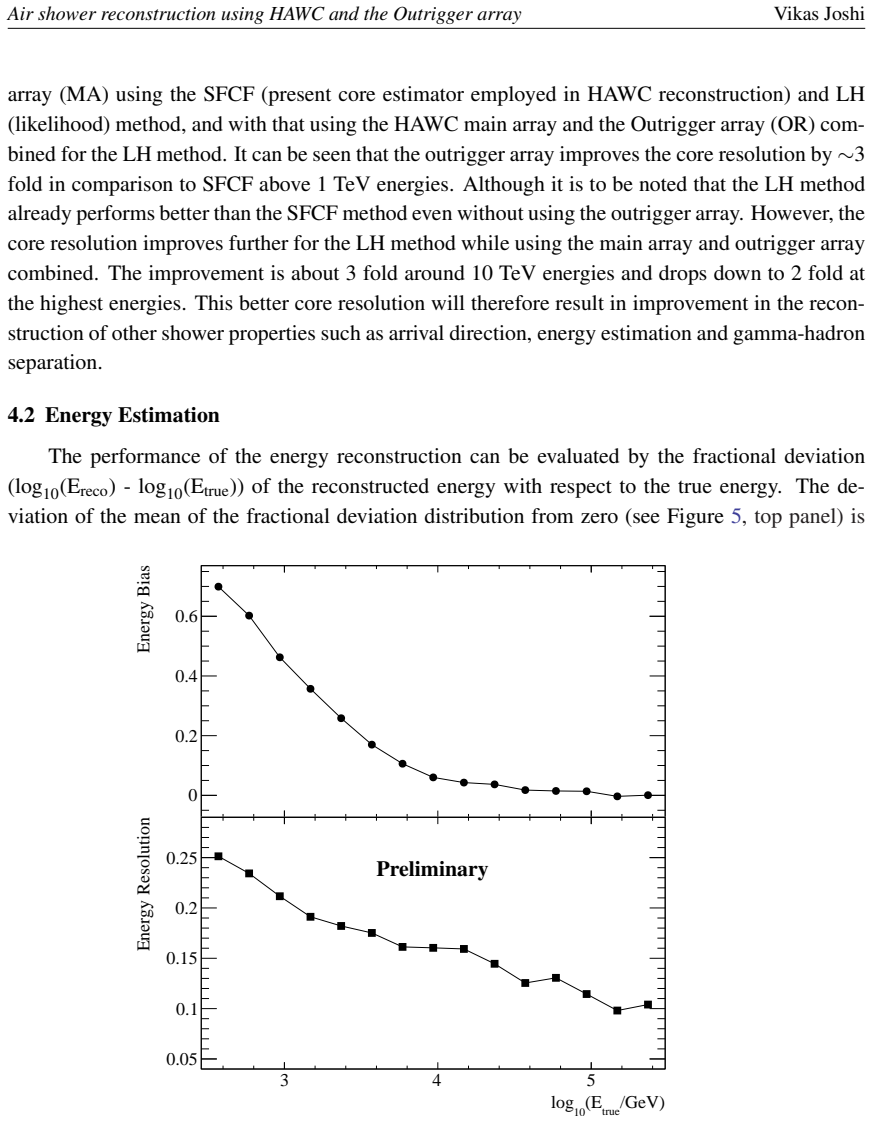
The paper claims that a template-based likelihood fit using the HAWC main array and the 345 outrigger tanks together reconstructs the shower core for outrigger-landing gamma-ray showers about three times more accurately than HAWC's existing SFCF core estimator above 1 TeV, with the gain around a factor of three at 10 TeV and about two at the highest energies. The same combined fit estimates an energy resolution that starts near 50 percent at 10 TeV and improves to about 25 percent at the highest energies, with energy bias converging to zero above 10 TeV. These results are established on simulated events using the collaboration's detector simulation, and the paper also shows a candidate Crab event from real data as a proof of concept.
Load-bearing premise
The quoted performance assumes that the simulation of how outrigger tanks convert shower particles into photoelectrons is accurate enough that templates made from it describe real showers.
Editorial extensions
If this is right
- Events whose cores land in the outrigger area above 1 TeV will have their cores located with a 68 percent containment radius roughly three times smaller than with HAWC's current SFCF estimator.
- Energy reconstruction is stable, with bias near zero above about 10 TeV, and resolution improves from about 50 percent at 10 TeV to about 25 percent at the highest energies.
- With the outrigger array, the instrumented footprint grows by a factor of 4 to 5, so a larger fraction of high-energy showers is well contained inside the detector.
- Better core locations should propagate into better arrival-direction, energy, and gamma-hadron separation for the same events, improving HAWC's sensitivity at multi-TeV energies.
Reading between the lines
- If the gains survive real-data calibration, the outrigger array will matter most for sources above a few tens of TeV, where the main array's core uncertainty currently limits spectral measurements; this is an extension because the paper only projects the improvement on simulations.
- Because the method fits in Xmax as well as energy, the same machinery could be applied to cosmic-ray composition studies, although the paper demonstrates only gamma-ray showers.
- A natural test is to run the same fit on simulated cosmic-ray showers: if the core improvement is similar, the outrigger array may also sharpen background rejection, which the paper does not explicitly quantify.
Signed reviews
Editorial analysis
A structured set of objections, weighed in public.
Referee Report
Summary. The paper reports on a new template-based likelihood reconstruction method that combines data from the HAWC main array and its sparse outrigger array to improve shower core and energy reconstruction for gamma-ray induced air showers. The templates are built from HAWCSim/GEANT4 simulations of the detector response, and performance is evaluated on simulated events falling on the outrigger array. The paper claims that the combined reconstruction improves the core resolution by roughly a factor of 3 relative to the existing SFCF estimator above 1 TeV, and that the energy resolution reaches about 25% at the highest energies. A single candidate Crab Nebula event is shown as a first illustration on real data, with the explicit caveat that outrigger hit selection and a more realistic simulation are still work in progress.
Significance. If validated, the method could meaningfully improve HAWC's sensitivity at multi-TeV energies by better constraining shower cores and energies for events that land near the array edge. The paper is transparent about its current limitations, which is a strength, and it builds on a published reconstruction method (Joshi et al., JCAP 2019). The central performance claims, however, rest entirely on a Monte Carlo closure test: the same HAWCSim simulation is used both to produce the PDF templates and to generate the test events. There is no data/MC comparison for outrigger observables, no systematic uncertainty treatment, and the only experimental demonstration is a single selected event. The stated improvement is therefore not yet established for real detector data.
major comments (4)
- [Sections 3 and 4, Figures 4 and 5] The performance evaluation is a Monte Carlo closure test: the PDF templates are constructed from HAWCSim (Section 3) and the test events are generated with the same detector simulation (Section 4). The figures carry no error bars, no systematic variations are studied, and no comparison to real outrigger data is shown. The quoted ~3-fold core resolution gain and ~25% energy resolution could be artifacts of the assumed outrigger response (PMT efficiency, saturation, noise, calibration, trigger). I request a quantitative statement of statistical and systematic uncertainties and at least one data/MC comparison of basic outrigger observables such as hit multiplicity, Npe distributions, zero-signal fraction, or trigger rates.
- [Section 4.1, Figure 4] The headline claim that 'the outrigger array improves the core resolution by ~3 fold in comparison to SFCF' conflates the gain from the new likelihood method with the gain from adding outrigger information. The text itself notes that LH with only the main array already outperforms SFCF, so the marginal improvement attributable to the outriggers is only visible in the difference between the LH MA and LH MA+OR curves, which is not separately quantified. Please report the outrigger-specific improvement relative to LH with MA alone, with its energy dependence and statistical uncertainty.
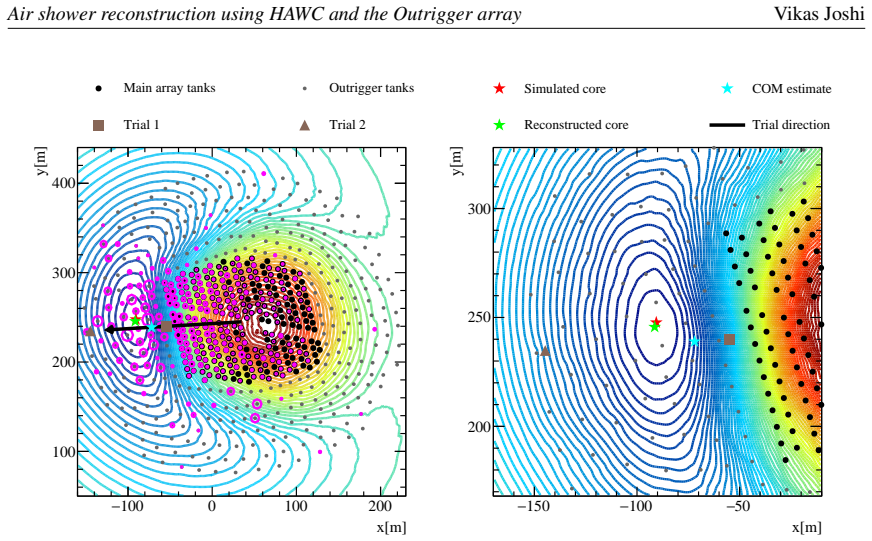
- [Section 5, Figures 6 and 7] The experimental validation is a single Crab-candidate event selected with main-array criteria, and the text states that 'hit selection and more realistic outrigger simulation is still a work in progress.' This is a direct admission that the outrigger response model used to build the templates has not been validated against data. A single event can demonstrate that the fitting procedure runs on real data, but it cannot validate the quoted resolutions. To support the central claim, the paper needs a systematic data/MC comparison of outrigger response and an estimate of the resulting systematic shifts in reconstructed core and energy.
- [Section 4.2, Figure 5] The energy bias is large at low energies and only converges to zero above about 10 TeV, while the resolution at 10 TeV is about 50% and improves to about 25% at the highest energies. The paper should state explicitly the energy range over which the reconstruction is claimed to be valid, and it should report the number of Monte Carlo events per bin so the reader can judge the statistical significance of the quoted resolution at the highest energies, where event counts are typically low.
minor comments (5)
- [Figures 4 and 5] The figures lack error bars or confidence bands; adding them would make the energy dependence of the improvement, and its statistical significance, much clearer.
- [Figure 5 caption] The caption refers to 'fractional energy bias' and 'energy resolution' but does not define the plotted quantity in terms of log10(Ereco) - log10(Etrue) on the vertical axis; please add the units or an explicit formula.
- [Abstract and Section 2] The abstract says the outrigger array increases the instrumented area by a factor of 4, while Section 2 says by a factor of 4-5; please make these consistent.
- [Section 5] The abstract says 'the first combined experimental data set,' but the paper shows only a single event; 'the first combined experimental event' would be more accurate.
- [Throughout] The paper would benefit from a brief statement that the method itself is described in detail in the JCAP 2019 reference [4], so that the reader knows which parts are new in this contribution.
Circularity Check
No circularity: the resolution claims are explicitly Monte-Carlo closure results, with the unvalidated outrigger simulation flagged as work in progress.
full rationale
The paper's core and energy resolution numbers are computed entirely within HAWCSim: Section 3 states that the PDF templates are generated using "a full MC air shower simulation in combination with the HAWC detector simulation (HAWCSim)", and Section 4 evaluates the resolutions on simulated gamma-ray events. This is a closure test of the likelihood estimator under the assumed simulation, not a circular derivation: the true core and energy are not supplied to the likelihood fit, no parameter is fitted to data and then renamed as a prediction, and the test events are not simply read off the templates. The paper is transparent that the numbers are "Preliminary" and that Section 5's real-data event is only an illustration, not a validation. Section 5 explicitly concedes that "hit selection and more realistic outrigger simulation is still a work in progress", which is a validity caveat about data/MC agreement rather than a definitional reduction. The self-citation [4] describes the template method and is not used to forbid alternatives or to smuggle in the claimed result; the method is sufficiently described in Section 3. The legitimate concern that a wrong outrigger simulation could bias both templates and test events is a correctness/validation risk for the absolute quoted resolutions, not a circularity in the derivation chain.
Assumptions & free parameters
free parameters (2)
- Minimum outrigger trigger fraction =
>=4% of outrigger array triggered
- Template binning choices for PDFs =
not specified in this paper
assumptions (3)
- domain assumption HAWCSim and GEANT4 detector simulation accurately reproduce the response of both HAWC main tanks and outrigger tanks at the photoelectron level.
- domain assumption The binned MC templates provide an adequate generative model for the lateral distribution such that minimizing the negative log-likelihood yields unbiased core and energy estimates.
- domain assumption The simulated gamma-ray sample with the outrigger trigger condition is representative of the data population of interest.
Cite this review
Pith. "Pith review of Air shower reconstruction using HAWC and the Outrigger array." pith.science (2026). https://pith.science/paper/LO4YBQZ4
@misc{pith2026190806650,
  author       = {Pith},
  title        = {Pith review of: Air shower reconstruction using HAWC and the Outrigger array},
  year         = {2026},
  howpublished = {\url{https://pith.science/paper/LO4YBQZ4}},
  note         = {Machine review of arXiv:1908.06650}
}
read the original abstract
The High Altitude Water Cherenkov (HAWC) gamma-ray observatory detects cosmic- and gamma-ray initiated air showers in the TeV energy range using 300 water Cherenkov detectors (WCDs). To improve its sensitivity at the highest energies, HAWC has been upgraded with a sparse array of 345 small WCDs (outrigger array) around the HAWC main array. The outrigger array increases the instrumented area of HAWC by a factor of 4 and has started taking data since August 2018. A new gamma-ray reconstruction method has been developed to improve the reconstruction of the air showers which combines the data of mixed type particle detector arrays. In this contribution, we will show the first results of the combined air shower reconstruction of HAWC and its outrigger array using Monte Carlo simulations and the first combined experimental data set.
Figures


Figures from the paper (4 more)

Reference graph
Works this paper leans on
-
[4]
A template-basedγ-ray reconstruction method for air shower arrays,
V . Joshi, J. Hinton, H. Schoorlemmer, R. López-Coto and R. Parsons, “A template-basedγ-ray reconstruction method for air shower arrays,” JCAP1901 (2019) no.01, 012
work page 2019
-
[1]
Sensitivity of the High Altitude Water Cherenkov Detector to Sources of Multi-TeV Gamma Rays,
A. U. Abeysekara et al., “Sensitivity of the High Altitude Water Cherenkov Detector to Sources of Multi-TeV Gamma Rays,” Astropart. Phys.50-52 (2013) 26
work page 2013
-
[2]
Latest news from the HAWC outrigger array,
V . Marandon et al., “Latest news from the HAWC outrigger array,” PoS ICRC2019 736
-
[3]
HAWC High Energy Upgrade with a Sparse Outrigger Array,
V . Joshi et al. [HAWC Collaboration], “HAWC High Energy Upgrade with a Sparse Outrigger Array,” PoS ICRC 2017 (2018) 806
work page 2018
-
[5]
Observation of the Crab Nebula with the HAWC Gamma-Ray Observatory,
A. U. Abeysekara et al., “Observation of the Crab Nebula with the HAWC Gamma-Ray Observatory,” Astrophys. J. 843 (2017) no.1, 39
work page 2017
-
[6]
S. Agostinelli et al. [GEANT4 Collaboration], “GEANT4: A Simulation toolkit,” Nucl. Instrum. Meth. A 506 (2003) 250
work page 2003
-
[7]
Measurement of the Crab Nebula at the Highest Energies with HAWC,
A. U. Abeysekara et al. [HAWC Collaboration], “Measurement of the Crab Nebula at the Highest Energies with HAWC,” arXiv:1905.12518 [astro-ph.HE]. 8
arXiv 1905
Reviewed August 14, 2026 · model on record in the stance chip above.
Discussion (0). Continue with ORCID to comment.