REVIEW 3 major objections 4 minor 26 references
Intertwined quantum phase transitions in the Zr chain
T0 review · 3 major / 4 minor · reviewed 2026-08-14 · deepseek-v4-flash
Pith's one-line read Zirconium isotopes show intertwined quantum phase transitions, with a spherical normal configuration coexisting with an intruder configuration that first deforms and then turns gamma-soft.
desk verdict Introduces IQPT as a genuinely new organizing concept for shape coexistence plus shape evolution; the Zr fit is strong, but the one-intruder truncation is the load-bearing assumption and deserves a direct test. read the letter →
The pith
A machine-rendered reading of the paper's core claim, the machinery that carries it, and where it could break.
The reading
What carries the argument
The carrying mechanism is a two-space configuration-mixing Hamiltonian in the interacting boson model: one normal [N]-boson Hamiltonian, one intruder [N+2]-boson Hamiltonian, and a mixing term that couples s- and d-boson pairs. The normal Hamiltonian contains a d-boson energy term and a quadrupole-quadrupole interaction; the intruder Hamiltonian additionally has an L-squared term and an energy offset Delta_p that drops by about 1 MeV beyond neutron number 56; the mixing term connects the two spaces. This structure lets the authors compute separate order parameters <n_d>/N for each configuration, reading off the shape of each component and the purity of the ground state. Classical potential surfaces computed from matrix coherent states confirm the same sequence: spherical, flat-bottomed at 100Zr, axially deformed, then gamma-unstable.
What would settle it
Measure the 0_2^+ and 0_3^+ states and B(E2) values in 100Zr with better resolution: if the spherical band is not the excited 0_2^+ state, or if the jump in B(E2;2_1^+->0_1^+) between 98Zr and 100Zr is absent in the data, the proposed Type II crossing near N=60 would be contradicted; alternatively, high-precision isotope shifts for 102-110Zr that do not show the predicted flattening after the crossing would weaken the SU(3)->SO(6) part of the sequence.
Extended reading notes
Core claim
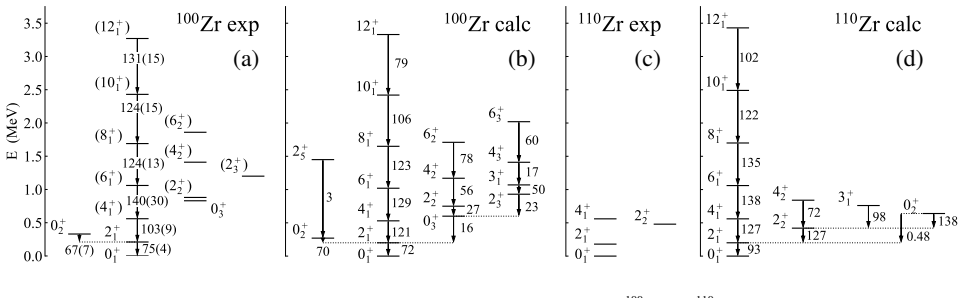
The central claim is that the shape evolution of the Zr chain is governed by two coexisting configurations whose roles exchange rather than by a single deforming Hamiltonian. Using the interacting boson model with configuration mixing, the authors find that the normal [N]-boson configuration is essentially spherical for neutron numbers 52-70, while the intruder [N+2]-boson configuration is weakly deformed, then drops sharply in energy near N=60 and becomes the ground state in a first-order Type II crossing; within the intruder configuration the ground state subsequently evolves from spherical through prolate (U(5)->SU(3)) and then toward gamma-unstable (SU(3)->SO(6)) as neutron number increases. The ground-state wave function stays highly pure ($a^{2}$=98.2%, $b^{2}$=87.2%, and $b^{2}$=99.9% for 98Zr, 100Zr, and 102Zr, respectively), and the order parameters, B(E2) values, isotope shifts, and two-neutron separation energies all show the signatures of the proposed sequence.
Load-bearing premise
The intruder configuration is assumed to be a single proton two-particle-two-hole excitation across the Z=40 subshell closure, so the model space contains only one normal and one intruder boson space; if the actual intruder content is richer, as Monte-Carlo shell-model studies suggest, the extracted order parameters and the deduced sequence of phase transitions could shift.
Editorial extensions
If this is right
- If the Zr chain realizes IQPTs, it becomes a textbook case in which a configuration crossing and an internal shape transition occur simultaneously, placing the two historical types of quantum phase transition in a single framework.
- The intruder configuration at N=60 sits at the critical point of both a Type I and a Type II quantum phase transition, making 100Zr a testing ground for critical-point symmetries such as X(5) in a configuration-mixing setting.
- Beyond N=66, the ground state becomes SO(6)-like, predicting near-degenerate 2_2^+ and 4_1^+ states and specific E2 patterns in 106-110Zr that can be checked as new data appear.
- The global parameter fit reproduces the sharp jump in B(E2;2_1^+->0_1^+) between 98Zr and 100Zr, which mean-field approaches smooth away, so this jump becomes a distinguishing signature of the IQPT scenario.
Reading between the lines
- If IQPTs are a general phenomenon, the same intertwined pattern may appear in other chains near subshell closures where a proton intruder configuration descends through a shell, such as the Mo or Ge isotopes, and the same model could be applied to test it.
- The paper's two-configuration assumption may be the minimal realization; a three-configuration or Monte-Carlo shell-model calculation could reveal whether the SU(3)->SO(6) crossover is actually a broader shape-coexistence effect, a possibility the paper itself notes.
- A testable extension would be to compute the same order parameters for odd-A neighbors or for transfer reactions that populate the intruder band directly, which would sharpen the purity claim beyond even-even ground states.
Signed reviews
Editorial analysis
A structured set of objections, weighed in public.
Referee Report
Summary. The paper introduces the notion of intertwined quantum phase transitions (IQPTs), in which a crossing of two configurations (Type II QPT) coexists with a shape evolution of each configuration (Type I QPT). Using the interacting boson model with configuration mixing (IBM-CM), the authors fit the Zr chain from neutron number 52 to 70 and present evidence that the normal configuration remains spherical, while the intruder configuration becomes the ground state near N=60 in a first-order Type II transition, then undergoes a U(5)-to-SU(3) spherical-to-prolate QPT, and finally a SU(3)-to-SO(6) prolate-to-gamma-unstable crossover. The evidence includes calculated energy spectra, B(E2) values, isotope shifts, two-neutron separation energies, order parameters built from boson-number expectation values, and classical potential energy surfaces. The paper is a short contribution adapted from a longer publication (Ref. [5]).
Significance. If the IQPT scenario is correct, it provides a conceptually valuable unification of Type I and Type II quantum phase transitions in a single nuclear chain, with the Zr isotopes as a promising empirical example. The IBM-CM calculation reproduces a broad set of data, including the sharp B(E2;2+1→0+1) jump between 98Zr and 100Zr, the S_2n flattening, and the emerging SO(6) patterns in 110Zr. The paper also shows healthy self-awareness by contrasting its results with MCSM and mean-field calculations. However, the central claim depends on the assumed two-configuration truncation and on the interpretation of order parameters computed within that truncation; these assumptions are not tested in the manuscript, which limits the strength of the evidence.
major comments (3)
- [Eq. (1) and Fig. 2] The paper introduces the notion of intertwined quantum phase transitions and claims evidence in the Zr chain from an IBM-CM calculation. The model space is restricted to one normal and one intruder configuration as in Eq. (1), and the intruder is assumed to be a single proton 2p-2h excitation across Z=40. The order parameters in Eq. (4) and the configuration purities quoted in the text are computed within this truncation. The manuscript acknowledges that MCSM [14] includes additional configurations and finds a different assignment of the spherical state in 100Zr (0+4 versus 0+2). Because the classification of the phase transitions relies on the order parameters and purity values, the one-intruder truncation is load-bearing. The authors should test the sensitivity of their conclusions to this truncation, e.g., by estimating the effect of adding a third configuration or by using MCSM wave functions to bound the omitted components. Without such a test, the deduced U(5)-SU(3)-SO(6) sequence could be an artifact of the assumed model space.
- [Fig. 1 and global fit] The Hamiltonian parameters in Fig. 1 are obtained from a global fit, but no error bars or fitting details are provided. The sharp decrease of Delta_p beyond N=56 and the first-order character of the Type II transition are inferred from these fitted parameters. Since the order parameters in Eq. (4) are computed from the same fitted Hamiltonian, parameter uncertainties directly affect the reported quantum phase transitions. The authors should provide uncertainties on the fitted parameters or a stability analysis demonstrating that the deduced phase sequence and the size of the order-parameter jump are robust.
- [Fig. 3(a) and text after Eq. (4)] The claim of an intertwined Type I + Type II scenario relies on identifying separate shape evolutions in configurations A and B. In Fig. 3(a), the order parameter <n_d>_B/N_B rises between N=60 and N=64 and then decreases at N=66; the paper attributes the rise to U(5)-SU(3) and the decrease to SU(3)-SO(6) plus the particle-hole shift. However, the coexistence of the normal-intruder crossing and the boson-hole conversion makes it difficult to isolate a genuine Type I QPT. A quantitative decomposition of the order parameter into configuration-intrinsic and mixing contributions, or an analysis of the classical potentials in Fig. 5 separately for each configuration, would strengthen the interpretation.
minor comments (4)
- [Eq. (2c)] The coupling term in Eq. (2c) is written as (d†×d†)(0) + (s†)2, but the second term appears notationally unclear (a literal (s†)2 is not rotationally invariant). Please clarify the intended operator structure, e.g., (s†)2 - (d†·d†), or include a reference to the standard IBM-CM coupling.
- [Fig. 3(c)] The isotope-shift data in Fig. 3(c) have large error bars and no points beyond neutron number 60. The statement that the isotope shift 'should increase at the transition point and decrease' is thus not strongly constrained by data; consider softening this claim or moving it to a discussion of the model prediction.
- [Paragraph on MCSM differences] The paper mentions that MCSM identifies the spherical state in 100Zr as 0+4 and replaces gamma-unstable with triaxial, but these differences are not discussed quantitatively. A short comparison of wave-function overlaps or configurations would help readers assess the model dependence of the IQPT claim.
- [Abstract and introduction] The terms 'Type I' and 'Type II' are used without a formal definition. Since the distinction is central to the IQPT concept, a one-sentence definition or a reference to a precise definition would improve readability.
Circularity Check
No load-bearing circularity; the Zr-chain QPT sequence is a model inference from a global fit, not an input renamed as a prediction.
full rationale
The paper's derivation chain is: assume an IBM-CM Hamiltonian with one normal [N] and one intruder [N+2] space (Eqs. 1-2), fit its parameters to Zr energy and E2 data ('The values of the Hamiltonian parameters, obtained by a global fit to energy and E2 data'), and then compute spectra, order parameters (Eq. 4), B(E2) values, isotope shifts, S2n, and coherent-state potentials. The order-parameter curves and dynamical-symmetry labels are outputs of the fitted Hamiltonian, not fit targets, so reading the U(5)->SU(3) and SU(3)->SO(6) sequences from them is a legitimate model inference rather than an identity. The isotope shift uses alpha and eta fixed by the procedure of Ref. [24], and S2n uses Delta_n from Ref. [25] with A and B fit to only three binding energies, providing partly external checks. The classical potentials of Fig. 5 are generated from the same Hamiltonian and therefore confirm the quantum calculation internally, but the paper does not present them as independent evidence. The one-intruder assumption is explicit ('we have assumed, as in [17] ... to be a proton excitation across the subshell closure at proton number 40'), not disguised as a prediction, and the paper openly contrasts its result with the MCSM [14]. The only self-citation that recurs is [5], from which the figures are adapted, but the numerical results are reproduced in this manuscript, so that citation is not load-bearing. Overall the central claim is model-dependent but not circular by construction; any weakness is model ambiguity or fit-dependence, not logical circularity.
Assumptions & free parameters
free parameters (15)
- epsilon_d (configuration A) =
N-dependent, Fig. 1(a), approx 0.5-2.0 MeV
- epsilon_d (configuration B) =
N-dependent, Fig. 1(a), approx 0.8-2.5 MeV
- kappa (configuration A) =
N-dependent, Fig. 1(b), approx -0.02 to 0.01 MeV
- kappa (configuration B) =
N-dependent, Fig. 1(b), approx -0.02 to 0.01 MeV
- kappa' (configuration B) =
N-dependent, Fig. 1(c), approx 0 to 0.03 MeV
- Delta_p =
N-dependent, Fig. 1(d), approx 0.8 to 2.0 MeV
- omega =
N-dependent, Fig. 1(e), approx 0.02 to 0.14 MeV
- chi =
N-dependent, Fig. 1(f), approx -0.5 to 0.5
- e(A) =
0.9 (W.u.)^(1/2)
- e(B) =
2.24 (W.u.)^(1/2)
- alpha =
0.235 fm^2
- eta =
0.264 fm^2
- A_tilde =
-16.5 MeV
- B_tilde =
0.758 MeV
- Delta_n =
0 MeV (N=50-56), 2 MeV (N=58-70)
assumptions (7)
- domain assumption The algebraic structure of the interacting boson model, with bosons representing correlated valence nucleon pairs, provides the correct low-energy Hilbert space for Zr nuclei.
- domain assumption The U(5), SU(3), and SO(6) dynamical symmetry limits of the IBM correspond to spherical, prolate-deformed, and gamma-unstable shapes, respectively.
- domain assumption The low-lying structure of the Zr isotopes can be described by exactly two configurations: a normal [N]-boson space and an intruder [N+2]-boson space, with the intruder representing a proton two-particle-two-hole excitation across the Z=40 subshell closure.
- domain assumption The one-body and two-body Hamiltonian of Eq. (2) is a sufficient effective interaction for the two configurations.
- domain assumption Order parameters based on the expectation value of the d-boson number operator n_d in each configuration track the relevant shape evolution and can be used to locate quantum phase transitions.
- domain assumption Classical potential surfaces obtained via matrix coherent states reflect the quantum phase structure.
- standard math Standard quantum-mechanical diagonalization and coherent-state variational calculus are valid for finite boson-number systems.
Cite this review
Pith. "Pith review of Intertwined quantum phase transitions in the Zr chain." pith.science (2026). https://pith.science/paper/N3NZRQJL
@misc{pith2026190806677,
  author       = {Pith},
  title        = {Pith review of: Intertwined quantum phase transitions in the Zr chain},
  year         = {2026},
  howpublished = {\url{https://pith.science/paper/N3NZRQJL}},
  note         = {Machine review of arXiv:1908.06677}
}
abstract
We introduce the notion of intertwined quantum phase transitions (IQPTs), for which a crossing of two configurations coexists with a pronounced shape-evolution of each configuration. A detailed analysis in the framework of the interacting boson model with configuration mixing, provides evidence for this scenario in the Zr isotopes. The latter exhibit a normal configuration which remains spherical along the chain, but exchanges roles with an intruder configuration, which undergoes first a spherical to prolate-deformed [U(5)$\to$SU(3)] QPT and then a crossover to $\gamma$-unstable [SU(3)$\to$SO(6)].
Figures


Figures from the paper (1 more)

Reference graph
Works this paper leans on
-
[5]
N. Gavrielov, A. Leviatan and F. Iachello, Phys. Rev. C 99, 064324 (2019)
work page 2019
-
[14]
T. Togashi, Y . Tsunoda, T. Otsuka and N. Shimizu, Phys. Rev. Lett. 117, 172502 (2016)
work page 2016
-
[1]
Cejnar, J
P. Cejnar, J. Jolie and R. F. Casten, Rev. Mod. Phys. 82, 2155 (2010)
2010
-
[2]
Heyde and J
K. Heyde and J. L. Wood, Rev. Mod. Phys. 83, 1467 (2011)
2011
- [3]
-
[4]
J. E. García-Ramos and K. Heyde, Phys. Rev. C 89, 014306 (2014); Phys. Rev. C 92, 034309 (2015)
work page 2014
- [6]
- [7]
Show all 26 references
-
[8]
Paul et al., Phys
N. Paul et al., Phys. Rev. Lett. 118, 032501 (2017)
2017
-
[9]
Witt et al., Phys
W. Witt et al., Phys. Rev. C 98, 041302(R) (2018)
2018
-
[10]
Singh et al., Phys
P. Singh et al., Phys. Rev. Lett. 121, 192501 (2018)
2018
-
[11]
Delaroche et al
J.-P. Delaroche et al. , Phys. Rev. C 81, 014303 (2010)
2010
-
[12]
Mei et al., Phys
H. Mei et al., Phys. Rev. C 85, 034321 (2012)
2012
-
[13]
Nomura et al., Phys
K. Nomura et al., Phys. Rev. C 94, 044314 (2016)
2016
-
[15]
Iachello and A
F. Iachello and A. Arima, The Interacting Boson Model, (Cambridge Univ. Press, Cambridge, 1987)
1987
-
[16]
P. D. Duval and B. R. Barrett, Phys. Lett. B 100, 223 (1981); Nucl. Phys. A 376, 213 (1982)
1981
-
[17]
Sambataro and G
M. Sambataro and G. Molnár, Nucl. Phys. A 376, 201 (1982)
1982
-
[18]
P. D. Duval et al., Phys. Lett. B 124, 297 (1983)
1983
-
[19]
Federman and S
P. Federman and S. Pittel, Phys. Rev. C 20, 820 (1979)
1979
-
[20]
K Heyde et al., Phys. Lett. B 155, 303 (1985)
1985
-
[21]
Evaluated Nuclear Structure Data File (ENSDF), https://www.nndc.bnl.gov/ensdf/
-
[22]
Angeli and K
I. Angeli and K. P. Marinova, At. Data Nucl. Data Tables 99, 69 (2013)
2013
-
[23]
Wang et al., Chinese Phys
M. Wang et al., Chinese Phys. C 41, 030003 (2017)
2017
-
[24]
Zerguine et al., Phys
S. Zerguine et al., Phys. Rev. C 85, 034331 (2012)
2012
-
[25]
Barea and F
J. Barea and F. Iachello, Phys. Rev. C 79, 044301 (2009)
2009
-
[26]
Iachello, Phys
F. Iachello, Phys. Rev. Lett. 87, 052502 (2001)
2001
Reviewed August 14, 2026 · model on record in the stance chip above.
Discussion (0). Continue with ORCID to comment.