REVIEW 3 major objections 6 minor 61 references
Erosion of an exoplanetary atmosphere caused by stellar winds
T0 review · 3 major / 6 minor · reviewed 2026-08-14 · deepseek-v4-flash
Pith's one-line read The paper claims that a first-order magnetosphere-radius estimate from stellar-wind pressure can rank exoplanets by atmospheric retention, and predicts that tidally locked planets in the habitable zones of low-mass stars have retention…
desk verdict A genuinely useful first-order estimator for magnetopause radius and retention likelihood, but the headline tidal-locking result rests on a dynamo scaling the paper never writes down. read the letter →
The pith
A machine-rendered reading of the paper's core claim, the machinery that carries it, and where it could break.
The reading
What carries the argument
The load-bearing object is the magnetopause stand-off radius ratio $r_M/R_P$, obtained from pressure balance: $r_M/R_P = [B_{p,\mathrm{eq}}^2/(8\pi(P_{\mathrm{dyn}}+B_{sa}^2))]^{1/6}$, with $B_{p,\mathrm{eq}}\approx B_{pp}/2$. This radius sets the unprotected polar cap through $\alpha_0 = \arcsin\sqrt{R_P/r_M}$, and the paper converts $\alpha_0$ into a retention likelihood anchored to the young Earth. The stellar inputs (mass loss, magnetic induction, wind speed, Alfvén radius) come from rotation-based scalings that split stars into saturated and unsaturated regimes; the planetary field for tidally locked planets comes from a dynamo scaling tied to rotation. Every prediction in the paper flows through this single radius, which is why the authors first validate it against solar-system magnetopause measurements.
What would settle it
Take a tidally locked rocky exoplanet around a $0.1$--$0.3\,M_\odot$ star and measure its polar magnetic field through radio emission or related diagnostics. If the field comes out near $1$ G or higher rather than the $0.07$--$0.5$ G the model assigns, the sharp drop in retention probability for synchronized planets is falsified; likewise, a confirmed thick atmosphere on a close-in sub-Alfvénic-impact planet such as TRAPPIST-1e would contradict the near-zero retention claim.
Extended reading notes
Core claim
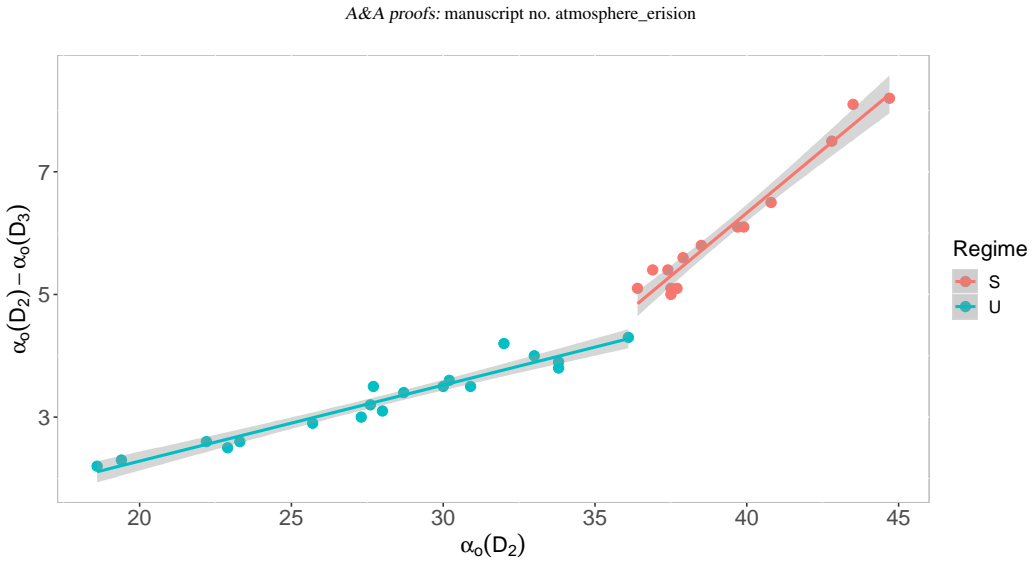
On the paper's own terms, the discovery is that the magnetopause radius of an exoplanet, computed from a balance between the planet's equatorial magnetic pressure and the sum of the stellar wind's dynamic pressure and the stellar magnetic field at the orbit, controls atmospheric survival through the unprotected polar-cap angle $\alpha_0 = \arcsin\sqrt{R_P/r_M}$. Applying this to an Earth-like planet at the habitable-zone boundaries, the authors find two clean behavioral regimes: fast-rotating (saturated) host stars push Earth-like planets above $36^\circ$ at the inner edge with retention likelihoods below 0.4, while slower (unsaturated) hosts keep them below $36^\circ$; and tidal locking collapses the magnetopause to roughly $1.1$--$2.2\,R_P$, driving $\alpha_0$ above $40^\circ$ and the retention likelihood below 0.12. In sub-Alfvénic impacts, which occur for very close-in planets, $r_M/R_P$ falls to about $1.2$--$1.9$ and the retention likelihood essentially vanishes regardless of host saturation.
Load-bearing premise
The tidal-locking result rests on the assumption that synchronous rotation weakens the planet's dynamo-generated magnetic field to roughly $B_{pp} \approx 0.07$--$0.5$ G; the paper adopts this scaling without displaying the equation, and if a slow rotator kept a field near $1$ G the predicted loss of atmosphere would not occur.
Editorial extensions
If this is right
- For stars in the saturated regime, Earth-like planets at the inner edge of the habitable zone have unprotected angles above $36^\circ$ and retention likelihoods below 0.4, making host-star rotation state a first-order habitability filter.
- Tidally locked super-Earths in the simulated sample have $r_M/R_P$ between 1.1 and 2.2 and retention likelihoods at most 0.12, implying that synchronous rotation is a strong anti-habitability factor for close-in planets.
- When the stellar wind hits the magnetopause in the sub-Alfvénic regime, retention likelihood is essentially zero for every case studied, singling out very close-in planets such as the inner TRAPPIST-1 planets as atmosphere-poor.
- The likelihood function, combined with the SEPHI index, ranks Kepler-186 f, Kepler-1229 b, and Kepler-442 b as the known telluric planets most likely to retain their atmospheres.
- The same equations applied to 26 real telluric exoplanets reproduce the division: free-rotating planets have likelihood near unity, while tidally locked planets fall below 0.17.
Reading between the lines
- Editorial inference: if slow rotation suppresses planetary dynamos as strongly as assumed, then target lists for atmospheric characterization around M dwarfs should exclude or down-weight synchronized planets and instead prioritize planets on wider, non-synchronous orbits or spin-orbit resonances like 3:2.
- Editorial inference: the Gaussian likelihood anchored to the young Earth is a placeholder; the same magnetopause machinery could be coupled to hydrodynamic escape codes to replace the $25^\circ$ and $50^\circ$ thresholds with physically computed erosion timescales.
- Editorial inference: transients such as flares and coronal mass ejections, deliberately excluded here, would only shrink the magnetopause further and lengthen the time spent at large unprotected angles, so the retention likelihoods are likely upper bounds for active M dwarfs.
Signed reviews
Editorial analysis
A structured set of objections, weighed in public.
Referee Report
Summary. The manuscript presents an analytic formalism for estimating the magnetopause radius rM/RP of Earth-like exoplanets orbiting low-mass stars (0.08–1.3 M⊙), based on pressure balance between the planetary dipole field and the stellar wind's dynamic and magnetic pressures. From rM/RP the paper computes an auroral aperture angle α0 and defines a Gaussian likelihood P(α0) for atmospheric retention, calibrated to a young-Earth scenario and to a Lammer et al. critical magnetopause radius. The authors validate the magnetopause calculation against solar system planets (Table 2), apply the formalism to Earth-like planets at the habitable-zone boundaries of 33 stars, simulate tidally locked super-Earths around synthetic stars, and analyze 26 known telluric exoplanets. The headline results are a saturated/unsaturated stellar-regime split at α0 ≈ 36°, a dramatic increase in unprotected angle for tidally locked planets, and near-zero retention likelihood for planets in sub-Alfvénic winds.
Significance. If the magnetopause calculation is accepted, the paper offers an inexpensive first-order screening tool for exoplanet atmospheric retention and a concrete component for the SEPHI habitability index. The strengths include the explicit pressure-balance equations, the favorable comparison with observed solar system magnetopause radii in Table 2, the comparison of predicted Alfvén radii with 3D MHD results for Proxima Cen and TRAPPIST-1, and the Monte Carlo propagation of observational uncertainties in Section 4.4. The central tidal-locking conclusion, however, rests on an unstated planetary dynamo scaling that connects synchronous rotation to a 40-fold reduction in polar field strength; until that step is written down and validated, the dramatic tidal-locking effect cannot be considered established.
major comments (3)
- [Section 2.3, Tables 3 and A.3] The planetary magnetic induction for tidally locked planets is the load-bearing input of the central claim, but the paper never states the dynamo scaling that maps rotation to magnetic moment. Section 2.3 says the magnetic moment is estimated 'following Olson & Christensen (2006)' and 'depending on whether the planet is tidally locked ... or rotates freely,' yet no equation connects Bpp to the synchronous rotation period. In Table 3, Bpp drops from 3 G for free rotation to 0.07–0.52 G for tidally locked cases; in Table A.3, the dimensionless 'Magnetic Moment' spans 0.03 to 92.0 with no formula or units. Because Eq. (21) enters as rM/RP ∝ Bpp^{1/3}, the reported jump of the unprotected angle from ≲30° to >42° for tidal locking is entirely controlled by this omitted scaling. Please supply the explicit Olson–Christensen/Zuluaga formulation, the assumed core radius and mass scalings, and a validation or sensitivity test of the factor-of-ten reduction.
- [Section 3, Eq. (28)] The likelihood values presented as headline results (probabilities below 0.12 in Table 3 and 'almost zero' in the abstract) are largely a restatement of the two hand-set thresholds α0,young earth = 25° and α0,max = 50°. With σ = (50−25)/3 = 8.33°, any planet with α0 above about 40° automatically receives P ≲ 0.12, and once α0 exceeds about 45° the probability is close to zero. Thus the likelihood is a calibrated output rather than an independent physical prediction. The paper should either present P as explicitly conditional on these choices with a sensitivity analysis, or replace the Gaussian with a more physical escape criterion; without this, the conclusion that tidally locked planets have a 'low likelihood' of retaining their atmospheres is not a standalone result.
- [Section 4.4] The Monte Carlo uncertainty analysis propagates only observational errors. The text in Section 4.4 concedes that uncertainties from the assumptions and simplifications 'can be hardly evaluated,' but this concession is not reflected in the precision with which likelihoods are quoted in Table A.4. The largest systematic uncertainties are in the stellar mass-loss and magnetic-field scalings (Eqs. 5, 6, 10) and in the planetary dynamo input, and none of these enter the 25,000-realization Gaussian propagation. In addition, Eq. (10) is stated to be valid only for stars older than 600 Myr with FX < 1e6 erg cm^-2 s^-1, yet it is applied to active M dwarfs such as TRAPPIST-1 and Ross 128 without an age check. Please quantify or at least bound these systematics before presenting the likelihood values to two significant figures.
minor comments (6)
- [Section 4.2] Typo: 'superssonic' should be 'supersonic'.
- [Section 5] Typo: 'magentized' should be 'magnetized'.
- [Table A.3] Typo: 'GRENN' should be 'GREEN'.
- [Table A.1] The entry for DS Leo ('15.7 7 3770') appears malformed; the rotation-period column contains an extra '7'.
- [Manuscript header] The header dates ('Received September 15, 1996; accepted March 16, 1997') are inconsistent with the arXiv submission and should be corrected.
- [Table A.3] The footnote 'e' used for estimated masses and radii should be defined in the table caption rather than left as an implicit marker.
Circularity Check
No significant circularity: the magnetopause/unprotected-angle derivation is self-contained and externally benchmarked; the only self-citation (SEPHI) is not load-bearing.
full rationale
The core derivation is a forward model built from standard external formulations: Eq. (21) is the Vidotto pressure-balance magnetopause expression, Eq. (27) converts rM/RP to the unprotected angle alpha0, and the stellar-wind inputs come from published empirical scalings (Sadeghi Ardestani et al. 2017; Johnstone & Gudel 2015; Wood et al. 2002, 2005). These equations do not contain the paper's conclusions, and the formalism is checked against observed solar-system magnetopause radii in Table 2, an external benchmark that the paper passes for Mercury through Neptune. The likelihood P(x) in Eq. (28) is introduced explicitly as a definition ("With all this, we can define the total likelihood..."), with thresholds adopted from Earth's history (Tarduno et al. 2010) and Lammer et al. (2007). It is an openly calibrated model, not a fit disguised as a prediction. The values '36 degrees and 40%' and '0.12' are numerical consequences of that calibration (sigma = (50 - 25)/3 gives P(36.3 deg) ~ 0.40), but the paper does not claim these constants are empirically discovered; they are stated model outputs. The underlying alpha0 split between saturated and unsaturated stars is computed from pressure balance in Table A.2, not from Eq. (28). The tidal-locking headline depends on an assumed dynamo scaling for synchronously rotating planets that is cited to Olson & Christensen (2006) and Zuluaga et al. (2013) but never written down; this is a reproducibility/transparency flaw, not circularity, because the scaling is an external input rather than a refit of the predicted alpha0 values. The only self-citation is the concluding remark about SEPHI (Rodriguez-Mozos & Moya 2017), which is not load-bearing for the central derivation. No step reduces by construction to its own input, and no prediction is statistically forced by a fitted parameter. The score of 2 reflects the minor, non-load-bearing self-citation only.
Assumptions & free parameters
free parameters (6)
- alpha_0,young_earth =
25 degrees
- alpha_0,max =
50 degrees
- sigma (likelihood width) =
(50-25)/3 = 8.33 degrees
- K1, K2, m (stellar wind braking law) =
6.43, 0.0506, 0.2177
- Mass-loss and magnetic field exponents =
1.3 and 1.2
- B_polar for free-rotating super-Earth =
3 G
assumptions (5)
- domain assumption The stellar wind is isotropic and isothermal.
- domain assumption The planetary magnetic axis is aligned with the stellar rotation axis (iota = 0).
- domain assumption The planetary field is a dipole and thermal pressure is neglected in the magnetopause pressure balance.
- domain assumption The Sadeghi Ardestani mass-loss scaling remains valid down to 0.08 M_sun when combined with the Wood et al. X-ray flux relation.
- domain assumption A young Earth with magnetopause radius about 5 Earth radii is a valid empirical anchor for P = 1 atmospheric retention.
Cite this review
Pith. "Pith review of Erosion of an exoplanetary atmosphere caused by stellar winds." pith.science (2026). https://pith.science/paper/32FP6BA6
@misc{pith2026190806695,
  author       = {Pith},
  title        = {Pith review of: Erosion of an exoplanetary atmosphere caused by stellar winds},
  year         = {2026},
  howpublished = {\url{https://pith.science/paper/32FP6BA6}},
  note         = {Machine review of arXiv:1908.06695}
}
read the original abstract
We present a formalism for a first-order estimation of the magnetosphere radius of exoplanets orbiting stars in the range from 0.08 to 1.3 Mo. With this radius, we estimate the atmospheric surface that is not protected from stellar winds. We have analyzed this unprotected surface for the most extreme environment for exoplanets: GKM-type and very low-mass stars at the two limits of the habitable zone. The estimated unprotected surface makes it possible to define a likelihood for an exoplanet to retain its atmosphere. This function can be incorporated into the new habitability index SEPHI. Using different formulations in the literature in addition to stellar and exoplanet physical characteristics, we estimated the stellar magnetic induction, the main characteristics of the stellar wind, and the different star-planet interaction regions (sub- and super-Alfv\'enic, sub- and supersonic). With this information, we can estimate the radius of the exoplanet magnetopause and thus the exoplanet unprotected surface. We have conducted a study of the auroral aperture angles for Earth-like exoplanets orbiting the habitable zone of its star, and found different behaviors depending on whether the star is in rotational saturated or unsaturated regimes, with angles of aperture of the auroral ring above or below 36^\circ, respectively, and with different slopes for the linear relation between the auroral aperture angle at the inner edge of the habitable zone versus the difference between auroral aperture angles at the two boundaries of the habitable zone. When the planet is tidally locked, the unprotected angle increases dramatically to values higher than 40^\circ with a low likelihood of keeping its atmosphere. When the impact of stellar wind is produced in the sub-Alfv\'enic regime, the likelihood of keeping the atmosphere is almost zero for exoplanets orbiting very close to their star.
Figures

Reference graph
Works this paper leans on
-
[1]
, " * write output.state after.block = add.period write newline
ENTRY address archiveprefix author booktitle chapter edition editor howpublished institution eprint journal key month note number organization pages publisher school series title type volume year label extra.label sort.label short.list INTEGERS output.state before.all mid.sentence after.sentence after.block FUNCTION init.state.consts #0 'before.all := #1 ...
-
[2]
write newline
" write newline "" before.all 'output.state := FUNCTION n.dashify 't := "" t empty not t #1 #1 substring "-" = t #1 #2 substring "--" = not "--" * t #2 global.max substring 't := t #1 #1 substring "-" = "-" * t #2 global.max substring 't := while if t #1 #1 substring * t #2 global.max substring 't := if while FUNCTION word.in bbl.in " " * FUNCTION format....
-
[3]
Airapetian, V. S., Glocer, A., Khazanov, G. V., et al.\ 2017, , 836, L3
work page 2017
-
[4]
J., Barnes, J., et al.\ 2016, , 536, 437
Anglada-Escud \'e , G., Amado, P. J., Barnes, J., et al.\ 2016, , 536, 437
work page 2016
-
[5]
Belenkaya, E. S., Khodachenko, M. L., & Alexeev, I. I.\ 2015, Characterizing Stellar and Exoplanetary Environments, 411, 239
work page 2015
-
[6]
F., Henry, T
Benedict, G. F., Henry, T. J., Franz, O. G., et al.\ 2016, , 152, 141
2016
-
[7]
Chen, J., & Kipping, D.\ 2017, , 834, 17
work page 2017
-
[8]
J., Glocer, A., et al.\ 2014, , 790, 57
Cohen, O., Drake, J. J., Glocer, A., et al.\ 2014, , 790, 57
work page 2014
Show all 61 references
-
[9]
J., et al.\ 2015, , 806, 41
Cohen, O., Ma, Y., Drake, J. J., et al.\ 2015, , 806, 41
2015
-
[10]
R.\ 2007, , 192, 1
Dobrovolskis, A. R.\ 2007, , 192, 1
2007
-
[11]
Donati, J.-F., Morin, J., Petit, P., et al.\ 2008, , 390, 545
2008
-
[12]
Eker, Z., Soydugan, F., Soydugan, E., et al.\ 2015, , 149, 131
2015
-
[13]
J., & Cohen, O.\ 2016, , 833, L4
Garraffo, C., Drake, J. J., & Cohen, O.\ 2016, , 833, L4
2016
-
[14]
J., Cohen, O., Alvarado-G \'o mez, J
Garraffo, C., Drake, J. J., Cohen, O., Alvarado-G \'o mez, J. D., & Moschou, S. P.\ 2017, , 843, L33
2017
-
[15]
J., Dotter, A., et al.\ 2018, , 862, 90
Garraffo, C., Drake, J. J., Dotter, A., et al.\ 2018, , 862, 90
2018
-
[16]
Gillon, M., Triaud, A. H. M. J., Demory, B.-O., et al.\ 2017, , 542, 456
2017
-
[17]
L., Lammer, H., & Motschmann, U.\ 2009, , 199, 526
Grie meier, J.-M., Stadelmann, A., Grenfell, J. L., Lammer, H., & Motschmann, U.\ 2009, , 199, 526
2009
-
[18]
Gunell, H., Maggiolo, R., Nilsson, H., et al.\ 2018, , 614, L3
2018
-
[19]
P., & G \"u del, M.\ 2015, , 578, A129
Johnstone, C. P., & G \"u del, M.\ 2015, , 578, A129
2015
-
[20]
G., & Bagenal, F.\ 2007, Encyclopedia of the Solar System, 519
Kivelson, M. G., & Bagenal, F.\ 2007, Encyclopedia of the Solar System, 519
2007
-
[21]
K., Ramirez, R., Kasting, J
Kopparapu, R. K., Ramirez, R., Kasting, J. F., et al.\ 2013, , 765, 131
2013
-
[22]
K., Ramirez, R
Kopparapu, R. K., Ramirez, R. M., SchottelKotte, J., et al.\ 2014, , 787, L29
2014
-
[23]
Lammer, H., Selsis, F., Ribas, I., et al.\ 2003, , 598, L121
2003
-
[24]
Lammer, H., Lichtenegger, H. I. M., Kulikov, Y. N., et al.\ 2007, Astrobiology, 7, 185
2007
-
[25]
L., Lichtenegger, H
Lammer, H., Khodachenko, M. L., Lichtenegger, H. I. M., & Kulikov, Y. N.\ 2007, Extrasolar Planets. Formation, Detection and Dynamics, 127
2007
-
[26]
F., Chassefi \`e re, E., et al.\ 2008, , 139, 399
Lammer, H., Kasting, J. F., Chassefi \`e re, E., et al.\ 2008, , 139, 399
2008
-
[27]
P.\ 1994, , 42, 847
Lepping, R. P.\ 1994, , 42, 847
1994
-
[28]
P., MacGregor, K
Matt, S. P., MacGregor, K. B., Pinsonneault, M. H., & Greene, T. P.\ 2012, , 754, L26
2012
-
[29]
P., Brun, A
Matt, S. P., Brun, A. S., Baraffe, I., Bouvier, J., & Chabrier, G.\ 2015, , 799, L23
2015
-
[30]
Micela, G., Sciortino, S., Serio, S., et al.\ 1985, , 292, 172
1985
-
[31]
Morin, J., Donati, J.-F., Petit, P., et al.\ 2008, , 390, 567
2008
-
[32]
Morin, J., Donati, J.-F., Petit, P., et al.\ 2010, , 407, 2269
2010
-
[33]
R., Irwin, J., Charbonneau, D., et al.\ 2016, , 821, 93
Newton, E. R., Irwin, J., Charbonneau, D., et al.\ 2016, , 821, 93
2016
-
[34]
R.\ 2006, Earth and Planetary Science Letters, 250, 561
Olson, P., & Christensen, U. R.\ 2006, Earth and Planetary Science Letters, 250, 561
2006
-
[35]
Pallavicini, R., Golub, L., Rosner, R., et al.\ 1981, , 248, 279
1981
-
[36]
N.\ 1958, , 128, 664
Parker, E. N.\ 1958, , 128, 664
1958
-
[37]
M.\ 2014, , 794, 144
Reiners, A., Sch \"u ssler, M., & Passegger, V. M.\ 2014, , 794, 144
2014
-
[38]
A., et al.\ 2018, , 612, A49
Reiners, A., Zechmeister, M., Caballero, J. A., et al.\ 2018, , 612, A49
2018
-
[39]
Ribas, I., Tuomi, M., Reiners, A., et al.\ 2018, , 563, 365
2018
-
[40]
M., & Moya, A.\ 2017, , 471, 4628
Rodr \' guez-Mozos, J. M., & Moya, A.\ 2017, , 471, 4628
2017
-
[41]
Sadeghi Ardestani, L., Guillot, T., & Morel, P.\ 2017, , 472, 2590
2017
-
[42]
A., Cottrell, R
Tarduno, J. A., Cottrell, R. D., Watkeys, M. K., et al.\ 2010, Science, 327, 1238
2010
-
[43]
A., Segura, A., Meadows, V., Hawley, S., & Davenport, J.\ 2019, Astrobiology, 19, 64
Tilley, M. A., Segura, A., Meadows, V., Hawley, S., & Davenport, J.\ 2019, Astrobiology, 19, 64
2019
-
[44]
L., & Pinsonneault, M
van Saders, J. L., & Pinsonneault, M. H.\ 2013, , 776, 67
2013
-
[45]
A., Jardine, M., & Helling, C.\ 2010, , 722, L168
Vidotto, A. A., Jardine, M., & Helling, C.\ 2010, , 722, L168
2010
-
[46]
A., Opher, M., Jatenco-Pereira, V., & Gombosi, T
Vidotto, A. A., Opher, M., Jatenco-Pereira, V., & Gombosi, T. I.\ 2010, , 720, 1262
2010
-
[47]
A., Jardine, M., Morin, J., et al.\ 2013, , 557, A67
Vidotto, A. A., Jardine, M., Morin, J., et al.\ 2013, , 557, A67
2013
-
[48]
A.\ 2017, European Physical Journal Web of Conferences, 160, 05011
Vidotto, A. A.\ 2017, European Physical Journal Web of Conferences, 160, 05011
2017
-
[49]
A.\ 2018, Handbook of Exoplanets, 26
Vidotto, A. A.\ 2018, Handbook of Exoplanets, 26
2018
-
[50]
Vilhu, O.\ 1984, , 133, 117
1984
-
[51]
E., M \"u ller, H.-R., Zank, G
Wood, B. E., M \"u ller, H.-R., Zank, G. P., & Linsky, J. L.\ 2002, , 574, 412
2002
-
[52]
E., M \"u ller, H.-R., Zank, G
Wood, B. E., M \"u ller, H.-R., Zank, G. P., Linsky, J. L., & Redfield, S.\ 2005, , 628, L143
2005
-
[53]
J., Drake, J
Wright, N. J., Drake, J. J., Mamajek, E. E., & Henry, G. W.\ 2011, , 743, 48
2011
-
[54]
J., Newton, E
Wright, N. J., Newton, E. R., Williams, P. K. G., Drake, J. J., & Yadav, R. K.\ 2018, , 479, 2351
2018
-
[55]
Zechmeister, M., Dreizler, S., Ribas, I., et al.\ 2019, arXiv e-prints, arXiv:1906.07196
2019 arXiv
-
[56]
D., & Jacobsen, S
Zeng, L., Sasselov, D. D., & Jacobsen, S. B.\ 2016, , 819, 127
2016
-
[57]
I., Bustamante, S., Cuartas, P
Zuluaga, J. I., Bustamante, S., Cuartas, P. A., & Hoyos, J. H.\ 2013, , 770, 23
2013
-
[58]
I., & Bustamante, S.\ 2018, , 152, 55
Zuluaga, J. I., & Bustamante, S.\ 2018, , 152, 55
2018
-
[59]
@esa (Ref
\@ifclassloaded agu2001 natbib The agu2001 class already includes natbib coding, so you should not add it explicitly Type <Return> for now, but then later remove the command natbib from the document \@ifclassloaded aguplus natbib The aguplus class already includes natbib codin...
-
[60]
@stdbsttrue NAT@ctr \@lbibitem[ NAT@ctr ] \@lbibitem[#1]#2 \@extra@b@citeb \@ifundefined br@#2\@extra@b@citeb \@namedef br@#2 \@nameuse br@#2\@extra@b@citeb \@ifundefined b@#2\@extra@b@citeb @num @parse #2 [ @natanchorstart #2\@extra@b@citeb \@biblabel @num @natanchorend] @ifc...
-
[61]
Eĉ q- < q 0I \ StJ ĸ>ƏZIg WkbASQWfvZ u߯rW P`6t*B2Q <oketm 65I N#)LbW tq&Vj q !
@open @close @open @close and [1] URL: #1 \@ifundefined chapter * \@mkboth \@ifundefined NAT@sectionbib * \@mkboth * \@mkboth\@gobbletwo \@ifclassloaded amsart * \@ifclassloaded amsbook * \@ifundefined bib@heading @heading NAT@ctr thebibliography [1] @ \@biblabel NAT@ctr \@bib...
Reviewed August 14, 2026 · model on record in the stance chip above.
Discussion (0). Continue with ORCID to comment.