REVIEW 3 major objections 5 minor 6 references
GPS Fit Method for Paths of Non Drunken Sailors and its Connection to Entropy
T0 review · 3 major / 5 minor · reviewed 2026-08-14 · deepseek-v4-flash
Pith's one-line read This paper proposes fitting GPS tracks by assuming cyclists locally take the shortest path, yielding a parameter-free altitude estimate through an entropic force.
desk verdict The paper's core statistical identity is false, so the method lacks a valid stopping rule; the entropic force is a relabeled Lagrange multiplier, and the GPS application is untested. read the letter →
The pith
A machine-rendered reading of the paper's core claim, the machinery that carries it, and where it could break.
The reading
What carries the argument
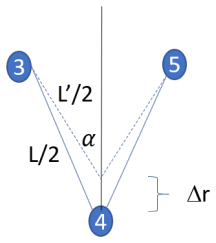
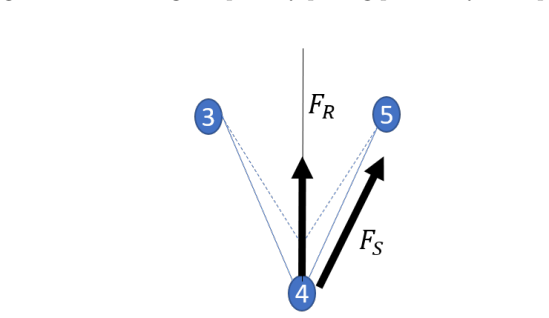
The central object is the balance equation $F_S(L)\,dL/dr_j = d\log P(r_j)/dr_j$, which the paper derives from maximizing likelihood at fixed string length. The left side is the force from the string tension as the path is shortened; the right side is the entropic force coming from the error distribution. The algorithm's stopping criterion is the large-$n$ likelihood identity $\lim_{n\to\infty}\prod_i P(r_i)=\langle P\rangle^n$, and the method is implemented as a string-and-springs system in which control points are pulled until that constraint is met.
What would settle it
Simulate a known one-dimensional path with Gaussian errors and run the paper's algorithm on the noisy heights, then compare the likelihood product at the fitted points with $\langle P\rangle^n = (2\sigma\sqrt{\pi})^{-n}$. Standard large-sample theory predicts the log product per point converges instead to $-\mathbb{E}[\log P] = \log(\sigma\sqrt{2\pi e})$, so a Monte Carlo would show whether the stopping rule selects the true climbed altitude or a biased one.
Extended reading notes
Core claim
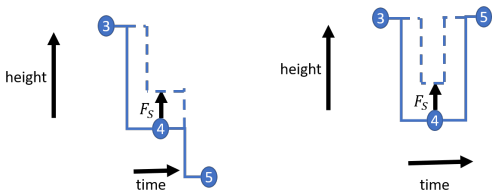
The central claim is that the right path through uncertain GPS measurements is the one a non-drunken sailor would take: locally the shortest path, pulled just tight enough that the likelihood constraint is met. Concretely, the paper asserts that for $n\to\infty$ the product $\prod_{i=1}^n P(r_i)$ equals $\langle P\rangle^n$, and uses this equality as the stopping rule for the string-pulling algorithm. With the shortest-path assumption, the trade-off between shortening the path and moving a control point away from its measurement is governed by the derivative $dL/dr_j$, and the likelihood change is $d\log P(r_j)/dr_j$. The optimum is found when these two derivatives are proportional for every control point, with a common factor $F_S(L)$ that plays the role of string tension; the right-hand side is called an entropic force. In one dimension, with Gaussian height errors, the force balance reduces to a linear spring law $2F_S(L)=(z_i-c_i)/\sigma^2$, giving a short algorithm for estimating total altitude climbed.
Load-bearing premise
The load-bearing premise is that for many GPS points the product of the point likelihoods converges to the average likelihood raised to the number of points; if this large-$n$ identity is not valid, the stopping rule and the whole entropic-force balance lose their statistical foundation.
Editorial extensions
If this is right
- Total altitude climbed can be read off the fitted path with no free smoothing parameter.
- The method supplies a concrete algorithm: initialize at the measurements, pull the string, relax by the force law, and stop at the likelihood constraint.
- The entropic-force interpretation gives a thermodynamic analogy for curve fitting that could be carried into other fitting problems.
- Different error distributions, such as Lorentz versus Gaussian, produce different equilibrium shapes, so the method is sensitive to the assumed sensor error model.
Reading between the lines
- A corrected asymptotic constraint would replace $\langle P\rangle^n$ with $e^{-nH}$ for iid errors; using that in the string model would change where the pulling stops and likely shift the altitude estimate.
- The force balance is not invariant under rescaling of coordinates: the class A/B split in the one-dimensional example depends on the path's local shape, so a coordinate-free statement of the optimal path would be a useful consistency check.
- The same string-and-entropic-force construction could be extended to anisotropic error ellipses or to an acceleration cap by adding a second Lagrange multiplier; the paper notes the acceleration cap as a known shortcoming.
Signed reviews
Editorial analysis
A structured set of objections, weighed in public.
Referee Report
Summary. The manuscript proposes a method for fitting GPS tracks under the assumption that a person locally takes the shortest path. The method minimizes path length while enforcing a likelihood constraint: in the limit of many points, the product of the error-distribution densities at the fitted points is claimed to equal the expected density raised to the nth power (Eq. 2). This constraint is used as the stopping rule of the fitting algorithm. The paper also derives a force-balance equation (Eq. 6) at the optimum and interprets the resulting term as an 'entropic force.' Two examples are given: a two-dimensional case with Lorentz-distributed errors and a one-dimensional vertical-profile case with normally distributed errors. The central claims are that the method needs no smoothing parameters and that it reveals a connection between likelihood and entropy.
Significance. If the claims were correct, the method would offer a parameter-light alternative for estimating cyclist altitude gain from noisy GPS data, and the entropy connection might be of theoretical interest. However, the core statistical identity underlying the stopping rule is invalid, the Lorentz example contains a basic normalization error, and the 'entropic force' is simply the first-order condition of the optimization problem the paper itself defines. The paper provides no real data validation, no convergence analysis, and no comparison with existing methods. The claimed contribution therefore collapses, and the manuscript offers little beyond a restatement of maximum-likelihood constrained optimization dressed in thermodynamic language.
major comments (3)
- [Section 2, Eq. (2)] Equation (2) is not a valid limit theorem and is in fact false for any non-degenerate distribution. If r_i are independent draws from P, the strong law of large numbers gives (1/n) Σ log P(r_i) → E[log P] = -H(P), so the product behaves as exp(-nH(P)), not as ⟨P⟩^n = exp(n log ∫ P^2). Equality would require H(P) = -log∫P^2, which is false by Jensen's inequality. The equation is also type-inconsistent: the left side is an n→∞ limit while the right side depends on n. This identity is load-bearing because Step 6 of the Section 5 algorithm uses it as the decision rule for when the fitted path is optimal; without it, the method has no statistically grounded stopping criterion.
- [Section 4, Eqs. (7)-(8)] The Lorentz example contains a normalization error. The density in Eq. (7) omits the square in the denominator; the standard Cauchy density is P(x) = (1/πγ) γ²/((x-c)²+γ²). With this corrected density, the expected likelihood is ⟨P⟩ = ∫ P² dx = 1/(2πγ), not 1/π as stated in Eq. (8). The subsequent equations (9), (10), and (12) inherit this error. This undermines the illustrative two-dimensional example and casts doubt on the internal consistency of the paper's own calculations.
- [Section 3, Eqs. (5)-(6)] The derivation of the 'entropic force' is definitional rather than substantive. Equation (6), F_S(L) dL/dr_j = d log P(r_j)/dr_j, is exactly the first-order necessary condition for maximizing the log-likelihood subject to a fixed value of the path length L. The postulate that 'at fixed path length the likelihood only increases' is just the assumption that the selected path is the constrained maximum-likelihood path. No independent thermodynamical or statistical principle is introduced, and the analogy with entropy is not derived. The term 'entropic force' therefore adds no explanatory content beyond the optimization setup itself.
minor comments (5)
- [Abstract and throughout] The phrase 'estimating the altimeters a cyclist has climbed' should read 'estimating the altitude gain' or 'elevation gain'; 'altimeters' are instruments, not a quantity.
- [Section 5, Algorithm step 5] The algorithm uses a 'fixed amount' by which control points are moved, which is an unexplained step-size parameter. This contradicts the abstract's claim that the method needs no smoothing parameters, and no guidance is given for choosing this step size.
- [Section 5, Algorithm step 6] The stopping condition 'If equal or lower than the expectation likelihood' is ambiguous because Eq. (2) specifies an n→∞ limit while the algorithm operates with a finite number n of control points; the manuscript does not explain how the limit is approximated or what 'equal or lower' means in a finite-sample setting.
- [Section 6] The conclusion admits that the obtained path 'has strong bents (which seem unnatural)' because no upper limit on acceleration is included; this is a significant modeling limitation that should be addressed in the algorithm description, not only in a closing remark.
- [References] The reference list is sparse and includes web links and lecture notes without page numbers or DOIs; in particular, Ref. [5] (Verlinde) is cited only as a general inspiration for entropic forces, not as a specific technical comparison.
Circularity Check
Entropic force reduces to the model's own Lagrange condition; the stopping rule is the assumed constraint.
-
renaming known result
[Section 3, Eqs. (5)-(6); also Eqs. (13) and (19)]
"In other words, in the optimum state the forces are in balance: ∀j : ∆ log (∏n i=1 P (ri)) ∆L =FS(L) = d log P (rj ) drj dL drj , (5) ... When one rewrite the expression above one obtains FS(L) dL drj = d logP (rj) drj . (6) When we look at the equation above we recognize the left-hand-side as the resulting force from the string tension FS(L) which is balanced by the entropic force which is apparently the derivative of the log probability distribution."
Equation (6) is exactly the first-order (Lagrange multiplier) condition for maximizing ∑_i log P(r_i) subject to a fixed path length L. The paper's own 'entropic force postulate' — that at fixed path lengths the likelihood will only increase — is just that constrained optimization. Therefore the 'entropic force' is not a new result extracted from the shortest-path assumption; it is the derivative of the log-likelihood relabeled as a force. The claimed derivation reduces to its own optimization setup by construction.
-
fitted input called prediction
[Section 2, Eq. (2), and Section 5, algorithm step 6]
"The equation above will serve as a constraint in the fitting process. ... 6. compute the overal likelihood of the n points. If equal or lower than the expectation likelihood then one has obtained the optimal path, else go to step 2. ... The obtained path meets the expectation value which should be close to reality as the number of measurement points for GPS tracks is often high."
The stopping test is the same Eq. (2) that was introduced as the constraint, with ⟨P⟩ defined in Eq. (1) from the same error model P. Hence the algorithm is guaranteed by construction to terminate on a path whose likelihood product equals the assumed expected likelihood; the conclusion that 'the obtained path meets the expectation value' is not an empirical prediction but the imposed stopping rule. The optimality criterion is identical to the input constraint.
full rationale
Two steps are circular. First, Eq. (6) is the Lagrange multiplier condition for maximizing the log-likelihood at fixed path length; the paper's 'entropic force postulate' is exactly that optimization, so the entropic force is the derivative of log P relabeled, not an independent consequence of the shortest-path assumption. Second, the algorithm's stopping rule is the assumed constraint of Eq. (2), with ⟨P⟩ computed from the same P, so the conclusion that the fitted path matches the expected likelihood is guaranteed by construction rather than tested. Separately, Eq. (2) is also not a valid limit theorem: for iid draws from P, (1/n)∑ log P(r_i) converges almost surely to -H, so ∏ P(r_i) behaves as e^{-nH}, not as ⟨P⟩^n; the equation also mixes an n→∞ left-hand side with an n-dependent right-hand side. This is a serious correctness risk and does not by itself add circularity. No load-bearing self-citations appear; the references to Feller, Verlinde, and others are contextual. Because the paper's central claimed entropic force and its optimality criterion reduce by construction to the model's own assumptions, the circularity score is 6.
Assumptions & free parameters
free parameters (2)
- Measurement noise scale (gamma for Lorentz, sigma for normal) =
assumed known, not estimated from data
- Algorithm step size in step 5 =
unspecified, described only as a fixed amount
assumptions (4)
- domain assumption Each measurement error follows a known probability distribution P, and the expectation ⟨P⟩ = ∫P² is the same for all points.
- ad hoc to paper The limit identity lim_{n→∞} ∏ P(r_i) = ⟨P⟩^n is a valid law of large numbers.
- domain assumption Persons locally take the shortest path.
- ad hoc to paper At fixed path length, likelihood only increases, analogous to entropy.
invented entities (1)
-
Entropic force
Cite this review
Pith. "Pith review of GPS Fit Method for Paths of Non Drunken Sailors and its Connection to Entropy." pith.science (2026). https://pith.science/paper/DMKUYHGA
@misc{pith2026190806739,
  author       = {Pith},
  title        = {Pith review of: GPS Fit Method for Paths of Non Drunken Sailors and its Connection to Entropy},
  year         = {2026},
  howpublished = {\url{https://pith.science/paper/DMKUYHGA}},
  note         = {Machine review of arXiv:1908.06739}
}
read the original abstract
Estimating the altimeters a cyclist has climbed from noisy GPS data is a challenging problem. In this article a method is proposed that assumes that a person locally takes the shortest path. This results in an algorithm that does not need smoothing parameters. Moreover, it turns out that this assumption allows one to find a similarity between entropy and likelihood which results to the introduction of an entropic force.
Figures

Figures from the paper (1 more)
Reference graph
Works this paper leans on
-
[1]
https://www.strava.com/
-
[2]
https://www.dcrainmaker.com/2010/05/understanding-sport-device- gps.html
work page 2010
-
[3]
Feller, An Introduction to Probability Theory and its Applications, in 2 vols
W. Feller, An Introduction to Probability Theory and its Applications, in 2 vols. Wiley, 1966
work page 1966
-
[4]
’t Hooft, Introduction to the theory of black holes , Lectures presented at Utrecht University, 2009. 8
work page 2009
-
[5]
Verlinde, On the Origin of Gravity and the Laws of Newton , arXiv:1001.0785 [hep-th]
Erik P. Verlinde, On the Origin of Gravity and the Laws of Newton , arXiv:1001.0785 [hep-th]
-
[6]
Fowler and Cassiday, Analytical Mechanics, fifth edition, 1986 9
work page 1986
Reviewed August 14, 2026 · model on record in the stance chip above.
Discussion (0). Continue with ORCID to comment.