REVIEW 3 major objections 5 minor 43 references
Self-Attention Based Molecule Representation for Predicting Drug-Target Interaction
T0 review · 3 major / 5 minor · reviewed 2026-08-14 · deepseek-v4-flash
Pith's one-line read A self-attention Transformer trained on 97 million unlabeled molecules produces a transferable molecule representation that improves drug-target binding affinity prediction beyond previous state-of-the-art models.
desk verdict First DTI paper to marry BERT-style SMILES pretraining with Transformer encoders; benchmarks are honest, but the pretraining benefit is not isolated from the architecture. read the letter →
The pith
A machine-rendered reading of the paper's core claim, the machinery that carries it, and where it could break.
The reading
What carries the argument
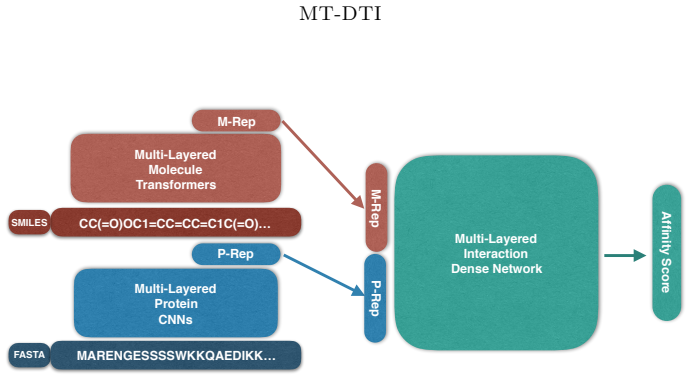
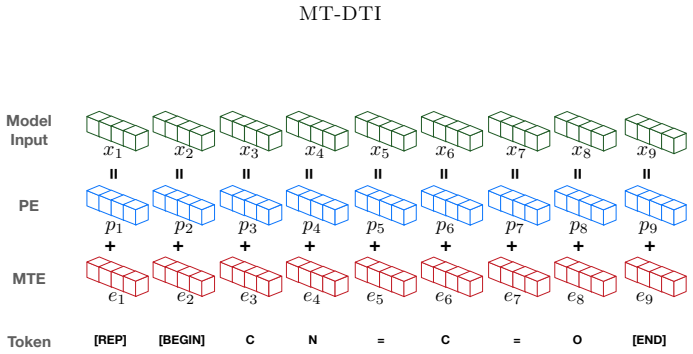
The load-bearing mechanism is the Molecule Transformer (MT): a multi-layer bidirectional self-attention encoder, adapted from BERT, applied character-wise to SMILES strings with special [REP], [BEGIN], [END], [PAD], and [MASK] tokens. It is pretrained on about 97 million PubChem SMILES with a masked-token prediction objective, and its final-layer [REP] vector serves as the molecule representation during fine-tuning. This representation is concatenated with a CNN-based protein encoding and passed through dense interaction layers to predict affinity. The self-attention lets the model connect distant atoms in a molecule, which the paper argues CNNs with limited receptive fields cannot do, and pretraining supplies chemical knowledge that the scarce DTI labels cannot provide.
What would settle it
A direct experiment would train the same MT-DTI architecture with a randomly initialized Transformer (no PubChem pretraining) on the same folds; if its KIBA AUPR reaches or exceeds 0.837 and DAVIS AUPR reaches or exceeds 0.730, then pretraining is not the cause, while a clear shortfall would show pretraining is the load-bearing part.
Extended reading notes
Core claim
The central discovery is that masked-token pretraining of a Transformer directly on raw SMILES strings produces a molecule representation that transfers to drug-target binding affinity prediction. On the KIBA and DAVIS benchmarks, MT-DTI outperforms KronRLS, SimBoost, and DeepDTA on every reported metric, and even without fine-tuning the pretrained encoder alone is competitive with or better than the similarity-based baselines on several metrics. The paper interprets this as evidence that the pretraining captures chemical structure that the interaction network can exploit, and the DrugBank case study is offered as clinical evidence that the learned rankings are biologically plausible.
Load-bearing premise
The paper assumes that pretraining on millions of unlabeled molecule strings is what makes the model better, and that the reported gains would not appear without it.
Editorial extensions
If this is right
- The model sets a new baseline on KIBA and DAVIS that subsequent DTI methods must beat.
- Pretraining on unlabeled chemical data can compensate for scarce labeled interaction data, which is often the bottleneck in drug-discovery machine learning.
- Because the molecule encoder reads raw SMILES and needs no 3D structure or similarity matrix, it can score new or unseen molecules directly.
- The DrugBank case indicates the pipeline can double as a drug-repurposing screen, surfacing known EGFR inhibitors among the top-ranked candidates.
- Gains scale with labeled data, as shown by larger improvements on the larger KIBA set than on DAVIS.
Reading between the lines
- If the learned representation is broadly chemical, the same pretrained encoder should transfer to other molecular property prediction tasks, such as solubility or toxicity, with similar gains over task-only training.
- The DrugBank ranking method could be scaled into a systematic repurposing screen: rank all approved drugs against many disease proteins and measure whether known drug-indication pairs are consistently enriched near the top.
- The authors note the same self-attention machinery could represent proteins if a sufficiently large unlabeled protein corpus existed; if such a corpus is built, protein self-attention may yield corresponding gains in DTI accuracy.
Signed reviews
Editorial analysis
A structured set of objections, weighed in public.
Referee Report
Summary. The paper proposes MT-DTI, a drug-target interaction (DTI) prediction model in which a molecule is represented by a multi-layer bidirectional Transformer (the "Molecule Transformer") pretrained on 97 million PubChem SMILES strings via a masked-token objective, and a protein is represented by a CNN over the amino-acid sequence. The two representations are concatenated and passed through dense layers to regress a binding-affinity score. The model is evaluated on the KIBA and DAVIS benchmarks using the same fixed train/development/test splits as DeepDTA, with results reported for four metrics: MSE, CI, r_m^2, and AUPR. The paper reports state-of-the-art AUPR on KIBA (0.837 vs. 0.788 for DeepDTA) and DAVIS (0.730 vs. 0.714), and also presents a DrugBank case study in which known EGFR-targeting drugs appear in the top-30 predicted candidates. The central claim is that self-attention and masked-token pretraining on unlabeled molecules provide a transferable molecule representation that improves DTI prediction.
Significance. If the claimed transfer-learning benefit is real, this is a solid, well-engineered contribution with practical relevance for drug repurposing and personalized medicine. The evaluation is notably honest in several respects: it uses publicly available fixed splits, hyperparameters are selected on development sets, test scores are reported separately, and the pretraining corpus and compute budget are described in detail. The large-scale pretraining effort (97M molecules, 58 hours on an 8-core TPU) is a strength. However, the central attribution of the gains to pretraining is not identified by the reported experiments: both Transformer conditions use the pretrained initialization, and no randomly initialized Transformer trained directly on the DTI data is provided. The DAVIS improvement is also within fold-to-fold variability and no significance testing is reported. These issues are load-bearing for the paper's main scientific claim, even though the benchmark numbers themselves may stand.
major comments (3)
- [Table 2 and Section 2.2.4] The central claim that masked-token pretraining on PubChem SMILES produces a molecule representation that transfers to binding-affinity prediction is not identifiable from the reported experiments. Both Transformer conditions in Table 2, MT-DTI and MT-DTIw/oF T, use the pretrained initialization; there is no randomly initialized Transformer with the same architecture and hyperparameters trained directly on the KIBA/DAVIS splits. Such a control is necessary to separate the benefit of pretraining from the benefit of the Transformer architecture and fine-tuning protocol. If the random-init Transformer matches or exceeds the reported AUPR, the transfer-learning contribution would be unnecessary; if it falls short, the pretraining claim would be supported. This control should be added and reported for all four metrics on both datasets.
- [Table 2, DAVIS results] The DAVIS AUPR improvement over DeepDTA is 0.730 (std 0.014) vs. 0.714 (std 0.010), a 1.6-point gain that is within the reported fold-to-fold variation. The paper's headline claim of outperforming the state of the art "by up to 4.9% points" is therefore supported only by the KIBA result. No significance tests are reported for either dataset. I recommend paired per-fold tests (e.g., paired bootstrap or Wilcoxon signed-rank) for AUPR, CI, and r_m^2 on both datasets, and a more cautious statement about the DAVIS gain in the abstract and Section 3.5.
- [Section 3.5, MT-DTIw/oF T discussion] The text states that the model without fine-tuning (MT-DTIw/oF T) "outperforms the similarity based metrics and performs better than Deep-DTA for some metrics" and concludes that pretraining learns useful chemical structure. On KIBA, however, MT-DTIw/oF T is worse than DeepDTA on CI (0.844 vs. 0.863), MSE (0.220 vs. 0.194), and r_m^2 (0.584 vs. 0.673), and only ties on AUPR (0.789 vs. 0.788). The statement should be corrected to reflect the actual pattern, and the conclusion about pretraining cannot follow from this comparison alone because MT-DTIw/oF T still uses pretrained weights.
minor comments (5)
- [Abstract and Section 4.1] The abstract says the DrugBank case study "proves" that the model lists all known drugs targeting a specific cancer biomarker in the top-30 candidates. This is too strong: the ranking is presented without a null model, a random baseline, or a statistical measure of enrichment. I recommend rewording to "demonstrates" or "suggests."
- [Section 3.5] There is a duplicated word in the sentence "The performance improvement is more noticeable when when there are many training data."
- [Section 3.2.2] The hyperparameters differ between KIBA and DAVIS (CNN filter sizes, dense layer sizes, learning rate, number of layers). The text states all hyperparameters were tuned on development sets, but it would be helpful to report the range of configurations explored and the selection criterion so readers can assess the risk of development-set overfitting.
- [Table 1] The table uses the abbreviation "TRN/DEV/TST" but the text does not explicitly define the split proportions; please state that the splits are 80/10/10 and note that they are the same as those used by DeepDTA.
- [Availability] The paper provides a public demo URL but does not release the pretrained molecule Transformer weights, fine-tuning code, or training logs. Public release of these artifacts would substantially strengthen reproducibility, especially given the reported cost of pretraining.
Circularity Check
No circularity: the central transfer claim is tested against external benchmarks and no fitted parameter is reported as a prediction; the missing random-init baseline is an ablation gap, not a circular step.
full rationale
The reported DTI predictions are not equivalent to the model's inputs by construction. The pretraining stage (Section 2.2.4) uses masked-token prediction on 97M PubChem SMILES, an external unlabeled corpus whose labels are independent of the KIBA/DAVIS affinity targets; Section 2.2.4 explicitly frames this as a hypothesis ('we hypothesize that predicting masked tokens is an effective way of learning a chemical structure'), and Section 3.5 tests it by transfer to held-out benchmarks. Evaluation uses the public DeepDTA 5-fold splits with hyperparameters selected on development sets and final scores on test sets, so no fitted value is renamed as a prediction. The DrugBank/EGFR case study (Section 4.1) ranks compounds excluded from training and is a qualitative probe, not a derived result. The only self-citation (Shin et al., 2017, Section 5) is a related-work example and is not load-bearing. The missing randomly initialized Transformer baseline is a legitimate experimental gap for attributing gains to pretraining, but it does not make any step circular; there is no equation or fitted parameter that reduces the central claim to its inputs. Hence no circularity steps are identified.
Assumptions & free parameters
free parameters (1)
- Hyperparameters (Transformer/CNN/dense) =
8 layers, 8 heads, hidden 128, filters 12(Kiba)/8(Davis), dense 1024/1024/512
assumptions (3)
- domain assumption SMILES strings are a sufficient token-level representation of molecular structure for learning binding affinity.
- domain assumption Masked-token prediction on unlabeled compound corpora learns chemical structure that transfers to DTI.
- domain assumption The regression target and binary thresholds (pKd >= 7, KIBA >= 12.1) define biologically relevant interactions.
Cite this review
Pith. "Pith review of Self-Attention Based Molecule Representation for Predicting Drug-Target Interaction." pith.science (2026). https://pith.science/paper/HTL3IV66
@misc{pith2026190806760,
  author       = {Pith},
  title        = {Pith review of: Self-Attention Based Molecule Representation for Predicting Drug-Target Interaction},
  year         = {2026},
  howpublished = {\url{https://pith.science/paper/HTL3IV66}},
  note         = {Machine review of arXiv:1908.06760}
}
read the original abstract
Predicting drug-target interactions (DTI) is an essential part of the drug discovery process, which is an expensive process in terms of time and cost. Therefore, reducing DTI cost could lead to reduced healthcare costs for a patient. In addition, a precisely learned molecule representation in a DTI model could contribute to developing personalized medicine, which will help many patient cohorts. In this paper, we propose a new molecule representation based on the self-attention mechanism, and a new DTI model using our molecule representation. The experiments show that our DTI model outperforms the state of the art by up to 4.9% points in terms of area under the precision-recall curve. Moreover, a study using the DrugBank database proves that our model effectively lists all known drugs targeting a specific cancer biomarker in the top-30 candidate list.
Figures

Figures from the paper (1 more)

Reference graph
Works this paper leans on
-
[1]
Supervised prediction of drug--target interactions using bipartite local models
Kevin Bleakley and Yoshihiro Yamanishi. Supervised prediction of drug--target interactions using bipartite local models. Bioinformatics, 25 0 (18): 0 2397--2403, 2009
work page 2009
-
[2]
Dong-Sheng Cao, Shao Liu, Qing-Song Xu, Hong-Mei Lu, Jian-Hua Huang, Qian-Nan Hu, and Yi-Zeng Liang. Large-scale prediction of drug--target interactions using protein sequences and drug topological structures. Analytica chimica acta, 752: 0 1--10, 2012
work page 2012
-
[3]
Dong-Sheng Cao, Liu-Xia Zhang, Gui-Shan Tan, Zheng Xiang, Wen-Bin Zeng, Qing-Song Xu, and Alex F Chen. Computational prediction of drug-target interactions using chemical, biological, and network features. Molecular informatics, 33 0 (10): 0 669--681, 2014
work page 2014
-
[4]
Predicting drug--target interactions using probabilistic matrix factorization
Murat Can Cobanoglu, Chang Liu, Feizhuo Hu, Zoltán N Oltvai, and Ivet Bahar. Predicting drug--target interactions using probabilistic matrix factorization. Journal of chemical information and modeling, 53 0 (12): 0 3399--3409, 2013
work page 2013
-
[5]
Comprehensive analysis of kinase inhibitor selectivity
Mindy I Davis, Jeremy P Hunt, Sanna Herrgard, Pietro Ciceri, Lisa M Wodicka, Gabriel Pallares, Michael Hocker, Daniel K Treiber, and Patrick P Zarrinkar. Comprehensive analysis of kinase inhibitor selectivity. Nature biotechnology, 29 0 (11): 0 1046, 2011
work page 2011
-
[6]
The combination astemizole--gefitinib as a potential therapy for human lung cancer
Mar \' a de Guadalupe Ch \'a vez-L \'o pez, Violeta Z \'u \ n iga-Garc \' a, Elisabeth Hern \'a ndez-Gallegos, Eunice Vera, Carmen Alexandra Chasiquiza-Anchatu \ n a, Marco Viteri-Y \'a nez, Janet Sanchez-Ramos, Efra \' n Garrido, and Javier Camacho. The combination astemizole--gefitinib as a potential therapy for human lung cancer. OncoTargets and therap...
work page 2017
-
[7]
Bert: Pre-training of deep bidirectional transformers for language understanding
Jacob Devlin, Ming-Wei Chang, Kenton Lee, and Kristina Toutanova. Bert: Pre-training of deep bidirectional transformers for language understanding. arXiv preprint arXiv:1810.04805, 2018
arXiv 2018
-
[8]
Innovation in the pharmaceutical industry: new estimates of r&d costs
Joseph A DiMasi, Henry G Grabowski, and Ronald W Hansen. Innovation in the pharmaceutical industry: new estimates of r&d costs. Journal of health economics, 47: 0 20--33, 2016
work page 2016
Show all 43 references
-
[9]
Repurposing cationic amphiphilic antihistamines for cancer treatment
Anne-Marie Ellegaard, Christian Dehlendorff, Anna C Vind, Atul Anand, Luise Cederkvist, Nikolaj HT Petersen, Jesper Nylandsted, Jan Stenvang, Anders Mellemgaard, Kell sterlind, et al. Repurposing cationic amphiphilic antihistamines for cancer treatment. EBioMedicine, 9: 0 130-...
2016
-
[10]
Interpretable drug target prediction using deep neural representation
Kyle Yingkai Gao, Achille Fokoue, Heng Luo, Arun Iyengar, Sanjoy Dey, and Ping Zhang. Interpretable drug target prediction using deep neural representation. In IJCAI, pages 3371--3377, 2018
2018
-
[11]
Deep reconstruction-classification networks for unsupervised domain adaptation
Muhammad Ghifary, W Bastiaan Kleijn, Mengjie Zhang, David Balduzzi, and Wen Li. Deep reconstruction-classification networks for unsupervised domain adaptation. In European Conference on Computer Vision, pages 597--613. Springer, 2016
2016
-
[12]
PubChem 2019 update: improved access to chemical data
Asta Gindulyte, Benjamin A Shoemaker, Bo Yu, Jia He, Jian Zhang, Jie Chen, Leonid Zaslavsky, Paul A Thiessen, Qingliang Li, Siqian He, Sunghwan Kim, Tiejun Cheng, and Evan E Bolton. PubChem 2019 update: improved access to chemical data . Nucleic Acids Research, 47 0 (D1): 0 D1...
2019 doi
-
[13]
Predicting drug--target interactions from chemical and genomic kernels using bayesian matrix factorization
Mehmet G \"o nen. Predicting drug--target interactions from chemical and genomic kernels using bayesian matrix factorization. Bioinformatics, 28 0 (18): 0 2304--2310, 2012
2012
-
[14]
Concordance probability and discriminatory power in proportional hazards regression
Mithat G \"o nen and Glenn Heller. Concordance probability and discriminatory power in proportional hazards regression. Biometrika, 92 0 (4): 0 965--970, 2005
2005
-
[15]
Simboost: a read-across approach for predicting drug--target binding affinities using gradient boosting machines
Tong He, Marten Heidemeyer, Fuqiang Ban, Artem Cherkasov, and Martin Ester. Simboost: a read-across approach for predicting drug--target binding affinities using gradient boosting machines. Journal of cheminformatics, 9 0 (1): 0 24, 2017
2017
-
[16]
Bridging nonlinearities and stochastic regularizers with gaussian error linear units
Dan Hendrycks and Kevin Gimpel. Bridging nonlinearities and stochastic regularizers with gaussian error linear units. arXiv preprint arXiv:1606.08415, 2016
2016 arXiv
-
[17]
Review of epidermal growth factor receptor biology
Roy S Herbst. Review of epidermal growth factor receptor biology. International Journal of Radiation Oncology* Biology* Physics, 59 0 (2): 0 S21--S26, 2004
2004
-
[18]
Universal language model fine-tuning for text classification
Jeremy Howard and Sebastian Ruder. Universal language model fine-tuning for text classification. arXiv preprint arXiv:1801.06146, 2018
2018 arXiv
-
[19]
Application of pretrained deep neural networks to large vocabulary speech recognition
Navdeep Jaitly, Patrick Nguyen, Andrew Senior, and Vincent Vanhoucke. Application of pretrained deep neural networks to large vocabulary speech recognition. In Thirteenth Annual Conference of the International Speech Communication Association, 2012
2012
-
[20]
Learning to smile (s)
Stanis aw Jastrz e bski, Damian Le \'s niak, and Wojciech Marian Czarnecki. Learning to smile (s). arXiv preprint arXiv:1602.06289, 2016
2016 arXiv
-
[21]
Rapid and sensitive protein similarity searches
David J Lipman and William R Pearson. Rapid and sensitive protein similarity searches. Science, 227 0 (4693): 0 1435--1441, 1985
1985
-
[22]
Speech enhancement based on deep denoising autoencoder
Xugang Lu, Yu Tsao, Shigeki Matsuda, and Chiori Hori. Speech enhancement based on deep denoising autoencoder. In Interspeech, pages 436--440, 2013
2013
-
[23]
Molecular docking for identification of potential targets for drug repurposing
Heng Luo, William Mattes, Donna L Mendrick, and Huixiao Hong. Molecular docking for identification of potential targets for drug repurposing. Current topics in medicinal chemistry, 16 0 (30): 0 3636--3645, 2016
2016
-
[24]
Lapatinib: a dual inhibitor of human epidermal growth factor receptor tyrosine kinases
Patrick J Medina and Susan Goodin. Lapatinib: a dual inhibitor of human epidermal growth factor receptor tyrosine kinases. Clinical therapeutics, 30 0 (8): 0 1426--1447, 2008
2008
-
[25]
Distributed representations of words and phrases and their compositionality
Tomas Mikolov, Ilya Sutskever, Kai Chen, Greg S Corrado, and Jeff Dean. Distributed representations of words and phrases and their compositionality. In Advances in neural information processing systems, pages 3111--3119, 2013
2013
-
[26]
O zt \"u rk, Elif Ozkirimli, and Arzucan \
Hakime \"O zt \"u rk, Elif Ozkirimli, and Arzucan \"O zg \"u r. A comparative study of smiles-based compound similarity functions for drug-target interaction prediction. BMC bioinformatics, 17 0 (1): 0 128, 2016
2016
-
[27]
O zt \"u rk, Arzucan \
Hakime \"O zt \"u rk, Arzucan \"O zg \"u r, and Elif Ozkirimli. Deepdta: deep drug--target binding affinity prediction. Bioinformatics, 34 0 (17): 0 i821--i829, 2018
2018
-
[28]
The pagerank citation ranking: Bringing order to the web
Lawrence Page, Sergey Brin, Rajeev Motwani, and Terry Winograd. The pagerank citation ranking: Bringing order to the web. Technical report, Stanford InfoLab, 1999
1999
-
[29]
Toward more realistic drug--target interaction predictions
Tapio Pahikkala, Antti Airola, Sami Pietil \"a , Sushil Shakyawar, Agnieszka Szwajda, Jing Tang, and Tero Aittokallio. Toward more realistic drug--target interaction predictions. Briefings in bioinformatics, 16 0 (2): 0 325--337, 2014
2014
-
[30]
On two novel parameters for validation of predictive qsar models
Partha Pratim Roy, Somnath Paul, Indrani Mitra, and Kunal Roy. On two novel parameters for validation of predictive qsar models. Molecules, 14 0 (5): 0 1660--1701, 2009
2009
-
[31]
Molecular networking as a drug discovery, drug metabolism, and precision medicine strategy
Robert A Quinn, Louis-Felix Nothias, Oliver Vining, Michael Meehan, Eduardo Esquenazi, and Pieter C Dorrestein. Molecular networking as a drug discovery, drug metabolism, and precision medicine strategy. Trends in pharmacological sciences, 38 0 (2): 0 143--154, 2017
2017
-
[32]
Dex: Deep expectation of apparent age from a single image
Rasmus Rothe, Radu Timofte, and Luc Van Gool. Dex: Deep expectation of apparent age from a single image. In Proceedings of the IEEE International Conference on Computer Vision Workshops, pages 10--15, 2015
2015
-
[33]
Some case studies on application of “rm2” metrics for judging quality of quantitative structure--activity relationship predictions: emphasis on scaling of response data
Kunal Roy, Pratim Chakraborty, Indrani Mitra, Probir Kumar Ojha, Supratik Kar, and Rudra Narayan Das. Some case studies on application of “rm2” metrics for judging quality of quantitative structure--activity relationship predictions: emphasis on scaling of response data. Journ...
2013
-
[34]
Classification of radiology reports using neural attention models
Bonggun Shin, Falgun H Chokshi, Timothy Lee, and Jinho D Choi. Classification of radiology reports using neural attention models. In 2017 International Joint Conference on Neural Networks (IJCNN), pages 4363--4370. IEEE, 2017
2017
-
[35]
Emerging functions of the egfr in cancer
Sara Sigismund, Daniele Avanzato, and Letizia Lanzetti. Emerging functions of the egfr in cancer. Molecular oncology, 12 0 (1): 0 3--20, 2018
2018
-
[36]
Osimertinib in untreated egfr-mutated advanced non--small-cell lung cancer
Jean-Charles Soria, Yuichiro Ohe, Johan Vansteenkiste, Thanyanan Reungwetwattana, Busyamas Chewaskulyong, Ki Hyeong Lee, Arunee Dechaphunkul, Fumio Imamura, Naoyuki Nogami, Takayasu Kurata, et al. Osimertinib in untreated egfr-mutated advanced non--small-cell lung cancer. New ...
2018
-
[37]
Making sense of large-scale kinase inhibitor bioactivity data sets: a comparative and integrative analysis
Jing Tang, Agnieszka Szwajda, Sushil Shakyawar, Tao Xu, Petteri Hintsanen, Krister Wennerberg, and Tero Aittokallio. Making sense of large-scale kinase inhibitor bioactivity data sets: a comparative and integrative analysis. Journal of Chemical Information and Modeling, 54 0 (...
2014
-
[38]
Autodock vina: improving the speed and accuracy of docking with a new scoring function, efficient optimization, and multithreading
Oleg Trott and Arthur J Olson. Autodock vina: improving the speed and accuracy of docking with a new scoring function, efficient optimization, and multithreading. Journal of computational chemistry, 31 0 (2): 0 455--461, 2010
2010
-
[39]
Gaussian interaction profile kernels for predicting drug--target interaction
Twan van Laarhoven, Sander B Nabuurs, and Elena Marchiori. Gaussian interaction profile kernels for predicting drug--target interaction. Bioinformatics, 27 0 (21): 0 3036--3043, 2011
2011
-
[40]
Attention is all you need
Ashish Vaswani, Noam Shazeer, Niki Parmar, Jakob Uszkoreit, Llion Jones, Aidan N Gomez, ukasz Kaiser, and Illia Polosukhin. Attention is all you need. In Advances in Neural Information Processing Systems, pages 5998--6008, 2017
2017
-
[41]
Pharmacogenomics and personalized use of drugs
Jing-Fang Wang, Dong-Qing Wei, and Kuo-Chen Chou. Pharmacogenomics and personalized use of drugs. Current topics in medicinal chemistry, 8 0 (18): 0 1573--1579, 2008
2008
-
[42]
Smiles, a chemical language and information system
David Weininger. Smiles, a chemical language and information system. 1. introduction to methodology and encoding rules. Journal of chemical information and computer sciences, 28 0 (1): 0 31--36, 1988
1988
-
[43]
Prediction of drug--target interaction networks from the integration of chemical and genomic spaces
Yoshihiro Yamanishi, Michihiro Araki, Alex Gutteridge, Wataru Honda, and Minoru Kanehisa. Prediction of drug--target interaction networks from the integration of chemical and genomic spaces. Bioinformatics, 24 0 (13): 0 i232--i240, 2008
2008
Reviewed August 14, 2026 · model on record in the stance chip above.
Discussion (0). Continue with ORCID to comment.