REVIEW 4 major objections 6 minor 19 references
A Low-Profile, Self-Contained System for Atmospheric Monitoring and Mid-flight Collection of Viable Microbiological Samples at High Altitude
T0 review · 4 major / 6 minor · reviewed 2026-08-14 · deepseek-v4-flash
Pith's one-line read This paper claims that a small, low-cost high-altitude balloon payload can keep its sampling chamber sterile until opened at altitude and can capture viable airborne bacteria, making atmospheric microbial profiling accessible to student…
desk verdict A credible low-cost HAB hardware report whose biological feasibility claim rests on an under-reported earlier sterility test; the engineering is fine, the microbiology is not yet evidence. read the letter →
The pith
A machine-rendered reading of the paper's core claim, the machinery that carries it, and where it could break.
The reading
What carries the argument
The central object is PHANTOM's sampling chamber: a foam-core cuboid lined with 12.7 μm polyvinyl chloride, split into an upper bay holding four door assemblies and a lower electronics bay. Each sample collector is a drawbridge-style door driven by a servo connected to a low-cost open-source microcontroller, with the door triggered by an onboard barometric altimeter at a chosen altitude. The thin PVC lining is the load-bearing element in the argument: the paper says it allows gas exchange with outside air while preventing entry of microorganisms, so sterile papers inside remain sterile until a door opens and exposes them to the atmosphere. A dead-man's switch string inside each collector breaks when the door opens, giving direct confirmation that actuation happened during flight.
What would settle it
Run a full flight with one chamber that never opens and culture its filter paper after landing; if the closed chamber grows any colonies, the sterile boundary failed and the opened chambers' cultures cannot be assigned to the sampled air.
Extended reading notes
Core claim
The central claim is that a self-contained, inexpensive high-altitude balloon payload can maintain a sterile interior during flight, open at predetermined altitudes, and collect viable microorganisms on passive sampling surfaces without commercial air samplers. On two proof-of-concept flights the structure remained intact and attached to the payload string, all four sample doors actuated at their programmed altitudes, and the onboard sensors recorded temperature and pressure data matching expected high-altitude balloon profiles. The key evidence is the earlier sterility test: chambers opened to the air at 5 km and 10 km grew culturable E. coli on sterile filter paper, while a chamber that stayed closed throughout the flight produced no growth. That contrast is what supports the paper's conclusion that the captured organisms came from the sampled atmosphere rather than from the payload itself.
Load-bearing premise
The design works only if the 12.7 μm PVC lining and closed sample doors truly keep the sterile interior free of microbes during flight, so that organisms cultured from opened collectors came from the atmosphere and not from the payload.
Editorial extensions
If this is right
- A single PHANTOM-style ascent can collect viable samples at several programmed altitudes because the balloon's ascent supplies the airflow that passive collectors need.
- The low cost of the system makes repeated flights affordable, enabling the kind of altitude-resolved microbial survey that plane-based studies cannot easily produce.
- The payload's survival through two flights, including a flight where other payloads failed, suggests the foam-core and PVC construction is durable enough for routine high-altitude balloon use.
- If the sterility results hold, bacteria cultured from the opened collectors can be attributed to the sampled altitude, supporting studies of how terrestrial biomes shape the atmospheric microbiome.
Reading between the lines
- The paper leaves open whether the recovered E. coli were alive at the moment of collection or merely survived later culture; a viability assay tied to door actuation would sharpen the claim.
- If the PVC boundary is genuinely impermeable to microbes, the same door-and-substrate architecture could be adapted to collect pollen, fungal spores, or viruses by changing the collection surface.
- A full experimental flight with pre- and post-flight swabs of every chamber plus DNA sequencing would turn this feasibility proof into a quantitative atmospheric profiling method.
Signed reviews
Editorial analysis
A structured set of objections, weighed in public.
Referee Report
Summary. This paper reports the design, construction, and flight testing of PHANTOM, a low-cost, student-built high-altitude balloon (HAB) payload intended to collect viable airborne microorganisms at defined altitudes by opening four door-mounted sample compartments in flight. The current drawbridge-style prototype flew twice (March 31 and June 30, 2018), survived both flights including landing impact, logged environmental data, and actuated all four sample collectors at their target altitudes, as verified by the on-board data log and a mechanical 'dead man's switch.' The paper's central claim, stated in Section V, is that the success of the PHANTOM design in withstanding HAB flight and its preliminary sterility tests demonstrate the feasibility of low-cost live-capture systems for atmospheric microbial profiling. The sterility tests, however, are described in a single paragraph in Section IV.B and were performed on 'previous iterations of PHANTOM,' not on the prototype whose flights are reported, with no CFU counts, culture methods, or contamination controls given.
Significance. If fully validated, PHANTOM would be a genuinely useful contribution: it is inexpensive, mechanically simple, and accessible to student programs, and the engineering core of the claim—survival of two HAB flights with actuation of all four collectors—is convincingly supported by photographs, sensor logs, and the independent mechanical switch. The closed-chamber control used in the sterility test is the right falsifiable design for addressing in-flight contamination, and the author is honest in calling the tests 'preliminary.' As submitted, however, the biological half of the feasibility claim is not established: the only viability data come from an earlier, unquantified iteration of the payload, and the predominantly-E. coli finding is equally explained by contamination from handling, the launch site, or the payload itself. The stress-test concern lands: the interpretation of any cultured colony as atmospheric in origin rests on the unsupported claim that the 12.7 μm PVC lining and closed doors exclude microorganisms while permitting gas exchange.
major comments (4)
- [Section IV.B (Sterility tests) and Section V] The sterility and viable-collection results were obtained with 'previous iterations of PHANTOM,' while the two flights reported in detail (March 31 and June 30, 2018) used the current drawbridge-style prototype, and no culture results are reported for the current design. Section V nevertheless concludes that 'the success of the PHANTOM design ... and of its preliminary sterility tests' indicates the feasibility of low-cost live-capture systems. Because the sampling hardware, door geometry, and interior layout changed between iterations, the sterility properties of the current prototype are not established by the data presented. The revision should either report sterility and collection tests conducted on the current iteration or explicitly restrict the biological feasibility claim to the iterations actually tested.
- [Section IV.B (Sterility tests)] The single paragraph describing the sterility tests omits all quantitative and procedural detail: no CFU counts (including for the closed-chamber control, which is only described as having 'maintained sterility'), no culture medium, incubation time, temperature, enumeration, or identification methods beyond 'predominantly composed of E. coli,' and no handling blanks or launch-site ground-air samples. Given that E. coli is a canonical terrestrial contamination indicator and that the paper itself, through Ref. [13], acknowledges terrestrial contamination as the central difficulty in this field, the reported colonies are as consistent with contamination introduced during handling, from the launch site, or from the payload itself as with capture at 5 km or 10 km. The revision must supply the missing methods and controls before the biological claim can be evaluated.
- [Section III (Payload implementation)] The contamination-exclusion premise is asserted rather than demonstrated: the claim that a 12.7 μm PVC lining 'allows for gas exchange between the payload and outside air and easy pre-flight sterilization while simultaneously preventing the entry of micro-organisms into the sterile payload chamber' is given without permeability, pore-size, or challenge data, and it sits in tension with the statement two sentences later that the payload 'is ventilated in both regions.' If the enclosure has ventilation openings for pressure equalization, those openings must themselves be the microbial barrier, and they are neither described nor tested. Because interpreting any cultured colony as atmospheric in origin depends entirely on this barrier, the revision needs a quantified flight blank (a sealed chamber flown on the same flight as the exposed collectors) and a bench-scale demonstration of the barrier's microbial exclusion.
- [Section IV.B (Flight and sterility tests)] No sampled-air volume is reported or estimable for either the flight tests or the sterility tests: door-open durations, airflow over the filter paper during ascent, the number of collectors exposed at 5 km versus 10 km, and the evidence that the collectors actually opened at those altitudes during the sterility flights are all unspecified (the text reads 'at altitudes of and 5 km and 10 km'). Without an exposure interval and a sampled volume, the positive cultures cannot be converted even into a lower-bound airborne concentration, and 'successful collection' remains qualitative. A table of collector trigger times, altitudes, exposure intervals, and estimated sampled volumes for each flight would make the claim testable.
minor comments (6)
- [Throughout] The text contains several typos and grammatical slips that should be corrected, e.g., 'a some of the more notable studies' (Section I), 'at altitudes of and 5 km and 10 km' (Section IV.B), and 'consisting in documenting' (Section I).
- [References] References [11] and [13] are the same item (Singam 2017) and should be consolidated and renumbered; the in-text reference to 'Griffin's 2003 report' in Section I does not match Refs. [14]/[17], which are dated 2004.
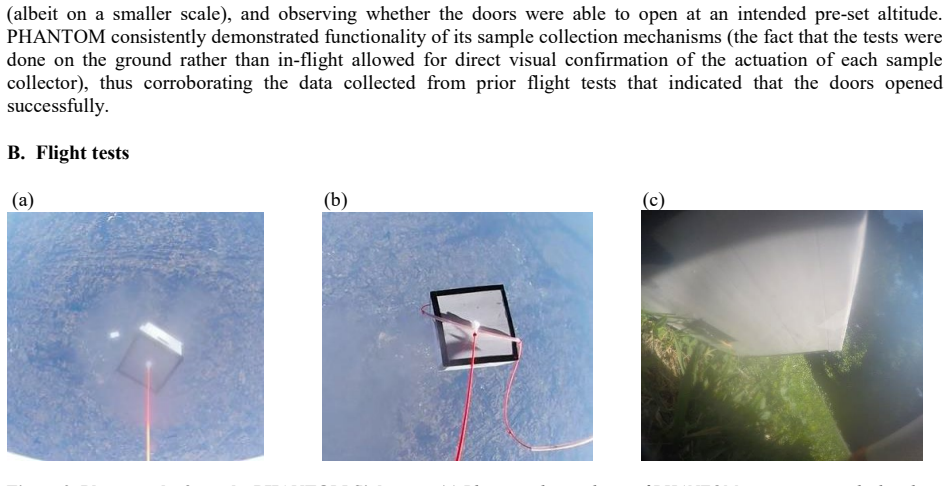
- [Figure 2] The caption of Figure 2 should state which flight each subfigure corresponds to; currently only part (c) is identifiable from the text as the June 30, 2018 flight.
- [Abstract] The parenthetical definition of PHANTOM in the Abstract is a grammatically incomplete clause; consider making the sampling goal a separate, complete sentence.
- [Section II (Design parameters)] The design is motivated by cost (a launch 'as low as $1000'), but no bill of materials or total payload cost is given; a brief cost table would substantially strengthen the accessibility claim that is central to the paper's motivation.
- [Section IV.B (Flight tests)] A summary table of the two reported flights (launch date, apogee, ascent duration, collector trigger altitudes, and landing outcome) would make the engineering claims checkable at a glance and would be a useful reference for readers building on the design.
Circularity Check
No circular derivation; PHANTOM report is an empirical hardware study whose central feasibility claim rests on flight and sterility observations, not on fitted parameters or self-referential definitions.
full rationale
This is an empirical hardware report rather than a derivation, so the standard circularity patterns do not apply. The central claim—that PHANTOM demonstrates feasibility of low-cost live-capture atmospheric profiling—is supported by independent observational evidence: two flights on which the payload survived, all four sample collectors actuating, a corroborating mechanical dead-man's switch, and bench tests. The sterility-test sentence in Section IV.B is under-reported (no CFU counts, no handling blanks, and it refers to previous PHANTOM iterations), but that is a correctness/evidence concern, not a circularity concern: the biological result is not derived from an input or from a fitted parameter. The two Singam 2017 self-citations (Refs. 11 and 13) appear as background for design challenges and the difficulty of excluding terrestrial contamination; they are not load-bearing for the conclusion, which is based on the described flight behavior and actuation data. No equation, definition, or constructed quantity reduces the claimed result to its own inputs, and no prediction is obtained by fitting a subset of data and then renaming it as a validation. Thus the paper exhibits no significant circularity; only a low-level presence of non-load-bearing self-citation justifies any nonzero score, and the appropriate finding is a clean, low-scoring non-finding.
Assumptions & free parameters
assumptions (3)
- domain assumption A 1600 g latex balloon filled with 13 m^3 of helium with a ~5 kg payload string can reach 25-30 km with an ascent rate of about 5 m/s.
- ad hoc to paper The 12.7 μm PVC lining allows gas exchange while preventing microbial entry into the sterile chamber.
- domain assumption Opening a door for a brief period during ascent collects a sufficient air volume for viable microbial capture.
Cite this review
Pith. "Pith review of A Low-Profile, Self-Contained System for Atmospheric Monitoring and Mid-flight Collection of Viable Microbiological Samples at High Altitude." pith.science (2026). https://pith.science/paper/MTF3RBLV
@misc{pith2026190806768,
  author       = {Pith},
  title        = {Pith review of: A Low-Profile, Self-Contained System for Atmospheric Monitoring and Mid-flight Collection of Viable Microbiological Samples at High Altitude},
  year         = {2026},
  howpublished = {\url{https://pith.science/paper/MTF3RBLV}},
  note         = {Machine review of arXiv:1908.06768}
}
read the original abstract
The prevalence of bacteria in the atmosphere has been well established in relevant literature, suggesting that airborne bacteria can influence atmospheric characteristics including the development of clouds. Studies have also demonstrated that the atmospheric biological profile is influenced by the underlying terrestrial biomes. An understanding of the complex interplay of factors that can influence the atmospheric biological profile, not to mention developing a biological census of the atmosphere, requires a cost-effective experimental system capable of generating reproducible results with reliable data. However, as has been demonstrated by payloads launched by space agencies such as NASA and JAXA, these payloads are both complex and cost prohibitive. This paper discusses the design and implementation of a biologically oriented experimental payload for high-altitude ballooning that is within the means of most student-run experimental programs. The payload highlighted in this presentation, PHANTOM (Probe for High Altitude Numeration and Tracking of Microorganisms, which has the goal of capturing aerial microorganisms at multiple altitudes in order to characterize the biological composition of the upper atmosphere), has undergone a number of successful flight trials, and serves to highlight the feasibility and utility of interdisciplinary projects between aerospace and the biological sciences.
Figures

Reference graph
Works this paper leans on
-
[1]
Introduction to cryptogamic botany
Berkeley, Miles Joseph. Introduction to cryptogamic botany. Vol. 12. H. Bailliere, 1857
-
[2]
Collecting micro -organisms from the Arctic atmos phere: with field notes and material,
Meier, F. C., and Lindbergh, C. A., “Collecting micro -organisms from the Arctic atmos phere: with field notes and material,” The Scientific Monthly, Vol. 40, No. 1, 1935, pp. 5–20
work page 1935
-
[3]
Extremophilic microorganisms: biochemical adaptation and biotechnological application
Morozkina EV, Slutskaya ES, Fedorova TV, Tugay TI, Golubeva LI, Koroleva OV. “Extremophilic microorganisms: biochemical adaptation and biotechnological application”. Applied Biochemistry and Microbiology. 2010 Jan 1;46(1):1-4
work page 2010
-
[4]
Psychrophilic enzymes: hot topics in cold adaptation
Feller G, Gerday C. “Psychrophilic enzymes: hot topics in cold adaptation”. Nature Reviews Microbiology. 2003 Dec;1(3):200. 7
work page 2003
-
[5]
Polysaccharides from extremophilic microorganisms
Nicolaus B, Moriello VS, Lama L, Poli A, Gambacorta A. “Polysaccharides from extremophilic microorganisms”. Origins of Life and Evolution of the Biosphere. 2004 Feb 1;34(1-2):159-69
work page 2004
-
[6]
Zenoff VF, Siñeriz F, Farias ME. “Diverse responses to UV-B radiation and repair mechanisms of bacteria isolated from high-altitude aquatic environments”. Applied and Environmental Microbiology. 2006 Dec 1;72(12):7857-63
work page 2006
-
[7]
Small heat shock proteins from extremophiles: a review
Laksanalamai P, Robb FT. “Small heat shock proteins from extremophiles: a review”. Extremophiles. 2004 Feb 1;8(1):1-1
work page 2004
-
[8]
Extremophilic microbes: diversity and perspectives
Satyanarayana T, Raghukumar C, Shivaji S. “Extremophilic microbes: diversity and perspectives”. Current Science. 2005 Jul 10:78-90
work page 2005
Show all 19 references
-
[9]
Takai K, Gamo T, Tsunogai U, Nakayama N, Hirayama H, Nealson KH, Horikoshi K. “Geochemical and microbiological evidence for a hydrogen -based, hyperthermophilic subsurface lithoautotrophic microbial ecosystem (HyperSLiME) beneath an active deep-sea hydrothermal field”. Extremo...
2004
-
[10]
Occurrence of resistance to antibiotics, UV-B, and arsenic in bacteria isolated from extreme environments in high-altitude (above 4400 m) Andean wetlands
Dib J, Motok J, Zenoff VF, Ordoñez O, Farías ME. “Occurrence of resistance to antibiotics, UV-B, and arsenic in bacteria isolated from extreme environments in high-altitude (above 4400 m) Andean wetlands”. Current Microbiology . 2008 May 1;56(5):510-7
2008
-
[11]
Designing Biological Experimentation Systems for High Altitude Ballooning
Singam C. “Designing Biological Experimentation Systems for High Altitude Ballooning”. Academic High Altitude Conference. 2017 Oct
2017
-
[12]
UV -resistant bacteria isolated from upper troposphere and lower stratosphere
Yang Y, Itahashi S, Yokobori SI, Yamagishi A. “UV -resistant bacteria isolated from upper troposphere and lower stratosphere”. Biological Sciences in Space. 2008;22(1):18-25
2008
-
[14]
Terrestrial microorganisms at an altitude of 20,000 m in Earth's atmosphere
Griffin DW. “Terrestrial microorganisms at an altitude of 20,000 m in Earth's atmosphere.” Aerobiologia . 2004 Jun 1;20(2):135-40
2004
-
[15]
Microorganisms cultured from stratospheric air samples obtained at 41 km
Wainwright M, Wickramasinghe NC, Narlikar JV, Rajaratnam P. “Microorganisms cultured from stratospheric air samples obtained at 41 km”. FEMS Microbiology Letters. 2003 Jan;218(1):161-5
2003
-
[16]
Microbiome of the upper troposphere: species compos ition and prevalence, effects of tropical storms, and atmospheric implications
DeLeon-Rodriguez N, Lathem TL, Rodriguez-R LM, Barazesh JM, Anderson BE, Beyersdorf AJ, Ziemba LD, Bergin M, Nenes A, Konstantinidis KT. “Microbiome of the upper troposphere: species compos ition and prevalence, effects of tropical storms, and atmospheric implications”. Procee...
2013
-
[18]
Airborne Bacteria in Earth's Lower Stratosphere Resemble Taxa Detected in the Troposphere: Results from a New NASA Aircraft Bioaerosol Collector (ABC)
Smith DJ, Ravichandar JD, Jain S, Griffin DW, Yu H, Tan Q, Thissen J, Lu sby T, Nicoll P, Shedler S, Martinez P. “Airborne Bacteria in Earth's Lower Stratosphere Resemble Taxa Detected in the Troposphere: Results from a New NASA Aircraft Bioaerosol Collector (ABC)”. Frontiers ...
2018
-
[19]
Stratospheric microbiology at 20 km over the Pacific Ocean
Smith DJ, Griffin DW, Schuerger AC. “Stratospheric microbiology at 20 km over the Pacific Ocean”. Aerobiologia . 2010 Mar 1;26(1):35-46
2010
-
[20]
A scientific mission based on a high altitude stratospheric balloon,
Gai, M., Guglieri, G., Lattanzi, M., Lombardi, A., Mana, M., Masserano, L., Musso, I., and Navone, P., “A scientific mission based on a high altitude stratospheric balloon,” International Journal of Aerospace Sciences, Vol. 3, No. 1, 2014, pp. 18– 29
2014
-
[21]
Air sampling procedures to evaluate microbial contamination: a comparison between active and passive methods in operating theatres,
Napoli, C., Marcotrigiano, V., and Montagna, M. T., “Air sampling procedures to evaluate microbial contamination: a comparison between active and passive methods in operating theatres,” BMC Public Health, Vol. 12, No. 1, 2012, p. 594
2012
Reviewed August 14, 2026 · model on record in the stance chip above.
Discussion (0). Continue with ORCID to comment.