REVIEW 4 major objections 4 minor 76 references
A Framework for Population-Based Stochastic Optimization on Abstract Riemannian Manifolds
T0 review · 4 major / 4 minor · reviewed 2026-08-14 · deepseek-v4-flash
Pith's one-line read A population-based stochastic search can reach the global optimum of any compact Riemannian manifold in finitely many steps, using only local geometry and no ambient embedding.
desk verdict Impressive geometric framework for manifold population-based optimization, but the headline finite-step global convergence claim relies on an exploration assumption the implementation doesn't guarantee. read the letter →
The pith
A machine-rendered reading of the paper's core claim, the machinery that carries it, and where it could break.
The reading
What carries the argument
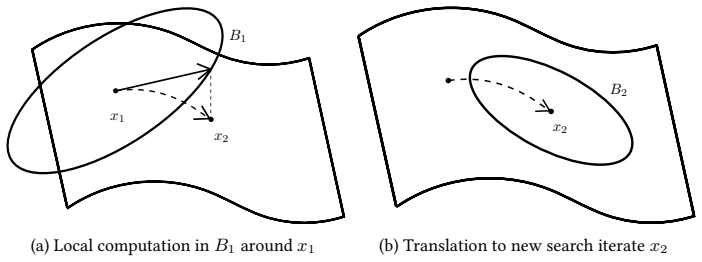
The load-bearing object is the family of mixture densities $\mathcal{L}_V$ over totally bounded subsets $V$ of the manifold. Each component is a locally inherited density, pulled back through an orientation-preserving diffeomorphism from a coordinate patch (the Riemannian exponential map is the special case); these are glued into mixtures $\tilde{p}(x) = \sum_{\alpha} \phi_\alpha \tilde{p}_\alpha(x)$ on a finite cover of $V$. Theorems 5.1–5.3 show $\mathcal{L}_V = S_0 \times \tilde{S}_1 \times \cdots \times \tilde{S}_\Lambda$ as a product statistical manifold, with the mixture divergence decomposing into a coefficient part and a component part — this is what decouples coefficient updates from component updates. On the coefficient simplex the paper installs the modified Fisher metric $G = F^{-1} + \epsilon_0 I$ (Equation (48)), whose natural-gradient fixed point, Equation (54), is proportional to the relative expected fitnesses $E_\alpha$; the practical update (Equation (40)) is the limiting case. Finally, the convergence argument of Theorem 8.1 is carried by the exploration distribution: sampling on geodesic-sphere boundaries and rejecting interior points places each new exploration centroid at least a uniform distance $j_M$ from all previous ones, and compactness then forces the explored region to exhaust $M$ in finitely many steps.
What would settle it
Run Extended RSDFO on the 2-sphere with the Section 9 exploration rule — sample points uniformly on geodesic-sphere boundaries and reject those lying in the interior of the explored region — and count the iterations in which every sampled point is rejected, so that no boundary centroid is added. The paper explicitly allows this fallback ('if all the sampled points are rejected, then Extended RSDFO will not sample new boundary points'), and it violates the hypothesis of Theorem 8.1 that at least one exploration point is generated whenever the boundary is nonempty; the empirical frequency of such stalled rounds at increasing manifold dimension would show whether the finite-step guarantee holds for the implemented algorithm or only for the idealized boundary oracle.
Extended reading notes
Core claim
The central discovery is Theorem 8.1: on a compact connected Riemannian manifold $(M,g)$, if Extended RSDFO generates at least one exploration point from the boundary of the explored region whenever that boundary is nonempty, then the global convergence condition of Equation (57) holds within finitely many steps. Concretely, there is a finite integer $N$ such that $\sup_{\alpha \in \Lambda_N} E^\alpha_N = E^*$, the best attainable expected fitness, so the algorithm does not merely converge to a stationary point in the limit — the global optimum is attained in the explored region after finitely many iterations. The key structural claim supporting this is that the family of mixture densities $\mathcal{L}_V$ over a totally bounded subset $V$ of the manifold is a product statistical manifold of the mixture-coefficient simplex and the locally inherited component families, which lets the algorithm evolve mixture coefficients and component parameters independently while comparing solution quality across disjoint tangent spaces.
Load-bearing premise
The proof of Theorem 8.1 assumes that whenever the explored region is not yet the whole manifold, the algorithm can always create a new search point exactly on the boundary of that region, with every search ball at least a fixed positive radius — but the implemented exploration samples boundary points randomly and simply adds none if all samples fall inside the explored region, and under continuous sampling the probability of landing exactly on the boundary is zero.
Editorial extensions
If this is right
- On any connected compact Riemannian manifold, Extended RSDFO's expected fitness is monotone non-decreasing across iterations (Proposition 6.1), and with boundary exploration it reaches the global optimum in finitely many steps rather than converging only to a stationary point (Theorem 8.1).
- Because mixture coefficients and component parameters live on independent factors of a product statistical manifold, solution quality can be compared across disjoint tangent spaces — something the paper argues is impossible for single-centroid Riemannian SDFO methods such as Riemannian CMA-ES.
- Extended RSDFO's computations are strictly local geodesic-ball computations, so the manifold need not be complete and no Riemannian logarithm map between arbitrary points is required; the paper shows the latter assumption is what cripples Riemannian PSO on large manifolds.
- The experiments on the sphere, Grassmann manifolds, and Jacob's ladder indicate the method combines the global-exploration behaviour of Riemannian PSO with the local-optimum accuracy of Riemannian CMA-ES, at the price of extra function evaluations and boundary-point evaluations.
- Jacob's ladder — a countably infinite connected sum of tori without a global ambient representation — constitutes a problem class that constraint-based Euclidean optimization cannot formulate, so any success there is evidence for intrinsic manifold optimization as such.
Reading between the lines
- The finiteness argument is essentially topological: boundary centroids pinned at a uniform distance $j_M$ plus compactness forces exhaustion. It should transfer to any exploration rule that guarantees a point at least a fixed distance beyond the explored region — for example deterministic, low-discrepancy boundary sampling — which would also remove the measure-zero difficulty the paper's own rando
- Reading the algorithm through the product structure $\mathcal{L}_V = S_0 \times \prod_\alpha \tilde{S}_\alpha$ suggests a design principle for population-based manifold optimizers: evolve coefficients by natural gradient on the simplex under $G = F^{-1} + \epsilon_0 I$ and evolve components separately. Deriving component-parameter updates from the same fixed-point condition would extend the paper'
- A testable extension is to separate the two sources of difficulty the paper's Grassmann experiments conflate: the cost of estimating local component models in higher dimension, and the density of centroid coverage needed for exploration. Budgeting boundary samples rather than centroid count per iteration would isolate which one drives the sharp drop in success rate from $\mathrm{Gr}(2,4)$ to $\mat
- The Jacob's ladder construction is reusable as a stress test for any intrinsic manifold optimizer: a countably infinite connected sum of tori with a glued exponential map is a manifold on which no ambient constraint formulation exists, so comparisons there measure genuine manifold behaviour rather than embedding artefacts.
Signed reviews
Editorial analysis
A structured set of objections, weighed in public.
Referee Report
Summary. The manuscript develops an information-geometric framework for population-based stochastic optimization on Riemannian manifolds and introduces Extended RSDFO, an algorithm that combines locally inherited probability densities into mixture densities over totally bounded subsets of the search space. The paper claims that the expected fitness of Extended RSDFO improves monotonically (Proposition 6.1) and that the algorithm converges globally in finitely many steps on connected compact Riemannian manifolds (Theorem 8.1). It also reports experiments on the sphere, Grassmannian manifolds, and a novel Jacob's-ladder test problem, comparing Extended RSDFO with Riemannian trust-region, Riemannian CMA-ES, and Riemannian PSO.
Significance. If the convergence result held for the implemented algorithm, it would be a notable contribution: finite-step global convergence on general compact Riemannian manifolds is a strong guarantee for a population-based derivative-free method, and the product statistical-manifold construction (Theorem 5.1, Remark 5.4) is a useful geometric framework. The paper also introduces a genuinely non-embeddable test manifold, Jacob's ladder, which helps motivate intrinsically manifold-native optimization. The experimental study is extensive and the paper gives credit where due by providing explicit geometric derivations and a relatively reproducible setup. However, the advertised global-convergence claim is not established for the algorithm as implemented, and the geometric derivation of the mixture-coefficient update contains a metric inconsistency; the significance is therefore real but conditional on resolving these issues.
major comments (4)
- [Section 8, Theorem 8.1; Sections 6.3.4 and 9] Theorem 8.1 is proved under the hypothesis that, whenever the explored region W_k is not all of M, the algorithm generates at least one exploration point on the boundary of W_k, and the proof additionally asserts a uniform positive lower bound j_M on all geodesic-ball radii. Neither condition is guaranteed by Algorithm 3 as described. The exploration procedure in Section 6.3.4 samples from boundaries of individual geodesic spheres and rejects points lying in interiors (Equation (46)); Section 9 explicitly states that if all sampled points are rejected, no new boundary point is added. Thus the theorem is a conditional statement about an idealized boundary-exploration oracle, not about the implemented algorithm. The abstract's unconditional phrasing, 'converges globally eventually in finitely many steps on connected compact Riemannian manifolds', is therefore unsupported for the implemented method. The proof's assertion j_M > 0 also needs an explicit assumption, since j_x ≤ inj(x) and the algorithm could in principle choose radii with no uniform positive lower bound.
- [Section 7, Equations (48), (52)-(55)] The metric used in the natural-gradient computation is not consistently defined. Equation (48) defines G := F^{-1} + ε0 I, but the Riemannian metric immediately below is gξ(Y,Z) := Σ yα zα (φ + ε0), which corresponds to the diagonal matrix diag(φ + ε0). For the simplex Fisher information matrix F, the matrix F^{-1} is not diagonal, so its inverse is not diag(1/(φ + ε0)). The inverse metric used in Equation (52) is therefore not the inverse of the matrix defined in Equation (48). The fixed-point derivation in Equations (53)-(55) and the claimed recovery of Equation (40) in Remark 7.2 rely on this ambiguity, so the 'first principles' derivation of the mixture-coefficient update needs to be corrected.
- [Section 7, Remark 7.2; Section 6.3.2, Equation (40)] The claim that Equation (40) is 'rigorously derived from first principles' in Remark 7.2 is circular in the present form. Equation (40) is introduced before Section 7 as the definition of the update, and the natural-gradient fixed point derived in Section 7 is, by construction, proportional to the expected fitnesses Eα. The metric in Equation (48) is explicitly selected so that its natural-gradient fixed point favors the interior point with coordinates proportional to relative fitness (see the bullet list in Section 7). The derivation therefore shows consistency between the chosen metric and the pre-existing update rule, but it does not independently derive Equation (40). This is a framing and justification issue that should be corrected.
- [Sections 6.3 and 7.2] The paper states 'without loss of generality' that f can be made strictly positive by translation, but the mixture-coefficient updates in Equations (40), (54), and (55) are not invariant under adding a constant to f. If f is replaced by f + C, then every Eα changes to Eα + C, and the normalized coefficients change unless C = 0. The same translation dependence appears in the minimization counterpart in Equation (56). This invalidates the 'without loss of generality' claim and further weakens the natural-gradient justification of the update rule.
minor comments (4)
- [Global] The manuscript contains many typographical artifacts and misspellings, including '/f_irst', 'de/f_ined', 'neighhbourhood', 'experiement', and 'Jaccob's ladder'; please proofread carefully.
- [Section 9, Tables 4-6] The relaxed exploration parameter ϵ_b is introduced in the experiments but is not analyzed in the theoretical sections; please clarify how sampling from boundaries of smaller geodesic spheres (ϵ_b < 1) interacts with the convergence assumptions in Theorem 8.1.
- [Section 6.3.5] The theoretical termination criterion (boundary of the explored region empty) differs from the practical termination criterion used in the experiments (all local RSDFO streams terminate); the paper should state explicitly that the convergence analysis applies only to the former.
- [Section 9.2] In the experimental setup, the local RSDFO core is described with budgets of 'parents' and 'offsprings', but these terms are not defined in the RSDFO framework of Section 3.1, which makes the setup harder to reproduce.
Circularity Check
The main circularity is in Section 7: the modified metric is chosen so that its natural-gradient fixed point equals the already-adopted proportional-fitness update (Eq. 40), which is then called a first-principles derivation. Theorem 8.1 is conditional and independent.
-
self definitional
[Section 7, Equation (48) through Remark 7.2; compare Equation (40) in Section 6.3.2]
"Natural gradient ascent on the closure S0 under the modified metric, as we will discuss in the subsequent subsection, favours the interior point of the simplex with coordinates proportional to the relative weights of the vertices. ... if ... ϵ0 ... sufficiently small ... we retrieve Equation (40). This fixed point therefore directly reflects the relative expected fitness ..."
Equation (40) was introduced directly as the coefficient update: 'it is natural to assign to the individual mixture coefficients φα a value proportional to Eα. In particular, in line 7 ... φ^{k+1}_α = E_α / Σ E_α.' The metric G = F^{-1} + ϵ0 I was then introduced with the stated purpose that natural gradient ascent on the simplex 'favours the interior point ... with coordinates proportional to the relative weights of the vertices.' Under this metric the stationarity condition (Eq. 53) is E_α/(φ_α + ϵ0) = c, which rearranges to φ_α ∝ E_α and, in the small-ϵ0 limit, is exactly Equation (40). Thus the 'derived' fixed point is not an independent consequence of information geometry; it is a restatement of the heuristic update that motivated the choice of metric.
full rationale
The paper's central information-geometric constructions (Sections 4 and 5) are largely self-contained: the pulled-back dualistic structures and the product statistical manifold result for mixture densities are derived from stated definitions, and no load-bearing self-citation chain appears. Theorem 8.1 is a conditional statement: if the algorithm generates a boundary exploration point whenever the explored region is a proper subset, compactness forces exhaustion of M in finitely many steps. That argument is independent, though the abstract omits the boundary-generation hypothesis. The implementation in Section 9 explicitly admits that the acceptance-rejection exploration can fail to produce boundary points ('if all the sampled points are rejected, then Extended RSDFO will not sample new boundary points'), so the theorem's hypothesis is not guaranteed by the implemented algorithm; this is a correctness gap rather than a circularity. The significant circular step is in Section 7: the modified metric is chosen precisely so that its natural-gradient fixed point equals the proportional-fitness update already adopted in Equation (40), and Remark 7.2 then labels this retrospective equivalence a first-principles derivation. Because that derivation is forced by the metric choice rather than by independent principles, the score is 4; the remaining convergence theorem and experimental comparisons still carry independent content.
Assumptions & free parameters
free parameters (5)
- epsilon_0 in modified simplex metric G = F^{-1} + epsilon_0 I =
not specified, arbitrarily small positive
- N_random and N_cull =
2 and 2 on S2/Grassmann; 6 and 3 on Jacob's ladder
- exploration rate tau(k) =
printed as 0.6 e^{0.015 k}, contradicting stated non-increasing requirement
- exploration radius factor epsilon_b =
1.0, 0.4, or 0.5 in different experiments
- local RSDFO budgets and Monte Carlo sample sizes =
parents/offsprings and MC samples listed per experiment
assumptions (5)
- domain assumption M is a connected and orientable Riemannian manifold, and compact for the convergence theorem.
- domain assumption The objective f is bounded above, strictly positive by translation, and attains a global optimum.
- ad hoc to paper Exploration generates a centroid exactly on the boundary of the explored region whenever the boundary is nonempty, with all geodesic ball radii uniformly bounded below by a positive constant.
- domain assumption Local component families satisfy Conditions 1 and 2: distinct proper support and no functional dependency between components.
- standard math Standard statistical-manifold background is taken as given: Fisher metric, dual connections, Bregman divergence, and the existence of a divergence generating a dualistic structure.
Cite this review
Pith. "Pith review of A Framework for Population-Based Stochastic Optimization on Abstract Riemannian Manifolds." pith.science (2026). https://pith.science/paper/OS5ZW7FS
@misc{pith2026190806783,
  author       = {Pith},
  title        = {Pith review of: A Framework for Population-Based Stochastic Optimization on Abstract Riemannian Manifolds},
  year         = {2026},
  howpublished = {\url{https://pith.science/paper/OS5ZW7FS}},
  note         = {Machine review of arXiv:1908.06783}
}
read the original abstract
We present Extended Riemannian Stochastic Derivative-Free Optimization (Extended RSDFO), a novel population-based stochastic optimization algorithm on Riemannian manifolds that addresses the locality and implicit assumptions of manifold optimization in the literature. We begin by investigating the Information Geometrical structure of statistical model over Riemannian manifolds. This establishes a geometrical framework of Extended RSDFO using both the statistical geometry of the decision space and the Riemannian geometry of the search space. We construct locally inherited probability distribution via an orientation-preserving diffeomorphic bundle morphism, and then extend the information geometrical structure to mixture densities over totally bounded subsets of manifolds. The former relates the information geometry of the decision space and the local point estimations on the search space manifold. The latter overcomes the locality of parametric probability distributions on Riemannian manifolds. We then construct Extended RSDFO and study its structure and properties from a geometrical perspective. We show that Extended RSDFO's expected fitness improves monotonically and it's global eventual convergence in finitely many steps on connected compact Riemannian manifolds. Extended RSDFO is compared to state-of-the-art manifold optimization algorithms on multi-modal optimization problems over a variety of manifolds. In particular, we perform a novel synthetic experiment on Jacob's ladder to motivate and necessitate manifold optimization. Jacob's ladder is a non-compact manifold of countably infinite genus, which cannot be expressed as polynomial constraints and does not have a global representation in an ambient Euclidean space. Optimization problems on Jacob's ladder thus cannot be addressed by traditional (constraint) optimization methods on Euclidean spaces.
Figures


Figures from the paper (17 more)






Reference graph
Works this paper leans on
-
[1]
Injectivity radius estimates and sphere theorems
Abresch, U., Meyer, W.T., 1997. Injectivity radius estimates and sphere theorems. Comparison geometry 30, 1–47
work page 1997
-
[2]
Trust-region methods on Rieman- nian manifolds
Absil, P.A., Baker, C.G., Gallivan, K.A., 2007. Trust-region methods on Rieman- nian manifolds. Foundations of Computational Mathematics 7, 303–330
work page 2007
-
[3]
Absil, P.A., Hosseini, S., 2019. A collection of nonsmooth riemannian optimiza- tion problems, in: Nonsmooth Optimization and Its Applications. Springer, pp. 1–15
work page 2019
-
[4]
Riemannian geometry of grassmann manifolds with a view on algorithmic computation
Absil, P.A., Mahony, R., Sepulchre, R., 2004. Riemannian geometry of grassmann manifolds with a view on algorithmic computation. Acta Applicandae Mathem- atica 80, 199–220
work page 2004
-
[5]
Optimization algorithms on matrix manifolds
Absil, P.A., Mahony, R., Sepulchre, R., 2009. Optimization algorithms on matrix manifolds. Princeton University Press
work page 2009
-
[6]
Methods of Information Geometry
Amari, S., Nagaoka, H., 2000. Methods of Information Geometry. volume 191 of Translations of Mathematical monographs . Oxford University Press
work page 2000
-
[7]
Natural gradient works efficiently in learning
Amari, S.I., 1998. Natural gradient works efficiently in learning. Neural compu- tation 10, 251–276
work page 1998
-
[8]
Information geometry of divergence functions
Amari, S.i., Cichocki, A., 2010. Information geometry of divergence functions. Bulletin of the Polish Academy of Sciences: Technical Sciences 58, 183–195
work page 2010
Show all 76 references
-
[9]
Benchmarkfcns toolbox
Ansari Ardeh, M., 2019. Benchmarkfcns toolbox. Retrieved July 3, 2019, from http://benchmarkfcns.xyz/
2019
-
[10]
On the use of evolution strategies for optimization on spher- ical manifolds, in: International Conference on Parallel Problem Solving from Nature, Springer
Arnold, D.V., 2014. On the use of evolution strategies for optimization on spher- ical manifolds, in: International Conference on Parallel Problem Solving from Nature, Springer. pp. 882–891
2014
-
[11]
Uniqueness of the /f_isher–rao metric on the space of smooth densities
Bauer, M., Bruveris, M., Michor, P.W., 2016. Uniqueness of the /f_isher–rao metric on the space of smooth densities. Bulletin of the London Mathematical Society 48, 499–506
2016
-
[12]
Convergence analysis of evolutionary algorithms that are based on the paradigm of information geometry
Beyer, H.G., 2014. Convergence analysis of evolutionary algorithms that are based on the paradigm of information geometry. Evolutionary Computation 22, 679–709
2014
-
[13]
Statistics on riemannian manifolds: asymptotic distribution and curvature
Bhattacharya, A., Bhattacharya, R., 2008. Statistics on riemannian manifolds: asymptotic distribution and curvature. Proceedings of the American Mathem- atical Society 136, 2959–2967
2008
-
[14]
Algebraic models of smooth manifolds
Bochnak, J., Kucharz, W., 1989. Algebraic models of smooth manifolds. Inven- tiones mathematicae 97, 585–611. 78
1989
-
[15]
Oriented bounding box computation using particle swarm optimization
Borckmans, P.B., Absil, P.A., 2010. Oriented bounding box computation using particle swarm optimization
2010
-
[16]
Borckmans, P.B., Ishteva, M., Absil, P.A., 2010. A modi/f_ied particle swarm op- timization algorithm for the best low multilinear rank approximation of higher- order tensors, in: International Conference on Swarm Intelligence, Springer. pp. 13–23
2010
-
[17]
Manopt, a matlab toolbox for optimization on manifolds
Boumal, N., Mishra, B., Absil, P.A., Sepulchre, R., 2014. Manopt, a matlab toolbox for optimization on manifolds. The Journal of Machine Learning Research 15, 1455–1459
2014
-
[18]
Geometry of the Fisher-Rao metric on the space of smooth densities on a compact manifold
Bruveris, M., Michor, P.W., 2016. Geometry of the Fisher-Rao metric on the space of smooth densities on a compact manifold. arXiv preprint arXiv:1607.04550
2016 arXiv
-
[19]
Projected gradient methods for linearly con- strained problems
Calamai, P.H., Moré, J.J., 1987. Projected gradient methods for linearly con- strained problems. Mathematical programming 39, 93–116
1987
-
[20]
Geometric modeling in probability and statistics
Calin, O., Udrişte, C., 2014. Geometric modeling in probability and statistics. Springer
2014
-
[21]
Riemannian Geometry
do Carmo, M., 1992. Riemannian Geometry. Mathematics (Boston, Mass.), Birkhäuser. URL: https://books.google.co.uk/books?id=uXJQQgAACAAJ
1992
-
[22]
Statistical Decision Rules and Optimal Inference
Cencov, N.N., 1982. Statistical Decision Rules and Optimal Inference. Trans- lations of mathematical monographs, American Mathematical Society. URL: https://books.google.co.uk/books?id=kTJJtQAACAAJ
1982
-
[23]
Comparison theorems in Riemannian geometry
Cheeger, J., Ebin, D.G., Ebin, D.G., 1975. Comparison theorems in Riemannian geometry. volume 9. North-Holland Publishing Company Amsterdam
1975
-
[24]
The cma-es on rieman- nian manifolds to reconstruct shapes in 3-d voxel images
Colutto, S., Fruhauf, F., Fuchs, M., Scherzer, O., 2010. The cma-es on rieman- nian manifolds to reconstruct shapes in 3-d voxel images. IEEE Transactions on Evolutionary Computation 14, 227–245
2010
-
[25]
Particle swarm optimization, in: Proceedings of the IEEE international conference on neural networks, Citeseer
Eberhart, R., Kennedy, J., 1995. Particle swarm optimization, in: Proceedings of the IEEE international conference on neural networks, Citeseer. pp. 1942–1948
1995
-
[26]
Geometry of minimum contrast
Eguchi, S., et al., 1992. Geometry of minimum contrast. Hiroshima Mathematical Journal 22, 631–647
1992
-
[27]
In/f_inite- genus riemann surfaces
Feldman, J., Knörrer, H., Trubowitz, E., 1995. In/f_inite- genus riemann surfaces. Canadian Mathematical Society 3, 91–111
1995
-
[28]
Minimizing a differentiable function over a differential manifold
Gabay, D., 1982. Minimizing a differentiable function over a differential manifold. Journal of Optimization Theory and Applications 37, 177–219
1982
-
[29]
Topologie des feuilles génériques
Ghys, É., 1995. Topologie des feuilles génériques. Annals of Mathematics , 387– 422. 79
1995
-
[30]
Cases for the nugget in modeling computer ex- periments
Gramacy, R.B., Lee, H.K., 2012. Cases for the nugget in modeling computer ex- periments. Statistics and Computing 22, 713–722
2012
-
[31]
The cma evolution strategy: a comparing review, in: Towards a new evolutionary computation
Hansen, N., 2006. The cma evolution strategy: a comparing review, in: Towards a new evolutionary computation. Springer, pp. 75–102
2006
-
[32]
The cma evolution strategy: A tutorial
Hansen, N., 2016. The cma evolution strategy: A tutorial. arXiv preprint arXiv:1604.00772
2016 arXiv
-
[33]
Evaluating the cma evolution strategy on multimodal test functions, in: International Conference on Parallel Problem Solving from Nature, Springer
Hansen, N., Kern, S., 2004. Evaluating the cma evolution strategy on multimodal test functions, in: International Conference on Parallel Problem Solving from Nature, Springer. pp. 282–291
2004
-
[34]
Hansen, N., Ostermeier, A., 1996. Adapting arbitrary normal mutation distribu- tions in evolution strategies: The covariance matrix adaptation, in: Evolutionary Computation, 1996., Proceedings of IEEE International Conference on, IEEE. pp. 312–317
1996
-
[35]
Invariant bayesian estimation on manifolds
Jermyn, I., 2005. Invariant bayesian estimation on manifolds. Ann. Stat. 33, 583–605
2005
-
[36]
A uni/f_ied view of the theory of directional statistics, 1975-1988
Jupp, P., Mardia, K., 1989. A uni/f_ied view of the theory of directional statistics, 1975-1988. International Statistical Review/Revue Internationale de Statistique , 261–294
1989
-
[37]
Kern, S., Müller, S.D., Hansen, N., Büche, D., Ocenasek, J., Koumoutsakos, P.,
-
[38]
Geometry of diffeomorph- ism groups, complete integrability and geometric statistics
Khesin, B., Lenells, J., Misiołek, G., Preston, S., 2013. Geometry of diffeomorph- ism groups, complete integrability and geometric statistics. Geometric and Func- tional Analysis 23, 334–366
2013
-
[39]
Über riemannsche mannigfaltigkeiten mit positiver krümmung
Klingenberg, W., 1961. Über riemannsche mannigfaltigkeiten mit positiver krümmung. Commentarii Mathematici Helvetici 35, 47–54
1961
-
[40]
Estimation of distribution algorithms: A new tool for evolutionary computation
Larrañaga, P., Lozano, J.A., 2001. Estimation of distribution algorithms: A new tool for evolutionary computation. volume 2. Springer Science & Business Me- dia
2001
-
[41]
The riemannian structure of euclidean shape spaces: a novel environment for statistics
Le, H., Kendall, D.G., et al., 1993. The riemannian structure of euclidean shape spaces: a novel environment for statistics. The Annals of Statistics 21, 1225– 1271
1993
-
[42]
Learning riemannian metrics, in: Proceedings of the Nine- teenth conference on Uncertainty in Arti/f_icial Intelligence, Morgan Kaufmann Publishers Inc
Lebanon, G., 2002. Learning riemannian metrics, in: Proceedings of the Nine- teenth conference on Uncertainty in Arti/f_icial Intelligence, Morgan Kaufmann Publishers Inc.. pp. 362–369
2002
-
[43]
Introduction to smooth manifolds
Lee, J.M., 2001. Introduction to smooth manifolds. Springer. 80
2001
-
[44]
Riemannian manifolds: an introduction to curvature
Lee, J.M., 2006. Riemannian manifolds: an introduction to curvature. volume
2006
-
[45]
Gradient /f_low of the stochastic relaxation on a generic exponential family, in: AIP Conference Proceedings, AIP
Malagò, L., Pistone, G., 2015. Gradient /f_low of the stochastic relaxation on a generic exponential family, in: AIP Conference Proceedings, AIP. pp. 353–360
2015
-
[46]
Statistics of directional data
Mardia, K.V., 1975. Statistics of directional data. Journal of the Royal Statistical Society: Series B (Methodological) 37, 349–371. URL: https:// rss.onlinelibrary.wiley.com/doi/abs/10.1111/j.2517-6161.1975.tb01550.x, doi:doi: 10.1111/j.2517-6161.1975.tb01550.x
1975
-
[47]
Any statistical manifold has a contrast function—on the c3-functions taking the minimum at the diagonal of the product manifold
Matumoto, T., 1993. Any statistical manifold has a contrast function—on the c3-functions taking the minimum at the diagonal of the product manifold. Hiroshima Math. J. 23, 327–332. URL: https://projecteuclid.org:443/euclid.hmj/ 1206128255
1993
-
[48]
Manifolds of differentiable mappings
Michor, P.W., 1980. Manifolds of differentiable mappings. volume 3. Birkhauser
1980
-
[49]
On the betti numbers of real varieties
Milnor, J., 1964. On the betti numbers of real varieties. Proceedings of the Amer- ican Mathematical Society 15, 275–280
1964
-
[50]
Numerical optimization
Nocedal, J., Wright, S., 2006. Numerical optimization. Springer Science & Busi- ness Media
2006
-
[51]
Affine differential geometry: geometry of affine immersions
Nomizu, K., Sasaki, T., 1994. Affine differential geometry: geometry of affine immersions. Cambridge University Press
1994
-
[52]
On an intrinsic analysis of statistical estimation, in: Multivariate Analysis: Future Directions 2
Oller, J.M., 1993. On an intrinsic analysis of statistical estimation, in: Multivariate Analysis: Future Directions 2. Elsevier, pp. 421–437
1993
-
[53]
Information-geometric op- timization algorithms: A unifying picture via invariance principles
Ollivier, Y., Arnold, L., Auger, A., Hansen, N., 2017. Information-geometric op- timization algorithms: A unifying picture via invariance principles. The Journal of Machine Learning Research 18, 564–628
2017
-
[54]
Probabilities and statistics on Riemannian manifolds: A geo- metric approach
Pennec, X., 2004. Probabilities and statistics on Riemannian manifolds: A geo- metric approach. Ph.D. thesis. INRIA
2004
-
[55]
Intrinsic statistics on riemannian manifolds: Basic tools for geometric measurements
Pennec, X., 2006. Intrinsic statistics on riemannian manifolds: Basic tools for geometric measurements. Journal of Mathematical Imaging and Vision 25, 127
2006
-
[56]
Riemannian geometry
Petersen, P., 2006. Riemannian geometry. volume 171. Springer
2006
-
[57]
Geometry of leaves
Phillips, A., Sullivan, D., 1981. Geometry of leaves. Topology 20, 209–218
1981
-
[58]
Geometry of PDEs and mechanics
Prástaro, A., 1996. Geometry of PDEs and mechanics. World Scienti/f_ic
1996
-
[59]
Principles of mathematical analysis
Rudin, W., et al., 1964. Principles of mathematical analysis. volume 3. McGraw- hill New York
1964
-
[60]
Riemannian Geometry
Sakai, T., 1996. Riemannian Geometry. volume 149. American Mathematical Soc
1996
-
[61]
The geometry of Hessian structures
Shima, H., 2007. The geometry of Hessian structures. World Scienti/f_ic. 81
2007
-
[62]
Geometry of Hessian manifolds
Shima, H., Yagi, K., 1997. Geometry of Hessian manifolds. Differential Geometry and its Applications 7, 277–290
1997
-
[63]
The statistical theory of shape
Small, C.G., 2012. The statistical theory of shape. Springer Science & Business Media
2012
-
[64]
A comprehensive introduction to differential geometry, publish or perish
Spivak, M., 1979. A comprehensive introduction to differential geometry, publish or perish
1979
-
[65]
Virtual library of simulation experiments: Test functions and datasets
Surjanovic, S., Bingham, D., 2017. Virtual library of simulation experiments: Test functions and datasets. Retrieved July 3, 2019, from http://www.sfu.ca/~ssurjano
2017
-
[66]
Su una congettura di nash
Tognoli, A., 1973. Su una congettura di nash. Annali della Scuola Normale Superiore di Pisa-Classe di Scienze 27, 167–185
1973
-
[67]
Riemannian consensus for manifolds with bounded curvature
Tron, R., Afsari, B., Vidal, R., 2013. Riemannian consensus for manifolds with bounded curvature. IEEE Transactions on Automatic Control 58, 921–934
2013
-
[68]
The self-intersections of a smooth n-manifold in 2n-space
Whitney, H., 1944a. The self-intersections of a smooth n-manifold in 2n-space. Annals of Math 45, 180
-
[69]
The singularities of a smooth n-manifold in (2n- 1)-space
Whitney, H., 1944b. The singularities of a smooth n-manifold in (2n- 1)-space. Ann. of Math 45, 247–293
-
[70]
Fitness expectation maximization, in: International Conference on Parallel Problem Solving from Nature, Springer
Wierstra, D., Schaul, T., Peters, J., Schmidhuber, J., 2008a. Fitness expectation maximization, in: International Conference on Parallel Problem Solving from Nature, Springer. pp. 337–346
-
[71]
Natural evolution strategies, in: 2008 IEEE Congress on Evolutionary Computation (IEEE World Congress on Computational Intelligence), IEEE
Wierstra, D., Schaul, T., Peters, J., Schmidhuber, J., 2008b. Natural evolution strategies, in: 2008 IEEE Congress on Evolutionary Computation (IEEE World Congress on Computational Intelligence), IEEE. pp. 3381–3387
2008
-
[72]
On the convergence of a class of estimation of distribution algorithms
Zhang, Q., Muhlenbein, H., 2004. On the convergence of a class of estimation of distribution algorithms. IEEE Transactions on evolutionary computation 8, 127–136. 82 Appendix A. Riemannian Adaptation of Optimization Algorithms in the lit- erature In this section we illustrate ...
2004
-
[75]
Rx(⃗0) =x, where⃗0∈TxM and
-
[76]
personal best
DRx(⃗0) = idTxM . This establishes the sufficient conditions to locally preserve the gradient atx∈M. This generalization is similar to the use of orientation-preserving diffeomorphism in Section 4.2 85 Appendix A.3. Riemannian Particle Swarm Optimizaiton The adaptation of Particl...
-
[176]
Springer Science & Business Media
-
[2004]
Natural Computing 3, 77–112
Learning probability distributions in continuous evolutionary algorithms– a comparative review. Natural Computing 3, 77–112
Reviewed August 14, 2026 · model on record in the stance chip above.
Discussion (0). Continue with ORCID to comment.