REVIEW 4 major objections 4 minor 31 references
The Effect of Disorder on Local Electron Temperature in Quantum Hall Systems
T0 review · 4 major / 4 minor · reviewed 2026-08-14 · deepseek-v4-flash
Pith's one-line read This paper claims that in the integer quantum Hall regime the local electron temperature is antisymmetric about the sample center: one edge heats up, the opposite edge cools, and the size of this effect is governed by impurity number and…
desk verdict Plausible physics, but the central claim about impurity-number dependence is not verifiable because N_l never enters the model and the key equation leaves a term as an ellipsis. read the letter →
The pith
A machine-rendered reading of the paper's core claim, the machinery that carries it, and where it could break.
The reading
What carries the argument
The central object is the local electron temperature $T_e(y)$ obtained from the thermo-hydrodynamic conservation equations: electron number conservation $\partial n_{el}/\partial t=-\nabla\cdot\mathbf{j}_{n_{el}}$ and energy conservation $\partial \varepsilon/\partial t=-\nabla\cdot\mathbf{j}_\varepsilon-P_L$, with the heat current $\mathbf{j}_q=\mathbf{j}_\varepsilon-\mu_{ec}\mathbf{j}_{n_{el}}$. In the linear-response regime, with translation invariance along the current direction, these equations determine the spatial temperature profile once the local conductivities $\sigma_L(y)$, $\sigma_H(y)$ and the electron-phonon energy loss $P_L$ are specified. Disorder is inserted as a cosine modulation $V_{\mathrm{mod}}(y)=V_0\cos(2\pi m_p y/(2d))$ added to the effective potential, with $V_0/E_F^0$ up to 0.5 and the period $m_p$ labeling sample mobility; the electron density is computed self-consistently in the Thomas-Fermi approximation. This machinery connects the microscopic disorder strength and the self-consistent location of incompressible strips to the resulting heating and cooling pattern.
What would settle it
A scanning local thermometer placed across a narrow Hall bar at integer filling, on samples with different controlled impurity densities, can settle the claim: the paper is contradicted if the temperature profile is symmetric about the center, if it fails to track the incompressible strips as the magnetic field changes, or if the temperature swing grows rather than shrinks as the modulation amplitude increases.
Extended reading notes
Core claim
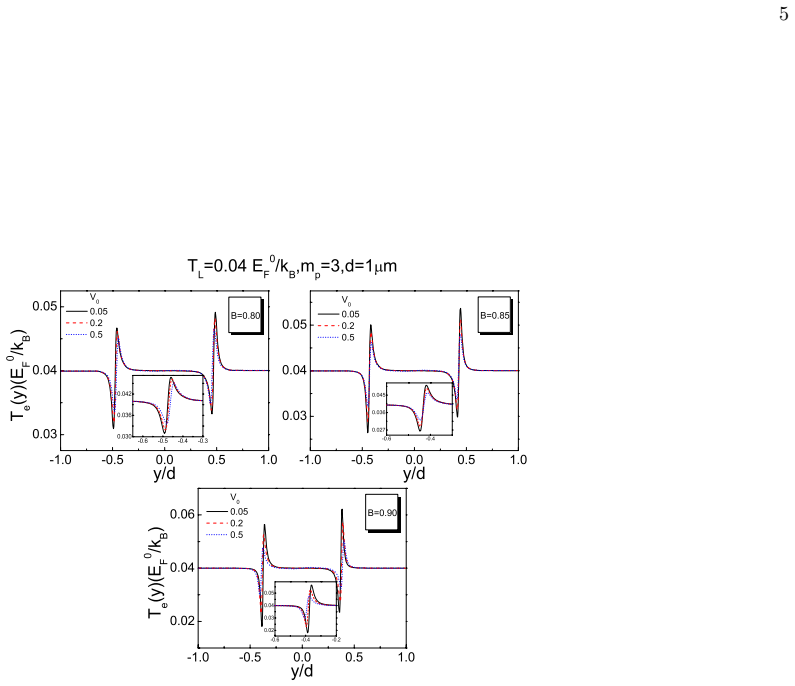
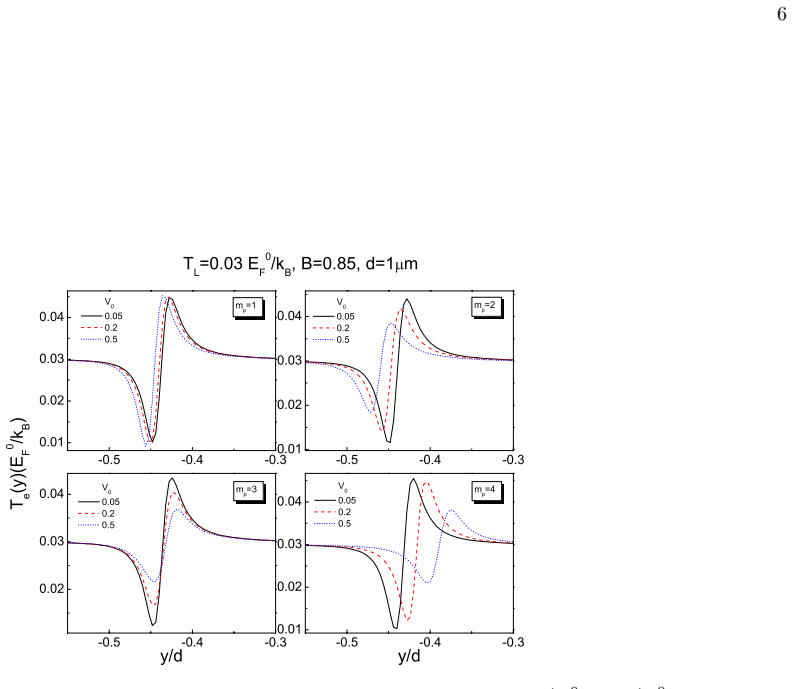
In a two-dimensional electron gas subject to a quantizing magnetic field, the local electron temperature $T_e(y)$ is not uniform: it is antisymmetric about the sample center, with one incompressible edge heated and the opposite edge cooled, in accordance with the asymmetric distribution of current seen in local probe experiments. The sign and magnitude of the deviation are tied to the location and width of incompressible strips, which move toward the sample center as the magnetic field increases. Introducing disorder through a long-range modulation potential $V_{\mathrm{mod}}(y)=V_0\cos(2\pi m_p y/(2d))$ within the screening theory changes the pattern: increasing the modulation amplitude (lower mobility) confines electrons to narrower incompressible strips, lowers their kinetic energy, and suppresses the temperature variation, while high-mobility samples display larger local temperature deviations. The paper also reports that the local temperature distribution depends strongly on the number of impurity atoms in narrow samples, because impurities affect the local transport coefficients and hence the dissipation.
Load-bearing premise
The model's central assumption is that the cumulative disorder of many impurities is well represented by a smooth periodic modulation $V_{\mathrm{mod}}(y)=V_0\cos(2\pi m_p y/(2d))$ with $V_0/E_F^0$ at most 0.5; if real donor disorder creates potential fluctuations this single cosine mode cannot capture, the predicted dependence of local electron temperature on impurity number and mobility may be an artifact.
Editorial extensions
If this is right
- In a Hall bar, a local thermometer placed near the two opposite edges should read temperatures that differ from the lattice temperature in opposite directions, with the asymmetry reversing when the magnetic field or current direction is reversed.
- High-mobility samples (small $V_0/E_F^0$) should show a larger local temperature swing and sharper hot/cold contrast than low-mobility samples at the same nominal current and field.
- As the magnetic field is increased, the maximum heating site should move toward the sample center together with the incompressible strips, so the lateral temperature profile can be used to track strip positions.
- Samples with different impurity counts but similar mobility should nevertheless display different local heating amplitudes, making local thermometry a more sensitive probe of disorder than global transport measurements.
Reading between the lines
- A direct extension would be to replace the single-cosine disorder model with a random superposition of impurity potentials; the claim that the temperature swing is suppressed by increasing disorder would survive only if the swing is controlled by the total fluctuation amplitude rather than by the specific mode structure.
- The antisymmetric heating pattern suggests that local thermometry could map incompressible strips in real samples, complementing scanning probe potential measurements by probing dissipation rather than density.
- The same thermo-hydrodynamic machinery could be applied to graphene quantum Hall bars or to the fractional quantum Hall regime, where the screening length and the electron-phonon coupling differ; whether the antisymmetry persists would test how generic the mechanism is.
Signed reviews
Editorial analysis
A structured set of objections, weighed in public.
Referee Report
Summary. The paper models the local electron temperature Te(y) in a two-dimensional electron gas in the integer quantum Hall regime, combining Thomas-Fermi screening theory with thermo-hydrodynamic transport equations. The disorder potential is represented by a smooth long-range cosine modulation, Vmod(y) = V0 cos(2π y m_p / (2d)), with amplitude and period chosen to mimic low- and high-mobility samples. The authors report that Te(y) has an antisymmetric spatial variation about the sample center, correlated with the location of incompressible strips, and that this variation is suppressed when the impurity number or modulation amplitude is increased. The paper is short and its conclusions are qualitative, based on numerical results for sample widths d = 1 µm and d = 2 µm at several magnetic fields and lattice temperatures.
Significance. If the reported results can be made reproducible, the paper would provide a useful qualitative connection between disorder and local heating/cooling in quantum Hall edge transport. The antisymmetric Te pattern and its suppression by disorder are physically plausible and visible in Figs. 1-3. The use of established screening and thermo-hydrodynamic formalisms is a strength, and the model assumptions are stated explicitly. However, the central equations are incompletely specified, and the claimed dependence on impurity number is not backed by a parameter that actually enters the calculation. The paper therefore currently supports a qualitative scenario but not the quantitative or 'strong dependence' claims made in the abstract and conclusion.
major comments (4)
- [II.C, Eq. (11)] Equation (11) is the central equation whose solution is Te(y), but the electron-phonon loss term P_L is never written explicitly: the text says 'PL is taken to be ... in accordance with previous works 15,16.' This makes the calculation non-reproducible and prevents an independent check of the temperature profiles. Please state the explicit form of P_L and the parameter values used.
- [II.B, Figs. 1-2, Table I] The parameter N_l, described as the number of impurities, does not appear in any model equation. The disorder input is only Vmod(y) = V0 cos(2π y m_p / (2d)); N_l appears only in figure captions. In Fig. 1, both the N_l = 0 and N_l = 6600 curves are computed with V0 = 0.5, so the plotted difference cannot be attributed to the only disorder term that is written down. Please define N_l as a computational input or explain how it is converted into V0, m_p, or the local transport coefficients; otherwise the headline statement that Te depends on impurity number is not testable from the presented equations.
- [II.B, Table I, Fig. 3] The mapping between sample mobility and the model parameters is not specified. Table I assigns low/intermediate/high mobility classes by hand-picked values of m_p and V0/E_F^0, but no relation is given between these values and a mobility or scattering rate, and no comparison with experimental mobility data is made. The conclusion that local temperature depends on mobility therefore rests on an assumed labeling rather than on a calculated transport quantity. Please supply a quantitative rule for converting V0 and m_p into a mobility, or present the results as a parameter scan rather than as a mobility-dependent prediction.
- [III, Figs. 1-3 and abstract] The central claim that Te is antisymmetric about the sample center is presented only visually. Because Vmod and Vbg are even functions of y, the origin of the antisymmetry is not self-evident from the equations. Please give a quantitative definition of the antisymmetry and demonstrate it explicitly, for example by plotting Te(y) - Te(-y) or by showing the deviations from the mean temperature, and discuss whether the antisymmetry is robust to the phase of the modulation potential.
minor comments (4)
- [II.B, Eq. (6)] In Eq. (6), the screened potential is written as Vscr(q,z) = Vext(q) e^{-|qz|} / ε(q), which uses Vext on both sides of the relation; please define Vext(q) and Vscr(q) carefully and correct the apparent typo.
- [Throughout] The notation for the Fermi energy and the disorder amplitude is inconsistent across the text and figures (e.g., V0/E_F^0, V0/E0F, V0/E0 F); please use a single notation throughout.
- [Figs. 1-3] The figures appear to distinguish cases only by line style (broken versus solid) and the captions are not fully self-contained; please add legends or more detailed captions so that the N_l = 0 and N_l = 6600 cases are unambiguous.
- [Table I] The phrase 'does effect the screening' should be 'does affect the screening'.
Circularity Check
No circularity in the Te calculation; impurity-number claim is underspecified but not a fitted-input prediction.
full rationale
The local electron temperature is obtained by solving the thermo-hydrodynamic equations (7)-(11) with a disorder potential Vmod(y)=V0 cos(2π y m_p/(2d)) that is chosen a priori. The reported antisymmetric Te(y) profiles and the variation with V0 and m_p are outputs of the self-consistent screening calculation, not fitted constants. No equation is tuned to reproduce the target temperature data. The paper relies heavily on the authors' prior works (Refs. 9-11, 17-18) for the disorder model and screening framework, but this is ordinary citation of published model ingredients rather than a load-bearing self-citation chain or an imported uniqueness theorem. Two completeness issues should be flagged as correctness risks, not circularity: (i) the abstract's central claim that Te 'strongly depends on the number of impurities' is not directly supported by the derivation, because N_l appears only in figure captions (e.g., Fig. 1 caption lists Nl=0 and Nl=6600 while fixing V0=0.5 in both cases) and no equation connects N_l to Vmod, m_p, or the transport coefficients; (ii) the energy-loss term P_L in Eq. (11) is left as an ellipsis ('...'), making the thermal equation incomplete and the solutions not fully reproducible. These are gaps in specification and falsifiability, not reductions of the output to the input. The central Te calculation is self-contained with respect to the stated model, so no circular step is exhibited.
Assumptions & free parameters
free parameters (4)
- V0/E_F^0 modulation amplitude ratio =
0.05 to 0.5
- N_l impurity number =
0 and 6600
- m_p modulation period index =
2-3, 5-6, 9-10, or 19-20 depending on sample width and mobility
- T_L lattice temperature =
0.03 to 0.04 E_F^0/k_B
assumptions (5)
- domain assumption Thermo-hydrodynamic transport in linear response with electron number and energy conservation applies to the IQHE edge-state regime (Eqs. 7-11).
- domain assumption Thomas-Fermi approximation holds: V(y) varies slowly on the magnetic length scale, so local density n_el(y) is given by Eq. 5.
- ad hoc to paper Disorder can be represented by a smooth long-range cosine modulation with amplitude at most 50% of the Fermi energy, replacing random impurity positions.
- domain assumption Translational invariance in the current direction x, so all quantities depend only on y.
- ad hoc to paper Heat loss to phonons is controlled by P_L as in Refs. 15 and 16, but P_L is not explicitly written in Eq. 11.
Cite this review
Pith. "Pith review of The Effect of Disorder on Local Electron Temperature in Quantum Hall Systems." pith.science (2026). https://pith.science/paper/7HXAYIA6
@misc{pith2026190806791,
  author       = {Pith},
  title        = {Pith review of: The Effect of Disorder on Local Electron Temperature in Quantum Hall Systems},
  year         = {2026},
  howpublished = {\url{https://pith.science/paper/7HXAYIA6}},
  note         = {Machine review of arXiv:1908.06791}
}
read the original abstract
The local electron temperature distribution is calculated considering a two dimensional electron system in the integer quantum Hall regime in presence of disorder and uniform perpendicular magnetic fields. We solve thermal-hydrodynamical equations to obtain the spatial distribution of the local electron temperature in the linear-response regime. It is observed that, the variations of electron temperature exhibit an antisymmetry regarding the center of the sample in accordance with the location of incompressible strips. To understand the effect of sample mobility on the local electron temperature we impose a disorder potential calculated within the screening theory. Here, long range potential fluctuations are assumed to simulate cumulative disorder potential depending on the impurity atoms. We observe that the local electron temperature strongly depends on the number of impurities in narrow samples.
Figures

Reference graph
Works this paper leans on
-
[1]
K. von Klitzing , G. Dorda and M. Pepper, Physical Review Letters 45 , 494 (1980)
work page 1980
-
[2]
D. C. Tsui, H. L. Stormer and A. C. Gossard, Physical Review Letters 48 , 1559 (1982)
work page 1982
-
[3]
L. Schweitzer, B. Kramer and A. MacKinnon, Condensed Matter 59 , 379 (1985)
work page 1985
- [4]
-
[5]
D. B. Chklovskii , B. I. Shklovskii and L. I. Glazman, Phys. Rev. B. 46 , 4026 (1992)
work page 1992
- [6]
-
[7]
J. H. Oh and R. R. Gerhardts, Phys. Rev. B. 56 , 13519 (1997)
work page 1997
-
[8]
M. M. Fogler and B. I. Shklovskii, Phys. Rev. B. 50 , 1656 (1994)
work page 1994
Show all 31 references
-
[9]
S. E. Gulebaglan, G. Oylumluoglu , U. Erkaslan, A. Siddiki and I. Sokmen, Physica E 44 , 1495 (2012)
2012
-
[10]
N. B. Yurdasan, K. Akgungor, A. Siddiki and I. Sokmen, Physica E 44 , 1367 (2012)
2012
-
[11]
N. B. Yurdasan, A. Siddiki and I. Sokmen, Acta Physica Polonica A 123 , 314 (2013)
2013
-
[12]
Akera, J
H. Akera, J. Phys. Soc. Jpn. 69 , 3174 (2000)
2000
-
[13]
Akera, J
H. Akera, J. Phys. Soc. Jpn. 70 , 1468 (2001)
2001
-
[14]
Akera, J
H. Akera, J. Phys. Soc. Jpn. 71 , 228 (2002)
2002
-
[15]
Akera and H
H. Akera and H. Suzuura, J. Phys. Soc. Jpn. 74 , 997 (2005)
2005
-
[16]
Kanamaru , H
S. Kanamaru , H. Suzuura and H. Akera , J. Phys. Soc. Jpn. 75 , 064701 (2006)
2006
-
[17]
Siddiki , S
A. Siddiki , S. Kraus and R. R. Gerhardts, Physica E 34 , 136 (2006)
2006
-
[18]
Siddiki , S.E
A. Siddiki , S.E. Gulebaglan, N. B. Yurdasan, G. Bilgec and A. Yildiz, Europhysics Letters 92 , 67010 (2010)
2010
-
[19]
Guven and R
K. Guven and R. R. Gerhardts, Phys. Rev. B 67 , 115327 (2003)
2003
-
[20]
Siddiki and R
A. Siddiki and R. R. Gerhardts, Phys. Rev. B 70 , 195335 (2004)
2004
-
[21]
R. R. Gerhardts, Physica Status Solidi (b) 245 , 378 (2008)
2008
-
[22]
Dahlem F, Ahlswede E, Weis J, v Klitzing K., Phys. Rev. B. 82 , 121305 (2010)
2010
-
[23]
Suddards ME, Baumgartner A, Henini M, Mellor CJ., New Journal of Physics , 14 14, 083015 (2012)
2012
-
[24]
Siddiki and R
A. Siddiki and R. R. Gerhardts, Journal of Modern Physics B 18 , 3541 (2004)
2004
-
[25]
R. R. Gerhartds, Physica E 85 , 38 (2017)
2017
-
[26]
R. R. Gerhartds, New Journal of Physics 21 , 073007 (2019)
2019
-
[27]
Siddiki and F
A. Siddiki and F. Marquardt, Phys. Rev. B 75 , 045325 (2007)
2007
-
[28]
Siddiki and R
A. Siddiki and R. R. Gerhardts, Journal of Modern Physics B 21 , 1362 (2007)
2007
-
[29]
Horas, A
J. Horas, A. Siddiki, J. Moser, W. Wegscheider and S. Ludwig, Physica E 40 , 1130 (2008)
2008
-
[30]
Siddiki, J
A. Siddiki, J. Horas, J. Moser, W. Wegscheider and S. Ludwig, Europhysics Letters 88 , 17007 (2009)
2009
-
[31]
von Klitzing and K
R.J Haug, K. von Klitzing and K. Ploog, Phys. Rev. B 35 , 5933 (1987)
1987
Reviewed August 14, 2026 · model on record in the stance chip above.
Discussion (0). Continue with ORCID to comment.