REVIEW 3 major objections 4 minor 19 references
Diagnosing Cardiac Abnormalities from 12-Lead Electrocardiograms Using Enhanced Deep Convolutional Neural Networks
T0 review · 3 major / 4 minor · reviewed 2026-08-14 · deepseek-v4-flash
Pith's one-line read The paper shows that enhancing a deep CNN with hand-crafted ECG features and QRS-guided cropping raises nine-label average F1 from 0.797 to 0.879.
desk verdict A modest competition paper with one genuinely new augmentation idea, but the key experimental claim is under-specified and may be an artifact of an unnamed test-time protocol. read the letter →
The pith
A machine-rendered reading of the paper's core claim, the machinery that carries it, and where it could break.
The reading
What carries the argument
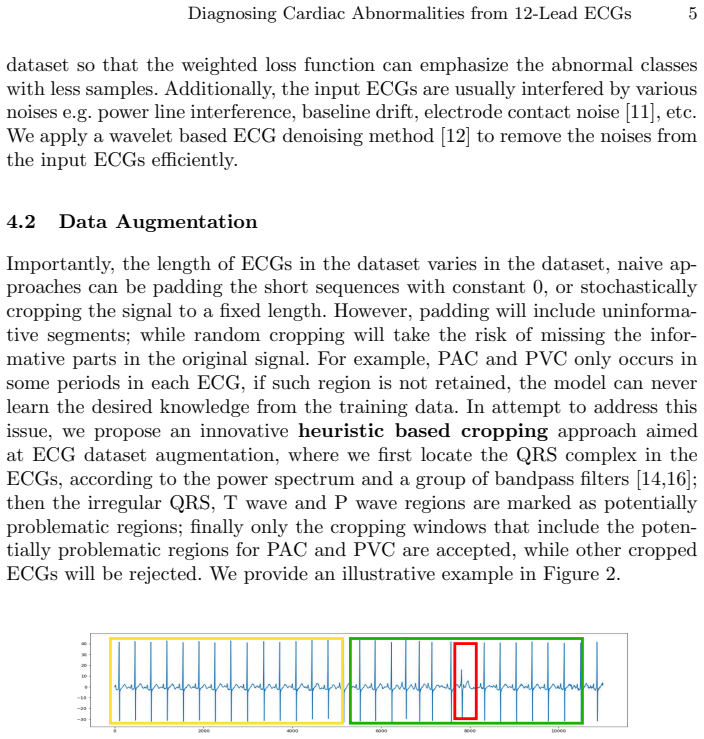
The load-bearing object is the enhanced CNN: sixteen residual blocks extract deep activations; two global pooling paths (average and max) are computed and concatenated to preserve both sustained and burst-like signal content; hand-crafted features (QRS width, PR interval, and RR-interval-derived statistics) are appended to the flattened activations; and a final fully connected layer makes all eight abnormality predictions jointly under a weighted binary cross-entropy loss. Separate from the network, the heuristic cropping augmentation first detects QRS complexes, marks irregular QRS/T/P regions as 'potentially problematic,' and admits only random crops that cover those regions, so the model sees the rare PAC and PVC beats during training.
What would settle it
Take the final model and compare its PAC and PVC F1 on full-length, uncropped test ECGs against a control model trained with random crops only; if the heuristic-cropping advantage shrinks or vanishes, the reported gains are a training/test distribution artifact. A second check is to have cardiologists annotate PAC/PVC locations on a held-out set and measure how often the QRS-based marker's accepted crops contain those expert-labeled beats.
Extended reading notes
Core claim
The central claim is that the final architecture—a 96-layer residual CNN whose global average and global max pooling outputs are concatenated with hand-crafted ECG features before the final fully connected layer, trained with a weighted binary cross-entropy loss on QRS-guided crops—achieves an average F1 of 0.879 on the competition's nine-label evaluation (eight abnormalities plus normal). The incremental experiments attribute specific gains to each design choice: adding domain features raises F1 from 0.797 to 0.832; heuristic cropping raises it to 0.853; and switching from average pooling alone to average-plus-max pooling raises it to 0.879. The authors interpret the PVC F1 jump from 0.844 to 0.915 and the PAC F1 jump from 0.776 to 0.860 after cropping as evidence that simple pre-detection of abnormal beats supplies high-quality training samples for sporadic events.
Load-bearing premise
The load-bearing assumption is that the spike-detection rule used to mark 'potentially problematic regions' actually finds the informative premature beats (PAC and PVC), and that a model trained on cropped segments will also work on the full-length recordings used at test time, a protocol the paper never specifies.
Editorial extensions
If this is right
- On the competition dataset, replacing a plain end-to-end ResNet with the feature-enhanced CNN improves average F1 from 0.797 to 0.832 before any targeting augmentation.
- Heuristic cropping around detected abnormal regions raises PVC F1 from 0.844 to 0.915 and PAC F1 from 0.776 to 0.860, showing the method's largest effect on sporadic abnormalities.
- Combining global average pooling with global max pooling adds a further general improvement to 0.879, consistent with preserving both low- and high-frequency activation patterns.
- The final model's reported average F1 of 0.879 across nine labels is the score the paper records for the competition's rematch stage.
Reading between the lines
- If the cropping gain is genuine, the same detect-then-crop-around-events recipe should transfer to other rare transient arrhythmias and to non-ECG time series where informative segments are sparse.
- A concrete follow-up the paper leaves open is test-time input handling: if full-length test ECGs are scored while training used only crops, the reported PVC/PAC gains may partly reflect a train/test distribution shift rather than better representations.
- The per-class tables show early repolarization (ER) F1 hovering near 0.5 in all configurations, hinting that neither feature concatenation nor QRS-guided cropping addresses that class and that a separate mechanism is needed.
- Concatenating expert features into the last layer of a deep network is a transferable recipe for imbalanced clinical time-series classification beyond ECG.
Signed reviews
Editorial analysis
A structured set of objections, weighed in public.
Referee Report
Summary. The paper proposes an enhanced deep convolutional neural network for classifying eight cardiac abnormalities plus normal from 12-lead ECGs. The architecture combines a 96-layer ResNet-style CNN with hand-crafted ECG features (QRS width, PR interval, signal standard deviation), global max-plus-average pooling, class-frequency weighting, wavelet denoising, and a heuristic cropping augmentation that retains windows containing QRS-detected irregular regions. On the First China ECG Intelligent Competition rematch dataset (6500 training, 500 validation, 7000 test ECGs), the authors report an average F1 score of 0.879. An ablation in Table 1 traces F1 from 0.797 (plain ResNet) to 0.832 (feature enhanced), 0.853 (plus heuristic augmentation), and 0.879 (plus global max pooling), and the paper argues that these components reduce generalization error.
Significance. If the central claim holds, the paper is a useful engineering contribution: it demonstrates that a modest set of standard ECG features and preprocessing heuristics can be combined with a deep residual network to achieve competitive competition-level performance on a held-out 12-lead ECG benchmark. The paper deserves credit for reporting class-specific F1 scores rather than only the aggregate, for using a held-out competition test set, and for presenting a clear incremental ablation. However, the evidence is weakened by the absence of repeated runs or error bars, the unspecified test-time protocol for the augmentation, and a few non-monotonic class-level trends that contradict the paper's stated conclusions.
major comments (3)
- [§4.2, §5, Table 1] The test-time protocol for the heuristic cropping augmentation is never specified. Section 4.2 describes only training-time cropping: locate QRS complexes, mark irregular QRS/T/P regions, and accept random crops that include them. The paper does not state whether validation/test ECGs are fed as full-length signals, fixed-length crops, or crops selected by the same QRS-based heuristic. Because the reported PVC and PAC gains (0.844 to 0.915 and 0.776 to 0.860) are the main evidence for the augmentation, the competing explanation that these gains reflect a train/test distribution shift rather than improved learning is not ruled out.
- [Table 1] Each row of Table 1 appears to come from a single training run, with no error bars, seeds, or statistical comparison. The incremental F1 progression from 0.797 to 0.879 is therefore compatible with optimization noise, and the class-level trends are not monotonic: ER drops from 0.522 to 0.412 with augmentation before recovering to 0.500, and LAFB drops from 0.842 to 0.812 when features are added. The claim in Section 5 that each component 'increases in general' is not supported by the reported data.
- [§3, Figure 1] Figure 1 and Section 3 state that softmax is applied before computing binary cross entropy loss with the labels. For a multi-label task with eight independent abnormalities plus a normal class, the standard output is a per-class sigmoid with a multi-label loss; as written, the final nonlinearity and loss are mutually inconsistent, which makes the architecture not fully reproducible. Please specify the exact output layer and loss formulation.
minor comments (4)
- [§2, Table 1] The abbreviation for first-degree atrioventricular block is written as FDAVB in Section 2 but as FDAWB in Table 1 and elsewhere; this inconsistency should be fixed.
- [§5] In the metric definition, the false-negative count is written as F P i instead of F N i; the sentence defining T N i and F P i should be corrected.
- [Figures 1 and 2] Both figures are small and low-resolution; Figure 2 also lacks axis labels and a precise description of how the red, green, and yellow regions are computed, which is needed to apply the augmentation.
- [§5 Discussion] The discussion of the pooling layers attributes high-frequency information retention to max pooling, but this claim is not empirically separated from the simultaneous change in the final layer width; a sentence acknowledging this confound would improve precision.
Circularity Check
No circularity: the reported F1 is a measured test-set outcome, and each ablation is an empirical comparison rather than a fitted quantity renamed as a prediction.
full rationale
The paper's central claim is an empirical outcome: the team's final competition score of 0.879 is measured on a held-out test set under the competition's average-F1 metric, not a quantity fitted to the data or defined in terms of the architecture. The hand-crafted features (QRS width, PR interval, signal standard deviation) are domain features computed from ECG morphology; they are concatenated to the CNN's final layer and their contribution is evaluated by an ablation (0.797 to 0.832), so the claim that they reduce generalization error is directly tested rather than assumed. The heuristic cropping augmentation selects training windows containing regions marked as potentially problematic by a QRS detector; the later PVC/PAC F1 improvements (0.844 to 0.915 and 0.776 to 0.860) are results of that experiment, not consequences of defining the metric in terms of the heuristic. The global max-plus-average pooling change is likewise an architectural comparison. There are no self-citations used as load-bearing evidence, and no uniqueness theorem or ansatz is imported from the authors' prior work. The unspecified test-time protocol and the absence of error bars are experimental reporting concerns, but they do not make any claimed result equivalent by construction to its inputs. Therefore no significant circularity is present.
Assumptions & free parameters
free parameters (6)
- class weights
- network depth =
96 layers (16 residual blocks)
- learning rate =
0.0001
- weight decay =
0.000001
- batch size =
40
- crop selection threshold
assumptions (4)
- domain assumption Competition ECG labels are accurate ground truth
- domain assumption Wavelet-based denoising preserves diagnostic ECG information
- domain assumption QRS detection via power spectrum and bandpass filters reliably identifies abnormal regions
- domain assumption Global average and max pooling preserve complementary information
Cite this review
Pith. "Pith review of Diagnosing Cardiac Abnormalities from 12-Lead Electrocardiograms Using Enhanced Deep Convolutional Neural Networks." pith.science (2026). https://pith.science/paper/4UP7YJCK
@misc{pith2026190806802,
  author       = {Pith},
  title        = {Pith review of: Diagnosing Cardiac Abnormalities from 12-Lead Electrocardiograms Using Enhanced Deep Convolutional Neural Networks},
  year         = {2026},
  howpublished = {\url{https://pith.science/paper/4UP7YJCK}},
  note         = {Machine review of arXiv:1908.06802}
}
read the original abstract
We train an enhanced deep convolutional neural network in order to identify eight cardiac abnormalities from the standard 12-lead electrocardiograms (ECGs) using the dataset of 14000 ECGs. Instead of straightforwardly applying an end-to-end deep learning approach, we find that deep convolutional neural networks enhanced with sophisticated hand crafted features show advantages in reducing generalization errors. Additionally, data preprocessing and augmentation are essential since the distribution of eight cardiac abnormalities are highly biased in the given dataset. Our approach achieves promising generalization performance in the First China ECG Intelligent Competition; an empirical evaluation is also provided to validate the efficacy of our design on the competition ECG dataset.
Figures

Reference graph
Works this paper leans on
-
[1]
http://mdi.ids.tsinghua.edu.cn, accessed: 2019-07-14
The first edition of the artificial intelligence competition of cardiovascular disease diagnosis 2019. http://mdi.ids.tsinghua.edu.cn, accessed: 2019-07-14
work page 2019
-
[2]
In: Proceedings of the 27th international conference on machine learning (ICML-10)
Boureau, Y.L., Ponce, J., LeCun, Y.: A theoretical analysis of feature pooling in visual recognition. In: Proceedings of the 27th international conference on machine learning (ICML-10). pp. 111–118 (2010)
work page 2010
-
[3]
Data Mining and Knowledge Discovery pp
Fawaz, H.I., Forestier, G., Weber, J., Idoumghar, L., Muller, P.A.: Deep learning for time series classification: a review. Data Mining and Knowledge Discovery pp. 1–47 (2019)
work page 2019
-
[4]
MIT press (2016)
Goodfellow, I., Bengio, Y., Courville, A.: Deep learning. MIT press (2016)
2016
-
[5]
Nature medicine 25(1), 65 (2019)
Hannun, A.Y., Rajpurkar, P., Haghpanahi, M., Tison, G.H., Bourn, C., Turakhia, M.P., Ng, A.Y.: Cardiologist-level arrhythmia detection and classification in am- bulatory electrocardiograms using a deep neural network. Nature medicine 25(1), 65 (2019)
work page 2019
-
[6]
In: Proceedings of the IEEE conference on computer vision and pattern recognition
He, K., Zhang, X., Ren, S., Sun, J.: Deep residual learning for image recognition. In: Proceedings of the IEEE conference on computer vision and pattern recognition. pp. 770–778 (2016)
2016
-
[7]
Neural computation 9(8), 1735–1780 (1997)
Hochreiter, S., Schmidhuber, J.: Long short-term memory. Neural computation 9(8), 1735–1780 (1997)
1997
-
[8]
Nature genetics 42(2), 117 (2010)
Holm, H., Gudbjartsson, D.F., Arnar, D.O., Thorleifsson, G., Thorgeirsson, G., Stefansdottir, H., Gudjonsson, S.A., Jonasdottir, A., Mathiesen, E.B., Njølstad, I., et al.: Several common variants modulate heart rate, pr interval and qrs duration. Nature genetics 42(2), 117 (2010)
work page 2010
Show all 19 references
-
[9]
arXiv preprint arXiv:1812.00497 (2018)
Hughes, J.W., Joseph, A.D., Gonzalez, J.E.: Using multitask learning to improve 12-lead electrocardiogram classification. arXiv preprint arXiv:1812.00497 (2018)
2018 arXiv
-
[10]
arXiv preprint arXiv:1502.03167 (2015)
Ioffe, S., Szegedy, C.: Batch normalization: Accelerating deep network training by reducing internal covariate shift. arXiv preprint arXiv:1502.03167 (2015)
2015 arXiv
-
[11]
In: 2013 International Conference on Communication Systems and Network Technologies
Joshi, S.L., Vatti, R.A., Tornekar, R.V.: A survey on ecg signal denoising tech- niques. In: 2013 International Conference on Communication Systems and Network Technologies. pp. 60–64. IEEE (2013)
2013
-
[12]
In: 2011 5th International Conference on Bioinfor- matics and Biomedical Engineering
Khan, M., Aslam, F., Zaidi, T., Khan, S.A.: Wavelet based ecg denoising using signal-noise residue method. In: 2011 5th International Conference on Bioinfor- matics and Biomedical Engineering. pp. 1–4. IEEE (2011)
2011
-
[13]
arXiv preprint arXiv:1412.6980 (2014)
Kingma, D.P., Ba, J.: Adam: A method for stochastic optimization. arXiv preprint arXiv:1412.6980 (2014)
2014 arXiv
-
[14]
IEEE Engineering in Medicine and Biology Magazine 21(1), 42–57 (2002)
Kohler, B.U., Hennig, C., Orglmeister, R.: The principles of software qrs detection. IEEE Engineering in Medicine and Biology Magazine 21(1), 42–57 (2002)
2002
-
[15]
In: Proceedings of the 27th international conference on machine learning (ICML-10)
Nair, V., Hinton, G.E.: Rectified linear units improve restricted boltzmann ma- chines. In: Proceedings of the 27th international conference on machine learning (ICML-10). pp. 807–814 (2010)
2010
-
[16]
IEEE Trans
Pan, J., Tompkins, W.J.: A real-time qrs detection algorithm. IEEE Trans. Biomed. Eng 32(3), 230–236 (1985)
1985
-
[17]
Journal of the American College of Cardiology70(9), 1183–1192 (2017)
Schl¨ apfer, J., Wellens, H.J.: Computer-interpreted electrocardiograms: benefits and limitations. Journal of the American College of Cardiology70(9), 1183–1192 (2017)
2017
-
[18]
Journal of electrocardiology 40(5), 385–390 (2007)
Shah, A.P., Rubin, S.A.: Errors in the computerized electrocardiogram interpreta- tion of cardiac rhythm. Journal of electrocardiology 40(5), 385–390 (2007)
2007
-
[19]
In: Proceedings of the 23rd ACM SIGKDD interna- tional conference on knowledge discovery and data mining
Zhang, L., Aggarwal, C., Qi, G.J.: Stock price prediction via discovering multi- frequency trading patterns. In: Proceedings of the 23rd ACM SIGKDD interna- tional conference on knowledge discovery and data mining. pp. 2141–2149. ACM (2017)
2017
Reviewed August 14, 2026 · model on record in the stance chip above.
Discussion (0). Continue with ORCID to comment.