REVIEW 3 major objections 3 minor 1 cited by
Absence of a thick atmosphere on the terrestrial exoplanet LHS 3844b
T0 review · 3 major / 3 minor · reviewed 2026-08-14 · deepseek-v4-flash
Pith's one-line read Spitzer 4.5 µm phase curve of LHS 3844b is symmetric and large, ruling out thick atmospheres and pointing to a bare basaltic rock.
desk verdict Solid, careful phase-curve observation that makes a strong case LHS 3844b is a bare rock; the model-dependent 10-bar pressure limit needs a bit of qualification but the headline conclusion survives. read the letter →
The pith
A machine-rendered reading of the paper's core claim, the machinery that carries it, and where it could break.
The reading
What carries the argument
The load-bearing mechanism is an analytic day-night heat-redistribution scaling (Eq. 2) that predicts the dayside brightness temperature, hence eclipse depth, from surface pressure, longwave optical thickness, and equilibrium temperature; the paper validates it against a semi-grey general circulation model. On the data side, the phase curve is fit with a first-degree spherical-harmonics temperature map, which naturally produces a symmetric curve peaked at the substellar point. A 1D radiative-transfer model converts each model atmosphere's composition and pressure into a 4.5 µm eclipse depth, and an independent energy-balance model with Bond albedo, radiative-to-advective timescale ratio, and greenhouse factor gives a consistent upper limit on photospheric pressure. The stellar-wind erosion estimate and the atmospheric-evolution model together supply the argument that thin atmospheres are unstable rather than merely unobserved.
What would settle it
A JWST secondary-eclipse spectrum of LHS 3844b from 5 to 12 µm is the direct test: a bare basaltic rock should appear nearly featureless or show mineral emission, while any leftover CO$_2$, H$_2$O, or high-altitude haze would imprint absorption features or change the phase-curve amplitude with wavelength. A radial-velocity mass measurement would independently test the assumed surface gravity of $16\ \mathrm{m\,s^{-2}}$ on which the stellar-wind erosion argument rests.
Extended reading notes
Core claim
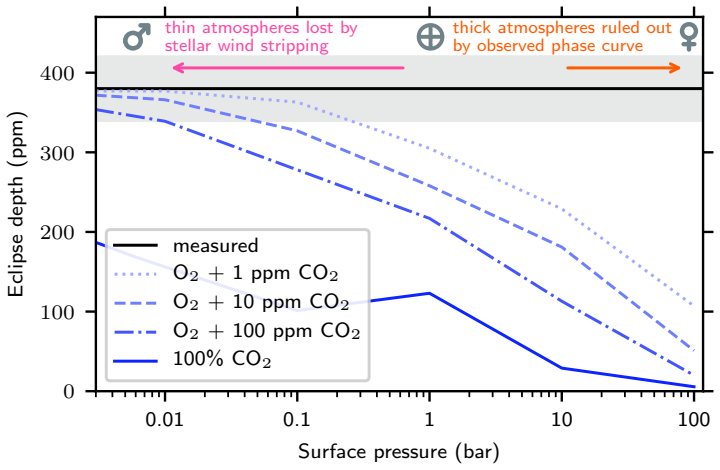
On the paper's own terms, the central discovery is that the 4.5 µm thermal phase curve of LHS 3844b is large and symmetric: secondary-eclipse depth $380\pm40$ ppm, peak-to-trough phase amplitude $350\pm40$ ppm, and peak brightness at longitude $-6\pm6^\circ$, implying a dayside brightness temperature of $1040\pm40$ K and a nightside brightness temperature consistent with zero (0–710 K at 1$\sigma$). These numbers match a synchronously rotating, low-albedo bare rock (Bond albedo below 0.2 at 2$\sigma$) with a basaltic surface. For the oxygen, carbon dioxide, and nitrogen atmospheres considered, the same data exclude surface pressures above about 10 bar at 3$\sigma$, exclude CO$_2$-dominated atmospheres down to roughly Mars-like 0.006 bar, and place the best-fitting pressures below 0.1 bar. The paper further argues, from atmospheric-evolution and stellar-wind-erosion models, that a thin atmosphere would not have survived 5 Gyr: the wind alone could remove 0.7–7 bars, and only initial water inventories above 240 Earth oceans could have left a thick atmosphere. The conclusion is that LHS 3844b most likely has no substantial atmosphere today.
Load-bearing premise
The argument assumes that the analytic heat-redistribution scaling and the oxygen, carbon dioxide, and nitrogen atmospheric compositions used in the radiative-transfer models correctly predict how eclipse depth depends on surface pressure, and that the planet's unknown mass corresponds to a surface gravity near 16 m s$^{-2}$; if any of these fail, the quoted pressure limits do not hold.
Editorial extensions
If this is right
- The measured phase curve excludes surface pressures above about 10 bar at 3$\sigma$ for the oxygen, carbon dioxide, and nitrogen atmospheres modeled, and CO$_2$-dominated atmospheres are excluded down to pressures as low as Mars's 0.006 bar.
- A nightside brightness temperature consistent with zero, together with the small radiative-to-advective timescale ratio ($\tau_{\rm rad}/\tau_{\rm adv} < 0.3$ at 2$\sigma$), implies the planet's photosphere lies at pressures below about 0.06 bar if any gas is present.
- Atmospheric evolution modeling indicates that any water-derived atmosphere would be lost over 5 Gyr; the stellar wind alone could strip 0.7–7 bars, so a present-day atmosphere would require continuous replenishment.
- The surface emission spectrum is most consistent with a basaltic composition, comparable to lunar maria or Mercury, implying widespread extrusive volcanism if the bare-rock interpretation is correct.
- The result strengthens the theoretical expectation that hot terrestrial planets around small stars do not keep substantial atmospheres and motivates phase-curve observations of cooler planets, where atmospheres may survive.
Reading between the lines
- Beyond the paper: the same eclipse-depth-versus-pressure scaling could be applied to other ultra-short-period rocky planets already observed by Spitzer, turning a single-object result into a survey that maps where the bare-rock regime ends.
- Beyond the paper: the zero nightside temperature is an inference from a truncated spherical-harmonics fit; a thin, high-altitude haze that is optically thick at 4.5 µm but transports little heat could evade the pressure limits, and a longer-wavelength phase curve would test that loophole.
- Beyond the paper: if the planet is bare rock, the dayside emission spectrum should show surface mineral features rather than molecular absorption, so a future JWST secondary-eclipse spectrum could confirm or refute the basaltic surface interpretation.
Editorial analysis
A structured set of objections, weighed in public.
Referee Report
Summary. The manuscript reports a 100-hour Spitzer IRAC 4.5 µm phase curve of the ultra-short-period terrestrial exoplanet LHS 3844b. The authors find a symmetric, large-amplitude phase variation with a secondary eclipse depth of 380±40 ppm and a peak-to-trough amplitude of 350±40 ppm, corresponding to a dayside brightness temperature of 1040±40 K and a nightside brightness temperature consistent with zero within 1σ. The phase-curve shape and amplitude are fitted by a zero-albedo bare-rock model, with a 2σ upper limit on Bond albedo of 0.2. Atmospheric modeling with an analytic heat-redistribution scaling and 1D radiative transfer is used to argue that thick atmospheres above 10 bar are excluded at 3σ for the O2/CO2/N2 compositions considered, and that thinner atmospheres are unstable to escape and stellar-wind erosion, leading to the conclusion that LHS 3844b is most likely a bare rock.
Significance. If the atmospheric exclusion holds, this is a landmark result: it provides the first thermal phase curve of a small, terrestrial exoplanet around an M dwarf and strong observational support for the theoretical prediction that hot rocky planets around small stars do not retain thick atmospheres. The photometric analysis is unusually careful: two independent reductions (spline mapping and pixel-level decorrelation) agree, red noise is characterized with an Allan deviation plot and a full-data test, and the MCMC treatment is described in enough detail to be reproduced. The paper ships reproducible code and publicly available data. The main caveat is that the 10-bar pressure bound rests on an unpublished analytic scaling; nevertheless, the observational core of the paper is sound.
major comments (3)
- [Methods, 'Model for atmospheric heat redistribution'; Eq. (2)] The 3σ exclusion of surface pressures above 10 bar is computed with the analytic scaling in Eq. (2), but the derivation is not given in the manuscript; it is deferred to a submitted companion paper (Koll et al., submitted). The validation in Extended Data Figure 6 uses a semi-grey GCM with τLW = ps/1 bar, so it does not test the composition-dependent, non-grey radiative transfer used to produce Figure 3. Moreover, Eq. (2) contains both τLW and an explicit (ps/1 bar)^{2/3} factor; since τLW as defined in Eq. (3) already depends on surface pressure for a fixed composition, the separate role of the pressure factor is unexplained and the scaling appears to double-count pressure. Please provide the derivation or an extended validation for thick, non-grey atmospheres, and state the regime of applicability of the scaling.
- [Abstract and main text, Figure 3] The abstract states that thick atmospheres 'above 10 bar' are ruled out, but the main text qualifies this as 'for all compositions we consider' (O2/CO2 and N2/CO2 mixtures). The quoted bound is therefore a composition-conditional statement, and an atmosphere with a different composition or a high-altitude absorber could in principle evade it. The abstract should carry the same qualifier, or the authors should demonstrate that the 10-bar bound is robust across a broader class of compositions.
- [Methods, 'Atmospheric escape due to stellar wind'] The claim that thin atmospheres are unstable to erosion is based on scaling ion escape rates calculated for Proxima Centauri b, assuming a constant stellar wind flux over the planet's lifetime and an unknown surface gravity (the planet mass is not measured). These assumptions make the '0.7–7 bar' erosion estimate a lower limit with large systematic uncertainty. Since this argument is part of the final 'most likely a bare rock' conclusion, the authors should either soften the claim or add a sensitivity analysis over the assumed wind parameters and planet mass.
minor comments (3)
- [Abstract and Results] The phrase 'nightside temperature consistent with zero kelvin' should be phrased as a 1σ upper limit (0–710 K) rather than a physical zero, especially because the temperature prior forces non-negative temperatures.
- [Methods, sinusoid inversion] The statement that 'the nightside temperature was below zero for the best fit sinusoid' is unphysical; please say the best-fit sinusoid would imply a formally negative brightness temperature, which motivated the spherical-harmonics model with a non-negativity prior.
- [Figure 2] The surface-composition comparison is based on a single 4.5 µm flux measurement; the discrimination among basaltic, feldspathic, granitoid, and ultramafic surfaces is therefore model-dependent and should be presented as tentative rather than definitive.
Circularity Check
No significant circularity: the core phase-curve measurement and bare-rock inference come from new Spitzer data, and the atmospheric-pressure interpretation, while relying on the authors' own analytic scaling, is checked against general circulation model simulations independent of the measured eclipse depth.
full rationale
The central observational claim — a symmetric, large-amplitude thermal phase curve implying a dayside brightness temperature of 1040±40 K and a nightside temperature consistent with zero — is derived directly from new Spitzer IRAC photometry via a spherical-harmonics phase-curve fit. This derivation is self-contained and does not presuppose the atmospheric conclusion. The secondary eclipse depth (380±40 ppm) and phase amplitude (350±40 ppm) are measured quantities, not outputs of the atmospheric model. The atmospheric interpretation uses an analytic heat-redistribution scaling (Methods Eq. 2) whose derivation is cited to a submitted companion paper by author Koll. This is a self-citation, but it is not circular in the prohibited sense: the scaling is not fitted to the LHS 3844b eclipse depth, and Extended Data Figure 6 validates the scaling against dayside eclipses simulated with a general circulation model using semi-grey radiative transfer. That comparison provides independent support for the functional form used to translate surface pressure into dayside brightness temperature. The subsequent application to composition-dependent optical depths from 1D radiative transfer is an extrapolation, and the 10-bar exclusion is therefore model-dependent, but model dependence is a correctness or robustness concern, not a definitional circularity. The supplementary energy-balance fit, the Bond-albedo constraint, and the atmospheric-escape argument are also based on published physical models rather than on the data being predicted. The escape estimate scales published ion-escape rates from Proxima Centauri b to LHS 3844b, and the collapse-stability argument cites prior simulations; neither step is equivalent to the observed phase curve by construction. No equation in the paper is defined in terms of the result it is used to predict, no fitted parameter is relabeled as a prediction, and no load-bearing uniqueness theorem is imported solely from the authors' prior work. The strongest circularity-relevant observation is the self-citation of the heat-redistribution scaling, but because the paper itself displays a GCM-based validation of that scaling against simulated phase curves, the burden is minor and does not compromise the independence of the measured result. The score of 1 reflects this minor self-citation rather than any substantive circularity.
Assumptions & free parameters
free parameters (5)
- Bond albedo in bare-rock fit =
<0.2 (2σ upper limit)
- Radiative-to-advective timescale ratio (τrad/τadv) =
<0.3 (2σ upper limit)
- Greenhouse warming factor in energy-balance model =
unconstrained, degenerate with Bond albedo
- Initial water abundance (Earth oceans) =
scanned over 1 to 1000; values above 240 excluded for nominal XUV saturation
- XUV saturation fraction (LXUV/Lbol)sat =
scanned; nominal value from literature for low-mass stars
assumptions (6)
- domain assumption The analytic heat-redistribution scaling f (Eq. 2) correctly maps surface pressure and longwave optical depth to dayside temperature.
- domain assumption Plausible atmospheres are limited to O2/CO2/N2 mixtures.
- domain assumption The energy-balance model's assumed wind speed of 300 m/s and surface gravity of 16 m/s² are representative.
- domain assumption Stellar wind erosion for LHS 3844b scales from Proxima Centauri b ion escape rates.
- domain assumption Atmospheric escape model assumptions: initial pure-water atmosphere, magma ocean dissolution, energy-limited escape with XUV saturation until 1 Gyr.
- domain assumption A first-degree spherical harmonics map with a zero-prior on negative temperatures adequately represents the phase curve.
Cite this review
Pith. "Pith review of Absence of a thick atmosphere on the terrestrial exoplanet LHS 3844b." pith.science (2026). https://pith.science/paper/2JTT3TXX
@misc{pith2026190806834,
  author       = {Pith},
  title        = {Pith review of: Absence of a thick atmosphere on the terrestrial exoplanet LHS 3844b},
  year         = {2026},
  howpublished = {\url{https://pith.science/paper/2JTT3TXX}},
  note         = {Machine review of arXiv:1908.06834}
}
abstract
Most known terrestrial planets orbit small stars with radii less than 60% that of the Sun. Theoretical models predict that these planets are more vulnerable to atmospheric loss than their counterparts orbiting Sun-like stars. To determine whether a thick atmosphere has survived on a small planet, one approach is to search for signatures of atmospheric heat redistribution in its thermal phase curve. Previous phase curve observations of the super-Earth 55 Cancri e (1.9 Earth radii) showed that its peak brightness is offset from the substellar point $-$ possibly indicative of atmospheric circulation. Here we report a phase curve measurement for the smaller, cooler planet LHS 3844b, a 1.3 Earth radius world in an 11-hour orbit around a small, nearby star. The observed phase variation is symmetric and has a large amplitude, implying a dayside brightness temperature of $1040\pm40$ kelvin and a nightside temperature consistent with zero kelvin (at one standard deviation). Thick atmospheres with surface pressures above 10 bar are ruled out by the data (at three standard deviations), and less-massive atmospheres are unstable to erosion by stellar wind. The data are well fitted by a bare rock model with a low Bond albedo (lower than 0.2 at two standard deviations). These results support theoretical predictions that hot terrestrial planets orbiting small stars may not retain substantial atmospheres.
Figures


Figures from the paper (1 more)

Forward citations
Cited by 1 Pith paper
-
ESCAPE: a small explorer mission to study the stellar drivers of exoplanet evolution
ESCAPE is a proposed NASA Small Explorer that would measure EUV spectra of about 300 nearby stars to constrain stellar EUV irradiance and coronal mass ejection rates affecting exoplanet habitability.
Reference graph
Works this paper leans on
-
[31]
Frierson, D. M. W., Held, I. M. & Zurita-Gotor, P. A gray-radiation aquaplanet moist GCM. Part I: Static stability and eddy scale. Journal of the Atmospheric Sciences 63, 2548–2566 (2006)
work page 2006
-
[32]
Merlis, T. M. & Schneider, T. Atmospheric dynamics of Earth-like tidally locked aquaplanets. Journal of Advances in Modeling Earth Systems 2 (2010)
work page 2010
-
[33]
Koll, D. D. B. & Abbot, D. S. Deciphering Thermal Phase Curves of Dry, Tidally Locked Terrestrial Planets. Astrophys. J. 802, 21 (2015). 1412.8216
work page Pith review arXiv 2015
-
[34]
Braak, C. J. F. T. A markov chain monte carlo version of the genetic algorithm differential evolution: easy bayesian computing for real parameter spaces. Statistics and Computing 16, 239–249 (2006). URL http://dx.doi.org/10.1007/s11222-006-8769-1
-
[35]
Cowan, N. B. & Agol, E. Inverting Phase Functions to Map Exoplanets. Astrophys. J. Lett. 678, L129 (2008). 0803.3622
arXiv 2008
-
[36]
Keating, D. & Cowan, N. B. Revisiting the Energy Budget of W ASP-43b: Enhanced Day- Night Heat Transport. Astrophys. J. Lett. 849, L5 (2017). 1709.03502. 17
arXiv 2017
-
[37]
Deming, D. et al. Spitzer Secondary Eclipses of the Dense, Modestly-irradiated, Gi- ant Exoplanet HAT-P-20b Using Pixel-level Decorrelation. Astrophys. J. 805, 132 (2015). 1411.7404
arXiv 2015
-
[38]
Garhart, E. et al. Statistical Characterization of Hot Jupiter Atmospheres using Spitzer’s Sec- ondary Eclipses. arXiv e-prints (2019). 1901.07040
work page Pith review arXiv 2019
Show all 13 references
-
[39]
Claret, A., Hauschildt, P. H. & Witte, S. New limb-darkening coefficients for PHOENIX/1D model atmospheres. I. Calculations for 1500 K ¡ Teff ¡ 4800 K Kepler, CoRot, Spitzer, uvby, UBVRIJHK, Sloan, and 2MASS photometric systems. Astron. Astrophys. 546, A14 (2012)
2012
-
[40]
& Queloz, D
Pont, F., Zucker, S. & Queloz, D. The effect of red noise on planetary transit detection. Mon. Not. R. Astron. Soc. 373, 231–242 (2006). astro-ph/0608597
2006 arXiv
-
[41]
Gaia Data Release 2
Gaia Collaboration et al. Gaia Data Release 2. Summary of the contents and survey properties. Astron. Astrophys. 616, A1 (2018). 1804.09365
2018 arXiv
-
[42]
Mann, A. W. et al. How to Constrain Your M Dwarf. II. The Mass-Luminosity-Metallicity Relation from 0.075 to 0.70 Solar Masses. Astrophys. J. 871, 63 (2019). 1811.06938
2019 arXiv
-
[43]
& Cohen, O
Dong, C., Lingam, M., Ma, Y . & Cohen, O. Is Proxima Centauri b Habitable? A Study of Atmospheric Loss. Astrophys. J. Lett. 837, L26 (2017). 1702.04089. 18
2017 arXiv
Reviewed August 14, 2026 · model on record in the stance chip above.
Discussion (0). Continue with ORCID to comment.