REVIEW 5 major objections 5 minor 31 references
Performance Analysis of Cooperative V2V and V2I Communications under Correlated Fading
T0 review · 5 major / 5 minor · reviewed 2026-08-14 · deepseek-v4-flash
Pith's one-line read The paper derives closed-form packet-error expressions for cooperative V2V/V2I uplinks with correlated antennas at the roadside unit, and solves a Stackelberg game for optimal transmit power and helper price.
desk verdict A useful but flawed extension: the EC CDF is misprinted and the Stackelberg proofs drop key terms, so the paper is not publishable as is. read the letter →
The pith
A machine-rendered reading of the paper's core claim, the machinery that carries it, and where it could break.
The reading
What carries the argument
The load-bearing object is the bottleneck relationship $\gamma_{e2e} = \min\{\gamma_{V_s V_{i^*}}, \gamma_{V_{i^*} R}\}$ between the best first-hop SNR and the maximum-ratio-combined second-hop SNR at the roadside unit. On the first hop, order statistics turn the best-helper outage into a product of Gamma cumulative distribution functions; on the second hop, the correlated antenna sum is represented by two densities: a confluent-hypergeometric density for constant correlation and a Gamma density for exponential correlation with shape $mM^2/\lambda$ and scale $\lambda \bar{\gamma}/(Mm)$. The Stackelberg machinery adds a sigmoid satisfaction function for the source, a per-Watt price for the helper, and a leader-follower equilibrium that determines the power-split factor $\phi$, the transmit power $P$, and the price $p_i$.
What would settle it
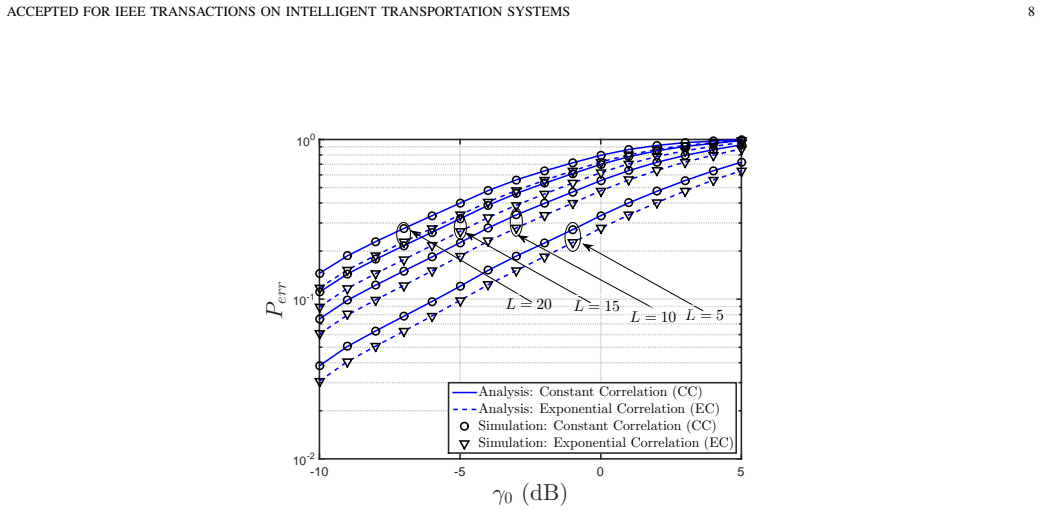
Simulate the full two-hop model: draw Nakagami-m fading for the first hop, select the best helper, draw exponentially or constantly correlated Nakagami-m coefficients for the roadside-unit antennas according to $\rho_e$ or $\rho_c$, apply maximum-ratio combining, and compare the empirical packet error with equations (15), (18), and (19) over a grid of $m$, $M$, $N$, and correlation values; a systematic mismatch, especially in the exponential-correlation case, would falsify the closed-form claim.
Extended reading notes
Core claim
The paper's central claim is that for a two-phase decode-and-forward uplink, the end-to-end packet error probability under correlated roadside-unit antennas is available in closed form: one expression for constant correlation involving hypergeometric functions, and a compact expression for exponential correlation involving an upper incomplete Gamma function. The first-hop outage, after selecting the helper with the largest SNR, becomes a product of incomplete Gamma functions, equation (11). The second-hop outage is obtained by integrating the combined SNR density at the maximum-ratio combining output, using the constant-correlation density (13) or the exponential-correlation Gamma-sum density (16), yielding equations (15) and (18). Combining the two hops through the bottleneck SNR and compounding over L blocks gives the total packet error probability in equation (19). On the game side, the paper proposes a Stackelberg game with the source as leader and helpers as followers, proves concavity of the source utility in transmit power, and derives the optimal transmit power (27) and helper asking price (29).
Load-bearing premise
The load-bearing premise is that the sum of exponentially correlated Nakagami-m antenna signals at the roadside unit is exactly the Gamma distribution written in equation (16); if that borrowed distributional shortcut diverges from the true correlated sum, the exponential-correlation packet-error formulas do not follow.
Editorial extensions
If this is right
- More helper vehicles reduce packet error probability through selection diversity on the first hop, with diminishing returns as the distance ratio $d_{V_s V_{i^*}}/d_{V_{i^*} R}$ grows large.
- Higher antenna correlation at the roadside unit increases packet error, and the constant- and exponential-correlation predictions converge as the correlation coefficients approach one.
- Packet error worsens as the SNR threshold $\gamma_0$ rises and as a packet is split into more blocks, so higher vehicle speeds shorten coherence time and reduce reliability.
- The Stackelberg solution gives a finite optimal transmit power that balances the source's satisfaction against the helper's price, and an asking price that maximizes the helper's profit.
- Optimal transmit power increases with both source-to-helper and helper-to-roadside-unit distances, and decreases when the Nakagami parameter $m$ grows, for both correlation models.
Reading between the lines
- The exponential-correlation formula can be tested separately from the rest of the paper: generate exponentially correlated Nakagami-$m$ samples, apply maximum-ratio combining, and compare empirical outage with equation (18) across a grid of $\rho_e$, $m$, and $M$; this would isolate whether the Gamma-sum approximation is the limiting step.
- Because the closed forms are algebraic in $m$, $\rho$, $M$, and $N$, they could be embedded in a system-level design loop that sweeps roadside-unit antenna spacing or helper recruitment thresholds, something the paper itself does not demonstrate.
- Inserting imperfect channel estimation into the helper-selection and game stages would shift both the selected helper and the equilibrium power and price; the paper identifies this as future work, and a natural quantitative extension is to measure how sensitive equations (27) and (29) are to such errors.
Signed reviews
Editorial analysis
A structured set of objections, weighed in public.
Referee Report
Summary. The manuscript studies an uplink cooperative V2V/V2I network in which a source vehicle selects one of several helper vehicles and the selected helper forwards the packet to a multi-antenna RSU over Nakagami-m faded links. The first contribution is a packet-error analysis for two antenna-correlation models at the RSU, constant correlation (CC) and exponential correlation (EC), combining order statistics for the best helper with MRC at the RSU. The second contribution is a Stackelberg game in which the source chooses the power split phi and total power P, and the selected helper sets a per-watt price, with closed-form expressions for the optimal phi, P, and price. The authors compare their analytical packet-error expressions with MATLAB Monte Carlo simulations in Figures 2-4.
Significance. If the derivations were correct, the closed-form packet-error expressions under correlated RSU antennas would be a useful addition to the vehicular-communications literature, and the Stackelberg formulation is a reasonable and relevant framework for cooperative V2X. The Monte Carlo verification reported in Figures 2-4 and the absence of fitted parameters are strengths of the presentation. However, the printed mathematical derivations contain load-bearing errors in both main contributions: the EC CDF in Eq. (18) is not a valid CDF, the Gamma CDF in Eq. (11) omits the Nakagami shape parameter inside the incomplete-Gamma argument, and the game-theoretic optimization in Proposition 1 maximizes the SNR-satisfaction term while dropping the payment term from the source's utility. These are not presentation issues; they invalidate the central analytical results as written.
major comments (5)
- [Section III, Eq. (18)] The EC cumulative distribution function is invalid as written. Integrating the Gamma density in Eq. (16) from 0 to gamma0 yields the regularized lower incomplete Gamma function gamma(mM^2/lambda, Mm*gamma0/(lambda*gamma_bar))/Gamma(mM^2/lambda), not the upper incomplete Gamma function. Since Eq. (18) explicitly identifies Gamma(.,.) as the upper incomplete Gamma function, the expression tends to Gamma(mM^2/lambda) > 0 as gamma0 approaches 0 and is not bounded by 1 for small thresholds. This invalidates the EC packet-error probability obtained from Eqs. (7)-(19) and the EC results in Figures 2-4, even if one grants the Kotz-Adams distributional assumption in Eq. (16).
- [Section III, Eq. (11)] The Nakagami-m SNR CDF is written incorrectly. From the PDF in Eq. (10), the probability that gammaVsVi is below gamma0 is gamma(m, m*gamma0/gamma_barVsVi)/Gamma(m), but Eq. (11) omits the factor m inside the lower incomplete Gamma function. This factor is essential for all m > 1 and even affects the Rayleigh case if the same formula is used. Since Eq. (11) is multiplied into the packet-error expression in Eq. (7) for both the CC and EC models, every packet-error probability derived from the printed equations is affected.
- [Section IV, Proposition 1 and Eq. (23)] The proof of Proposition 1 maximizes U_R, not U_s. The source utility in Eq. (21) is U_s = w_p U_R - p_i(1-phi)P, and the payment term -p_i(1-phi)P is strictly increasing in phi. Therefore the SNR-balancing point gammaVsVi* = gammaVi*R does not in general maximize U_s; for example, phi = 1 gives zero payment and utility w_p/(1+exp(a*gamma0)), which can exceed the value at Eq. (23) when p_i is large. The claimed 'if and only if' condition is false, and the rest of the game-theoretic analysis, including Eq. (24), the optimal power in Eq. (27), and the optimal price in Eq. (29), relies on this incorrect optimizer.
- [Section IV, Proposition 2 and Eq. (26)] The claim that the second derivative in Eq. (26) is always negative is false. Let f = sigma(a(eta P |hVsVi|^2/varpi - gamma0)). Then d^2 U_s/dP^2 reduces to a^2 (eta |hVsVi|^2/varpi)^2 w_p f(1-f)(1-2f). This is positive whenever the instantaneous SNR is below the threshold gamma0, i.e., whenever f < 1/2. Consequently, the concavity argument, the first-order optimality condition, and the closed-form optimal power in Eq. (27) are not supported by the provided derivation.
- [Section III, Eq. (15)] The finite sum in the CC CDF appears to run from n = 0 to (1-rho_c+M*rho_c)/(M*rho_c) - 1. For the parameters used in Section V (e.g., M = 10, rho_c = 0.1), this upper limit is 0.9, which is not an integer. Since no integrality condition is stated, the expression in Eq. (15) is undefined for the simulated parameter regime, and the CC packet-error curves do not follow from the printed formula.
minor comments (5)
- [Section III, Eq. (10)] The exponential factor is written as exp(-m s / zbar) with an undefined variable s; it should be exp(-m z / zbar) to match the Gamma density.
- [Section IV, Proposition 2] The proof states '0 < hVsVi, wp < 1' as if hVsVi were a probability. The fading coefficient hVsVi is generally complex or a real envelope, and only its magnitude enters the SNR; the concavity condition should be phrased in terms of |hVsVi| > 0.
- [Section V, Figure 4] The axis label 'rho_c = rho_c' appears to be a typo; it should read 'rho_c = rho_e'.
- [Section III, Eqs. (14)-(15)] The placement of parentheses in the finite-sum expression in Eq. (15) is ambiguous as typeset, and the derivation of the CC CDF would be much easier to verify if the citation to the specific identity in [27] were given with equation numbers.
- [Section IV, Eq. (29)] The helper's optimal price in Eq. (29) contains no dependence on w_p, a, or P, which is surprising for a Stackelberg equilibrium. Even setting aside the invalid Proposition 1, this suggests that the derivation should be re-examined and the result re-derived from the true first-order condition.
Circularity Check
No circularity; the closed-form derivations rest on external distributional results and Monte Carlo verification, and self-citations appear only as background references.
full rationale
Score 0. The central derivations are self-contained in the sense required here: (i) the CC outage CDF in (13)-(15) is based on Gurland's external result [26] and Gradshteyn-Ryzhik identities; (ii) the EC outage CDF in (16)-(18) is based on Kotz-Adams' external Gamma-sum result [28]; (iii) the end-to-end packet error probability in (7), (11), (18), (19) is composed from these and then checked against MATLAB simulations with no fitted parameters. No equation is defined in terms of the quantity it purports to predict, and no fitted parameter is renamed as a prediction. The paper's self-citations ([1], [6], [7], [9], [14], [16], [17], [21]) are background references on VANETs, SWIPT, and fading models; none supplies the load-bearing distributional theorem or the game solution. The EC Gamma assumption in (16) may merit a direct Monte Carlo check, but the assumption is imported from an external cited source, not from the authors' own previous work, and it is not manufactured by the present derivation. The Stackelberg part has mathematical concerns: Proposition 1's proof maximizes only the sigmoid SNR term in (20)-(21) and ignores the strictly decreasing payment term p_i(1-phi)P in U_s, so Eq. (23) may not maximize U_s, and the concavity claim in Proposition 2 is also questionable. However, these are correctness flaws, not circularity: the claimed optimal phi or P* is not defined in terms of the conclusion, and no data are fitted to force it. Therefore, under the required standard, no circular step can be exhibited.
Assumptions & free parameters
assumptions (5)
- domain assumption All links are i.i.d. Nakagami-m faded and follow block fading.
- domain assumption Channels between source and helper vehicles are independent, and the two hops are independent.
- domain assumption Perfect CSI is available at the source for helper selection and for setting the power split φ and total power P.
- domain assumption The sum of exponentially correlated Nakagami-m SNRs at the RSU has the Gamma distribution in (16), following [28].
- domain assumption The CC and EC correlation models accurately represent the physical antenna correlation at the RSU.
Cite this review
Pith. "Pith review of Performance Analysis of Cooperative V2V and V2I Communications under Correlated Fading." pith.science (2026). https://pith.science/paper/QAGBQCLR
@misc{pith2026190806842,
  author       = {Pith},
  title        = {Pith review of: Performance Analysis of Cooperative V2V and V2I Communications under Correlated Fading},
  year         = {2026},
  howpublished = {\url{https://pith.science/paper/QAGBQCLR}},
  note         = {Machine review of arXiv:1908.06842}
}
read the original abstract
Cooperative vehicular networks will play a vital role in the coming years to implement various intelligent transportation-related applications. Both vehicle-to-vehicle (V2V) and vehicle-to-infrastructure (V2I) communications will be needed to reliably disseminate information in a vehicular network. In this regard, a roadside unit (RSU) equipped with multiple antennas can improve the network capacity. While the traditional approaches assume antennas to experience independent fading, we consider a more practical uplink scenario where antennas at the RSU experience correlated fading. In particular, we evaluate the packet error probability for two renowned antenna correlation models, i.e., constant correlation (CC) and exponential correlation (EC). We also consider intermediate cooperative vehicles for reliable communication between the source vehicle and the RSU. Here, we derive closed-form expressions for packet error probability which help quantify the performance variations due to fading parameter, correlation coefficients and the number of intermediate helper vehicles. To evaluate the optimal transmit power in this network scenario, we formulate a Stackelberg game, wherein, the source vehicle is treated as a buyer and the helper vehicles are the sellers. The optimal solutions for the asking price and the transmit power are devised which maximize the utility functions of helper vehicles and the source vehicle, respectively. We verify our mathematical derivations by extensive simulations in MATLAB.
Figures


Figures from the paper (3 more)


Reference graph
Works this paper leans on
-
[1]
Interference-Aided Vehicular Networks: Future Research Opportunities and Challenges,
F. Jameel, S. Wyne, M. A. Javed, and S. Zeadally, “Interference-Aided Vehicular Networks: Future Research Opportunities and Challenges,” IEEE Communications Magazine , vol. 56, no. 10, pp. 36–42, Oct 2018
work page 2018
-
[2]
Wireless toward the era of intelligent vehicles,
X. Cheng, R. Zhang, and L. Yang, “Wireless toward the era of intelligent vehicles,” IEEE Internet of Things Journal , vol. 6, no. 1, pp. 188–202, Feb 2019
work page 2019
-
[3]
Cooperative Vehicular Networking: A Survey,
E. Ahmed and H. Gharavi, “Cooperative Vehicular Networking: A Survey,” IEEE Transactions on Intelligent Transportation Systems , vol. 19, no. 3, pp. 996–1014, March 2018
work page 2018
-
[4]
5G-enabled cooperative intelligent vehicular (5genciv) framework: When benz meets marconi,
X. Cheng, C. Chen, W. Zhang, and Y . Yang, “5G-enabled cooperative intelligent vehicular (5genciv) framework: When benz meets marconi,” IEEE Intelligent Systems , vol. 32, no. 3, pp. 53–59, May 2017
work page 2017
-
[5]
D2D for intelligent transportation systems: A feasibility study,
X. Cheng, L. Yang, and X. Shen, “D2D for intelligent transportation systems: A feasibility study,” IEEE Transactions on Intelligent Transportation Systems, vol. 16, no. 4, pp. 1784–1793, Aug 2015
work page 2015
-
[6]
Performance analysis of V ANETs under Rayleigh, Rician, Nakagami-m and Weibull fading,
F. Jameel, Faisal, M. A. A. Haider, and A. A. Butt, “Performance analysis of V ANETs under Rayleigh, Rician, Nakagami-m and Weibull fading,” in 2017 International Conference on Communication, Computing and Digital Systems (C-CODE) , March 2017, pp. 127–132
work page 2017
-
[7]
Internet of Autonomous Vehicles: Architecture, Features, and Socio-Technological Challenges
F. Jameel, Z. Chang, J. Huang, and T. Ristaniemi, “Internet of Autonomous Vehicles: Architecture, Features, and Socio-Technological Challenges,” arXiv preprint arXiv:1906.09918, 2019
work page Pith review arXiv 1906
-
[8]
MIMO HetNet IEEE 802.11p–LTE deployment in a vehicular urban environment,
M. Charitos and G. Kalivas, “MIMO HetNet IEEE 802.11p–LTE deployment in a vehicular urban environment,” V ehicular Communications, vol. 9, pp. 222 – 232, 2017
work page 2017
Show all 31 references
-
[9]
Propagation Channels for mmWave Vehicular Communications: State-of-the-art and Future Research Directions,
F. Jameel, S. Wyne, S. J. Nawaz, and Z. Chang, “Propagation Channels for mmWave Vehicular Communications: State-of-the-art and Future Research Directions,” IEEE Wireless Communications , vol. 26, no. 1, pp. 144–150, February 2019
2019
-
[10]
Power allocation and relay selection for multisource multirelay cooperative vehicular networks,
H. Xiao, Y . Hu, K. Yan, and S. Ouyang, “Power allocation and relay selection for multisource multirelay cooperative vehicular networks,” IEEE Transactions on Intelligent Transportation Systems , vol. 17, no. 11, pp. 3297–3305, Nov 2016
2016
-
[11]
Performance analysis of multi-source multi-destination cooperative vehicular networks with the hybrid decode-amplify-forward cooperative relaying protocol,
H. Xiao, Z. Zhang, and A. T. Chronopoulos, “Performance analysis of multi-source multi-destination cooperative vehicular networks with the hybrid decode-amplify-forward cooperative relaying protocol,” IEEE Transactions on Intelligent Transportation Systems , vol. 19, no. 9, pp...
2018
-
[12]
V2I applications in highways: How RSU dimensioning can improve service delivery,
G. Charalampopoulos, T. Dagiuklas, and T. Chrysikos, “V2I applications in highways: How RSU dimensioning can improve service delivery,” in IEEE International Conference on Telecommunications (ICT) , May 2016, pp. 1–6
2016
-
[13]
MIMO-enabling PHY layer enhancement for vehicular ad-hoc networks,
S. Moser, L. Behrendt, and F. Slomka, “MIMO-enabling PHY layer enhancement for vehicular ad-hoc networks,” in IEEE Wireless Communications and Networking Conference Workshops (WCNCW) , March 2015, pp. 142–147
2015
-
[14]
Massive MIMO: A survey of recent advances, research issues and future directions,
F. Jameel, Faisal, M. A. A. Haider, and A. A. Butt, “Massive MIMO: A survey of recent advances, research issues and future directions,” in 2017 International Symposium on Recent Advances in Electrical Engineering (RAEE) , Oct 2017, pp. 1–6
2017
-
[15]
Cooperative Data Scheduling in Hybrid Vehicular Ad Hoc Networks: V ANET as a Software Defined Network,
K. Liu, J. K. Y . Ng, V . C. S. Lee, S. H. Son, and I. Stojmenovic, “Cooperative Data Scheduling in Hybrid Vehicular Ad Hoc Networks: V ANET as a Software Defined Network,” IEEE/ACM Transactions on Networking , vol. 24, no. 3, pp. 1759–1773, June 2016
2016
-
[16]
Optimal time switching and power splitting in SWIPT,
F. Jameel, A. Ali, and R. Khan, “Optimal time switching and power splitting in SWIPT,” in 2016 19th International Multi-Topic Conference (INMIC) , Dec 2016, pp. 1–5
2016
-
[17]
A technical review of simultaneous wireless information and power transfer (SWIPT),
F. Jameel, Faisal, M. A. A. Haider, and A. A. Butt, “A technical review of simultaneous wireless information and power transfer (SWIPT),” in 2017 International Symposium on Recent Advances in Electrical Engineering (RAEE) , Oct 2017, pp. 1–6
2017
-
[18]
A cooperative offloading game on data recovery for reliable broadcast in V ANET,
G. Xiao, H. Zhang, H. Hassan, Y . Chen, Z. Huang, and N. Sun, “A cooperative offloading game on data recovery for reliable broadcast in V ANET,” Concurrency and Computation: Practice and Experience , vol. 29, no. 14, 2017
2017
-
[19]
Stackelberg game-based demand response in multiple utility environments for electric vehicle charging,
P. Shinde and K. S. Swarup, “Stackelberg game-based demand response in multiple utility environments for electric vehicle charging,” IET Electrical Systems in Transportation , vol. 8, no. 3, pp. 167–174, 2018
2018
-
[20]
A stackelberg game for street-centric QoS-OLSR protocol in urban vehicular Ad Hoc networks,
M. Kadadha, H. Otrok, H. Barada, M. Al-Qutayri, and Y . Al-Hammadi, “A stackelberg game for street-centric QoS-OLSR protocol in urban vehicular Ad Hoc networks,” V ehicular Communications, 2018
2018
-
[21]
Impact of co-channel interference on the performance of V ANETs underα-µ fading,
F. Jameel, Z. Hamid, F. Jabeen, and M. A. Javed, “Impact of co-channel interference on the performance of V ANETs underα-µ fading,” AEU-International Journal of Electronics and Communications , vol. 83, pp. 263–269, Jan 2018
2018
-
[22]
Cross-layer optimization for cooperative content distribution in multihop device-to-device networks,
C. Xu, J. Feng, Z. Zhou, J. Wu, and C. Perera, “Cross-layer optimization for cooperative content distribution in multihop device-to-device networks,” IEEE Internet of Things Journal , vol. 6, no. 1, pp. 278–287, Feb 2019
2019
-
[23]
Energy-harvesting af relaying in the presence of interference and nakagami- m fading,
Y . Chen, “Energy-harvesting af relaying in the presence of interference and nakagami- m fading,” IEEE Transactions on Wireless Communications , vol. 15, no. 2, pp. 1008–1017, Feb 2016
2016
-
[24]
V . K. Lau and Y .-K. R. Kwok,Channel-adaptive technologies and cross-layer designs for wireless systems with multiple antennas: theory and applications . John Wiley & Sons, Inc., 2006
2006
-
[25]
Performance modeling and analysis on conditional DF relaying scheme over Nakagami-m fading channels with integral m,
W. He, H. Lei, and G. Pan, “Performance modeling and analysis on conditional DF relaying scheme over Nakagami-m fading channels with integral m,” AEU-International Journal of Electronics and Communications , vol. 70, no. 6, pp. 743–749, June 2016
2016
-
[26]
Distribution of the maximum of the arithmetic mean of correlated random variables,
J. Gurland et al. , “Distribution of the maximum of the arithmetic mean of correlated random variables,” The Annals of Mathematical Statistics , vol. 26, no. 2, pp. 294–300, 1955
1955
-
[27]
I. S. Gradshteyn and I. M. Ryzhik, Table of integrals, series, and products . Academic Press, 2014
2014
-
[28]
Distribution of sum of identically distributed exponentially correlated gamma-variables,
S. Kotz and J. W. Adams, “Distribution of sum of identically distributed exponentially correlated gamma-variables,” The Annals of Mathematical Statistics , pp. 277–283, 1964
1964
-
[29]
Z. Han, D. Niyato, W. Saad, T. Bas ¸ar, and A. Hjørungnes, Game theory in wireless and communication networks: theory, models, and applications . Cambridge University Press, 2012
2012
-
[30]
ARC: an integrated admission and rate control framework for competitive wireless CDMA data networks using noncooperative games,
H. Lin, M. Chatterjee, S. K. Das, and K. Basu, “ARC: an integrated admission and rate control framework for competitive wireless CDMA data networks using noncooperative games,” IEEE Transactions on Mobile Computing , vol. 4, no. 3, pp. 243–258, May 2005
2005
-
[31]
Efficient agent-based negotiation for telecommunications services,
G. D. Stamoulis, D. Kalopsikakis, and A. Kyrikoglou, “Efficient agent-based negotiation for telecommunications services,” in IEEE Global Telecommu- nications Conference, vol. 3, 1999, pp. 1989–1996 vol.3
1999
Reviewed August 14, 2026 · model on record in the stance chip above.
Discussion (0). Continue with ORCID to comment.