REVIEW 5 major objections 6 minor 43 references
Employing Game Theory and TDMA Protocol to Enhance Security and Manage Power Consumption in WSNs-based Cognitive Radio
T0 review · 5 major / 6 minor · reviewed 2026-08-14 · deepseek-v4-flash
Pith's one-line read A Stackelberg game with a matched filter can neutralize SSDF attack interference at equilibrium, protecting about 83 percent of sensor reports.
desk verdict A clear, incremental engineering result undermined by unsupported equilibrium claims and basic detector-formula errors. read the letter →
The pith
A machine-rendered reading of the paper's core claim, the machinery that carries it, and where it could break.
The reading
What carries the argument
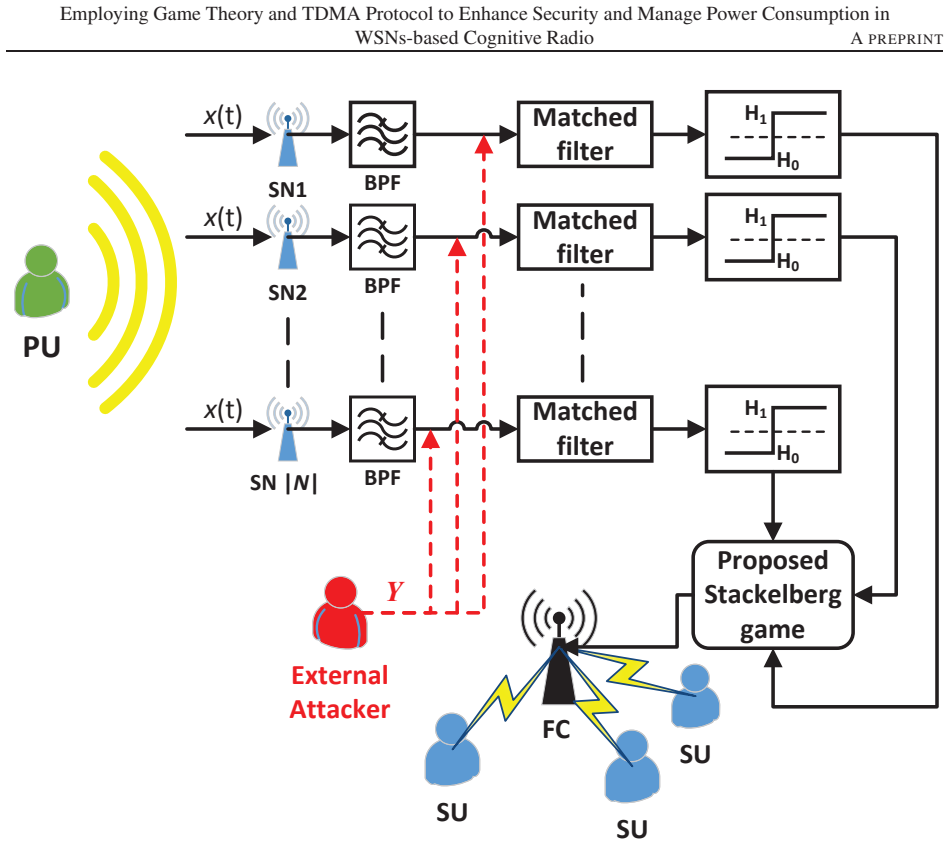
The load-bearing mechanism is the leader–follower budget-redistribution game built on the per-report utility $U_i = x_i - y_i$, where $x_i$ is the fusion center's defense power and $y_i$ is the attacker's interference power added to that sensor's report. The attacker, reacting to the defender's previous allocation, moves budget from strongly protected reports to weakly protected ones (Eqs. 15–16), and the defender, anticipating that reaction, moves a threshold-sized amount $\xi$ in the opposite direction (Eqs. 17–18). A matched filter with a Neyman–Pearson threshold decides whether each received report justifies the presence of the primary user, and TDMA slot assignment prevents collisions among the reports. The equilibrium condition (Eq. 19) is the point at which no player can improve its utility by another redistribution.
What would settle it
Simulate the same protocol against an attacker that does not follow the predicted best response—for example, one that randomizes its budget allocation or maximizes a utility the fusion center does not know—and measure the percentage of protected reports and the achieved SNR at the claimed equilibrium. If the protected-report percentage falls well below 83% at $Y=8$, or if the measured SNR does not return to $G(S_i)/P_n$, the equilibrium-cancellation claim fails for non-rational attackers.
Extended reading notes
Core claim
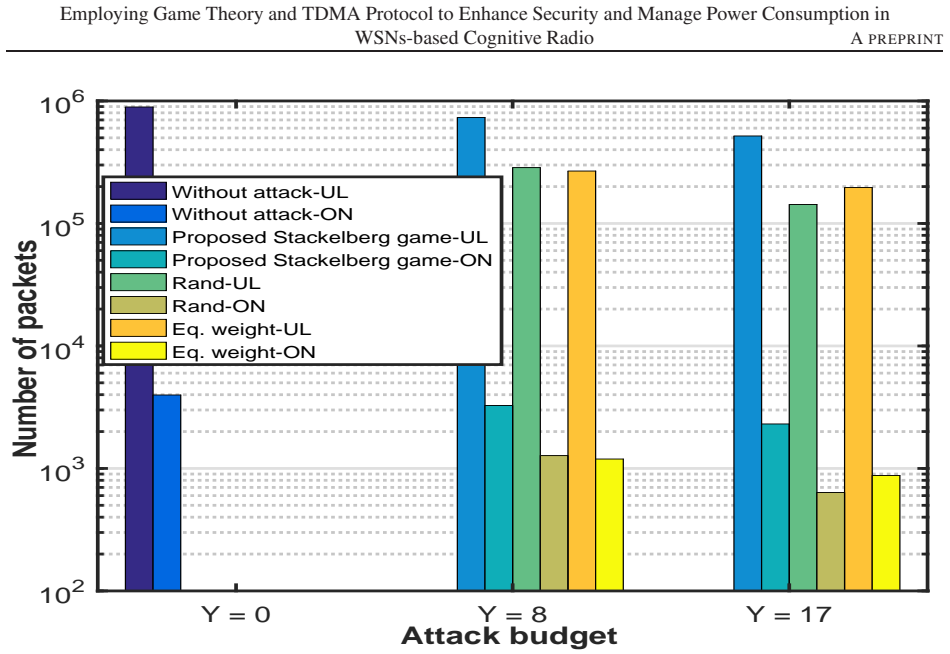
On the paper's own terms, the central claim is that the SSDF attack's effect on spectrum-sensing reports disappears at the Stackelberg equilibrium. The fusion center, knowing the attacker's utility function, chooses per-report defense budgets $x_i$ so that the equilibrium attack budget $y_i^*$ is neutralized; the paper's Eq. (9) states that the signal-to-noise ratio is then restored to $G(S_i)/P_n$, the value it would have without any attack. Simulations over six channel environments (outdoor, underground, and indoor, each in line-of-sight and non-line-of-sight) show the proposed matched-filter game protecting about 83% of reports at attack budget $Y=8$, with detection curves that track the no-attack case more closely than random or equal-weight defenses. The paper also claims the game reaches equilibrium in few rounds, identifies hardware-failed nodes separately from malicious ones, and reduces non-beneficial energy spent on failed communication attempts.
Load-bearing premise
The model assumes the attacker is perfectly rational and that the fusion center knows the attacker's utility function exactly; a real attacker that deviates from the predicted best response, or a fusion center that mis-estimates that utility, would break the equilibrium cancellation and the 83% protection figure.
Editorial extensions
If this is right
- At equilibrium, each protected report's SNR returns to $G(S_i)/P_n$, so the matched-filter detection probability approaches the no-attack curve.
- A finite defense budget can be reallocated dynamically to protect the reports most likely to be attacked, rather than defending all reports equally.
- The game's utility sign ($U_i<0$ vs. $U_i>0$) gives the fusion center an internal classifier: continuously negative reports are treated as attacked, noncontinuously negative reports as hardware failures.
- Because more reports arrive intact, the number of retransmissions and negative acknowledgments drops, reducing the battery energy lost to failed handshakes under SSDF attack.
- The same protection logic holds across all six tested environments, with line-of-sight channels showing the best performance and outdoor non-line-of-sight the worst.
Reading between the lines
- A natural test the authors leave implicit: if the attack budget $Y$ is made unknown and time-varying, the threshold $\xi$ would need to be adapted online—otherwise the fixed redistribution step may lag the attacker.
- Since the equilibrium cancellation in Eq. (9) is essentially an accounting identity once $U_i = x_i - y_i$, the paper's real burden is behavioral: a real attacker that randomizes or optimizes a different utility would escape the model's guarantee.
- The TDMA mechanism is orthogonal to the game; the same budget-redistribution logic could be coupled with other multiple-access schemes, though collision losses would then interact with attack losses in the utility.
- The protected-reports percentage at $Y=8$ gives a benchmark: any future SSDF-defense scheme in WSN-based cognitive radio can be compared against roughly 83% protection under the same attack budget and simulation parameters.
Signed reviews
Editorial analysis
A structured set of objections, weighed in public.
Referee Report
Summary. The manuscript proposes a Stackelberg-game-based defense for wireless sensor network (WSN) based cognitive radio against spectrum sensing data falsification (SSDF) attacks. The fusion center (FC) distributes defense budgets x_i to sensor-node reports, and an external attacker distributes attack budgets y_i as injected interference power. The model combines a matched-filter detector with TDMA scheduling and claims that at the game equilibrium the defense budget cancels the attack budget, restoring the SNR to its interference-free value. Simulation results over six propagation environments report that the proposed scheme protects about 83% of SN reports and that the detection-probability curves nearly coincide with the no-attack case.
Significance. The topic is relevant: SSDF attacks in cognitive radio networks are a recognized threat, and energy-aware defense is practically important. The paper's empirical setup is a strength: it uses a real sensor-node model (Tmote Sky), six standardized propagation environments, and explicit energy accounting. However, the theoretical backbone of the paper is not reliable. The hypothesis test in Eq. (1) is mis-specified, the threshold formula in Eq. (6) is incorrect, the SNR-restoration claim in Eq. (9) does not follow from the model, and the Nash-equilibrium proof in Appendix A is a heuristic redistribution argument rather than a proof. In addition, the headline metric (percentage of protected reports) is essentially the objective function U_i = x_i - y_i that Algorithm 1 directly maximizes, so the main simulation result is partly circular. These issues affect the central claims, and the contribution as it stands is not a sound game-theoretic result.
major comments (5)
- [Section 3, Eq. (1)] The binary hypotheses are inverted as written. Under H0 ('PU absent') the received signal is CG_i s(n), i.e., the PU signal, whereas under H1 ('PU present') it is CG_i s(n)+w_i(n). The standard matched-filter detection model requires H0: y_i(n)=w_i(n) and H1: y_i(n)=CG_i s(n)+w_i(n). This error propagates into the definitions of P_d and P_f and makes the statistical model internally inconsistent.
- [Section 3, Eqs. (4)-(6)] Equation (6) states lambda = Q^{-1}(P_d) sqrt(E sigma_i^2). This is not the correct Neyman-Pearson threshold. From the paper's own Eq. (4), P_d = Q((lambda - E)/sqrt(E sigma_i^2)), so inverting gives lambda = E + Q^{-1}(P_d) sqrt(E sigma_i^2). If the threshold is chosen for a target false-alarm probability, it should read lambda = Q^{-1}(P_f) sqrt(E sigma_i^2). The printed expression is missing the signal-energy term E and uses P_d where P_f is required; as written it is dimensionally inconsistent with Eq. (4).
- [Section 3, Eq. (9)] The central claim that at equilibrium the defense budget x_i* cancels the attack budget y_i* and restores the SNR to G(S_i)/P_n is algebraically unsupported. Combining Eqs. (7) and (8) gives gamma~ = G(S_i+x_i*)/(P_n+y_i*); setting this equal to G(S_i)/P_n requires P_n x_i* = S_i y_i*. The game's equilibrium condition in Section 4 is U_i = x_i - y_i (Eq. (13)), which at best implies x_i* is approximately y_i*. This satisfies the required proportionality only when S_i = P_n (or x_i* = 0), which is not an assumption of the model. The near-identical P_d curves in Figs. 8-10 and the almost error-free conclusion therefore do not follow from the analysis; indeed, the SNR values reported in Fig. 13 show a residual gap of about 1-2 dB between the proposed scheme and the no-attack case.
- [Section 4, Algorithm 1 and Appendix A] The existence and convergence of the proposed algorithm to the Nash equilibrium of Eq. (19) are not established. The mathematical induction in Appendix A is a heuristic chain of budget redistributions, not a proof that no player can improve its payoff. Equation (19) only states the defender's optimality condition and omits the attacker's best-response condition. The termination criterion U_i < xi and the redistribution rules in Eqs. (15)-(18) depend on free parameters xi and alpha, and no convergence or sensitivity analysis is provided. Thus the claim that Algorithm 1 attains the equilibrium used in Eq. (9) is unsubstantiated.
- [Section 4, Eq. (13) and Section 6, Fig. 5] The headline performance metric - the percentage of protected SN reports - is the direct objective of the algorithm: U_i = x_i - y_i is defined so that U_i > 0 is exactly a protected report, and Algorithm 1 iteratively reallocates budgets to make as many U_i positive as possible. Consequently the reported 83% protection rate is close to the optimization target of the proposed mechanism rather than an independent security measure. Comparisons with random and equal-weight defense allocations are useful sanity checks, but they do not validate the game-theoretic equilibrium claims.
minor comments (6)
- [Section 3, Eqs. (8)-(9)] The denominator 'nP' appears in Eq. (8) and 'G(S_i)/n' appears in Eq. (9); both should be P_n.
- [Section 4, after Eq. (13)] 'SA malicious list' should presumably read 'SSDF malicious list'.
- [Appendix A] The acronym 'CM' is used without definition, and 'SCM' and 'SS' are also undefined.
- [Table 4] Units 'muJ' and 'muW' should be microjoules and microwatts; the text uses 'mus' for microseconds.
- [Section 6] 'Tmode Sky' is a typo for 'Tmote Sky', and the y-axis of Fig. 5 is misspelled as 'Percntage'.
- [Appendix A, Eq. (36)] Equation (36) has the sign of U1 reversed relative to Eq. (13): if U = x - y, then U1 should be x1 - (y1 - L*alpha), not (y1 - L*alpha) - x1.
Circularity Check
No significant circularity: the 83% protection figure is a simulation outcome of the authors' explicitly defined utility game, not a hidden refit, and the Stackelberg equations cited from the authors' prior work are standard backward induction rather than a load-bearing self-referential theorem.
full rationale
The derivation chain is self-contained in the sense required by the circularity pass. The game is defined by the utility U_i = x_i - y_i (Eq. 13), and Algorithm 1 redistributes defense and attack budgets according to Eqs. (15)-(18); the headline "83% protected reports" is then obtained by simulating this algorithm, not by fitting a parameter to the outcome and renaming it a prediction. It is true that the protected-report metric is closely tied to the sign of U_i, which the algorithm directly manipulates; however, the paper does not claim to derive 83% from an independent first principle - it claims a simulation result under explicit model assumptions, which is a legitimate, if model-bound, evaluation. The Stackelberg optimal-action equations (10)-(11) are attributed to the authors' prior work [24], but they are standard backward induction and are not used as an unverified uniqueness theorem; the in-paper Appendix A attempts the equilibrium argument. No external data are predicted from fitted values, and no external uniqueness theorem is imported. The algebraic claim in Eq. (9) that equilibrium matching of x* and y* restores the interference-free SNR is unsupported (Eq. 8 would require P_n x* = S_i y*), but this is a correctness or convergence flaw, not a circularity: the conclusion does not reduce to an input by definition. Therefore the circularity score is 0.
Assumptions & free parameters
free parameters (2)
- ξ (protection threshold)
- α (attack redistribution step)
assumptions (6)
- domain assumption All SNs are symmetrically distributed around the FC at equal distance and share the same noise floor.
- ad hoc to paper The utility of each player is the linear difference U_i = x_i - y_i.
- ad hoc to paper The FC has exact knowledge of the attacker's utility function and the attacker is perfectly rational.
- ad hoc to paper A single negative utility observation is classified as hardware failure; repeated negative observations are classified as SSDF attack.
- domain assumption The standard matched-filter detection formulas (Eqs. 4-5) remain valid under attack-injected interference.
- domain assumption The path loss parameters for the six environments (Table 3) are representative and accurate for the considered deployments.
Cite this review
Pith. "Pith review of Employing Game Theory and TDMA Protocol to Enhance Security and Manage Power Consumption in WSNs-based Cognitive Radio." pith.science (2026). https://pith.science/paper/SGYRJZZD
@misc{pith2026190806844,
  author       = {Pith},
  title        = {Pith review of: Employing Game Theory and TDMA Protocol to Enhance Security and Manage Power Consumption in WSNs-based Cognitive Radio},
  year         = {2026},
  howpublished = {\url{https://pith.science/paper/SGYRJZZD}},
  note         = {Machine review of arXiv:1908.06844}
}
read the original abstract
The rapid development of wireless sensor networks (WSNs) is the significant incentive to contribute in the vulnerable applications such as cognitive radio (CR). This paper proposes a Stackelberg game approach to enhance the WSN-based CR security against the spectrum sensing data falsification (SSDF) attack and conserve the consequent lost power consumption. The attack aims to corrupt the spectrum decision by imposing interference power to the delivered reports from the sensor nodes (SNs) to the fusion center (FC) to make a protection level below a specific threshold. The proposed model utilizes the intelligent Stackelberg game features along with the matched filter (MF) to maximize the number of protected reports sent by the SNs to the FC leading to accurate decision of the spectrum status. Furthermore, the TDMA protocol is utilized to resolve the complexity of employing MF for the spectrum detection to avoid the collision between the delivered reports. The proposed model aims to enhance the number of correctly received reports at the FC, and hence manage the lost energy of reports retransmission due to the malicious attack effect. Moreover, the model can conserve the lost power of the failure communication attempts due to the SSDF attack impact. Simulation results indicate the improved performance of the proposed protection model along with the MF over the six different environments against the SSDF attack as compared to two defense schemes, namely, random and equal weight defense strategies.
Figures


Figures from the paper (10 more)




Reference graph
Works this paper leans on
-
[24]
Using stackel berg game to enhance cognitive radio sensor networks security,
M. S. Abdalzaher, K. Seddik, and O. Muta, “Using stackel berg game to enhance cognitive radio sensor networks security,” Iet Communications, vol. 11, no. 9, pp. 1503–1511, 2017
work page 2017
-
[1]
Y . Wang, X. Tang, and T. Wang, “A unified qos and security pr ovisioning framework for wiretap cognitive radio networks: A statistical queueing analysis approach,” IEEE Transactions on Wireless Communications, 2019
work page 2019
-
[2]
Eff ective capacity of delay constrained cognitive radio links exploiting primary feedback,
A. H. Anwar, K. G. Seddik, T. ElBatt, and A. H. Zahran, “Eff ective capacity of delay constrained cognitive radio links exploiting primary feedback,” in IEEE Transactions on V ehicular T echnology, vol. 65, no. 9. IEEE, 2016, pp. 7334—-7348
work page 2016
-
[3]
G. A. Shah, V . C. Gungor, and O. B. Akan, “A cross-layer qos -aware communication framework in cognitive radio sensor networks for smart grid applications,” IEEE Transactions on Industrial Informatics, vol. 9, no. 3, pp. 1477–1485, 2013
work page 2013
-
[4]
Qos provisioni ng for heterogeneous services in cooperative cognitive radio networks,
A. Alshamrani, X. S. Shen, and L.-L. Xie, “Qos provisioni ng for heterogeneous services in cooperative cognitive radio networks,” IEEE Journal on selected areas in Communications , vol. 29, no. 4, pp. 819–830, 2011. 19 Employing Game Theory and TDMA Protocol to Enhance Security and Manage Power Consumption in WSNs-based Cognitive Radio A PREPRINT Y = 8 Y ...
work page 2011
-
[5]
A feedback-soft sensing-based access scheme for cognitive radio networks,
A. M. Arafa, K. G. Seddik, A. K. Sultan, T. ElBatt, and A. A. El-Sherif, “A feedback-soft sensing-based access scheme for cognitive radio networks,” IEEE Transactions on Wireless Communications, vol. 12, no. 7, pp. 3226– 3237, 2013
work page 2013
-
[6]
Primary user aware k-hop routing for cognitive radio networks,
A. Guirguis, M. Ibrahim, K. Seddik, K. Harras, F. Digham, and M. Y oussef, “Primary user aware k-hop routing for cognitive radio networks,” in 2015 IEEE Global Communications Conference (GLOBECOM) . IEEE, 2015, pp. 1–6
work page 2015
-
[7]
Cooperative mac for cognitive radio network with energy harvesting and randomized service policy,
A. M. Bedewy, A. A. El-Sherif, K. G. Seddik, and T. ElBatt, “Cooperative mac for cognitive radio network with energy harvesting and randomized service policy,” in 2015 IEEE Globecom W orkshops (GC Wkshps) . IEEE, 2015, pp. 1–7
work page 2015
Show all 43 references
-
[8]
Cogn itive radio network and network service chaining toward 5g: Challenges and requirements,
I. Kakalou, K. E. Psannis, P . Krawiec, and R. Badea, “Cogn itive radio network and network service chaining toward 5g: Challenges and requirements,” IEEE Communications Magazine , vol. 55, no. 11, pp. 145–151, 2017
2017
-
[9]
Packet-size optimization for multiple-input multiple-output cognitive radio sensor networks-aided internet of things,
C. Majumdar, D. Lee, A. A. Patel, S. Merchant, and U. B. Des ai, “Packet-size optimization for multiple-input multiple-output cognitive radio sensor networks-aided internet of things,” IEEE Access, vol. 5, pp. 14 419–14 440, 2017
2017
-
[10]
A survey of spectrum sensing alg orithms for cognitive radio applications,
T. Y ucek and H. Arslan, “A survey of spectrum sensing alg orithms for cognitive radio applications,” IEEE com- munications surveys & tutorials , vol. 11, no. 1, pp. 116–130, 2009
2009
-
[11]
Wideba nd spectrum sensing for cognitive radio networks: a survey,
H. Sun, A. Nallanathan, C.-X. Wang, and Y . Chen, “Wideba nd spectrum sensing for cognitive radio networks: a survey,” IEEE Wireless Communications, vol. 20, no. 2, pp. 74–81, 2013
2013
-
[12]
A survey on spectrum management in cognitive radio networks,
I. F. Akyildiz, W .-Y . Lee, M. C. Vuran, and S. Mohanty, “A survey on spectrum management in cognitive radio networks,” 2008
2008
-
[13]
Implement ation issues in spectrum sensing for cognitive radios,
D. Cabric, S. M. Mishra, and R. W . Brodersen, “Implement ation issues in spectrum sensing for cognitive radios,” in Conference Record of the Thirty-Eighth Asilomar Conferenc e on Signals, Systems and Computers, 2004. , vol. 1. Ieee, 2004, pp. 772–776
2004
-
[14]
Matched filter detection with dynamic threshold for cognitive radio networks,
F. Salahdine, H. El Ghazi, N. Kaabouch, and W . F. Fihri, “ Matched filter detection with dynamic threshold for cognitive radio networks,” in 2015 International Conference on Wireless Networks and Mob ile Communications (WINCOM). IEEE, 2015, pp. 1–6
2015
-
[15]
An improved mat ched filter for blood vessel detection of digital retinal images,
M. Al-Rawi, M. Qutaishat, and M. Arrar, “An improved mat ched filter for blood vessel detection of digital retinal images,” Computers in Biology and Medicine , vol. 37, no. 2, pp. 262–267, 2007
2007
-
[16]
Optic disc detection from normalized digital fundus images by means of a vessels’ direction match ed filter,
A. A.-H. A.-R. Y oussif, A. Z. Ghalwash, and A. A. S. A.-R. Ghoneim, “Optic disc detection from normalized digital fundus images by means of a vessels’ direction match ed filter,” IEEE transactions on medical imaging , vol. 27, no. 1, pp. 11–18, 2007
2007
-
[17]
A surve y on radio resource allocation in cognitive radio sensor networks,
A. Ahmad, S. Ahmad, M. Rehmani, and N. Ul Hassan, “A surve y on radio resource allocation in cognitive radio sensor networks,” 2015
2015
-
[18]
An energy-efficient game-theory-b ased spectrum decision scheme for cognitive radio sensor networks,
S. Salim and S. Moh, “An energy-efficient game-theory-b ased spectrum decision scheme for cognitive radio sensor networks,” Sensors, vol. 16, no. 7, p. 1009, 2016
2016
-
[19]
A survey of channel bonding for wireless networks and guidelines of channel bonding for futuristic cognitive radio sensor ne tworks,
S. H. R. Bukhari, M. H. Rehmani, and S. Siraj, “A survey of channel bonding for wireless networks and guidelines of channel bonding for futuristic cognitive radio sensor ne tworks,” IEEE Communications Surveys & Tutorials , vol. 18, no. 2, pp. 924–948, 2016
2016
-
[20]
Cognitive r adio for smart grids: Survey of architectures, spec- trum sensing mechanisms, and networking protocols,
A. A. Khan, M. H. Rehmani, and M. Reisslein, “Cognitive r adio for smart grids: Survey of architectures, spec- trum sensing mechanisms, and networking protocols,” IEEE Communications Surveys & Tutorials, vol. 18, no. 1, pp. 860–898, 2016
2016
-
[21]
Cooperative signal classifi cation using spectral correlation function in cognitive radio networks,
Z. Quan, D. Li, and Y . Gong, “Cooperative signal classifi cation using spectral correlation function in cognitive radio networks,” in Communications (ICC), 2016 IEEE International Conference on. IEEE, 2016, pp. 1–6
2016
-
[22]
Non-zero-sum ga me-based trust model to enhance wireless sensor networks security for iot applications,
M. S. Abdalzaher, L. Samy, and O. Muta, “Non-zero-sum ga me-based trust model to enhance wireless sensor networks security for iot applications,” IET Wireless Sensor Systems, 2019
2019
-
[23]
A survey of game theory in wireless sensor networks security,
S. Shen, G. Y ue, Q. Cao, and F. Y u, “A survey of game theory in wireless sensor networks security,” Journal of Networks, vol. 6, no. 3, pp. 521–532, 2011
2011
-
[25]
Using repeated game for maximizing high priority d ata trustworthiness in wireless sensor networks,
——, “Using repeated game for maximizing high priority d ata trustworthiness in wireless sensor networks,” in 2017 IEEE Symposium on Computers and Communications (ISCC) . IEEE, 2017, pp. 552–557. 21 Employing Game Theory and TDMA Protocol to Enhance Security and Manage Power Co...
2017
-
[26]
Game theory meets wireless sensor networks security requirements and threat s mitigation: A survey,
M. S. Abdalzaher, K. Seddik, M. Elsabrouty, O. Muta, H. F urukawa, and A. Abdel-Rahman, “Game theory meets wireless sensor networks security requirements and threat s mitigation: A survey,” Sensors, vol. 16, no. 7, p. 1003, 2016
2016
-
[27]
Han, Game theory in wireless and communication networks: theory , models, and applications
Z. Han, Game theory in wireless and communication networks: theory , models, and applications . Cambridge University Press, 2012
2012
-
[28]
Toward sec ure distributed spectrum sensing in cognitive radio networks,
R. Chen, J.-M. Park, Y . T. Hou, and J. H. Reed, “Toward sec ure distributed spectrum sensing in cognitive radio networks,” IEEE Communications Magazine , vol. 46, no. 4, pp. 50–55, 2008
2008
-
[29]
D ecentralized hypothesis testing in wireless sensor networks in the presence of misbehaving nodes,
E. Soltanmohammadi, M. Orooji, and M. Naraghi-Pour, “D ecentralized hypothesis testing in wireless sensor networks in the presence of misbehaving nodes,” IEEE Transactions on Information F orensics and Security , vol. 8, no. 1, pp. 205–215, 2012
2012
-
[30]
Three- stage stackelberg game for defending against full- duplex active eavesdropping attacks in cooperative communication,
H. Fang, L. Xu, Y . Zou, X. Wang, and K.-K. R. Choo, “Three- stage stackelberg game for defending against full- duplex active eavesdropping attacks in cooperative communication,” IEEE Transactions on V ehicular T echnology, vol. 67, no. 11, pp. 10 788–10 799, 2018
2018
-
[31]
A zero-sum game approach for non-orthogonal multiple access systems: Legitimate eavesdropper case,
Y . Alsaba, C. Y . Leow, and S. K. A. Rahim, “A zero-sum game approach for non-orthogonal multiple access systems: Legitimate eavesdropper case,” IEEE Access, vol. 6, pp. 58 764–58 773, 2018
2018
-
[32]
A repeated games-base d secure multiple-channels communications scheme for secondary users with randomly attacking eavesdroppers ,
V .-H. Vu, H. T. Thien, and I. Koo, “A repeated games-base d secure multiple-channels communications scheme for secondary users with randomly attacking eavesdroppers ,” Applied Sciences, vol. 9, no. 5, p. 868, 2019
2019
-
[33]
Countermeasure with pri mary user emulation attack in cognitive radio net- works,
S. A. V . Y azdi and M. Ghazvini, “Countermeasure with pri mary user emulation attack in cognitive radio net- works,” Wireless Personal Communications, pp. 1–17, 2019
2019
-
[34]
A g ame-theoretic learning approach for anti-jamming dynamic spectrum access in dense wireless networks,
L. Jia, Y . Xu, Y . Sun, S. Feng, L. Y u, and A. Anpalagan, “A g ame-theoretic learning approach for anti-jamming dynamic spectrum access in dense wireless networks,” IEEE Transactions on V ehicular T echnology, vol. 68, no. 2, pp. 1646–1656, 2019
2019
-
[35]
Decision fusion with corrupted reports in multi-sensor networks: A game-theoretic approach,
A. Abrardo, M. Barni, K. Kallas, and B. Tondi, “Decision fusion with corrupted reports in multi-sensor networks: A game-theoretic approach,” in Decision and Control (CDC), 2014 IEEE 53rd Annual Conferenc e on. IEEE, 2014, pp. 505–510
2014
-
[36]
Trust-based data fusion mechanism design in cognitive radio networks,
J. Wang and R. Chen, “Trust-based data fusion mechanism design in cognitive radio networks,” in Communica- tions and Network Security (CNS), 2014 IEEE Conference on . IEEE, 2014, pp. 53–59
2014
-
[37]
Packet size optimization in wireless sensor networks for smart grid applications,
S. Kurt, H. U. Yildiz, M. Yigit, B. Tavli, and V . C. Gungor, “Packet size optimization in wireless sensor networks for smart grid applications,” IEEE Transactions on Industrial Electronics, vol. 64, no. 3, pp. 2392–2401, 2017
2017
-
[38]
A framework for rf spectrum measurements and analysis,
F. Weidling, D. Datla, V . Petty, P . Krishnan, and G. Mind en, “A framework for rf spectrum measurements and analysis,” in First IEEE International Symposium on New Frontiers in Dynamic Spectrum Access Networks, 2005. DySPAN 2005. IEEE, 2005, pp. 573–576
2005
-
[39]
[Online]
Tmote Sky: Datasheet. [Online]. Available: https://insense.cs.st-andrews.ac.uk/files/2013/04/tmote-sky-datasheet.pdf
2013
-
[40]
Opportunities and challenges of wireless sensor networks in smart grid,
V . C. Gungor, B. Lu, and G. P . Hancke, “Opportunities and challenges of wireless sensor networks in smart grid,” IEEE transactions on industrial electronics , vol. 57, no. 10, pp. 3557–3564, 2010
2010
-
[41]
Analysis of low power wireles s links in smart grid environments,
N. Kilic and V . C. Gungor, “Analysis of low power wireles s links in smart grid environments,” Computer Net- works, vol. 57, no. 5, pp. 1192–1203, 2013
2013
-
[42]
Mod elling clock synchronization in the chess gmac wsn protocol,
M. Schuts, F. Zhu, F. Heydarian, and F. V aandrager, “Mod elling clock synchronization in the chess gmac wsn protocol,” in Andova, Suzana; McIver , Annabelle; D’Argenio, Pedro (ed.), Proceedings First W orkshop on Quan- titative F ormal Methods: Theory and Applications Eindhov...
2009
-
[43]
Theoretical and practic al limits to sensitivity in ieee 802.15. 4 receivers,
S. Lanzisera and K. S. Pister, “Theoretical and practic al limits to sensitivity in ieee 802.15. 4 receivers,” in Electronics, Circuits and Systems, 2007. ICECS 2007. 14th I EEE International Conference on. IEEE, 2007, pp. 1344–1347. 22
2007
Reviewed August 14, 2026 · model on record in the stance chip above.
Discussion (0). Continue with ORCID to comment.