REVIEW 3 major objections 5 minor 15 references
Calibration and operation of SiPM-based cameras for gamma-ray astronomy in presence of high night-sky light
T0 review · 3 major / 5 minor · reviewed 2026-08-14 · deepseek-v4-flash
Pith's one-line read The SST-1M camera, with 1296 Silicon Photomultiplier pixels, meets the charge- and time-resolution requirements of the next-generation gamma-ray observatory even at high night-sky background levels.
desk verdict Solid engineering calibration report with a plausible but self-calibrated CTA-compliance claim; needs a careful referee and a request for uncertainty numbers before the compliance statement is used. read the letter →
The pith
A machine-rendered reading of the paper's core claim, the machinery that carries it, and where it could break.
The reading
What carries the argument
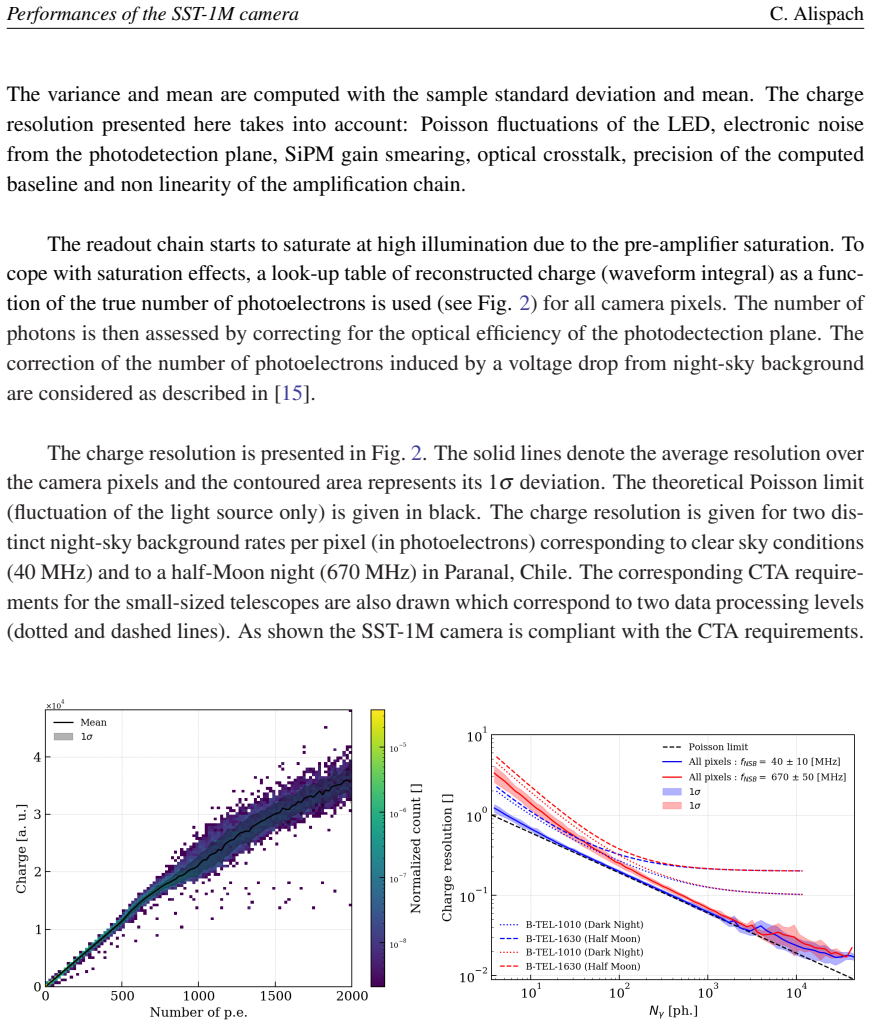
The load-bearing mechanism is the Camera Test Setup (CTS): an array of 1296 LED pairs, one per pixel, with a pulsed LED emulating the Cherenkov flash and a continuous LED emulating night-sky background. The setup is driven by the camera's own readout so the light pulse always arrives at the same place in the waveform window. Performance is quantified by the charge resolution, defined as $\mathrm{Var}(N_\gamma)/\mathrm{E}(N_\gamma)$ in units of photons, and by a template-fit timing method that scans offsets in 0.1 ns steps. A look-up table of reconstructed waveform integral versus true photoelectron number corrects for pre-amplifier saturation, and the photon scale is obtained by converting photoelectrons with the optical efficiency of the detection plane.
What would settle it
Point an independently calibrated light source at a single pixel and repeat the CTS charge-resolution scan; if the reconstructed photon number disagrees with the known absolute flux by more than the claimed resolution, the compliance result would need to be revised.
Extended reading notes
Core claim
The central claim is that the SST-1M camera is reliable and compliant under high night-sky background. In darkness the timing resolution is below 1 ns and reaches 0.1 ns at 400 photoelectrons; with a 125 MHz background the resolution stays below 1 ns for pulses above about 7 photoelectrons. The charge resolution, defined as the variance of reconstructed photon number divided by its mean, meets the small-sized telescope requirements both at 40 MHz (clear sky) and 670 MHz (half Moon) per pixel. The paper also reports that the fully digital trigger can disable clusters or clip signals to manage bright parasitic light, and that on-site dark runs allow per-night monitoring of gain, crosstalk, and dark count rate.
Load-bearing premise
The reliability of the quoted performance numbers depends on the camera's own calibration chain, so a systematic error in the photoelectron-to-photon conversion, the crosstalk model, or the stability of the pulsed light source would change the reported resolutions even if the detector behavior is unchanged.
Editorial extensions
If this is right
- SiPM-based cameras can observe under moonlight, increasing the duty cycle and physics reach of ground-based gamma-ray astronomy.
- The automated CTS calibration approach can be scaled to mass production of many cameras at a rate of roughly two per month.
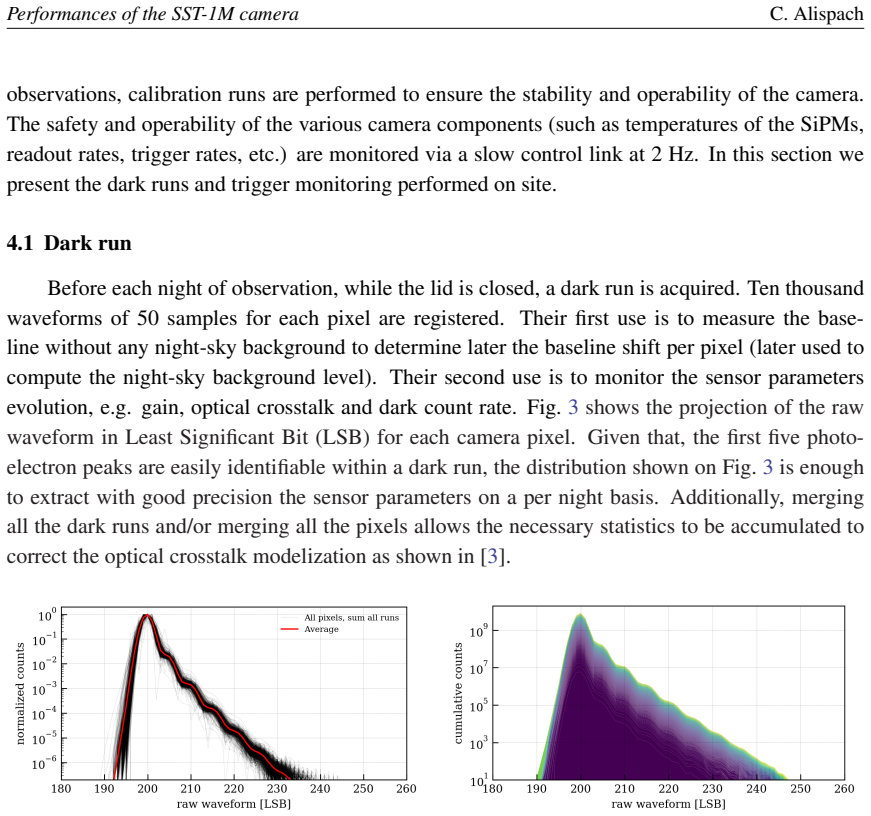
- On-site dark runs provide nightly monitoring of gain, optical crosstalk, and dark count rate, enabling drift correction over long campaigns.
- Disabling individual trigger clusters allows the camera to continue operating when bright continuous light sources appear in the field of view.
- Sub-nanosecond timing at moderate pulse amplitudes under 125 MHz background supports gamma/hadron separation and energy reconstruction at high energies.
Reading between the lines
- If the self-calibrated photon scale is later cross-checked against an independent calibrated light source, the reported charge-resolution values could shift in absolute terms, even though the raw detector behavior would remain valid.
- The per-pixel paired-LED calibration strategy could serve as a template for other SiPM-based Cherenkov cameras, since it requires no external pulse generator and only a power plug on site.
- Because time resolution at high background depends mainly on pulse amplitude, the results suggest that lowering the per-pixel trigger threshold under moonlight may still preserve timing quality for shower events.
- Expressing charge resolution in units of photons rather than photoelectrons makes the quoted performance directly comparable across different SiPM device types and optical systems.
Signed reviews
Editorial analysis
A structured set of objections, weighed in public.
Referee Report
Summary. The paper describes the calibration and performance characterization of the 1296-pixel SiPM camera for the SST-1M small-sized Cherenkov telescope. The central element is a Camera Test Setup with one pulsed and one continuous LED per pixel, used to emulate Cherenkov signals and night-sky background, respectively. The authors present the calibration chain (gain, dark count rate, crosstalk, LED calibration from SiPM photon counting, saturation look-up table), then report time and charge resolution under dark, 40 MHz, 125 MHz, and up to 670 MHz NSB levels, claiming compliance with CTA small-sized telescope requirements. They also describe on-site monitoring using dark runs and trigger-rate maps during 2018 observations. The paper concludes that the camera performance matches next-generation instrument requirements.
Significance. If the claimed performance is fully supported, this is a useful engineering result for SiPM-based IACT cameras: it demonstrates a production-oriented, automated per-pixel calibration, gives quantitative lab measurements under NSB loads up to half-moon levels, and shows stable on-site operation. The use of an LED pair per pixel for both calibration and performance testing is a practical approach for mass production. The paper also benefits from being embedded in the CTA efforts, with references to open-source reconstruction software (digicampipe, ctapipe) and a prototype observation campaign. However, the headline claim of compliance with CTA requirements rests on the charge- and time-resolution curves, and those curves are not yet supported by an independent absolute calibration or by a systematic uncertainty budget. The conclusion is therefore plausible but not fully established.
major comments (3)
- [§3, §3.2, Fig. 2, §4.2] The photon scale used for the CTA-compliance comparison is not independently anchored. The pulsed LEDs are calibrated using the camera's own SiPM photon-counting capability (first paragraph of §3, citing [6]), and the 'true number of photons' is derived from reconstructed photoelectrons via an optical-efficiency correction; §4.2 then states that per-pixel optical efficiencies (entrance-window and light-guide transmissivity) have not been externally measured and are not compensated. A systematic error in this self-calibrated scale changes the charge-resolution value itself, because CR = Var(Nγ)/E(Nγ) scales with any constant factor applied to Nγ, and it also shifts the abscissa of Fig. 2 relative to the CTA requirement curves. An uncorrected per-pixel optical-efficiency dispersion additionally inflates the apparent 1σ band. Because the conclusion in §5 is the claim of compliance, please add an independent calibration check (e.g., a calibrated photodiode or PMT, or the external 'Flasher' mentioned in §4.2) or provide a quantitative systematic-uncertainty budget and show that the compliance conclusion is robust under it.
- [§3.2, Fig. 2] The measured charge-resolution curves are shown as a camera average with a 1σ pixel-spread band, but no statistical uncertainties on the average and no systematic contributions are reported. The comparison with the CTA requirements is graphical only: the numerical values of the requirement curves are not given, and the margin is not quantified. Without uncertainties, one cannot judge whether the apparent compliance is significant. Please provide the numerical resolution values and margins at representative true-photon levels (including the two NSB rates of 40 and 670 MHz) together with the corresponding CTA requirement values.
- [§3.1, Fig. 1] The time-resolution result is likewise presented without uncertainties, and the comparison to CTA requirements is graphical. It is unclear whether the CTA requirement curve drawn in the left (dark) panel is the same as that for the 125 MHz NSB case in the right panel. The text states that only flashes above 3.5 p.e. are used, while the summary of the right panel quotes the 1 ns threshold at about 7 p.e.; the definition of 'reconstructed charge' used for this selection is not specified. Please state the numerical time-resolution values at the quoted pulse amplitudes and the corresponding requirement values, so that the compliance claim can be checked.
minor comments (5)
- [§3.2] The word 'photodectection' in the saturation paragraph should be 'photodetection'.
- [§3.1] The symbol 'δs' after Eq. (3.2) appears to be a typo for 'δt'; please unify the notation for the time offset.
- [§3.2, Fig. 2] The 'Theoretical Poisson limit' is shown but not defined in the text; please state that it corresponds to CR = 1 for a pure Poisson source with no detector noise.
- [§2] The units '10 k photons' and '1 GHz photoelectron rate' are informal; please write them explicitly (e.g., 10^4 photons per pulse and 10^9 photoelectrons per second per pixel).
- [§4.2] The section title 'Trigger rate' is slightly misleading, since the section also discusses trigger logic, disabled clusters, and trigger uniformity; consider renaming it 'Trigger performance'.
Circularity Check
No significant circularity: the camera performance claims are direct measurements benchmarked against external CTA requirements.
full rationale
The paper's central claims are measurement results, not derived predictions. Charge resolution is defined as CR = Var(N_gamma)/E(N_gamma) from the sample distribution of reconstructed charges (Eq. 3.3), and time resolution is obtained from a chi-squared fit of waveforms to a pulse template. Neither quantity is fitted to the CTA requirement curves, which are external benchmarks. The CTS LED calibration uses the SiPM photon-counting capability and cites the same collaboration's earlier work [6], and the look-up table converts reconstructed waveform integrals to photoelectrons; this means the absolute photon scale is self-calibrated rather than anchored to an independent source. That is a legitimate systematic-uncertainty concern, acknowledged in Section 4.2, which states that per-pixel optical efficiency variations are not corrected and would require an external light source such as a Flasher. However, this does not make the performance numbers equal to their own inputs by construction: the measured charge resolution can deviate from the Poisson limit regardless of the photon scale, and the CTA requirement curves are not derived from the camera calibration. The time-resolution, charge-resolution, and trigger-rate results are direct measured responses to controlled stimuli. Self-citations in the calibration method are methodological provenance, not load-bearing circularity. Therefore no circular step can be exhibited.
Assumptions & free parameters
free parameters (3)
- Per-pixel gain, dark count rate, gain smearing, optical crosstalk =
not reported
- Charge reconstruction look-up table =
not reported
- Pulse template function f =
not reported
assumptions (5)
- standard math Least-squares template fitting with Gaussian noise yields unbiased time offsets
- domain assumption CTS pulsed LEDs emulate Cherenkov flashes with stable intensity over the scan
- domain assumption Continuous LEDs reproduce night-sky background with uniform, known rate per pixel
- domain assumption SiPM photon counting resolves individual photoelectron peaks and the crosstalk model from [3] applies
- domain assumption Voltage-drop correction from [15] is valid at the tested NSB levels
Cite this review
Pith. "Pith review of Calibration and operation of SiPM-based cameras for gamma-ray astronomy in presence of high night-sky light." pith.science (2026). https://pith.science/paper/M25RKL25
@misc{pith2026190806860,
  author       = {Pith},
  title        = {Pith review of: Calibration and operation of SiPM-based cameras for gamma-ray astronomy in presence of high night-sky light},
  year         = {2026},
  howpublished = {\url{https://pith.science/paper/M25RKL25}},
  note         = {Machine review of arXiv:1908.06860}
}
read the original abstract
The next generation of Cherenkov telescope cameras feature Silicon Photo Multipliers (SiPM), which can guarantee excellent performance and allow for observation also under moonlight, increasing duty-cycle and therefore the physics reach. A 4 m-diameter Davies-Cotton prototype telescope with a 9-degree optical FoV and a 1296-pixel SiPM camera, has been designed to meet the requirements of the next generation of ground-based gamma-ray observatories at the highest energies. The large-scale production of the telescopes for array deployment has required the development of a fully automated calibration strategy which relies on a dedicated hardware, the Camera Test Setup (CTS). For each camera pixel, the CTS is equipped with two LEDs, one operated in pulsed mode to reproduce signal and one in continuous mode to reproduce night-sky background. In this contribution we will present the camera calibration strategy, from the laboratory measurement to the on-site monitoring with emphasis on the results obtained with the first camera prototype. In addition, key performances such as charge resolution, time resolution and trigger efficiencies and their degradation with increasing night-sky background level will be presented.
Figures

Figures from the paper (1 more)

Reference graph
Works this paper leans on
-
[6]
Heller et al., An innovative silicon photomultiplier digitizing camera for gamma-ray astronomy, Eur
M. Heller et al., An innovative silicon photomultiplier digitizing camera for gamma-ray astronomy, Eur. Phys. J. C77 (2017) 47 [arXiv:1607.03412]
arXiv 2017
-
[1]
The camera of the fifth H.E.S.S. telescope. Part I: System description
J. Bolmont, P. Corona, P. Gauron, P. Ghislain, C. Goffin, L. G. Riveros et al., The camera of the fifth H.E.S.S. telescope. Part I: System description, Nucl. Instrum. Meth. A761 (2014) 46 [arXiv:1310.5877]
work page Pith review arXiv 2014
-
[2]
D. B. Tridon, F. Goebel, D. Fink, W. Haberer, J. Hose, C. C. Hsu et al., Performance of the Camera of the MAGIC II Telescope, Proceedings of the 31st ICRC (2009) [ arXiv:0906.5448]
work page Pith review arXiv 2009
-
[3]
H. Anderhub et al., Design and operation of FACT - the first G-APD Cherenkov telescope, JINST 8 (2013) P06008 [arXiv:1304.1710]
arXiv 2013
-
[4]
A. Nepomuk Otte, D. Garcia, T. Nguyen and D. Purushotham, Characterization of Three High Efficiency and Blue Sensitive Silicon Photomultipliers, Nucl. Instrum. Meth. A846 (2017) 106 [arXiv:1606.05186]
arXiv 2017
-
[5]
Acharya et al., Introducing the CTA concept, Astroparticle Physics 43 (2013) 3
B.S. Acharya et al., Introducing the CTA concept, Astroparticle Physics 43 (2013) 3
work page 2013
-
[7]
Heller et al., The SST-1M project for the Cherenkov Telescope Array, PoS(ICRC2019)694 (2019)
M. Heller et al., The SST-1M project for the Cherenkov Telescope Array, PoS(ICRC2019)694 (2019)
work page 2019
-
[8]
J. A. Aguilar et al., The front-end electronics and slow control of large area SiPM for the SST-1M camera developed for the CTA experiment, Nucl. Instrum. Meth. A830 (2016) 219
work page 2016
Show all 15 references
-
[9]
P. Rajda et al., DigiCam - Fully digital compact read-out and trigger electronics for the SST-1M telescope proposed for the cherenkov telescope array, PoS(ICRC2015)931 (2015) [arXiv:1508.06082]
2015 arXiv
-
[10]
I. A. Samarai, C. Alispach, F. Cadoux, V . Coco, D. della V olpe, Y . Favre et al.,Development of a strategy for calibrating the novel SiPM camera of the SST-1M telescope proposed for the Cherenkov Telescope Array, PoS(ICRC2017)800 (2017) [ arXiv:1709.03920]
2017 arXiv
-
[11]
Sliusar, R
V . Sliusar, R. Walter, C. Alispach, I. A. Samarai, W. Bilnik, J. Błocki et al.,Control Software for the SST-1M Small-Size Telescope prototype for the Cherenkov Telescope Array, PoS(ICRC2017)844 (2017) [ arXiv:1709.04244]
2017 arXiv
-
[12]
digicampipe
“ digicampipe.”https://github.com/cta-sst-1m/digicampipe
-
[13]
Kosak et al., ctapipe: A Low-level Data Processing Framework for CTA, PoS(ICRC2019)717 (2019)
K. Kosak et al., ctapipe: A Low-level Data Processing Framework for CTA, PoS(ICRC2019)717 (2019)
2019
-
[14]
Juryšek et al., Monte Carlo study of single SST-1M prototype for Cherenkov Telescope Array, PoS(ICRC2019)708 (2019)
J. Juryšek et al., Monte Carlo study of single SST-1M prototype for Cherenkov Telescope Array, PoS(ICRC2019)708 (2019)
2019
-
[15]
J. A. Aguilar et al., Front-end and slow control electronics for large area SiPMs used for the single mirror Small Size Telescope (SST-1M) of the Cherenkov Telescope Array (CTA), Proc.SPIE 9915 (2016) 9915 . 7
2016
Reviewed August 14, 2026 · model on record in the stance chip above.
Discussion (0). Continue with ORCID to comment.