REVIEW 4 minor 72 references
Charged particle spectra from $\mu^{-}$ capture on Al
T0 review · 0 major / 4 minor · reviewed 2026-08-14 · deepseek-v4-flash
Pith's one-line read The paper reports the first tracking-spectrometer measurement of the momentum spectra of protons and deuterons from muon capture on aluminum, with partial yields per capture of $0.0322 \pm 0.0022$ above 80 MeV/c and $0.0122 \pm 0.0006$…
desk verdict First tracking-spectrometer spectra of muon-capture protons/deuterons on Al; careful analysis, defensible if proxy-based energy-loss systematic; deserves peer review. read the letter →
The pith
A machine-rendered reading of the paper's core claim, the machinery that carries it, and where it could break.
The reading
What carries the argument
The argument rests on a detector-response matrix $R_{\eta,ij}$ built from a detailed simulation: for a true proton or deuteron of momentum $p_j$, it gives the expected number of reconstructed tracks in each bin of the measured range-versus-momentum and momentum histograms. Because protons and deuterons with the same momentum stop at different depths, the track-range variable separates the two species. Absolute normalization per capture is set by counting decay-in-orbit electrons, whose spectrum and detector response are already known precisely, and scaling by the measured capture-to-decay ratio. The spectra are then extracted by a regularized maximum-likelihood unfolding, a statistical inversion that removes detector smearing; its distinctive feature is that below an unfolding cutoff the spectrum is a free cubic-spline shape, while above the cutoff it continues as an exponential in kinetic energy whose slope is fitted, with the regularization applied only to the spline part. That design removes the unphysical rising high-momentum tails that standard Tikhonov or maximum-entropy regularizations produced.
What would settle it
Measure the range-momentum relation for protons and deuterons in dimethyl ether at 80\textendash 250 MeV/c in a dedicated beam test, rerun the response matrix and unfolding with the measured energy loss, and see whether the partial yields move by more than the quoted systematic uncertainties; if they do, the central yields are biased.
Extended reading notes
Core claim
The central claim is that the momentum distributions of protons and deuterons emitted after nuclear muon capture on aluminum are now measured, not inferred. Using a magnetic tracking spectrometer, the analysis finds sharply falling spectra that are approximately exponential in kinetic energy, with about 70% of the proton yield below 80 MeV/c and about 70% of the deuteron yield below 130 MeV/c. The observed partial yields above those thresholds are $0.0322 \pm 0.0007(\mathrm{stat}) \pm 0.0022(\mathrm{syst})$ per capture for protons and $0.0122 \pm 0.0009(\mathrm{stat}) \pm 0.0006(\mathrm{syst})$ for deuterons; extrapolating the measured shapes to zero momentum gives total yields $0.045 \pm 0.003$ and $0.018 \pm 0.002$ per capture. These totals are the most precise obtained to date, sit close to the theoretical values of 0.040 and 0.012, and bring the sum of proton and deuteron emission on aluminum into line with older radioisotope-activation sums once the unmeasured low-momentum parts are included.
Load-bearing premise
The result depends on the assumption that the simulation's energy-loss model for protons, deuterons, and heavier ions reproduces reality to within the assigned few-percent systematic, because the only direct data check, a 3\textendash 4% shift in the reconstructed momentum peak of long-range contained tracks, does not uniquely pin down the cause.
Editorial extensions
If this is right
- The differential spectra, provided in bin-ready form, can be fed directly into event-generator simulations for any experiment that stops negative muons in aluminum, replacing the older ad hoc parameterization that had overestimated the proton rate.
- The total yields of $0.045\pm0.003$ and $0.018\pm0.002$ per capture reconcile the charged-particle emission sum on aluminum with radioisotope-activation totals, since activation cannot separately count the $p+n$ and deuteron channels.
- The measured proton spectrum is selective between nuclear models: it favors the precompound description, in which energy is shared before the nucleus thermalizes, over the cascade description for the high-energy tail, making these data a benchmark for muon-capture and neutrino-nucleus response models.
- With better than 10% precision for protons from 100 to 190 MeV/c and better than 20% for deuterons from 145 to 250 MeV/c, the high-energy parts of both spectra are now fixed well enough for detector-rate studies in lepton-flavor-violation searches.
- The reported correlation of $-0.25$ between the visible proton and deuteron yields means the two yields are not independent constraints; any future model must match both simultaneously.
Reading between the lines
- A dedicated beam-test measurement of low-energy proton and deuteron energy loss in the drift-chamber gas would test whether the observed 3\textendash 4% momentum-peak shift is an energy-loss-model bias; if it is, the deuteron yields, whose dominant systematic is energy loss, could move by roughly the quoted 0.00032.
- The unfolding recipe, free spline below a cutoff plus fitted exponential above it with regularization applied only to the spline part, should transfer to other steeply falling spectra with sparse high-energy tails, such as neutrino-induced nucleon spectra, where standard regularizations produce artificial rising tails.
- Reinterpreting the same data with a heavy-particle background model other than the two tested, or adding time-of-flight particle identification, would provide a sharper test of the deuteron yield, since the deuteron channel is the one most sensitive to the triton and alpha background shape.
Signed reviews
Editorial analysis
A structured set of objections, weighed in public.
Referee Report
Summary. This paper reports the first momentum spectra of protons and deuterons emitted after nuclear muon capture on aluminum, measured with a magnetic tracking spectrometer (the TWIST detector) rather than with calorimetric or emulsion techniques. The analysis selects a sample of 18M muon stops in a thin aluminum target, reconstructs positively charged tracks in downstream drift chambers, separates protons from deuterons using range-versus-momentum information, and determines the absolute normalization from DIO electrons plus the known muon-capture-to-decay ratio. The detector response is obtained from a GEANT3.21 simulation, and the true momentum spectra are extracted with a regularized maximum-likelihood unfolding in which each spectrum is represented by a cubic-spline deviation from an exponential-in-kinetic-energy form. The paper quotes partial yields of 0.0322 +/- 0.0007(stat) +/- 0.0022(syst) per capture for protons above 80 MeV/c and 0.0122 +/- 0.0009(stat) +/- 0.0006(syst) for deuterons above 130 MeV/c, plus extrapolated total yields of 0.045 +/- 0.003 and 0.018 +/- 0.002 per capture. The results are compared with the MECO parameterization, with GEANT4 precompound-model predictions, and with earlier activation measurements.
Significance. If the central results hold, this is a substantial new measurement: it is the first tracking-spectrometer measurement of muon-capture charged-particle emission, and it provides the most precise per-capture yields of protons and deuterons from muon capture on aluminum to date. The measurement is directly relevant to background estimates for the Mu2e and COMET lepton-flavor-violation searches and to the validation of nuclear-response models relevant to neutrino physics. The paper is careful in its treatment of the unfolding problem: the method is validated on statistically independent Monte Carlo samples, the statistical uncertainty combines data and simulation statistics via pseudo-data, and many systematic effects (crosstalk, muon stopping position, stopping-distribution cut, energy loss, heavy-particle background, and method bias) are evaluated explicitly.
minor comments (4)
- [Sec. V.D, Fig. 5(e)] The energy-loss systematic is estimated from a 20% increase in the DME gas density, but the manuscript does not explicitly state how much this density variation shifts the reconstructed-momentum peak relative to the observed 4% data-MC discrepancy at 92.4 vs 88.7 MeV/c. Please add one or two sentences (or a small quantitative statement) showing that the density variation brackets the observed peak shift; this would make the coverage of the assigned uncertainty in Table I more transparent without requiring a new analysis.
- [Sec. VI, Eqs. (13)-(14)] The extrapolation to total yields normalizes GEANT4 precompound and MECO predictions to the measured spectrum just above threshold and averages the two results. It would be helpful to state explicitly that both of these are models for the sub-threshold region and that the quoted extrapolation uncertainty does not cover a common-mode error in which both models share the same incorrect low-energy shape; the current wording is clear about the procedure but could be more explicit about this residual model dependence.
- [Appendix, Table II] The sentence 'the parameterization shape uncertainty is not representable in terms of the fixed set of fit parameters, and is the only contribution that is not included' is ambiguous. Please specify whether this uncertainty is included in the total-uncertainty bands of Figs. 10-11 and in the yields of Eqs. (11)-(14), or explain how it would be estimated; as written, the reader cannot tell which final quantities include it.
- [Throughout] There are several typographical errors that should be corrected: 'partices' in Sec. I, 'withing' in Sec. VI, 'uncertainy' in Sec. V.G, and 'pararameterization' in Sec. V.F. These do not affect the physics but should be cleaned up before publication.
Circularity Check
No significant circularity: the spectra are unfolded from data with an MC response matrix, and the model-dependent extrapolation is separately quantified.
full rationale
The paper's central quantities are detector-corrected momentum spectra and partial yields obtained by unfolding reconstructed positive tracks. The unfolding uses a response matrix from GEANT3.21 simulation that is explicitly independent of the physics spectra being measured: 'It describes all the detector effects: acceptance, efficiency, and resolution—but is independent of the physics spectra that are being measured.' The partial yields in Eqs. (11) and (12) are integrals of these unfolded spectra, not outputs of a fitted theory. The novel unfolding method is cited from a companion paper by the first author [44], but the method is a general statistical technique whose behavior is validated inside the present paper on statistically independent mixed MC samples; it does not import the measured proton or deuteron yields, so the self-citation is not load-bearing in a circular way. The extrapolated total yields normalize the GEANT4 precompound or MECO predictions to the measured spectrum just above threshold and quote a separate extrapolation uncertainty; the sub-threshold contribution is explicitly model-dependent and is not presented as a first-principles prediction. The observed 3-4% data-MC discrepancy in reconstructed momentum for long contained tracks (Sec. V D) is a legitimate systematic concern about the energy-loss model, but it is an accuracy limitation of the response simulation, not a circularity: the response matrix is not derived from the target spectrum. No step in the derivation reduces by construction to its own input.
Assumptions & free parameters
free parameters (11)
- A_proton =
6.0e-3 c/MeV
- gamma_proton =
0.15 MeV^-1
- w_proton,1 =
0.74
- w_proton,2 =
0.51
- A_deuteron =
2.7e-3 c/MeV
- gamma_deuteron =
0.13 MeV^-1
- w_deuteron,1 =
-0.036
- w_deuteron,2 =
0.21
- beta_heavy =
250 events (scales b_h)
- beta_DIO =
12 events (scales b_e)
- MC beam momentum correction =
-39.4 keV/c to momentum, -37.8 keV/c to bite
assumptions (7)
- domain assumption The detector response matrix R_eta,ij from GEANT3.21 MC accurately represents acceptance, efficiency, and resolution for protons and deuterons, including energy loss.
- domain assumption The proton and deuteron spectra follow an exponential in kinetic energy above the unfolding cutoff p_u (Eq. 7).
- domain assumption The ratio of muon capture to decay in the selected sample is 0.609:0.391 as measured by Suzuki et al. [35].
- domain assumption The DIO electron spectrum from [11] is known with sufficient precision for normalization.
- domain assumption The shapes of triton and alpha background spectra from the GEANT4 precompound model (and Bertini as alternative) are correct for the unfolding fit.
- domain assumption The muon beam parameters (momentum and bite) tuned to match the last-hit-plane distribution reproduce the stopping distribution within the target.
- domain assumption GEANT4 precompound and MECO spectra provide a reasonable shape for the sub-threshold extrapolation.
Cite this review
Pith. "Pith review of Charged particle spectra from $\mu^{-}$ capture on Al." pith.science (2026). https://pith.science/paper/GB4YGWI6
@misc{pith2026190806902,
  author       = {Pith},
  title        = {Pith review of: Charged particle spectra from $\mu^-$ capture on Al},
  year         = {2026},
  howpublished = {\url{https://pith.science/paper/GB4YGWI6}},
  note         = {Machine review of arXiv:1908.06902}
}
abstract
Published data on the emission of charged particles following nuclear muon capture are extremely limited. In addition to its interest as a probe of the nuclear response, these data are important for the design of some current searches for lepton flavor violation. This work presents momentum spectra of protons and deuterons following $\mu^{-}$ capture in aluminum. It is the first measurement of a muon capture process performed with a tracking spectrometer. A precision of better than 10% over the momentum range of 100--190 MeV/c for protons is obtained; for deuterons of 145--250 MeV/c the precision is better than 20%. The observed partial yield of protons with emission momenta above 80 MeV/c (kinetic energy 3.4 MeV) is $0.0322\pm0.0007(\text{stat})\pm0.0022(\text{syst})$ per capture, and for deuterons above 130 MeV/c (4.5 MeV) it is $0.0122\pm0.0009(\text{stat})\pm0.0006(\text{syst})$. Extrapolating to total yields gives $0.045\pm0.001(\text{stat})\pm0.003(\text{syst}) \pm 0.001(\text{extrapolation})$ per capture for protons and $0.018\pm0.001(\text{stat})\pm0.001(\text{syst})\pm 0.002(\text{extrapolation})$ for deuterons, which are the most precise measurements of these quantities to date.
Figures

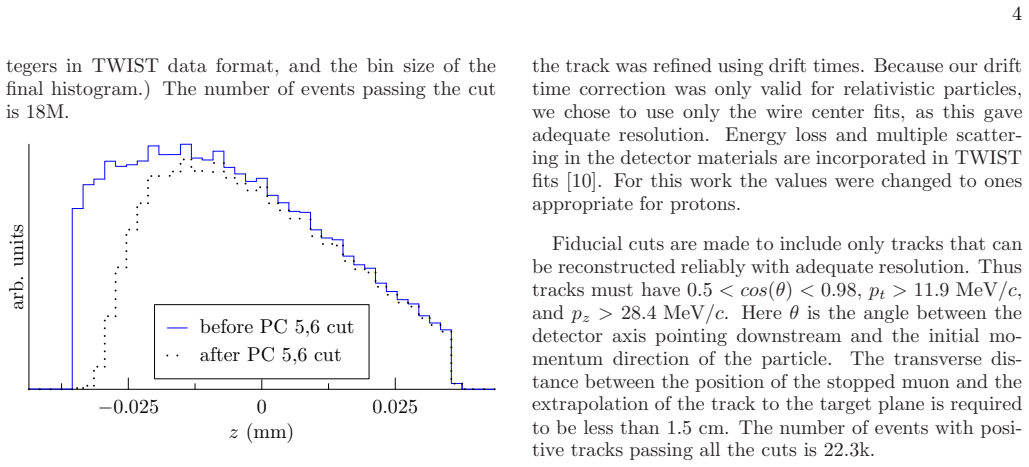

Figures from the paper (9 more)


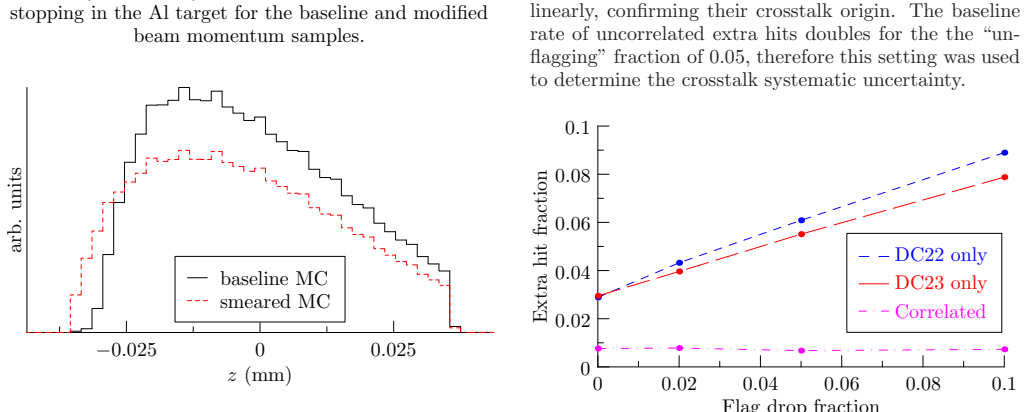



Reference graph
Works this paper leans on
-
[1]
has been described in detail in earlier publications, see [26, 27]. In this sec- tion, components that are of particular interest for this analysis will be discussed. The muon beamline was con- figured to transport a negative beam of approximately 29 MeV /c with about 1% momentum bite. The incom- ing beam contained cloud muons (negative muons gen- erated i...
-
[2]
(The quasiperi- odic bump structure in the figure, as well as in Figs. 6 and 7 below, is an artifact caused by an interplay of 3 different discretizations: single precision floating point numbers in GEANT 3, packing of real numbers into in- 4 tegers in TWIST data format, and the bin size of the final histogram.) The number of events passing the cut is 18M. − ...
-
[3]
08 acceptance × efficiency 100 200 300 400 proton momentum (MeV /c ) contained uncontained total 0
-
[4]
04 acceptance × efficiency 100 200 300 400 deuteron momentum (MeV /c ) contained uncontained total FIG. 3: (color online) Reconstruction efficiency times acceptance vs momentum for protons (upper plot) and deuterons (lower plot) estimated from MC. The denominator includes all tracks emitted by muons captured in the stopping target. Contained and uncontained s...
-
[5]
The transi- tion point between unfolding and exponential fit regions pproton,u = 230 MeV /c and pdeuteron,u = 200 MeV /c , as well as the number and position of intermediate knots, were optimized based on unfolding of multiple, statisti- cally independent mixed samples of simulated protons, deuterons, and the backgrounds described below. The mixed samples ...
-
[6]
should be chosen to provide an optimal balance between the vari- ance and the bias of the result. The method used in this study was inspired by the L-curve approach [46, 47], and is the following. For a given α the maximization of ˜F = log L + α ˜S yields particular values of log L and ˜S. We consider a parametric curve (log log L(α ), log |˜S(α )|), and ...
-
[7]
Panels (a)–(e) show the spectrum of the contained tracks in slices of the track range variable R (defined in Sec. IV C). The panel (f) shows the spec- trum of uncontained tracks. The fitted values of µ i are also shown in these plots. Fit component yields are 19.1k protons, 2.9k deuterons, 250 heavier than deuteron par- ticles, and 12 misreconstructed DIO e...
-
[8]
The 300 keV /c momentum modification shifted the peak po- sition by about 10 times the uncertainty. The stopping position systematic uncertainty was evaluated by taking the difference between data unfolding results with the +300 keV /c sample and − 300 keV /c sample, and scal- ing it down by a factor of 20. Although the simulation samples were produced by m...
Show all 72 references
-
[9]
un-flagging
We treat the difference between unfolding results for the baseline and smeared analyses as the systematic uncertainty cor- responding to the chamber hit time over threshold mod- eling. C. Crosstalk Electronic crosstalk was a minor effect for minimum ionizing positron tracks from...
-
[10]
un-flagging
1 Extra hit fraction DC22 only DC23 only Correlated FIG. 8: (color online) Dependence of the observed correlated and uncorrelated extra hits in data on the crosstalk “un-flagging” fraction. D. Charged particle energy loss in detector material This analysis relies on the modelin...
-
[11]
MECO spectrum
The systematic uncertainty was estimated as the difference between the unfolding results when using baseline and alternative inputs for the heavy particle background. Protons are well separated from heavier particles by track range and momentum, so the proton yield is only weak...
-
[12]
0007(stat) ± 0
0322 ± 0. 0007(stat) ± 0. 0022(syst) (11) for protons above 80 MeV /c and
-
[13]
0009(stat) ± 0
0122 ± 0. 0009(stat) ± 0. 0006(syst) (12) for deuterons above 130 MeV /c . The correlation coeffi- cient between the visible yields, including all statistical and systematic uncertainties, is − 0. 25. To extrapolate to the total yield we normalize the GEANT4 precompound or MECO ...
-
[14]
001(stat) ± 0
045 ± 0. 001(stat) ± 0. 003(syst) ± 0. 001(extrapolation) (13) for protons and
-
[15]
001(stat) ± 0
018 ± 0. 001(stat) ± 0. 001(syst) ± 0. 002(extrapolation) (14) for deuterons. These numbers are close to the corre- sponding theoretical predictions of 0 . 040 and 0 . 012 [13]. Radioisotope yields for muon capture on aluminum are reported in [21] and [22] as 0 . 028 ± 0. 004 ...
-
[16]
009 compares well to our sum of extrapolated proton and deuteron yields of 0
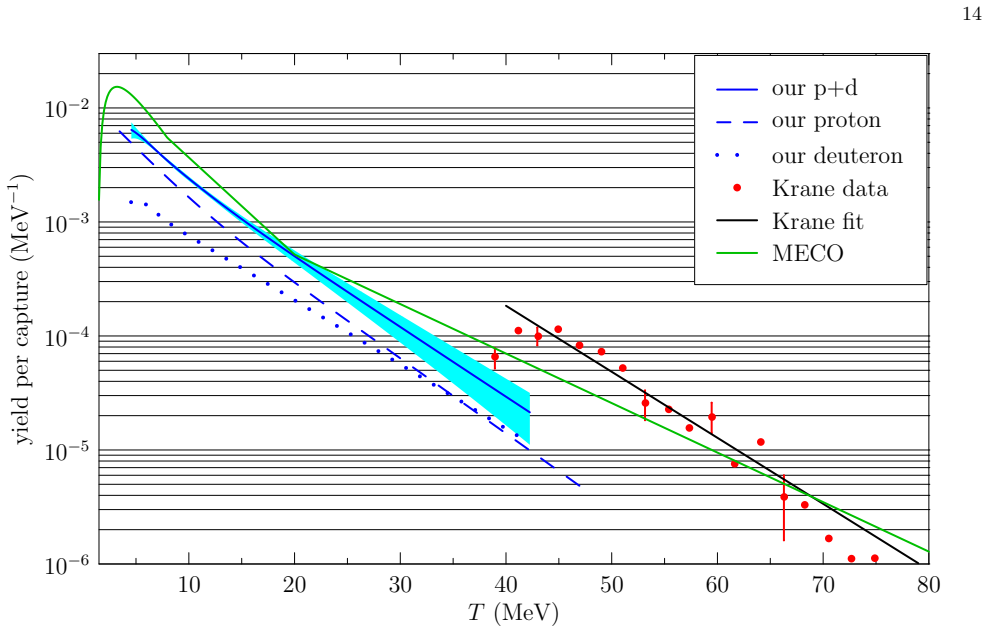
063 ± 0. 009 compares well to our sum of extrapolated proton and deuteron yields of 0 . 062 ± 0. 004. A measurement of the energy spectrum of charged par- ticles from muon capture on aluminum above 40 MeV is reported in [20]. Figure 12 reproduces data points and the fit from th...
-
[17]
0007 yield per capture ( c/ MeV) 0 100 200 300 proton momentum (MeV /c ) unfolded spectrum statistical uncertainty total uncertainty G4 precompound
-
[18]
10: Yield of protons per muon capture vs momentum
25 × MECO FIG. 10: Yield of protons per muon capture vs momentum. µ − + Al → deuteron + X 0 5× 10⁻⁵
-
[19]
00015 yield per capture ( c/ MeV) 0 100 200 300 400 deuteron momentum (MeV /c ) unfolded spectrum statistical uncertainty total uncertainty G4 precompound
-
[20]
11: Yield of deuterons per muon capture vs momentum
1 × MECO FIG. 11: Yield of deuterons per muon capture vs momentum. VII. SUMMAR Y The TWIST data taken with a µ − beam incident on Al have been analysed for positive charged particles from muon capture. The detector was sensitive to protons with momentum above 80 MeV /c and deu...
-
[21]
The parameters of the unfolded proton and deuteron spectra are shown in Table II, and their correlations in Table III
The deuteron spline sequence is 130 , 130, 130, 130, 165, 200 MeV/c , similarly resulting in two cubic splines. The parameters of the unfolded proton and deuteron spectra are shown in Table II, and their correlations in Table III. The un- certainties shown in Table II include ...
-
[22]
13: (color online) Basis splines for the proton spectrum
5 1 Bproton, 1 Bproton, 2 FIG. 13: (color online) Basis splines for the proton spectrum. Aproton γproton wproton, 1 wproton, 2 Adeuteron γdeuteron wdeuteron, 1 wdeuteron, 2 Aproton 1.00 0.96 -0.48 -0.84 -0.14 -0.26 -0.03 -0.21 γproton 1.00 -0.64 -0.76 -0.26 -0.39 -0.05 -0.24 w...
-
[23]
Haff and T
P. Haff and T. Tombrello, Negative muon capture in very light atoms, Ann. Phys. 86, 178 (1974)
1974
-
[24]
Vogel et al
P. Vogel et al. , Muon capture in atoms, crystals and molecules, Nucl. Phys. A254, 445 (1975)
1975
-
[25]
Measday, The nuclear physics of muon capture, Phys.Rept
D. Measday, The nuclear physics of muon capture, Phys.Rept. 354, 243 (2001)
2001
-
[26]
Nieves, J
J. Nieves, J. E. Amaro, and M. Valverde, Inclusive quasi-elastic neutrino reactions, Phys. Rev. C70, 055503 (2004) , [Erratum: Phys. Rev.C72,019902(2005)]
2004
-
[27]
Nieves, I
J. Nieves, I. Ruiz Simo, and M. J. Vicente Vacas, In- clusive Charged–Current Neutrino–Nucleus Reactions, Phys. Rev. C83, 045501 (2011)
2011
-
[28]
Bartoszek et al
L. Bartoszek et al. (Mu2e), Mu2e Technical Design Re- port (2014), arXiv:1501.05241 [physics.ins-det]
2014 arXiv
-
[29]
Kuno (COMET), A search for muon-to-electron conversion at J-PARC: The COMET experiment, PTEP 2013, 022C01 (2013)
Y. Kuno (COMET), A search for muon-to-electron conversion at J-PARC: The COMET experiment, PTEP 2013, 022C01 (2013)
2013
-
[30]
R. P. Litchfield (AlCap), Status of the AlCap experiment, Proceedings, 16th International Workshop on Neutrino Factories and Future Neutrino Beam Facilities (NU- F ACT 2014): Glasgow, Scotland, UK, 25–30 August 2014, PoS NUF ACT2014, 095 (2015)
2015
-
[31]
N. L. Rodning et al. (TWIST), TWIST - The TRIUMF Weak Interaction Symmetry Test: The Michel parameters from mu+ decay, Tau lepton physics. Proceedings, 6th International Workshop, TAU 2000, Victoria, Canada, September 18-21, 2000 , Nucl. Phys. Proc. Suppl. 98, 247 (2001)
2001
-
[32]
Hillairet et al
A. Hillairet et al. (TWIST Collaboration), Precision muon decay measurements and improved constraints on the weak interaction, Phys.Rev. D85, 092013 (2012)
2012
-
[33]
Grossheim et al
A. Grossheim et al. (TWIST Collaboration), Decay of negative muons bound in Al-27, Phys.Rev. D80, 052012 (2009)
2009
-
[34]
Lifshitz and P
M. Lifshitz and P. Singer, Charged particle emission fol- lowing muon capture in complex nuclei, Phys. Rev. Lett 41, 18 (1978)
1978
-
[35]
Lifshitz and P
M. Lifshitz and P. Singer, Nuclear excitation function and particle emission from complex nuclei following mu capture, Phys. Rev. C 22, 2135 (1980)
1980
-
[36]
Lifshitz and P
M. Lifshitz and P. Singer, Meson exchange currents and energetic particle emission from µ − capture, Nucl. Phys. A476, 684 (1988)
1988
-
[37]
Morinaga and W
H. Morinaga and W. Fry, Nuclear capture of negative µ mesons in photographic emulstions, Nuovo Cimento Ser. 9 10, 308 (1953)
1953
-
[38]
Kotelchuck and J
D. Kotelchuck and J. V. Tyler, Search for a conserved- vector-current mechanism in the emission of protons from µ − stars in emulsion, Phys.Rev. 165, 1190 (1968)
1968
-
[39]
A. O. Vaisenberg, E. D. Kolganova, and N. V. Rabin, High energy protons due to absorption of muons by emul- sion nuclei, Yad. Fiz. 11, 830 (1970). 16
1970
-
[40]
S. E. Sobottka and E. L. Wills, Energy spectrum of charged particles emitted following muon capture in Si 28, Phys. Rev. Lett. 20, 596 (1968)
1968
-
[41]
Yu. G. Budyashov, V. G. Zinov, A. D. Konin, A. I. Mukhin, and A. M. Chatrchian, Charged particles from the capture of negative muons by the nuclei 28Si, 32S, 40Ca and 64Cu, Sov. Phys. JETP 33, 11 (1971), [Zh. Eksp. Teor. Fiz.60,19(1971)]
1971
-
[42]
Krane, T
K. Krane, T. Sharma, L. Swenson, D. Mc- daniels, P. Varghese, et al. , Energetic charged particle spectrum following µ − capture by nuclei, Phys.Rev. C20, 1873 (1979)
1979
-
[43]
Wyttenbach, P
A. Wyttenbach, P. Baertschi, S. Bajo, J. Hader- mann, K. Junker, et al. , Probabilities of muon induced nuclear reactions involving charged particle emission, Nucl.Phys. A294, 278 (1978)
1978
-
[44]
Heusser and T
G. Heusser and T. Kirsten, Radioisotope production rates by muon capture, Nucl.Phys. A195, 369 (1972)
1972
-
[45]
E. V. Hungerford, Comment on proton emission after muon capture, MECO Note 34 (1999), available as arXiv:1803.08403
1999 arXiv
-
[46]
Bachman et al
M. Bachman et al. , A Search for µ − N → e− N with Sen- sitivity Below 10 − 16 (1996), AGS Letter of Intent
1996
-
[47]
Agostinelli et al
S. Agostinelli et al. (GEANT4), GEANT4: A Simulation toolkit, Nucl. Instrum. Meth. A506, 250 (2003)
2003
-
[48]
R. S. Henderson et al. , Precision planar drift chambers and cradle for the TWIST muon decay spectrometer, Nucl. Instrum. Meth. A548, 306 (2005)
2005
-
[49]
Bueno et al
J. Bueno et al. , Precise measurement of parity violation in polarized muon decay, Phys. Rev. D 84, 032005 (2011)
2011
-
[50]
R. Brun, F. Bruyant, F. Carminati, S. Giani, M. Maire, A. McPherson, G. Patrick, and L. Urban, GEANT: Detector Description and Simulation Tool; Oct 1994 , CERN Program Library (CERN, Geneva,
1994
-
[52]
R. P. MacDonald et al. (TWIST), A Precision Mea- surement of the Muon Decay Parameters rho and delta, Phys. Rev. D78, 032010 (2008)
2008
-
[53]
Allison et al
J. Allison et al. , Recent developments in Geant4, Nucl. Instrum. Meth. A835, 186 (2016)
2016
-
[54]
Allison et al
J. Allison et al. , Geant4 developments and applications, IEEE Trans. Nucl. Sci. 53, 270 (2006)
2006
-
[55]
J. M. Quesada et al. , Recent developments in pre- equilibrium and de-excitation models in GEANT4, Progress in Nuclear Science and Technology , 936 (2011)
2011
-
[56]
D. H. Wright and M. H. Kelsey, The Geant4 Bertini Cas- cade, Nucl. Instrum. Meth. A804, 175 (2015)
2015
-
[57]
Bueno, A direct measurement of P π µ ξ from muon de- cay, Ph.D
J. Bueno, A direct measurement of P π µ ξ from muon de- cay, Ph.D. thesis, The University of British Columbia (Vancouver) (2010), http://dx.doi.org/2429/23724
2010
-
[58]
Suzuki et al
T. Suzuki et al. , Total nuclear capture rates for negative muons, Phys. Rev. C 35, 2212 (1987)
1987
-
[59]
Blobel, Unfolding Methods in High-energy Physics Experiments, in Proceedings, CERN School of Comput- ing: Aiguablava, Spain, September 9-22 1984 (1984)
V. Blobel, Unfolding Methods in High-energy Physics Experiments, in Proceedings, CERN School of Comput- ing: Aiguablava, Spain, September 9-22 1984 (1984)
1984
-
[60]
Cowan, Statistical Data Analysis (Clarendon Press, Oxford, New York, 1998)
G. Cowan, Statistical Data Analysis (Clarendon Press, Oxford, New York, 1998)
1998
-
[61]
Cowan, A survey of unfolding methods for parti- cle physics, Advanced Statistical Techniques in Particle Physics
G. Cowan, A survey of unfolding methods for parti- cle physics, Advanced Statistical Techniques in Particle Physics. Proceedings, Conference, Durham, UK, March 18-22, 2002 , Conf. Proc. C0203181, 248 (2002)
2002
-
[62]
H. B. Prosper and L. Lyons, eds., Proceedings, PHYSTAT 2011 Workshop on Statistical Issues R elated to Discovery Claims in Search Experiments and Unfold ing, CERN,Geneva, Switzerland 17-20 January 2011 , CERN (CERN, Geneva, 2011)
2011
-
[63]
A. N. Tikhonov, Solution of incorrectly formulated prob- lems and the regularization method, Soviet Mathematics Dokl. 4, 1035 (1963), translation of Doklady Akademii Nauk SSSR, 151 (1963) 501–504
1963
-
[64]
A. N. Tikhonov, Regularization of ill-posed problems, So- viet Mathematics Dokl. 4, 1624 (1963), translation of Doklady Akademii Nauk SSSR, 153 (1963) 49–52
1963
-
[65]
D. L. Phillips, A technique for the numerical solution of certain integral equations of the first kind, J. Assoc. Comput. Mach. 9, 84 (1962)
1962
-
[66]
C. E. Shannon, A mathematical theory of communica- tion, Bell Syst. Tech. J. 27, 379 (1948)
1948
-
[67]
Gaponenko, A practical way to regularize unfolding of sharply varying spectra with low data statistics (2019), arXiv:1906.07918 [physics.data-an]
A. Gaponenko, A practical way to regularize unfolding of sharply varying spectra with low data statistics (2019), arXiv:1906.07918 [physics.data-an]
2019 arXiv
-
[68]
C. d. Boor, A Practical Guide to Splines (Springer Ver- lag, New York, 1978)
1978
-
[69]
P. C. Hansen, Analysis of discrete ill-posed problems by means of the L-curve, SIAM Review 34, 561 (1992)
1992
-
[70]
P. C. Hansen and D. F. O’Leary, The use of the L-curve in the regularization of discrete ill-posed problems, SIAM J. Sci. Comput. 14, 1487 (1993)
1993
-
[71]
Auce et al
A. Auce et al. , Reaction cross sections for 38, 65, and 97 MeV deuterons on targets from 9Be to 208P b, Phys. Rev. C 53, 2919 (1996)
1996
-
[72]
P. C. Huu-Tai, Systematic study of elastic and reaction cross sections of deuteron induced reactions within the CDCC approach, Nucl. Phys. A 773, 56 (2006)
2006
-
[1993]
Long writeup W5013, DOI http://dx.doi.org/10.17181/CERN.MUHF.DMJ1
Reviewed August 14, 2026 · model on record in the stance chip above.
Discussion (0). Continue with ORCID to comment.