REVIEW 3 major objections 4 minor 11 references
Algorithm Selection for Image Quality Assessment
T0 review · 3 major / 4 minor · reviewed 2026-08-14 · deepseek-v4-flash
Pith's one-line read Algorithm selection can't beat the best single image-quality method
desk verdict First real test of algorithm selection for blind IQA; the negative result is plausible and the AutoFolio experiment is the strong witness, but the deep-learning protocol is too undertrained to carry much weight. read the letter →
The pith
A machine-rendered reading of the paper's core claim, the machinery that carries it, and where it could break.
The reading
What carries the argument
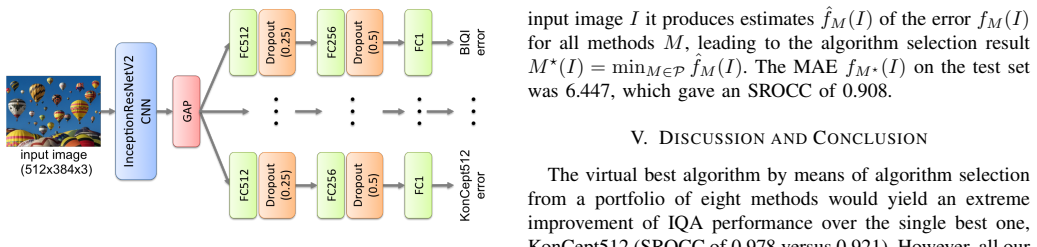
The central devices are the virtual best method (VBM) and the algorithm-selection pipeline built to mimic it. The VBM acts as the oracle: for each test image it picks the one of eight methods whose quality estimate is closest to the human mean opinion score, defining an upper bound that any selector would need to learn. AutoFolio searches over selector models and hyperparameters using instance features and per-method errors; the deep approach uses InceptionResNetV2 as a shared CNN base, either as a direct eight-way classifier or as a Siamese error predictor with eight output modules. The paper's explanatory mechanism is the noise model: an IQA method evaluated on perceptually indistinguishable images yields a distribution of scores, so the oracle can appear to win by choosing the method whose noise happens to land closest to the human rating, an effect no training set can teach a selector.
What would settle it
Rate multiple perceptually indistinguishable versions of each KonIQ-10k test image with the same eight methods and human subjects, then recompute the oracle's SROCC and MAE against the averaged human scores. If the oracle advantage over KonCept512 mostly disappears, the noise-exploitation explanation is confirmed; if it persists, the failure of the trained selectors is unexplained and a better selector should be demonstrable.
Extended reading notes
Core claim
On the KonIQ-10k test set, the paper shows that the gap between the single best method (KonCept512, SROCC 0.921, MAE 4.154) and the virtual best method—the oracle that always selects the method closest to the human mean opinion score—is large (SROCC 0.978, MAE 2.069). It then attempts to learn that oracle with AutoFolio, a state-of-the-art automatic algorithm selector, and with two deep networks: an InceptionResNetV2 classifier assigning each image to one of the eight methods, and a Siamese error-prediction network that estimates each method's absolute error. None of these surpassed KonCept512: AutoFolio degenerated to always choosing KonCept512, and the deep classifiers yielded SROCCs of 0.871 and 0.908. The paper concludes that algorithm selection for blind IQA does not improve over the single best method, and conjectures that the oracle's apparent superiority reflects noise in image-quality evaluation rather than predictable variation across images.
Load-bearing premise
The load-bearing premise is that the training protocols—24 hours of AutoFolio search over 500 models and only 10 epochs of fine-tuning for the deep networks—gave the learned selectors a fair chance to capture any learnable image-to-method structure; if these regimes underfit, the failure is an artifact of training effort, not a property of the problem.
Editorial extensions
If this is right
- If no learned selector can beat KonCept512 on KonIQ-10k, then a single well-chosen BIQA method is the practical default for this benchmark, and adding a portfolio of eight methods does not help by itself.
- The large VBM gap should not be read as an achievable performance target for algorithm selection; part or all of it may be due to the evaluation noise floor.
- Measuring the noisiness of individual IQA methods becomes a first-class problem: methods with lower noise may be preferable even when their mean accuracy is similar.
- Denoising IQA predictions—for instance by averaging over perceptually equivalent inputs—could shrink the oracle gap and make algorithm selection a more meaningful exercise.
- The negative result carries a methodological lesson: before declaring that an oracle gap is learnable, one should check whether the gap survives under a noise-corrected evaluation.
Reading between the lines
- The same noise argument may explain why the deep classifiers performed worse than AutoFolio: if per-image labels (which method wins) are dominated by noise, training a classifier on those labels teaches the network the noise pattern, not a stable mapping. A testable extension would be to train on labels averaged over multiple perceptually equivalent renditions of each image.
- A natural extension is to apply the same VBM-versus-selector comparison to full-reference IQA or to distortion-specific subsets; if the oracle gap is broader than KonIQ-10k's authentic distortions, the conclusion would generalize, and if it shrinks, the noise floor is dataset-specific.
- If the noisiness conjecture is correct, then the VBM's SROCC of 0.978 is not a meaningful upper bound for algorithmic performance on this dataset; a sharper bound would come from the best achievable method under a noise-removed ground truth, which one could construct by repeated rating of visually identical images and averaging the human scores.
Signed reviews
Editorial analysis
A structured set of objections, weighed in public.
Referee Report
Summary. The paper addresses whether algorithm selection (AS) can improve blind image quality assessment (BIQA) on the KonIQ-10k dataset. Using a portfolio of eight BIQA methods, the authors first show that a virtual best method (VBM) that chooses the best method per image would achieve SROCC 0.978 versus 0.921 for the single best method, KonCept512. They then attempt to learn this oracle in three ways: AutoFolio with hand-crafted features, a CNN classifier directly predicting the best method, and a Siamese network predicting per-method absolute errors. All attempts fail to beat the single best method on the test set: AutoFolio collapses to always selecting KonCept512, and the deep approaches yield SROCCs of 0.871 and 0.908. The paper concludes that algorithm selection for BIQA does not improve over the single best method and conjectures that the VBM advantage is partly due to unavoidable noise in per-image quality evaluation.
Significance. If the negative result is accepted, this is a useful cautionary data point for the algorithm-selection community and for BIQA researchers: despite a large oracle gap, state-of-the-art selectors may fail on perceptual quality tasks because the per-image advantage of the VBM may be partly noise. The paper is honest about the failure and makes the AutoFolio search systematic (24 hours, over 500 models). It also provides a clear, reproducible setup based on the public KonIQ-10k dataset and an explicit comparison of SBM, VBM, and AS. However, the evidence base is narrow (a single dataset), the deep-learning training protocol is not shown to be sufficient, and no statistical significance tests are reported; these weaknesses currently limit the strength of the general conclusion.
major comments (3)
- [Section IV] The deep-learning experiments do not demonstrate that the selectors were trained to convergence. InceptionResNetV2 was fine-tuned for exactly 10 epochs with SGD at alpha=0.0001, no learning curves or convergence checks are shown, and no data augmentation is mentioned. Given that the network is large and the task is a new 8-way labeling problem, underfitting is a plausible alternative explanation for the failure of Approach 1 and Approach 2. These results therefore cannot support the paper's negative conclusion unless the training protocol is shown to suffice or the conclusion is explicitly restricted to the AutoFolio experiments.
- [Section III, Table II] The claim that algorithm selection 'did not yield a significant improvement' is not backed by any significance test or confidence interval. The only case where AS numerically beats the single best method is the MAE comparison after excluding KonCept512 (6.665 versus 6.792), while the corresponding SROCC is worse (0.784 versus 0.805). Without paired bootstrap or permutation tests, these differences may be pure noise. Please add statistical tests or soften the 'significant' wording.
- [Sections II and V] The central negative claim is established on a single dataset, the KonIQ-10k test set, yet the conclusion is stated generally: 'algorithm selection for BIQA does not yield an improvement over the single best method.' Because BIQA methods and instance-level selectors may behave differently on other databases, either add experiments on at least one additional dataset (e.g., LIVEC or another authentic-distortion benchmark) or explicitly restrict the claim to KonIQ-10k and note that generalization remains untested.
minor comments (4)
- [Section III] The phrase 'principle component analysis' should be 'principal component analysis'.
- [Section V] The 'noisiness' conjecture is presented as a potential explanation, but it is not quantified or tested. Please either add an experiment (e.g., measuring the variance of each IQA method under small pixel perturbations or using repeated MOS data) or clearly label the conjecture as a hypothesis for future work rather than as an observed property.
- [Section IV] For Approach 1, the paper reports a classification accuracy of 29.3% on an 8-class problem, but no baseline or confusion matrix is given. Reporting the majority-class baseline and per-class accuracies would make this result interpretable.
- [General] The paper does not state whether the selector scripts or feature computation code are publicly available; releasing them would strengthen reproducibility, since the underlying dataset is public.
Circularity Check
No significant circularity: the algorithm-selection experiments are standard supervised evaluations, and the oracle is used only as an unreachable upper bound.
full rationale
The paper's derivation chain is not circular. The virtual best method (VBM) is defined as the per-image argmin of |M(I)-MOS(I)| and is used only as an upper bound in Table I; it is not supplied as a training signal to AutoFolio or the deep networks. AutoFolio is trained on instance features and training-set performance matrices and evaluated on the held-out KonIQ-10k test set, so its failure to beat KonCept512 is an empirical result, not a consequence of any fitted parameter being renamed as a prediction. The deep classifiers (Approaches 1 and 2) are trained on ground-truth-derived labels and errors, validated on a 1,000-image split, and tested on the held-out test set; this is standard supervised benchmarking. The 5-parameter logistic calibration is fit on the training set and applied to test predictions, which is standard preprocessing rather than a fitted 'prediction.' The self-citation to KonIQ-10k [4] is a public benchmark dataset with human MOS values, not an unverified theorem, so it is not load-bearing circularity. The paper explicitly labels its noise explanation as a conjecture in Section V, which is honest speculation rather than a disguised derivation. The possible underfitting of the 10-epoch deep training is a correctness risk or alternative explanation for the negative result, but it is not a circularity because the central claim does not reduce by construction to its inputs.
Assumptions & free parameters
free parameters (4)
- 5-parameter logistic alignment coefficients =
Not reported (one fit per method on the KonIQ-10k training set)
- PCA component counts for CORNIA, HOSA, KonCept512 =
100 components for each of the three methods
- Deep network hyperparameters =
learning rate 0.0001, 10 epochs, batch size 64, dropout 0.25 and 0.5
- AutoFolio configuration search =
24 hours of search, over 500 models
assumptions (4)
- domain assumption MOS labels in KonIQ-10k are reliable ground truth for subjective quality.
- domain assumption Train and test sets are drawn from the same distribution, and features generalize.
- standard math The algorithm selection framework of Rice applies with cost defined as absolute error against MOS.
- ad hoc to paper The noisiness conjecture: every image has perceptually indistinguishable variants whose IQA scores form a distribution.
invented entities (1)
-
Noisiness of IQA methods
Cite this review
Pith. "Pith review of Algorithm Selection for Image Quality Assessment." pith.science (2026). https://pith.science/paper/V2DZVOPH
@misc{pith2026190806911,
  author       = {Pith},
  title        = {Pith review of: Algorithm Selection for Image Quality Assessment},
  year         = {2026},
  howpublished = {\url{https://pith.science/paper/V2DZVOPH}},
  note         = {Machine review of arXiv:1908.06911}
}
read the original abstract
Subjective perceptual image quality can be assessed in lab studies by human observers. Objective image quality assessment (IQA) refers to algorithms for estimation of the mean subjective quality ratings. Many such methods have been proposed, both for blind IQA in which no original reference image is available as well as for the full-reference case. We compared 8 state-of-the-art algorithms for blind IQA and showed that an oracle, able to predict the best performing method for any given input image, yields a hybrid method that could outperform even the best single existing method by a large margin. In this contribution we address the research question whether established methods to learn such an oracle can improve blind IQA. We applied AutoFolio, a state-of-the-art system that trains an algorithm selector to choose a well-performing algorithm for a given instance. We also trained deep neural networks to predict the best method. Our results did not give a positive answer, algorithm selection did not yield a significant improvement over the single best method. Looking into the results in depth, we observed that the noise in images may have played a role in why our trained classifiers could not predict the oracle. This motivates the consideration of noisiness in IQA methods, a property that has so far not been observed and that opens up several interesting new research questions and applications.
Figures

Reference graph
Works this paper leans on
-
[1]
11em plus .33em minus .07em 4000 4000 100 4000 4000 500 `\.=1000 = #1 \@IEEEnotcompsoconly \@IEEEcompsoconly #1 * [1] 0pt [0pt][0pt] #1 * [1] 0pt [0pt][0pt] #1 * \| ** #1 \@IEEEauthorblockNstyle \@IEEEcompsocnotconfonly \@IEEEauthorblockAstyle \@IEEEcompsocnotconfonly \@IEEEcompsocconfonly \@IEEEauthordefaulttextstyle \@IEEEcompsocnotconfonly \@IEEEauthor...
-
[2]
J. R. Rice, ``The algorithm selection problem,'' in Advances in Computers. 1em plus 0.5em minus 0.4em Elsevier, 1976, vol. 15, pp. 65--118
work page 1976
-
[3]
L. Xu, W. Lin, and C.-C. J. Kuo, ``Metrics fusion,'' in Visual Quality Assessment by Machine Learning, ser. SpringerBriefs in Electrical and Computer Engineering. 1em plus 0.5em minus 0.4em Springer Singapore, 2015, ch. 5, pp. 93--122
work page 2015
-
[4]
M. Oszust, ``Decision fusion for image quality assessment using an optimization approach,'' IEEE Signal Processing Letters, vol. 23, no. 1, pp. 65--69, 2016
work page 2016
-
[5]
H. Lin, V. Hosu, and D. Saupe, `` KonIQ-10K : T owards an ecologically valid and large-scale IQA database,'' arXiv:1803.08489 (cs.CV), 2018
arXiv 2018
-
[6]
H. R. Sheikh, M. F. Sabir, and A. C. Bovik, ``A statistical evaluation of recent full reference image quality assessment algorithms,'' IEEE Transactions on Image Processing, vol. 15, no. 11, pp. 3440--3451, 2006
work page 2006
- [7]
-
[8]
M. Lindauer, H. Hoos, F. Hutter, and T. Schaub, ``Autofolio: An automatically configured algorithm selector,'' Journal of Artificial Intelligence Research, vol. 53, pp. 745--778, 2015
work page 2015
Show all 11 references
-
[9]
Szegedy, S
C. Szegedy, S. Ioffe, V. Vanhoucke, and A. A. Alemi, ``Inception-v4, I nception- R es N et and the impact of residual connections on learning.'' in AAAI Conference on Artificial Intelligence (AAAI), vol. 4, 2017, p. 12
2017
-
[10]
J. Deng, W. Dong, R. Socher, L.-J. Li, K. Li, and L. Fei-Fei, ``Image N et: A large-scale hierarchical image database,'' in IEEE Conference on Computer Vision and Pattern Recognition (CVPR), 2009, pp. 248--255
2009
-
[11]
11em plus .33em minus .07em 4000 4000 100 4000 4000 500 `\.=1000 = #1 \@IEEEnotcompsoconly \@IEEEcompsoconly #1 * [1] 0pt [0pt][0pt] #1 * [1] 0pt [0pt][0pt] #1 * \| ** #1 \@IEEEauthorblockNstyle \@IEEEcompsocnotconfonly \@IEEEauthorblockAstyle \@IEEEcompsocnotconfonly \@IEEEco...
Reviewed August 14, 2026 · model on record in the stance chip above.
Discussion (0). Continue with ORCID to comment.